


Erhalten Sie Zugang zu diesem und mehr als 300000 Büchern ab EUR 5,99 monatlich.
- Herausgeber: Nick Hern Books
- Kategorie: Poesie und Drama
- Serie: NHB Modern Plays
- Sprache: Englisch
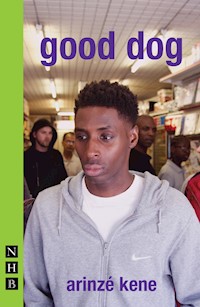
Estate Walls is the story of Obi, a young writer who dreams of leaving his estate. But with bad boys Myles and Cain for best friends, there are bound to be setbacks… Arinzé Kene's play premiered at Ovalhouse Theatre in south London in September 2010, directed by Ché Walker, winning Arinzé the Most Promising Playwright at the Offies (Off West End Theatre Awards) in 2011.
Sie lesen das E-Book in den Legimi-Apps auf:
Seitenzahl: 89
Veröffentlichungsjahr: 2019
Das E-Book (TTS) können Sie hören im Abo „Legimi Premium” in Legimi-Apps auf:
Ähnliche










Arinzé Kene
ESTATE WALLS
NICK HERN BOOKSLondonwww.nickhernbooks.co.uk
Contents
Original Production
Foreword
Characters
Estate Walls
About the Author
Copyright and Performing Rights Information
Estate Walls was first performed at Oval House Theatre, London, on 21 September 2010, with the following cast:
Sophie BenjaminDaniel GreeneGarbiya HussRicci McLeodDaniel Norford
Directed by Ché Walker
Real Talk
Foreword by Tobi Kyeremateng
Dem man would say dem man are mandem and us man are dem manBut then my mandem would say us man are mandem and dem man are dem man.
Kareem Parkins-Brown, Sunny D or The Purple Stuff?
Optional reading soundtrack: ‘Sittin’ Here’ or ‘Do It’ by Dizzee Rascal (Boy In Da Corner, 2003)
Since the early 2000s, I have seen the language of my ends archived in the mouths of the teenaged youth of the third millennium and evolved through cultures, shifted by the latter end of Generation Z. In my school, mandem recited ‘P’s and Q’s’ like a Sunday prayer with not a single syllable missed, and some of South London’s most loyal playground ambassadors would later join in reciting ‘Talkin’ Da Hardest’ with the same religious inflection, honouring the joining of North, South, East and West through this National Anthem of the ends. In a new decade, the mandem of the 2010s would forge their own worship here. The language of my ends has always sat between an electric poem backed against the pacey riddim of an old-school grime track, and the war-cry that escapes when the first noticeable seconds of our favourite tune drops in a dance. So much of the beauty of theatre exists in the subtexts we give language to; the private jokes only specific cultures could dictate, the space between the beat and the silence which speaks emotions ‘proper’ English doesn’t have words for, and the fact that ‘fam’ has approximately 10 different meanings depending on how we say it.
This language allows us to preserve our own histories in our personal archives, and this oral tradition has historically given communities that have been oppressed permission to keep these histories relevant and authentic. The stories I grew up hearing Kano and Dizzee Rascal spit through the speakers of a Sony Ericsson Walkman W810 sit comfortably in my archive alongside the stories the likes of Arinzé Kene, Bola Agbaje and debbie tucker green have dedicated to our stages. The stories we tell ourselves about the cultures we consume can help us question the presentation of the theatrical self, and characters like Kehinde, Joanne and Rugrat in Little Baby Jesus not only taught me about the compelling and complex personalities I was raised around, but emphasised the power of language moulded by inner-city ecosystems. The friendship between Obi, Myles and Cain in Estate Walls is reminiscent of the boyhood-to-manhood I witnessed with my peers in similar settings. Watching a show and being able to say, ‘I know that character personally’, ‘that character right there is my aunty-who-isn’t-actually-my-aunty’, ‘boy, that used to be me once upon a time’ is a privilege not everyone has, and when it comes around, it is glorious.
‘Come like Cyclops Polyphemus the way he be watching me.’ (Joanne, Little Baby Jesus) – The beginning of a sentence starting with ‘Come like’ already lets you know a madness is about to follow, and it’ll most likely be all types of funny, extra yet true. Young people from ends have always had a knack for pulling from the wildest references to deliver a very specific yet subtle description of feeling, and in this case, it’s the glare from an infamous Greek monster.
‘You make me happy like when the Oyster machine on the bus ain’t working.’ (Chelsea, Estate Walls) – Only a few of us will be able to relate to the pleasure of a free bus ride once adulthood punched us square in the face in the form of having to part with our money and hand it over to TfL. The wave from the bus driver moving you along to the seats as the Oyster machine rang red felt like an ‘I got you’ directly from God, saving you that extra coin you’d later spend on something frivolous and joyful.
There’s a sophistication to the way we speak that hasn’t always been welcome in our theatres and our society despite Black, working-class cultures being a key synergist of homegrown British entertainment, and for some this rejection is internalised in the politics behind ‘speaking proper English’ and dubbing this syntax as ‘Ghetto Grammar’ to dismiss the validity of building communityled languages in a society that teaches us that expression is only valid through the gaze of white acceptance. Poor young people and those adjacent to them are consistently villainised by what they wear, what they eat and how they speak by people that believe culture and/or Blackness is monolithic.
Performing respectability is a much-loved theatrical piece of the colonial gaze which has pockets of communities that have been oppressed running away from our salvation, but respectability can never be our saving grace when its very birth is symptomatic of white supremacy, and art cannot operate in a vacuum when these dynamics of power exist in every space we occupy. Our internalised -isms are reproduced in the ways in which we watch and respond to the work we see, and if we truly believe in the future development, diversity and accessibility of theatre, we must ask ourselves the necessary question of how we as individuals are helping keep the languages of our city alive and away from endangerment.
From Patois to Nigerian Pidgin, slang and abbreviations, the ends carry an assurance and culturally rich palette that lets me know I am home, and this feeling isn’t all too dissimilar from the poetics of a nostalgic grime track or the first ever play you saw that truly represented the whole of you.
To my young g’s from ends:
The multilinguists; the performers; the code-switchers; the mandem and gyaldem; the gang gang gang; the makers and thinkers; the playground hustlers; the back-of-the-bus caretakers; the street poets; the riddim creators and adlib instigators; the multifaceted culture pioneers of our London city streets - your lingual legacy is something to be preserved and upheld. Speak up and speak tall; speak boldly and daringly.
Gwaan wid yuh bad self. Real talk.
This is the Foreword to Little Baby Jesus and Estate Walls; the collection in which this play first appeared.
Characters
OBI, twenty years young
CAIN, twenty years old
MYLES, nineteen years old
CHELSEA, nineteen years old
REGGIE, thirty-nine years old
Setting
Pembury Estate, Hackney, 2009.
Notes
Names appearing without dialogue indicate active silences between characters listed.
/ denotes where dialogue is interrupted.
[ ] denotes where dialogue is spoken at the same time and in non-specific order.
PROLOGUE
Enter OBI, MYLES and CAIN.
OBI. I’m on da estate wall!
CAIN. Me too.
MYLES. Me too.
CAIN. On da estate wall.
OBI. And that’s where?
MYLES. Right here.
CAIN. Within da estate walls.
OBI. He’s back.
CAIN. I’m back!
MYLES. When da world’s outside.
OBI. Outside.
CAIN. All I know are these estate walls.
ALL. Estate walls.
MYLES. These cracked windows.
ALL. Estate walls.
OBI. These cracks in my ceiling.
ALL. Estate walls.
CAIN. These cracks that I peep through.
ALL. Estate walls.
MYLES. These cracks on da floor.
ALL. Estate walls.
OBI. You can’t jump these cracks.
ALL. Estate walls.
CAIN. You’ll get eaten by da crack.
ALL. Estate walls.
MYLES. Feel you bones go CRACK!
ALL. Estate walls.
CAIN. But I love it here.
OBI. Right here?
CAIN. Right here on da estate wall.
MYLES. Me too.
OBI. Me too.
CAIN. On da estate wall.
MYLES. You bored?
OBI. Not at all.
CAIN. How long?
MYLES. All day.
OBI. How far?
CAIN. Bare far.
MYLES. You bored?
OBI. Gettin’ bored.
CAIN. How long?
MYLES. Too long.
OBI. How far?
CAIN. This far.
MYLES. Where you at?
OBI. Right here.
CAIN. Right where?
MYLES. At da wall.
OBI. Alone?
CAIN. Never that.
MYLES. Who you with?
CAIN. I’m wid you.
OBI. And me.
MYLES. Obviously.
CAIN. There’s three.
OBI. A family.
MYLES. You scared?
CAIN. Don’t ask them questions there.
OBI. You scared?
MYLES. Don’t ask them questions there.
CAIN. You scared?
OBI. Don’t ask them questions there, there’s no fear on da estate wall.
CAIN. Not at all.
Scene One
A cool summer day. An estate wall. CAIN, MYLES, and OBI. OBI has a book. MYLES’ mobile phone beeps. It’s a text message
MYLES. Message.
This girl’s always texting me some emotional lovey-dovey waste messages. Tell me if this makes any sense to you lot.
(Reading.) ‘Dear Myles, I watched a leaf get blown off its branch today and it reminded me of the time you and I broke up, I’m so glad we’re back together xXx : )’
OBI. The girl likes you so she’s making an effort.
MYLES. I don’t wanna know about no leaf gettin’ blown off a twig, b. Why can’t she just say ‘Hi Myles, I like the way you broke me off last week, can I have round two?’ She’s always chatting some garbage and because nobody understands it but her, she finks it’s deep.
OBI. She’s trying to stimulate your mind.
MYLES. Stimulate ma – you know what, you chat to her then. I don’t speak in riddles.
OBI. You sure you wanna do that?
CAIN. Handing her over to the merchant of lyrics. That’s a sucker move.
OBI. Tell him.
CAIN. Now, there’s a certain type of man they say you shouldn’t leave your girl around.
OBI. I can out-slick a can of oil.
I can sell water to a well.
Don’t leave me round your girl.
MYLES. You could never steal my girl…
OBI. There’s no challenge for the ruler.
MYLES. Not even in your wildest, b…
OBI. You’re lucky I’m done with that.
MYLES.…’Cause I’m too pretty.
I mean look at me! (Stands, gives us a twirl, his trousers hang low.) See, Obi, I’ve been blessed and burdened at the same time. My blessing lies at face value, it’s evident – I’m good looking. But my burden… man, so many… I’ve had so many of those caramel tings that I can’t even remember their names… and I ain’t proud of that but – that’s the way the cookie crumbles.
My gift is my curse.
Being beautiful.
This face is a good look. It’s just the way I was born, gotta live with it. But you, Obi, you’re one of the lucky ones, I envy you – you’ll never feel this pain.
OBI. Never?
MYLES. Never. You’re too ugly.
CAIN. Oh! Deeep.
OBI. You got jokes.
MYLES. I’m just sayin’, you don’t wanna go through this, b. I’m the Eighth Wonder of the World, that’s a lot to digest every day. Even the way my hair grows is unique, it grows that way, like feng shui – to the east or something… or north… I don’t care, the girls love it.
OBI disregards MYLES and gets back to reading his book.
Your sister knows – she is drunk off of love potion for me.
OBI




