


Erhalten Sie Zugang zu diesem und mehr als 300000 Büchern ab EUR 5,99 monatlich.
- Herausgeber: Nick Hern Books
- Kategorie: Poesie und Drama
- Serie: NHB Modern Plays
- Sprache: Englisch
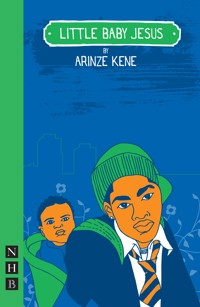
Three magnetic personalities and three remarkable stories from the poetic imagination of Arinzé Kene, winner of the Most Promising Playwright Award at the 'Offies' (Off West End Theatre Awards). Kehinde is older than his years, a boy with an innocence and a passion for mixed-race girls. Joanne is dipped in rudeness and rolled in attitude. And then there's Rugrat, the class clown, underachiever and playground loudmouth. The boy who never leaves, the schoolgirl trying to distance herself from her past, and the schoolboy always on the outer of the inner circle – in this lyrical triptych of interconnected monologues, three inner-city teenagers are about to become adults. Little Baby Jesus was first performed at Oval House Theatre, London, in May 2011 in a co-production by Oval House, BEcreative and the English Touring Theatre.
Sie lesen das E-Book in den Legimi-Apps auf:
Seitenzahl: 78
Veröffentlichungsjahr: 2019
Das E-Book (TTS) können Sie hören im Abo „Legimi Premium” in Legimi-Apps auf:
Ähnliche










Arinzé Kene
LITTLE BABY JESUS
NICK HERN BOOKSLondonwww.nickhernbooks.co.uk
Contents
Original Production
Foreword
Characters
Little Baby Jesus
About the Author
Copyright and Performing Rights Information
Little Baby Jesus was originally produced by Oval House Theatre, BEcreative and Spora Stories, and was first performed at Oval House Theatre, London, on 25 May 2011. The cast was as follows:
KEHINDE
Fiston Barek
JOANNE
Seroca Davis
RUGRAT
Akemnji Ndifernyen
Director
Ché Walker
Designer
Chris Gylee
Lighting Designer
Arnim Friess
Composer and Sound Designer
Richard Hammarton
Costume Supervisor
Bianca Ward
Assistant Director
Philippa Thomas
Scenic Artist
Katie Jamieson
Assistant Director
Kemi David
Production Manager
Bernd Fauler
Deputy Stage Manager
Suu Wernham
Assistant Stage Manager
Sylvia Darkwa-Ohemeng
Little Baby Jesus was performed at the Orange Tree Theatre, Richmond, on 18 October 2019. The cast was as follows:
KEHINDE
Anyebe Godwin
JOANNE
Rachel Nwokoro
RUGRAT
Khai Shaw
Director
Tristan Fynn-Aiduenu
Designer
Tara Usher
Lighting Designer
Bethany Gupwell
Sound Designer
Nicola Chang
Movement Consultant
DK Fashola
Casting
Nadine Rennie CDG
Sarah Murray
Production Manager
Lisa Hood
Production Technician
Rhea Jacques
Company Stage Manager
Jenny Skivens
Deputy Stage Manager
Helen Cobb
Technical Assistant Stage Manager
Rhea Jacques
Associate Sound
Johnny Edwards
Production Electrician
Chris McDonnell
Real Talk
Foreword by Tobi Kyeremateng
Dem man would say dem man are mandem and us man are dem manBut then my mandem would say us man are mandem and dem man are dem man.
Kareem Parkins-Brown, Sunny D or The Purple Stuff?
Optional reading soundtrack: ‘Sittin’ Here’ or ‘Do It’ by Dizzee Rascal (Boy In Da Corner, 2003)
Since the early 2000s, I have seen the language of my ends archived in the mouths of the teenaged youth of the third millennium and evolved through cultures, shifted by the latter end of Generation Z. In my school, mandem recited ‘P’s and Q’s’ like a Sunday prayer with not a single syllable missed, and some of South London’s most loyal playground ambassadors would later join in reciting ‘Talkin’ Da Hardest’ with the same religious inflection, honouring the joining of North, South, East and West through this National Anthem of the ends. In a new decade, the mandem of the 2010s would forge their own worship here. The language of my ends has always sat between an electric poem backed against the pacey riddim of an old-school grime track, and the war-cry that escapes when the first noticeable seconds of our favourite tune drops in a dance. So much of the beauty of theatre exists in the subtexts we give language to; the private jokes only specific cultures could dictate, the space between the beat and the silence which speaks emotions ‘proper’ English doesn’t have words for, and the fact that ‘fam’ has approximately 10 different meanings depending on how we say it.
This language allows us to preserve our own histories in our personal archives, and this oral tradition has historically given communities that have been oppressed permission to keep these histories relevant and authentic. The stories I grew up hearing Kano and Dizzee Rascal spit through the speakers of a Sony Ericsson Walkman W810 sit comfortably in my archive alongside the stories the likes of Arinzé Kene, Bola Agbaje and debbie tucker green have dedicated to our stages. The stories we tell ourselves about the cultures we consume can help us question the presentation of the theatrical self, and characters like Kehinde, Joanne and Rugrat in Little Baby Jesus not only taught me about the compelling and complex personalities I was raised around, but emphasised the power of language moulded by inner-city ecosystems. The friendship between Obi, Myles and Cain in Estate Walls is reminiscent of the boyhood-to-manhood I witnessed with my peers in similar settings. Watching a show and being able to say, ‘I know that character personally’, ‘that character right there is my aunty-who-isn’t-actually-my-aunty’, ‘boy, that used to be me once upon a time’ is a privilege not everyone has, and when it comes around, it is glorious.
‘Come like Cyclops Polyphemus the way he be watching me.’ (Joanne, Little Baby Jesus) – The beginning of a sentence starting with ‘Come like’ already lets you know a madness is about to follow, and it’ll most likely be all types of funny, extra yet true. Young people from ends have always had a knack for pulling from the wildest references to deliver a very specific yet subtle description of feeling, and in this case, it’s the glare from an infamous Greek monster.
‘You make me happy like when the Oyster machine on the bus ain’t working.’ (Chelsea, Estate Walls) – Only a few of us will be able to relate to the pleasure of a free bus ride once adulthood punched us square in the face in the form of having to part with our money and hand it over to TfL. The wave from the bus driver moving you along to the seats as the Oyster machine rang red felt like an ‘I got you’ directly from God, saving you that extra coin you’d later spend on something frivolous and joyful.
There’s a sophistication to the way we speak that hasn’t always been welcome in our theatres and our society despite Black, working-class cultures being a key synergist of homegrown British entertainment, and for some this rejection is internalised in the politics behind ‘speaking proper English’ and dubbing this syntax as ‘Ghetto Grammar’ to dismiss the validity of building communityled languages in a society that teaches us that expression is only valid through the gaze of white acceptance. Poor young people and those adjacent to them are consistently villainised by what they wear, what they eat and how they speak by people that believe culture and/or Blackness is monolithic.
Performing respectability is a much-loved theatrical piece of the colonial gaze which has pockets of communities that have been oppressed running away from our salvation, but respectability can never be our saving grace when its very birth is symptomatic of white supremacy, and art cannot operate in a vacuum when these dynamics of power exist in every space we occupy. Our internalised -isms are reproduced in the ways in which we watch and respond to the work we see, and if we truly believe in the future development, diversity and accessibility of theatre, we must ask ourselves the necessary question of how we as individuals are helping keep the languages of our city alive and away from endangerment.
From Patois to Nigerian Pidgin, slang and abbreviations, the ends carry an assurance and culturally rich palette that lets me know I am home, and this feeling isn’t all too dissimilar from the poetics of a nostalgic grime track or the first ever play you saw that truly represented the whole of you.
To my young g’s from ends:
The multilinguists; the performers; the code-switchers; the mandem and gyaldem; the gang gang gang; the makers and thinkers; the playground hustlers; the back-of-the-bus caretakers; the street poets; the riddim creators and adlib instigators; the multifaceted culture pioneers of our London city streets - your lingual legacy is something to be preserved and upheld. Speak up and speak tall; speak boldly and daringly.
Gwaan wid yuh bad self. Real talk.
This is the Foreword to Little Baby Jesus and Estate Walls; the collection in which this play previously appeared.
Characters
RUGRAT, ex-schoolboy
JOANNE, ex-schoolgirl
KEHINDE, the boy who never leaves
Synopsis
A lyrical triptych of monologues based around the lives of three distinct school pupils. Each account is a riveting narrative relaying the exact point that a teenager becomes an adult. They are written to be appreciated together.
Set in contemporary inner-city London.
This ebook was created before the end of rehearsals and so may differ slightly from the play as performed.
PROLOGUE
KEHINDE. As the world gets better at spinning.
JOANNE. We get dizzy and fall on our rare.
RUGRAT. Some keep falling through the atmosphere
KEHINDE. Some don’t survive past 12:05.
JOANNE. But if you’ve got this – (Heart.)
RUGRAT. And if you use this – (Brains.)
KEHINDE. Then you don’t need much or a little bit else.
ONE
Kehinde
(KEHINDE is sixteen, black. He is mature, very sensible for his age, but there is a sensitivity about him; an innocence.)
I used to have ‘mixed-raced-girl syndrome’. Mixed-race-girl syndrome is the long obsessive phase of over-fancying mixed-race girls. Girls of that lighter complexion. Most guys get it when they’re like fourteen, fiffteen. My favourite was when that black African or Caribbean skin mixes with that white English or European skin. You get that sun-kissed finish.
At one point. I actually wanted to be mixed-race. I wished for it. I wished my hair wouldn’t curl over itself like pepper grains, I wanted it to be bouncy and coolie. But no, broom bristles instead I concluded I was stuck with. I’d gladly have traded this nose for one that was sharper at the end. Shameful, I know. I was so stupid, I got down one time, asked God to forgive me for my sins, to protect my family and to bless me with pink lips. I actually remember going to sleep wishing that I’d wake up with green eyes.
My prayers were obviously ignored and I didn’t turn into a mixed-raced boy. And if I were God I would’ve blanked me for a year just to chastise me for being so ungrateful of this beautiful black skin I was gifted with – Praise God. Believe I had a lot of growing up to do.




