


14,39 €
Mehr erfahren.
- Herausgeber: Packt Publishing
- Kategorie: Wissenschaft und neue Technologien
- Sprache: Englisch
Tired of the same old math, science, statistics, and programming memes people post online and want something a little more elaborate? This is the book for you.
Tremble as we make up all our own facts and data, hand-draw diagrams in MS Paint, and quote from fictional studies and journals. Cower as authors write in the first person because their study is just a little too personal for them. Recoil from the sheer mass of oversimplified methodology, distilling someone's entire thesis into a paragraph of jokes crude enough to make it into a Mike Myers movie.
Over the last few years, we have taken arguments that you would normally have after four Jack and cokes at game night and turned them into properly formatted research papers with a writing tone serious enough to confuse the uninitiated. These papers are high-effort jokes by researchers and scientists for researchers and scientists. They cover a range of topics such as the consequences of re-releasing tourists back into Yellowstone National Park after COVID-19, how to play StarCraft competitively online on a quantum computer, and most importantly, how trees around the globe are becoming increasingly radicalized.
Das E-Book können Sie in Legimi-Apps oder einer beliebigen App lesen, die das folgende Format unterstützen:
Seitenzahl: 405
Veröffentlichungsjahr: 2023
Ähnliche




















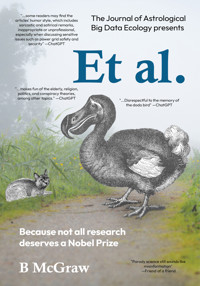
Et al.
Because not all research deserves a Nobel Prize
B McGraw
BIRMINGHAM—MUMBAI
Et al.
Copyright © 2023 Packt Publishing
All rights reserved. No part of this book may be reproduced, stored in a retrieval system, or transmitted in any form or by any means, without the prior written permission of the publisher, except in the case of brief quotations embedded in critical articles or reviews.
The information contained in this book is sold without warranty, either express or implied. Neither the author, nor Packt Publishing or its dealers and distributors, will be held liable for any damages caused or alleged to have been caused directly or indirectly by this book.
Packt Publishing has endeavored to provide trademark information about all of the companies and products mentioned in this book by the appropriate use of capitals. However, Packt Publishing cannot guarantee the accuracy of this information.
Lead Senior Publishing Product Manager: Tushar Gupta
Project Editor: Janice Gonsalves
Content Development Editor: Tanya D’cruz
Copy Editor: Safis Editing
Technical Editor: Aniket Shetty
Proofreader: Safis Editing
Indexer: Hemangini Bari
Presentation Designer: Pranit Padwal
Developer Relations Marketing Executive: Monika Sangwan
First published: August 2023
Production reference: 1240823
Published by Packt Publishing Ltd.
Grosvenor House
11 St Paul’s Square
Birmingham
B3 1RB, UK.
ISBN 978-1-83763-257-2
www.packt.com
Contributor
About the author
B McGraw is a GTRI research engineer who works in software and algorithm development in sensor fusion, navigation, test engineering, modeling and simulation, and data analytics. He is the Chief Editor of the Journal of Astrological Big Data Ecology (Jabde) and writes satirical research papers and novels. He obtained a B.S in Electrical and Computer Engineering at USAFA and an M.S. in Signals Processing from the AFIT because he didn’t want student loans and didn’t mind doing pushups.
I’d like to thank my grandmother for instilling in me a love for learning and my grandfather who had a great sense of humor. I miss them very much; they’d love this book for very different reasons. I’d also like to thank the commanders at my previous test unit for not kicking me out of the Air Force for writing satire about our operations.
[This page was intentionally left blank]
Contents
Preface
The Pirate Kitty Theory: How a House Cat Being Let Out Led to the Extinction of the Dodo Bird
Cows All the Way Down: Could Cow-Based Planetoids Support Methane Atmospheres?
Ecological Impacts of Re-Releasing Tourists into Yellowstone
The Great Rabbit War of 863AD: Myth or Historical Fact?
The Cat Homing Infrared Laser Drone Defense (CHILD) System: A Novel Approach to Suburban Defense
The Sarah Palin Mandela Effect: How America Believes in a Fictional Politician
Utilitarianism, Shame, and Mysticism: Autonomous Vehicle Moral Compass Design and Analysis
A Comparative Analysis of Trevor’s Mom: Age Estimation Methodology
Adaptive Smart Grids for Migratory Government Drones
Tracking International Communism Through Mycorrhizal Networks
Markov Models for Ruining Your Weekend: A Comparative Study
Novel Techniques for Random Number Generation: Toddler Behavioral Sampling
Computer Vision Object Permanence Detection Algorithm for My Clingy Robot Dog
Flavortown in the Brain: Localizing Generators of Hedonic Food Response in the Forebrains of Foodies
A Particle Physics Model of Why My Room Is Never Clean and Why My Mommy Shouldn’t Put Me In Time-Out for Something That’s Not My Fault
Me and My Best Friend Prove the 3n + 1 Problem Even Though It’s a REALLY Hard Problem
A Loopy Belief Propagation Factor Graph Simulation of My Grandma Nonna’s Insane Facebook Feed
Dietetic Benefits of Simple Carbohydrates and Bovine Byproduct in Low Earth Orbit
There Can Be No True Scottish Spoken Language System
Quantum Computing Applications in Competitive StarCraft
Full-Cycle Banana Fission Reactor Design and Analysis
A Computationally Efficient Solution to the SLAM Problem in Houses of Mirrors
Ray Tracing and the Optical Design of Healing-Crystal-Constructed Adaptive Optics
Index
Landmarks
Cover
Index
Preface
Despite how well formatted these papers may be, not only are they a work of fiction but their authors are as well, with the exception of Article 2, which is a genuine contribution submitted by real authors. Most of the references are fictional, though they have been inspired by real-life papers and processes. Some references and concepts, however, are real. For instance, the article on international communism spreading through trees cites a famous paper from 2006 on the Wood Wide Web by Manuela Giovannetti et al. and how trees talk to each other through underground fungal networks. While it is a scientific fact that trees do talk to each other through mycorrhizal networks, there is no evidence they are spreading political propaganda.
This book is a work of fictional science. Similar to science fiction, there will be made up science, though the style will emphasize the science and the overall fiction. It will be like if you were peering into the academic community from another universe with an entirely different grant process. In this universe, you could get a paper published on creating a random number generator by sampling your toddler’s behavior. The two genres are additionally different in content. A science fiction story answers questions like “What if robots could feel? Here’s a story about my relationship with a robot dog and how I live with him”. In fictional science, instead of a story, it’s a well formatted paper answering questions like “If my robot dog could feel, how do I use computer vision to teach it object permanence, so it’ll stop panicking when I leave it alone for hours; here’s the methodology, the results, and what we did to filter out all the ghosts my robot dog started detecting.” The emphasis is on the science with a fictional background.
Instead of world building different planets, we world build a treasure trove of other fictional research papers, journals, and competing authors who may have beef with each other or an ulterior motive. In this fictional science genre, we not only world build the science but the subtext around the authors of these papers. What are their motivations besides citing all of their previous papers in their own article? We can play on the bias, point of view, and motivation of each author solving a problem only they care about or comically interpret data in a one-sided way to support their results as a publishable success. Some people may think it’s irresponsible to make such nonsense look like published research. Yes, it probably is. However, if someone confuses these papers with real science, I think they’re already confusing Facebook memes with science too and may be beyond helping. I’ve worked my hardest to discredit these works with terrible MS Paint drawn graphs, grossly informal language, and made-up author names, but not everyone picks up on that.
When I started writing and editing satirical research papers for my Journal of Astrological Big Data Ecology (Jabde), a lot of people asked me “Why?” and “How do you have the time?” and “Isn’t Scottish and Scot spelled differently?”. To these questions I answer, “Why not?”, “It’s better than watching Bridgerton or getting into baseball,” and “Whoops.” I missed writing satire. When I was in the U.S. Air Force testing new defense technology in the desert at a quarter of the necessary schedule, I was inspired with all sorts of characters and funny situations, personal and technical, that just had to get satirized. We were a specialized unit filled with divas. Out of all the divas in the office, I was the biggest and I began writing a weekly newsletter that became so renowned that I was asked to start the mailing list from scratch as it got too big, and I got yelled at by a Colonel for making fun of their software.
Satire is a genre that is near and dear to my heart. The more dead pan, the better. After leaving the Air Force and getting a slower-paced, less-operational research job with fewer things to make fun of, I missed writing satire. While taking a break from novel writing, I gave it a shot combining topics and writing styles from my research job by writing Article 19, There Can Be No True Scottish Spoken Language System. It turned out so well that I kept writing them and a few years later, those papers just started piling up. A new community is even forming around the genre of satirical research with the likes of the Journal of Immaterial Science, and we are gaining more and more writers! This is the first book of Jabde hand-selected papers, and I don’t expect it to be the last.
Who this book is for
Et al. is for all the science lovers who like some humor beyond a joke about how Americans don’t use the metric system or some overused pun or meme. We go above and beyond and write our jokes thoroughly in a properly researched and cited academic paper. Though the jokes are higher level and technical, Et al. has something for everyone who enjoys humorous science. You don’t need to be an expert at machine learning to understand jokes about how difficult it would be for a machine to understand the Scottish accent. Additionally, you don’t need to know nuclear fission to enjoy a farcical design of a banana-based fission reactor.
However, these jokes can be niche and if you would like to understand every single joke in this book, it is recommended to acquire an advanced degree in ecology, medieval and pirate history, physics (particle, atmospheric, and optical), ecology, geology, philosophy, religion, defense systems, electrical engineering, nuclear engineering, civil engineering, mycology, computer science, neuro science, mathematics, signals processing, nutrition, paranormal Studies, and machine learning. It’s recommended to make sure classes can transfer between programs or it may take a while. Alternatively, you could just keep Wikipedia open while you’re reading. Many of the concepts in this book are based on real elements that are very interesting; other concepts are totally made up.
What this book covers
Article 1, The Pirate Kitty Theory: How a House Cat Being Let Out Led to the Extinction of the Dodo Bird, picks apart the diary testimony of the 17th century pirate Captain Cooksley “Poopdeck” Johnson, and a new theory is analyzed through modeling and simulation. Did the dodo bird become extinct when they let a house cat, Lord Whiskers, off the pirate ship?
Article 2, Cows All The Way Down: Could Cow-Based Planetoids Support Methane Atmospheres?, tries to determine just how many cows it would actually take to support and sustain a cow produced atmoosphere on varying planets and moons. Additionally, it determines how a planetary herd could be reared and supported.
Article 3, Ecological Impacts of Re-Releasing Tourists into Yellowstone, follows the park closures due to the Covid-19 pandemic, and tries to find out what the secondary fifth-level effects will be of re-releasing these tourists into their natural habitat.
Article 4, The Great Rabbit War of 863AD: Myth or Historical Fact?, analyzes new archeological evidence to confirm the true location of the fields of Trouchgordes and the Siege of Berplesberg, a historic war between well-armed rabbits and dogs, as famously depicted by doodles in the margins of Medieval manuscripts.
Article 5, The Cat Homing Infrared Laser Drone Defense (CHILD) System: A Novel Approach to Suburban Defense, uses a pointing dog, a laser pin, and a cat, to detail a home defense method to chase away and destroy privacy invading government drones (aka birds).
Article 6, The Sarah Palin Mandela Effect: How America Believes in a Fictional Politician, breaks down the famous Mandela effect to explain why America seems to think Tina Fey’s famous SNL character is a real politician. It also documents the trans-dimensional journey to the Palin universe to meet the real Sarah Palin.
Article 7, Utilitarianism, Shame, and Mysticism: Autonomous Vehicle Moral Compass Design and Analysis, creates and tests different religious and philosophical frameworks of teaching morality to autonomous vehicles in an attempt to replace the industry standard algorithm, “If (about to hit someone): Don’t.”
Article 8, A Comparative Analysis of Trevor’s Mom: Age Estimation Methodology, tests methods like carbon dating, surface exposure dating, and chronostratigraphical age estimation against a new sample from our friend Trevor’s Mom whose age continues to baffle us. We still can’t believe just how old she is!
Article 9, Adaptive Smart Grids for Migratory Government Drones, designs and tests an adaptive smart grid resistant to government micro-UAV drones (aka birds) who swarm and overwhelm power grids by recharging on high and low voltage power lines.
Article 10, Tracking International Communism Through Mycorrhizal Networks, studies the underground fungal networks through which trees send water, nitrogen, carbon, phosphorus and now political pamphlets through the Wood Wide Web. In this paper, the resulting spread of a central, democratically elected, tree-based anarcho-communist syndicate of trees is tracked.
Article 11, Markov Models for Ruining Your Weekend: A Comparative Study, models chores and activities as a Markov process. This paper shows how you can ruin your weekend by perfectly disorganizing a small number of chores.
Article 12, Novel Techniques for Random Number Generation: Toddler Behavioral Sampling, discusses and tests methodologies for generating random numbers by measuring the most non-deterministic systems known to man: toddlers.
Article 13, Computer Vision Object Permanence Detection Algorithm for My Clingy Robot Dog, teaches a robot dog the concept of object permanence so it will stop tearing up the carpet when its owner leaves for work. This is done by extrapolating methods for object detection algorithms into the astral domain. However, things get weird when the robot dog starts detecting ghosts.
Article 14, Flavortown in the Brain: Localizing Generators of Hedonic Food Response in the Forebrains of Foodies, maps out the Flavortown center of the brain by getting participants to eat bland oatmeal with no raisins and a juicy cheeseburger inside an MRI machine.
Article 15, A Particle Physics Model of Why My Room Is Never Clean and Why My Mommy Shouldn’t Put Me In Time-Out for Something That’s Not My Fault, is a paper written by a second grader and his action figures, who propose a new subatomic particle to explain why their room is never clean.
Article 16, Me and My Best Friend Prove the 3n+1 Problem Even Though It’s a REALLY Hard Problem, is written by the same second grader when he gets grounded for not cleaning his room. He uses the time to solve the famous and unsolved Collatz Conjecture with his friend Aaron.
Article 17, A Loopy Belief Propagation Factor Graph Simulation of My Grandma Nonna’s Insane Facebook Feed, proposes a cyclic information graphical model to explain how Grandma Nonna’s Facebook intersection with Uncle Johnny and Grand Aunt Elizah’s produces a radicalized grandmother.
Article 18, Dietetic Benefits of Simple Carbohydrates and Bovine Byproduct in Low Earth Orbit, is a paper that details the findings of an experiment we conducted by putting astronauts on a mac n’ cheese only diet and then ruthlessly judging their physical and mental performance with nebulous exercises and fun, brightly colored puzzles.
Article 19, There Can Be No True Scottish Spoken Language System, tracks the development and testing of a voice recognition system for computers to be able to understand and interact with Scots. It is determined that the accent is non-convergent and there is no true model.
Article 20, Quantum Computing Applications in Competitive StarCraft, proposes a special, albeit cheaply made and depressurized, shaving-cream-cooled quantum computer to develop unbeatable StarCraft 2 strategies for competitive online play.
Article 21, Full-Cycle Banana Fission Reactor Design and Analysis, proposes a process to highly enrich bananas with radioactive 40K and power a light water fission reactor by lowering said highly enriched bananas, via a banana hammock, into water.
Article 22, A Computationally Efficient Solution to the SLAM Problem in Houses of Mirrors, tracks the development and implementation of a Simultaneous Localization and Mapping (SLAM) algorithm on a search and rescue robot to visually navigate through a house of mirrors.
Article 23, Ray Tracing and the Optical Design of Healing Crystal Constructed Adaptive Optics, designs and implements a healing crystal based adaptive optics system to see through all of the spiritual turbulence boyfriend Jeffrey is going through.
To get the most out of this book
This book covers many different concepts and uses a multitude of simulation studies. If you would like to understand the full concepts and would like to recreate the data for yourself and conduct further experiments, you may want:
Epic Battle SimulatorSome agile house catsA flock of flightless birds~10-20 million cattle and means of transportation to the moonAccess to Yellowstone National ParkA box of loose wires and microcontrollersA trustworthy pointing dogA powerful green laser (with protective eyewear)A log-periodic dipole array antennaOne Trans-Dimensional Time Travel Discovery Device (TDTTDD)Pen and paperA fleet of street legal autonomous vehicles and/or Grand Theft Auto 5Radiocarbon dating equipmentA dozen pellet gunsOne telepath capable of talking to treesA city-wide power gridOne free weekendOne child 1-3 years oldOne AIBO robotic dogAn exorcist (optional)One demagnetized bacon cheeseburgerOne bowl of oatmealThree ghosts entangled in a spectral love triangle5-10 astronauts and a week’s supply of macaroni and cheeseThree pubs’ worth of Scottish residentsOne shaving cream cooled quantum computer194,000 green bananas and an enrichment facility and/or one highly potassium 40 enriched bananaOne house of mirrorsOne motorized skateboard, twine, and a bump padA collection of healing crystalsKeep an open mind, and most importantly, embrace the first rule of this book, which is to have fun!
Download the color images
We also provide a PDF file that has color images of the screenshots/diagrams used in this book. You can download it here: https://packt.link/0hVQR.
Get in touch
Feedback from our readers is always welcome.
General feedback: Email [email protected], and mention the book’s title in the subject of your message. If you have questions about any aspect of this book, please email us at [email protected].
Errata: Although we have taken every care to ensure the accuracy of our content, mistakes do happen. If you have found a mistake in this book we would be grateful if you would report this to us. Please visit, http://www.packtpub.com/submit-errata, selecting your book, clicking on the Errata Submission Form link, and entering the details.
Piracy: If you come across any illegal copies of our works in any form on the Internet, we would be grateful if you would provide us with the location address or website name. Please contact us at [email protected] with a link to the material.
If you are interested in becoming an author: If there is a topic that you have expertise in and you are interested in either writing or contributing to a book, please visit http://authors.packtpub.com.
If you would like to submit an article: If you just want to write your own article and make it into the next book compilation, please visit http://jabde.com/about to get to know the contribution guidelines and templates. Three articles in this book are fan submissions (Articles 2, 15 and 16).
Share your thoughts
Once you’ve read Et al., we’d love to hear your thoughts! Please click here to go straight to the Amazon review page for this book and share your feedback.
Your review is important to us and the tech community and will help us make sure we’re delivering excellent quality content.
Download a free PDF copy of this book
Thanks for purchasing this book!
Do you like to read on the go but are unable to carry your print books everywhere?Is your eBook purchase not compatible with the device of your choice?
Don’t worry, now with every Packt book you get a DRM-free PDF version of that book at no cost.
Read anywhere, any place, on any device. Search, copy, and paste code from your favorite technical books directly into your application.
The perks don’t stop there, you can get exclusive access to discounts, newsletters, and great free content in your inbox daily
Follow these simple steps to get the benefits:
Scan the QR code or visit the link belowhttps://packt.link/free-ebook/9781837632572
Submit your proof of purchaseThat’s it! We’ll send your free PDF and other benefits to your email directly[This page was accidentally left blank]




