


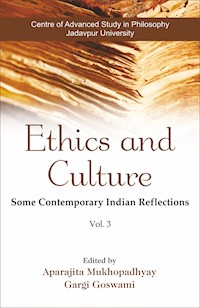
Ethics and Culture E-Book
10,99 €
Mehr erfahren.
- Herausgeber: D.K. Printworld
- Kategorie: Geisteswissenschaft
- Sprache: Englisch
The present volume of Ethics and Culture contains six articles of renowned teachers of Philosophy who are also the members of the Value Group, Centre of Advanced Study in Philosophy, Jadavpur University. In all these articles authors have explored the contributions of the great thinkers of modern India regarding the value system of our country. Here the perspectives of Bankim Chandra Chattopadhyay, Bal Gangadhar Tilak, Dwijendranath Tagore, Tarabai Shinde, J.N. Mohanty and Sri Ramakrishna Paramahamsa have been discussed in detail as all of them have a distinct view and faith on the traditional cultural beliefs of India and also have taken a critical approach to judge the mundane, orthodox attitude of people.
The authors have explained the views of these great thinkers as their unique interpretations about Indian tradition can be used as a weapon against cultural encroachment and intolerance. The book, thus, helps to revive the true essence of our culture which is veiled by many socio-political factors of the present world.
Sie lesen das E-Book in den Legimi-Apps auf:
Seitenzahl: 290
Veröffentlichungsjahr: 2022
Ähnliche




















Ethics and Culture
Ethics and Culture
Some Contemporary Indian Reflections
Vol. 3
Edited by
Aparajita Mukhopadhyay
Gargi Goswami
Department of Philosophy
Jadavpur University
Kolkata
in collaboration with
Cataloging in Publication Data — DK
[Courtesy: D.K. Agencies (P) Ltd. <[email protected]>]
Ethics and culture : some contemporary Indian reflections /
edited by Aparajita Mukhopadhyay & Gargi Goswami.
volumes cm
Contributed articles.
Includes bibliographical references.
ISBN 9788193607626 (vol. 3)
1. Ethics – India. 2. India – Intellectual life. I. Mukhopadhyay, Aparajita, editor. II. Goswami, Gargi, editor.
LCC BJ122.E84 2020 | DDC 170.954 23
ISBN: 978-81-936076-2-6 (HB)
ISBN: 978-81-936076-8-8 (E-Book)
First published in India in 2020
© Jadavpur University, Kolkata
All rights reserved. No part of this publication may be reproduced or transmitted in any form or by any means, electronic or mechanical, including photocopying, recording or any information storage or retrieval system, without prior written permission of both the copyright owner, indicated above, and the publisher.
Published by:
Department of Philosophy
Jadavpur University
Kolkata - 700032
and
Suryodaya Books
Suryodaya, D-36A/1, Mohan Garden
Najafgarh Road, New Delhi - 110059
Phone: (011) 25353435
Distributed by:
D.k. Printworld (P) Ltd.
Regd. Office:VedaœrÁ, F-395, Sudarshan Park
(Metro Station: ESI Hospital), New Delhi - 110015
Phones: (011) 2545 3975, 2546 6019
e-mail: [email protected]
Website: www.dkprintworld.com
Printed by: Suryodaya Books, New Delhi
Preface
Ethics and Culture: Some Contemporary Indian Reflections, vol. 3, is an outcome of the group research project of Centre of Advanced Study, Department of Philosophy, Jadavpur University. The value group of the department brings out this third volume as a sequel to its publication series – Ethics and Culture. Like two other previous volumes, our aim here is to explore and analyse various ethical concepts, norms and values as these have surfaced through the writings of different scholars of contemporary India. We acknowledge our indebtedness to each and every author who has extended her help to see this volume the light of day. We thank all the contributors of this volume for their enormous timely effort to put forward our dream.
We express our thanks to the University Grants Commission, New Delhi for providing the financial support for publishing this volume. We convey our gratitude to Jadavpur University for providing all sorts of administrative assistance. We thank our referees, Professor Prabhat Mishra, Former Professor of Philosophy, Vidyasagar University and Professor Papiya Gupta, Department of Philosophy and the Life-World, Vidyasagar University for their kind advice and suggestions. We are also thankful to Mr Rajendra Agarwal of Suryodaya Books for bringing out this publication with utmost care and professionalism.
Aparajita Mukhopadhyay
Gargi Goswami
Kolkata
15 February 2020
Contents
Preface
Introduction
– Aparajita Mukhopadhyay
1. Svadharma of the Bhagavadgītā
– Madhumita Chattopadhyay
2. Bal Gangadhar Tilak’s Rationalization of Violence through the Interpretation of the Gītā
– Gargi Goswami
3. Dwijendranath’s Method for Ascertaining Values
– Ratna Dutta Sharma
4. Tarabai Shinde: Questioning Caste Hierarchy and Gender Bias in Nineteenth-century India
– Atashee Chatterjee Sinha
5. Mohanty on Religiosity
– Jhuma Chakraborty
6. Values in Sri Ramakrishna’s Message to the World
– Rubai Saha
Contributors
Index
Introduction
Aparajita Mukhopadhyay
Ethics, as a discipline of critical thinking, guides people in both their private and public life. The major task of ethics is to map human behaviour through continuous orientation of his belief system. The source of our behaviour is the set of beliefs which we possess as a member of a society and of a cultural group. But these beliefs are not any permanent fixtures as new information, experiences of life, interpersonal and intrapersonal conversation insist us to restructure our beliefs for furtherance of our life prospect. Thus sometimes we reject our old moral beliefs, values, norms as dogma and entertain the newly-developed values as we consider them more suitable for the emerging social-political scenario. Again we also think to detain some of our old moral beliefs and reject the new ones as we consider old as good for social environment. Sometimes we modify both the old and new beliefs and try to fit them with each other to create a new set of beliefs. Thus our moral beliefs, concepts of good and right, principles and rules go through a continuous change according to the need of our moral and social life. A large number of philosophers are not ready to accept such redesigning of our moral belief structure as their goal is to establish objectivity in ethical thought. They do not accept changes in moral concepts on the ground of human needs. They are willing to depend on the rational faculty of man which provides arguments in favour of their actions only on the basis of objective truth. In their view, morality involves one or a few basic demands which are applicable to all and everyone ought to accept them as obligatory. Interference on the basis of subjective choice is strictly prohibited as that hampers the universality of ethical thought. In their view, universal principles and rules are helpful for making logical inference to justify our behaviour from an impersonal perspective.
But recent trend in ethics reflects a different view as contemporary thinkers suggest that at the time of providing normative standard philosophers should be more cautious about the psychology of mankind. They cannot prescribe such a standard which is impossible for human beings to achieve. According to Owen Flanagan “make sure when constructing a moral theory or projecting a moral ideal that the character, decision processing, and behaviours prescribed are possible … for creatures like us”(Liszka 1999: 4). Contemporary thinkers deny this objectivity and rigidity of normative standard and take the initiative to make ethics much more user friendly. In their view, ethics must give emphasis on the well-being and freedom of the agent. It is not the task of ethics to make us ethical. Man becomes ethical by his own choice. So he must have the freedom to choose the standard according to his own well-being. The reason which the agent provides to justify his action, i.e. the normative reason of the agent must spring from the orientation of the agent. Philosophers think that overconcentration on objectivity may create a barrier in front of our motivation to attain that value. If motivation is decoupled from agent’s own justification then human being will feel lonely, as if he is living in a state of schizophrenia(Stocker 1997: 120). A moral demand can be accepted as a moral demand when the agent has the reason to follow that. Acceptance of moral demands depends on the social customs, practices, conventions, values and principles that are accepted in the society to which the agent belongs. Moral principles cannot be followed impersonally as we believe in moral development of the agent.
When a child acts morally, he just follows the teachings of his parents and teachers. At that stage of his life he accepts the subordination of some authority. He is acting morally not by his choice, but he obeys the order of the authority blindly either for the fear of punishment or for the sake of some rewards. In the next stage of his life the agent follows moral path as he realizes that it will be beneficial to him. He acts rightly as his right attitude helps him to get benefits from other people as his right actions bring benevolence to others also. This is a fair agreement among the egoist people as all are conscious about their own benefits. After that stage people realize the value of socially accepted virtues, character traits, social rules and principles which are present as the cause of these actions. From this stage people start to think critically as they start to justify the prevailing beliefs, norms and values. At this stage people may accept or discard the existing values from his own point of view. At this level agent is morally developed and not following moral principles only because that is uttered by some authority. He considers himself as a member of moral community who is responsible for his own moral actions. A person can be considered as responsible only when he can provide justification in favour of his action. Here other members of the society are not treated as mere party of the agreement, but the agent finds an emotional bonding with them.
Gradual development of agent’s moral sense cannot be possible if morality concentrates only on the objective validity of the actions. When the agent learns to respect other members of the society, he finds justification to follow principles. It means, moral principles cannot be considered as applicable to all. An agent ought to follow a moral principle only if he finds it justified. Here lies the difference between a law and a moral principle. Law is applicable to all the members of the society and all are bound to follow the law without questioning it. But, Harman(1976: 431-63)thinks, the moral principles which a person accepts are treated as valid to that person only in the sense that they are the source of that person’s moral reasons to do things. The agent accepts a moral principle only if it harmonizes with his own moral reasons.
It means an agent considers to do x for the reason p if his own rational deliberation recommends doing x as more justified by comparing all the available alternatives. A moral principle is applicable or obligatory to someone means that a person has sufficient moral reasons to follow that. Though deliberation indicates a rational process, it does not lead to determinism. Deliberation here means not to point out the well-known end on the basis of available explanatory reasons only, but to find out new ends suitable for life. By the act of deliberation we also decide the means to achieve that goal, to fit all the ends of life in a systematic order, to harmonize particular goals with the final goal of life. By deliberation we also arrange the ends according to their priority in life, if they cannot coexist. Bernard Williams(1995) thinks that deliberation not only involves knowledge, experience and intelligence; rather it takes the help of imagination which makes the process of deliberation indeterminate. Thus the agent justifies his action, but there is no guarantee that his justification is considered as universally valid. So values cannot be absolute and self-evident. Values are relative, though based on justification. As providing justification in favour of moral beliefs is essential, philosophers think that morality presupposes at least a social hegemony and so values cannot be entirely subjective. We follow the path of morality as we try to fulfil our social roles due to our sense of sociability. There is a unity among the goals of human beings. All human beings have some common goals, for example, to live a good life or happy life, which can be satisfied by this moral way of life. So values of one person cannot fully contradict with the values of another person always, especially if they belong to an identical social atmosphere and possess similar character traits.
Goal of ethics is to produce some good for the whole community and, for that coherent, a socially accepted cooperative measure should be followed. Values cannot differ in every sphere of life as values are not rootless. Moral beliefs and values are judged in terms of good life. To understand and define a good life we have to explain the social scenario of a particular society. For example, in a materialistic society good life means achieving material goods and to get the sensual pleasure. On the contrary, in Indian culture spirituality is embedded in all the avenues of life and material enjoyment is not considered as the ultimate end. Good life here means to know the true “I” by overcoming all the worldly attachments. This shows that ethical beliefs are culture bound. The notion of good and the accepted standard of an Indian society or a cultural group dismisses the subjective, self-centred, egoist, materialist way of life.
Our values are important because they help us to grow and develop. They help us to create the future we want to experience. Every individual and every organization is involved in making hundreds of decisions every day. The decisions we make are a reflection of our values and beliefs, and they are always directed towards a specific purpose. That purpose is the satisfaction of our individual as well as collective needs. As values differ from time to time, society to society, culture to culture, our aim in this anthology is to cope up the nature of the value system embedded in Indian society from nineteenth century to the present era. In this period India has witnessed revolutionary changes in its political, social, spiritual spheres. We consider it very important to explore the ethical outlooks of those great Indian thinkers who showed courage to restructure the ethical view of India. Authors have clarified here how social–political–economical turmoil of the country affected its value system as such conditions raised questions against our age-old concept of good living. In this anthology we have included thoughts of those thinkers also who are not popularly known as philosophers, rather known as social reformer, political leader, spiritual person and novelist. Here we have included the philosophical interpretations of various thinkers who belong to the different parts of India and are from different economic and cultural backgrounds. Authors have meticulously studied the ideas of these thinkers to understand the positive contributions made by them. Some names are quite renowned and some are not so much, but we are really grateful to those thinkers for bringing into light a novel way of looking into the so-called age-old value system of India. The field chosen here is that of modern India where the thinkers presented a reformulated account of ancient Indian value system through the lens of so-called modern Westernized outlook. We will see whether these new perspectives provide a better social condition or help to throw light on both positive and negative sides of our socio-ethical system.
Discussions about the thoughts of these great thinkers are important as in the period of nineteenth century India was passing through a tremendous cultural turmoil due to European enlightenment. A new attitude developed, especially in the young generation of India, to throw away all the old values and norms of Indian culture considering them as useless and contrary to progress. Great thinkers of that period realized the need to re-establish the true value of our traditional culture and to uncover it in front of the common people. But their approach was not similar to the orthodox Indian paṇḍits who were drowned in their dogmatic interpretation of scriptures. Rather these people were enlightened with modern education and adopted a path of rationality. Their way of convincing people was not to impose old values forcefully in the name of God; but they started to justify our scriptures rationally to find out the truth lying in these age-long literatures and in philosophical thoughts. Their aim to survey the literature was twofold – first, to incorporate the views which are rationally justified and utterly necessary to live a right life. This attempt justifies the relevance and utility of the scriptures. Second, to open the new allay to welcome newly developed knowledge relevant for present world scenario. For this purpose they started to interpret the scriptures in their own way. They realized that the fundamental essence of Indian culture is spiritualism and any attempt to understand it from the materialistic perspective of European world would go in vain. It is true that to continue our own entity cultural exchange is necessary, but rejection of everything in the name of modernity is not the right way. They believed that without understanding the scriptures properly we cannot consider them null and void.
Madhumita Chattopadhyay in her article “Svadharma in the Bhagavadgītā: A New Interpretation” deals with the outlook of Bankim Chandra Chattopadhyay, an eminent litterateur of Bengal, on the issue of svadharma as found in the Bhagavadgītā. Because of his intention to safeguard Indian culture Bankim Chandra interpreted the Bhagavadgītā which is the fundamental text of Hindus and carries the essence of Upaniṣadic thought. The importance of the text lies in the fact that it is not a mere religious text of the Hindus, but upholds the Indian value system. To understand Indian culture, its socio-political-moral principles, the religious beliefs of Hindus, it is essential to understand the Bhagavadgītā. In spite of the presence of so many commentators on this text written by great thinkers like Śaṅkarācārya, Rāmānuja, Madhvācārya and the like, Bankim Chandra felt the need to compose a new interpretation of the text to make the essence of the Gītā clear to the young people of the nineteenth and twentieth centuries, who had been trained up in Western education and Western thoughts. This book has a huge impact on Indian people. Its multi-faceted nature makes it relevant to different people because of different purposes. The Bhagavadgītā, as it carries the essence of Upaniṣads, is welcome by religious people; the moral sense, the values which are lying in its every line guide common people to do their duties. This book acted as a motivational force too to inspire the young people of India to fight for removing the shackles of British colonialism. Bankim Chandra has thrown light on some important notions of the Gītā, but author Madhumita Chattopadhyay in her article has focused on two concepts – svadharma and dharma-yuddha. Bankim Chandra’s discussion gives a new dimension to these concepts. These two are connected terms as svadharma provides the argument to encourage Arjuna to take part in dharma-yuddha.
As war means loss of innocent lives, a question arises about its justification. For him the battle between the Kauravas and the Pāṇḍavas was a “just war”, and the “just” consists in the protection of one’s legal right, i.e. not to be encroached by others. As Kauravas refused the non-violent approach of Pāṇḍavas regarding sharing the land, war was the only way to regain the land of Pāṇḍavas and to punish the other party for their unlawful activities. War means a revolt against all unlawful attempts of Kauravas to subjugate the right of Pāṇḍavas. Here war is considered as dharma (duty). So concept of war cannot be categorized as good or right unconditionally, condition makes it right or wrong. The author clarifies that Bankim Chandra is introducing the notion of svadharma to prove the just nature of the war. As Arjuna is a kṣatriya, it is the duty of his caste to protect his own territory and the people of that territory from any kind of unlawful encroachment. To be reluctant to fulfil one’s duty in such situations means to violate svadharma. In this connection Bankim Chandra raises questions against the traditional approach of determining castes on the basis of natural inherent qualities of people acquired by heredity and also against the method of deciding profession on that basis. He finds that this traditional interpretation is overly restrictive and also invites other problems. We find a new dimension in Bankim’s way of classifying people in different groups.
Bankim Chandra is providing a liberal interpretation of svadharma on the basis of classifying the occupation of people. In traditional interpretation it was decided according to the predominance of svatta, rajas, tamas in human nature. So the people of different castes – brāhmaṇa, kṣatriya, vaiśyaand śūdra – were capable to perform different acts according to the prevalent nature of the guṇaspresent in their character. In this sense duties are caste specific and castes are determined by the pre-fixed nature of the guṇas. Madhumita in her article has discussed elaborately Bankim Chandra’s view in this regard and his reason for such a new interpretation. Bankim Chandra’s modern outlook considers this interpretation of svadharma as very rigid as all the people of the world are not embraced in this caste system. So using the old terminology he interprets it on the basis of occupation. Such explanation also fits with the new modern world. He identifies humanity as a combination of physical and mental propensities. In this respect dharma means cultivation of both of these propensities. So cultivation leads man to acquire knowledge and to perform actions – both of which are the svadharma of human beings. On the basis of this interpretation of svadharma Bankim Chandra divides people under four groups – brāhmaṇa, who holds the knowledge and realizes Brahman. Other three castes are consecutively engaged in external activities – production, accumulation, preservation and successively known as kṣatriya, vaiśya and śūdra. By this he is trying to accommodate all the people under this classification. This interpretation is similar to the division of occupation of the present world – agriculturist, merchant and warrior. Naturally the determining characteristic of every caste has changed from past days to present time, e.g. in new interpretation śūdras are involved in production and not to serve other three castes. His pragmatic outlook realizes the need to appoint a group for the others. Such thought insists him to restructure caste division in a new format – he divides people under five categories – first, people who acquire knowledge and educate others, i.e. engaged in teaching profession; second, soldiers who are protecting the country; third, industrialists, who are engaged in trading; fourth, workers and agriculturists, who are in the occupation of producing goods; fifth, people who are engaged in serving other people.
Bankim Chandra is aware about the problem of India where this system runs on the basis of heredity. But due to high increase rate of population people may adopt new occupation following the new demand of the society. But if the choice of occupation is dependent on the habit, ability, inclination of the person then that strengthens the svadharma. If the choice does not tally with the nature, it is para-dharma and contrary to one’s progress. Para-dharma produces evil activities and so necessarily be avoided. So whatever a person accepts as his occupation, in Bankim’s view, that must be his svadharma. In this sense svadharma is equivalent to loyalty; to be loyal towards his own occupation. This entirely new interpretation of svadharma, Bankim claims, is described in the Bhagavadgītā also, though overlooked by the traditional interpreters who understood it in a very narrow, restricted form. In determining svadharma Bankim is not allowing the role of God or heredity, but he is admitting nature of the person as the cause. In this respect he is presenting a contrary view to traditional view. Such an explanation has a universal, objective impact as it is applicable not only to Indian Hindu culture, but to all over the world. At the same time he is not deviating from the Gītā as Kr̥ṣṇa is also classifying varṇa in terms of guṇas. Moreover his interpretation is capable to handle other problems like varṇa-saṁkara which was posed as a genuine problem in the Gītā. Madhumita has justified that by such an interpretation, Bankim has established the traditional Indian system of varṇa on a strong foundation.
The notion of svadharma in the Gītā is also the issue of discussion in the article entitled “Bal Gangadhar Tilak’s Rationalization of Violence through the Interpretation of Gītā”. Author Gargi Goswami here tries to bring out a new understanding provided by Bal Gangadhar Tilak, the famous freedom fighter of Indian National Movement. Tilak is among the prominent leaders of modern India who has significantly influenced the extremist form of Hindu nationalism. Bal Gangadhar Tilak, the “father of Indian unrest” professed a different ethics from that of Gandhi and followed a trend of extremism and violence. He advocated violence as “the higher duty” based on his interpretation of the Bhagavadgītā, the most important text among the Hindus. In his opinion the Gītā is not prescribing renunciation and devotion through performing niṣkāma-karma, so need not be understood only as a holy text of India. Tilak aimed to aware the world regarding its other dimensions through unveiling its hidden sense. He brought to the forefront a novel way of understanding the Gītā which preaches the rationalization of violence through the notion of svadharma. Tilak, the believer in extremism, accused Mahatma Gandhi’s concept of non-violence (ahiṁsā) due to which the militant tradition in India had not been fully explored and remained to a great extent underestimated. His interpretation of the Gītā, known as Gītārahasya, is following a scientific way as it is free from all sorts of religious, dogmatic presuppositions. Like Bankim Chandra, Tilak is also suggesting Arjuna to follow svadharma and in this sense as a kṣatriyait is Arjuna’s duty to fight against his enemies. Thus he is justifying war as war is heredharma-yuddha because participating in the war Arjuna was fulfilling his dharma. In his view, karma-yoga, the prescribed path of the Gītā, is superior to renunciation and devotion as karma (action) has a greater impact than birth and devotion. His exposition significantly makes a hierarchy between asādhāraṇa dharma and sādhāraṇa dharma as Kr̥ṣṇa himself is structuring a warrior-religion which transgresses the law of fraternity. Tilak’s this unique interpretation of the Gītā had a great impact as it encouraged the young people of India to participate in National Movement. This interpretation initiated social activism and indoctrinated people in patriotism. He was able to popularize the Gītā among common people as his interpretation focused not on its sacredness, but on its usefulness. Tilak’s estimation of the Gītā differs from Mahatma Gandhi’s view. Gandhi explained conversation between Kr̥ṣṇa and Arjuna as imaginary and in his view the great epic Mahābhārata supported anti-war policy. But Tilak brought a revolutionary change in understanding the message of the Gītā, a part of Mahābhārata.
Gargi Goswami, the author of the article, has sketched the character of Tilak in an unbiased tone. She has discussed different dimensions of his nature and has taken a critical attitude towards him. It is true that Tilak was a popular leader of India’s National Movement and had a great contribution to make India free from the British rule, but Gargi also mentions that Tilak’s firm conviction in favour of following svadharma had a sensational impact on the society as it initiated the devastating awakening of Hinduism. He indoctrinated the young people to fight against British as he believed that it is the religious, social and moral duty of them to make their country free and to live united. On the other hand, his obedience to Hinduism inspired him to build a Hindu nation which will incorporate all other sects into it through the tolerant nature of Hinduism. Bal Gangadhar Tilak’s obsession towards Hinduism also affected his education policy. He realized the need of education for taking deliberative decisions, but in his view, secular education is not sufficient. Hindu religion and scriptures should be studied along with the study of modern science. The author is also raising questions against Tilak’s attitude of rationalizing violence by treating it as a religious act, as an act of Divinity. Gargi is not ready to accept it as a universal and objective moral law. Using different examples from our practical life experiences she is pointing the disastrous impact of rationalizing violence. Tilak’s aggressive attitude to identify Hindu religion with the warrior-morality goes against the spiritual flavour of Indian culture. Tilak’s attitude lacks justification as his entire focus is on the consequence and he is indifferent regarding evaluation of the nature of the action following which the agent is producing the consequence. Thus the action may be sinful, though the result is justified. Such a view encourages him to justify lying in morality. Such relative morality cannot be accepted as the foundation of spiritual tradition of India.
We have mentioned that nineteenth and twentieth centuries were very important in the history of India as in that period India experienced severe conflicts in every spheres of life – in politics, education, religion, cultural atmosphere and so on. Indians were then trying to gain self-rule in politics and British rulers were almost convinced to handover the political power to them. The then young Indian people, educated in English learning, started to question against the indigenous education system. Blind faith on religious rituals and worshipping idols were challenged by this English-educated Indian people. They disregarded the old Indian culture as orthodox, stagnant, primitive and prejudiced. This was a period of doubts and uncertainties as young generation was pulled in two opposite directions – their age-long old beliefs and cultural heritage was totally bankrupted by their newly governed thought of modern education and culture. Dwijendranath Tagore, son of Debendranath Tagore, is a representative of this period who actively participated in the then social movement of India. He can be known as an iconoclast of his time because of his rationalistic spirit. Author Ratna Dutta Sharma in her article “Dwijendranath’s Method for Ascertaining Values” has taken an attempt to explore the monotheistic belief of Dwijendranath Tagore. Dwijendranath was a prominent figure of the educated elite class of Bengal in the nineteenth century. Due to his open mindedness Dwijendranath thought to assimilate Upaniṣadicteachings with the Western science and knowledge. He had the courage to judge everything critically without accepting the old rituals in the name of tradition and for the sake of scriptures. As a citizen of subjugated India he realized the need to make India free. But at the same time he understood that we have to enrich ourselves for the attainment of freedom. For the goal of enrichment he proposed to follow the method of assimilation among different aspects. He never suggested denying our own culture. On the contrary he emphasized to value indigenous culture as much as possible. Dwijendranath actually appreciated to make a balance between Indian and Western culture to improve our outlook. From his father he inherited the courage to review the teachings of Indian scriptures through a critical eye.
Through her discussion the author is trying to clarify the position of Dwijendranath. Though he was living in a period of disturbance when all the old values were diminishing by a new English-oriented approach, he decided to adopt a middle path – he was neither ready to throw away all our old scriptures, nor to accept them as it is. Rather he realized the need to assess our scriptures critically. His judgemental attitude criticized both the extremists’ view of welcoming European culture without evaluating its real value and our attitude to stick to old beliefs without any attempt to measure it. His praiseworthy attitude towards different values of Indian culture like patience, courage, non-violence, expressed his attachment with Indian culture. He considered these values as the internal essence of our culture. But he refused the external rituals and customs as meaningless. In his opinion these ought to be redesigned according to the newly developed knowledge and requirements. He preferred to maintain a demarcation line between the external and internal essence of a culture, because in his view changes in external aspect must not hamper the internal essence of a culture. He referred some metaphysical notions like self, supreme self, religion, afterlife as the foundation of Indian culture which must not be shadowed by the scientific knowledge of the present era. Dwijendranath agreed that there are some ideas which must be changed for social progress. But such changes should not disturb the foundation of the society. To rescue the society he realized the need to bring changes in the irrational part of our culture as such dogmatic beliefs make it stagnant. Thus preservation of good and rejection of bad things were his strategy in maintaining the good health of a society. In this respect his position differed from the young English-educated Indians as he was not ready to embrace everything of foreign culture in the name of freedom. He never allowed the attempt of rejecting Indian culture without understanding properly its true essence. In his view freedom also encompasses duties to follow our own culture. Mere imitation of behavioural pattern cannot make us free in real sense. For that we have to restructure our beliefs, livelihood according to the Indian tradition. This idea insisted him to believe that knowledge about our mother tongue is essential. At the same time he realized the need to know foreign language, because if we do not learn that we will be in a lonely island as to communicate with others will be impossible.
Dwijendranath’s attitude of making a balance between different things is also reflected in his view about balancing our material and spiritual needs. His life-oriented attitude encouraged him towards both agricultural and industrial development. For this he recognized the need to know agriculture, to study chemistry. Apart from fulfilling materialistic needs, he recognized the satisfaction of spiritualistic needs through the cultivation of self. He realized that self-knowledge should be our ultimate goal. But as he adopted the middle path he never denied the reality of finite beings and the world. He neither denied the existence of finite beings, nor accepted their existence as independent of supreme Brahman. Like young generation people, Dwijendranath never thought to demoralize worshipping God. Rather for achieving the final goal he suggested to follow the path of devotion to God with a desireless mind. Indian concept of niṣkāma-karma was interpreted differently in his philosophical framework. He believed that in our life we experience different levels of attachment depending on the nature of the object of attachment. At the highest level we feel attachment with God. This attachment makes us free from other kinds of attachment towards body or life. So he never talked about detachment, rather believed in attachment to God which strengthens his religious position. Attachment to God helped him to understand everything as one. Thus he developed a detachment in him by removing the distinction between I and other. This is possible to achieve only through the attachment to God. The action performed in this mental state is called niṣkāma-karma or dharma as in this stage the person is free from the sense of possessiveness. He believed that this kind of attitude, the attitude of purity, simplicity and benevolence, is also helpful for the nation building and a real patriot must develop such attitude in him. This attitude is also helpful to remove all the differences and rivalries between two nations. Through cultural exchanges we can remove many differences. Realization of nobleness of God makes a person noble. At the same time he believed in the role of self-effort. For being a noble person one has to purify his self by controlling his unethical sensual desires and attitudes. Self-power helps to overcome all the obstructions come on our way. Such mentality of Dwijendranath actually reflects the then attitude of those young people of India who were trained in English culture, though embraced the spiritual flavour of Indian culture.
It is true that in nineteenth century a revolutionary change occurred in Indian value system as spiritualism was intermingled with modern scientific knowledge; a rapid change appeared as Indian culture was highly influenced by European culture. Changes in value system always appear with the help of education. We find that some good-hearted, rational, open-minded people from both India and Western country realized the need to introduce girls’ education as they observed that Indian girls were still in a neglected position and were not treated equally with the male members of the society. The major problem they identified for the miseries of women were




