


Erhalten Sie Zugang zu diesem und mehr als 300000 Büchern ab EUR 5,99 monatlich.
- Herausgeber: The History Press
- Kategorie: Geisteswissenschaft
- Sprache: Englisch
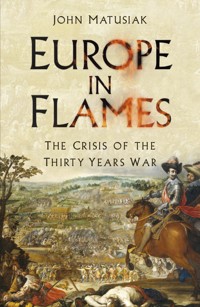
The Thirty Years War claimed more lives proportionately than either the First or Second World Wars – not only from battle and the endemic violence of marauding armies, but also from famine and plague. The bitter struggle encompassed the entire political and religious future of Europe and involved all the major players of the Continent. As the turmoil unfolded, vast mercenary armies exacted an incalculable toll upon helpless civilian populations, while their commanders and the men who equipped them frequently grew rich on the profits, leaving rulers perched on the brink of catastrophe. When peace came in 1648, the underlying tensions were far from wholly resolved. In Europe in Flames John Matusiak provides a compelling account of this most tumultuous time, exploring the causes, course and outcomes of a conflict that not only produced one of the greatest manmade calamities of its kind, but changed the direction of European history forever.
Sie lesen das E-Book in den Legimi-Apps auf:
Seitenzahl: 721
Veröffentlichungsjahr: 2018
Das E-Book (TTS) können Sie hören im Abo „Legimi Premium” in Legimi-Apps auf:
Ähnliche














To all my special friends across the years.
First published 2018
The History Press
The Mill, Brimscombe Port
Stroud, Gloucestershire, GL5 2QG
www.thehistorypress.co.uk
© John Matusiak, 2018
The right of John Matusiak to be identified as the Author of this work has been asserted in accordance with the Copyright, Designs and Patents Act 1988.
All rights reserved. No part of this book may be reprinted or reproduced or utilised in any form or by any electronic, mechanical or other means, now known or hereafter invented, including photocopying and recording, or in any information storage or retrieval system, without the permission in writing from the Publishers.
British Library Cataloguing in Publication Data.
A catalogue record for this book is available from the British Library.
ISBN 978 0 7509 8969 5
Typesetting and origination by The History Press
Printed and bound by CPI Group (UK) Ltd
eBook converted by Geethik Technologies
Eilt, dass ihr den Verstand zum Nutzen noch gebrauchet,
Eh dann Europa ganz, das golden Land, verrauchet!
Ach, glaubt mir, einmal sich erreten von den Kriegen
Ist mehr, als tausendmal unüberwindlich siegen.
Hasten, use your common sense,
Before the whole of Europe, that golden Land, goes up in smoke!
Believe me, avoiding war
Is more than a thousand victories.
Andreas Scultetus, Friedens Lob- und Krieges Leid-Gesang (1641)
CONTENTS
1The Crucible
2Crisis of Emperors
3‘The Start of Our Destruction’
4‘Fatal Conflagration’
5Crisis of Empires
6‘Soldier under Saturn’
7Crisis of a Continent
8‘Lion of the North’
9Magdeburg and Breitenfeld
10The Plenitude of Power
11War without Limit, War without End
12The Crisis of the Peace
Acknowledgements
1
THE CRUCIBLE
[Germany] is now become a Golgotha, a place of dead mens skuls; and an Acaldama, a field of blood. Some nations are chastised with the sword, others with famine, others with the man-destroying plague. But poor Germany hath been sorely whipped with all these three iron whips at the same time and that for above twenty yeers space.
Edmund Calamy, England’s Looking Glass (1641)
In the spring of 1648, the Augustinian abbess Clara Staiger surveyed the devastation at her convent of Marienstein just outside the Bavarian city of Eichstätt, and lamented the loss with a deep sense of gloom and foreboding that mirrored the sentiments of so many survivors of the shipwreck of the previous thirty years. ‘May God come to our aid like a father,’ she wrote, ‘and send us some means so we can build again.’ In this particular case, the perpetrators had been the Swedish-French armies of Generals Wrangel and Turenne, but before them countless other soldiers had been visited upon the abbess’s homeland from the four corners of the Continent – Spanish, French, Swedish, Danish, Italian, Croat, Scottish; Catholic, Lutheran, Calvinist; conscripts, mercenaries and freebooters alike – all bringing plague, poverty and destruction in their wake and spawning a death toll that the most reliable estimates now set at some 8 million souls. One soldier alone, Peter Hagendorf, had marched more than 15,000 miles over the course of his service, travelling with his family in tow and enduring not only robbers, foul weather, gunshot wounds, scant food and scarcer pay for his trouble, but also the deaths of his first spouse and children. ‘At this time my wife went into labour,’ he wrote after he had been ordered to Stade, downriver of Hamburg, early in 1628, ‘but the child was not yet ready to be born and so shortly died. God grant him a joyous resurrection.’ Three daughters – Anna Maria, Elisabeth and Barbara – would also be entrusted to the consolations of a merciful Creator over the next five years before their mother, Anna Stadlerin of Traunstein, herself succumbed in Munich, some days after the birth of Barbara.
Clara Staiger’s own hopes for divine deliverance, meanwhile, were hardly gratified promptly, if an account produced two decades later by the Lutheran theologian Joachim Betke is any guide:
How miserable is now the state of the large cities! Where in former times there were a thousand lanes, today there are no more than a hundred. How wretched is the state of the small and open market towns! There they lie, burnt, decayed, destroyed, so that you see neither roofs nor rafters, doors or windows. Think of how they treated nunneries, churches, priories and temples: They have burnt them, carried the bells away, turned them into cesspits, stables, sutlerships and brothels … Oh God, how pitiable is the state of the villages …! You travel ten, twenty or forty miles without seeing a single human being, no livestock, not one sparrow, if there are not some few places where you find one or two old men or women or a child.
Not all areas, it is true, had been continuously occupied or callously ravaged and destroyed like tragic Magdeburg, for example, where the population had fallen from 25,000 in 1618 to only 2,464 a quarter of a century later, and where one resident, Otto von Guericke, spoke of the packed corpses floating horribly at the city’s Water Gate long after its sack in 1631 – ‘some with their heads out of the water, others reaching out their hands towards heaven, giving onlookers a quite horrible spectacle’. Certain places, indeed, which lay outside the most intense killing fields stretching from Pomerania in the Baltic to the Black Forest, had remained untouched by the conflict. Ulm, for instance, where the shoemaker Hans Heberle had kept his Zeytregister, or chronicle, of events, was spared serious inconvenience during the early years at least, while Staiger’s Marienstein actually appears to have fallen into what may best be considered the middle category of privation. But even Ulm at its most peaceful did not escape the resulting economic upheaval, for on 15 March 1623, as Heberle recorded, ‘no more than four sacks of grain entered the granary’ and ‘spelt went for forty-two and rye as much as forty gulden’, as a result of ‘bad money’. Two years later, moreover, the nearby towns of Langenau, Öllingen, Setzingen, Nerenstetten and Wettingen had suffered ‘great plagues’ and ‘all kinds of maliciousness’ at the hands of enemy troops. ‘The men,’ wrote Heberle, ‘were badly beaten, and many women were raped’ – all of which, the shoemaker tells us, ‘continued for nine days’.
Yet at the dawn of the same century, the Holy Roman Empire of the German Nation, as it was formally known, had betrayed few outward signs of the looming crisis that was already threatening to consume both it and the continent to which it belonged. A multi-ethnic, multilingual and multi-confessional state, governed since 1438 by an elected Habsburg emperor in conjunction with a motley assortment of dukes, counts, margraves, lords, archbishops, ‘prince-bishops’, ‘Imperial Knights’ and urban oligarchs representing some eighty or so ‘Imperial Free Cities’, it was as vast in extent as it was variable in complexion, stretching from the Alps in the south to the Baltic in the north, and from the more prosperous southern and western territories of Bavaria, Alsace and the Palatinate to the fertile agricultural plains of the east, and the starkly contrasting regions of the north-west, whose barren heaths and wastelands had become prey to ravaging armies operating in the war-torn Netherlands where Spanish troops were embroiled in a bloody struggle against Dutch independence. In its full compass, the Empire comprised, indeed, not only modern Germany and Austria, but Slovenia, Hungary, Luxembourg and the Czech Republic, as well as parts of eastern France, southern Denmark, northern Italy, western Poland and – technically at least – the modern Netherlands, Belgium and Switzerland, though the latter had long since functioned separately.
There could be no doubt, of course, that the task of administering this vast mosaic was made all the more formidable by the existence of some 1,000 separate autonomous units within its jurisdiction – all varying considerably in size and stature and all jealously protective of their ‘liberties’. Organised since the early sixteenth century into ten regional bodies known as Kreise or ‘Circles’, responsible for local defence, public peace and monetary and economic matters, the Empire included not only territories like Saxony, Brandenburg and Bavaria – all with a population of over a million and worthy of consideration as unified and discreet ‘states’ in their own right – but also micro-princedoms like Anhalt, only a little larger than Essex, and divided between no less than four rulers. Hesse, Trier and Württemberg, meanwhile – each with populations of 400,000 – had undergone similar fragmentation as a result of ingrained antipathy to the principle of primogeniture, and even the Palatinate – another of the major Imperial princedoms with a population of perhaps 600,000 – was itself divided into two major components: the ‘Lower’ Palatinate, a rich wine-growing district between the rivers Mosel, Saar and the Rhine, which had previously belonged to Bavaria and in which Calvinism had more recently gained control, and its so-called ‘Upper’ counterpart, a formerly Lutheran and relatively poor agricultural area between the Danube and Bohemia.
Bohemia itself, moreover, had been held by the Habsburg dynasty only since 1526 – along with its dependencies of Moravia, Lusatia and Silesia – and remained an autonomous kingdom within the Empire, with a population of some 1.4 million, no less distinctively proud of their traditions, idiosyncracies and ‘liberties’ than their German counterparts whose passion for independent action seemed, at every turn, to stifle the ongoing Habsburg quest for more effective central control or, as many feared, absolute hegemony. When Protestant authors even balked at the Empire’s official designation, rejecting the term ‘Holy’ and questioning the expression ‘of the German nation’, there seemed hardly more scope for unity of purpose than that unity of faith which had been so decisively shattered by Martin Luther a hundred years earlier. And while jurists quibbled over endless other technicalities, the more practical problems generated in particular by the nature of the Imperial Circles continued to hamstring the day-to-day processes of government. Swabia, for example, covered an area more or less equal in size to modern Switzerland, but included no less than sixty-eight secular and forty spiritual lords, as well as thirty-two Imperial Free Cities. All were represented in the Kreistag or Circle Assembly, which met sixty-four times between 1555 and 1599, and each was a direct vassal of the emperor. But they ranged in importance from the compact duchy of Württemberg, covering 9,200 square kilometres, down to the paltry lands of individual Imperial Knights, some of whom owned only one part of one village. More significantly still, over half of the members of the Swabian Circle, and almost half its population were Catholic, while the rest were either Lutheran or Calvinist, providing a perfect formula for paralysis, or much worse still bloody conflict, which was equally the case in most of the Circles of south and west Germany.
Under such circumstances, it was hardly surprising that the potential for successful co-operation both between and within the Circles should have proven so limited. Their inability, on the one hand, to maintain local defence had been conclusively demonstrated by the invasion of Westphalia in 1599 when the entire Spanish field army of the Netherlands had gone in search of winter quarters, only to be met by mutinous troops from the Rhenish and Westphalian Circle who had been vainly raised to resist them. And attempts at inter-Circle co-operation on the economic front had been no more fruitful either. For just as the weaving regulations, common currencies and grain controls agreed during 1564–72 between the Swabian, Bavarian and Franconian Circles proved exceptional and impermanent, so attempts even at establishing a coherent system of boundary markers between territories had proved all but impossible in places other than the Palatinate where a network of specially-erected columns provided welcome guidance to otherwise bemused visitors. Elsewhere, travellers frequently experienced difficulty in establishing where they were, notwithstanding the existence of numerous customs posts on both land and water, which were, of course, no less niggling a symptom of localism in their own right. On the Elbe between Hamburg and Prague, indeed, there were as many as thirty toll stations, and between Mainz and Cologne on the Rhine no less than eleven, each equipped with a small cannon to sink ships attempting to avoid payment.
To the Hessian, it has been said, ‘fatherland’ was Hesse and ‘abroad’ was Bavaria, and as the ultimate testament to its disunity, the Empire likewise employed two principal coins whose precious metal content, and therefore value, varied in accordance with where and when they had been minted. The south, west and hereditary Habsburg lands, on the one hand, used the florin, which was divided into 60 Kreuzer – each worth 4 pfennigs (pennies) – while the subdivision of the thaler used in the north and east varied from 24 to 36 smaller coins of different names, depending upon the territory concerned. Where attempts at rationalisation occurred, as in 1551 and 1559, they had encountered a variety pitfalls, so that by 1571 responsibility for currency matters had been passed to three associations of Circles who were requested to ‘correspond’ on the matter. And if the Emperor’s subjects had difficulty in deciphering the contents of their purses, their lot was no more enviable, it seems, when it came to determining the date, since the Gregorian calendar used by Catholic Europe had not been welcomed by Protestants who retained the Julian Old Style, which lagged behind by all of ten days.
For some foreign observers, naturally enough, it was a source of no inconsiderable relief that the Holy Roman Empire remained a confusion within a complexity, a name rather than a nation. ‘If it were entirely subject to one monarchy,’ wrote Sir Thomas Overbury in 1609, ‘it would be terrible to all the rest.’ Yet for all its diversity and divisions, its anomalies, complexities, quirks and contrasts, this self-same sprawling entity, governed traditionally from its Habsburg nerve centre in Vienna, had not only extricated itself from the protracted civil wars of religion that had bedevilled a kingdom like France, and avoided the bitter fighting engendered by the Dutch War of Independence, but achieved a degree of comparative economic prosperity – particularly in the area formally designated its ‘German section’ and known more popularly as ‘the Germanies’ – that made it the envy of many. In the preface to the Topographia Germaniae, the Frankfurt publisher Mathäus Merian lauded the numerous cities, castles, fortresses, villages and hamlets of his native land, which were, he claimed, as favourably situated as almost any in Europe. And if Merian’s musings may well have been gilded by an understandable hankering for the happier days of peace that had by the 1640s become such a distant memory, they were more than amply matched by many other commentators of his day, both German and foreign alike. For Martin Zeiller, author of the Topographia, Lower Austria was home to a sociable, hospitable people, lushly served with everything to equip them for long and happy lives, while visitors, likewise, were equally impressed by the fertile coastal districts of the North, the ‘Börder’ areas of Central Germany, large areas of Lower Bavaria, the densely populated Vogtland, and above all, the beauty and harmony of the Rhenish Palatinate and Alsace. When the Englishman Thomas Coryat journeyed from Basel to Mainz on his way back from a visit to Venice in 1608, he was able to do so alone, on foot and unimpeded, encountering soldiers only once along the way. And though he found it prudent to sail down the Rhine below Mainz on a passenger barge, since the roads in that area were reputed to be infested with outlaws, Coryat nevertheless commented altogether favourably upon the orderliness, peace and prosperity of the Upper Rhine Valley, where bread and vegetables were so cheap that one could have a nourishing meal for a farthing and buy a year’s supply of grain for £2.
Nor was this last claim an exaggeration, for by 1600 both Prussia and Pomerania, soon to be decimated by marauding armies, had become major suppliers of grain to the whole of western Europe, generating vast trade with the great markets of Amsterdam, Hamburg and London via the ports of Danzig, Königsberg, Riga and Stettin. And though the condition of the peasantry, which made up some 85 per cent of the Empire’s population, varied markedly with location, for many their lot was more than tolerable. Both Upper and Lower Austria had been shaken by a violent rural uprising from 1594 to 1597, caused by heavy financial burdens and services resulting from war with the Turks, and such outbursts were not untypical of episodes elsewhere: in the ecclesiastical principality of Augsburg; in the Bavarian county of Haag; in the small territory of Rettenberg to the south of Kempten; and among the Sorb population of Upper Lusatia and Silesia. In the eastern lands of Brandenburg, Mecklenburg, Pomerania, Silesia and Prussia, furthermore, the east German ‘Junker’ nobility, prompted by the prospect of rich profits from the export of grain, had deliberately set out to annex the peasants’ holdings and raise their labour services accordingly – in Mecklenburg from three-and-a-half days a year in 1500 to three days a week in 1600.
In what German land [asked a writer in 1598] does the German peasant enjoy his old rights? Where does he have any use or profit of the common fields, meadows or forests? Where is there any limit to the number of feudal services or dues? Where has the peasant his own tribunal? God have pity on him.
Yet in south-west Germany where small farms predominated and were usually leased on a lifetime basis, services and dues remained both fixed and generally reasonable, while west of the Elbe the circumstances of the peasantry had shown no appreciable deterioration at all during the 1500s. Indeed, north-west Germany was largely a land of free, small-scale peasant-holders who had progressively acquired full rights of inheritance, and even in those places where serfdom still existed, it was rarely deemed an unnatural or insufferable burden.
While peace obtained, therefore, the doughty German peasant had no more cause for complaint than his counterparts elsewhere. And for much of the Empire, too, the buoyancy of handicrafts and industrial production in the half century or so up to 1618 likewise gave no appreciable hint of crisis or approaching catastrophe. Silesia, Westphalia, the Lower Rhine and Swabia were known for their knitting and weaving, north-west Germany for its copper and brassware, central Germany for pottery and glass, and south Germany for products of wood and precious metals. The merchants of southern Westphalia, in their turn, had ignored the opposition of urban guilds to develop large-scale manufacture of scythes, sickles and ploughshares, while their counterparts to the north established a flourishing linen industry, with Osnabrück as its centre. It was Westphalian merchants too, who, along with their Saxon counterparts, exploited the expanding market for coarse cloths, resulting from the large labour force of Negro slaves in the Spanish colonies, and Nuremberg merchants who extended the production of cheap linen for this purpose to Bohemia, which by the beginning of the seventeenth century had become one of central Europe’s foremost producers of textiles. Even more profitable were the mining centres located in the Harz mountains, Tyrol and Styria, the Siegerland and Lahn-Dill areas and the Upper Palatinate, along with Bohemia and Moravia’s tin-producing zones, which alone accounted for as much as two-thirds of the continent’s entire supply.
Saxony, moreover, was not only the greatest mining area of all, but the richest place in Germany, abounding in natural resources and boasting a flourishing agriculture and textile industry, which had helped gain international recognition for the twice-yearly fairs held every March and September at Leipzig. ‘The riches I observed at this Mart were infinite,’ wrote Thomas Coryat, who reserved a particular note of admiration for the ‘incredible’ wealth of the goldsmiths in attendance. And although the notoriously bibulous Duke John George I, ruler of Saxony from 1611 to 1656, would spend much of his time immersed in an alcoholic haze, he was neither typical of his more industrious subjects nor representative, for that matter, of at least a few of his more enterprising peers and predecessors. Indeed, his grandfather, Augustus I, had been shrewd enough to acquire shares in a mining company that allowed him to grow rich by means of influencing the price movements of iron and copper ore, as well as vitriol, alum, cobalt and coal. And just as Augustus went on to encourage new mining techniques and improve the stamping and iron mills of his duchy, so his contemporary, Duke Julius of Brunswick, another princely entrepreneur of some considerable stature, had not only employed his factories and workshops to produce everything from brass boxes to garden ornaments and chess sets, but gone on to renew the decaying iron pits and forges at the northern and eastern slopes of the Harz mountains, which turned out excellent thin steel for the export of culverin and arquebuses, as well as cannonballs, produced from the sullage, that would soon be shattering city walls and soldiers’ bones alike.
For even in times of peace and comparative prosperity, it seems, the instruments of death and destruction could still be used to turn a tidy profit, notwithstanding nobler princely enthusiasms, extending well beyond the needs of war, that had made many Imperial cities among the most delightful centres of their kind in all Europe – adorned with extravagant buildings and boasting some of the Continent’s foremost artists and musicians like Dresden’s Heinrich Schulz, and the renowned Orlando di Lasso, who, before his death in 1594, had been awarded the Order of the Golden Spur by Pope Gregory XIII. Munich’s renowned ‘Antiquarium’, which was begun in 1570 to house the art collection of Duke Albrecht V, was said, with its Italianate and neo-Roman frescoes, to rival even the Vatican, while Ferdinand II of Tyrol was prepared to lavish similarly vast sums on ambitious building projects like Ambras near Innsbruck, where he housed his magnificent art collection, and the Star Castle not far from Prague in which he salted away his secret wife Philippine in pampered splendour. Comparable edifices arose, in fact, all over the Empire – at Dresden, Wismar, Heidelberg, Salzburg, Prague and other places – so that even the Margrave of Ansbach-Bayreuth, one of the poorest principalities in the Empire, was nevertheless prepared to lavish 237,000 florins on his Plassenburg Palace, while the imperial residence in Vienna – the Amalienburg, built by Rudolf II in 1575 – came to excel anything else of its kind in other contemporary capitals, making it small wonder, perhaps, that this particular emperor was no less ready than other princes of his territories to employ alchemists in the hope of meeting his immense expenses.
The artefacts in such majestic dwellings – like the exquisite kunstschrank or art cupboard delivered to Duke Philip II of Pomerania in 1617, which had been ordered from Philipp Hainhofer of Augsburg five years earlier, with the intention that it should contain a complete survey of art and science to that date – were also altogether more suggestive of high culture and fine living than the horrors of impending war, as indeed were the splendid gardens in which the palaces themselves were set. For, to the everyday observer, it still seemed almost inconceivable as the seventeenth century dawned that anything other than gracious pleasure and wellbeing might lie in store for the Empire’s elites. In 1559 the first orange, lemon and citron trees were planted at Stuttgart, while in 1562 the Imperial Ambassador at Constantinople brought lilac and gillyflower to Vienna. And when lesser German noblemen and their families were not strolling and picnicking amid the kind of pre-war harmony depicted so evocatively by the Flemish artist Lucas van Valkenborch, they too were equally inclined to indulge their fancies, albeit with a less self-conscious eye upon posterity. For amid the background tremors of religious friction and baleful rumblings of political dissent, they still found time on festive occasions for tournaments, animal-baiting and shootings, ring-runnings, sleigh rides, masquerades, ballets, dances and plays – often performed by travelling English troupes – as well as dazzling firework displays at which likenesses of the Sultan of Turkey or the Tsar of Russia or, in the predominantly Protestant north, the ‘Bishop of Rome’ were gleefully incinerated.
Eating and drinking too, it seems, were major sources of recreation among the Empire’s well-to-do in the heady days of peace when such indulgence was still an option. At a nobleman’s wedding at Liegnitz in 1587, 54 Polish oxen, 6 cows, 97 goats, 267 sheep, 55 calves, 16 pigs and 46 suckling pigs were all consumed with carefree abandon, and it was characteristic of the times that one waggish German prince should sign his letters Valete et inebriamini (Be well and get drunk). Christian II of Saxony, indeed, drank himself to death at the age of 27, and when Germany’s first temperance society was established to do battle against the evils of alcohol, it was a fitting comment on the times that its first president should later die of liver damage. ‘Owing to immoderate eating and drinking,’ wrote Erasmus Winter in 1599, ‘there are now few old people, and we seldom see a man of thirty or forty who is not affected by some sort of disease, either stone, gout, cough, consumption, or what not.’ Wealthy burghers, too, were equally proud of their appetites, which, like the dress of their womenfolk, served as brazen tokens of their prosperity. Dinners lasting seven hours, with fourteen toasts, were not, it seems, unusual as Germans drifted heedlessly to the brink, while one particular gourmand, who had made his fortune as a circus performer, earned national fame by eating at one meal a pound of cheese, thirty eggs, and a large loaf of bread – after which he promptly fell dead.
For the omnipresent poor in town and countryside alike, of course – and above all for the so-called gutsherrschaft or class of landless labourers – the simple task of everyday survival was an altogether grittier priority. The protective wing of the craft guild had already been broken irreparably by the progressive exploitation of day labourers, and in some industries the working day began at 4 a.m. and ended at 7 p.m., punctuated only by ‘breaks for beer’. In 1573, as their employers reaped record profits, braziers worked a ninety-two-hour week, and six years later there were widespread strikes throughout Germany against the introduction of textile machinery – merely increasing the already crippling pressure among the growing numbers of urban poor. At Augsburg, largest of all the Imperial Free Cities with 50,000 inhabitants, almost half of taxpayers owned no property whatsoever, while another quarter had not more than 300 florins to their name, so that in times of a bad harvest when grain prices soared, the most vulnerable came close to starvation. During the Great Famine of 1570, in fact, only the subsidised sale of lard and bread by the city’s authorities – 23,000 loaves in all – had saved the populace from catastrophe. And even in the smaller towns and villages of comparatively prosperous areas, let alone those other great cities of the Empire whose fortunes remained precarious, a similar pattern of deprivation seems to have repeated itself, especially between 1596 and 1600 when harvest failure facilitated severe outbreaks of plague in Hessen, Nassau, Lower Saxony, Thuringia, Silesia, Pomerania and East Prussia.
Nor, of course, was the incidence of such poverty in the Empire’s 2,200 towns and 150,000 villages unconnected to the precipitous rise in population that would soon be reversed so drastically by the harrowing toll of war. At Augsburg, once again, the number of tax payers increased by 14 per cent between 1558 and 1604, and though towns remained small on the whole, the same demographic expansion and related rise in prices was nevertheless evident throughout Germany where the population appears to have increased from around 14 million in 1560 to some 16 or 17 million in 1618. In Saxony, the most urbanised area of all, where no more than 70 per cent of the population was involved in agriculture, only fourteen urban centres had more than 2,000 inhabitants, the largest being Leipzig with 7,500 and Dresden, the capital, with 6,450. Other capitals were not much larger either, so that by 1600 Heidelberg had merely 6,300 people, Stuttgart 9,000 and Munich 10,000. Instead, the largest cities were the commercial centres like Stettin with 12,000, Frankfurt with 18,000, Hamburg with 22,500, Breslau and Magdeburg, both with 30,000, and Cologne with around 40,000. But large and small alike were all expanding, and the same scourge of inflation invariably followed in tow, with the result that at Augsburg, which was typical of the times, the price of rye, barley and oats rose by 69 per cent from 1550 to 1618 while the wages of unskilled building workers increased by only 47 per cent. In the Mansfeld copper belt too, to take but one example, wages in 1600 were no longer sufficient to buy bread for the families of miners.
But even where such challenges existed, there remained once again signs of growth and regeneration uncharacteristic of a land facing calamity. How far shifts in international trade away from northern Italy, the south Netherlands and Upper Germany toward France, Britain and Holland may have affected regional trade within the Empire, especially in the German hinterland beyond the Rhine and North Sea coast, remains uncertain. But while the merchants of the Hanseatic League faltered in Lübeck and along the south-west Baltic coast, they nevertheless regrouped successfully around Hamburg, Bremen and German North Sea outlets to boast by 1600 a fleet still larger than those of England, France and Spain, and second only to that of the Dutch. When, moreover, Augsburg lost no less than seventy of its internationally-known trading houses between 1556 and 1584, as a result of the bankruptcies of the Spanish and French crowns, Nuremberg merchants opened others in Leipzig and at Breslau, Posen, Danzig and Krakow. Equally significantly, as German territories adjusted to harsher terms of trade, higher inflation and greater underemployment, so internal trade was nevertheless consolidated and greater exploitation undertaken of the immediate hinterlands between Hamburg and Prague along the Elbe and Vlatva, and Silesia and West Prussia along the Oder and Vistula, as well as further territory across the Carpathians stretching into industrial north Bohemia and Slovakia, and onwards to the pasturelands of Hungary. Controlled by urban centres like Leipzig and Nuremberg on its western periphery, this east-central European economy was still being consolidated, in fact, on the very eve of the Thirty Years War which would soon lay waste to everything.
And in the meantime, as the Empire’s economy adapted and evolved, so the merchants and burghers who had come to take their quiet lives for granted, continued in the main to flourish, luxuriating for the present in their privileged lot while snugly immuring themselves as far as they might from the creeping peril all around. The façade of Bremen’s town hall, built in 1609, just like the splendid merchants’ houses of Hamburg, left little doubt about the residing wealth of north German towns and the prosperous citizens that had benefited so markedly from membership of the Hanseatic League, which had until recently dominated trade in the Baltic. Many cities too, like Nuremberg, which had become burgeoning business centres in an increasingly aggressive capitalistic world, now boasted an expanding middle class that imitated the great courts of their betters in culture and manners, mimicking Spanish fashions in particular and indulging their fetish for newfangled playthings like those mechanical toys serving as table ornaments which gave fresh scope not only for the ingenuity of the Empire’s numerous goldsmiths, but for the poe-faced rancour of disapproving moralists like the preacher of 1581 who noted how ‘an unchristian love of gold has seized upon everybody and all classes’. ‘Whoever has anything to stake,’ he complained, ‘instead of engaging in honest and strenuous work … thinks to grow rich … by all sorts of speculation, money dealing and usurious contracts.’ For conservative patrician families of long-standing like the famous Welsers and Imhofs were now increasingly rivalled by a newer more thrusting type of entrepreneur, many of whom were foreign, like the Venetian-born Bartholomäus Viatis, or Johann von Bodeck, son of an Antwerp merchant, and Lazarus Henckel from Upper Hungary.
Among such men, not unnaturally, the primary business of life was business itself. But, as their rulers contested the Empire’s destiny with increasing vigour, even they, like many of humbler status too, could not entirely ignore the broader tide of events. And by 1600 a widening window on the lofty world of political affairs was readily at hand, both to feed the curiosity and stoke the misgivings of one and all. For the self-same literary revolution that had led the Parisian scholar Henri Estienne to declare Frankfurt the ‘Athens of Europe’ four decades earlier had, in the meantime, generated its own ‘newspaper believing public’, which the poet Johann Fischart was already ridiculing for its gullibility, but which demonstrated nonetheless the growing consciousness that, in spite of so many appearances to the contrary, all was not entirely well, both within and without Germany. Since the early 1500s, in fact, numerous reports on political events, or Zeitungen as they were called, had enjoyed considerable appeal, so that by 1599 at least 877 are known to have existed – one of the more successful being a journal produced by Michaël Eytzinger between 1580 and 1583 to report on the troubling conflict between Protestants and Spaniards at Aachen in the prince-bishopric of Cologne. Shortly before 1609, moreover, Johann Carolus had begun publishing weekly reports at Strasbourg in quarto format, containing news from no less than seventeen European cities. Vienna had such a newspaper in 1610, Frankfurt in 1615, Berlin in 1617, with other Protestant cities quickly following suit – to such a degree, indeed, that even schoolmasters saw fit to fulminate against parents who neglected the education of their children by running to bookshops and drinking places in order to read of current events. ‘This they consider summum necessarium, the most needful thing,’ wrote one bristling critic, who, in venting his indignation, nevertheless ignored the more troubling implications arising from the great mass of slanderous lampoons, libellous pamphlets, satirical poems and squibs which were printed clandestinely and sold by hawkers in market places and taverns and, above all, at the gates of German colleges.
For new universities had also proliferated during the previous century, acting not only as seats of learning but, much more significantly still, hothouses for the religious divisions that were soon to send the superficial harmony of the previous decades crashing down. Between 1517 and 1618, the number rose from fourteen to twenty-five, and while some contained no more than 400 students, the largest, Lutheran Wittenberg, boasted between 1,800 and 2,000, all suitably imbued with the reforming zeal of their teachers and numbering in their midst those self-same ministers of ‘the Word’ who were firmly set upon stirring the coals of conflict when the time came for their return to an outside world that had known only peace in their lifetime. The other leading university, Rostock, was Lutheran too, as were Tübingen, Leipzig, Greifswald, Heidelberg, Königsberg, and Marburg, which followed close behind. Nuremburg, in its turn, had established the beginnings of a university at Altdorf in 1573, as had the Duke of Brunswick, at Helmstädt, one year later, further confirming, it seemed, a Protestant assault on the moral and intellectual high ground and a proselytising intent that led one Venetian diplomat to claim in 1577 – albeit with no little exaggeration – that nine-tenths of Germany was by then Protestant.
It was no coincidence either that the smaller Catholic universities which had hitherto largely stagnated were also undergoing renewal – most notably at Cologne, Vienna and Ingolstadt – or, more ominously still, that control of their philosophy and theology faculties should have steadily fallen to members of Ignatius Loyola’s Society of Jesus, who had initially arrived in the Empire in the 1540s with little more than a simple reputation for rigour that had before long degenerated into widespread loathing and paranoid distrust. ‘The young women,’ wrote Hermann Weinsberg of Cologne shortly after the Society’s appearance in his city in 1544, ‘are good Jesuits; they go to church first thing in the morning, and fast a great deal.’ And the Jesuit priests themselves had at first been keen, wherever possible, to avoid all hint of controversy. One of their leading figures in Germany, Peter Canisius of Nijmegen, had indeed explicitly endeavoured to keep them away from princely courts and palaces, and they had been issued, too, with specific instructions not to meddle in Imperial affairs of state. But, as the vanguard of the Counter-Reformation, they were nevertheless progressively associated with ultra-orthodoxy and a sinister commitment to secret sabotage and ruthlessness – extending even to tyrannicide – that was only exacerbated by their predominantly Spanish and Italian membership and their unwavering emphasis on the veneration of the Virgin Mary and the cult of relics, as well as pilgrimages and gorgeous ceremony.
By 1600, in fact, there were no fewer than 1,111 Jesuit fathers operating in Germany, spread over twenty-five colleges, nine residences and three noviciates, propagating their lay fraternities among students, burghers and noblemen alike, and helping in the process to initiate that great blossoming of the Catholic Baroque which left such an inimitable architectural mark upon posterity. But with every new convert and each new edifice, suspicion at their success and the means by which they achieved it intensified. To frenzied contemporary critics like Elias Hasenmüller, whose History of the Jesuits appeared in 1594, and the anonymous author of the Monita Secreta Societatis, which claimed in 1612 to reveal the order’s secret agenda for restoring Roman despotism, the Society’s priests were comparable to Janissaries, Templars, Assassins, Pharisees, the Plagues of Egypt, the Flood, and Balaam’s ass, while in Germany more generally, they were widely decried as the ‘black horsemen of the pope’, accused, among many other things, of impregnating salt cellars and saucepans with poisons, and generating in the process a bitter antipathy that infected both Protestants and indeed Catholics alike. Even for a Franciscan writing at Ingolstadt in 1583, they were nothing less than ‘the scourge of monks’, while a Dominican had openly confessed six years earlier how he felt compelled to cross himself whenever he met one. Later they would be accused of accumulating a fabulous fortune from the gold of Paraguay and trade with Japan, and of holding even the Roman Curia in thrall after the near-election of one their number, Cardinal Roberto Bellarmine, to the papacy in 1605. Later too, in 1645, student priests of the Jesuit order would stun contemporaries by fighting alongside 1,500 Imperial dragoons in defence of the Moravian fortress of Brno (Brünn). And all the while, those self-same prejudices that had prompted a gang of small boys to pursue a group of them through the streets of Augsburg in 1582 with cries of ‘Jesuswider’ (Antijesus) continued to be fuelled remorselessly by a propaganda onslaught, in which no accusation seemed too outlandish.
One German woodcut of 1569, for instance, depicted the Pope in the form of a sow, giving birth to members of the Society as piglets, while in 1593 the Lutheran theologian Polycarp Leiser published the notorious Historia Jesuitici ordinis, which condemned them for practising pederasty and bestiality with full licence and pardon from the Vatican. Eine wahrhaftige neue Zeitung (A Truthful New Journal, 1614) informed its readers that Cardinal Bellarmine himself had committed adultery no less than 2,236 times with 1,642 women, before detailing the agonising demise of the culprit, irrespective of the fact that he was still a full seven years short of death at that time. And as Protestants wove their webs of misinformation and calumny, so the Jesuits themselves frequently responded in kind. For while Peter Canisius, on the one hand, advised his subordinates to use temperate language in response to even the more outlandish charges levelled against them, not all complied. Conrad Vetter, for example, would publish ten pamphlets between 1594 and 1599 in which he used the grossest terms of abuse, excusing himself on the grounds that he was simply following the lead of his Lutheran opponents. And the Jesuits of Cologne were hardly less outspoken in declaring that ‘the stubborn heretics who spread dissension everywhere’ in Catholic territory,
ought to be punished as thieves, robbers and murderers are punished; indeed more severely than such criminals, for the latter only injure the body, while the former plunge souls into everlasting perdition … If forty years ago Luther had been executed or burned at the stake, or if certain persons had been put out of the world, we should not have been subjected to such abominable dissensions, or to those multitudes of sects who upset the whole world.
Yet if Jesuits were the object of universal fear and loathing among the townspeople of Germany’s Protestant heartlands, so too, it seemed, in Lutheran communities far and wide across the Empire, was another infection, widely considered no less diabolical in origin or corrosive in effect – as even an unwitting innocent like Johannes Kepler would discover to his cost in 1611 when, in spite of his groundbreaking scientific discoveries, he found himself refused a chair at the Lutheran university of Tübingen, on grounds of apparent sympathy for the Calvinist Doctrine of the Communion. Almost three decades earlier, the hysteria generated by Jean Calvin’s advocacy of predestination and radical presbyterianism had already been expressed by one commentator in a way amply reflecting what Philip Melanchthon chose to term the rabies theologorum of the day:
If anybody wishes to be told in a few words concerning which articles of faith we are fighting with the diabolical brood of Calvinist vipers, the answer is, all and every one of them … for they are no Christians, but only baptised Jews and Mohammedans.
And by 1582, as the surge of anti-Calvinist literature attained new heights, a Lutheran pastor named Nivander was going further still, listing forty characteristics of wolves before demonstrating that these were precisely the distinctive marks of the Calvinist foe.
Nor, it seems, had the flood much abated ten years later, as Stanislaus Rescius brooded on the fact that, at the Frankfurt fair, ‘we have noticed for several years past that the books written by Protestants against Protestants are three times as numerous as those of Protestants against Catholics.’ For while most of the forty-six published sermons celebrating the Lutheran jubilee of 1617 still vilified first and foremost the Catholic enemy, calling for an immediate crusade against Rome – centre of idolatry and sodomy and seat of ‘the Beast of the Apocalypse’ – many commentators like the Lutheran court preacher Matthias Hoë von Hoënegg, who became chaplain-in-chief to Duke John George of Saxony in 1613, saw little to choose between either of his avowed religious foes, as the titles of his works amply confirmed. Written in 1601, A solid, just and orthodox detestation of Papists and Calvinists was followed ultimately by A weighty (and in these dangerous times very necessary) discussion of whether and why it is better to have conformity with Catholics … than with the Calvinists. And as the ever-pugnacious Hoënegg duly aligned himself with the long list of militants comparing Calvinism unfavourably with Islam, he left no doubt either about his solution to the threat posed by his Protestant rivals: ‘I remain determined to make war for the Lord,’ he declared prophetically, ‘and I thank my God that he has taught my hands to fight.’
As the ‘theological rabies’ escalated, moreover, so too had the casualties on both sides. Johann Funck, accused of Calvinist leanings, had been put to death in Königsberg’s market place in 1566 amid general rejoicing, while in 1601, it was the turn of Chancellor Nicholas Krell to be beheaded in Dresden for altering Lutheran ritual along Calvinist lines and for supporting France’s Huguenots. Likewise, when Landgrave Maurice of Hesse-Kassel saw fit to impose Calvinism upon his reluctant subjects in 1605, his troops were ordered to beat back a resisting crowd of Lutherans before tearing down the images in their churches. In Brandenburg, similar disorder accompanied debates concerning the nature of the consecrated Host, and when David Pareus, Professor of Theology at the Calvinist University of Heidelberg, issued his Irenicum sive de unione et synodo evangelicorum liber votivus in 1614, the results were equally predictable. Calling for the convention of a general Evangelical synod to heal the schism between Lutheranism and Calvinism from which Catholicism was deriving such tremendous advantage, the response was a furious rebuttal from the Lutheran theologians Hutter and Siegwart. On only one point of principle, Pareus had argued – and one not affecting the foundation of belief – was there significant divergence between the two faiths. But Hutter in particular was resolute on the errors of ‘damnable Calvinism’, and by the time of his death in 1622 Pareus had witnessed the full consequences of such intransigence.
‘These raging theologians,’ mourned one Protestant writer in 1610, ‘have so greatly aggravated and augmented the disastrous strife among the Christians who have seceded from the papacy, that there seems no hope of all this screaming, slandering, abusing, anathematising, etc., coming to an end before the advent of the Last Day.’ And in the meantime, hardly surprisingly, the Jesuit Professor of Holy Scripture at the University of Mainz, Adam Contzen, had drawn his own conclusions about the rift between Lutherans and Calvinists in two swiftly penned manifestoes: De Unione et Synodo Evangelicorum and De Pace Germaniae. Deeply alarmed at the prospect of a reconciliation between the sworn enemies of his religion, he roundly condemned Pareus’s ‘syncretism’ but took consolation nevertheless from what he considered the imminent and definitive triumph of the old religion. If so many had already defected from Lutheranism to Calvinism, Contzen reasoned, what was to prevent them from completing the circle and returning to the Catholic fold? ‘It is easy,’ he concluded, with an ominous naivety that explains much of the disaster that followed, ‘to restore the faith of Europe.’ For, in addition to his gifts as a biblical exegete, the Jesuit was also confessor to Duke Maximilian of Bavaria, crusader-in-chief of the Catholic cause within the Empire and spearhead of the Counter-Reformation surge that would soon be heralding war.
In the event, of course, Contzen’s – and indeed Maximilian’s – hopes for reunification were to prove no less vain than Pareus’s solitary plea for unity among Protestants. Indeed, as some rulers and contemporary artists were already reflecting, such giddy aspirations were not only baseless but consigned to imminent destruction amid a disaster that, as Landgrave Maurice of Hesse-Kassel made clear to Louis XIII of France on 23 March, 1615, was unlikely to suffer containment once unleashed:
I am very much afraid that the states of the Empire, quarrelling fiercely among themselves, may start a fatal conflagration embracing not only themselves … but also all those countries that are in one way or another connected with Germany. All this will undoubtedly produce the most dangerous consequences, bringing about the total collapse and unavoidable alteration in the present state of Germany.
‘And it may also perhaps,’ he added, with what proved to be stunning understatement, ‘affect some other states.’ For one year earlier, in a crowded canvas painted by Adriaen van de Venne, taking as its theme Christ’s promise to make his disciples ‘fishers of men’, massed ranks of Protestants and Catholics had already been depicted facing each other across an unbridgeable river as priests and pastors feverishly compete to drag naked men and women into their own boats. On one bank of de Venne’s painting stand the Protestant champions of Europe – the Dutch general Maurice of Nassau, James I of England, Christian IV of Denmark – and their councillors and theologians; on the other, Philip III of Spain, his sister Isabella, regent of the southern Netherlands, and her husband, Albert, along with members of their respective courts; while to the rear hovers the Pope amid a vermillion throng of cardinals. Over one and all, stretching from one side to the other but universally ignored, shines the rainbow of God. And though the painting was intended as an ironic commentary upon the Twelve Years Truce of 1609 between Catholic Spain and her rebellious Dutch subjects in the War of Independence that was continuing to divide de Venne’s own homeland along the River Scheldt, it remained a powerful and poignant image applying with no less force to the current predicament of the Holy Roman Empire and the territories surrounding it.
For no amount of cultural refinement or underlying economic vitality in the Empire at large could mask indefinitely, let alone resolve, the critical religious tensions that were soon to dash the fragile constitutional balance established more than half a century earlier by the compromise Religious Peace of Augsburg. Framed over six months in 1555 ‘to protect the German nation, our beloved fatherland, against ultimate division and collapse’, the settlement had remained at bottom a reluctant exercise in transitory and tentative toleration, born, like the temporary lull in the Netherlands, more from the mutual exhaustion of the contending parties involved than from any genuine desire for reconciliation. Though rather more, perhaps, than the simple breathing space as which it is frequently dismissed, it nevertheless amounted, as its progenitors fully appreciated, to little more than a provisional ‘public peace’ which still assumed the validity of the time-honoured medieval vision of a corpus Christianum, entailing one Church and one Empire, single and indivisible. And at a time when the proponents of religious reform were as confident of their ultimate victory as Catholics were resentful of their losses and determined to win back lost ground, the eventual renewal of hostilities was always in prospect. To the extent that it replaced eight years of armed conflict with a state of comparatively tepid cold war lasting almost eight times as long, the Augsburg Settlement was not, of course, without credit of kind. But it was fraught throughout with hidden contradictions and long-term pitfalls, leaving little doubt that within its pages lay all the hallmarks of future war.
Certainly, if the intensity of the ongoing invective among priests and preachers is any guide, the prospects for peaceful coexistence had never been encouraging. In 1565, the Catholic writer Johann Nas accused his Lutheran enemies of practising ‘murder, robbery, lying, deceit, gluttony, drunkenness, incest and villainy without fear, for faith alone, they say, justifies everything’. Nor did he hesitate to add how every Lutheran woman was a prostitute. And while Catholics took the damnation of Protestants as an axiom of theology, so reformers like the preacher Andreas Lang could declare with equal certainty in 1576 how:
Papists, like other Turks, Jews and heathens, are outside the pale of God’s grace, of forgiveness of sins, and of salvation; they are destined to howl, lament and gnash their teeth everlastingly in the burning fire and brimstone of the flames of hell.
Scandalous stories of the most provocative kind, like the outrageously tall tale of the fictitious ‘Popess Joanna’ – a favourite myth within Protestant literature – obtained widespread credence, prompting one particular Lutheran clergyman to declare to his horrified congregation in 1589 not only that an English whore named Agnes had indeed been installed as pontiff, but that she had ‘given birth to a boy during a public procession’. The Popes themselves on the other hand, according to a further sermon of the same year, had always been and still were, without a single exception, sodomites, necromancers and magicians – many of them able to spit hellfire out of their mouths. Satan, claimed one account, ‘often appeared visibly’ to them ‘and joined with them in cursing and trampling the cross of Christ underfoot’, as naked dances, ‘which they called divine service’, were conducted over the Saviour’s image. And while ranting bigots declaimed from their pulpits, so congregations drank in their words with an unquestioning eagerness that allowed one Protestant clergyman to confirm with no little satisfaction in 1584 how ‘children in the streets have learned to curse and mark the Roman antichrist and his damned crew’ – none of which, it must be said, would have overly surprised the dead emperor most responsible for the Religious Peace of Augsburg in the first place.
In 1553, an English envoy had already written of Charles V that ‘he is so weak and pale as to seem a very unlike man to continue’. ‘He covets to sit up and walk,’ the same account went on, ‘and is sometimes led between two, with a staff also in his hand, but like as he desires to be thus afoot, so immediately after he has been a little up, he must be laid down again, and feels himself so cold, as by no means he can attain any heat,’ Racked by gout and ruined by galloping consumption of pickled eels, live oysters, Spanish sausages and huge tankards of iced German ale taken at whim both day and night, Charles had for decades carried his huge Habsburg empire on his back like a geriatric tortoise until he could do so no more, finally abdicating in 1558 but choosing beforehand to split his dominions along the very lines which, some forty years earlier, he had found wholly unacceptable. Ferdinand, his brother, was to retain the Imperial crown and the Habsburg lands in eastern and central Europe, while Philip, his son, was to inherit Spain, Italy, the Netherlands and the riches of the New World. As a result, Holy Roman Emperors would henceforth be left with the trappings of power but little of the financial backbone needed to make those trappings good. Nor could they sustain their pretended status as ‘universal’ rulers. And in the interim, with the Peace of Passau of 1552, Charles had not only acknowledged that his own attempts to impose religious unity upon his German subjects had failed beyond recall, but seen fit to laden his successor with the unenviable task of plucking a semblance of hope from the smouldering coals of an armed religious conflict that had persisted within the Empire since 1547.
For a settlement based upon the principle of parity between faiths, which the new emperor subsequently attempted to contrive, was an effective impossibility when the parties involved were neither in balance nor, for that matter, even remotely intent upon mutual toleration in the longer term. In 1545, faced with a mounting Protestant tide, the Catholic Church had finally convened the Council of Trent, and in doing so committed itself irrevocably to the task of Counter-Reformation. Purged of those very flaws that had spawned Protestantism in the first place and armed with a new zeal, embodied in a phalanx of new religious orders, it hoped to overturn the initiative which its enemies currently enjoyed, rolling back their previous successes and reasserting its own unquestioned supremacy. Plainly, it was not an agenda for reconciliation and nor, arguably, could it have been otherwise when the ‘universal’ Church was confronted with such a confident foe in its precious Imperial heartlands. For by 1555 all the duchies in central and northern Germany were solidly Lutheran and even the formerly dependable prince-bishoprics of the north-east seemed on the verge of succumbing. In south Germany too, the Palatinate, Baden, Württemberg and Ansbach had turned Protestant, and while Bavaria and the south German prince-bishoprics remained nominally Catholic, large numbers of their inhabitants had likewise been fired with the new faith. Apart from Cologne and Aachen, indeed, all important Imperial cities were either predominantly or wholly Protestant. And more alarmingly still, that most feared of all Protestant creeds, Calvinism, was also on the offensive, soon gaining its most significant success to date with its adoption as the official religion of the Palatinate by Frederick III in 1562 and subsequent acceptance by several less senior rulers in the years that followed.
Even in Austria, home of the emperors and bulwark of the West against the onslaught of the Turks, who currently occupied two thirds of Hungary and had established a frontier less than 100 miles from Vienna, Protestantism posed a threat no less potent and every bit as direct. For during the reign of Ferdinand I, which ended in 1564, the Lutheran catechism had been adopted in most parishes, and Lutheranism had come to prevail, too, not only in the University of Vienna, but within the Austrian legislature itself which had sanctioned clerical marriage as well as communion in both kinds. ‘It was considered a sign of an enlightened mind,’ declared one contemporary observer, ‘to despise Christian interment, and to be buried without the assistance of a priest.’ And as the contagion spread, only the Tyrol, out of all the hereditary Habsburg homelands, remained essentially untouched, rendering the emperor, his relatives and his supporters, to all intents and purposes a religious minority among their own people, compelled by their Protestant-dominated Estates to grant varying degrees of toleration on all fronts and at all levels: everywhere, in fact, except the Tyrol itself and Croatia. In some quarters, indeed, there were even reports of outright atheism. ‘Thousands and tens of thousands in the towns – yea, even in the villages,’ reckoned one commentator in 1567, ‘no longer believe in God.’
As the old religion came under such sustained attack across the Empire, therefore, truces rather than treaties were always the only feasible option and it was a truce, in essence, that had finally emerged at Augsburg in September 1555. Faced with an urgent need for a makeshift solution to a conflict that had become temporarily unsustainable for both sides, Charles V himself had not attended, preferring instead to delegate authority to his brother, Ferdinand, to ‘act and settle’ disputes of territory, religion and local power. And in consequence the future Emperor Ferdinand I had been left with little choice beyond the hapless task of legalising a muddled and inherently unstable status quo by means of the Imperial legislature or ‘Diet’. In doing so, moreover, he would seal the triumph of separatism at the expense of religious unity, and mark the victory of the Empire’s princes at the expense of the emperor’s own. For the rulers of Imperial territories – armed with the advice of doctors learned in Roman law, from whom their councillors were increasingly drawn – had already been fortifying their own administrative systems in defence of their ‘German liberties’ by establishing Courts of Appeal to circumscribe their creaking Imperial counterparts whose jurisdiction had never been clearly designated beyond the fact that one, the Reichskammergericht or ‘Imperial Supreme Court’, was mainly under the influence of the Empire’s representative institutions, and the other, the Reichshofrat or ‘Aulic Council’, was exclusively accountable to the emperor in Vienna. Intent, too, upon consolidating their authority in relation to their own representative institutions, the same rulers were therefore firmly placed to withstand Habsburg ‘absolutism’ if ever and whenever the need arose. And this was not all. For should any future emperor attempt to redress the prevailing constitutional balance, he would henceforth face a stubbornly self-confident opposition, fully prepared to outface him on the grounds that, having blinked once, he might surely do so again.
But if the Peace of Augsburg came ultimately to encapsulate a critical eclipse of Imperial authority as the price for a fragile modus vivendi, which was likely to dissolve irrevocably in the event of a decisive switch in the religious or political balance of power, it was also part of a protracted process whereby successive Holy Roman Emperors had in any case come to lack both the means and, indeed, the will, to impose order upon their independently-minded subjects. Attempts around 1500 to create effective central institutions and a ‘national’ system of taxation had languished as soon as they were made, and although the cohesion of the Empire as a united polity remained the heartfelt preference of most German princes a century later, the time for stern reckonings was increasingly close at hand. As late as 1625 the Lutheran Landgrave Ludwig of Hesse Darmstadt admonished his sons in his will to respect the occupant of the Imperial throne as their ‘natural ruler and highest lord’ and never to take up arms against either the emperor or the House of Habsburg. Yet for the Protestant Erasmus von Tschernembl, addressing the Estates of Upper Austria a decade and a half earlier, it was the right of the nobility ‘to choose their prince’ just as ‘the territory decides for itself whether its ruler shall be hereditary’, while for others of similar outlook, the proudest feature of the Empire’s constitution, like that of the aurea libertas




