


25,99 €
Mehr erfahren.
- Herausgeber: John Wiley & Sons
- Kategorie: Wissenschaft und neue Technologien
- Serie: RGS-IBG Book Series
- Sprache: Englisch
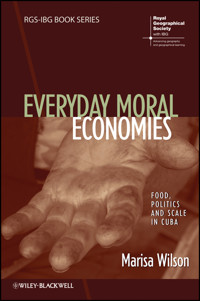
Offering a rare glimpse of rural life in modern-day Cuba, this book examines how ordinary Cubans carve out their own spaces for ‘appropriate’ acts of consumption, exchange, and production within the contradictory normative and material spaces of everyday economic life.
- Discusses the conflict between the socialist-welfare ideal of food as an entitlement and the market value of food as a commodity
- Bridges the fields of human geography and anthropology
- Approaches food networks and the scale of food systems in a novel way
- Provides a comprehensive look at Cuba today, with coverage of history, politics, economics, and social and environmental justice
- Enhanced by vivid photos from the field
Sie lesen das E-Book in den Legimi-Apps auf:
Seitenzahl: 474
Veröffentlichungsjahr: 2013
Ähnliche



















Contents
Series Editors’ Preface
Preface
Crossovers in anthropology and geography I
Caveats and limitations
Notes
References
Acknowledgements
Acronyms
Chapter One: Introduction
Political economies: re-connecting ‘is’ and ‘ought’
Shifting scales of responsibility
Crossovers in anthropology and geography II
The economy–culture relation
Positioning the ethnographer I: habitual and representational knowledge
Positioning the ethnographer II: food and the ‘politics of negotiation’
The provisioning perspective
Outline of the chapters
Notes
References
Chapter Two: The Historical Emergence of a National Leviathan
The first revolution ‘of the humble, for the humble and by the humble’
José Martí and contradictions of Cuba’s creation myth
Town and country in the early republic: pre-revolutionary values of commodities and culture, work and reciprocity
Agrarianism, Guevara and the Great Debate
Pendulum shifts and moral continuities
Notes
References
Chapter Three: Scarcities, Uneven Access and Local Narratives of Consumption
The ideal of national re-distribution and the reality of uneven access
Local narratives of consumption and the Fight
Notes
References
Chapter Four: Changing Landscapes of Care: Re-distributions and Reciprocities in the World of Tutaño Consumption
Reciprocity and re-distribution: a comparative view
Merit and nourishment
‘Hunger’ in post-1990s Tuta: means testing for food and energy
Hunger and need
Continuities and change in the social contract
Notes
References
Chapter Five: Localizing the Leviathan: Hierarchies and Exchanges that Connect State, Market and Civil Society
Institutions and ideologies of the national moral economy
Shifting scales of appropriate exchange
Conclusion
Notes
References
Chapter Six: The Scalar Politics of Sustainability: Transforming the Small Farming Sector
Food and other ‘sovereignties’ in Cuba
Positioning small farmers in Cuba: the agroecology movement in historical context
Controlling the mercenary, designating the worthy: small farming and national institutions
Shifting borders of Cuban agroecology
Notes
References
Chapter Seven: Conclusion
Alternative economic geographies and systems of provisioning: contributions and possibilities
Towards value pluralism
Notes
References
Appendix 1: Key Political Economic Events of the Cuban Revolution
Appendix 2: Daily Nutritional Requirements in Cuba
Appendix 3: Institutional Levels for National Food Provisioning
Appendix 4: Monthly Food Rations per Person
Appendix 5: Weekly Household Food Purchases
Appendix 6: The Cuban Urban Agriculture Programme
Index
RGS-IBG Book Series
Published
Material Politics: Disputes Along the PipelineAndrew Barry
Everyday Moral Economies: Food, Politics and Scale in CubaMarisa Wilson
Working Lives: Gender, Migration and Employment in Britain, 1945–2007Linda McDowell
Fashioning Globalisation: New Zealand Design, Working Women and the Cultural EconomyMaureen Molloy & Wendy Larner
Dunes: Dynamics, Morphology and Geological HistoryAndrew Warren
Spatial Politics: Essays for Doreen MasseyEdited by David Featherstone & Joe Painter
The Improvised State: Sovereignty, Performance and Agency in Dayton BosniaAlex Jeffrey
Learning the City: Knowledge and Translocal AssemblageColin McFarlane
Globalizing Responsibility: The Political Rationalities of Ethical ConsumptionClive Barnett, Paul Cloke, Nick Clarke & Alice Malpass
Domesticating Neo-Liberalism: Spaces of Economic Practice and Social Reproduction in Post-Socialist CitiesAlison Stenning, Adrian Smith, Alena Rochovská & Dariusz Świątek
Swept Up Lives? Re-envisioning the Homeless CityPaul Cloke, Jon May & Sarah Johnsen
Aerial Life: Spaces, Mobilities, AffectsPeter Adey
Millionaire Migrants: Trans-Pacific Life LinesDavid Ley
State, Science and the Skies: Governmentalities of the British AtmosphereMark Whitehead
Complex Locations: Women’s Geographical Work in the UK 1850–1970Avril Maddrell
Value Chain Struggles: Institutions and Governance in the Plantation Districts of South IndiaJeff Neilson & Bill Pritchard
Queer Visibilities: Space, Identity and Interaction in Cape TownAndrew Tucker
Arsenic Pollution: A Global SynthesisPeter Ravenscroft, Hugh Brammer & Keith Richards
Resistance, Space and Political Identities: The Making of Counter-Global NetworksDavid Featherstone
Mental Health and Social Space: Towards Inclusionary Geographies?Hester Parr
Climate and Society in Colonial Mexico: A Study in VulnerabilityGeorgina H. Endfield
Geochemical Sediments and LandscapesEdited by David J. Nash & Sue J. McLaren
Driving Spaces: A Cultural-Historical Geography of England’s M1 MotorwayPeter Merriman
Badlands of the Republic: Space, Politics and Urban PolicyMustafa Dikeç
Geomorphology of Upland Peat: Erosion, Form and Landscape ChangeMartin Evans & Jeff Warburton
Spaces of Colonialism: Delhi’s Urban GovernmentalitiesStephen Legg
People/States/TerritoriesRhys Jones
Publics and the CityKurt Iveson
After the Three Italies: Wealth, Inequality and Industrial ChangeMick Dunford & Lidia Greco
Putting Workfare in PlacePeter Sunley, Ron Martin & Corinne Nativel
Domicile and DiasporaAlison Blunt
Geographies and MoralitiesEdited by Roger Lee & David M. Smith
Military GeographiesRachel Woodward
A New Deal for Transport?Edited by Iain Docherty & Jon Shaw
Geographies of British ModernityEdited by David Gilbert, David Matless & Brian Short
Lost Geographies of PowerJohn Allen
Globalizing South ChinaCarolyn L. Cartier
Geomorphological Processes and Landscape Change: Britain in the Last 1000 YearsEdited by David L. Higgitt & E. Mark Lee
Forthcoming
Smoking Geographies: Space, Place and TobaccoRoss Barnett, Graham Moon, Jamie Pearce, Lee Thompson & Liz Twigg
Africa’s Information Revolution: Technical Regimes and Production Networks in South Africa and TanzaniaPádraig Carmody & James T. Murphy
Peopling Immigration Control: Geographies of Governing and Activism in the British Asylum SystemNick Gill
Geopolitics and Expertise: Knowledge and Authority in European DiplomacyMerje Kuus
The Geopolitics of Expertise in the Nature of Landscape: Cultural Geography on the Norfolk BroadsDavid Matless
Rehearsing the State: The Political Practices of the Tibetan Government-in-ExileFiona McConnell
Frontier Regions of Marketization: Agribusiness, Farmers, and the Precarious Making of Global Connections in West AfricaStefan Ouma
Articulations of Capital: Global Production Networks and Regional TransformationsJohn Pickles, Adrian Smith & Robert Begg, with Milan Buček, Rudolf Pástor & Poli Roukova
Origination: The Geographies of Brands and BrandingAndy Pike
Making Other Worlds: Agency and Interaction in Environmental ChangeJohn Wainwright
Metropolitan Preoccupations: The Spatial Politics of Squatting in BerlinAlexander Vasudevan
This edition first published 2014© 2014 John Wiley & Sons, Ltd
Registered OfficeJohn Wiley & Sons, Ltd, The Atrium, Southern Gate, Chichester, West Sussex, PO19 8SQ, UK
Editorial Offices350 Main Street, Malden, MA 02148-5020, USA9600 Garsington Road, Oxford, OX4 2DQ, UKThe Atrium, Southern Gate, Chichester, West Sussex, PO19 8SQ, UK
For details of our global editorial offices, for customer services, and for information about how to apply for permission to reuse the copyright material in this book please see our website at www.wiley.com/wiley-blackwell.
The right of Marisa Wilson to be identified as the author of this work has been asserted in accordance with the UK Copyright, Designs and Patents Act 1988.
All rights reserved. No part of this publication may be reproduced, stored in a retrieval system, or transmitted, in any form or by any means, electronic, mechanical, photocopying, recording or otherwise, except as permitted by the UK Copyright, Designs and Patents Act 1988, without the prior permission of the publisher.
Wiley also publishes its books in a variety of electronic formats. Some content that appears in print may not be available in electronic books.
Designations used by companies to distinguish their products are often claimed as trademarks. All brand names and product names used in this book are trade names, service marks, trademarks or registered trademarks of their respective owners. The publisher is not associated with any product or vendor mentioned in this book.
Limit of Liability/Disclaimer of Warranty: While the publisher and author(s) have used their best efforts in preparing this book, they make no representations or warranties with respect to the accuracy or completeness of the contents of this book and specifically disclaim any implied warranties of merchantability or fitness for a particular purpose. It is sold on the understanding that the publisher is not engaged in rendering professional services and neither the publisher nor the author shall be liable for damages arising herefrom. If professional advice or other expert assistance is required, the services of a competent professional should be sought.
Library of Congress Cataloging-in-Publication Data
Wilson, Marisa L. (Marisa Lauren), 1979–Everyday moral economies: food, politics and scale in Cuba / Marisa Wilson.pages cm – (RGS-IBG book series)Includes index.
ISBN 978-1-118-30200-2 (hardback) – ISBN 978-1-118-30192-0 (paper)1. Food supply – Social aspects – Cuba. 2. Food supply – Economic aspects – Cuba.3. Consumption (Economics) – Cuba. 4. Exchange – Cuba. 5. Value. 6. Cuba –Economic conditions – 1990–. I. Everyday moral economies.HD9014.C92W55 2014338.1′97291—dc23
2013018233
A catalogue record for this book is available from the British Library.
Cover image: ‘The hand is that of a woman farmer in her mid-60s, who requested that the photo be taken as a symbol of “a real worker in Cuba”. As she told me, “you can always tell a campesino [farmer] by their hands”.’ © Marisa WilsonCover design by Workhaus.
For my parents
Series Editors’ Preface
The RGS-IBG Book Series only publishes work of the highest international standing. Its emphasis is on distinctive new developments in human and physical geography, although it is also open to contributions from cognate disciplines whose interests overlap with those of geographers. The Series places strong emphasis on theoretically informed and empirically strong texts. Reflecting the vibrant and diverse theoretical and empirical agendas that characterize the contemporary discipline, contributions are expected to inform, challenge and stimulate the reader. Overall, the RGS-IBG Book Series seeks to promote scholarly publications that leave an intellectual mark and change the way readers think about particular issues, methods or theories.For details on how to submit a proposal please visit:
www.rgsbookseries.com
Neil CoeNational University of SingaporeJoanna BullardLoughborough University, UKRGS-IBG Book Series Editors
Preface
¡Con lo que un yanqui ha gastadono más que en comprar botellasse hubiera Juana curado! …With what a Yankee spendsJust buying bottles,Juana could have been cured! …
Nicolas Guillén (from the poem, Visita á un solar, 1930)1
This book is about the relationship between provisioning and politics. To be clear, politics is understood in terms of values, economic or otherwise. In this sense, politics is ‘less about the struggle to appropriate value (or freedom to create/accumulate value), but the struggle to establish what value is (or the freedom to decide what makes life worth living)’ (Graeber 2001: 88). I am concerned with values and their spatio-temporal dimensions, like nationalism or economic globalization, and with the way associated values are evidenced in moral ideas and practices that shape everyday life.
In the above verses, for example, there are two values of beer: the first is the market value paid for by tourists from the United States, the second, the social value of finding a cure for Juana (a poor woman from rural Cuba). As the poem suggests, in the 1930s ordinary Cubans saw the two forms of value as commensurable; ‘Yankees’ did not. Since then, contradictions between social values and market values have become even more pronounced, associated with incessant bi-polar discourses of liberalism and socialism. As I will argue, each discourse is tied to particular temporalities and spatialities, becoming what I call Leviathans2 that frame the material and ideational spaces in which ordinary people in Cuba claim their rights and entitlements.
Officially if not always empirically, values set by markets such as price stand in direct contrast to welfare values such as the grand narrative of Cuban socialism, according to which necessities such as food are considered human rights, distinct from the world of commodities. In this normative scheme, basic foodstuffs should be accessible to all needy Cubans in domestic currency, pesos, though more desirable items may only be available in hard currency (or in equivalent peso prices). The traditional planned economy of Cuba is based on a model that treats the nation as one socialist enterprise, whose ultimate aim is not profit (surplus value) but to ensure alimentary and other needs (social values) of the national community. The scalar project of Cuban nationhood, which controls and rationalizes collective forms of provisioning, and the global political economy that gives some Cubans more options than others, are practical effects of these contrasting normative and material systems, the one that privileges the sovereign nation, the other, the sovereign consumer. This book reveals how people in rural Cuba rationalize the practicalities of living in this contradictory moral and political economic world, in which both national and supranational norms influence rather than determine a more localized politics of value-making.
It was this interest in the relation between values and experience, and in the moralities, materialties and spatialities of this relation, that first motivated me to write this book. My own concern with food politics developed when I spent time in Cuba observing and often living through Cubans’ daily ‘fight’ () to provision food for their families. As an ethnographic researcher, my analysis had to start with the ‘concrete conditions which stimulate interest in some abstract problems rather than others’ (Hart 1986: 637), and so naturally I focused on the main concern of the people under study: food. As someone from a country with much influence over the global political economy of food, the topic of food politics was also personal.
Lesen Sie weiter in der vollständigen Ausgabe!
Lesen Sie weiter in der vollständigen Ausgabe!
Lesen Sie weiter in der vollständigen Ausgabe!
Lesen Sie weiter in der vollständigen Ausgabe!
Lesen Sie weiter in der vollständigen Ausgabe!
Lesen Sie weiter in der vollständigen Ausgabe!
Lesen Sie weiter in der vollständigen Ausgabe!
Lesen Sie weiter in der vollständigen Ausgabe!
Lesen Sie weiter in der vollständigen Ausgabe!
Lesen Sie weiter in der vollständigen Ausgabe!
Lesen Sie weiter in der vollständigen Ausgabe!
Lesen Sie weiter in der vollständigen Ausgabe!
Lesen Sie weiter in der vollständigen Ausgabe!
Lesen Sie weiter in der vollständigen Ausgabe!
Lesen Sie weiter in der vollständigen Ausgabe!
Lesen Sie weiter in der vollständigen Ausgabe!




