


25,99 €
Mehr erfahren.
- Herausgeber: John Wiley & Sons
- Kategorie: Wissenschaft und neue Technologien
- Serie: RGS-IBG Book Series
- Sprache: Englisch
Winner of the 2016 Julian Minghi Distinguished Book Award of the Political Geography Specialty Group at the AAG
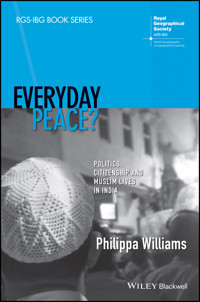
Providing important insights into political geography, the politics of peace, and South Asian studies, this book explores everyday peace in northern India as it is experienced by the Hindu-Muslim community.
- Challenges normative understandings of Hindu-Muslim relations as relentlessly violent and the notion of peace as a romantic endpoint occurring only after violence and political maneuverings
- Examines the ways in which geographical concepts such as space, place, and scale can inform and problematize understandings of peace
- Redefines the politics of peace, as well as concepts of citizenship, agency, secular politics, and democracy
- Based on over 14 months of qualitative and archival research in the city of Varanasi in Uttar Pradesh, India
Sie lesen das E-Book in den Legimi-Apps auf:
Seitenzahl: 471
Veröffentlichungsjahr: 2015
Ähnliche




















Table of Contents
Cover
Title Page
Series Editors’ Preface
Acknowledgements
List of Abbreviations
Glossary
List of Figures
Chapter One: Introduction
Situating Everyday Peace
The Politics of Hindu–Muslim Violence and Nonviolence
On Peace and Peaceful Sociality
Geographies of Peace
Feminist Geopolitics, Violence and “
Everyday
Peace?”
Citizenship as Inclusion and the Scalar Politics of Peace
Muslim Geographies: Experience, Identity and Agency
Structure of the Book and Key Arguments
Chapter Two: The Scalar Politics of Peace in India
The Nation
The State
The City
The Market
The Neighborhood
Field Research
Chapter Three: Making Peace Visible in the Aftermath of Terrorist Attacks
Attacks on the City, and the Nation
The State, Party Politics and Mechanisms for Peace
Everyday Shared Spaces
Local Agency, “Peace Talk” and Legitimacy
Conclusion
Chapter Four: Political life: Lived Secularism and the Possibility of Citizenship
Introduction
Experiencing the State and the Potential of Secularism
Engaging with the State, Practicing Citizenship
Partial Citizenship, Imagining Citizenship as Connection
“Muslim” Rights to Urban Space?
Conclusions
Chapter Five: Civic Space: Playing with Peace and Security/Insecurity
The Procession
Reconfiguring Spaces of Security: Consolidating the “Muslim
Mohallā
”
Violent Episodes, Suspended Tensions
Playing with Everyday Peace and (Re)producing Power
Policing Peace and Making (In)securities
Local Peace Initiatives
Conclusions
Chapter Six: Economic Peace and the Silk Sari Market
Imagining Everyday Peace and “Peace Talk”
Peace at Work
Peace and the Political, Reproducing Difference
Spaces of Contest and Cooperation
Economic Transformation and the Maintenance of Peace
Conclusion
Chapter Seven: Becoming Visible: Citizenship, Everyday Peace and the Limits of Injustice
Introduction
The Protest as an “Act of Citizenship”
Solidarities: Injustice, Recognition and Rights to the City
The Act as Answerable
Answerability and Contingent Geographies of Citizenship
Conclusions
Chapter Eight: Conclusions: Questioning Everyday Peace
The Politics of Everyday Peace
Muslim Citizenship, Justice and Transformative Possibilities
Geography and Everyday Peace
References
Newspapers
Index
End User License Agreement
List of Illustrations
Chapter 02
Figure 2.1 India, showing Uttar Pradesh and Varanasi.
Figure 2.2 Uttar Pradesh.
Figure 2.3 Banarasi Brocade.
Figure 2.4 A weaver carries silk
belans
whilst others dry in the sun.
Figure 2.5 Varanasi, showing majority Muslim neighborhoods.
Figure 2.6 Madanpura, a Muslim majority neighborhood.
Figure 2.7 My research assistant, Ajay Pandey.
Chapter 05
Figure 5.1 A member of the Civil Defense looks on as the Goddess Durga is paraded in the main high street.
Figure 5.2 Police presence in the lanes of Madanpura on the evening of the Golden Sporting Club procession.
Chapter 06
Figure 6.1 Hindu traders wait for business in Kunj gali, Chowk.
Figure 6.2 Intercommunity encounter in the lanes of Kunj gali, Chowk.
Guide
Cover
Table of Contents
Begin Reading
Pages
ii
iii
iv
v
ii
ix
x
xi
xii
xiii
xiv
xv
xvi
xvii
xviii
1
2
3
4
5
6
7
8
9
10
11
12
13
14
15
16
17
18
19
20
21
22
23
24
25
26
27
28
29
30
31
32
33
34
35
36
37
38
39
40
41
42
43
44
45
46
47
48
49
50
51
52
53
54
55
56
57
58
59
60
61
62
63
64
65
66
67
68
69
70
71
72
73
74
75
76
77
78
79
80
81
82
83
84
85
86
87
88
89
90
91
92
93
94
95
96
97
98
99
100
101
102
103
104
105
106
107
108
109
110
111
112
113
114
115
116
117
118
119
120
121
122
123
124
125
126
127
128
129
130
131
132
133
134
135
136
137
138
139
140
141
142
143
144
145
146
147
148
149
150
151
152
153
154
155
156
157
158
159
160
161
162
163
164
165
166
167
168
169
170
171
172
173
174
175
176
177
178
179
180
181
182
183
184
185
186
187
188
189
190
191
192
193
194
195
196
197
198
199
200
201
202
203
204
205
206
207
208
209
210
211
212
213
214
215
216
217
218
219
220
221
RGS-IBG Book Series
For further information about the series and a full list of published and forthcoming titles please visit www.rgsbookseries.com
Published
Everyday Peace? Politics, Citizenship and Muslim Lives in IndiaPhilippa Williams
Assembling Export Markets: The Making and Unmaking of Global Food Connections in West AfricaStefan Ouma
Africa’s Information Revolution: Technical Regimes and Production Networks in South Africa and TanzaniaJames T. Murphy and Pádraig Carmody
Origination: The Geographies of Brands and BrandingAndy Pike
In the Nature of Landscape: Cultural Geography on the Norfolk BroadsDavid Matless
Geopolitics and Expertise: Knowledge and Authority in European DiplomacyMerje Kuus
Everyday Moral Economies: Food, Politics and Scale in CubaMarisa Wilson
Material Politics: Disputes Along the PipelineAndrew Barry
Fashioning Globalisation: New Zealand Design, Working Women and the Cultural EconomyMaureen Molloy and Wendy Larner
Working Lives - Gender, Migration and Employment in Britain, 1945-2007Linda McDowell
Dunes: Dynamics, Morphology and Geological HistoryAndrew Warren
Spatial Politics: Essays for Doreen MasseyEdited by David Featherstone and Joe Painter
The Improvised State: Sovereignty, Performance and Agency in Dayton BosniaAlex Jeffrey
Learning the City: Knowledge and Translocal AssemblageColin McFarlane
Globalizing Responsibility: The Political Rationalities of Ethical ConsumptionClive Barnett, Paul Cloke, Nick Clarke and Alice Malpass
Domesticating Neo-Liberalism: Spaces of Economic Practice and Social Reproduction in Post-Socialist CitiesAlison Stenning, Adrian Smith, Alena Rochovská and Dariusz Świątek
Swept Up Lives? Re-envisioning the Homeless CityPaul Cloke, Jon May and Sarah Johnsen
Aerial Life: Spaces, Mobilities, AffectsPeter Adey
Millionaire Migrants: Trans-Pacific Life LinesDavid Ley
State, Science and the Skies: Governmentalities of the British AtmosphereMark Whitehead
Complex Locations: Women’s geographical work in the UK 1850–1970Avril Maddrell
Value Chain Struggles: Institutions and Governance in the Plantation Districts of South IndiaJeff Neilson and Bill Pritchard
Queer Visibilities: Space, Identity and Interaction in Cape TownAndrew Tucker
Arsenic Pollution: A Global SynthesisPeter Ravenscroft, Hugh Brammer and Keith Richards
Resistance, Space and Political Identities: The Making of Counter-Global NetworksDavid Featherstone
Mental Health and Social Space: Towards Inclusionary Geographies?Hester Parr
Climate and Society in Colonial Mexico: A Study in VulnerabilityGeorgina H. Endfield
Geochemical Sediments and LandscapesEdited by David J. Nash and Sue J. McLaren
Driving Spaces: A Cultural-Historical Geography of England’s M1 MotorwayPeter Merriman
Badlands of the Republic: Space, Politics and Urban PolicyMustafa Dikeç
Geomorphology of Upland Peat: Erosion, Form and Landscape ChangeMartin Evans and Jeff Warburton
Spaces of Colonialism: Delhi’s Urban GovernmentalitiesStephen Legg
People/States/TerritoriesRhys Jones
Publics and the CityKurt Iveson
After the Three Italies: Wealth, Inequality and Industrial ChangeMick Dunford and Lidia Greco
Putting Workfare in PlacePeter Sunley, Ron Martin and Corinne Nativel
Domicile and DiasporaAlison Blunt
Geographies and MoralitiesEdited by Roger Lee and David M. Smith
Military GeographiesRachel Woodward
A New Deal for Transport?Edited by Iain Docherty and Jon Shaw
Geographies of British ModernityEdited by David Gilbert, David Matless and Brian Short
Lost Geographies of PowerJohn Allen
Globalizing South ChinaCarolyn L. Cartier
Geomorphological Processes and Landscape Change: Britain in the Last 1000 YearsEdited by David L. Higgitt and E. Mark Lee
Everyday Peace?
Politics, Citizenship and Muslim Lives in India
Philippa Williams
This edition first published 2015© 2015 John Wiley & Sons, Ltd.
Registered OfficeJohn Wiley & Sons, Ltd, The Atrium, Southern Gate, Chichester, West Sussex, PO19 8SQ, UK
Editorial Offices350 Main Street, Malden, MA 02148-5020, USA9600 Garsington Road, Oxford, OX4 2DQ, UKThe Atrium, Southern Gate, Chichester, West Sussex, PO19 8SQ, UK
For details of our global editorial offices, for customer services, and for information about how to apply for permission to reuse the copyright material in this book please see our website at www.wiley.com/wiley-blackwell.
The right of Philippa Williams to be identified as the author of this work has been asserted in accordance with the UK Copyright, Designs and Patents Act 1988.
All rights reserved. No part of this publication may be reproduced, stored in a retrieval system, or transmitted, in any form or by any means, electronic, mechanical, photocopying, recording or otherwise, except as permitted by the UK Copyright, Designs and Patents Act 1988, without the prior permission of the publisher.
Wiley also publishes its books in a variety of electronic formats. Some content that appears in print may not be available in electronic books.
Designations used by companies to distinguish their products are often claimed as trademarks. All brand names and product names used in this book are trade names, service marks, trademarks or registered trademarks of their respective owners. The publisher is not associated with any product or vendor mentioned in this book.
Limit of Liability/Disclaimer of Warranty: While the publisher and author have used their best efforts in preparing this book, they make no representations or warranties with respect to the accuracy or completeness of the contents of this book and specifically disclaim any implied warranties of merchantability or fitness for a particular purpose. It is sold on the understanding that the publisher is not engaged in rendering professional services and neither the publisher nor the author shall be liable for damages arising herefrom. If professional advice or other expert assistance is required, the services of a competent professional should be sought.
Library of Congress Cataloging-in-Publication Data
Williams, Philippa (Lecturer), author. Everyday peace? : politics, citizenship and Muslim lives in India / Philippa Williams. pages cm – (RGS-IBG book series) Includes bibliographical references and index.
ISBN 978-1-118-83781-8 (cloth) – ISBN 978-1-118-83780-1 (pbk.) 1. Peace. 2. Muslims–India–Uttar Pradesh. 3. Hindus–India–Uttar Pradesh. I. Title. II. Series: RGS-IBG book series. JZ5584.I4W55 2015 303.6′609542–dc23 2015017218
A catalogue record for this book is available from the British Library.
Cover image: © Philippa Williams
The information, practices and views in this book are those of the author(s) and do not necessarily reflect the opinion of the Royal Geographical Society (with IBG).
For my parents, Maureen and Ted
Series Editors’ Preface
The RGS-IBG Book Series only publishes work of the highest international standing. Its emphasis is on distinctive new developments in human and physical geography, although it is also open to contributions from cognate disciplines whose interests overlap with those of geographers. The Series places strong emphasis on theoretically-informed and empirically-strong texts. Reflecting the vibrant and diverse theoretical and empirical agendas that characterize the contemporary discipline, contributions are expected to inform, challenge and stimulate the reader. Overall, the RGS-IBG Book Series seeks to promote scholarly publications that leave an intellectual mark and change the way readers think about particular issues, methods or theories.
For details on how to submit a proposal please visit:www.rgsbookseries.com
David FeatherstoneUniversity of Glasgow, UK
Tim AllottUniversity of Manchester, UK
RGS-IBG Book Series Editors
Acknowledgements
The ideas for this project have changed a great deal over the years, for which I am extremely indebted to a large number of people for their generosity, insight and intellect. The vast majority of research on which this book is based was conducted between 2006 and 2008 during my PhD studies at the School of Geography, and further developed on fieldtrips in 2010 and 2011 when I was a Smuts Research Fellow in Commonwealth Studies at the Centre of South Asian Studies, both at the University of Cambridge.
First and foremost I am hugely grateful to the residents of Varanasi and in particular, Madanpura, for generously accepting me as a fairly constant presence in their lives for over 14 months. Abdul Ansari, Mohammed Toha, Atiq Ansari and Rana P. B. Singh were just some of those who facilitated my research in different ways, whilst it was a conversation with Manju Vira Gupta that led me to Varanasi in the first place. My utmost thanks to my Research Assistant, Ajay Pandey, whose friendship, curiosity and dedication made the research process all the more productive and enjoyable. I also acknowledge the research assistance of Hemant Sarna, Afreen Khan, Pintu Tripathi and I. B. Misha at different stages in the project.
In a notoriously overwhelming and bustling Indian city I found a wonderful sanctuary in the home away from home of Prabhudatt, Pintu, Shivangi and Babu Tripathi, from whom I learned so much about Varanasi and life more generally. My thanks to Simon Roberts for such a precious introduction, and to other companions and occasional informants in the city: Vinay, Rakesh, Navneet and Nitya as well as Jolie Wood, Mike Thompson and Brita Ahlenius. My Hindi teacher, Virendra Singh, was also hugely instrumental in shaping my introduction to, and freedom in, the city.
In Cambridge, I wish to acknowledge the long-standing support and instrumental nudge by Phil Howell which kick-started my graduate career. My warmest thanks to my PhD supervisor Bhaskar Vira, whose constructive comments and encouragement have been hugely important, in ways that go far beyond this book. A 3-month ESRC overseas institutional visit to the University of Seattle, Washington proved to be formative in furthering my academic career and continuing interest in South Asia. It was both in the USA and subsequently on my return to the UK that I have benefited enormously from conversations with Craig Jeffery, Jane Dyson, Dena Aufseeser and Stephen Young, whose comments greatly improved the final draft of the manuscript.
I am grateful for the constructive comments of my PhD examiners, Roger Jeffery and Sarah Radcliffe. As a PhD student and Research Fellow I was lucky enough to meet superb friends, colleagues and collaborators who formed a stimulating research environment. There are too many to mention, but ideas for this book have undoubtedly been shaped by discussions with Deepta Chopra, Heather Bedi Plumridge, Tatiana Thieme, Fiona McConnell, David Beckingham, Eleanor Newbigin, Delwar Hussain, Karenjit Clare, Jesse Hohman, Venkat Ramanujam Ramani, Emma Mawdsley, Gerry Kearns and Humeira Iqtidar.
It was during my time at the Centre of South Asian Studies that I started reworking aspects of the PhD into a book. I benefited enormously from the institutional and usually caffeinated support of Chris Bayly, Barbara Roe, Kevin Greenbank and Rachel Rowe.
In recent years I have worked especially closely with Nick Megoran and Fiona McConnell as well as contributors on the production of an edited volume on the Geographies of Peace for I.B. Tauris. Talking and writing together about peace has undoubtedly shaped and sharpened my conceptual approach to peace, and challenged me to think about the geography of peace in other places.
Sections of this manuscript have been shared at various conferences and seminars, in Oxford, Madison, Seattle, Cambridge, Washington, Yale, Leicester, Manchester, Boston and Princeton, where it has benefited from the comments of amongst others, Alpa Shah, Ed Simpson, Sara Koopman, Manali Desai, Nosheen Ali, Glyn Williams, Isabel Clarke-Deces, Tim Raeymaekers, Gurharpal Singh and Barbara Harriss-White.
The editing for this book has taken place since starting a new lectureship at Queen Mary University of London. I wish to thank the third-year students taking my module, ‘Contemporary India: Society, politics and the economy’ for energizing the editing process, and to acknowledge the support of colleagues, Al James, Miles Ogborn, Cathy McIlwaine and Kavita Datta; I look forward to new academic ventures at QMUL.
The manuscript has benefited tremendously from the critical comments on the book proposal and manuscript of the anonymous reviewers and the editor, Neil Coe, for which I am very grateful. Neil Coe has been an excellent editor with swift, insightful and clear comments on the editing process. Many thanks, too, to Jacqueline Scott for cheerfully and efficiently keeping things on track.
I would like to acknowledge the generous financial support I have received over the past decade from a number of bodies including the Economic and Social Research Council, Smuts Commonwealth Fund and British Academy small grant, without which fieldwork in India, as well as participation at conferences, would not have been possible.
The biggest thank you is saved for my family, in particular, my parents Maureen and Ted, and sister Catherine, whose unconditional support, sound advice and unreserved affection has made this book possible. And to my husband, James for believing in this project from the beginning, tolerating my long stints away and providing encouragement and advice when it was most needed. And finally, I am grateful to the arrival of our son, Alexander, who has brought additional happiness, love and perspective to academic writing.
Philippa Williams
London, 2014
An earlier version of Chapter 3 appeared as Williams, P. (2007) “Hindu Muslim Brotherhood: Exploring the Dynamics of Communal Relations in Varanasi, North India.”
Journal of South Asian Development
2(2): 153–76.
A version of Chapter Four appeared as Williams, P. (2013) “Reproducing Everyday Peace in North India: Process, Politics and Power.”
Annals of the Association of American Geographers
103(1): 230–50.
Chapter Six draws on aspects of two articles: Williams, P. (2012) “India’s Muslims, Lived Secularism and Practicing Citizenship.”
Citizenship Studies
16(8): 979–95 and Williams, P. (2011) “An Absent Presence: Experiences of the ‘Welfare State’ in an Indian Muslim
mohallā
.”
Contemporary South Asia
19(3): 263–80.
List of Abbreviations
BHU
Banaras Hindu University
BIMARU
Bihar, Madhya Pradesh, Rajasthan and Uttar Pradesh
BJP
Bharatiya Janata Party
BSP
Bahujan Samaj Party
BJP
Bharatiya Jan Sangh
CM
City Magistrate
DM
District Magistrate
DPSP
Directive Principles of State Policy
DSP
Deputy Superintendent of Police
GSC
Golden Sporting Club
FDI
Foreign Direct Investment
HIS
Health Insurance Scheme
INC
Indian National Congress Party
INTACH
Indian National Trust for Art and Culture
NGO
Non governmental organization
MLA
Member of Legislative Assembly
MP
Member of Parliament
NDA
National Democratic Alliance
OBC
Other Backward Class
PAC
Provincial Armed Constabulary
POTA
Prevention of Terrorism Act
PUCL
People’s Union for Civil Liberties
PUHR
People’s Union of Human Rights
RAP
Rapid Action Force
RSS
Rashtriya Swayamsevak Sangh
SC
Scheduled Classes
SEZ
Special Economic Zone
SGDP
State Gross Domestic Product
SP
Samajwadi Party
SSP
Special Superintendent of Police
ST
Scheduled Tribes
UC
Upper Caste
UP
Uttar Pradesh
UPA
United Progressive Alliance
VDA
Varanasi Development Authority
VHP
Vishva Hindu Parishad
Glossary
Ansāri
Muslim caste/community, often synonymous with the occupation of weaving, self-referential term for Muslim weavers.
Ante
Large spinning structure for ordering silk yarn in preparation for the loom
antewāllā
Sari production worker who spins silk yarn in preparation for winding on to
Lesen Sie weiter in der vollständigen Ausgabe!
Lesen Sie weiter in der vollständigen Ausgabe!
Lesen Sie weiter in der vollständigen Ausgabe!
Lesen Sie weiter in der vollständigen Ausgabe!
Lesen Sie weiter in der vollständigen Ausgabe!
Lesen Sie weiter in der vollständigen Ausgabe!
Lesen Sie weiter in der vollständigen Ausgabe!
Lesen Sie weiter in der vollständigen Ausgabe!
Lesen Sie weiter in der vollständigen Ausgabe!
Lesen Sie weiter in der vollständigen Ausgabe!
Lesen Sie weiter in der vollständigen Ausgabe!
Lesen Sie weiter in der vollständigen Ausgabe!




