


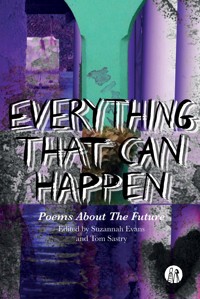
Everything That Can Happen E-Book
Erhalten Sie Zugang zu diesem und mehr als 300000 Büchern ab EUR 5,99 monatlich.
- Herausgeber: The Emma Press
- Kategorie: Poesie und Drama
- Serie: The Emma Press Poetry Anthologies
- Sprache: Englisch
Everything That Can Happen contains many kinds of future: an android fills out a passport form; the local cricket pitch is lost underwater; frozen limbs thaw from cryogenic sleep; robotic shoes allow for highspeed parenting. The poems in this anthology explore time, language, changing landscapes, future selves, uncertainty, catastrophe and civilisation. Whether imagining a distant, apocalyptic future or the moment we live in, nudged slightly beyond what we know, the poems ask what we can do to prepare ourselves for a future that edges a little closer every day.
Sie lesen das E-Book in den Legimi-Apps auf:
Seitenzahl: 57
Veröffentlichungsjahr: 2019
Das E-Book (TTS) können Sie hören im Abo „Legimi Premium” in Legimi-Apps auf:
Ähnliche




















EVERYTHINGTHATCANHAPPENPOEMSABOUTTHEFUTURE
Note from the illustrator: For this book I decided to create series of scenes of the old town centre of my hometown of Bracknell, once a vision of the future when it was designated a New Town after WW2.
THEEMMAPRESS
First published in the UK in 2019 by the Emma Press Ltd
Poems copyright © individual copyright holders 2019Selection copyright © Suzannah Evans and Tom Sastry 2019
Illustrations copyright © Emma Dai’an Wright 2019
All rights reserved.
The right of Suzannah Evans and Tom Sastry to be identified as the editors of this work has been asserted by them in accordance with the Copyright, Designs and Patents Act 1988.
ISBN 978-1-910139-52-3
A CIP catalogue record of this book is available from the British Library.
Printed and bound in Great Britain by TJ International, Padstow.
The Emma Press
theemmapress.com
Jewellery Quarter, Birmingham, UK
EDITORS’ FOREWORD
How do contemporary poets imagine the future? Your answer is between these covers. There are many kinds of future in here, and versions of our world that are recognisable in differing degrees. Poets look forward in different ways: some anxiously, some with hope, and some with resignation.
Some look into a distant, apocalyptic future; some take the moment we live in and nudge it very slightly beyond what we know; all explore their feelings about the present. This book is full of energy, prophecy, humour, despair, passion, anger, fear and love. It is sometimes indecent. It looks unflinchingly into the darkness, at the brutality of human nature and the fatbergs of our shadow selves.
This book is profoundly humanistic. It understands how high the stakes are, whether the future in question is that of a single person or the whole of humanity. It is deeply concerned with the question what is it to be human? It has some surprising answers.
What this book does not offer is carefree optimism. In these times where both the planet and Western politics appear to be at melting point, that is not a surprise. What is surprising is how little the book touches on current affairs. We mentioned the Trump Presidency in the blogs we wrote to accompany the call for submissions. Our poets did not. There is no Brexit in this book.
Instead, the prophecies in this book are varied; there are robots and floods. There is cryogenic thawing, strange music and occasionally a glint of hope for the future.
Perhaps what the book reflects is not so much our immediate fears as the fact that the foreseeable future is, almost by definition, a frightening place. For one thing, it is going to kill you. Even more annoyingly, it favours those already on the rise as we project current trends forward. It is the place where our most urgent fears are played out. When we anticipate the future, it is natural to take the aspects of our own time which are changing fastest – the ones we understand least and find most alienating – and amplify them.
This book looks forward with trepidation, not cynicism; with a profound sense of human fragility and an intense engagement with life. It is full of mischief and full of beauty. It contains a spirit which, fortified with a little optimism could transform the world.
But because the future is unknowable, let us stick with what we know. This is a collection of poems which had the power to take us somewhere unfamiliar and make us believe in it. We hope you enjoy them as much as we have.
SUZANNAHEVANSANDTOMSASTRY
NOVEMBER 2018
CONTENTS
SECTIONONE: THEFUTUREISJUSTAPOINTINTIME
counting, by Pamela Johnson
Mechanical Time is not the Creator’s, by Karin Molde
Womb, by Kerry Priest
Future You, by Shelley Roche-Jacques
Signs of the Times, by Tim Kiely
Once, by Luke Palmer
To his crazy future eyes, looking coyly at the future, by Rishi Dastidar
Divination, by Charlotte Eichler
Feed the Fatberg! by Jo Young
SECTIONTWO: JUSTAROUNDTHECORNER
Daughter, by Craig Barker
An unborn child wonders if it’s worth it, by Anita Pati
Gaza, by Robert Hamberger
Worlds, by Shruti Chauhan
Flood Defences, by Ilse Pedler
Reef, by Joe Carrick-Varty
The End of the End of the Pier Show, by Emma Simon
Breaking the Curfew with Dangerous Friends, by Rosie Garland
In Case, by Jessica Mookherje
Phone Call, by Carole Bromley
Everything that can happen, by Shauna Robertson
Hello. I’ve been waiting a long time to give you this. by Amy Acre
SECTIONTHREEE: ADIFFERENTKINDOFLIFE
Death Magazine, by Matthew Haigh
The Great Wall (2016), by Nina Mingya Powles
Canoply, by Jo Young
Everything will be permitted, nothing will be desired, by Laura Ring
An Android Decides To Apply For A Passport, by Sue Burge
Letter from the silent city, by Annie Fisher
Post-diluvial interview, by Jane Wilkinson
Dad, by Peter Twose
Thaw, by Charley Reay
Algorithmically Designed Electronic Universal Score, by Rishi Dastidar
Space Walk – Postcard Home, by Alexandra Citron
My Robot, by Matthew Haigh
Man is a liyre, by Chloe Murphy
SECTIONFOUR: ATTHEENDOFTHINGS
At the end of the road, by Susannah Hart
Good milk for our children, by Rishi Dastidar
The Sky Has Fallen, by Frank Dullaghan
Silence and pause, by Susannah Hart
The last giant, by Susannah Hart
The Tiger, by Sharon Black
The keeper of bones, by Alice Merry
Mate choice, by Jessica Mookherjee
On the Last Day, by Marion Tracy
Acknowledgements
About the editors
About the poets
About the Emma Press
THEFUTUREISJUSTAPOINTINTIME
To sit, conscious of occupying an arbitrary present, looking into the past or the future – this is a deviant act. It subverts our animal nature.
It creates a radical fiction: that the past and future are places we can imagine if not visit.
These places were never equals. The past has precedence. It has reproachful ancestors and heroes of improbable dimensions. It has a form.
The future has none of these. There is something disreputable about it.
PAMELAJOHNSON
counting
every ten seconds a wave breaks
swirls up the shore
forty babies are born
twenty into poverty, twenty people die
a hummingbird’s wings beat seven hundred times
lightning strikes the ground in a thousand places
ten thousand barrels of oil burn while the sun
flings five million tons of matter into space
and the universe expands by ninety-two miles
the next wave comes, drenching my boots
KARINMOLDE
Mechanical Time is not the Creator’s
after Franz Radziwill
A bird with broken mechanics clanks its cuck-oo.
An hour glass rolls across the highway like tumbleweed.




