


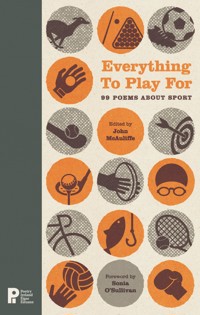
Everything to Play For: 99 Poems about Sport E-Book
Erhalten Sie Zugang zu diesem und mehr als 300000 Büchern ab EUR 5,99 monatlich.
- Herausgeber: Poetry Ireland
- Kategorie: Poesie und Drama
- Sprache: Englisch
Sometimes sport takes over Irish life: we meet up at the match everyone is going to, or we stay in touch by talking about sport. And sport's the stuff of family lore – the wrong turn at Ballybrit that led to Connemara instead of the Galway Races, the ex who came good with tickets, the All-Ireland winner throwing an American football on the beach. The poems collected in this anthology know sport, and they respond to the way that sport in Ireland forms our alternative history, viewed from the stands, the sideline, and the centre circle. The first ever anthology of sports poems to be published in Ireland, Everything to Play For is edited by poet John McAuliffe and includes a foreword by World Champion athlete Sonia O'Sullivan, one of Ireland's best-loved sporting heroes. With poems on all major sporting disciplines, Everything to Play For brings together the work of many of Ireland's leading poets including Paul Durcan, Vona Groarke, Seamus Heaney, Rita Ann Higgins, Patrick Kavanagh, Brendan Kennelly, Michael Longley, Louis MacNeice, Sinéad Morrissey, Paul Muldoon, Enda Wyley, and many more.
Sie lesen das E-Book in den Legimi-Apps auf:
Seitenzahl: 119
Veröffentlichungsjahr: 2019
Das E-Book (TTS) können Sie hören im Abo „Legimi Premium” in Legimi-Apps auf:
Ähnliche




















Everything
To Play For
99 Poems About Sport
Poetry Ireland Ltd / Éigse Éireann Teo gratefully acknowledges the assistance of The Arts Council / An Chomhairle Ealaíon and The Arts Council of Northern Ireland.
The moral right of the copyright holders has been asserted.
ISBN: 978-1-902121-57-4
DESIGN: Niall McCormack www.hitone.ie
EBOOK CONVERSION: Ben Styles leeds-ebooks.co.uk
First published by Poetry Ireland, 2015
www.poetryireland.ie
Everything
To Play For
99 Poems About Sport
Edited by
John McAuliffe
Foreword by
Sonia O’Sullivan
Contents
FOREWORD
INTRODUCTION
1 TENNIS & TABLE TENNIS
Paul Durcan
A Spin in the Rain with Seamus Heaney
Vona Groarke
The Game of Tennis in Irish History
Iggy McGovern
The Difference
Fergus Allen
Tennis in Wicklow
Paul Muldoon
How to Play Championship Tennis
2 GAELIC FOOTBALL
Pádraig J. Daly
Footballer
Seamus Heaney
Station Island, VII
Gabriel Fitzmaurice
Munster Football Final 1924
Bernard O’Donoghue
Munster Final
Noel Monahan
The Football Field
Seamus Heaney
The Point
Michael Hartnett
Reconstructionists
Brendan Kennelly
The Madness of Football
Brendan Kennelly
A Religious Occasion
Peter Fallon
Hay
Bernard O’Donoghue
Croke Park or Ballylee, 1989
Martina Evans
A Man’s World
Paul Durcan
Sport
3 HORSE RACING
Peggie Gallagher
The Three Card Trick Man
Tom French
The Race Field
Gerard Fanning
Laytown Races, 1959
Padraic Fallon
Gowran Park, Autumn Meeting
W.B. Yeats
At Galway Races
Tom Duddy
The Racing Festival
Frank Ormsby
Action Replays
Mary Noonan
Lone Patrol
F.R. Higgins
The Old Jockey
Martina Evans
The Wide World
4 GOLF, PITCH & PUTT
Matthew Sweeney
The Yellow Golf Ball on the Lawn
Maurice Riordan
He Begins With A Line by Sandy Lyle
Conor O’Callaghan
Pitch & Putt
David Wheatley
Moonshine
John O’Donnell
Poetry
Dermot Bolger
Remembering Certain Golf Holes
5 HANDBALL & BOWLS
Seamus Heaney
Squarings, XI
Martin Dyar
Handball Legend
Greg Delanty
After Viewing The Bowling Match at Castlemary, Cloyne, 1847
6 SOCCER
Brendan Kennelly
Manager, Perhaps
Robert Greacen
Goals
David Park
George Best
Miriam Gamble
Tinkerness
Elaine Feeney
Ryan Giggs is a Ride
Paul Durcan
The Beautiful Game
Alan Gillis
If There was Time All Day to Wait
Rita Ann Higgins
Ireland Is Changing Mother
Paul Muldoon
Soccer Moms
Tom French
The Fathers Raising the Nets for theLast Game of the Season: a Triptych
7 RUNNING
John O’Donnell
Sports Day
Theo Dorgan
Running with the Immortals
Colette Bryce
Great North
Gerry Murphy
Keeping in Shape
8 CYCLING
Vincent Woods
Bicycle
Louis MacNeice
The Cyclist
John F. Deane
Bikes
9 FISHING, ARCHERY, FALCONRY & SKIING
Sebastian Barry
Two Brothers Up
Patrick Deeley
Fisherman
Ciaran Carson
Finding the Ox
Caitríona O’Reilly
The Curée
Paula Cunningham
Seeing Things
10 INDOOR / OUTDOOR SPORTS & GAMES
Conor O’Callaghan
Green Baize Couplets
Paul Durcan
The 2003 World Snooker Championship
Louis MacNeice
Soap Suds
Louis MacNeice
Darts & Shove halfpenny
Seamus Heaney
Squarings, III
Gerard Smyth
Marbles
Matthew Sweeney
The Glass Chess Set
11 BOXING
Daragh Breen
Boxer
Patrick Kavanagh
A Knight at the Tournament
Michael Longley
The Boxers
Declan Ryan
Rope-a-Dope
12 WATER SPORTS
Eiléan Ní Chuilleanáin
The Last Glimpse of Erin
Sinéad Morrissey
Forty Lengths
Pat Boran
Learning to Dive
Leontia Flynn
Saturday in the Pool
Conor O’Callaghan
The End of the Line
Gerry Murphy
Swimming Out
Mary O’Malley
Surfing
13 HURLING & CAMOGIE
Paul Durcan
The One-Armed Crucifixion
Patrick Deeley
Minding Goal
Michael Gorman
Camogie
Patrick Kavanagh
Camogie Match
John FitzGerald
Ecstasis
Liam Murphy
Donal Foley Played Hurling with My Father
Bryan MacMahon
A Song for Christy Ring
Theo Dorgan
Learning My Father’s Memories
Billy Ramsell
Lament for Christy Ring
Enda Wyley
On My Father’s Birthday
Tom French
A Laminated Hurley
14 AMERICAN SPORTS
Frank McGuinness
American Football in Booterstown Park
Conor O’Callaghan
Game Night
Greg Delanty
Tagging the Stealer
Paul Muldoon
Chunkey
15 RUGBY & CRICKET
Louis MacNeice
Rugby Football Excursion
John O’Donnell
Team Photo
Thomas McCarthy
The Cappoquin Cricket XI
Gerard Fanning
Offering the Light
16 THE DOGS
Paul Muldoon
At Master McGrath’s Grave
Ciaran Carson
Night Music
Maurice Riordan
The Holy Land
ACKNOWLEDGEMENTS
Foreword
YOU MIGHT wonder why I’m writing the foreword to a poetry anthology, even if it is poetry inspired by sport. When I was told about this book my first thoughts went to all those times when people commented that watching me run was like poetry in motion, like a gazelle in the distance eating up the ground.
And that is exactly how it is for me, particularly if I’m out for a run on my own. People often ask me what do you think about when you’re out running. It’s one of the hardest questions to answer, as so many thoughts go through my mind, so many great ideas if only I could break them down into a little rhyme that I could recall and share when standing in front of an audience. My thoughts drift as I reflect on recent events or recall a medal-winning run or great training session. Days when everything just flowed with effortless strides. When I returned home, if only I could have ordered my thoughts and put them on paper! But they were soon dispersed as I was brought back to the reality of daily life once the early morning run was over.
Sport is such that those immersed in it will never be satisfied, rarely will you get the perfect day and even when you do it drives you on to achieve more. As athletes we all work hard training and preparing for the events that lie ahead, we all have the ingredients to get a great result, but it’s how you mix those ingredients together and the care and patience you take in training that will deliver the perfect result. Poetry too I’m sure needs such patience and care. It’s a form of the written word that can be interpreted in many ways, just like a boxing match or an Olympic race: if you have a room full of people watching, they will all predict the outcome in their own way, and believe that if different decisions were made then the outcome would have been different. When the race is over we can all look back and think, what could I have done differently? Even if you win you still think you could’ve run faster, or played better, or tried a little harder.
I have competed at the highest levels in sport and now I take part in a really wide range of activities. Only recently over the course of a weekend I climbed the highest mountain in Ireland and cycled the Beara Peninsula. The sheer beauty carried me up and down the hills alongside people of all abilities taking part and immersing themselves in sport.
The Olympic motto ‘Faster, Higher, Stronger’ was proposed in 1894 by Pierre de Coubertin, founder of the modern Olympic Games. He said, ‘These three words represent a programme of moral beauty. The aesthetics of sport are intangible.’ That aesthetic is easier to feel than it is to explain, and Coubertin also went on to add to this motto, in 1908, ‘The most important thing is not to win but to take part.’
I understand more now about the enjoyment and satisfaction of taking part, of being involved, sharing and inspiring the next generation. We can’t all be Olympic champions but we can all get out there, take part and feel the joy and satisfaction so often seen when watching great sporting feats and achievements, many of which have inspired the poems that are compiled for your enjoyment in this wonderful book.
Sonia O’Sullivan
INTRODUCTION
Bright Particular Star
‘I USED to run with my friend when he was training to keep him in company. He would give me a long start and soon overtake me.’ So wrote W.B. Yeats of his teenage athletics training, and then, in relation to his enthusiasm for sport: ‘I followed the career of a certain professional runner for months, buying papers that would tell me if he had won or lost. I had seen him described as “the bright particular star of American athletics,” and the wonderful phrase had thrown enchantment over him.’
Almost everyone has similar stories about ‘bright particular stars’ they followed, or still follow, runners or hurlers, a jockey or footballer or tennis player whose excellence shines out week after week and from year to year. And who is to say that Yeats’s devotion to the solitary art of writing was not in some way formed by his youthful interest in athletics? The discipline, practice and exposingly public occasions of the writing life do have something in common with the athlete’s, and may explain why so many Irish poets have been drawn to sport. Given the hundreds of poems on the subject, it is striking that no anthology like this has been published before now.
Sport has long been at the heart of people’s relationships in Irish life: it is one of the ways in which we stay in touch and one of the pleasures of our continuing conversations with one another. And sport’s the stuff of family lore – the wrong turn at Ballybrit that led to Connemara instead of the Galway Races, the ex who came good with tickets, the All-Ireland winner throwing an American football on the beach one summer’s day. And it continues to be the better, social part of many working lives, whether at a workplace gym, a group that meets for Sunday runs, or increasingly slow-paced Monday evening five-a-sides on deteriorating pitches, where knee injuries, parenthood and job changes increasingly encroach. Some poets have wondered, then, at how sports get compartmentalized and separated from high art: Bernard O’Donoghue asks, one September day, ‘Should we go up to the All-Ireland final / or repeat another tried pilgrimage / […] to Yeats’s Tower?’, but this is a choice which many of the poems here refuse to make. Instead, these poets, like O’Donoghue, bring together the private moment of the lyric poem with the more public occasion of the sporting event.
Many of the poems collected in this anthology respond to the way that sport has formed a kind of alternative national narrative: maybe it is true that we measure out our lives in relation to sporting events, from 1978 and the sheer, quick-witted imagination of Mikey Sheehy’s lobbing a free over Paddy Cullen; to 1979, the year Brady set up the Cup winner against Utd; to 1982 with Seamus Darby and his two wild leaps after his late goal; the midnight session of tea and biscuits as Dennis Taylor peered through his big glasses at each eminently missable black in 1985, the same year Barry McGuigan defeated Eusebio Pedroza; Stephen Roche turning a corner seconds behind Pedro Delgado in 1987, crossing the line and collapsing and needing oxygen (and his great peer Sean Kelly dominating the classics all that decade); David O’Leary’s penalty in 1990; Sonia running away from Ribeiro in 1995 in Gothenberg (and her great race with Gabriela Szabo in Sydney in 2000); 1999 is Ben O’Connor pointing from the sideline in the rain, and so on…
Poets have been drawn to those moments when a sport-star or event brings us out of ourselves and into an imagined community: in this book there are exalting tributes to George Best (and Ryan Giggs), Sonia O’Sullivan and Paula Radcliffe, Ken Doherty and Master McGrath. And Christy Ring who, in Billy Ramsell’s poem, becomes a CGI marvel: ‘his stick of ashy liquidity / that’s rippling, eel-flexible, alive. // And now his body it is liquid too, / an impressionist version of itself / as he slights the wall of three defenders, / pours himself through some improbable gap / and on the other side re-solidifies.’
These poems take a vicarious pleasure in the feats of sportsmen and sportswomen: the thrill and intensity of bringing work to a very high level, the sense of achievement in preparing for and completing an event. They somehow find and communicate exactly how we feel about the pleasure of working at full capacity.
But sport is more than a heroic enterprise and the ‘actual’ national narrative also figures strongly in these poems: sport is intricately interwoven into every aspect of Irish society. The backdrop to the Parnells playing tennis in 1871 is, for Vona Groarke, ‘incident and outrage’, while Gabriel Fitzmaurice observes the ‘open wounds’ of the Civil War recede as team-mates line out together so that ‘on Con Brosnan’s safe conduct Sheehy takes the field.’ Seamus Heaney’s great long poem Station Island powerfully centres on a figure whose humanity is brought home in lines like: ‘he was still that same / rangy midfielder in a blue jersey /and starched pants, the one stylist on the team, // the perfect clean, unthinkable victim’, and Rita Ann Higgins imagines a changing Ireland where ‘the Namibian gods and the Bally Bane Taliban / are bringing the local yokels / to their menacing senses /and scoring more goals than Cú Chulainn.’
But if sport lends itself to the marking of public occasions, more often the poets find angles that would not make the news. There is a reason why in their poems about horse-racing, both Peggie Gallagher and Tom Duddy begin with the line, ‘The reason I come here is not the horses’: what they are after instead is caught by Padraic Fallon’s beautiful images of a winter meeting in Gowran Park, ‘A low sun noses through the damps; / The trees are bare down to the stumps; / A mist can spring up white as lime.’ And Gerard Fanning’s take on the Laytown Races is similarly original and atmospheric as it catches the sporting event’s potential: ‘I’ll soon be called to eat or swim. / The horses are held back with bunting. / A langourous tide is coming in.’




