


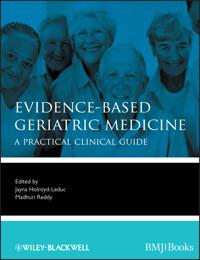
Evidence-Based Geriatric Medicine E-Book
55,99 €
Mehr erfahren.
- Herausgeber: John Wiley & Sons
- Kategorie: Fachliteratur
- Serie: Evidence-Based Medicine
- Sprache: Englisch
The latest addition to the Evidence-Based Book series, Evidence-Based Geriatric Medicine provides non-geriatrician clinicians an overview of key topics central to the care of the older patient. This guide focuses on the management of common problems in the elderly taking into account their life situations as well as treatment of specific conditions. Leading geriatricians with expertise in evidence-based medicine utilize the best available evidence and present this information in a concise, easy-to-use, question-based format. Evidence-Based Geriatric Medicine is a unique guide to the optimum management of older patients.
Sie lesen das E-Book in den Legimi-Apps auf:
Seitenzahl: 536
Veröffentlichungsjahr: 2012
Ähnliche




















Table of Contents
Cover
Series
Title
Copyright
List of Contributors
Foreword
CHAPTER 1: Function and frailty: the cornerstones of geriatric assessment
Introduction
Search strategy
What is frailty?
Is this person frail?
What are ADLs?
How do i assess ADLs?
How can i prevent this frail older adult from declining in ADLs?
Chapter summary
CHAPTER 2: Computer-based clinical decision support systems in the care of older patients
Introduction
Search strategy
Do cds tools improve healthcare providers’ performance of tasks or clinical outcomes related to appropriate medication prescribing for older patients?
Do cds tools improve healthcare providers’ performance of tasks or clinical outcomes in adult patients with hypertension, the most common ambulatory diagnosis among older patients?
Summary
Acknowledgment
Disclaimer
CHAPTER 3: Simplifying the pillbox: drugs and aging
Introduction
Search strategy
What is inappropriate prescribing and how can it be prevented?
What strategies can clinicians employ to optimize prescribing in individual older patients?
Once we identify optimal prescribing, how can we promote long-term adherence to these medications?
Acknowledgment
CHAPTER 4: Breathing easier: respiratory disease in the older adult
Introduction
Search strategy
How should i treat my older patient with asthma?
How should copd be managed in my older patient?
How should pneumonia be treated in the older patient?
Is my older patient at risk for tb?
How do i manage my older patients with obstructive sleep apnea?
How is lung cancer managed in the older patient?
Chapter summary
CHAPTER 5: Breathing easier: an approach to heart failure in a patient with an aging heart
Introduction
Search strategy
What role does exercise play in the management of heart failure?
Which pharmacological agents should be used in the management of heart failure?
What is the role for cardiac resynchronization and implantable cardioverter defibrillators?
How should heart failure patients be monitored?
Summary
CHAPTER 6: Clarifying confusion: preventing and managing delirium
Introduction
Search strategy
How can i screen for delirium?
How can i prevent this older hospitalized patient from becoming delirious?
How can i best manage this older hospitalized patient with delirium?
Summary
CHAPTER 7: Preserving memories: managing dementia
Introduction
Search strategy
What are the risk factors for alzheimer's dementia?
How can i screen for dementia?
What are other important areas to assess with caregivers and individuals diagnosed with dementia
Are medications effective in treating the cognitive symptoms of alzheimer's dementia?
What are the best interventions for challenging behaviors associated with dementia?
Chapter summary
Acknowledgments
CHAPTER 8: Enjoying the golden years: diagnosing and treating depression
Introduction
Search strategy
Is this older adult depressed?
What are the best options for the initial treatment of this depressed older adult?
Chapter summary
CHAPTER 9: A balancing act: preventing and treating falls
Introduction
Search strategy
What risk factors are associated with falls?
What interventions should be considered for fall prevention?
How should osteoporosis be addressed among fallers?
Chapter summary
Acknowledgment
CHAPTER 10: Keeping dry: managing urinary incontinence
Introduction
Search strategy
What is the best way to assess urinary incontinence in the office setting?
What are the best options for treating urinary incontinence?
What is the best treatment approach for ltc residents and people with dementia?
Summary
CHAPTER 11: Keeping things moving: preventing and managing constipation
Introduction
Search strategies
How do you define and diagnose chronic constipation?
What are the common causes of constipation in the older adult?
What is the suggested diagnostic workup of constipation?
What are the potential complications of constipation?
What are the methods of preventing constipation?
What are the nonpharmacological treatments of constipation?
What are the pharmacological treatments of constipation?
How should constipation be managed among patients on opioid analgesics?
Should my patient with severe constipation have colonic surgery?
Is there evidence to treat constipation with biofeedback?
Chapter summary
CHAPTER 12: Preventing and treating pressure ulcers
Introduction
Search strategy
What are the best ways to prevent pressure ulcers?
What are the best ways to treat pressure ulcers?
What are the best noninvasive ways to diagnose infection in chronic wounds?
Summary
CHAPTER 13: Elder abuse
Introduction
Search strategy
What are the types of elder abuse?
How do you identify a victim of elder abuse?
How can elder abuse be prevented or reduced?
Summary
Acknowledgment
CHAPTER 14: A good death: appropriate end-of-life care
Introduction
Search strategy
What is a good death?
How is pain management unique in the older adult?
What evidence exists for treatment of dyspnea at the end of life?
What role do advance directives play at the end of life for older adults?
Summary
Index
End User License Agreement
Guide
Cover
Table of Contents
Begin Reading
List of Tables
CHAPTER 1: Function and frailty: the cornerstones of geriatric assessment
Table 1.1 Contrasting the frailty phenotype and the frailty index
Table 1.2 Basic and instrumental activities of daily living
Table 1.3 Some commonly used, nondisease specific, disability assessment tools
CHAPTER 2: Computer-based clinical decision support systems in the care of older patients
Table 2.1 Summary of trials investigating computerized Clinical Decision Support (CDS) interventions to improve medication choice and decrease adverse events in older patients
Table 2.2 Summary of trials investigating computerized Clinical Decision Support (CDS) interventions to improve hypertension management and control in adult patients
CHAPTER 3: Simplifying the pillbox: drugs and aging
Table 3.1 2002 Criteria for potentially inappropriate medication use in older adults: independent of diagnoses or conditions
Table 3.2 2002 Criteria for potentially inappropriate medication use in older adults: considering diagnoses or conditions
Table 3.3 STOPP (Screening Tool of Older People's potentially inappropriate Prescriptions)
Table 3.4 START: Screening Tool to Alert doctors to Right i.e. appropriate, indicated Treatment
CHAPTER 4: Breathing easier: respiratory disease in the older adult
Table 4.1 Potentially modifiable risk factors for obstructive sleep apnea
Table 4.2 Symptoms and physical signs associated with obstructive sleep apnea
CHAPTER 5: Breathing easier: an approach to heart failure in a patient with an aging heart
Table 5.1 Evidence-based treatment options for heart failure
CHAPTER 6: Clarifying confusion: preventing and managing delirium
Table 6.1 Distinguishing delirium from dementia
Table 6.2 Multivariate predictors of postoperative delirium (a) Validated Clinical Prediction Rule developed among patients over 50 years of age scheduled for elective noncardiac surgery
Table 6.3 The Confusion Assessment Method (CAM)
Table 6.4 Examples of preventative strategies that target delirium risk factors
Table 6.5 Delirium management strategy
CHAPTER 7: Preserving memories: managing dementia
Table 7.1 Modifiable and nonmodifiable risk factors for dementia
Table 7.2 Commonly used dementia screening instruments
CHAPTER 8: Enjoying the golden years: diagnosing and treating depression
Table 8.1 The patient health questionnaire-9 (PHQ-9)
CHAPTER 9: A balancing act: preventing and treating falls
Table 9.1 Studies evaluating the tools used to assess falls
a
Table 9.2 Studies evaluating the risk factors for falls
Table 9.3 Studies evaluating the accuracy of elements of the history and physical exam for diagnosing falls
Table 9.4 Studies evaluating interventions for preventing falls
Table 9.5 Osteoporosis guidelines for Canada, United Kingdom, and United States
CHAPTER 10: Keeping dry: managing urinary incontinence
Table 10.1 Commonly used medications that can affect the lower urinary tract and the ability to toilet successfully
Table 10.2 Incontinence types and their underlying causes
Table 10.3 Evidence-based interventions for different UI types in women and men
Table 10.4 Characteristics of the different antimuscarinic agents used in the treatment of overactive bladder
CHAPTER 11: Keeping things moving: preventing and managing constipation
Table 11.1 Rome III Criteria for the diagnosis of functional constipation
Table 11.2 Drugs commonly associated with constipation
Table 11.3 Disease states associated with constipation
Table 11.4 Pharmacological treatment of constipation
CHAPTER 12: Preventing and treating pressure ulcers
Table 12.1 Prevention of pressure ulcers
Table 12.2 Medical management of pressure ulcers
CHAPTER 13: Elder abuse
Table 13.1 Types of elder abuse
Table 13.2 Historical and physical exam findings suggestive of elder mistreatment
CHAPTER 14: A good death: appropriate end-of-life care
Table 14.1 Treatments for pain
Table 14.2 Treatments for dyspnea
List of Illustrations
CHAPTER 7: Preserving memories: managing dementia
Figure 7.1 Timeline of symptom presentation and interventions for dementia. Solid line indicates strong evidence in support of a therapy, and dashed line indicates a potentially beneficial therapy.
Figure 7.2 Interventions for cognitive and behavioral symptoms of dementia. • indicates relevant chapter sections.
CHAPTER 8: Enjoying the golden years: diagnosing and treating depression
Figure 8.1 Flow chart for diagnosis and initial management of older adults with depressive symptoms.
CHAPTER 10: Keeping dry: managing urinary incontinence
Figure 10.1 Innervation of the lower urinary tract.
Figure 10.2 Seven-step-prompted voiding strategy.
CHAPTER 11: Keeping things moving: preventing and managing constipation
Figure 11.1 Management algorithm for constipation.
Pages
cover
contents
ii
iii
iv
vi
vii
viii
ix
x
1
2
3
4
5
6
7
8
9
10
11
12
13
14
15
16
17
18
19
20
21
22
23
24
25
26
27
28
29
30
31
32
33
34
35
36
37
38
39
40
41
42
43
44
45
46
47
48
49
50
51
52
53
54
55
56
57
58
59
60
61
62
63
64
65
66
67
68
69
70
71
72
73
74
75
76
77
78
79
80
81
82
83
84
85
86
87
88
89
90
91
92
93
94
95
96
97
98
99
100
101
102
103
104
105
106
107
108
109
110
111
112
113
114
115
116
117
118
119
120
121
122
123
124
125
126
127
128
129
130
131
132
133
134
135
136
137
138
139
140
141
142
143
144
145
146
147
148
149
150
151
152
153
154
155
156
157
158
159
160
161
162
163
164
165
166
167
168
169
170
171
172
173
174
175
176
177
178
179
180
181
182
183
184
185
186
187
188
189
190
191
192
Website: Evidence-Based Medicine Series
The Evidence-Based Medicine Series has a website at:www.evidencebasedseries.com
Where you can find:
Links to companion websites with additional resources and updates for books in the series
Details of all new and forthcoming titles
Links to more Evidence-Based products: including the Cochrane Library, Essential Evidence Plus, and EBM Guidelines.
How to access the companion sites with additional resources and updates:
Go to the Evidence-Based Series site:
www.evidencebasedseries.com
Select your book from the list of titles shown on the site
If your book has a website with supplementary material, it will show an icon next to the title
Click on the icon to access the website
Evidence-Based Geriatric Medicine
A Practical Clinical Guide
Jayna M. Holroyd-Leduc, MD FRCPC
Associate ProfessorDepartments of Medicine and Community Health SciencesDivision of GeriatricsUniversity of CalgaryCalgary, ABCanada
Madhuri Reddy, MD MSc
Hebrew Senior LifeBoston, MAUSA
This edition first published 2012, © 2012 by Blackwell Publishing Ltd.
BMJ Books is an imprint of BMJ Publishing Group Limited, used under licence by Blackwell Publishing which was acquired by John Wiley & Sons in February 2007. Blackwell's publishing programme has been merged with Wiley's global Scientific, Technical and Medical business to form Wiley-Blackwell.
Registered office:John Wiley & Sons, Ltd, The Atrium, Southern Gate, Chichester, West Sussex, PO19 8SQ, UK
Editorial offices:9600 Garsington Road, Oxford, OX4 2DQ, UKThe Atrium, Southern Gate, Chichester, West Sussex, PO19 8SQ, UK111 River Street, Hoboken, NJ 07030-5774, USA
For details of our global editorial offices, for customer services and for information about how to apply for permission to reuse the copyright material in this book please see our website at www.wiley.com/wiley-blackwell
The right of the author to be identified as the author of this work has been asserted in accordance with the UK Copyright, Designs and Patents Act 1988.
All rights reserved. No part of this publication may be reproduced, stored in a retrieval system, or transmitted, in any form or by any means, electronic, mechanical, photocopying, recording or otherwise, except as permitted by the UK Copyright, Designs and Patents Act 1988, without the prior permission of the publisher.
Designations used by companies to distinguish their products are often claimed as trademarks. All brand names and product names used in this book are trade names, service marks, trademarks or registered trademarks of their respective owners. The publisher is not associated with any product or vendor mentioned in this book. This publication is designed to provide accurate and authoritative information in regard to the subject matter covered. It is sold on the understanding that the publisher is not engaged in rendering professional services. If professional advice or other expert assistance is required, the services of a competent professional should be sought.
The contents of this work are intended to further general scientific research, understanding, and discussion only and are not intended and should not be relied upon as recommending or promoting a specific method, diagnosis, or treatment by physicians for any particular patient. The publisher and the author make no representations or warranties with respect to the accuracy or completeness of the contents of this work and specifically disclaim all warranties, including without limitation any implied warranties of fitness for a particular purpose. In view of ongoing research, equipment modifications, changes in governmental regulations, and the constant flow of information relating to the use of medicines, equipment, and devices, the reader is urged to review and evaluate the information provided in the package insert or instructions for each medicine, equipment, or device for, among other things, any changes in the instructions or indication of usage and for added warnings and precautions. Readers should consult with a specialist where appropriate. The fact that an organization or Website is referred to in this work as a citation and/or a potential source of further information does not mean that the author or the publisher endorses the information the organization or Website may provide or recommendations it may make. Further, readers should be aware that Internet Websites listed in this work may have changed or disappeared between when this work was written and when it is read. No warranty may be created or extended by any promotional statements for this work. Neither the publisher nor the author shall be liable for any damages arising herefrom.
Library of Congress Cataloging-in-Publication Data
Evidence-based geriatric medicine : a practical clinical guide / edited byJayna M. Holroyd-Leduc and Madhuri Reddy.p. ; cm.Includes bibliographical references and index.ISBN 978-1-4443-3718-1 (pbk. : alk. paper)I. Holroyd-Leduc, Jayna M., 1970– II. Reddy, Madhuri, 1972–DNLM: 1. Geriatrics–methods. 2. Aged. 3. Aging–physiology. 4. Evidence-Based Medicine. 5. Geriatric Assessment. WT 100]618.97–dc232011049726
1 2012
List of Contributors
Ranjani Aiyar
Fellow
General Internal Medicine
Division of General Internal Medicine
Department of Medicine
University of Calgary
Calgary, AB, Canada
Shabbir M.H. Alibhai
Associate Professor
Departments of Medicine and Health Policy, Management, and Evaluation
University of Toronto
Toronto, ON, Canada;
Consultant Geriatrician
Toronto Rehabilitation Institute
Toronto, ON, Canada;
Staff Physician
Internal Medicine and Geriatrics
University Health Network
Toronto, ON, Canada
Anita Asgar
Director
Transcatheter Valve Therapy Clinic
Institut de Cardiologie de Montréal
Montréal, Quebec, Canada;
Assistant Professor
Université de Montréal
Montréal, Quebec, Canada
Stuart Carney
Deputy National Director
UK Foundation Programme Office
Cardiff Bay, UK
Dov Gandell
Resident, Geriatric Medicine
Department of Medicine
Division of Geriatrics
University of Toronto
Toronto, ON, Canada
Sudeep S. Gill
Associate Professor
Department of Medicine
Division of Geriatric Medicine
Queen's University
Kingston, ON, Canada
Mary K. Goldstein
Director
Geriatrics Research Education and Clinical Center (GRECC)
VA Palo Alto Health Care System
Palo Alto, CA, USA;
Professor of Medicine (Center for Primary Care & Outcomes Research)
Stanford University School of Medicine
Stanford, CA, USA
Jayna M. Holroyd-Leduc
QI Lead
Department of Medicine
University of Calgary and Alberta Health Services
Calgary, AB, Canada;
Medical Coordinator of Clinical Informatics
Department of Medicine
Alberta Health Services
Calgary, AB, Canada;
Associate Professor
Departments of Medicine and Community Health Sciences
Director, Geriatric Medicine Training Program
Division of Geriatrics
University of Calgary
Calgary, AB, Canada
Landon D. Hough
Resident Physician
Department of Family and Community Medicine
University of Missouri
Columbia, MO, USA
Sunila R. Kalkar
Research Coordinator
Women's College Research Institute
Women's College Hospital
Toronto, ON, Canada
Jean S. Kutner
Professor of Medicine
University of Colorado
Denver School of Medicine
Aurora, CO, USA
Emily Kwan
Resident, Geriatric Medicine
Department of Medicine
Division of Geriatrics
University of Toronto
Toronto, ON, Canada
Philip E. Lee
Assistant Professor
Division of Geriatric Medicine
University of British Columbia
Vancouver, BC, Canada
Cari Levy
Associate Professor of Medicine
University of Colorado Denver School of Medicine
Denver, CO, USA;
Denver VA Medical Center
Denver, CO, USA
Erik J. Lindbloom
Associate Professor
Department of Family and Community Medicine
University of Missouri
Columbia, MO, USA
Salahaddin Mahmudi-Azer
Clinical Fellow
Department of Critical Care Medicine
Foothills Hospital
University of Calgary
Calgary, AB, Canada
Marina Martin
Clinical Instructor of Medicine (General Internal Medicine)
Stanford University
Stanford, CA, USA
Paige K. Moorhouse
Assistant Professor
Geriatric Medicine
Dalhousie University
Halifax, NS, Canada
Jane Pearce
Consultant Old Age Psychiatrist and Honorary Senior Clinical Lecturer in Psychiatry
University of Oxford
Oxford, UK;
Fulbrook Centre
Churchill Hospital
Oxford, UK
Madhuri Reddy
Hebrew Senior Life
Boston, MA, USA
Paula A. Rochon
Vice President, Research
Women's College Research Institute
Women's College Hospital
Toronto, ON, Canada;
Senior Scientist
Institute for Clinical Evaluative Sciences
Toronto, ON, Canada;
Professor
Department of Medicine
University of Toronto
Toronto, ON, Canada
Kenneth Rockwood
Professor
Geriatric Medicine
Dalhousie University
Halifax, NS, Canada;
Kathryn Allen Weldon Professor of Alzheimer Research
Dalhousie University
Halifax, NS, Canada;
Consultant Physician
Queen Elizabeth II Health Sciences Centre
Halifax, NS, Canada
Dallas P. Seitz
Assistant Professor
Department of Psychiatry
Division of Geriatric Psychiatry
Queen's University
Kingston, ON, Canada;
Fellow
Women's College Research Institute
Toronto, ON, Canada
Sharon Straus
Professor
Department of Medicine
Director, Division of Geriatrics
University of Toronto
Toronto, ON, Canada;
Director, Knowledge Translation Program
Li Ka Shing Knowledge Institute of St. Michael's
Toronto, ON, Canada
Cara Tannenbaum
Associate Professor
Faculties of Medicine and Pharmacy
Université de Montréal
Montréal, QC, Canada;
Director
Geriatric Incontinence Clinic
Institut Universitaire de Gériatrie
Université de Montréal
Montréal, QC, Canada
Karli R.E. Urban
Resident Physician
Department of Family and Community Medicine
University of Missouri
Columbia, MO, USA
Wei Wu
Statistical Analyst
Women's College Research Institute
Women's College Hospital
Toronto, ON, Canada
Foreword
Worldwide a major change in the population demographic is posing challenges to health care systems. In many countries the baby boom, that followed World War II and extended to the 1960s, will soon result in a substantial increase in the number of people over 65 years of age. Moreover, most countries including Canada, the United States and the United Kingdom have experienced a continuing increase in life expectancy, with an increase of approximately 1 year occurring every 5 years. These factors translate into a growing proportion of people aged 65 and older and these people will have many more years of life after attaining age 65. This situation is not unique to western countries; many developing countries will grow old before they get rich. For example, in 2000, 7% of China's population was ≥ 65 years old; by 2030 this will increase to 16%. As the proportion of older people increases, there is an increasing need for services targeted to care for older people, in particular to optimize the independence and vitality of those living in the community. There is an urgent need for health care professionals from all disciplines (aside from paediatrics!) to become comfortable with caring for this population. This book will address this demand and provide a resource for health care professionals to provide evidence-based care for older patients.
Evidence-Based Geriatric Medicine, a Practical Guide focuses on bringing together 2 critically important issues in health care – evidence-based practice (EBP) and care of the older patient. Interest in EBP has grown exponentially since the coining of the term in 1992, from 1 MEDLINE citation in that year to more than 75000 hits in January 2012. Training in EBP has become a component of educational curricula for health care disciplines, patients and policy makers amongst others[1]. This growing interest arose from a number of realisations including: our inability to afford more than a few seconds per patient for finding and assimilating evidence[2] or to set aside more than half an hour per week for general reading and study[3]; and the finding that the gaps between evidence and practice (including underuse and overuse of evidence) lead to variations in practice and quality of care[4, 5].
To meet these challenges, this book focuses on providing an approach to care for older patients that is based on the best available evidence. An ideal evidence-based resource should use rigorous and transparent methods for seeking and appraising the evidence, and provide the evidence in a clinically useful format. The format of each chapter in this book includes questions that have been generated by clinicians while the content focuses on a systematic review of the evidence and provides the reader with the bottom line for their clinical practice. Finally, the book highlights the gaps in the evidence, which are targets for future research (we hope!).
Topics addressed in the book include assessing and managing the geriatric giants such as delirium, dementia, urinary incontinence and falls. The authors also tackle issues, such as elder abuse, that are often underappreciated in clinical care. And, the book includes discussion of the management of chronic diseases in the complex older patient which is useful information for any generalist clinician.
This book will be a resource for trainees and clinicians from various disciplines, worldwide. It addresses issues of global importance – promoting healthy aging and building capacity to care for older persons.
References
1.Straus SE, Richardson WS, Glasziou P, Haynes RB (2011) Evidence-based Medicine: How to practice and teach it. Fourth Edition. Elsevier; Edinburgh.
2. Sackett DL, Straus SE (1998) Finding and applying evidence during clinical rounds: the ‘evidence cart’. JAMA 280: 1336–8.
3. Sackett DL (1997) Using evidence-based medicine to help physicians keep up-to-date. Serials 9: 178–81.
4. Shah BR, Mamdani M, Jaakkimainen L, Hux JE (2004) Risk modification for diabetic patients. Can J Clin Pharmacol 11: 239–44.
5. Pimlott NJ, Hux JE, Wilson LM, et al. (2003) Educating physicians to reduce benzodiazepine use by elderly patients. CMAJ 168: 835–9.
Sharon StrausFebruary 2012
CHAPTER 1Function and frailty: the cornerstones of geriatric assessment
Paige K. Moorhouse1,2 & Kenneth Rockwood1,2
Lesen Sie weiter in der vollständigen Ausgabe!
Lesen Sie weiter in der vollständigen Ausgabe!
Lesen Sie weiter in der vollständigen Ausgabe!
Lesen Sie weiter in der vollständigen Ausgabe!
Lesen Sie weiter in der vollständigen Ausgabe!
Lesen Sie weiter in der vollständigen Ausgabe!
Lesen Sie weiter in der vollständigen Ausgabe!
Lesen Sie weiter in der vollständigen Ausgabe!
Lesen Sie weiter in der vollständigen Ausgabe!
Lesen Sie weiter in der vollständigen Ausgabe!
Lesen Sie weiter in der vollständigen Ausgabe!
Lesen Sie weiter in der vollständigen Ausgabe!
Lesen Sie weiter in der vollständigen Ausgabe!
Lesen Sie weiter in der vollständigen Ausgabe!
Lesen Sie weiter in der vollständigen Ausgabe!




