


139,99 €
Mehr erfahren.
- Herausgeber: John Wiley & Sons
- Kategorie: Wissenschaft und neue Technologien
- Sprache: Englisch
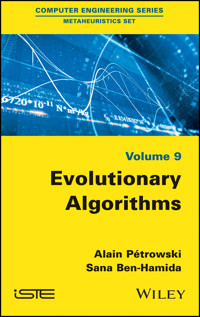
Evolutionary algorithms are bio-inspired algorithms based on Darwin’s theory of evolution. They are expected to provide non-optimal but good quality solutions to problems whose resolution is impracticable by exact methods.
In six chapters, this book presents the essential knowledge required to efficiently implement evolutionary algorithms.
Chapter 1 describes a generic evolutionary algorithm as well as the basic operators that compose it. Chapter 2 is devoted to the solving of continuous optimization problems, without constraint. Three leading approaches are described and compared on a set of test functions. Chapter 3 considers continuous optimization problems with constraints. Various approaches suitable for evolutionary methods are presented. Chapter 4 is related to combinatorial optimization. It provides a catalog of variation operators to deal with order-based problems. Chapter 5 introduces the basic notions required to understand the issue of multi-objective optimization and a variety of approaches for its application. Finally, Chapter 6 describes different approaches of genetic programming able to evolve computer programs in the context of machine learning.
Sie lesen das E-Book in den Legimi-Apps auf:
Seitenzahl: 343
Veröffentlichungsjahr: 2017
Ähnliche




















Table of Contents
Cover
Title
Copyright
Preface
1 Evolutionary Algorithms
1.1. From natural evolution to engineering
1.2. A generic evolutionary algorithm
1.3. Selection operators
1.4. Variation operators and representation
1.5. Binary representation
1.6. The simple genetic algorithm
1.7. Conclusion
2 Continuous Optimization
2.1. Introduction
2.2. Real representation and variation operators for evolutionary algorithms
2.3. Covariance Matrix Adaptation Evolution Strategy
2.4. A restart CMA Evolution Strategy
2.5. Differential Evolution (DE)
2.6. Success-History based Adaptive Differential Evolution (SHADE)
2.7. Particle Swarm Optimization
2.8. Experiments and performance comparisons
2.9. Conclusion
2.10. Appendix: set of basic objective functions used for the experiments
3 Constrained Continuous Evolutionary Optimization
3.1. Introduction
3.2. Penalization
3.3. Superiority of feasible solutions
3.4. Evolving on the feasible region
3.5. Multi-objective methods
3.6. Parallel population approaches
3.7. Hybrid methods
3.8. Conclusion
4 Combinatorial Optimization
4.1. Introduction
4.2. The binary representation and variation operators
4.3. Order-based Representation and variation operators
4.4. Conclusion
5 Multi-objective Optimization
5.1. Introduction
5.2. Problem formalization
5.3. The quality indicators
5.4. Multi-objective evolutionary algorithms
5.5. Methods using a “Pareto ranking”
5.6. Many-objective problems
5.7. Conclusion
6 Genetic Programming for Machine Learning
6.1. Introduction
6.2. Syntax tree representation
6.3. Evolving the syntax trees
6.4. GP in action: an introductory example
6.5. Alternative Genetic Programming Representations
6.6. Example of application: intrusion detection in a computer system
6.7. Conclusion
Bibliography
Index
End User License Agreement
Guide
Cover
Table of Contents
Begin Reading
Pages
C1
iii
iv
v
xi
xii
1
2
3
4
5
6
7
8
9
10
11
12
13
14
15
16
17
18
19
20
21
22
23
24
25
26
27
28
29
30
31
32
33
34
35
36
37
38
39
40
41
42
43
44
45
46
47
48
49
50
51
52
53
54
55
56
57
58
59
60
61
62
63
64
65
66
67
68
69
70
71
72
73
74
75
76
77
78
79
80
81
82
83
84
85
86
87
88
89
90
91
93
94
95
96
97
98
99
100
101
102
103
104
105
106
107
108
109
110
111
112
113
114
115
116
117
118
119
120
121
122
123
124
125
126
127
128
129
130
131
132
133
135
136
137
138
139
140
141
142
143
144
145
146
147
148
149
150
151
152
153
154
155
156
157
158
159
160
161
162
163
165
166
167
168
169
170
171
172
173
174
175
176
177
178
179
180
181
182
183
184
185
186
187
188
189
190
191
192
193
194
195
196
197
198
199
200
201
202
203
204
205
206
207
208
209
210
211
212
213
214
215
216
217
218
219
220
221
222
223
224
225
226
227
228
229
230
231
233
234
235
236
G1
G2
G3
G4
G5
G6
G7
G8
Metaheuristics Set
coordinated by
Nicolas Monmarché and Patrick Siarry
Volume 9
Evolutionary Algorithms
Alain Pétrowski
Sana Ben-Hamida
First published 2017 in Great Britain and the United States by ISTE Ltd and John Wiley & Sons, Inc.
Apart from any fair dealing for the purposes of research or private study, or criticism or review, as permitted under the Copyright, Designs and Patents Act 1988, this publication may only be reproduced, stored or transmitted, in any form or by any means, with the prior permission in writing of the publishers, or in the case of reprographic reproduction in accordance with the terms and licenses issued by the CLA. Enquiries concerning reproduction outside these terms should be sent to the publishers at the undermentioned address:
ISTE Ltd
27-37 St George’s Road
London SW19 4EU
UK
www.iste.co.uk
John Wiley & Sons, Inc.
111 River Street
Hoboken, NJ 07030
USA
www.wiley.com
© ISTE Ltd 2017
The rights of Alain Pétrowski and Sana Ben-Hamida to be identified as the authors of this work have been asserted by them in accordance with the Copyright, Designs and Patents Act 1988.
Library of Congress Control Number: 2017931831
British Library Cataloguing-in-Publication Data
A CIP record for this book is available from the British Library
ISBN 978-1-84821-804-8
Preface
Evolutionary algorithms are expected to provide non-optimal but good quality solutions to problems whose resolution is impracticable by exact methods. They are inspired by Darwin’s theory of natural selection.
This book is intended for readers who wish to acquire the essential knowledge required to efficiently implement evolutionary algorithms. The vision offered by this book is essentially algorithmic and empirical. Indeed, the theoretical contributions in this field are still too incomplete to provide significant help in solving the problems for which these algorithms are used.
Chapter 1 describes a generic evolutionary algorithm as well as the basic operators that compose it. The main concepts presented in the other chapters are introduced here. This chapter also presents the binary representation and introduces Genetic Algorithms.
Chapter 2 is devoted to the solving of continuous optimization problems, without constraint. Real representation is introduced as well as basic variation operators able to deal with it. Three efficient approaches are then described: Covariance matrix Adaptation Evolution Strategies, Differential Evolution and Particle Swarm Optimization, which are well suited for continuous optimization. The chapter ends with comparisons between these approaches on a set of test functions.
Chapter 3 supplements Chapter 2 by adding constraints to an objective function defined in a continuous search space. The different approaches to taking constraints into account are presented with their main variants. Some methods are related to multi-objective optimization, which is presented in Chapter 5.
Chapter 4 is related to combinatorial optimization. These problems are extremely varied and often very difficult. From examples of resolution, it is difficult or even impossible to deduce information that is generalizable to other cases. Thus, we have decided to present a catalog of variation operators able to deal with the constraints associated with order-based problems. This class of problems has been chosen because they are often parts of real-world problems. For this reason, they have been the subject of an important research effort for several decades.
Chapter 5 first presents the basic notions necessary to understand the issue of multi-objective optimization. It then describes the NSGA-II method, which is one of the best known and most effective in the field. But NSGA-II, like the other algorithms based on Pareto dominance, is efficient when there are less than 4 objectives. So, the chapter ends with a presentation of a range of approaches to solve problems with many objectives, i.e. 4 or more.
Chapter 6 is devoted to the description of different approaches of genetic programming used in the context of machine learning. Two classes of applications are presented: symbolic regression and symbolic classification. Genetic programming is the subject of a special chapter to emphasize the ability of evolutionary algorithms to discover good solutions in an ill-defined search space, whose size is not fixed during an evolution.
Acknowledgments
We warmly thank Professors Patrick Siarry and Nicolas Monmarché for inviting us to contribute to the “Metaheuristics” set of books. Professor Michalewicz agreed to give us valuable advice when we developed the contents of this book. We are indebted to him for his help and we thank him with gratitude.
Alain PÉTROWSKI
Sana BEN-HAMIDA
February 2017




