


Erhalten Sie Zugang zu diesem und mehr als 300000 Büchern ab EUR 5,99 monatlich.
- Herausgeber: Independent Thinking Press
- Kategorie: Bildung
- Sprache: Englisch
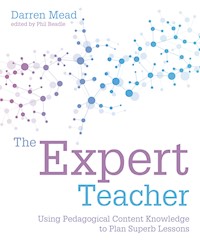
'But what does this look like in the classroom?' This question generally occurs to educators when they enquire into evidence-based approaches to teaching - and often they will get to the end of a teaching manual only to find that it remains unanswered. In The Expert Teacher, however, Darren Mead provides many of the answers. One of the most universally respected teachers in Britain, Darren has devoted his professional life to attaining pedagogical excellence. In this book he examines in depth what expert teachers do to help students progress their learning and strive for academic success. He lays bare the concept of pedagogical content knowledge and eloquently explains how to utilise it to overcome student misconceptions, create contexts and connections in learning and teach difficult and important content - empowering educators to transform their sub-ject knowledge into multiple means of representing it in teachable ways. The intention of The Expert Teacher is to help teachers to reflect on what and how they plan, how they teach and how to improvise around these plans, and to pave the way for deep professional thinking about best practice. It is split into two parts - entitled How is Your Subject Learned? and Expert Teaching and Learning - and provides educators with a variety of practical tools, illuminating examples and flexible frameworks geared to help them underpin and reinforce the very ampersand in expert teaching & learning. A warning though: this book is not for teachers seeking quick fixes or superficial tricks. The Expert Teacher is for educators who are eager to experience the excitement of knowing and teaching their subject masterfully. Suitable for all teachers in all settings.
Sie lesen das E-Book in den Legimi-Apps auf:
Seitenzahl: 460
Veröffentlichungsjahr: 2019
Das E-Book (TTS) können Sie hören im Abo „Legimi Premium” in Legimi-Apps auf:
Ähnliche

















Praise for The Expert Teacher
I am not sure I have ever read a sharper book on instruction than The Expert Teacher, written by a master classroom educator with remarkable depth of knowledge in educational research.
The book offers a powerful fusion of hands-on experience and underpinning research, and I love the fierce attention to detail in Darren’s analysis of exactly what makes a lesson succeed in terms of student understanding. Darren achieves this not just by suggesting practices such as analogies, examples, diagrams and confronting misconceptions, but also by teasing apart exactly what makes those practices effective or not.
I have spent over 40 years in education considering what makes a beautiful lesson, and I still found myself surprised and enlightened by what I encountered on almost every page. It’s hard to imagine any teacher reading this book without becoming profoundly more intentional in building and leading effective lessons.
Ron Berger, Chief Academic Officer, EL Education
Darren Mead brings his lifelong professional obsession with pedagogical perfection to life in an accessible and intelligent book which, much like the man himself, is unassuming and not beholden to fashionable ideas.
Alistair Smith, trainer, author anddesignated learning consultant to the Football Association
Reading this book is like sitting in the theatre of the mind of one of the most nuanced, thoughtful and eclectic educators in the world. Darren manages to take everything you took for granted about planning lessons and help you realise that not only is it the most important part of the job, but it can always be done better.
Unlike some other texts which espouse solely academic theory, The Expert Teacher is a true handbook that should be read, revisited, sticky-noted and kept on every teacher’s person at all times. And while serious in intent, the book is peppered with anecdotes, metaphors and even the occasional simile which will have you laughing out loud.
A truly wonderful companion for all those who believe that every child deserves a teacher who designs wonderful, purposeful and responsive learning experiences.
Chris Harte, Director, Unstuck Learning Design
The Expert Teacher is a wide-ranging and erudite volume on what it means not just to know the content of our subject, but to understand how to teach our subject. It successfully combines links to academic research with a distillation of both Darren’s and others’ years of practice and collaboration, and ultimately provides a framework for improvement for all teachers.
Through the lens of pedagogical content knowledge, we are taken through our students’ learning journey and their misconceptions to the destination where the important knowledge and skills have been embedded and become part of their constitution. The distinction of the expert teacher from the novice teacher is humanely explored too, making it clear that – just as our students have a hard path to follow – all teachers must accept the hard graft required to gain expertise in our chosen profession.
This book will prove to be thought-provoking and challenging, and is worth careful contemplation and regular revisiting.
David Paterson, science teacher, Aldenham School,author, blogger and teacher trainer
Darren Mead has always used a vast evidence base to craft learning experiences for his students. In The Expert Teacher he distils and explains what the educational community has learned to date, and effectively translates it into simple-to-implement actions.
Sometimes irreverent, always sage, he exposes and explores the true complexity of quality teaching, while also showing how to tweak existing practice (without increasing workload!). He provides a plethora of tools to aid this process, and helps us to decide when and how to use them at different stages of the learning process.
Darren reveals why expert teaching is an intellectually, emotionally and logistically demanding endeavour, and why becoming an expert in this profession requires extraordinary social sensitivity, real-time assessment-led responsiveness and subject pedagogical expertise. It invigorates the intellectual task of creating balance between planning for the learner and the learning, and offers a one-stop repository for stimulating professional dialogue around the challenges of expert teaching and learning. Misguided, non-evidence-based, received wisdom gets short shrift and is eruditely debunked.
The Expert Teacher raises the bar of expectation for teachers, and brings clarity of insight to the canon of educational research, as well as to the fields of sociology and psychology. It is perfect for those who wish to continue to hone their craft and move themselves and others to the highest levels of professionalism.
Fergus Hegarty, Director of Science, Laidlaw Schools Trust,and Chair, Association of Science Education – North East region
Darren Mead’s tour de force, The Expert Teacher, illuminates the complex business of teaching and learning with absolute clarity – and is a must-read for teachers aiming to develop a real professionalism in the classroom.
Painstakingly researched, the book equips the reader with a whole armoury of structuring tools and frameworks, all made accessible by Darren’s well-chosen and illuminating applications and anecdotes. The book’s content and message is also well-balanced, with its nourishing imperative to think deeply and rigorously about the journey of knowledge acquisition wisely countered by its permissive advocacy of tinkering with ‘the exquisite lesson plan’ mid flow if and when it simply isn’t working. A further energy within this wonderful book is a vein of scurrilous and irreverent humour, which provides welcome – and nearly always well-judged – colour.
The moment has definitely arrived for this book to make a significant contribution to the evolution of the teaching profession.
Mark Moorhouse, Head Teacher, Matthew Moss High School
To observe an expert teacher can be a confounding experience for some: ‘The students just got it’, ‘He really has their behaviour under control’, ‘I could never teach like her!’ In The Expert Teacher, Darren Mead reminds us that these outcomes and expert teacher behaviours – and the planning of superb lessons – can be learned, but require careful consideration of the content to be studied: how it is best sequenced, taught and learned, and its relative conceptual importance. This is the tacit knowledge of the expert, a maestro. To possess this knowledge is remarkable enough; to be able to communicate it is a gift – though not to the possessor, but to those who they teach.
Rimsky-Korsakov gave us this gift in his teachings and writings on the orchestra. In The Expert Teacher, Darren Mead gives teachers that same gift.
Martin Said, School Designer, XP Trust
A real strength of The Expert Teacher is its accessibility. Developing educators can often find the language of educational writing a barrier to the ideas being expressed and be turned off; here, however, we have a book written by someone who has no desire to show us how clever they are or to stray into academia at the expense of classroom practice. Darren Mead is able to encapsulate a number of ideas that cross dichotomies and manages to bring them together in a straightforward, insightful and, ultimately, readable way.
I’ve not experienced what Darren refers to as his ‘terrible’ guitar playing, but if this book is even a slight indication of the way that he approaches his work in the classroom then I have no doubts that he is very much an expert teacher.
Colin Goffin, Vice Principal and Alternate Provision Lead, Inspiration Trust
The Expert Teacher is a unique book which offers both a synthesis of educational research and a practical insight into what works in the classroom.
Essential reading for those teachers, subject leaders and senior leaders in education who want to go beyond the quick fix and tips and tricks and take their first steps to truly understanding what mastery looks like in practice.
Mark Lovatt, teacher, author and former principal
For Tomas and Mandy
Contents
Foreword
It’s early 2012, and I am trawling the internet for ideas about metacognition. I am in the middle of writing a book (for money – but not for much of it) that is going to be called The Mighty Book of Plenary and which eventually ends up being called The Book of Plenary: Here Endeth the Lesson. I already know quite a bit about the theoretical basis of metacognition and have read enough boring, excessively dense academic papers on it to know that anyone who says to you that it’s ‘thinking about thinking’ isn’t thinking – that would be meta-thought, you sillies.
What I want are ideas from someone who has been trying stuff out in the classroom, who has read the theoretical stuff and tried to make it concrete, realistic, doable. I keep coming back to the same blog. It is called Sharing Pedagogical Purposes and the bloke writing it seems a bit different. Genuinely, the point of the blog is not to promote his brand, his career, his ideas. Genuinely, he is using it to share his professional learning. He is also – genuinely – a little odd. His name is Darren Mead and he claims to be a former circus strongman. From his picture, you can’t be sure if he is lying.
I get a bit stuck with this blog because the level of learning in it is quite a way above mine. He has clearly read a lot of books and academic papers. But not only this, he has digested them and shares whether and how he feels they work in the classroom. He doesn’t seem to have any overriding ideology, he belongs to no club; he just wants to help.
It’s 2013. I approach Darren, who, it turns out, is a science teacher in the far, cold part of the North where people speak a different language, to see if he wants to write a book. ‘Why aye’ he replies.
It’s 2014 and I am speaking at a conference for the Essex Secondary Head Teachers’ Association. I am on after Alistair Smith and am nervous as, in terms of speaking, Alistair is a legend to my mildly experienced ingénue. He starts off his speech by talking about the best teacher he has ever seen: someone he has seen recently who has blown him away! He says something along the lines of, ‘He is the Jimi Hendrix of teaching. He can play it left-handed. He can play it right-handed. He can play it behind his back.’ The teacher he is talking about is Darren Mead.
I don’t tell Alistair that, by this time, Darren and I have been working for a year on this book. You will note that that was, at the very least, by the time you read this, five years ago. This book has taken six years from the initial approach to publication.
There are many reasons for this. Not the least is that Darren is a man of great enthusiasms, and his original text was the size of three books (there are another two books waiting to go if this one does as well as it should – his ideas on assessment (in particular) are profound). He is also very clever indeed and knows more than could possibly be fit into one book. The process of delivering this tome you are now holding has been a long one: Darren and I have skills in almost oppositional areas. He is about depth of detail where I like things artfully expressed. Hopefully, what you are holding is a worthy eventual compromise.
What it most certainly isn’t, however, is a text for beginners. Darren is the one British teacher whose book, should it have existed, I would have rushed to the shops to buy as he knows more (I think) than anyone else in the profession about the theoretical basis of teaching. But, most importantly, that research hasn’t just confined itself to the library. Everything Darren has to share has been trialled time and time again in the classroom. As a result, what you have in your hands is a book that I hope will be perceived to be exactly what it is – a serious piece of work by a serious person – and what it could be – a highly influential text. You’ll not, I wager, find it easy reading, and you’ll not, I imagine, have it by the bog for a light read (though there are funnies). But if you dive in, you’ll learn lots of things you didn’t know. If you dive in, you’ll know some (a fraction) of what the man who might reasonably claim (though he wouldn’t as he’s actually quite shy) to be one of the most universally respected teachers that the world of education knows. If you dive in, you’ll be on the way to the kind of expertise that Darren has. And that, dear teacher, is no small thing.
Phil Beadle
Acknowledgements
I have been fortunate to have worked with some inspirational people over my years in the classroom, too many to mention here. However, I will be forever thankful for the start I got as a student teacher from my professional mentors: John Burford, Mark Lovatt, Sarah Napthen and Rob Scott – experts in every sense of the word. I must also give an honourable mention to the original fire-starter, Alistair Smith. I was lucky enough to work alongside some amazing teachers at Cramlington Learning Village for 20 years, and I am grateful for the conversations, support and collaboration from which I learned so much. Thank you to Wendy Heslop and her staff.
Sadly, two of the great educators I have been blessed to work with are no longer with us. Dee Palmer Jones and Derek Wise CBE continue to be reference points in everything I do in my classroom. ‘What would Dee do?’ and ‘What would Derek say?’ are constant prompts in my and many others’ thinking, and is a testament to their expertise and downright wisdom.
I am also thankful for the unique collaboration and support from the board members of the Two Jumps Learning Trust: Simon Brown, Chris Harte, Fergus Hegarty, Ian Neslon, Graeme Porter and Martin Said. I am grateful too to my colleagues from the old Teacher Effectiveness Enhancement Programme training days – Ken Brechin, Julie Mosley, Cath Rothwell and Trish Wright – and to our colleagues and friends from the Project for Enhancing Effective Learning, Ian Mitchell and the inspirational Jill Flack.
Thank you also to Phil Beadle for taking a random interest in what I do and for extending the offer of writing a book about it. Derek Wise once said to me, ‘Darren, I know we can’t teach you anything, but please let us support you in working out what you think is important,’ which startled me somewhat as I thought I had concealed my stubborn single-mindedness rather well. Phil has done exactly this.
Finally, and most importantly, I want to thank my family for their love, support, encouragement and food. I love you Mandy, Tomas, Linda, Keith, Andrea, Mark and Rafa.
Introduction
An ode to lesson planning
Drive-through restaurants, click of a mouse shopping, no nails adhesive, get rich quick, open top bus tour, the 60 second news.
Silver service, personal shopper, bespoke carpentry, investments, exploring, a newspaper.
The second list appears marginally indulgent, but had we the time and money we would choose it over the former in an instant. Furthermore, most of us would actively avoid the first list (with the exception of no nails adhesive – a wondrous material), and herein lies the message: lesson planning is not a quick event; it is something to be indulged in, considered and practised, adagio. Amid the frantic pace and creeping pressure of being a teacher, this is our moment to slow down, reflect, research, collaborate and think. This is our choice.
Here is my belief: lesson planning should not be simplified – it should be made complex and rich. Complex planning necessitates that we, the professionals, understand how learning happens, how our students ‘work’, how our subjects (specifically) are learned and how they can be taught better. Then, and only then, will we be able to plan lessons that are complete.
It is in our planning that we become professional; for me, it is impossible to extricate professional learning from the planning we do. Our professional kudos is wrapped up in our ability to work out how to teach groups of individuals intricate and, at times, abstract ideas so that they understand, remember, apply and enjoy them. Our professionalism is all this and more. We manage emotions, conflicts, motivation, community and identity. This is the beautiful complexity we were first drawn to. To do all of this – and we cannot unravel it – is hard yakka: it takes time, knowledge and time. Yes, time: lots of it; it takes a whole career’s worth of time to get this art half right.
Ask yourself this, ‘When do I really get to reflect about how I do my job?’ If I am honest, it is when I am planning lessons. Although I don’t really want to plan lessons – those arbitrary divisions of time; what I want to plan is how each bit of content is learned. It is actually impossible to plan an individual lesson as they don’t exist in the learning world. When planning, I ponder: what went well? Whom did it go well for? What bombed? Did I have the right information to make good decisions today? Was all the information available to the students so they could make sense of it? How many times did they get each bit of vital information? All the questions I cannot possibly answer during a lesson, while I’m staving off the dominant question that we ask all lesson, every lesson: ‘Is it OK to move on?’ Classrooms are busy and complex, so succumbing to the overriding temptation of getting through the plan no matter what else happens is an understandable preoccupation. But is it the right one? Good planning and an understanding of how learning takes place help to prevent the thought of starting the next activity from becoming too dominant.
Never worry that you spend too long on a lesson plan, even in the sometimes overwhelmingly busy working day of a classroom teacher. It is an investment in you and your students – and as the famous shampoo vendor L’Oréal says, ‘You’re worth it.’ In the long run, your planning and resources will be recycled and time will be saved, and you will be better at teaching that particular concept. Time constraints do have benefits; after all, necessity is the mother of invention. A lack of time encourages us to plan collaboratively and learn from someone else’s experience (or allow them to learn from ours), and it is our students who benefit. Spending an age on a plan can lead teachers towards the fatal predilection of overly zealous and blind adherence to that plan. However, it is worth knowing that this is more likely if the plan is merely a series of activities. If the plan is built around what needs to be done to learn a concept, and furthermore, what the emerging understanding(s) might look like, then we can do the apparently contradictory thing of sticking to the plan and being entirely flexible and responsive at the same time.
All of the planning decisions we make are based on our pedagogical content knowledge. Pedagogical content knowledge is what we know about how learning happens, what we know about how our subjects are learned and what we know about the learners in front of us. This is practical knowledge. It is how we transform our subject knowledge into multiple ways of representing it in teachable ways. It is how we take the implicit expert thinking of a subject specialist and make it explicit through modelling. It is how we find out our students’ prior conceptions and tailor their experiences in order for them to learn – and potentially reorganise their understanding when their preconceptions turn out to be misconceptions. Knowing how to do this is pedagogical content knowledge. Clearly, the role of pedagogical content knowledge in planning is central. To access it we have to stop, think and reflect on what students tend to already know, what they generally find difficult, what has helped in the past, what are the parts that make up the whole knowledge and what sequence the concepts should be taught in. This may require some research and discussions with other subject specialists. It takes time.
Questioning
From our pedagogical content knowledge we also get the knowledge to ask useful questions. There is a certain truth in the idea that many of our best questions are thought up on the spot as part of a dialogue. However, in order to more regularly ask purposeful questions, the planning is best done before the lesson. This allows us to consider:
Why we are asking the question: is it to gather information on student learning? Is it to encourage students to think about an idea? Is it to consolidate learning? Is it to engage students with a new idea? Is it to reveal prior knowledge?Who is/are the question(s) for: the whole class or just a selected group of students?What response are we expecting to hear if they understand the concepts, if they know the concept, or if they are retaining a misconception or making a common mistake?In the worst-case scenario, a teacher asks rhetorical questions to individuals as an attention keeping device, playing the baked potato skinned host of a bizarre quiz show, ‘Guess What’s In My Head?’ The prize being that the teacher will continue with their explanation once a single correct answer has been given. In short, the questioning lacks pedagogical purpose. These questions are probably recall questions, perhaps on what has just been said or even about concepts the students should (already) know. If the only mechanisms a teacher has to ensure that key ideas are being recalled to aid long-term retention are some off-the-cuff questions flung at little Darren, who is staring out of the window, then all we can do is rue 30 lost opportunities.
If the aiding of retention is the purpose of the questioning, then the identification of the facts to be recalled should really be identified before the discussion, not when our attention is focused on who is paying attention. This allows us to couple the right question with the right mechanism. So, a question that recalls a key fact that will be useful in learning the new knowledge (e.g. that chlorophyll makes plants green), and the appropriate mechanism to ensure that all students have the opportunity to recall the information (e.g. think-pair-share, a random name generated with a 30 second think time or a choice of A, B, C answers) can then be matched to the content according to the teacher’s professional knowledge as to which will serve this purpose best.
Effective teacher behaviours
Try an internet search of ‘Who am I in …?’ and marvel at the myriad of unheard of TV shows where you can take a quiz to work out which character you would be in this show. (Apparently, I’m 53% Mickey Mouse, with which I’m fine.) As teachers, we are all character actors and on any one day will have to be most things to most people. Unfortunately, we tend to perceive how a fellow teacher acts as being a manifestation of their innate personality and ascribe their success to this. I have lost count of the number of conversations I’ve had about behaviour management after I have sent a willing newly qualified teacher to go and watch how a more experienced member of staff manages behaviour, only to be told that ‘there weren’t any problems’, suggesting that the many nuances of the teacher’s strategies were entirely missed.
Thankfully, there is a huge body of research on effective teacher behaviours, most notably from McBer (2000) and Muijs and Reynolds (2011), which suggests that an effective maths teacher might act in differing ways to an effective English teacher, with there being an area of overlap between all effective teachers. The key message here is that the behaviours of the most effective teachers are not based on their personalities but can be learned. The effective teacher behaviour research exemplifies the difficulties that teachers can have in applying research to practice, because this goes beyond knowledge and into the realm of our beliefs. This makes teaching a unique field of expertise. When student medics enter an operating theatre the environment and procedures are alien to them; they are an outsider learning to become an insider. As a student teacher, the classrooms, corridors, halls and desks are very familiar to us – we are already insiders and we bring with us an array of beliefs. This is not, of course, an argument for teachers having to enter voluntary psychoanalysis in order to uproot and reconstruct our belief systems in order to plan a lesson; however, sometimes we fail to see how we can do things better because of our certainties and our beliefs about learning and schooling. Our beliefs can act as filters to new information and experiences.
There are undeniable commonalities in the behaviours of the most effective teachers. A very brief summary of effective teacher behaviours might look like this. Effective teachers are confident in their ability and are highly committed to the success of all students. Their interactions are consistently fair and respectful, inducing a sense of trust in their classroom. They have the ability to think analytically and conceptually, allowing them to be flexible in their approaches. They act proactively and are constantly seeking out information to make good decisions. They set high standards, model them and hold others accountable. They have an overwhelming passion for learning and for what education can do. They work in teams, understand the motivations of others and seek to influence them in positive ways. They communicate clearly and are inclusive. They employ a variety of teaching methodologies that engage and stimulate thinking. They take an active interest in their own pedagogical content knowledge and use this knowledge to teach as well as they can. They create classroom communities that provide an orderly and civilised climate where students feel safe and suitably challenged. They teach, they learn and they seek to model the behaviours that exemplify these noble pursuits (McBer 2000: 2).
As expert teachers we need to have deep and rich knowledge of many pedagogies as well as of the subjects and students we teach. This is our DNA. Planning lessons is how we learn this, so I am going to take my time over this, not as an indulgence but as a right.
How to use this book
Within this book I hope you find a detailed (but not absolute) set of notes on what we know about pedagogical content knowledge, teaching and learning. Where there seems to be an answer, it has been offered; where it is vague, what we think we know has been offered. This has been done in the spirit that it is better to know what you do not know than to not know that you do not know. The intention of this book is to help teachers to reflect on what and how they plan, how they teach and how to improvise around these plans.
When I was asked by Phil Beadle to write this book, my first reaction was to ask who had turned him down first. Phil was too polite to answer but my reaction has borne me out. I knew, somehow, that writing a book that was originally called ‘How to Plan Lessons’ was a nigh on impossible mission. What seems like a simple process involves much knowledge about the stuff to be learned; how it is learned; the context of the school, class and students; and the relationships, thinking and motivation behind being a learner. Not to mention how assessment, examinations and schools work, and how the system does not. My initial feeling is my final feeling – that there is much to say on the subject. So, on 6 August 2014 at 8:29am, I sat down and randomly wrote questions that I thought might constitute a checklist.1 It quickly became overwhelming and out of sequence, as many ideas ran concurrent with others. I present the list here to illustrate what goes on in teachers’ heads. I am sure the list is incomplete.
What exactly needs to be learned?How exactly can this be and remain useful?How will this connect to the bigger question or problem?Where is this knowledge headed towards – what are the next things to be learned in subsequent sessions?Do all the intentions have equal value? Are some concepts more important than others? What might the students already know that will be useful during learning this?How can this be made useful and relevant to them?What misconceptions might they have?How might these be challenged and corrected?What might they find difficult?How might this be made easier?Has this been oversimplified? How might they develop a more complex understanding? How do we work towards complexity?How best is this taught?How best is this learned?What activities will help them to learn this?How do I need to be to manage this learning?How will the students be motivated?What questions will be asked to develop their understanding?What questions will be asked to check their understanding?How might the uniqueness of learning be expressed by different students?How will the teacher collect enough information to make good decisions?How will the teacher collect detailed information about student learning?What feedback could be given to develop their understanding? What alternative explanations could be used to develop their understanding?How many exposures to each learning intention are the students getting?Are there any subsequent exposures to this knowledge?How will the students know they have learned this?Do they have an opportunity to make sense of this information?Do they have an opportunity to improve the quality of their work and/or understanding?Do they have an opportunity to practise and rehearse?Do they have an opportunity to reflect and respond to feedback?Which tasks are best served as group tasks? Which tasks are best served as individual tasks?Who is being served by each task? Is it for the students to learn or to provide me with information about their learning? Can it do both?How will motivation be maintained?How long do I expect each activity to take?Will the students cover all of the intentions satisfactorily in the time we have?Are there too many intentions for this time period?Which activities are OK to move on from in a slightly incomplete form? Which ones must have 100% completion?What do successfully completed tasks look like? What will their qualities be? Will increasing student ownership of the tasks/learning improve motivation and retention? How can the tasks be designed to do this?Do any of the tasks help to develop broader literacy and numeracy?What does this knowledge look like when fully formed?What are the intermediary steps to get there?Do any of the tasks help to develop literacy within my subject area?How do these opportunities support the original subject learning intentions?How can a balance be found over subject content and developing literacy?How can feedback be provided to develop literacy and numeracy?Do we all have an opportunity to be human?What attributes and skills would support students learning these concepts?How can this be scaffolded to help students develop these? How can students be supported with these?What feedback might develop this over time? What experiences might they need to become better at these?Is our classroom community strong enough for mistakes to be made publicly?Is our classroom community strong enough for students to support one another?How will the class be managed?Who will sit with whom? How will the students be greeted and settled?What rituals and protocols might be useful to build and maintain our classroom community?How will I set the tone for today’s lesson?What is the appropriate tone for this learning to take place in?How will the learning be made memorable?How will the students memorise the learning?How will all students be challenged? How will all students be supported?How will all students access the information?What questions will they ask to gain the right information?What signs might there be to tell me that it is time to move the whole class on?What signs might there be to tell me that some students need a different route?What questions will encourage discussions about the content knowledge?What questions will encourage discussions about the strategies being used?When a student answers a question, how will I know they know this and have not just deduced it?How will learning look different to performance?How will students learn from other students? How will I ensure that this is right?What questions will stimulate metacognitive thinking around this content? How does this lesson and its pedagogy fit in with my school’s broader educative purpose?Over time, are my students experiencing sufficient variety in pedagogy and experiences?Who is this student work for?Is this student work significant beyond the classroom?Does this lesson necessitate that I am at least cognisant of their prevailing emotions?How might I manage the emotions in the classroom?How am I encouraging the students to be kind?How am I communicating high expectations in all aspects of how the students are in my lesson?How many times have the students already been exposed to this information? How well did they understand it last time?We can’t fit all of this thinking into every plan, every lesson, every day, but the more we learn, and the more we are conscious of the decisions we make, the more our vast knowledge will come to bear. Ultimately, it helps us to design what we hope will be a useful and productive lesson for our students. It also helps us to realise that the exquisite lesson plan we have crafted is actually pants. It then gives us confidence to be able to change it, mid flow, seamlessly, so that the time we get to spend with our students is valuable to them, valuable to us and valuable to the endeavour that education brings.
My initial start point was to reject the idea of a checklist, a simple set of steps that will organise our time with students but, in reality, do little to pave the way for deep professional thinking about what we do. So this book, and it is intended as more of a recipe book, exists to inform but also allows for your skill, knowledge, passion, unique abilities and professionalism. This spirit is best summed up by Claudia Roden (2005: 7) in her Arabesque cookbook:
Trust your taste and allow yourself a certain freedom in the preparation of the dishes. This is in the spirit of these cuisines which, although faithful to tradition, have no absolute rules and are rich in variations and poor in precision. You are told to ‘weigh with the eye’ and to taste as you go along. And that is what cooking is about. We are dealing with products of nature and these vary. … Many vegetables available to us come from different countries and are grown in different soils. … They have a different taste and respond differently to cooking. Rice, even of the same variety, and same provenance varies from one year to the next and, depending on whether it is new or old [differs] in the amount of water it absorbs. Once upon a time the recommendation for many rice recipes was to add ‘as much water as it takes’. There was much sense in that.
It’s time to get cooking …
1 Isn’t Google Docs an amazing and unnerving thing!
PART I
Pedagogical Content Knowledge: How is Your Subject Learned?
CHAPTER 1
Using Pedagogical Content Knowledge to Plan to Overcome Misconceptions
Pedagogical content knowledge is rather a mouthful to say. It might be thought of as the millefeuille1 of educational thought, in that it is known yet remains unfamiliar. The cake of a thousand leaves is reminiscent of the many interleaved layers of understanding that a teacher has: of the content being learned, how the learning tends to happen, the strategies it is best to employ, the knowledge and learning needs of their students. Pedagogical content knowledge was developed by Lee Shulman (1986, 1987) and is a blend of subject knowledge, pedagogical knowledge and knowledge of the context in which learning takes place. It is all of these things and more; describing it as a ‘blend’ does not really do it justice. Although the individual elements are important in themselves, it is in combination that they become as potent as when the Ghostbusters crossed their proton beams.
At first glance, pedagogical content knowledge appears to be ‘jargoneering’, but the name is a useful one in terms of giving us a focus on how the content is to be transmitted so that it is learned. It is our pedagogical content knowledge that differentiates us, as teachers, from our equivalent non-teaching specialists (scientists, writers, mathematicians, economists); it is our pedagogical content knowledge that compels us to organise the transmission of knowledge in the way that we do. It is our own pedagogical content knowledge that we must employ in our planning, and it is the students’ pedagogical content knowledge that we must seek to spot in lessons so that we can speed up its acquisition.
My first, and only, formal experience of pedagogical content knowledge came early on in my career. (I say formal but, in reality, it was only as formal as a cramped science prep room can possibly be.) It involved a dear colleague, Mark Lovatt, passing me a folder with Ros Driver’s Eliciting Children’s Ideas in Science inside and being told, ‘Read this. It’s great for planning lessons!’2 It was great; it still is great.
Sadly, I do not think I am alone in not having had any real training or discussion about how our subjects are learned. We tend to focus therefore on what we do as teachers – getting hung up on strategies, methods, teacher actions and any feedback we receive on our teaching. We call this teaching & learning: excited colleagues produce teaching & learning bulletins; we attend training in teaching & learning; we build teaching & learning toolkits; we speak of teaching & learning cycles; go on jollies to teaching & learning conferences; ruminate over teaching & learning development plans; we adhere to teaching & learning policies. And all the time we do this, pedagogical content knowledge is under our noses – ignored. What is pedagogical content knowledge? Let me tell you, dear colleague … pedagogical content knowledge is the very ampersand between teaching & learning.
The ampersand
The great potential for formalising our use of pedagogical content knowledge is that we can move from using it instinctively and inconsistently to being able to plan with it systematically. Perhaps most importantly, it helps us to become more aware of what learning might look like in the classroom, sensitising us to misconceptions when they arise and turning them into teachable moments.
Pedagogical content knowledge most commonly manifests as one of four interacting forms:
Knowing how to represent knowledge so that it can be learned. This is context dependent, with teachers’ prior understanding of their class(es) being a key part of how they go about representing this knowledge.Knowing how to organise or sequence knowledge so that it can be learned. We have to understand how the knowledge is connected to other knowledge and other concepts. This must involve planning on a macro and micro scale so that the overarching idea and the interrelated details underneath become clearly connected.Knowing which concepts and ideas are difficult to learn and, subsequently, how to help students learn them. This includes knowledge of likely student misconceptions.Knowing which knowledge is important. This includes threshold concepts.We can also add to this our knowledge of the (ever changing) curriculum and the assessment of the subject.
To be clear, the content of this book, and not just this chapter, is dedicated to understanding our pedagogical content knowledge. The next two chapters detail how we can understand the teaching of our subjects better, and the last three look at the more generic pedagogical content knowledge of the processes of how to teach and how we learn.
Planning to tackle misconceptions
What are misconceptions?
Carnegiea gigantea, the Saguaro cactus (a native of the south-western United States) is the stereotypical flora of our cartoon childhood; it is the version of cactus that marked the barren landscape through which Wile E. Coyote chased the Road Runner. Although they are surprisingly shallow rooted for a plant of that size, their rooting system is well adapted, with roots wrapping around rocks to provide anchorage. They are also incredibly robust plants. It is no surprise that Wile E. generally comes off second best when he runs into one. The Saguaro cactus itself has no awareness of how silly its choice of home is or even of how it has changed the climatic and edaphic3 features of the Mojave Desert.
Similarly, student misconceptions are generally shrouded in a haze of blissful unawareness of their folly or illogic. Like the cactus, they too are anchored to rocks, this time of ‘knowing’, and like the cactus, these misconceptions can be extremely hardy. Additionally, misconceptions – like the effect the cactus has on Wile E. when he comes into close contact with one – also have the capacity to taint any ideas that come into contact with them. The cactus belongs in its habitat. Likewise, there can be many logical reasons for misconceptions to exist. The idea itself may be wrong but the reasoning behind it can be as right as rain.
The problem with misconceptions
Misconceptions can have a strong grounding in our students’ everyday experiences. They can lie in their use of day-to-day language or in partially formed ideas that have persisted because they haven’t yet been challenged. In some cases, students have actually seen the phenomena with their own eyes! And seeing, as we know, often results in believing. The word ‘belief’ tells us that our students’ misconceptions can be deeply held to the point of feeling as if they are unquestionable. The importance of this is brought to bear by Nuthall (2007: 156): students ‘evaluate [each] new experience, and what the experience implies, against their prior knowledge and beliefs’. Here, he is saying that students use their prior experiences and what they know to interpret and make sense of any new ideas being presented. If this ‘knowledge’ is actually incorrect, then the students will not make the correct interpretation of this information and learning won’t happen. This model of learning suggests that, for learning to take place, there must be enough information to be assimilated into the students’ working memory before it can then be transferred into long-term memory. If insufficient information is available – and misconceptions will reduce the amount of correct information – then the new information is either thought of as a different version of a known idea and is absorbed into it or, alternatively, it is simply forgotten.
How misconceptions are different to mistaks4
Although this may sound a trifle hair-splitting, there is a useful distinction to be made between misconceptions and mistakes. Misconceptions are genuinely held beliefs: as a result, they can be difficult for students to spot and address. Their roots are in preconceived notions and stereotypes, our misinterpretation of concepts and facts, and our confusions about common and technical language. Mistakes, on the other hand, are often a result of carelessness or of the fact that the thing being learned is pretty difficult. Misconceptions appear to be important things to address, mistakes less so. But this is not necessarily the case. We must reference the content being learned to determine what is important.
An approach to tackling misconceptions
Time flies like an arrow. Fruit flies like a banana.
As a gentleman of a certain age, I can write this next section with a certain partially humiliated air of knowledge and wisdom. Although I am yet to suffer a proper mid-life crisis, and have thus far avoided buying a leather jacket with tassels, I have breached the other side of forty. For me, it was no big deal, I just accepted it and got on with life. However, I’ve observed others around me succumb to the psychological trauma of confronting the fact that they are slowly turning into old men and must now dispense with their conception of themselves as being young and replace it with an idea that is rather more disappointing.
All in all, there are six more possible reactions (!) to facing the concept of being forty, most of which are about avoiding the issue in some way:
The more curmudgeonly will simply stick their fingers in their ears, whistle to themselves and ignore the fact that soon everyone will see them as old.Others reject it claiming, ‘But I feel nineteen!’ Thereby blaming the accepted use of the Gregorian calendar to measure the passing of time, rather than the way they feel. Bloody Gregorians!The second variety of age deniers are nowhere near as irritating, however, as the deflectors – those bastards who prefer to identify the aging process in others rather than focus on themselves. A deflector will come up with choice remarks such as, ‘Well, I must say, Darren is looking rather old these days. It’s the slap-head, you see.’ Sad as this is, it’s not as sad as their utter inability to see the relevance of aging to their own selves.The most worrying way of avoiding the issue (and its implications) is to hold it in abeyance, promising to ‘cross that bridge when I have to’. You wouldn’t organise a pension on the day you retire, so do you really want the enormity of not being young any more suddenly befalling you at the exact point that you find yourself unable to hold yourself up in Morrisons without the aid of a shopping trolley? No. Thought not. People will stare at and mock your tears.The more ingenious of us will attempt to reinterpret the facts in a manner that allows their belief of themselves as still being young to remain unaffected. Statements such as, ‘Fifty is the new forty’ and other such bollocks can be heard coming from the mouths of these fellers.The classic line ‘Life begins at forty’ gives us another type of reinterpreter – one who makes surface changes to the way in which they view life’s ugly landmarks. Avoid these idiots like you would a leprous dog.If I sound at all bitter here, I am not. I am just old.
Learners do a version of all of these things when faced with a new idea that conflicts with something they previously believed, even when the idea presented to them is as true as the passing of time. Some spot the beauty in the new idea and accept it readily, but not many. Most will either ignore it, reject it, exclude it, hold it in abeyance or reinterpret it. Few will readily accept the new idea as their new belief because it overrides what they hold to be true (Chinn and Brewer 1993).
Beliefs are strong, therefore (at the risk of sounding like an odd kind of superhero – one who does wear tights but only when the cold winter nights bite) our pedagogy must be too. Beliefs are also notoriously difficult to shift by logic and reason alone so, more than ever, we need to structure our students’ interactions with the right (and wrong) conceptions. Pedagogical content knowledge – or, more precisely, our knowledge of potential misconceptions – provides a useful start point.
Detailed information about subject-specific misconceptions are easy to search for, being readily available on the internet, and will become well-known to you the longer you teach your subject. After a couple of years of teaching, you will often find yourself thinking, ‘They always make the same mistake or have the wrong idea.’ It is a genuinely sensible thing to wonder why they always do that. Each teacher experiences these moments, so asking colleagues about common student misconceptions can be a treasure trove too. Once we are aware of them, we can then go on to help students become aware of their own misconceptions. We can scrutinise resources for potential errors; we can design our instruction to reduce the chances of students misinterpreting the information we’ve provided; and we can therefore avoid reinforcing or forming misconceptions.
Posner and Strike (1992: 149) suggest that the following conditions must be met if students are to correct their misconceptions (or have them corrected):
‘The student must experience some dissatisfaction with their current conception’ or understanding. Students are unlikely to be aware of these dissatisfactions, and it therefore falls to us to make them purposefully aware of the ones they hold. This can be difficult because ‘theories’ work for them perfectly well in their everyday lives, so we have to tutor our students to become critical of their own thinking. The new conception must be intelligible or understandable to learners. This is where our skill in representing ideas specifically tailored to the learning needs of the students in front of us comes to the fore. Our assessment practices need to allow students (and teachers) to see that they are ‘getting it’.The new conception must appear initially plausible; it must seem to be a better possible answer than the misconception. Keeping our instruction ‘real’ and rooted in what is known (i.e. their prior knowledge), making connections clear and using concrete examples all help students to alter their understanding of things.Finally, the new conception should suggest the possibility of being fruitful or useful to them as learners. We can do this by helping students to transfer their new understanding and applying it to new examples.The remainder of this chapter will be organised around the following ideas to aid the planning for tackling student misconceptions:
How can we make students aware of misconceptions?How could deliberately leading them towards a moment of ambiguity help?How does making our teaching ‘real’ and connected help?Why should we make misconceptions the focus of our assessment?How might the development of students’ critical thinking help?Making students aware of misconceptions
When teachers purposely pay attention to anticipated student misconceptions, it is more likely that accurate student learning will occur – although it is worth pointing out the academic distinction between the term ‘misconception’ and the complementary idea of the ‘alternative conception’. Alternative conception is seen as a gentler, more politically correct term, as the incorrect idea held by the student may well be based on observation and logic. While I won’t be using the term alternative conception, I do feel that a sensitive approach to what the students might think is proper and professionally appropriate.
The ultimate goal is to safely leave the students with some sense of dissatisfaction with their current thinking, and it is therefore important to normalise the idea that we all have misconceptions because this helps to avoid making them feel as if they are stupid. Phrases such as, ‘Common errors in this area include …’, ‘People often think that … but they would be wrong’ or ‘I was expecting you to say that’ all help to convey this intention.
The mind reader game
The mind reader game is a good way of engaging students in the process of exploring their misconceptions (and those of others). The quiz show QI does this entertainingly: when the contestants say an obvious but incorrect answer it flashes up behind them demonstrating that their response (misconception) was entirely expected, and a loud siren peals to further imbue the misconception with comedy. In the classroom, a simple ‘A-ha!’ and the flipping round of a piece of paper with the wrong idea written on it suffices quite brilliantly. It is important here to flash a quick smile accompanied by a comment along the lines of, ‘You wouldn’t believe how many people think that’ or asking, ‘Who else thought this?’ Lots of hands usually go up – making it normal, making it safe.




