


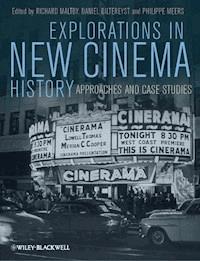
Explorations in New Cinema History E-Book
35,99 €
Mehr erfahren.
- Herausgeber: John Wiley & Sons
- Kategorie: Geisteswissenschaft
- Sprache: Englisch
Explorations in New Cinema History brings together cutting-edge research by the leading scholars in the field to identify new approaches to writing and understanding the social and cultural history of cinema, focusing on cinema’s audiences, the experience of cinema, and the cinema as a site of social and cultural exchange.
- Includes contributions from Robert Allen, Annette Kuhn, John Sedwick, Mark Jancovich, Peter Sanfield, and Kathryn Fuller-Seeley among others
- Develops the original argument that the social history of cinema-going and of the experience of cinema should take precedence over production- and text-based analyses
- Explores the cinema as a site of social and cultural exchange, including patterns of popularity and taste, the role of individual movie theatres in creating and sustaining their audiences, and the commercial, political and legal aspects of film exhibition and distribution
- Prompts readers to reassess their understanding of key periods of cinema history, opening up cinema studies to long-overdue conversations with other disciplines in the humanities and social sciences
- Presents rigorous empirical research, drawing on digital technology and geospatial information systems to provide illuminating insights in to the uses of cinema
Sie lesen das E-Book in den Legimi-Apps auf:
Seitenzahl: 770
Veröffentlichungsjahr: 2011
Ähnliche




















Contents
Notes on Contributors
Acknowledgements
Part 1 Mapping Cinema Experiences
1 New Cinema Histories
Richard Maltby
2 Reimagining the History of the Experience of Cinema in a Post-Moviegoing Age
Robert C. Allen
3 Putting Cinema History on the Map: Using GIS to Explore the Spatiality of Cinema
Jeffrey Klenotic
4 What to do with Cinema Memory?
Annette Kuhn
Part 2 Distribution, Programming and Audiences
5 Social Class, Experiences of Distinction and Cinema in Postwar Ghent
Daniel Biltereyst, Philippe Meers and Lies Van de Vijver
6 Distribution and Exhibition in The Netherlands, 1934–1936
Clara Pafort-Overduin
7 Patterns in First-Run and Suburban Filmgoing in Sydney in the mid-1930s
John Sedgwick
8 From Hollywood to the Garden Suburb (and Back to Hollywood): Exhibition and Distribution in Australia
Mike Walsh
9 Hollywood and its Global Audiences: A Comparative Study of the Biggest Box Office Hits in the United States and Outside the United States Since the 1970s
Peter Krämer
10 Blindsiding: Theatre Owners, Political Action and Industrial Change in Hollywood, 1975–1985
Deron Overpeck
Part 3 Venues and their Publics
11 ‘No Hits, No Runs, Just Terrors’: Exhibition, Cultural Distinctions and Cult Audiences at the Rialto Cinema in the 1930s and 1940s
Tim Snelson and Mark Jancovich
12 Going Underground with Manny Farber and Jonas Mekas: New York’s Subterranean Film Culture in the 1950s and 1960s
Peter Stanfield
13 Searching for the Apollo: Black Moviegoing and its Contexts in the Small-Town US South
Arthur Knight
14 Film Distribution in the Diaspora: Temporality, Community and National Cinema
Deb Verhoeven
Part 4 Cinema, Modernity and the Local
15 The Social Biograph: Newspapers as Archives of the Regional Mass Market for Movies
Paul S. Moore
16 Modernity for Small Town Tastes: Movies at the 1907 Cooperstown, New York, Centennial
Kathryn Fuller-Seeley
17 Silent Film Genre, Exhibition and Audiences in South India
Stephen Putnam Hughes
18 The Last Bemboka Picture Show: 16 mm Cinema as Rural Community Fundraiser in the 1950s
Kate Bowles
Index
Explorations in New Cinema History
This edition first published 2011© 2011 Blackwell Publishing Ltd.
Blackwell Publishing was acquired by John Wiley & Sons in February 2007. Blackwell’s publishing program has been merged with Wiley’s global Scientific, Technical, and Medical business to form Wiley-Blackwell.
Registered OfficeJohn Wiley & Sons Ltd, The Atrium, Southern Gate, Chichester, West Sussex, PO19 8SQ, United Kingdom
Editorial Offices350 Main Street, Malden, MA 02148-5020, USA9600 Garsington Road, Oxford, OX4 2DQ, UKThe Atrium, Southern Gate, Chichester, West Sussex, PO19 8SQ, UK
For details of our global editorial offices, for customer services, and for information about how to apply for permission to reuse the copyright material in this book please see our website at www.wiley.com/wiley-blackwell.
The right of Richard Maltby, Daniel Biltereyst and Philippe Meers to be identified as editors of the editorial material in this work has been asserted in accordance with the UK Copyright, Designs and Patents Act 1988.
All rights reserved. No part of this publication may be reproduced, stored in a retrieval system, or transmitted, in any form or by any means, electronic, mechanical, photocopying, recording or otherwise, except as permitted by the UK Copyright, Designs and Patents Act 1988, without the prior permission of the publisher.
Wiley also publishes its books in a variety of electronic formats. Some content that appears in print may not be available in electronic books.
Designations used by companies to distinguish their products are often claimed as trademarks. All brand names and product names used in this book are trade names, service marks, trademarks or registered trademarks of their respective owners. The publisher is not associated with any product or vendor mentioned in this book. This publication is designed to provide accurate and authoritative information in regard to the subject matter covered. It is sold on the understanding that the publisher is not engaged in rendering professional services. If professional advice or other expert assistance is required, the services of a competent professional should be sought.
Library of Congress Cataloging-in-Publication Data
Explorations in new cinema history : approaches and case studies / edited by Richard Maltby, Daniel Biltereyst and Philippe Meers.
p. cm.
Includes bibliographical references and index.
ISBN 978-1-4051-9949-0 (hardcover, alk. paper), ISBN 978-1-4051-9950-6 (paperback, alk paper)
1. Motion picture audiences. 2. Motion pictures–Distribution. 3. Motion picture theaters.4. Motion picture industry–History–20th century. I. Maltby, Richard, 1952– II. Biltereyst, Daniel, 1962– III. Meers, Philippe.
PN1995.9.A8E97 2011
302.23′43–dc21
2010051054
A catalogue record for this book is available from the British Library.
This book is published in the following electronic formats: ePDFs 9781444396393; Wiley Online Library 9781444396416; ePub 9781444396409
Contributors
Robert C. Allen is James Logan Godfrey Professor of American Studies, History, and Communication Studies at the University of North Carolina. He has written on the history of US radio and television (Speaking of Soap Operas, 1985), film history and historiography (Film History: Theory and Practice, 1985), and American popular theatre of the nineteenth and early twentieth centuries (Horrible Prettiness: Burlesque and American Culture, 1992). He is principal investigator on ‘Going to the Show’, a digital humanities project documenting and mapping the experience of moviegoing in North Carolina from 1896 to 1930 (http://docsouth.unc.edu/gtts/).
Daniel Biltereyst is Professor in Film, Television and Cultural Studies at the Department of Communication Studies, Ghent University, Belgium, where he is head of department and director of the Centre of Cinema and Media Studies. His work on film and screen culture, controversy and the public sphere has been published in The European Journal of Cultural Studies, The Historical Journal of Film, Radio and Television, Media, Culture & Society, Northern Lights, Screen, Studies in French Cinema, Studies in Russian and Soviet Cinema, and in edited collections, including Understanding Rebel without a Cause (SUNY), Communication Theory and Research in Europe (Sage), Youth Culture in Global Cinema (University of Texas Press), Watching The Lord of the Rings (Lang), Going to the Movies (Exeter UP), The Handbook of Political Economy of Communications (Wiley-Blackwell), Billy Wilder, Moviemaker (McFarland), Je t’Aime, Moi Non Plus: Franco-British Cinematic Relations (Berghan).
Kate Bowles is Senior Lecturer at the School of Social Sciences, Media and Communications, University of Wollongong, Australia. Her work has been published in Jane Austen on Screen (Cambridge University Press, 2003), Hollywood Abroad: Audiences and Cultural Exchange (BFI, 2004), The Media and Communications in Australia (Allen & Unwin, 2006), and Studies in Australasian Cinema (2007).
Kathryn Fuller-Seeley is Associate Professor of Moving Image Studies and Associate Chair of the Communication Department, Georgia State University. Her research interests include early US film exhibition, and historical audience reception studies. Publications include: Hollywood in the Neighborhood: Historical Case Studies of Moviegoing in Small Town America, ed. (University of California Press, 2007); ‘Television as gendered technology: America’s first audiences’, in The Columbia History of Television (ed. Gary Edgerton; Columbia, 2007); ‘“What the picture did for me:” small town exhibitors and the Great Depression’, in Hollywood in the Neighborhood (2007); ‘Dish night at the movies: exhibitors and female audiences during the Great Depression’, in Looking Past the Screen: Case Studies in American Film History and Method (eds Eric Smoodin and Jon Lewis; Duke, 2007); At the Picture Show: Small Town Audiences and the Creation of Movie Fan Culture (Smithsonian/Virginia 1997).
Stephen Putnam Hughes completed both his MA and PhD in Social and Cultural Anthropology at the University of Chicago, where he specialised in media history and visual anthropology with special reference to cinema in south India. He currently teaches Anthropology and Sociology at the School of Oriental and African Studies, University of London, where he is the Director of Studies for the MA programme in the Anthropology of Media. Having lived and worked in Tamil-speaking south India over the course of the last 20 years, he has conducted research on various topics related to the history of media.
Mark Jancovich is Professor of Film and Television Studies at the University of East Anglia. His publications include: The Place of the Audience: Cultural Geographies of Film Consumption (with Lucy Faire and Sarah Stubbings; BFI, 2003); Defining Cult Movies: The Cultural Politics of Oppositional Taste (MUP, 2003); Quality Popular Television: Cult TV, the Industry and Fans (BFI, 2003); Horror: The Film Reader (Routledge, 2001); The Film Studies Reader (Arnold, 2000); Rational Fears: American Horror in the 1950s (Manchester University Press, 1996); Approaches to Popular Film (Manchester University Press, 1995); The Cultural Politics of the New Criticism (Cambridge University Press, 1993); Horror (Batsford, 1992).
Jeffrey Klenotic is Associate Professor of Communication Arts at the University of New Hampshire in Manchester. His essays on cinema history and historiography have been published in journals such as Film History, The Communication Review and Velvet Light Trap, as well as in several edited anthologies and encyclopedias including The Sounds of Early Cinema, The Encyclopedia of Early Cinema and Going to the Movies: Hollywood and the Social Experience of Moviegoing. He is currently developing a research tool on moviegoing, social demography and cultural geography that takes the form of an interactive map, or Geographic Information System (GIS).
Arthur Knight is an Associate Professor of American Studies and English at the College of William and Mary in Virginia (USA), where he also directs the Film and Cultural Studies Program. He has published Disintegrating the Musical: Black Performance and American Musical Film (Duke UP, 2002) and coedited Soundtrack Available: Essays on Film and Popular Music (Duke UP, 2001). He is also the director of the Williamsburg Theatre Project, a data collection project on film exhibition and moviegoing that focuses on Williamsburg, Virginia (http://moviegoing.wm.edu/wtp/), and a founding member of the Homer Project (www.homerproject.org). He is currently at work on a book, tentatively titled, Black Star: A Cultural History of African American Fame.
Peter Krämer teaches Film Studies at the University of East Anglia. He has published essays on American film and media history, and on the relationship between Hollywood and Europe, in Screen, The Velvet Light Trap, Theatre History Studies, The Historical Journal of Film, Radio and Television, History Today, Film Studies, Scope, Sowi: Das Journal far Geschichte, Politik, Wirtschaft und Kultur and numerous edited collections. He is the author of The New Hollywood: From Bonnie and Clyde to Star Wars (Wallflower Press, 2005), and the coeditor of Screen Acting (Routledge, 1999) and The Silent Cinema Reader (Routledge, 2004). He also cowrote a book for children entitled American Film: An A-Z Guide (Franklin Watts, 2003).
Annette Kuhn is Professor of Film Studies at Queen Mary, London University. She has Bachelor’s and Master’s degrees in Sociology from the University of Sheffield and a PhD on the history of film censorship from the University of London. Her publications include: Ratcatcher (BFI, 2008), Screening World Cinema: a Screen Reader (Routledge, 2006, with Catherine Grant), An Everyday Magic: Cinema and Cultural Memory (I.B. Tauris, 2002), Screen Histories: a Reader (Oxford University Press, 1998, with Jackie Stacey), Women’s Pictures: Feminism and Cinema (Verso, 1994), Alien Zone: Cultural Theory and Contemporary Science Fiction Cinema (Verso, 1990), Cinema, Censorship and Sexuality (Routledge, 1988), The Power of the Image: Essays on Representation and Sexuality (Routledge and Kegan Paul, 1985).
Richard Maltby is Professor of Screen Studies and Executive Dean of the Faculty of Education, Humanities and Law at Flinders University, South Australia. Before moving to Australia in 1997, he was the founding Director of the Bill Douglas Centre for the History of Cinema and Popular Culture at the University of Exeter and then Research Professor of Film Studies at Sheffield Hallam University. His publications include Hollywood Cinema: Second Edition (Blackwell, 2003; Hua Xia Press, Beijing, 2005), “Film Europe” and “Film America”: Cinema, Commerce and Cultural Exchange, 1925–1939, which won the Prix Jean Mitry for cinema history in 2000, and five edited books on the history of movie audiences and exhibition history, the most recent being Going to the Movies: Hollywood and the Social Experience of Cinema (University of Exeter Press, 2007). He is Series Editor of Exeter Studies in Film History, and the author of over 50 articles and essays. With Ruth Vasey he is currently completing Reforming the Movies: Politics, Censorship, and the Governance of the American Cinema, 1908–1939. He is currently the lead investigator on two Australian Research Council Discovery projects examining the structure of the distribution and exhibition industry and the history of cinema audiences in Australia.
Philippe Meers is an Associate Professor in film and media studies at the University of Antwerp, Belgium, where he is deputy director of the Visual Culture Research Group. He has published on popular media culture and film audiences in Media, Culture and Society, Illuminace, The Journal of Popular Film and Television and Screen, and in edited collections, including Big Brother International (Wallflower Press, 2004); Hollywood Abroad. Audiences and Cultural Relations (BFI, 2004); The Lord of the Rings: Popular Cinema in Global Culture (Wallflower, 2007); Watching The Lord of the Rings (Lang, 2007), The Contemporary Hollywood Reader (Routledge, 2009), The Handbook of Political Economy of Communications (Wiley-Blackwell, 2011). With Daniel Biltereyst and Richard Maltby, he is editing Audiences, Cinema and Modernity: New Perspectives on European Cinema History (Routledge, 2011). His current research focuses on historical and diasporic cinema cultures.
Paul S. Moore is director of the Canadian Theatre Historical Project at Ryerson University in Toronto. He is coeditor of Marquee: Journal of the Theatre Historical Society of America (THSA). His essay ‘Dream Palaces that Remained Dreams: Unbuilt Chicago Theatres’, won the first prize in the THSA’s 2006 Weiss award competition. He has published several essays on the history of film exhibition and moviegoing in Canada and has presented papers at Society for Cinema and Media Studies, Domitor, Screen and other conferences. His book, Now Playing: Early Movie-going and the Regulation of Fun (Toronto 1906–1918), is forthcoming from SUNY Press.
Deron Overpeck teaches film and media studies courses in the Department of Communication and Journalism at Auburn University. His research interests include the American cinema since the end of the studio system, the relationship between the American media industry and internet journalism, and Italian cinema.
Clara Pafort-Overduin is Assistant Professor at the department of Theater, Film and Television Studies, Utrecht University, and is a founding member of ICARG (International Cinema Attendances Research Group). She is currently completing her dissertation on Dutch film and national identity in the Thirties.
John Sedgwick is Academic Leader at the Department of Economics, Finance and International Business, London Metropolitan University. He is the author of Filmgoing in 1930s Britain: a Choice of Pleasures (Exeter University Press, 2000) and editor of An Economic History of Film (Routledge, 2005, with Mike Pokorny). His work has been published in many journals, including Economic History Review, Journal of Cultural Economics, Historical Journal of Film, Radio and Television, and books including Going to the Movies: Hollywood and the Social Experience of Movie-going (2007); Americanisation in 20th Century Europe (2002); and The Unknown 1930s: An Alternative History of the British Cinema, 1929–39 (1999).
Tim Snelson is a Lecturer in Media and Culture at the University of East Anglia. His research addresses the relationship between media and social history. His publications include ‘“From grade B thrillers to deluxe chillers”: prestige horror, female audiences and allegories of spectatorship in The Spiral Staircase (1946)’, in The New Review of Film and Television Studies 7 (2), June 2009, and ‘The Ghost in the Machine: World War Two, Popular Occultism and Hollywood’s “Serious” Ghost Films’ in Media History 17:1 (January 2011).
Peter Stanfield is a Reader in Film Studies at the University of Kent, the author of Body & Soul: Jazz & Blues in American Film, 1927–63 (2005), Horse Opera: The Strange History of the Singing Cowboy (2002), Hollywood, Westerns and the 1930s: The Lost Trail (2001), and joint editor of Mob Culture: Hidden Histories of the American Gangster Film (2005). He is currently working on a book titled Maximum Movies.
Lies Van de Vijver has Master’s degrees in Arts History from Ghent University and in Film Studies from the University of Antwerp. She works as a researcher on a project entitled ‘Gent Kinemastad’ and is preparing her doctoral thesis on the film exhibition and cinemagoing in the city of Ghent.
Deb Verhoeven is Professor and Chair in Media and Communication at Deakin University in Melbourne, Australia. Her most recent publication is Jane Campion (Routledge, 2009). She is President of the online journal Senses of Cinema, and Deputy Chair of the National Film and Sound Archive of Australia.
Mike Walsh is the Head of the Screen Studies Department at Flinders University in South Australia. He has published in numerous anthologies and journals and is currently completing a book on the international distribution network established by United Artists. He has been a coordinating editor of The Velvet Light Trap and currently he is a programmer and catalogue editor for the Adelaide Film Festival.
Acknowledgements
This collection launches the ‘new cinema history’, a body of work that focuses on the circulation and consumption of film and examines cinema as a site of social and cultural exchange. The contributors have sought to consolidate and develop lines of argument advanced in a series of books edited by Richard Maltby and Melvyn Stokes, examining the history of cinema audiences, exhibition and reception. As with many of the pieces in these earlier books, the chapters in this volume were first discussed at a groundbreaking conference, held in Ghent in December 2007, under the title ‘The Glow in Their Eyes: Global Perspectives on Film Cultures, Film Exhibition and Cinema-Going’. The editors would like to thank all participants and in particular the keynote speakers, Robert C. Allen and Annette Kuhn, for contributing to the success of the conference.
We are very much indebted to all those who helped organise this event, in particular Lies Van de Vijver, Gert Willems and Carl de Keyser, the members of the Centre for Cinema and Media Studies at Ghent University, and the Visual Culture Research Group at the University of Antwerp, as well as Deb Verhoeven and Kate Bowles. We thank the Flemish Scientific Research Council (FWO-Vlaanderen), the university film-club Film-Plateau (Ghent University), and the City of Ghent for their generous support of the conference. At Wiley-Blackwell, ably aided by Margot Morse and Matthew Baskin, Jayne Fargnoli has been a model of patience and support. The editors thank Kathleen Lotze and Lies Van de Vijver for their excellent work in compiling the index.
The conference and this collection would not have been possible without the inspiration of an international group of scholars in the History of Moviegoing, Exhibition, and Reception (HOMER) project, chaired by Arthur Knight. The HOMER project, many of whose members are represented in this volume, promotes the idea that historians of the media must seek to understand what Robert Allen has called the ‘social, spatial, experiential, geographic, architectural, and cultural situatedness of cinema and media’. The editors hope that this book meets this challenge and will foster more work in this direction.
Richard Maltby, Daniel Biltereyst and Philippe Meers
Part 1Mapping Cinema Experiences
1
New Cinema Histories
RICHARD MALTBY1
History is not yet what it ought to be. That is no reason to make history as it can be the scapegoat for the sins which belong to bad history alone.
Marc Bloch (1953, p. 66)
Whenever I hear the word cinema, I can’t help thinking hall, rather than film.
Roland Barthes (1986, p. 346)
Over the past 10 years, an emerging international trend in research into cinema history has shifted its focus away from the content of films to consider their circulation and consumption, and to examine the cinema as a site of social and cultural exchange.2 This shared effort has engaged contributors from different points on the disciplinary compass, including history, geography, cultural studies, economics, sociology and anthropology, as well as film and media studies. Their projects have examined the commercial activities of film distribution and exhibition, the legal and political discourses that craft cinema’s profile in public life, and the social and cultural histories of specific cinema audiences. Many of their projects have been collaborative, facilitated by computational analysis and the opportunities for quantitative research offered by databases and Geographical Information Systems, which allow for the compilation of new information about the history of cinema exhibition and reception in ways that would previously have been too labour intensive to undertake.3 Having achieved critical mass and methodological maturity, this body of work has now developed a distinct identity, to which we have given the name ‘the new cinema history’ (Bowles et al., 2011). The aim of this collection is to showcase recent work in the field, and to illustrate the questions that the new cinema history asks. As well as providing a guide to the individual contributions, this introductory essay seeks to explain what the editors believe is new about new cinema history, and what is distinctive in its approach.
In calling this body of work new cinema history, we are deliberately distinguishing it from film history. Film history has been predominantly a history of production, producers, authorship and films. It is most often evaluative, classificatory or curatorial in its remit, and primarily concerned with understanding the complex economic, aesthetic and social systems that might cause particular films to assume the shape that they do. This activity, which has engaged historians already located within the discipline of film studies, has greatly expanded our understanding of the ‘proximate forces’ influencing the development and uses of the medium (Keil, 2004, p. 52). Borrowing its methods and rationale from the practices of art and literary history, historical work of this nature helps to decipher the complex aesthetic codes of the wide range of different cinematic traditions across the globe, drawing out both regularities and irregularities in the ways in which these different cinemas imitate or critique each other’s stylistic habits. It can, for example, explain ‘why we have dialogue hooks, montage sequences, goal-oriented protagonists, and a switch from orthochromatic to panchromatic film stock’ in Hollywood movies of a particular period (Bordwell, 2005). In its close attention to the formal and ideological properties of film as a signifying system, this form of film history can reveal the ways in which the precise and subtle conventions in this system evolve over time, or change in response to external circumstances.
Placing films into a wider historical context has proven to be more problematic, however, in part because of the sceptical attention of some other historians concerned to show that films themselves do bad historical work or fail to meet adequate analytical standards to pass as works of history. As recently as 2006, the American Historical Review (AHR) removed its regular film review section, on the grounds that movies ‘although undoubtedly useful as teaching devices, do not always contribute to an analytical, sophisticated understanding of history’.4 Sceptical historians have dismissed film as a form of historical evidence on a variety of grounds: firstly, for what Ian Jarvie has described as its ‘poor information load’, a ‘discursive weakness’ that renders it a ‘very clumsy medium for presenting argument’ and disables it from participating in debates about historical problems. Lacking historiographical complexity, film is at best, according to Jarvie, ‘a visual aid’ (Jarvie, 1978, pp. 377–8). Formany historians, moreover, it is too often an inaccurate visual aid, its imitation of the past fatally compromised by the inevitable distortions of fiction and anachronism. As Robert Rosenstone summarises this critique, films ‘fictionalise, trivialise, and romanticise people, events, and movements. They falsify history.’ (Rosenstone, 1995, p. 46). Carla and William Phillips complain that films commonly
treat the historical record as mere raw material, to be adapted to the needs of the screenplay. Chronology is expanded, compressed, reversed, or falsified to suit the dramatic trajectory. Historical personages are revised, deified or demonized, conflated or created from whole cloth to serve the director’s will. (Phillips and Phillips, 1996, p. 63)
Lesen Sie weiter in der vollständigen Ausgabe!
Lesen Sie weiter in der vollständigen Ausgabe!
Lesen Sie weiter in der vollständigen Ausgabe!
Lesen Sie weiter in der vollständigen Ausgabe!
Lesen Sie weiter in der vollständigen Ausgabe!
Lesen Sie weiter in der vollständigen Ausgabe!
Lesen Sie weiter in der vollständigen Ausgabe!
Lesen Sie weiter in der vollständigen Ausgabe!
Lesen Sie weiter in der vollständigen Ausgabe!
Lesen Sie weiter in der vollständigen Ausgabe!
Lesen Sie weiter in der vollständigen Ausgabe!
Lesen Sie weiter in der vollständigen Ausgabe!
Lesen Sie weiter in der vollständigen Ausgabe!
Lesen Sie weiter in der vollständigen Ausgabe!
Lesen Sie weiter in der vollständigen Ausgabe!
Lesen Sie weiter in der vollständigen Ausgabe!
Lesen Sie weiter in der vollständigen Ausgabe!
Lesen Sie weiter in der vollständigen Ausgabe!
Lesen Sie weiter in der vollständigen Ausgabe!
Lesen Sie weiter in der vollständigen Ausgabe!
Lesen Sie weiter in der vollständigen Ausgabe!




