


39,99 €
Mehr erfahren.
- Herausgeber: John Wiley & Sons
- Kategorie: Wissenschaft und neue Technologien
- Sprache: Englisch
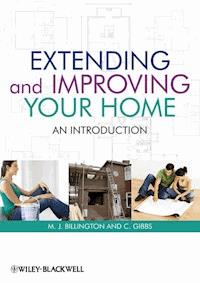
Written for small builders and tradesmen such as bricklayers and carpenters, as well as householders wanting to provide more space and enhanced living conditions without the substantial cost of moving house. While there are many books that deal with the construction aspects of extending a house, there are few sources that combine the planning, construction and regulatory aspects into one easily accessible source. Extending and Improving a Home meets that need. By focussing on specific building elements – foundations, walls, roofs, services, finishes etc – the book neatly provides a comprehensive, accessible guide to the areas of home improvement that cause most concern for householders and small builders.
Extending and Improving a Home will: Guide you through the maze of legislation that affects most building alterations and extensions; show how to go about getting a project realised in terms of design, choice of contractor and construction, successfully and to budget, and give sound technical solutions for all the elements of a project that also comply with Building Regulations.
Sie lesen das E-Book in den Legimi-Apps auf:
Seitenzahl: 424
Veröffentlichungsjahr: 2012
Ähnliche


















Contents
Cover
Title Page
Copyright
Preface
Chapter 1: Extending and Improving Your Home – An Introduction
Why Extend or Improve Your Home?
Do-it-Yourself
Extending and Improving Your Home – Practices and Procedures
Practical Design Tips
Chapter 2: Legal Background
Introduction
Planning Permission
Listed Buildings and Conservation Areas
The Building Act 1984 and the Building Regulations
Building Regulations
Competent Persons Schemes
The Party Wall Act
Energy Performance
Occupiers' Liability Act
Chapter 3: Arranging and Organising the Work
Use of Professional Designers
Getting a Builder or Doing it Yourself?
Cost Implications
Contractual Arrangements
Availability of Grants
Insurances for Contract and After
Further Information
Chapter 4: Issues Affecting the Property as a Whole
Structural Stability
Weatherproofing and Damp-Proofing the Envelope
Maintenance
Further Information
Chapter 5: Site Survey and Investigation
Site Investigation
Subsoil Investigation
Significance and Proximity of Site Boundaries
Presence and Significance of Trees
Measured Survey
Further Information
Chapter 6: Foundations
Introduction
Foundation Types
Further Information
Chapter 7: Ground and Upper Floors
Ground Floors
Upper Floors
Building Regulations and Approved Document Guidance
Further Information
Chapter 8: External Walls
Introduction
Solid Walls
Cavity Walls
Framed Wall Construction
Building Regulations and Approved Document Guidance
Further Information
Chapter 9: Internal Walls
Partition Walls
Building Regulations and Approved Document Guidance
Further Information
Chapter 10: Roofs
Roof Structure and Coverings
Roof Coverings
Other Coverings
Building Regulations and Approved Document Guidance
Design for Thermal Efficiency
Further Information
Chapter 11: Wall and Ceiling Finishes
Wall Finishes
Ceiling Finishes
Further Information
Chapter 12: Services
Introduction
Installing New Kitchens and Bathrooms
Above and Below Ground Drainage
Electrical Installations
Heating and Ventilating Services
Hot and Cold Water Supply
Further Information
Chapter 13: Improving the Thermal Efficiency of the Home
Thermal Efficiency
The Green Deal
Building Regulations and Approved Document Guidance
Further Information
Chapter 14: Conversions
What Type of Conversion
Loft Conversions
Garage Conversions
Basement Conversions
Further Information
Case Study 1: Thermal Upgrading
Elements
Heat Losses
Case Study 2: Loft Conversion
Existing Property
Proposal
Specifications
Additional Notes
Glossary of Terms
Index
This edition first published 2012 © 2012 by M. J. Billington and C. Gibbs
Blackwell Publishing was acquired by John Wiley & Sons in February 2007.
Blackwell's publishing program has been merged with Wiley's global Scientific,
Technical and Medical business to form Wiley-Blackwell.
Registered office: John Wiley & Sons, Ltd, The Atrium, Southern Gate, Chichester, West Sussex, PO19 8SQ, UK
Editorial offices: 9600 Garsington Road, Oxford, OX4 2DQ, UK
The Atrium, Southern Gate, Chichester, West Sussex, PO19 8SQ, UK
2121 State Avenue, Ames, Iowa 50014-8300, USA
For details of our global editorial offices, for customer services and for information about how to apply for permission to reuse the copyright material in this book please see our website at www.wiley.com/wiley-blackwell.
The right of the author to be identified as the author of this work has been asserted in accordance with the UK Copyright, Designs and Patents Act 1988.
All rights reserved. No part of this publication may be reproduced, stored in a retrieval system, or transmitted, in any form or by any means, electronic, mechanical, photocopying, recording or otherwise, except as permitted by the UK Copyright, Designs and Patents Act 1988, without the prior permission of the publisher.
Designations used by companies to distinguish their products are often claimed as trademarks. All brand names and product names used in this book are trade names, service marks, trademarks or registered trademarks of their respective owners. The publisher is not associated with any product or vendor mentioned in this book. This publication is designed to provide accurate and authoritative information in regard to the subject matter covered. It is sold on the understanding that the publisher is not engaged in rendering professional services. If professional advice or other expert assistance is required, the services of a competent professional should be sought.
Library of Congress Cataloging-in-Publication Data
Billington, M. J. (Michael J.)
Extending and improving your home : an introduction / M.J. Billington,
Clive Gibbs.
p. cm.
Includes bibliographical references and index.
ISBN 978-1-4051-9811-0 (pbk.)
1. Dwellings–Remodeling. 2. Building–Superintendence. I. Gibbs, Clive.
II. Title.
TH4816.B55 2012
690'.24–dc23
2011053110
Preface
In April 2008, I (MJB) was invited to provide support to the ‘Ask the Expert’ stand at the Ideal Home Show at Earl's Court in London. Being a Chartered Building Surveyor and Building Regulations expert, I was anticipating lots of questions from the public on defects in houses and on specific regulation queries. These occurred as expected but were far outweighed by the multitude of questions on altering and extending homes. It quickly became clear that because of the recession we were in a new era whereby, instead of moving house, people were now far more interested in staying put and improving. It also became clear that most people did not have the foggiest idea about what they could do and how they could go about doing it. People even brought in rough floor plans of their houses and I ended up doing off-the-cuff sketch schemes for everything from fitting a loo to designing an extension!
Thus was born the idea for this book. It is entitled Extending and Improving Your Home: An Introduction. The last two words are important because even in a book dedicated entirely to this subject, it is impossible to cover everything comprehensively. What we have done is provided a focused guide to all the areas in the field of home improvement that cause most concern for householders, and at the end of each chapter we provide sources of further information in terms of written texts and web sites. It should be noted that the sources of information provided are for information only. The authors have used these sources in the past and found them to be accurate, informative and reliable. We can make no promises that they will continue to be so in the future. Therefore, their inclusion in this book must not be taken as a recommendation or endorsement and we are, of course, not responsible for their content.
So who should purchase this book? Although it is aimed at anyone considering improving or extending a house and is written in non-technical language as far as this is possible, the technical sections can be applied to the construction of brand new homes as well as extensions. Therefore, it will be of use not only to householders but also to small builders, tradesmen such as bricklayers and carpenters, students on the first year of construction and architectural design courses at tertiary and higher education establishments and building professionals such as estate agents, building surveyors, architects and other designers.
Our aims in writing this book are to
Combining over 70 years of experience specifically in the field of home improvements and alterations, we also point out the common pitfalls that can occur and show how they can be avoided.
More specifically, in Chapter 1, the book starts by considering the pros and cons of moving house as opposed to extending or altering what you have already. It discusses the rise of DIY and considers the implications of getting someone else to do it for you. The processes and procedures of home alterations and extensions are discussed in detail and the chapter ends with a series of tips to assist you in the design and construction of your project.
Chapter 2 goes into detail on the labyrinth of legislation that applies to this sector of construction and shows what you need to comply with and how compliance can be achieved.
In Chapter 3, we look at the various ways you can arrange and organise the project to ensure that you realise your ideas successfully and do not get ripped off. And if things still go wrong, we suggest methods for ensuring recovery of the situation.
Chapter 4 looks at those issues that affect the property as a whole no matter what you intend to do, such as structural stability, weatherproofing and maintenance.
The first, general part of the book ends with Chapter 5. Here, we consider the importance of gathering information on the interior of your house and on the site outside to avoid any nasty surprises arising when the work starts.
The technical part of the book covers Chapters 6–12 and discusses each element of the work (foundations, floors, external and internal walls, roofs, external and internal finishes and services) and includes detailed examination of the Building Regulations that apply in each case.
The last part of the book provides practical guidance on specific projects. Thus, Chapter 13 looks at all the ways you can improve the thermal efficiency of your home (highly topical at present) and Chapter 14 looks at specific conversions to increase the space within your home without recourse to extending such as, loft, garage and basement conversions.
Finally, we provide two case studies. Case Study 1 demonstrates the economic advantages of improving the thermal efficiency of your home by reference to simplified calculations for a number of common upgrades.
Case Study 2 shows a typical loft conversion and points out the most important regulatory and technical considerations in what is a surprisingly difficult area of work.
It must be stressed that this book is a guide to commonly accepted construction details, techniques and methods of building. Since the authors cannot be aware of all the circumstances of a particular case, they cannot take responsibility for inappropriate use of the guidance contained in this book. Additionally, the information given on the Building Regulations throughout this book is provided as a guide to the regulations, not a substitute for them. When using an Approved Document, it should be remembered that the guidance in them is not mandatory and differences of opinion can quite legitimately exist between controllers and builders or designers as to whether a particular detail in a building design does actually satisfy the mandatory functional requirements of the Building Regulations.
We hope that by using this book, you will be able to make decisions on the basis of facts rather than feelings, hearsay or rumour. We will feel that we have done our job in writing this book if after reading it you are
The law is stated on the basis of cases and other material available to us on 1 September 2011.
M. J. BillingtonClive Gibbs
Chapter 1
Extending and Improving Your Home – An Introduction
Houses are like people. They are conceived (in the mind of the designer). Over several months they grow (during construction) and they are eventually born (when completed). They grow and have to change to meet the changing circumstances of a growing family (extra bedrooms or new conservatory) and gradually mature as they grow older. If they go out of fashion they are updated with all the latest trends (en-suite bathrooms and central heating). Sometimes they get sick (dry rot, woodworm and rising damp) and have to be cured so that their lives can be extended. Eventually they get very old and then it may be necessary to put them out of their misery (although we do not advocate euthanasia here!).
Unlike people, houses are virtually immortal and as they get very old they usually become more interesting and more loved (even if they are a bit crotchety).
There is no doubt that carrying out significant changes to your own house can be incredibly rewarding. We all have our own ideas about the sort of house we want to live in but, unfortunately, we nearly always have to buy a house that does not come up to our expectations. So then we have a choice, keep moving in the forlorn hope that we will find the perfect house, or try to make the one we are living in as near as possible to our perfect house.
It is reckoned that the three most stressful things that can happen to you in life are (in order of greatest stress)
In this book we cannot help with the first two but, hopefully, we can eliminate the stress of the third by helping you to avoid moving.
In this chapter, a few basic questions are covered, such as
Why Extend or Improve Your Home?
There are almost as many answers to this question as there are ways of actually doing the work. It is incredible to think that only 5 years ago property prices seemed that they would continue inexorably to rise by considerably more than the rate of inflation year after year. After all, it had been like this for such a long time that your house was seen (perhaps incorrectly) as not just a place to live but also as an investment. How else, the theory went, could you expect to beat inflation so easily. People tended to move rather than face the stress and strain of ‘having the builders in’ and they were often put off carrying out improvements for fear of getting ripped off by unscrupulous tradesmen and builders, and then of course there was ‘the mess’! Strangely enough, when they actually did move, they would normally replace the bathroom and kitchen and carry out a complete redecoration!
Lesen Sie weiter in der vollständigen Ausgabe!
Lesen Sie weiter in der vollständigen Ausgabe!
Lesen Sie weiter in der vollständigen Ausgabe!
Lesen Sie weiter in der vollständigen Ausgabe!
Lesen Sie weiter in der vollständigen Ausgabe!
Lesen Sie weiter in der vollständigen Ausgabe!
Lesen Sie weiter in der vollständigen Ausgabe!
Lesen Sie weiter in der vollständigen Ausgabe!
Lesen Sie weiter in der vollständigen Ausgabe!
Lesen Sie weiter in der vollständigen Ausgabe!
Lesen Sie weiter in der vollständigen Ausgabe!
Lesen Sie weiter in der vollständigen Ausgabe!
Lesen Sie weiter in der vollständigen Ausgabe!
Lesen Sie weiter in der vollständigen Ausgabe!
Lesen Sie weiter in der vollständigen Ausgabe!
Lesen Sie weiter in der vollständigen Ausgabe!
Lesen Sie weiter in der vollständigen Ausgabe!




