


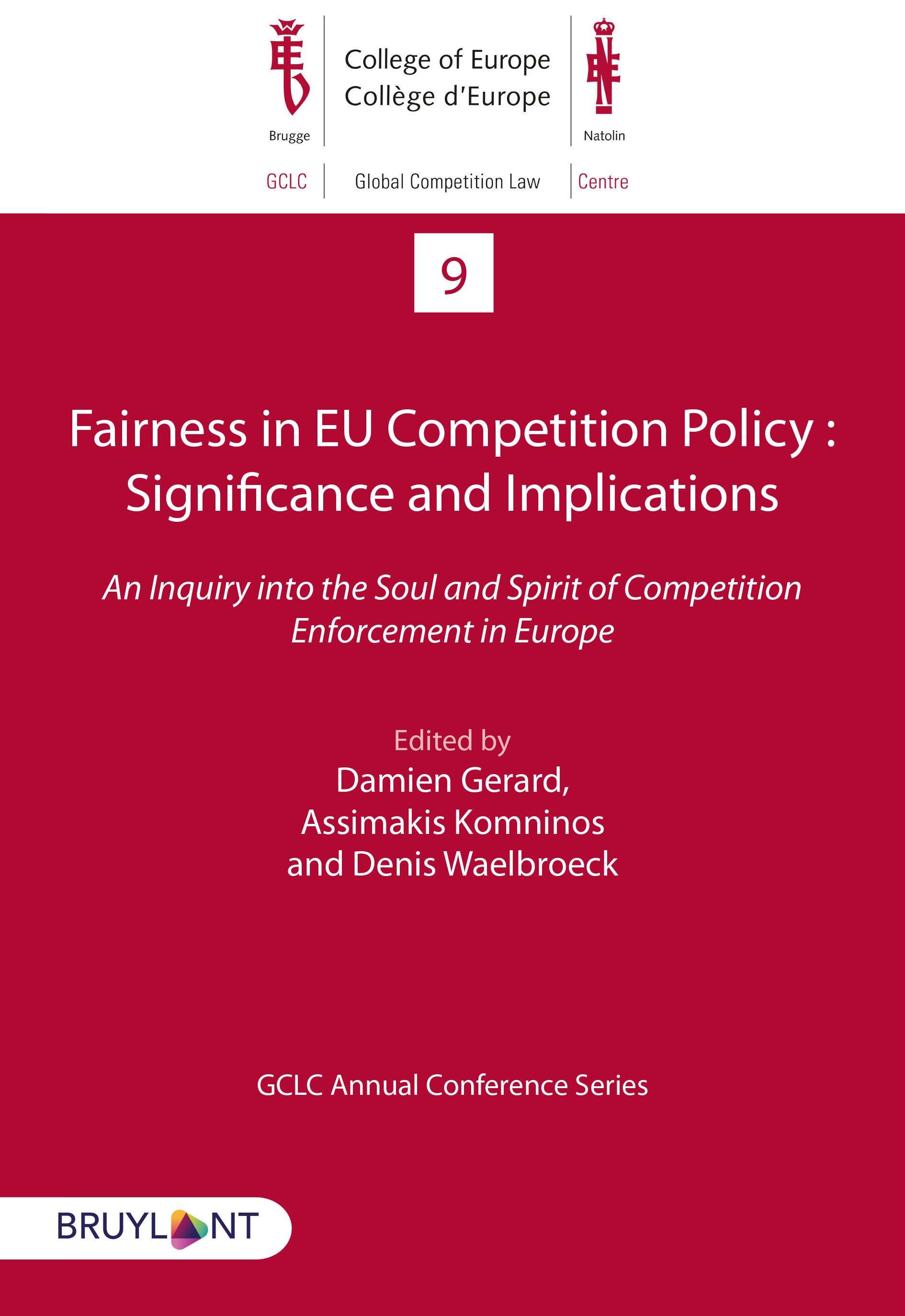
Fairness in EU Competition Policy : Significance and Implications E-Book
99,99 €
Mehr erfahren.
- Herausgeber: Bruylant
- Kategorie: Fachliteratur
- Serie: Global Competition Law Centre
- Sprache: Englisch
The idea of fairness has recently re-entered the policy discourse underpinning competition law enforcement, in the EU and beyond. Of course, the term “unfair” can be found in the EU Treaty and the avoidance of consumers’ exploitation is the ultimate aim of competition principles. Still, the boundaries of fairness as a driver of competition enforcement appear unclear and, for some, dangerously flexible. At the same time, whilst the application of competition rules has over the years been focusing on restrictions to the competitive process with the effect of harming consumers, a wave of cases recently brought or decided at EU and national level appear to be inspired by wide and somewhat elusive fairness considerations, including non-discrimination, neutrality, equality of opportunities, natural justice or avoidance of abuse of law. Reference can be made to cases relating to product design, IP licensing, geo-blocking, network neutrality, privacy concerns or fiscal justice. This volume explores how fairness may guide competition enforcement, what its significance may be in explaining recent trends and actual outcomes, and what implications can be observed or expected by relying on a fairness standard in the design of substantive principles. Associating lawyers and economists, practitioners and academics, it discusses the boundaries of fairness in a world where the rationality of markets has been profoundly shaken by recent crises.
Das E-Book können Sie in Legimi-Apps oder einer beliebigen App lesen, die das folgende Format unterstützen:
Seitenzahl: 384
Veröffentlichungsjahr: 2020
Ähnliche




















Pour toute information sur nos fonds et nos nouveautés dans votre domaine de spécialisation, consultez notre site web : www.larcier.com
© Lefebvre Sarrut Belgium s.a., 2020
Éditions Bruylant
Rue Haute, 139/6 - 1000 Bruxelles
Tous droits réservés pour tous pays.
Il est interdit, sauf accord préalable et écrit de l’éditeur, de reproduire (notamment par photocopie) partiellement ou totalement le présent ouvrage, de le stocker dans une banque de données ou de le communiquer au public, sous quelque forme et de quelque manière que ce soit.
ISBN 978-2-8027-6718-3
Table of contents
Foreword
By Damien Gerard*
Fairness and competition
By CommissionerMargrethe Vestager*
I. Competition and fairness
II. Striking the right balance with dominant companies
III. Exclusivity rebates
IV. Qualcomm
V. The Intel judgment
VI. Internal documents as evidence
Fairness in competition law and policy
By Juliane Kokott andDaniel Dittert*
I. The procedural aspects of fairness in competition cases
II. The substantive aspects of fairness in competition cases
How to avoid A fairness paradox in competition policy
By Maurits Dolmans andWanjie Lin*
I. Fairness: An imprecise moral concept
II. Objectives: “Fairness” versus “consumer welfare” as goals of competition policy
III. Benchmark: “Fairness” versus “effects” and “competition on the merits” as criteria to discern infringement
A. Competition on the Merits
B. Effect on Competition
C. Exploitative Abuses
D. FRAND – Fair, Reasonable and Non-Discriminatory
IV. Fairness versus proportionality as a benchmark for outcomes and remedies
V. Due process and the rule of law ensure fairness in competition enforcement
VI. Conclusion
“Fairness” in competition law: Nothing more than a feel-good epithet?
By Thomas Lübbig*
I. Fairness as a legal term (Germany)
II. German competition law: a smorgasbord of undefined terms in which fairness as a substantive term of legal analysis would be yet another
III. Use in communications by the FCO
IV. Review of the “equity” of pricing, notably of utilities (German Civil Code, German Antitrust Act)
V. Examples of reviewing “inequitable” behaviour in abuse cases
Unfair commercial practices and fair competition
By Jules Stuyck*
I. Unfair competition law
II. Unfair commercial practices
III. Fairness beyond the law: ethical rules
IV. Unfair contract terms: fairness by restoring the balance
V. Unfair trading practices: the same objective
VI. Fairness in commercial relations
VII. One competition law?
VIII. Some further thoughts on fairness in market law
Regulating e-commerce through competition rules: A fairness agenda?
By Helen Jenkins and Aline Blankertz*
I. Dimensions of fairness
II. Procedural fairness: trust and transparency
A. Transparency in platform-to-business transactions
B. Trust through reputation systems
III. Distributive fairness: sharing gains fairly
A. Differentiated prices
B. Unfair prices
IV. Conclusion: the relationship between fairness and efficiency
“Fairness” in article 102 TFEU
By Pinar Akman*
I. Fairness and ordoliberalism
II. EU case law
III. Notions of “fairness”
A. In General
B. Contract Law
C. The Similarity of Fairness Notions in Contract Law with Article 102 and its Implications
1. Inequality of Bargaining Power
2. Duress, Economic Duress and Undue Influence
(a) Duress and Economic Duress
(b) Undue Influence
D. EU Consumer Law
1. Unfair Contract Terms
2. Unfair Commercial Practices
Administrability of fairness standards by courts
By Marc van der Woude*
I. Legality review
II. Unlimited jurisdiction
Foreword
Damien Gerard*
“Fair competition” is referred to in the preamble of the Treaty on the Functioning of the European Union (“TFEU”) as a corollary to the elimination of barriers to trade between Member States justifying action at EU level in promotion of economic and social progress. But what does “fair” really mean when associated with “competition”, as it is in statutes enacted by various jurisdictions across the world? The question might sound utterly academic at first if it wasn’t for the pervasive references to fairness in today’s policy discourses underpinning competition law enforcement, in the EU but also beyond, and for the perception that a stream of cases recently brought or decided at EU and national level are guided by somewhat elusive fairness considerations, including non-discrimination, neutrality, equality of opportunities, natural justice or the avoidance of abuses of law. Hence, in pursuance of its mission to pool expertise and experience to shed light upon profound evolutions in EU competition policy, the Global Competition Law Center (GCLC) of the College of Europe invited practitioners and academics, enforcers and business advisers, lawyers and economists to reflect on the significance of fairness in explaining recent enforcement trends and actual outcomes, and on the implications of relying on fairness standards in applying substantive competition principles. That exercise took place on 25-26 January 2018 in Brussels on the occasion of the 13th GCLC Annual Conference.
Commissioner Vestager can be largely credited for spurring this renewed interest for a notion of fairness long overshadowed by a more technocratic vocabulary revolving around concepts of welfare, harm to competition and efficiencies. Fairness is indeed mentioned in one way or another in more than half of the Commissioner’s public remarks since 2014, and in numbers that will most probably top her three predecessors combined before the end of her mandate. Yet equally remarkable was the way former US Assistant Attorney General for Antitrust, Renata Hesse, hailed “economic fairness” as the “ultimate goal of antitrust” at a time where the Obama administration started questioning the existence of a possible causal relationship between declining competition, market entry and labour market mobility, on the one hand, and increased industry concentration and corporate profits, on the other hand. In her Georgetown speech of September 2016, Ms Hesse openly equated fairness with properly functioning competitive markets and postulated that fairness was inherent in protecting competition, thereby attempting to reconcile the popular and technocratic understandings of antitrust principles’ overarching goals. Needless to say that the resurgence of fairness in the US context elicited mixed reactions; likewise in Europe, competition professionals have displayed some discomfort at the inherently multifaceted nature and seemingly limitless reach of fairness as an enforcement principle.
In her opening address to the 13th GCLC Annual Conference, reproduced with permission in this volume, Commissioner Vestager clarified that fairness was about the social rationale of competition principles and not their application in individual cases: “[f]airness is about one of the most fundamental questions in our work – what, exactly, is competition policy for?” At a high level, competition enforcement involves complex balancing exercises between preserving businesses’ incentives to succeed and ensuring that consumers retain the possibility to arbitrate between competing options. These exercises are governed by established rules and standards, and require an in-depth assessment of legal and economic arguments. Fairness is about the outcome of these exercises: anticompetitive effects are unfair because they ultimately deprive consumers of the power to arbitrate the market place. This is fundamental, in Commissioner Vestager’s view, because the ubiquity of markets means that losing such power may significantly contribute to a general loss of trust in society and the institution tying it together, with unpredictable consequences. Markets are so much embedded in the social fabric that they have been the subject of various forms of regulations since time immemorial, and competition law can be viewed as one such form. Importantly, though, competition law is no silver bullet for solving all unfairness in society: “it doesn’t mean that just because something is unfair, it’s automatically also against the competition rules”. Yet, competition rules do contribute to ensuring faith in the allocative functions of free markets, as they lie at the core of the institutional arrangements governing our liberal society. Hence, competition principles “do [their] bit to make Europe a fairer place to live”.
DG COMP Director General Laitenberger also emphasized during the conference that references to fairness in policy discourses are not meant to replace rigorous, evidence-based analysis of individual cases, and that fairness is not an operational concept: it needs to be translated into more specific rules, standards and tests underpinned by the law, the jurisprudence, economic analysis and the painstaking establishment of the facts of each case.
Indeed, fairness as a concept can be viewed as inherently relative and open-ended, in tension with the legal certainty required for the proper functioning of markets. Likewise, there is across Europe a wide body of unfair trading practices law concerned with the protection of end-consumers and individual market participants, which belong to a different realm than competition law. Conversely, fairness as a social rationale for competition policy is sustainable as long as there is clarity about how the legal principles articulating that rationale are to be implemented in specific circumstances, e.g., by means of effects-based assessments of harm to competition. In turn, research into the legislative history of the EU rules of competition as included in the Treaties of Rome seems to confirm that fairness was not conceived at the time as an operational principle. The reference to unfair prices or trading conditions in Article 102(a) TFEU can even be attributed to an inaccurate translation of the German “unangemessen”, which literally means “inappropriate” and does not encapsulate specific fairness considerations, as explained by Thomas Lübbig. Moreover, as the conference also revealed, fairness is no operational principle under French or German competition law either, with some possible and interesting exceptions for network industries and utilities as they originated in or are still endowed with regulatory monopolies.
In the US as well, the FTC has publicly stated that the standalone enforcement of the notion of “unfair methods of competition” under Section 5 of the FTC Act would be guided by “the public policy underlying the antitrust laws, namely, the promotion of consumer welfare” and would require evidence of “harm to competition or the competitive process, taking into account any associated cognizable efficiencies and business justifications”. Thus “unfair” at an operational level amounts to “anticompetitive” under the Sherman Act, as interpreted by the US Supreme Court in cases like Brooke Group or Trinko. That does not prevent Congress to keep referring to “fair competition” in communicating to the general public about the social value of antitrust principles, including the fact that they do not entail protecting firms from competition itself. In other words, fairness can be used in different contexts as a convenient unifying concept to capture and convey the overarching objective of competition policy, thereby also accommodating different conceptions of the defining principles of justice governing social institutions, including the role and scope of government intervention.
Against this background, it would be pointless to try summarizing each of the rich and stimulating presentations to the 13th GCLC Annual Conference and of the written contributions reproduced in this volume. The remainder of this foreword therefore focuses on three recurring themes that can assist in conceptualising the significance and implications of fairness for competition policy and, by way of consequence, the social rationale ascribed to antitrust principles in today’s EU context.
Firstly, very much like the EU itself, competition enforcement originated as a technocratic enterprise with a view to serving a higher purpose but still contained in its aims and reach. Its direction was shaped by interrelated institutional, procedural and substantive dimensions, which have evolved over time. With the EU turning into an autonomous albeit contested polity, and while it only recently emerged from a profound crisis that has shaken faith in markets and continues to have severe social repercussions, relying on fairness to locate competition policy as part as the EU’s core social arrangements surfaces as both a useful and clever endeavour. At the highest level, competition policy may indeed be theorised as an institution aimed at reconciling individual and collective rationality, i.e., each entrepreneur’s efforts to maximize profits, on the one hand, and the welfare of society at large, on the other hand. To that extent, fair competition may entail that there are boundaries to profit maximisation strategies beyond which these are considered socially unacceptable by reference to certain standards of justice as articulated in antitrust principles and applied by means of an array of legal tests and enforcement rules.
From there, while naturally concerned with overall welfare effects and the recognition of businesses’ contribution thereto, this basic fairness rationale emerges as an interesting epistemological tool to recognise the particular sensitivity of cases involving the ownership and use of specific rights and resources granted by society, including the actions of (former) de jure monopolies, the monetisation of IP rights or the operation of regulatory processes, including the reliance on possible loopholes therein, but also public compensations. That particular sensitivity rooted in the balancing of public and private interests may then translate into a possible gradation in the level of harm to competition justifying findings of infringement. Conversely, fairness suggests that the special responsibility ascribed to dominant firms in Europe may be construed as a relative concept whereby those who contribute most to society may claim a larger share of the wealth pie, including of the value along the value chain. In turn, it may also support heightened scrutiny of the dealings of those market players who have achieved levels of prominence making them socially unassailable.
At the end, references to fairness in recent competition policy discourses appear to have been widely perceived as an invitation to take a step back from discussions of the subtle nuances of individual legal tests or the respective merits of economic models to reflect on the wider context and relevance of competition policy, in recognition of the fact that justice principles conveyed by the notion of fairness (or otherwise) may serve to adjust individual outcomes within the boundaries of the law. Hence, while Commissioner Vestager underlined the role that fairness may play in determining enforcement priorities, the acknowledgment that fairness does not mandate particular legal standards but pertains to the social rationale of competition policy also informs the exercise of the discretion permissible under established legal standards. Thus, instead of weakening legal certainty, the candid exposure of the fairness rationale underlying competition principles, as sketched out hereinabove, is due to increase the predictability of individual assessment.
In closing, it is quite remarkable that while discussing fairness over two consecutive days the GCLC conference did not specifically echo discussions ongoing in the US over the direction of antitrust enforcement and the alleged failure of the consumer welfare standard, as claimed by the tenants of the “New Brandeis School”. There seems indeed to be a tendency to approximate the EU fairness conversation with renewed attention in the US for issues of economic concentration and the proposition that they originate (at least in part) in lenient antitrust enforcement rooted in unduly conservative legal standards. One may only speculate about the possible difference in perception on both sides of the Atlantic as to the connection between fairness and the alleged limitations of the consumer welfare standard, aside from any hypothetical consensus between Commissioner Vestager and Justice Brandeis over the centrality of markets as the primary institutions where individuals experience freedom (or lack thereof) in their daily lives.
For example, the EU fairness conversation does not seem to advocate a departure from an effects/outcomes-based approach to determinations of harm to competition. Fairness rather emerges as an alternative way to capture enforcement outcomes, and one that is not anathema to efficiency considerations. Possibly, the different perception also arises from different starting points in the respective discussions; while the EU settled in for a broad understanding of the notion of consumer welfare concerned with all plausible static and dynamic effects, the US is often presented as having adhered over the years to a narrower understanding of that standard, partly informed by normative assumptions about the robustness of markets and the virtues of monopoly rents. From a EU point of view, it is tempting to see in the claims formulated by the New Brandeis School a subtle plea for convergence with the kind of holistic approach developed in Europe and the prevailing trust in competition over monopolies in delivering optimal outcomes, even though that approach is fundamentally independent of fairness considerations. Finally, one cannot fully dismiss a certain discomfort in Europe with certain US-centred doctrinal debates that come across as partly detached from enforcement realities and the complex trade-offs involved in establishing harm to competition. At the end, independently of labels and removed from policy discourses, the crux of the antitrust discipline lies indeed in dialectic and iterative exchanges over the substance of cases with a view to assessing the (likely) welfare effects of business practices restricting competition, according to justiciable process rules and within the boundaries set by enabling statutory provisions.
*
By subjecting fairness to the scrutiny of the antitrust community at large, the organisers of the 13th GCLC Annual Conference at least hope to have contributed to fostering a better understanding of some of the variables capable of affecting enforcement trends and individual outcomes, as well as their significance and implications. This edited volume containing written accounts of various contributions to the conference is designed to enable readers to delve deeper into this wide-ranging topic. Utmost gratitude goes to their authors for their commitment to this project, and their patience. This volume would have never seen the light without the invaluable support of Joanna Hornik and Lina Restivo who took charge of the practical – and flawless – organisation of the 13th GCLC Annual Conference.
* Director, Global Competition Law Center (GCLC); Visiting Professor, College of Europe and University of Louvain. All views are personal. Reactions and inquiries welcome at [email protected].
Fairness and competition
CommissionerMargrethe Vestager*
Ladies and gentlemen
It’s a great pleasure to be with you all today.
I’m especially glad to join you to look at one of the most fundamental questions in our work. What, exactly, is competition policy for?
That isn’t a question we ask ourselves every day. But from time to time, it pays to give it some thought. It’s a bit like knitting. When you knit, you spend most of the time following a pattern, moving forward one stitch at a time. But however satisfying that may be, you still need to know that your work has a purpose. That when it’s done, you’ll end up with a sweater, or a scarf – or maybe an elephant.
And the fact is, the competition rules aren’t there just because we think that competition is a good thing in itself. Like any of the other rules that govern our world, we have competition rules because we believe they make our society a better place to live. That they make our markets work more fairly for consumers.
I. Competition and fairness
In the Louvre in Paris there’s a large black stone, shaped a bit like a finger, and nearly four thousand years old. That stone records the laws of the Babylonian king, Hammurabi. There are rules about marriage and taverns and crime – those are separate subjects, just to be clear. There are also rules that are there to regulate the market.
Because for millennia, rulers have seen it as part of their job to make sure that markets work fairly for everyone. They’ve known it was dangerous to fail in that responsibility. Because when people feel cheated by the market, they very easily lose trust in their whole society.
The Code of Hammurabi sets out to make sure the market works fairly by regulating the prices for things like hiring a ferryboat. Those regulations, of course, could produce mixed results. But today, we have a more refined answer to that question of how to make markets fair – an answer that includes the competition rules.
Because we know that competition gives consumers the power to demand a fair deal. To shop around to find a better price, or a wider choice of products. To seek out better quality, whatever that means to them – whether it’s a more reliable car, or a social network that protects their private data better.
That doesn’t mean that we at the Commission see ourselves as superheroes, solving all unfairness, and righting every wrong. It doesn’t mean that just because something is unfair, it’s automatically also against the competition rules. All it means is that simply by doing our job – simply by enforcing the competition rules in our Treaty – we do our bit to make Europe a fairer place to live.
II. Striking the right balance with dominant companies
I say “simply”, but applying the competition rules is often anything but simple. Because the very same things that make competition work can also end up undermining it. The very same desire to outdo their rivals, which drives companies to innovate and cut their prices, can also encourage them to try to shut down competition.
So we have a balance to strike.
We should welcome, and encourage, the drive to succeed – as long as it works in a way that’s good for consumers. Because when companies compete and succeed on their own merits – when they grow and make profits by serving customers better – then competition is working the way that it should.
That’s why we’ve never objected to the success of Google’s search engine. Google has more than 90% of the market for Internet searches in the EU. But that success doesn’t mean that the market isn’t working. Quite the opposite. It means there are rewards for companies that innovate and compete. Rewards that encourage other companies to try to do the same.
And as long as those markets stay open for competition, even the most dominant company can’t be sure to have everything its own way. Even a company as powerful as Google has to reckon with the chance that something better might come along. It has to keep working to serve customers better.
So the real problem comes when dominant companies misuse their power. To avoid the risk that competition will disrupt their business, just as they once disrupted others. To close down the routes that other companies can use to challenge them with new, more innovative products.
III. Exclusivity rebates
So we need to step in, for example, when powerful companies try to stop their rivals breaking into the market, by blocking their access to customers. And that strategy can be most effective when it hits customers in their pockets – when, for example, they get a rebate in return for an exclusive relationship with the dominant company.
The issue for us isn’t the rebate itself. We obviously don’t object to companies cutting prices. But these rebates can be the price of an exclusive relationship – the price of keeping rivals out of the market. And losing the rebate can be the threat that makes that exclusivity stick. Because the moment that a buyer tries out a different supplier, that can cost it the rebate on everything else it buys.
IV. Qualcomm
And that can be a real problem for companies that want to break into the market, or grow.
Just yesterday, we decided to fine Qualcomm 997 million euros for making payments to Apple in return for Apple’s agreement to buy exclusively from Qualcomm.
Qualcomm is by far the world’s biggest maker of baseband chipsets – and those chips are at the heart of every smartphone, and many tablets as well. Baseband chipsets allow devices to connect to the network. They’re the difference between a mobile device and a rather pretty paperweight.
And the payments that Qualcomm gave in return for exclusivity hurt competition, by shutting out its rivals.
The main rival involved in this case was Intel, which was trying to compete in the market for baseband chipsets. And it had a chance of landing an important customer. Apple was seriously thinking about switching from Qualcomm to Intel for some of the chips it bought. That would have been a big breakthrough for Intel. Apple is one of the biggest makers of smartphones in the world, and where Apple leads, other companies often follow. Winning part of its business would have been a big success in itself. But it could also have been a step towards supplying more chips for Apple – and maybe other makers of smartphones and tablets as well.
But in the end, Apple decided not to make the change at that time. Because the chance to try out a new chip supplier wasn’t worth the cost of losing the rebate on all the chips it got from Qualcomm. So in the end, Intel lost out on the order – and consumers lost the benefit of real competition to produce cheaper, better chips.
Things have changed since then. As it got towards the end of the arrangement with Qualcomm – and as our investigation was going on – Apple did start to use Intel chips. Reports say that last year, after the end of the arrangement, Apple got about half its chips from Intel. So without the exclusive deal, the market has opened up. But consumers would have benefited even more if that had happened years ago.
V. The Intel judgment
We’ve taken that decision just a few months after the European Court of Justice gave its judgment in another case on exclusivity rebates.
In 2009, it was Intel that had given these rebates. At the time, its rival, a company called AMD, was making excellent products that consumers wanted. But AMD couldn’t make headway with the big computer makers. In one case, it even offered to supply one million free chips to a computer maker. And that company said no. Because it didn’t want to lose its rebate from Intel.
The Court’s judgment has clarified how we should look at this sort of exclusive rebate arrangement. It’s made clear that the Court understands very well how much harm these arrangements can do to competition. So its judgment confirmed the basic rule – that we can presume that this sort of rebate, from a dominant company, is against the competition rules.
But the Court has also made clear that our work doesn’t necessarily stop there. It’s explained that a company can come to us with concrete evidence, trying to show why a particular exclusivity rebate doesn’t harm competition. And if that evidence is substantial enough, then it’s up to us to examine whether this particular rebate, in this particular situation, can shut out companies that are just as efficient as their dominant rival.
In the last few months, we’ve looked very closely at how this judgment affects what we do. And in practical terms, our main conclusion is that you won’t see fundamental change.
Because for us, there’s nothing new about looking at the effects of a rebate before we decide to take action. We’ve been doing that for many years, to help us focus our work on the cases where consumers will benefit the most. In the case of Intel, for instance, the Commission looked in detail at the harm Intel’s actions had done – including whether the rebates could shut out competitors with costs just as low as Intel’s.
To do that, we used a so-called “as efficient competitor test”, with a detailed analysis of costs, prices and quantities. But in other situations, there could be more appropriate ways to show the effect that an exclusivity rebate has. And although the Court has clarified the legal framework for these tests, it’s left it up to us to decide on the best method in each case.
For instance, in our decision against Qualcomm, we looked at a whole series of factors. That included direct proof from Apple’s internal company documents that the payments from Qualcomm did affect its decisions. At the same time, Qualcomm itself presented us with an as efficient competitor test. But there were serious problems with the way it was done, which meant it didn’t actually prove that the rebates couldn’t harm competition.
VI. Internal documents as evidence
The thing is, there’s no one gold standard that always gives the best indication of how a company’s actions affect competition.
In the case of Qualcomm, for instance, the internal documents we got from Apple gave us an understanding that we could never have achieved just by looking at prices and costs. And that sort of evidence was also important to our decision last year to fine Google nearly two and a half billion euros, for favouring its own comparison-shopping service in search results. Those documents made it clear that Google knew its own service wasn’t doing well – and that it decided to show that service more prominently in search results, whilst demoting those of its rivals.
Internal documents can be important for complex mergers too. Last year, when we looked at the merger between Dow and DuPont, the companies’ own documents helped to prove that the merger would reduce their research efforts. And in 2016, internal documents showed us that the merger between Wabtec and Faiveley wasn’t likely to reduce competition for complete train braking systems.
So these internal documents can help us make better decisions. They can help us understand the markets, and the companies’ plans for the future.
But of course, in a merger case, timetables are short. We know businesses face serious pressures of time. That’s why we’ve decided to start preparing a set of best practices on these requests for internal documents in merger cases, which we aim to publish in the coming months. So we can help businesses handle these requests more efficiently – without compromising on our responsibility to protect consumers.
*
Because in the end, that’s what the competition rules are for. Not to stop companies succeeding on their own merits. Not to switch off the competitive spirit. But to make sure that our markets stay competitive enough to give consumers the power to demand a fair deal.
Talking of fairness like that doesn’t make us Don Quixote. Nor does the fact that we take such a lot of decisions about windmills – including the Greek plan we approved a few weeks ago to help cut the cost of supporting renewable energy. It’s not our job to rush around looking for people to rescue, getting involved in anything that looks like it might be unfair.
On the contrary. In our work on competition, like any good knitter, we have a pattern to follow. We have principles, rules, ways of analysing the data that lawyers and economists have been working on for decades.
And that’s the way we make Europe a fairer place. Not by tilting at windmills. But by sticking to our knitting.
Thank you.
* European Commissioner for Competition. Conference opening speech reproduced with permission.
Fairness in competition law and policy
Juliane Kokott andDaniel Dittert*
Discussing fairness issues seems to be very fashionable these days, but there is also a genuine – and growing – need in our society to address fairness concerns and to resolve fairness problems in all kinds of contexts.
For instance, the fight against tax evasion has become a top priority for political leaders around the globe in recent years, not least because the general public is increasingly concerned about the perceived “unfairness” of our taxation system as it currently stands or, at least, as it is currently enforced.1
Moreover, the concept of “fair trial”, which is one of the cornerstones of our European system of fundamental rights,2 has a long-standing tradition in the jurisprudence of national and supranational courts all over Europe.3
Although everybody seems to have some basic idea of what fairness is about, the concept of fairness as such remains pretty vague. It implies the balancing of conflicting interests – an exercise that appears to be simple and almost self-explanatory in the abstract but can turn out to be quite difficult to perform in concrete cases.
If we had to apply the concept of fairness as such, in our day-to-day practice, we would possibly create more problems than we would solve, especially in terms of legal certainty. However, it is useful to acknowledge that fairness considerations are the driving principle behind many pieces of modern legislation, be they national or supra-national, and the concept of fairness therefore needs to be borne in mind when interpreting the specific rules making up the law governing a given sector.
When talking about fairness in competition law and policy, it needs to be stressed from the outset that the very existence of common competition rules is a token of fair treatment of all undertakings active on the EU’s internal market, since those rules create a “level playing field”, that is to say, a framework which must be observed by everyone and which, at the same time, guarantees equal treatment and equal opportunities for all.
When taking a closer look, two main aspects spring to mind: on the one hand, competition rules are supposed to ensure fair commercial practices of undertakings vis-à-vis their competitors, their upstream and downstream business partners, and of course the consumer. On the other hand, competition authorities and competition courts must respect some basic considerations of fairness when enforcing the rules of the game against individual players active on a given market.
I. The procedural aspects of fairness in competition cases
As far as procedure is concerned, there exist some well-established principles in EU competition law which aim at ensuring fair treatment of companies both by the competition authorities and by the courts, be it at the national level or at the EU level. One very well-known example is certainly the general principle according to which administrative proceedings must be handled impartially and concluded within a reasonable time-frame. That principle, together with the rights of defence, constitutes the core of the right to good administration.4
Similar procedural safeguards apply when it comes to judicial review of administrative decisions: the impartiality of the judges, the appropriate length of the proceedings over which they preside, the equality of arms between the parties, and the rule that all parties need to be heard (“audi alteram partem” in Latin, or “principe du contradictoire” in French), are only a few well-known emanations of procedural fairness in court proceedings.5
In recent years, the European Court of Justice has clearly shown that it intends to enforce such fundamental procedural principles in order to ultimately ensure the fair treatment of all companies involved in competition proceedings. To name only a few examples: the Court found that various competition proceedings had been excessively long,6 it annulled two Commission decisions in the Solvay cases7 due to the breach of the right to access to the file, it circumscribed the Commission’s powers of inspection on companies’ premises in Deutsche Bahn8 and, in its Intel appeal judgment,9 it held that the Commission needed to record and keep track of all interviews with individuals in the course of competition investigations,10 be they formal or informal.
However, it should be recalled in this context that the concept of fairness – including procedural fairness – always implies a delicate balancing exercise. A typical example of how the conflicting interests at stake need to be reconciled is the jurisprudence on formal requests for information addressed to companies by decision of the European Commission.11 While it is true that undertakings must never be compelled to admit their own anticompetitive conduct, there is no such thing as an absolute right to silence on the part of those under investigation in EU competition proceedings. In fact, the undertakings concerned are obliged to cooperate with the Commission and to provide all facts and documents in their possession which are relevant for the purpose of the investigation. Another example for this balancing exercise is the Court’s jurisprudence on excessive length of proceedings: the Court made it clear that an infringement of the principle of appropriate duration does not lead to the annulment of the first instance judgment or of the administrative decision, but can give rise to modest claims for damages.12
II. The substantive aspects of fairness in competition cases
Turning to the substantive aspects of fairness, one should first recall the reasons why competition rules exist in market economies. In fact, it is commonly accepted that the smooth functioning of markets may be impaired not only by government intervention but also by unfair commercial conduct of private undertakings, not least by the conduct of large companies that hold important market shares.
There are rules for every game, and there must be sanctions for foul play. Competition legislation aims at ensuring just that: all undertakings active on the internal market of the EU must abide by the rules of fair play, and that is precisely why we prosecute cartels (Article 101 TFEU) as well as abuses of dominant positions (Article 102 TFEU) in the European Union, why we make sure that mergers do not significantly impede effective competition (EU Merger Regulation),13 why we impose strict limits on the granting of state aid by national governments (Articles 107 and 108 TFEU), and why we have created regulators for recently liberalised sectors where market forces alone cannot – or not yet – produce fair results for the consumer (e.g. telecoms, energy).
We go to all these efforts because we are convinced that our society in general, and consumers in particular, would be worse off in terms of prices and product choice if we did not make sure that all market players respect the rules of free and effective competition.
It is, of course, never an easy task to strike the right balance between the public interest in free and effective competition, on the one hand, and the private interest of undertakings to maximise their profit and strengthen their position on the market, on the other hand. How much effort and economic analysis is required in each case to support the finding that an agreement between undertakings or the commercial practice of a dominant undertaking is anticompetitive and, therefore, falls foul of the rules of “fair play” on the market? That question has probably been the main battleground of European antitrust law over the last decade.
It is the conventional wisdom that certain types of commercial conduct – such as price-fixing cartels – should be considered to be “per se” restrictions of competition, that is to say, there will be no need to show any specific economic evidence of their harmful nature in a given case. Those practices are illegal, just as driving a car under the significant influence of alcohol or drugs is always forbidden, even if nobody gets hurt.14 It would be an outright waste of resources to oblige prosecutors to come up with hard evidence of the harmfulness of such conduct in every single case, which would in turn be likely to result in under-enforcement.
In recent years, however, the Court of Justice has seized the opportunity to clarify that the category of “per se” restrictions remains the exception and may not be interpreted too extensively. The Court explained so in Cartes Bancaires15 with regard to a complex cooperation agreement between several financial institutions in the field of Article 101 TFEU, and a very similar approach was followed in the context of Article 102 TFEU, when the Court annulled the General Court’s judgment in the famous Intel16 case on fidelity rebates granted by a dominant company.
But we should not let ourselves be deceived: Cartes Bancaires and Intel do not mean that the category of “per se” restrictions of competition has disappeared from European competition law. Hard-core cartels are still illegal, no matter what economic impact they actually have, and the granting of fidelity rebates is still a very strong indication of abusive conduct by a dominant undertaking, regardless of whether competitors have actually been squeezed out of the market or not.
What is new, however, is the Court’s increased attention to the context in which the incriminated commercial conduct takes place. From that perspective, one might say that a slight shift in balance between the public and the private interests at stake has occurred. Time will tell whether that shift turned out to be in the interests of competition enforcement in general and of consumers in particular.
The likely result of Intel is that non-rebuttable presumptions may have ceased to exist in the realm of Article 102 TFEU, at least as far as rebate systems are concerned.17 From now on, the Commission will have to counter all relevant arguments which a dominant undertaking may put forward in order to defend itself against charges of abusive conduct. And the General Court will have to review the Commission’s answer to these arguments, probably by examining the plausibility of the Commission’s reasoning. As a consequence, fidelity rebates post-Intel will be treated no differently from any other type of pricing conduct by dominant undertakings.
Admittedly, some spectators or practicioners might be tempted to go much further and interpret the Intel appeal judgment in such a way as to oblige the Commission and the General Court to always come forward with a complex economic analysis – notably in the form of the infamous “As Efficient Competitor Test” (AEC-Test) –18 in order to prove the harmful nature of fidelity rebates granted by dominant companies. In our opinion, however, that would be a pretty hasty conclusion,19 and it would turn the delicate balance between public and private interests in this complicated area upside down. Under-enforcement would be the likely result.
What the Intel appeal judgment does say is, simply put, that fidelity rebates must be “capable of restricting competition”20 in the context of a given case. To that end, the Commission needs to examine “the possible existence of a strategy aiming to exclude competitors that are at least as efficient as the dominant undertaking from the market”.21 That in itself is not really new and does not appear to be the fruit of any kind of “effects-based approach”, since it remains unnecessary to prove that such a strategy on the part of the dominant company really existed and that it did actually drive a competitor out of the market.
The AEC Test appears to have been mentioned by the Court in the Intel appeal judgment because the Commission itself had chosen to carry out such a test in the case at hand, while Intel had tried to counter the results of that test with alternative calculations.22
It is certainly too early days to draw any definite conclusions from the Intel appeal judgment. The case is now once again pending before the General Court. And it is not at all excluded that the Intel saga might end up before the Court of Justice again, in a second appeal procedure.
* Juliane Kokott is Advocate General at the Court of Justice of the European Union; Daniel Dittert is a Head of Unit and former legal secretary. Both are expressing their personal opinions in this chapter, which expands on a speech given by Juliane Kokott, with the support of Daniel Dittert, at the 13th Annual Conference of the GCLC in Brussels on 25 January 2018.
1 See J. Kokott, “Der EuGH als Garant fairen Steuerwettbewerbs”, 11 Internationales Steuerrecht 2017, p. 395 (on the role of the European Court of Justice in safeguarding fair competition in the field of taxation).
2 Art. 6(1) of the European Convention on Human Rights and Art. 47(2) of the Charter of Fundamental Rights of the European Union.
3 See J. Kokottand W. Rosch, “Procedural Fairness in the European Union Courts”, in Procedural Fairness in International Courts and Tribunals (A. Sarvarian, R. Baker, F. Fontanelli and V. Tsevelekos eds), London, British Institute of International and Comparative Law, 2015, pp. 311-324.
4 That right is nowadays also enshrined in Art. 41 of the Charter of Fundamental Rights.
5 See also Art. 47 of the Charter of Fundamental Rights.
6 As regards the length of the administrative proceedings, see ECJ, FEG v. Commission, C-105/14 P, EU:C:2006:592, pts 35-62; as regards the length of the judicial proceedings at first instance, see – among many others – ECJ, Gascogne Sack Deutschland v. Commission, C-40/12 P, EU:C:2013:787, pts 97-102.
7 ECJ, Solvay v. Commission, C-109/10 P, EU:C:2011:686, and Solvay v. Commission, C-110/10 P, EU:C:2011:687.
8 ECJ, Deutsche Bahn v. Commission, C-583/13 P, EU:C:2015:404.
9 ECJ, Intel v. Commission, C-413/14 P, EU:C:2017:632, pts 90-91, read together with pt 84.
10 See Art. 19 of Council Regulation (EC) No 1/2003 and Art. 3 of Commission Regulation (EC) No 773/2004.
11 ECJ, Orkem v. Commission, 374/87, EU:C:1989:387, pts 29-35; ECJ, Dalmine v. Commission, C-407/04 P, EU:C:2007:53, pt 34; CFI, Mannesmannröhren-Werke v. Commission, T-112/98, EU:T:2001:61, pts 62-67.
12 See, for instance, EJC, European Union v. Gascogne Sack Deutschland and Gascogne, C-138/17 P and C-167/17 P, EU:C:2018:1013.
13 Council Regulation (EC) No 139/2004 of 20 January 2004 on the control of concentrations between undertakings (OJ 2004, L 24, p. 1).
14 See Opinion of Advocate General Kokott in case T-Mobile Netherlands, C-8/08, EU:C:2009:110, pt 47.
15 ECJ, Groupement des cartes bancaires v. Commission, C-67/13 P, EU:C:2014:2204, in particular pt 57; see also, more recently, ECJ, Coty Germany, C-230/16, EU:C:2017:941.
16 ECJ, Intel v. Commission, C-413/14 P, EU:C:2017:632, in particular pts 138-150.
17 See D. Dittert, “Abus de position dominante en matière de rabais de fidélité: une jurisprudence « précisée » en termes de compétence, de procédure et, surtout, d’analyse économique”, 3 Revue des affaires européennes 2017, pp. 583-588 (587).
18 Simply put, the AEC-Test is supposed to indicate whether, in a given case, a competitor whose business is as efficient as that of the dominant company would have been able to counter the rebates granted by that company. If the competitor would not have been able to do so, the rebates will be considered to be abusive.
19 See also the contribution of Commissioner M. Vestager in thepresent volume, “Fairness and Competition (Speech at the 13th Annual Conference of the GCLC in Brussels on 25 January 2018)”: “[…] in other situations, there could be more appropriate ways to show the effect that an exclusivity rebate has. And although the Court has clarified the legal framework for these [AEC] tests, it’s left it up to us to decide on the best method in each case”.
20 ECJ, Intel v. Commission, C-413/14 P, EU:C:2017:632, in particular pts 143, 147 and 149.
21 ECJ, Intel v. Commission, C-413/14 P, EU:C:2017:632, in particular pt 139.
22 ECJ, Intel v. Commission, C-413/14 P, EU:C:2017:632, in particular pts 142, 143 and 145.
How to avoid A fairness paradox in competition policy
Maurits Dolmans andWanjie Lin*
Recent speeches by antitrust enforcers put “fairness” at the heart of competition policy. Former US Assistant Attorney General for Antitrust Renata Hesse referred to “promot[ing] the interests of the public over the power of the few” and “the ultimate goal of antitrust, economic fairness.”1




