


1,99 €
Mehr erfahren.
- Herausgeber: Quickie Classics
- Kategorie: Gesellschafts- und Liebesromane
- Sprache: Englisch
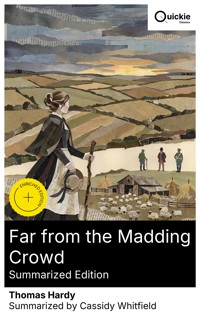
Set in Hardy's Wessex, Far from the Madding Crowd follows Bathsheba Everdene—newly independent mistress of Weatherbury farm—and three men who orbit her: steadfast Gabriel Oak, haunted farmer William Boldwood, and dazzling Sergeant Troy. The novel renews the Victorian pastoral through granular detail, an ironic yet compassionate narrator, and motifs in which weather, toil, and chance govern fate. Its serially crafted design moves from festivity to catastrophe to chastened balance, fusing lyric description with social critique of gendered autonomy, agrarian economies, and surveillance. Hardy, a Dorset-born former architect, absorbed village cadences while surveying churches and lanes, then transmuted them into his mapped realm of Wessex. Written in 1874, his first success channels anxieties about modernization and class mobility, inflected by a Darwinian sense of contingency. Sympathy for working people, technical knowledge of husbandry, and fascination with moral luck yield the book's distinctive blend of fatalism and tenderness. This British Classics Series volume suits readers seeking a classic lucid and profound: students of Victorian culture, lovers of nature writing, and anyone curious about the early modern heroine. Read it for indelible set pieces—the storm, the shearing, the market—and linger for its exacting psychology and humane wisdom, which render Hardy's world startlingly contemporary. Quickie Classics summarizes timeless works with precision, preserving the author's voice and keeping the prose clear, fast, and readable—distilled, never diluted. Enriched Edition extras: Introduction · Synopsis · Historical Context · Author Biography · Brief Analysis · 4 Reflection Q&As · Editorial Footnotes.
Das E-Book können Sie in Legimi-Apps oder einer beliebigen App lesen, die das folgende Format unterstützen:
Veröffentlichungsjahr: 2026
Ähnliche



















Far from the Madding Crowd (Summarized Edition)
Table of Contents
Introduction
At the heart of Thomas Hardy’s Far from the Madding Crowd lies the restless negotiation between individual desire, communal obligation, and the unruly forces of the natural world, where love, livelihood, and reputation are tested not only by human will but by seasons, accident, and time; set in a closely knit rural district whose rhythms shape every choice, the novel follows people whose ambitions and vulnerabilities collide with tradition, labor, and weather, revealing how courage and tenderness can coexist with vanity, stubbornness, and misreading, and how freedom claimed in one sphere can exact an unforeseen cost in another.
Far from the Madding Crowd is a Victorian realist novel with strong pastoral and romantic elements, first published in 1874. Its action unfolds in Hardy’s Wessex, a fictionalized region of southwest England that draws on farms, downs, and market towns to create a living social landscape. The book balances scenes of agricultural work with courtship, comic interludes with sober reflection, and local speech with a poised, observant narrative voice. Written early in Hardy’s career, it established the imaginative territory he would explore thereafter, marrying meticulous attention to rural life with moral inquiry into choice, chance, and the consequences of decision.
At its outset, the story introduces Bathsheba Everdene, a spirited young woman who comes into responsibility for a farm, and Gabriel Oak, a capable shepherd whose fortunes swiftly turn. Their paths intersect with a respected neighboring farmer and a striking soldier, whose presences complicate affection, duty, and pride. Hardy’s narrator moves with steady assurance between panoramic description and intimate interiority, allowing humor to sit beside foreboding without melodrama. Readers encounter vivid scenes of husbandry, village custom, and seasonal crisis that feel earned rather than sensational, while dialogue shaped by class and place underscores how words, gestures, and silence can carry different weights.
The novel examines how independence is asserted and negotiated, especially when a woman holds authority in a milieu accustomed to male proprietors. Bathsheba’s management of land, workers, and reputation becomes a lens on leadership, desire, and the costs of self-definition. Around her, forms of love—steadfast, possessive, impulsive—press upon the limits of consent, patience, and ethical responsibility. Class position and economic fluctuation shape choices as much as temperament, while the community’s watchful eyes magnify missteps and rewards. Hardy’s attention to practical labor—shearing, sowing, marketing—anchors abstract questions in concrete tasks, reminding readers that emotion unfolds alongside work, weather, and the daily arithmetic of survival.
Nature in this book is neither backdrop nor ornament but a system with its own tempos and demands, indifferent to human hopes and yet constantly shaping them. Sudden storms, droughts, and harvest windows create pressures that reveal character more surely than declarations. Hardy’s descriptive art dwells on hedgerows, barns, and night skies, but it also registers the logistics of labor, the choreography of many hands acting in concert. The result is a pastoral that refuses complacency, where beauty and peril coexist. Chance events are not supernatural turns but ordinary hazards magnified by circumstance, inviting reflection on prudence, resilience, and the ethics of preparedness.
For contemporary readers, the novel’s questions feel urgent: What does it mean to choose freely within social structures that constrain and define us, and what obligations do leaders owe to those in their care? Its portrait of rural enterprise speaks to continuing debates about stewardship, sustainability, and economic precarity. The intricacies of consent, mixed signals, and pride resonate in an age attentive to power and communication. Community life, with its intimacy, rumor, and endurance, mirrors networks that still shape identity. Above all, Hardy’s patient scrutiny reminds us that character is forged where feeling meets responsibility, and that kindness needs stamina as well as warmth.
As an entry in British classics, this novel offers both narrative pleasure and moral texture: a story of courtship and work that invites readers to watch carefully how people speak, wait, and change. Expect a measured pace that rewards attention to detail, a narrator who can be wry without cruelty, and scenes whose quiet accumulation sharpens later stakes. Newcomers will find it accessible yet layered; returning readers often notice fresh symmetries between landscape, labor, and choice. Encountered today, it stands as a capacious pastoral that honors skill, memory, and community while acknowledging the fallibility that makes every promise, and every harvest, uncertain.
Synopsis
Thomas Hardy’s Far from the Madding Crowd unfolds in his fictional Wessex, a rural landscape whose fields, seasons, and customs shape the lives of its inhabitants. At its center is Bathsheba Everdene, a spirited young woman whose independence challenges local expectations, and Gabriel Oak, a capable shepherd whose steadiness marks him as a quiet moral anchor. The novel sets an enduring conflict between constancy and impulsive desire, against which Hardy observes village routines, labor rhythms, and social ties. Through measured narration and vivid pastoral detail, the story introduces a community where private choices carry public consequences, and character is tested by work, weather, and chance.
Early chapters trace Bathsheba’s pride and self-reliance as she encounters Gabriel’s respectful proposal, which she declines. Soon after, calamity ruins Gabriel’s prospects when an accident destroys his flock, forcing him to seek employment. Meanwhile, Bathsheba’s fortunes rise: she becomes mistress of her late uncle’s farm at Weatherbury, stepping into a role rarely held by a woman and attracting village scrutiny. Hardy contrasts Oak’s patient resilience with Bathsheba’s assertive new authority, establishing a partnership of necessity rather than romance. Their paths cross again under altered circumstances, placing them in a professional relationship that tests boundaries of duty, respect, and feeling.
Gabriel’s competence quickly proves vital. When disaster threatens Bathsheba’s property, he acts decisively, earning a position on her farm and the trust of laborers who recognize his skill. Bathsheba, determined to manage without deference, faces skepticism from neighbors and workers alike, learning the rituals of hiring, shearing, and harvest. Hardy details the technicalities of rural life, using them to reveal character: Gabriel is diligent and foresighted; Bathsheba is bold and quick, yet prone to moments of caprice. Their interactions remain formally contained, defined by work and propriety, with unspoken tensions simmering beneath the tasks that bind them to land and season.
A lighthearted gesture alters the village’s equilibrium when Bathsheba sends a teasing valentine to William Boldwood, a respected, solitary farmer. The act, small in intention, awakens an intense fixation that surprises Bathsheba and unsettles Weatherbury. Boldwood’s earnest courtship embodies social stability and material security, and pressures mount for Bathsheba to accept him. Hardy traces how playful self-assertion can take on weight in a tight-knit community, where misread signs quickly harden into expectations. Gabriel, reliably clear-eyed, senses the risk of entanglements founded on pride or wounded vanity, but his counsel carries limits when personal feeling and public appearance do not align.
Into this charged setting marches Sergeant Francis Troy, a handsome soldier whose jaunty confidence captivates Bathsheba. Hardy juxtaposes Troy’s theatrical charm and daring displays with Boldwood’s sober constancy and Gabriel’s quiet integrity, arranging three distinct masculine ideals. Bathsheba’s attraction to flair challenges her earlier pragmatism, and the narrative’s pulse quickens as flirtation shades into commitment. The farm’s routine continues, yet the presence of Troy introduces volatility: wit and spectacle excite the village even as they unsettle its norms. Hardy observes Bathsheba negotiating desire, reputation, and authority, showing how attraction can disrupt carefully ordered roles and complicate practical leadership.
Beneath Troy’s bravado lies a past connection to Fanny Robin, a former servant whose misfortune and miscommunication have left unresolved ties. Bathsheba, confident in her judgment, is initially unaware of the full extent of their history. Hardy layers these relationships with quiet inevitability, hinting at consequences that arise from overlooked promises and hasty choices. At the same time, nature demands attention: a violent storm lashes the farm, and Gabriel and Bathsheba labor side by side to save the ricks. The scene underscores Hardy’s theme that character is revealed under pressure, binding private conflicts to the elemental facts of weather, work, and endurance.
As Bathsheba’s involvement with Troy deepens, strains surface in both household and village. Money slips through careless hands, the farm’s order teeters, and gossip feeds on visible lapses. Boldwood’s suit does not fade; instead, his fixation intensifies, complicating social gatherings and business dealings. Gabriel remains the practical conscience of the enterprise, offering advice that is sometimes heeded, sometimes resented. Hardy uses market days, shearing feasts, and harvest rituals to show how personal choices reverberate through communal life, measuring Bathsheba’s leadership against a constant reckoning of debts, contracts, and the steady expectations of those who depend on her.
Fanny Robin’s situation returns to the forefront with sobering force, demanding recognition of past obligations and clarifying the costs of self-deception. The revelations that follow challenge Bathsheba’s assumptions and cast new light on Troy’s character, narrowing the space for compromise among the three men orbiting her life. A public festivity becomes a crucible in which long-suppressed tensions surface, and Hardy sketches the pressures of honor, jealousy, and law as they converge. Without dwelling on incident, the narrative signals that nearly every choice has gathered to a point of reckoning, after which reputations, fortunes, and affections cannot remain unchanged.
Hardy closes by returning the reader’s gaze to endurance: the value of steadiness, the dignity of labor, and the quiet moral weight of responsibility. Far from the Madding Crowd holds that independence finds its true measure not in defiance alone but in sustained care for land, livelihood, and others. Its rural world is never merely picturesque; it is a testing ground where passion must answer to consequence, and where community memory preserves both error and growth. The novel endures for its balance of realism and feeling, its unsentimental compassion, and its assurance that the everyday can carry the shape of a life’s deepest commitments.
Historical Context
Published in 1874 in the Cornhill Magazine and issued in volume the same year, Far from the Madding Crowd established Thomas Hardy as a major novelist. The story is set in Hardy’s fictional “Wessex,” a carefully mapped rendering of southwest counties such as Dorset and Wiltshire in mid-Victorian England. Rural life there revolved around farms, market towns, and the parish, with the Church of England, magistrates, and estate agents shaping everyday order. Hiring fairs, shearing feasts, and markets punctuated the agricultural calendar. Hardy’s setting mirrors a region where customary practice coexisted with statute law, and where kinship and reputation remained powerful social currencies.
Rural society in the southwest rested on a hierarchy of landowners, tenant-farmers, bailiffs, shepherds, and day laborers. The enclosure movement of previous decades had consolidated land and weakened common rights, leaving many dependent on wages or yearly hiring. The Poor Law Amendment Act of 1834 centralized relief in workhouses, reshaping village responses to hardship. The Tithe Commutation Act of 1836 converted church tithes into monetary rent, altering farmer-parish relations. Sheep husbandry was economically prominent in Dorset and Wiltshire, and skilled shepherds commanded respect within limits. Such institutions and occupations frame the novel’s attention to authority, obligation, and rural dependency.
Mid-century policy and technology altered farm economics. The repeal of the Corn Laws in 1846 exposed British grain growers to foreign competition, producing volatile prices but lowering food costs for consumers. Railway expansion in the 1840s–1870s—via the Great Western Railway and the London and South Western Railway—linked formerly remote markets, accelerated livestock and produce shipments, and brought seasonal workers greater mobility. Mechanization advanced unevenly: reaping and threshing machines spread, yet many West Country farms continued labor-intensive methods. Hardy draws on this transition, depicting a community still governed by seasonal rhythms and skilled manual labor while touched by national market forces.
In Victorian Britain, the legal doctrine of coverture subsumed a married woman’s property under her husband’s control. Reform arrived gradually: the Married Women’s Property Act 1870 allowed wives to keep earnings and certain property; the broader 1882 Act granted separate ownership. Before and during Hardy’s writing, an unmarried woman could own property in her own name, but marriage altered rights and obligations. Debates over female independence, consent in courtship, and the social scrutiny of reputation animated public discourse through magazines and sermons. The novel’s portrayal of a woman managing a farm engages directly with these contested norms.
The Church of England structured parish life through rites, moral teaching, and oversight of charities, even as Nonconformist chapels expanded across the countryside. Vestry traditions and the authority of rectors and churchwardens influenced communal order, while bell-ringing, fairs, and harvest suppers affirmed collective identity. The 1870s also saw tighter regulation of public houses, though alehouses remained hubs for news, hiring, and conviviality. Hardy, trained as an architect who worked on church restorations, knew parish buildings and customs intimately. His rural gatherings, rituals, and funerals reflect the ceremonial frameworks that organized village time, reputation, and sanction.
Memories of rural unrest shadowed the Victorian countryside. The Swing Riots of 1830–31 protested wage cuts and threshing machines; in 1834 the Tolpuddle Martyrs from Dorset were transported for forming a friendly society, becoming symbols of labor rights. By 1872 Joseph Arch had founded the National Agricultural Labourers’ Union, signaling new collective organization among farm workers. At the same time, low wages and irregular employment drove migration to towns or overseas. These pressures inform Hardy’s depiction of precarious labor, negotiations over hiring, and the delicate balance between paternalism and independence within the farm community.
Far from the Madding Crowd first appeared as a serial in the Cornhill Magazine, edited by Leslie Stephen, reaching a broad middle-class readership attuned to debates about morality, science, and social change. Hardy developed “Wessex” as a sustained regional canvas, using place-names modeled on real towns, topographical accuracy, and rustic dialect to ground realism. His approach conversed with the pastoral tradition while aligning with Victorian regional fiction exemplified by George Eliot’s rural novels. Serial publication encouraged cliffhangers and careful pacing, yet Hardy’s descriptive focus emphasized work processes—shearing, lambing, harvesting—anchoring narrative in material culture rather than drawing-room convention.
Hardy’s novel thus emerges from a moment when rural England balanced continuity and upheaval: entrenched hierarchies and parish customs met market volatility, expanding railways, and legal reforms reshaping marriage and property. By detailing agricultural labor, local governance, and public ritual, the book records practices already threatened by migration and mechanization. Its treatment of courtship, contract, and reputation engages Victorian norms critically, questioning how law and custom distribute power and risk. Without discarding pastoral beauty, the work scrutinizes the costs of deference, the vulnerability of workers, and the constraints placed on women, offering a nuanced commentary on its era.
Author Biography
Thomas Hardy (1840–1928) was an English novelist and poet whose work bridged the late Victorian era and the early twentieth century. Best known for setting his fiction in a vividly realized “Wessex”—a partly fictional version of southwest England—he combined social realism with a tragic sense of fate. His novels examine rural life under the pressures of industrial modernity, while his poems explore memory, time, and historical consciousness. Over a long career, he moved from popular serial fiction to major tragic novels and, finally, to a body of poetry that helped shape modern English verse. His influence endures across fiction, poetry, and adaptation.
Raised in rural Dorset, Hardy received a solid local education before being apprenticed to a Dorchester architect. He later worked in London as a draftsman, studying classical and contemporary literature alongside his professional duties. Without a university degree, he educated himself widely, reading Romantic poetry, the Bible and classical tragedy, and contemporary science and philosophy. Critics have long noted that evolutionary thought, historical research, and the Higher Criticism informed his skeptical, empirical cast of mind. The discipline of architectural restoration also sharpened his eye for craft, structure, and place—qualities that would become central to his descriptive prose and to the spatial imagination of Wessex.
Hardy’s earliest attempts at fiction met with rejection, but they brought him into contact with figures in London publishing. George Meredith, then working as a reader, advised him to suppress an early polemical manuscript and to try something less confrontational. Hardy’s published debut, Desperate Remedies (1871), was followed by Under the Greenwood Tree (1872) and A Pair of Blue Eyes (1873). These novels developed the rural settings and social observation that would become his signature. They also taught him the demands of serial publication—pacing, cliffhangers, and vivid set-pieces—skills he used to balance popular appeal with increasingly ambitious moral and philosophical design.




