


25,99 €
Mehr erfahren.
- Herausgeber: John Wiley & Sons
- Kategorie: Wissenschaft und neue Technologien
- Serie: RGS-IBG Book Series
- Sprache: Englisch
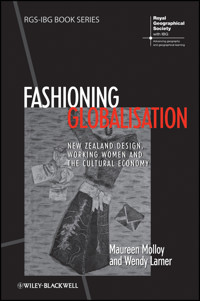
Drastic changes in the career aspirations of women in the developed world have resulted in a new, globalised market for off-the-peg designer clothes created by independent artisans. This book reports on a phenomenon that seems to exemplify the twin imperatives of globalisation and female emancipation.
- A major conceptual contribution to the literatures on globalisation, fashion and gender, analysing the ways in which women’s entry into the labour force over the past thirty years in the developed world has underpinned new forms of aestheticised production and consumption as well as the growth of ‘work-style’ businesses
- A vital contribution to the burgeoning literature on culture and creative industries which often ignores the significant roles taken by women as entrepreneurs and designers rather than mere consumers
- Introduces fashion scholars and economic geographers to a paradigmatic example of the new designer fashion industries emerging in a range of countries not traditionally associated with fashion
- Takes a fresh perspective on an industry in which Third World garment workers have been the subject of exhaustive analysis but first world women have been largely ignored
Sie lesen das E-Book in den Legimi-Apps auf:
Seitenzahl: 417
Veröffentlichungsjahr: 2013
Ähnliche



















Contents
List of Figures and Credits
Figures
Credits
Preface
Series Editors’ Preface
Acknowledgements
Chapter One What We Saw and Why We Started this Project
Introduction
The New Zealand Designer Fashion Industry
The Rise of the Designer Fashion Industry
The New Zealand Designer Fashion Industry Today
Structure of the Book
References
Chapter Two Global Aspirations: Theorising the New Zealand Designer Fashion Industry
Introduction
Globalisation
Cultural Economy
New Cultural Economies/Old Gender Stories
Conclusion
References
Chapter Three Policy for a New Economy: ‘After Neoliberalism’ and the Designer Fashion Industry
Introduction
‘After Neoliberalism’
The Globalisation Project
The Knowledge Economy
Creative Cities
Social Development
Conclusion
References
Chapter Four Cultivating Urbanity: Fashion in a Not-so-global City
Introduction
Designer Fashion and the Urban Landscape
Auckland and the New Urban Economy
Creative Clustering
New Zealand Fashion Week
Urban Denial
Borrowing Cultural Capital
Conclusion
References
Chapter Five Gendering the ‘Virtuous Circle’: Production, Mediation and Consumption in the Cultural Economy
Introduction
The Feminisation of the New Zealand Labour Force
Work and Employment in the New Zealand Designer Fashion Industry
Fluid Firms
The New Generation
Fashion Auxiliaries
Consuming Fashion and the Presentation of Self
Conclusion
References
Chapter Six Creating Global Subjects: The Pedagogy of Fashionability
Introduction
Subjectivity, Identity, Culture
What is the ‘New Zealand’ in New Zealand Fashion?
Local Culture, Aesthetics and Politics
Global Kiwis
Brandlettes
Conclusion
References
Chapter Seven Lifestyle or Workstyle? Female Entrepreneurs in New Zealand Designer Fashion
Introduction
The Cultural Economy and Gendered Entrepreneurship
‘No Fire in their Belly?’
‘An Export Failure?’
‘Mouse on a Treadmill?’
‘Living and Breathing?’
Ethics
Conclusion
References
Chapter Eight Conclusion: An Unlikely Success Story?
Introduction
Rethinking Fashion, Gender and Globalisation
References
Index
RGS-IBG Book Series
Published
Fashioning Globalisation: New Zealand Design, Working Women and the Cultural EconomyMaureen Molloy and Wendy LarnerWorking Lives– Gender, Migration and Employment in Post-War BritainLinda McDowellDunes: Dynamics, Morphology and Geological HistoryAndrew WarrenSpatial Politics: Essays for Doreen MasseyEdited by David Featherstone and Joe PainterThe Improvised State: Sovereignty, Performance and Agency in Dayton BosniaAlex JeffreyLearning the City: Knowledge and Translocal AssemblageColin McFarlaneGlobalizing Responsibility: The Political Rationalities of Ethical ConsumptionClive Barnett, Paul Cloke, Nick Clarke and Alice MalpassDomesticating Neo-Liberalism: Spaces of Economic Practice and Social Reproduction in Post-Socialist CitiesAlison Stenning, Adrian Smith, Alena Rochovská and Dariusz ŚwiątekSwept Up Lives? Re-envisioning the Homeless CityPaul Cloke, Jon May and Sarah JohnsenAerial Life: Spaces, Mobilities, AffectsPeter AdeyMillionaire Migrants: Trans-Pacific Life LinesDavid LeyState, Science and the Skies: Governmentalities of the British AtmosphereMark WhiteheadComplex Locations: Women’s Geographical Work in the UK 1850–1970Avril MaddrellValue Chain Struggles: Institutions and Governance in the Plantation Districts of South IndiaJeff Neilson and Bill PritchardQueer Visibilities: Space, Identity and Interaction in Cape TownAndrew TuckerArsenic Pollution: A Global SynthesisPeter Ravenscroft, Hugh Brammer and Keith RichardsResistance, Space and Political Identities: The Making of Counter-Global NetworksDavid FeatherstoneMental Health and Social Space: Towards Inclusionary Geographies?Hester ParrClimate and Society in Colonial Mexico: A Study in VulnerabilityGeorgina H. EndfieldGeochemical Sediments and LandscapesEdited by David J. Nash and Sue J. McLarenDriving Spaces: A Cultural-Historical Geography of England’s M1 MotorwayPeter MerrimanBadlands of the Republic: Space, Politics and Urban PolicyMustafa DikeçGeomorphology of Upland Peat: Erosion, Form and Landscape ChangeMartin Evans and Jeff WarburtonSpaces of Colonialism: Delhi’s Urban GovernmentalitiesStephen LeggPeople/States/TerritoriesRhys JonesPublics and the CityKurt IvesonAfter the Three Italies: Wealth, Inequality and Industrial ChangeMick Dunford and Lidia GrecoPutting Workfare in PlacePeter Sunley, Ron Martin and Corinne NativelDomicile and DiasporaAlison BluntGeographies and MoralitiesEdited by Roger Lee and David M. SmithMilitary GeographiesRachel WoodwardA New Deal for Transport?Edited by Iain Docherty and Jon ShawGeographies of British ModernityEdited by David Gilbert, David Matless and Brian ShortLost Geographies of PowerJohn AllenGlobalizing South ChinaCarolyn L. CartierGeomorphological Processes and Landscape Change: Britain in the Last 1000 YearsEdited by David L. Higgitt and E. Mark Lee
Forthcoming
Smoking Geographies: Space, Place and TobaccoRoss Barnett, Graham Moon, Jamie Pearce, Lee Thompson and Liz TwiggMaterial Politics: Disputes Along the PipelineAndrew BarryPeopling Immigration Control: Geographies of Governing and Activism in the British Asylum SystemNick GillThe Geopolitics of Expertise: Knowledge and Authority in an Integrating EuropeMerje KuusThe Geopolitics of Expertise In the Nature of Landscape: Cultural Geography on the Norfolk BroadsDavid MatlessOrigination: The Geographies of Brands and BrandingAndy PikeMaking Other Worlds: Agency and Interaction in Environmental ChangeJohn WainwrightEveryday Moral Economies: Food, Politics and Scale in CubaMarisa Wilson
This edition first published 2013© 2013 John Wiley & Sons, Ltd
Wiley-Blackwell is an imprint of John Wiley & Sons, formed by the merger of Wiley’s global Scientific, Technical and Medical business with Blackwell Publishing.
Registered OfficeJohn Wiley & Sons, Ltd, The Atrium, Southern Gate, Chichester, West Sussex, PO19 8SQ, UK
Editorial Offices350 Main Street, Malden, MA 02148-5020, USA9600 Garsington Road, Oxford, OX4 2DQ, UKThe Atrium, Southern Gate, Chichester, West Sussex, PO19 8SQ, UK
For details of our global editorial offices, for customer services, and for information about how to apply for permission to reuse the copyright material in this book please see our website at www.wiley.com/wiley-blackwell.
The right of Maureen Molloy and Wendy Larner to be identified as the authors of this work has been asserted in accordance with the UK Copyright, Designs and Patents Act 1988.
All rights reserved. No part of this publication may be reproduced, stored in a retrieval system, or transmitted, in any form or by any means, electronic, mechanical, photocopying, recording or otherwise, except as permitted by the UK Copyright, Designs and Patents Act 1988, without the prior permission of the publisher.
Wiley also publishes its books in a variety of electronic formats. Some content that appears in print may not be available in electronic books.
Designations used by companies to distinguish their products are often claimed as trademarks. All brand names and product names used in this book are trade names, service marks, trademarks or registered trademarks of their respective owners. The publisher is not associated with any product or vendor mentioned in this book.
Limit of Liability/Disclaimer of Warranty: While the publisher and author(s) have used their best efforts in preparing this book, they make no representations or warranties with respect to the accuracy or completeness of the contents of this book and specifically disclaim any implied warranties of merchantability or fitness for a particular purpose. It is sold on the understanding that the publisher is not engaged in rendering professional services and neither the publisher nor the author shall be liable for damages arising herefrom. If professional advice or other expert assistance is required, the services of a competent professional should be sought.
Library of Congress Cataloging-in-Publication Data
Molloy, Maureen, 1949–Fashioning globalisation / Maureen Molloy, Wendy Larner.pages cmIncludes index.
ISBN 978-1-4443-3701-3 (cloth) – ISBN 978-1-4443-3702-0 (pbk.) 1. Clothing trade–New Zealand. 2. Fashion design–New Zealand. I. Larner, Wendy. II. Fashioning globalisation.HD9940.N452M65 2013382′.456870993–dc23
2013006161
A catalogue record for this book is available from the British Library.
Cover image: Heather Kerr, ‘Fashioning New Zealand’ by Tim MackrellCover design by Workhaus
A few years ago there were just four or five designers selling their gear. Now it’s been turned into a wholescale industry.
(Laura NZ2NY Phase II Fashion Show, 2002)
List of Figures and Credits
Figures
Figure 1.1
Cook Street Market. Image courtesy of Dick Frizzell and Momentum Gallery.
Figure 1.2
Style Council. Photograph by and courtesy ofMonty Adams.
Figure 3.1
‘Back to Black’ Dresses from New Zealand Four, London Fashion Week 1999. Courtesy of The New Zealand Fashion Museum.
Figure 4.1
Auckland Viaduct Events Centre. Courtesy of theViaduct Events Centre.
Figure 4.2
Bobbie Jarvis models a gown imported to New Zealandfrom England and designed for the Coronationcelebrations, 1953. Photograph from personalcollection of the model.
Figure 4.3
High Street Auckland fashion precinct. Photographby and courtesy of Ally Larner.
Figure 4.4
Auckland designer fashion retail outlets, 2006.Map courtesy of Nick Lewis.
Figure 4.5
Final check. Courtesy of New Zealand Fashion Week.
Figure 4.6
Photographer at Fashion Festival. Courtesy ofNew Zealand Fashion Week.
Figure 4.7
Crowd at Fashion Festival. Courtesy of New ZealandFashion Week.
Figure 4.8
Advertisement for Air New Zealand Fashion Week 2006.Courtesy of Air New Zealand.
Figure 5.1
Make-up artist gives model final touch up. Courtesy of New Zealand Fashion Week.
Figure 5.2
Volunteer’s meeting, New Zealand Fashion Week. Courtesy of New Zealand Fashion Week.
Figure 6.1
President Bill Clinton wearing a Snowy Peak merino shirt at APEC 1999. Photograph courtesy of
The
New Zealand Herald
.
Figure 6.2
Prime Minister Helen Clark in the winning costume from the World of Wearable Arts. Photograph by and courtesy of Tina Smigielski.
Figure 6.3
What the Frock! Designer fashion meets local politics. Courtesy of ACP Media.
Figure 6.4
NZ to NYC: Blogger Isaac Hindin-Miller now does a regular column for
The
New York Times
. Photograph by Noah Emrich, courtesy of Isaac Hindin-Miller.
Figure 7.1
Annah Stretton’s
Pink
magazine. Courtesy of Annah Stretton.
Pink
Magazine Spring/Summer 2010 © Stretton Publishing.
Credits
We are grateful to Feminist Theory for permission to republish material in Chapter 2 originally published in Larner, W. and M.A. Molloy, 2009, ‘Globalization, the “New Economy” and Working Women: Theorizing from the New Zealand Designer Fashion Industry’, Feminist Theory 10, 35–59.
We are grateful to Dunmore Press for permission to republish material in Chapter 4, originally published in Goodrum, A., W. Larner and M.A. Molloy, 2004, ‘Wear In the World? Fashioning Auckland as a Globalising City’ in I. Carter, D. Craig and S. Matthewman (eds.) Almighty Auckland? Palmerston North: Dunmore Press, pp. 257–274.
Excerpts reprinted in Chapter 3 with permissions of the Publisher (UBC Press) from Leviathan Undone? By Roger Keil and Rianne Mahon © University of British Columbia Press 2009. All rights reserved by the Publisher.
We are grateful to Environment and Planning D for permission to republish material in Chapter 4 originally published in Larner, W., M. Molloy, and A. Goodrum, 2007, ‘Globalization, Cultural Economy, and Not-So-Global Cities: and The New Zealand Designer Fashion Industry’. Environment and Planning D: Society and Space 25(3):381–400.
We are grateful to The Journal of Cultural Economy for permissions to republish material in Chapter 5 originally published in Molloy, M. and W. Larner, 2009, ‘Who Needs Cultural Intermediaries, Indeed’, Journal of Cultural Economy, www.tandfonline.com
We are grateful to Fashion Theory for permission to republish material in Chapter 6 originally published in Molloy, M., 2005, ‘Cutting-edge Nostalgia: New Zealand Fashion Design for the New Millenium’, Fashion Theory, 8(4):477–490, Berg Publishers, an imprint of Bloomsbury Books.
Preface
The global fashion industry has recently undergone a significant change in form and content. Over the past ten years a gap has opened up between the increasing spectacle and decreasing practicality of haute couture, and the ubiquity of designer diffusion lines. It is being filled by what New Zealand designer Karen Walker calls ‘high casual’ clothing. This clothing typically originates in small to medium sized privately owned firms that produce small runs of high quality original garments in named and themed seasonal collections. Designers of this scale and target markets are now operating successfully in and out of New Zealand, Australia, Hong Kong, Brazil, Canada and a range of other countries not traditionally associated with fashion. The opening up of this gap arises from many things: the relative ease, and indeed necessity, of doing business internationally; changes in the organisation and modes of working for the aspiring middle classes; the opening up of new occupations, including those of mediation and representation; the turn to culture and creativity as privileged modes of being in the developed world; and the consequent emergence of new kinds of global subjects. All of these are underpinned by massive changes in women’s lives and careers during the past 30 years.
This book analyses these claims through the exemplary case of the New Zealand designer fashion industry. An unexpected economic success story, this rapidly growing export oriented industry is overwhelmingly dominated by women as designers, design studio employees, wholesale and public relations agents, industry officials, fashion writers and editors, as well as the more traditionally acknowledged gendered roles of garment workers, tastemakers and consumers. Drawing on over seven years of in-depth multi-method, triangulated, empirical research, including a comprehensive archive of media, policy and industry texts, over 50 semi-structured interviews with designers, buyers, public relations agents, intellectual property lawyers, industry specialists, government officials and other associated occupations and participant observation at four successive New Zealand Fashion Weeks, the book shows how the designer fashion industry’s innovative designs, explosive growth and global focus have been harnessed to broader ambitions to build a globalising knowledge-based economy in New Zealand and rebrand the country as creative, cutting edge and sophisticated. In successive chapters we examine the rise to prominence of a group of young, largely self-employed, women designers in the late 1980s and reveal how their new, niche market, export orientation has transformed policy formulations, urban geographies, economic and industry formation, fashion and fashionability and workplace relations.
Our analysis of the New Zealand designer fashion industry underlines the point that the economy/culture production/consumption split that continues to run through broader literatures on globalisation, clothing and fashion is untenable. This industry involves producing garments and images for consumption and consuming garments and images for production. Consequently the ongoing separation of the material and symbolic, the economic and cultural, the producer and consumer is getting in the way of developing the accounts we need to understand these new gendered firms emerging in the global fashion industry. From this starting point the book retheorises the gendering of globalisation by challenging in consecutive chapters accepted explanations for the rise of globalising cultural and creative industries such as designer fashion, the assumed characteristics of ‘creative cities’, the relationships between production and consumption, the emergence of new feminised entrepreneurial subjects. At the very heart of our account is the claim that there are as-yet-not understood connections between first world women’s entry into paid employment and globalising processes. This study of New Zealand fashion demonstrates that economic globalisation, the movement of middle class women into the labour force and the changing structure of the clothing industry are not only coterminous but intrinsically connected.
Finally, and to forestall an obvious and immediate criticism, while it might be assumed that such a small industry in a tiny country at the bottom of the South Pacific must be inconsequential to understanding global processes, it is precisely the improbability of this industry which has forced us to question gendered accounts of globalisation and exposed blind spots in existing literatures on globalisation, the cultural and creative industries and fashion studies. We also know that the rise of these small entrepreneurial fashion firms is increasingly widespread, particularly in North American, European and Asian countries not historically associated with fashion, and that this rise is being harnessed to broader creative industries and economic development strategies. By tracking the ways the New Zealand designer fashion industry is globalising, this book transforms understandings of the processes of globalisation, the significance of first world women’s entry into the labour force and the designer fashion industry itself.
The book thus makes three major contributions to economic geography and broader social science literatures: It makes a conceptual contribution to the literatures on globalisation, fashion and gender by explicating the ways in which first world women’s entry into the labour force over the past 30 years has underpinned new forms of aetheticised production and consumption.
It is an important contribution to the burgeoning literature on culture and creative industries which virtually ignores the fact that these industries, including designer fashion, are highly structured by gender with women, for the first time, playing significant roles as entrepreneurs, designers, cultural mediators and policy makers, as well as their more traditional roles as consumers and factory workers.
It introduces fashion scholars and economic geographers to a paradigmatic example of the new designer fashion industries emerging in a range of countries not traditionally associated with fashion.
Maureen MolloyProfessor of Women’s Studies, Department of Anthropology, The University of Auckland, NZWendy LarnerProfessor of Human Geography and Sociology, School of Geographical Sciences, University of Bristol, UK2013
Series Editors’ Preface
The RGS-IBG Book Series only publishes work of the highest international standing. Its emphasis is on distinctive new developments in human and physical geography, although it is also open to contributions from cognate disciplines whose interests overlap with those of geographers. The Series places strong emphasis on theoretically-informed and empirically-strong texts. Reflecting the vibrant and diverse theoretical and empirical agendas that characterize the contemporary discipline, contributions are expected to inform, challenge and stimulate the reader. Overall, the RGS-IBG Book Series seeks to promote scholarly publications that leave an intellectual mark and change the way readers think about particular issues, methods or theories.For details on how to submit a proposal please visit:www.rgsbookseries.com
Neil CoeNational University of SingaporeJoanna BullardLoughborough University, UKRGS-IBG Book Series Editors
Acknowledgements
This book has been ten years in the making and owes its appearance to many people who contributed along the way. First and foremost we are truly grateful to the diverse industry members – designers, industry and government officials, public relations agents, photographers, stylists, journalists – who gave so graciously of their time. Special thanks also to Emeritus Professor Warren Moran and Professor Richard Le Heron who lent their weighty credentials to the project as it was getting off the ground and to Dr Nick Lewis whose decision to include fashion in his postdoctoral study of industry formation sparked us into (finally) developing a project together after years of talking about the emerging industry. Anna Chappaz (TradeNZ) provided valuable policy insights in the early stages of developing the project. Ally Larner (then of Servilles) provided contacts, observations and photographs from her experience of the wider industry. Thanks to our postdoctoral fellow Dr Alison Goodrum who brought her British experience and perspective to the project in its first two years. Numerous University of Auckland students worked on The Fashion Project, some of whom produced theses while others worked as research assistants or summer scholars. These include Dr Amanda Bill, Renee Orr, Dr Eva Neitzert, Geraldine Read, Annamary Aydin, Indigo Roher-Cliquot, Caitlyn Cook, Rachael Cowie and Megan Birnie.
Funding for the project was provided by The University of Auckland Research Committee, the Faculty of Arts Research Development Fund, the Department of Anthropology of The University of Auckland and the British Academy. Our gratitude goes to all those involved in granting these funds which became especially crucial to the success of the project once we were living and working on opposite sides of the world. Thanks to colleagues at the University of British Columbia Centre for Research in Gender and Women’s Studies for a berth and an opportunity to present some of our work and to colleagues and friends in the School of Geographical Sciences at the University of Bristol for their ongoing support.
Many colleagues have commented on conference presentations and earlier forms of these chapters, as well as sharing conversations about the development of localised fashion industries. These include Deborah Leslie, Norma Rantisi, Barbara Kirshenblatt-Gimblett, Catherine West-Newman, Cris Shore, Yadira Perez, Christine Dureau and Sally Weller. Valuable feedback was received from presentations at the ESRC Seminar on Feminism and Futurity, University of Bristol (2011), Creativity and Place Conference, Exeter University (2010), IBG Urban Geography Study Group Annual Conference (2009), College of Arts and Sciences Committee on Social Theory, University of Kentucky (2008), Centre for Gender Studies, Umea University, Sweden (2008), University of Bristol Politics Department (2008), Queen Mary Geography Department (2008), University of Tampere (2007), ESRC Seminar on Postcolonial Economies, University of Durham (2006), ESRC Seminar on Gender, Work and Life in the New Global Economy, London School of Economics (2006), the Department of Geography, University of Wisconsin-Madison (2004) and the Winter Lecture Series, University of Auckland (2003). Thanks also to Kevin Ward for initially soliciting this book for the RGS-IBG Book Series, his successor Neil Coe for waiting patiently for the final version of the manuscript and Jacqueline Scott and an anonymous referee for their very helpful suggestions.
Earlier versions of some of the arguments developed here are published in the following journals and books and reproduced here with permission: Molloy, M. and W. Larner (2010) ‘Who Needs Cultural Intermediaries Indeed? Gendered Networks in the Designer Fashion Industry’. Journal of Cultural Economy 3(3): 361–377; Larner, W. and M. Molloy (2009) ‘Globalization, the New Economy and Working Women: Theorizing from the New Zealand Designer Fashion Industry’. Feminist Theory 10(1): 35–59; Larner, W., N. Lewis and R. Le Heron (2009) ‘The State Spaces of “After Neoliberalism”: Co-constituting the New Zealand Designer Fashion Industry’. In R. Keil and R. Mahon (eds) Leviathan Undone? Towards a Political Economy of Scale. Vancouver: University of British Columbia Press; Lewis, N., W. Larner and R. Le Heron (2008) ‘The New Zealand Designer Fashion Industry: Making Industries and Co-constituting Political Projects’. Transactions of the Institute of British Geographers 33(1): 42-59; Larner, W., M. Molloy and A. Goodrum (2007) ‘Globalisation, Cultural Economy and Not-so-Global Cities: The New Zealand Designer Fashion Industry’. Environment and Planning D: Society and Space 25(3): 381–400; Molloy, M. (2004) ‘Cutting-edge Nostalgia: New Zealand Fashion Design at the New Millennium’. Fashion Theory: The Journal of Dress, Body & Culture 8(4): 477–490.
Finally, special thanks to Doug Sutton and Don Kerr for their engaging conversation and generous hospitality as we hopped back and forth across the world to work together.
Chapter One
What We Saw and Why We Started this Project
Introduction
The global fashion industry is undergoing a significant change in form. Over the past 10 years a gap has opened between the increasing spectacle and decreasing practicality of haute couture and the ubiquity of designer diffusion lines. It is being filled by what New Zealand designer Karen Walker calls ‘high casual’ clothing. This clothing typically originates in small privately owned firms that produce high quality original garments in themed seasonal collections. Designers of this scale are now operating successfully in New Zealand, Australia (Maynard, 1999, 2000, 2001; Weller, 2006, 2008), Hong Kong (Skov, 2002, 2004), Brazil (Leitão, 2008), Canada (Palmer, 2004; Rantisi and Leslie, 2010), Sweden (Hauge, Malmberg and Power, 2009) and a range of other countries not traditionally associated with fashion. Indeed, a 2011 special issue of Fashion Theory called ‘Dreams of Small Nations in a Polycentric Fashion World’, focused on small European countries, suggests this phenomenon is now becoming widespread. The opening of this gap arises from many things: the relative ease, indeed necessity, of doing business internationally; changes in the organisation of work for the middle classes; the emergence of new occupations, including those of mediation and representation; the turn to culture and creativity as privileged modes of being in the developed world; the consequent emergence of new kinds of global subjects. All of these are underpinned by massive changes in middle-class women’s lives and careers during the past 30 years.
This book arises from our research on the New Zealand designer fashion industry. An unexpected economic and cultural success story, this high profile export-oriented industry is overwhelmingly dominated by women as designers, studio employees, wholesale and public relations agents, industry and government officials, fashion writers and editors, as well as the more traditionally gendered roles of garment and retail workers, tastemakers and consumers. We were drawn to the research because, in New Zealand at least, this was the first female dominated industry to be identified as a vehicle for the country’s new globalising ambitions, after receiving extraordinary attention from government officials, tastemakers and the media. We were also intrigued by the apparent sway that this emergent industry had over the middle-class women around us; our friends, colleagues, sisters and students were becoming amateur fashion aficionados in ways that were both unexpected and unprecedented in a hitherto largely unfashionable New Zealand. As a women’s studies scholar long steeped in cultural studies, and a political economic geographer interested in globalisation and neoliberalism, we found ourselves embarking on a research project that would draw on our respective interests and skills in order to explain the unexpected rise and broader implications of this globalising ‘new economy’ creative industry.
In our efforts to find analytical material which would help us account for the growth and profile of this gendered industry, we became dismayed by the tenor of existing scholarship in relevant academic fields. More specifically, our work has exposed a number of disconnections between our observations of women’s positions in, and experiences of, the New Zealand designer fashion industry and the academic literatures on globalisation, fashion studies and the cultural economy. While it is now well recognised that globalising processes are both embodied and gendered, analyses of male dominated areas such as technology, the high skill service sector and finance continue to be privileged over the quieter and more massified changes in women’s lives. Nor are we content with existing attempts to gender these accounts which position women only as either low skilled vulnerable workers or, at best, embodied agents of resistance. We argue that the globalising processes of the past two decades have both forced and enabled changes in women’s lives. In particular, we claim that processes understood to be central to economic globalisation are underpinned by first world women’s entry into the workforce in large numbers at a time when middle-class work is changing profoundly, changes which have come to be glossed as the ‘new economy’ or the rise of the ‘cultural and creative industries’. It is these changes that contribute to the unexpected success of the New Zealand designer fashion industry.
This book is an attempt to rethink the relationship between changes in the global cultural economy over the past 20 years and changes in middle-class women’s working lives through the exemplary case of the New Zealand designer fashion industry. Drawing on 10 years of empirical research, including analysis of media, policy and industry texts, 50 interviews with designers, buyers, public relations agents, intellectual property lawyers, industry specialists, government officials and other associated occupations, and observations at four New Zealand Fashion Weeks, the book shows how the designer fashion industry’s innovative designs, explosive growth and global focus have been harnessed to rebrand New Zealand as creative, cutting edge and sophisticated. In successive chapters we examine the rise to prominence of a group of young, largely self-employed, women fashion designers in the late 1980s. We reveal how their activities were harnessed by policy projects aimed at creating a new globalised economy for New Zealand based on export orientation and niche markets, how these transformed New Zealand’s urban geographies, created a new industry based on networks of small businesses, generated new forms of cultural capital based on fashionability, and cohered into a distinctive form of gendered economy we term ‘workstyle’.
In writing this book we hope to make a number of contributions to the academic study of gender and globalisation. While it might be assumed that such a small industry in a tiny country at the bottom of the South Pacific must be inconsequential to our understandings of global processes, it is precisely the improbability of this industry which has forced us to question gendered accounts of globalisation and exposed blind spots in existing literatures on globalisation, fashion studies and the cultural economy. By tracking the ways the New Zealand designer fashion industry is globalising, this book transforms our understanding of the processes of globalisation, the significance of middle-class women’s entry into the labour force and the nature of the designer fashion industry itself. First, we make a conceptual contribution to the literatures on globalisation and new economies by explicating the ways in which middle-class women’s entry into the labour force over the past 30 years has underpinned new forms of aetheticised production and consumption. Second, we make a contribution to the burgeoning literature on culture and creative industries which virtually ignores the fact that women dominate in many of the industries that this literature focuses on. Finally, by focusing on a new designer fashion industry emerging in a country not traditionally associated with fashion we can contribute to an understanding of how globalising economies develop outside the paradigmatic cases of global cities and powerful nation-states.
The New Zealand Designer Fashion Industry
The growth and success of the New Zealand designer fashion industry took the country, and indeed the international fashion community, by surprise. New Zealand fashion design seemed to burst from nowhere onto the international scene in the late 1990s. Before that the profile of designer fashion even within New Zealand was so low as to be almost nonexistent.There had been a very small number of long established haute couture designers selling within New Zealand to a tiny elite market. Elite labels such as Christian Dior were sold under licence and other international brands such as Mary Quant and Pierre Cardin were manufactured in New Zealand and sold in major department stores. Shopping districts carried mass-produced clothing manufactured by a small number of heavily protected local companies with very limited variation in design or choice. But few New Zealand women bought clothes; almost all women had been taught to sew as girls and prided themselves on their ability to be self-sufficient in creating wardrobes for both everyday wear and special occasions. One of the very few exceptions to this pattern of elite haute couture, conformist ready-made apparel, and DIY fashion was found in street markets such as the Wakefield market in Wellington and the well-known Cook Street market in New Zealand’s largest city Auckland.
Today, all New Zealand inner-city shopping districts have a high proportion of independent local designer-retailers selling original clothing to a growing discerning local market. The High Street-Chancery area in downtown Auckland markets itself to tourists as a distinctive fashion quarter and New Zealand Fashion Week, now in its eleventh year, draws ever more attention from the national and international press. Established designers are focused on expanding their export markets, while young designers are being formally mentored into ‘export-readiness’. Garments by high profile New Zealand designers such as Karen Walker and World have been acquired by art galleries and museums internationally. Popular, often expensive, books on New Zealand fashion aimed at the mass market are being produced (DePont, 2012; Gregg, 2003; Hammonds, Lloyd-Jenkins and Regnault, 2010; Lassig, 2010). The most recent of these books (DePont, 2012) was produced in conjunction with the initial exhibition of the New Zealand Fashion Museum in conjunction with the 2011 Rugby World Cup. In sum, New Zealand designer fashion is an example of remarkable growth and change and appears to exemplify the characteristics and attributes of the cultural and creative industries more generally.
The increasing profile of the New Zealand designer fashion industry is in part attributable to government interest. Between 1999 and 2009, successive governments seized on the new high-profile designer fashion industry as both a driver of economic prosperity and a way of marketing a contemporary image of New Zealand to the world. As Gilbert (2000, 20) notes ‘[a]cross the world, governments are paying particular attention to middle-class consumer demand for distinctive, high-quality cultural commodities in efforts to regenerate or promote particular cities’. In the New Zealand case, the new emphasis on the cultural and creative industries has been deliberately harnessed to governmental aspirations to ‘go global’ for the whole country. Designer fashion has been the poster girl for this reorientation, sharing the field with Lord of the Rings film director Peter Jackson and his hobbits. The government privileging of this cultural economy is seen as explicitly producing a double benefit. It is both a means to create a new basis for economic development in the context of a globalising economy, and it involves an explicit reworking of national identity and national branding.
There are, however, distinctive industrial, socio-cultural and aesthetic characteristics to the New Zealand fashion industry. In contrast to North America and Europe there are no corporate design houses on the model of Ralph Lauren or Donna Karan operating out of New Zealand. Global luxury goods companies, such as LVMH, have only a minor presence as retailers or event sponsors. Rather the New Zealand designer fashion industry is made up of independent, design-led labels produced by small to medium sized companies where uniqueness (of materials, design, production and merchandising) is crucial. New Zealand designer fashion firms are usually intensely local in set-up, sometimes working out of a single site that doubles as both workroom and salesroom. With a few exceptions the garment construction is done by New Zealand manufacturers or individual outworkers. Employees can take on a wide range of roles from finishing the actual product, to administration and/or sales. Even those ‘stars’ that inhabit the top echelon of New Zealand designer fashion, some of which are now multi-million dollar firms, continue to run their businesses as family concerns and/or husband-and-wife teams and champion a ‘hands-on’ style of doing business in which their business, creative and personal identities are inextricably linked. Nor do they aspire to leave New Zealand and join major international fashion houses. In numerous public statements the top designers have all expressed their ambitions to remain New Zealand-based niche players at the cutting edge of global fashion trends.
These designers also draw on an unexpected aesthetic for a country notable for its rural ‘green’ connotations. Fashion journalists and critics have consistently commented on the development of a distinctive New Zealand style, noted for garments that are described insistently as ‘dark’, ‘edgy’, ‘ironic’ and ‘intellectual’. These terms are often used to characterise fashion designs that challenge conventional approaches by taking risks with sharp, unexpected and confrontational cuts and looks. A preponderance of black, sharp tailoring, and gothic referencing are amongst the more visible aspects of this distinctive aesthetic. In strong contrast to the traditional tropes of indigeneity, sport and landscape which underpin New Zealand’s longstanding strengths based on agriculture and tourism, the new aesthetic has been mobilised to position New Zealand as an urban, urbane and creative place. While celebrating this avant-garde direction, high profile fashion reportage of the New Zealand incursion into the international fashion arena also hints at the paradox at the heart of our analysis, namely, how a tiny unfashionable country at the bottom of the South Pacific, more noted for its spectacular scenery and numerous sheep, could produce ‘from nowhere’ a cutting edge fashion industry. It is precisely this question that motivates our analysis.
The Rise of the Designer Fashion Industry
Until recently, the very idea that the designer fashion industry might play a central role in New Zealand’s global bid for export-led prosperity would have seemed laughable. While a small domestic clothing and apparel industry had grown up behind protectionist policies during the post-war period, 15 years ago this industry was moribund – a casualty of the deregulation and tariff cutting that characterised the 1980s more generally. Economic liberalisation had facilitated a trend for mass and middle market apparel to be sourced offshore. As a result, clothing imports to New Zealand more than doubled between the mid-1980s and the mid-1990s (Blomfield, 2002; Perera and Bell, 2000; Walton and Duncan, 2002). The implications for the small domestic industry dominated by a small number of major firms, were dramatic, with mass redundancies ensuing as manufacturing was relocated to lower wage sites, initially Fiji (Harrington, 1998), but more recently China following the signing of an international trade agreement in 2008. More generally, imports from China to New Zealand increased from 8 to 11% in the two decades from 1989 to 2009 (Shand, 2010, xxi). According to a union submission cited by Kelsey (1999) the number of full-time equivalent workers in the footwear, apparel and textile sectors dropped from 30,939 in 1985 to 16,710 in 1997, and was then employing less than 10,000 people. Other figures, which include textiles, clothing, footwear and leather manufacturing, show that numbers in the sector fell from 27,241 in 1996 to 17,097 in 2006 (Business Economic Research Ltd., 2006). While the exact figures may be in dispute, the trajectory is not.
Those who survived were forced to reconsider their approach. Across the sector those clothing manufacturers began to invest in new technologies, encourage more innovative design and explore the potential for international niche marketing. While the emphasis remained on sustaining a domestic market, for many clothing manufacturers exporting became an integral part of local operations during this period. High-profile examples include Sony Elegant Knitwear, founded after the Second World War by Croatian refugees Zarko and Sonia Milich. Like other New Zealand garment manufacturers this firm was badly affected by the broader political-economic shifts of the 1980s which saw both increased costs for essential imported materials and the loss of its customer base to cheaper clothes made elsewhere. The international share market crash of 1987, which saw New Zealand’s market hit especially hard and following which ‘you couldn’t just do the things that you did previously any longer’, provided the final impetus to reinvent the company (Lassig, 2010, 215). Today this company – rebranded as Sabatini White – makes very high quality, directional, women’s knitwear that sells well internationally, including into Italy.
Figure 1.1 Cook Street Market by Dick Frizzell. Image courtesy of Dick Frizzell and Momentum Gallery.
During the same period the early entrepreneurs of the New Zealand fashion industry – World, Karen Walker, Zambesi, Kate Sylvester, NOM*D, Trelise Cooper – became visible. Some began by selling clothes in markets such as the inner city Cook St (see Figure 1.1) and Wakefield markets in Auckland and Wellington respectively, and then as supplementary lines for retail stores.
These embryonic firms were part of a wider shift in New Zealand culture, as a formerly rural and conservative society began to be challenged by a new generation of more urban and urbane young people. In the late 1980s, following the share market crash, inner city retail property became widely available at relatively affordable prices, while import goods became prohibitively expensive due to the massive devaluation of the New Zealand dollar. During this period key designers opened their own inner city retail premises. These were small firms, often with co-located workrooms and retail premises, and in which almost everything was done by the designer herself, or with the support of partners and/or sisters. Over the next decade they were to gradually increase in profile amongst those young New Zealanders ‘in-the-know’.
In the late 1990s these small avant garde designers came to both government and public attention. In 1997 four designers – Wallace Rose, Zambesi, World and Moontide (a swimwear company) were sponsored to attend the first Australian Fashion Week. The following year the New Zealand contingent attending Australian Fashion Week was expanded to include Karen Walker, Blanchet, Kate Sylvester and Workshop. These events mark the first signs of a recognisable New Zealand fashion industry, and international and national attention began to focus on the emergence of the distinctive ‘edgy’ design aesthetic so often associated with New Zealand fashion. Later the same year Karen Walker was selected to participate in a young designers show attached to the first Hong Kong Fashion Week. There she launched ‘Daddy’s Gone Strange’, her first full collection. When pop star Madonna wore a pair of so-called ‘killer pants’ from the collection to perform at that year’s televised MTV awards, Walker’s name went firmly international. In New Zealand she became a celebrity overnight.
London Fashion Week in 1999 is now widely regarded as the watershed event for the New Zealand fashion industry, with industry commentators suggesting that there is a pre- and post-1999 character to New Zealand designer fashion (Shand, 2010). Government sponsorship of four designers (Zambesi, World, Karen Walker, NOM*D) in a combined showing labelled ‘The New Zealand Four’ was a wild success, resulting in an invitation to return to London for the autumn showing. International observers commented on the emergence of a new distinctive New Zealand style and hailed New Zealand as the new Belgium – ‘fashion-speak for a small country with hot ideas’ (Floyd, 1999). The usually staid New Zealand media began to give local designers long overdue coverage and an independent assessment estimated that New Zealand as a whole benefited from over NZ$1 million in subsidiary publicity from the attention the New Zealand designers received in London.
In 2001 Pieter Stewart, a former model and TV presenter, launched the first, highly successful, New Zealand Fashion Week in Auckland. This event is now the showpiece for New Zealand designer fashion and, more generally, for Auckland’s attempts to position itself as a creative city. Fashion Week, still owned and run by Stewart and her daughters, has become a fixture on the annual cultural events programme. New Zealand Fashion Week and other fashion weeks are also central to the strategies of fashion designers and figure significantly on their yearly calendars. In 2010 Fashion Week was complemented by the introduction of a further event; an autumn Fashion Festival explicitly targeted at the public rather than industry insiders, and with the same high profile mix of fashion and cognate activities. Beyond the actual activities and the associated sales, New Zealand Fashion Week generates significant economic impacts as an event and in terms of international media coverage. It has also come to figure prominently in the social and cultural landscape of the city, with massive media coverage, live streaming of shows, the development of a post-show fashion weekend featuring condensed catwalk shows, designer garage sales, music, and other events. But perhaps even more importantly for us, it is now a site in which the New Zealand designer fashion industry as a whole becomes visible. This event underlines the extraordinary transformation that occurred in a decade; from a few women making clothes for their friends and to sell in informal markets, to a fully fledged, export oriented, creative industry charged with both economic and cultural meaning.
The New Zealand Designer Fashion Industry Today
Conventional measures of the contemporary New Zealand designer fashion industry are difficult to generate. New Zealand designers are notoriously reluctant to discuss their finances, in part because of the reputational repercussions (government official, 2003; designer, 2008). Indeed, we have gathered 10 in-depth media interviews with high profile designer Karen Walker herself, plus our own, and none has been able to put a precise figure on her exports or turnover. More generally, as we have already seen, routine statistical measures of industry and employment do not distinguish designer fashion from other garment and textile manufacturing, and employment measures are confused by the prevalence of subcontracting and temporary employment. Neither of the relevant government departments (New Zealand Trade and Enterprise (NZTE), Ministry of Economic Development (MED)), nor the national industry association (Fashion Industry New Zealand (FINZ)) has been able to generate meaningful and reliable statistics because of the difficulty of excising designer fashion from broader activity in the clothing and apparel sector (government official, 2007; industry official, 2007). Nonetheless, there are various material indications to support the tale of increasing visibility and success presented above. Because of New Zealand’s limited domestic market, designers’ aspirations and growth prospects are tied to exports from day one, so one widely accepted metric of success is export earnings. Estimates suggest that exports of designer fashion clothing more than doubled between 2001 and 2004 (Moore, 2004). More recent figures show apparel exports account for NZ$326m per annum (New Zealand Trade and Enterprise, 2010). Although this figure includes children’s wear and outdoor clothing, which are also successful stories of economic reinvention, it is widely accepted that designer fashion makes up roughly 50% of these apparel exports.
Table 1.1 New Zealand Fashion Week Participation 2001–2011
Source: compiled by authors from New Zealand Fashion Week Press releases and programmes.
There have been other attempts at assessing the size of the New Zealand designer fashion sector. An industry scoping report carried out in 2001 identified 119 companies, accounting for 1,500 employees, which then met the generously interpreted criteria of ‘design focus’, exhibition and production of diffusion lines. Of these companies, 72% had a turnover of less than NZ$2 million per annum, and 69% employed fewer than 10 full time staff (Blomfield, 2002). This report also confirmed the relative youth of the designer fashion industry, with two-thirds of these firms established in the 1990s and 13% set up since 2000. Employment patterns in the broader apparel industry underline the point that most designer fashion firms are very small. According to government agency Market New Zealand, in 2002 there were 962 firms in the garment and apparel industries. Of these, 760 (79%) employed ‘just over two people’, suggesting that these are in fact, for the most part, partnerships with some casual labour brought in during peak periods. Only 2% of firms in the New Zealand apparel business have over 70 employees, a vast change from the regulated post-war period in which three or four large firms dominated New Zealand garment manufacturing and employed thousands of people around the country.
A third way of assessing the size and shape of the designer fashion sector is that between 40 and 60 designers have exhibited at each of the 10 New Zealand Fashion Weeks, of whom about half have been developed enough to present solo shows, while the balance have presented smaller collections in group or ‘New Generation’ shows. As Table 1.1 shows, participation amongst the top designers has been remarkably consistent over the last 10 years. Of the 48 firms which have appeared at Fashion Weeks three or more times, 36 are trading at the time of writing (September 2011). Of those which appeared once or twice (139), 24 are still trading, of which eight are designer fashion firms, while another 16 are either retailers or high street manufacturers. The remaining 115 do not appear to be active. In sum, therefore, there are 60 firms, the majority of which are design-intensive, actively trading in New Zealand.
While these firms vary considerably in size, it is a condition of participation in New Zealand Fashion Week that even the so-called ‘new generation designers’ must already be supplying 10 retailers and be export ready suggesting there is now significant capacity in designer fashion. Of those participating in New Zealand Fashion Weeks, six designers – Karen Walker, Trelise Cooper, Zambesi, World, Kate Sylvester, NOM*D – have been consistently profiled and are commonly identified as the ‘top designers’ in terms of public profile and export earnings (see Figure 1.2).
Figure 1.2 Style Council. From left to right: Karen Walker, Adrian Hailwood, Elizabeth Findlay (Zambesi), Patrick Steele, Helen Cherry, Murray Crane, Kate Sylvester, Liz Mitchell, Trelise Cooper. Photograph by and courtesy of Monty Adams.
These designers have all grown dramatically in the last 10 years. Trelise Cooper has the largest business and now claims to have a staff of 75, a turnover of more than $NZ15 million, exports of more than NZ$7.5 million, and to be responsible for the employment of 500 further workers. Karen Walker and Zambesi are the next most significant players. Walker’s exports are estimated to be somewhere between NZ$3.5 and $5 million, and to make up 80% of her business. Her clothes are sold in more than 130 stores in 15 countries, including nearly 50 cities outside of New Zealand. Forty per cent of her export revenue is generated in Japan. Zambesi is smaller but also claims to employ over 50 staff across its manufacturing operations and its six stores (four in New Zealand and one each in Sydney and Melbourne). Zambesi has a further 22 stockists in Australia, three in Japan, two in Los Angeles and one each in Singapore, London, Stockholm, New York and Paris. World and NOM*D, the other two of the New Zealand Four from London Fashion Week in 1999, remain leading players but are significantly smaller.
More generally, the women who dominate the leading firms in the New Zealand designer fashion industry have become prominent figureheads for women in business; Trelise Cooper, Kate Sylvester, Denise L’Estrange Corbett and Karen Walker have all won national export awards, and are regular speakers at export promotion and leadership conferences associated with the ‘new economy’. They are frequently portrayed in the business news as exemplary entrepreneurs. They have also become involved in new fields. For example, Karen Walker, perhaps the highest profile of these designers, now lends her brand name to paint, eyewear, jewellery and a diffusion clothing line. These women have also become local celebrities, with all that implies for the management of their own images. Their houses, pregnancies and career trajectories are widely reported, while their clothing appears in regular media features promoting ‘new looks’. Finally charity work, particularly around breast cancer, has become a high profile part of the industry. Annah Stretton, who now runs one of the largest businesses in the sector, produces a magazine devoted to breast cancer issues; Karen Walker and Trelise Cooper are both associated with the Breast Cancer Research Trust which holds regular charity events and a highly successful fund-raising T-shirt campaign in association with New Zealand designers and the lower-end clothing chain Glassons.




