


21,99 €
Mehr erfahren.
- Herausgeber: John Wiley & Sons
- Kategorie: Wissenschaft und neue Technologien
- Sprache: Englisch
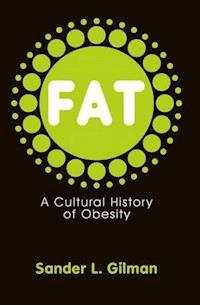
The modern world is faced with a terrifying new ‘disease’, that of ‘obesity’. As people get fatter, we have come to see excess weight as unhealthy, morally repugnant and socially damaging. Fat it seems has long been a national problem and each age, culture and tradition have all defined a point beyond which excess weight is unacceptable, ugly or corrupting.
This fascinating new book by Sander Gilman looks at the interweaving of fact and fiction about obesity, tracing public concern from the mid-nineteenth century to the modern day. He looks critically at the source of our anxieties, covering issues such as childhood obesity, the production of food, media coverage of the subject and the emergence of obesity in modern China. Written as a cultural history, the book is particularly concerned with the cultural meanings that have been attached to obesity over time and to explore the implications of these meanings for wider society. The history of these debates is the history of fat in culture, from nineteenth-century opera to our global dieting obsession. Fat, A Cultural History of Obesity is a vivid and absorbing cultural guide to one of the most important topics in modern society.
Sie lesen das E-Book in den Legimi-Apps auf:
Seitenzahl: 370
Veröffentlichungsjahr: 2013
Ähnliche



















FAT
FAT
A CULTURAL HISTORY OF OBESITY
SANDER L. GILMAN
polity
Copyright © Sander Gilman 2008
The right of Sander Gilman to be identified as Author of this Work has been asserted in accordance with the UK Copyright, Designs and Patents Act 1988.
First published in 2008 by Polity Press
Polity Press
65 Bridge Street
Cambridge CB2 1UR, UK.
Polity Press
350 Main Street
Malden, MA 02148, USA
All rights reserved. Except for the quotation of short passages for the purpose of criticism and review, no part of this publication may be reproduced, stored in a retrieval system, or transmitted, in any form or by any means, electronic, mechanical, photocopying, recording or otherwise, without the prior permission of the publisher.
ISBN-13: 978-0-7456-5875-9
A catalogue record for this book is available from the British Library.
Typeset in 10.75 on 14 pt Adobe Janson by
Servis Filmsetting Ltd, Stockport, Cheshire
Printed and bound in Great Britain by Biddles Ltd, Kings Lynn, Norfolk
The publisher has used its best endeavours to ensure that the URLs for external websites referred to in this book are correct and active at the time of going to press. However, the publisher has no responsibility for the websites and can make no guarantee that a site will remain live or that the content is or will remain appropriate.
Every effort has been made to trace all copyright holders, but if any have been inadvertently overlooked the publishers will be pleased to include any necessary credits in any subsequent reprint or edition.
For further information on Polity, visit our website: www.polity.co.uk
CONTENTS
Introduction: Some Weighty Thoughts on Dieting and Epidemics
1 Epidemic Obesity
2 Childhood Obesity
3 The Stigma of Obesity
4 Obesity as an Ethnic Problem
5 Regions of Fat
6 Chinese Obesity
Conclusion: ‘Globesity’ and its Odd History
Notes
Further Reading
Index
INTRODUCTION
SOME WEIGHTY THOUGHTS ON DIETING AND EPIDEMICS
In November 2005 George W. Bush, then the President of the United States, evoked the influenza pandemic of 1918 as the reason for a massive preparation for a potential worldwide outbreak of avian ’flu. He noted, ‘there is no pandemic influenza in the United States or the world, but if history is our guide there’s reason to be concerned’. His fear was of the repetition of the pandemic ‘which struck in 1918, killed over half a million Americans and more than 20 million people across the globe. One-third of the U.S. population was infected, and life expectancy in our country was reduced by 13 years.’ And the proof of the risk, as we shall see in the course of this book was that in the very recent past ‘a previously unknown virus called SARS appeared in rural China. . . . It infected more than 8,000 people and killed nearly 800.’1 Hardly, one can add, a pandemic but an indicator that an older model of illness could be revivified.
But, as one rather shrill book published in 2006 about the potential public health crisis argues, we stand on the brink of disaster. Not only do all forms of infectious disease, from HIV/AIDS to polio, threaten us but ‘what if obesity was caused by a virus?’2
The parodic implications of such a view were not lost on American satirists. Based on George W. Bush’s evocation of a world-wide avian ’flu disaster, comics had a field day. The United States had already been declared to be in the middle of an obesity epidemic. The jokes mounted quickly:
In a press conference at the White House today, President George W. Bush announced an ambitious plan to slow the potential spread of avian flu by making birds obese. ‘Birds spread the flu by flying’, the president told reporters. ‘So it stands to reason that if birds are too fat to fly, they can’t spread the flu.’ The president said that he personally developed the strategy for slowing the spread of the deadly flu after realizing that ‘obesity is America’s secret weapon in the battle for global health’. Mr Bush said that starting next week, government-issued pamphlets would be distributed at such fast-food outlets as McDonald’s, Burger King, and Kentucky Fried Chicken, encouraging customers to buy an additional fat-laden meal and feed it to birds. If all goes according to plan, the president said, the global population of birds will be so badly out of shape and easily winded, ‘they will only have enough energy to sit around and watch television’.3
As we shall see in the course of this volume the odd pairing of the two also makes some kind of historical sense, if we listen to the recapitulation of concerns about risk and the dangers of certain diseases as well as about the efficacy of certain treatments.
But we must remember that this anxiety about epidemics is a recent phenomenon (even though it mirrors the rhetoric of the nineteenth century). As late as 1969 the then Surgeon General of the United States, William T. Stewart, suggested to Congress that it was now ‘time to close the book on infectious disease as a major health threat’.4 Three decades later, in 1996, Gro Harlem Brundtland, the then Director-General of the World Health Organization, gave a very different prophecy: ‘We stand on the brink of a global crisis in infectious diseases. No country is safe from them.’5 We have moved from a sense of accomplishment to one of foreboding.
Parallel to the seemingly unstoppable spread of obesity as a new epidemic was the development of new, radical cures. From the mid-nineteenth century until today, medical specialists and lay practitioners have tried to claim fat people (however defined) as their patients. Would the ‘war against obesity’ in the late twentieth century be conquered by surgical means (stomach stapling), genetic intervention (‘conquering’ of the ‘obesity-gene’), or would it be the old, tried and true ‘cure’ of dieting?
Fat, however, is truly in the eye of the beholder. Each age, culture, and tradition has defined acceptable weight for itself, and yet all have a point beyond which excess weight is unacceptable, unhealthy, ugly, or corrupting. Today we call this ‘morbid obesity’, and it is always seen as an issue of health. Yet health, as we well know, is a code word for a positive range of qualities that any given society wishes to see in its citizens: from beauty to loyalty to responsibility to fecundity (and the list marches on). This is in no way to minimize the health implications of excess weight, but it is also clear, from the extraordinary explosion of public concern and blame associated with obesity, that fat has taken on a new and rather sinister quality over the past century. Obesity is a national rather than an individual problem and that, not only because of epidemiological evidence, but also because of the meanings now firmly attached to an expansive waistline.
Since the 1860s diet culture dominated the marketplace as the appropriate ‘cure’ for obesity. Bio-medical science developed the tools to understand the biochemical nature of metabolism after the 1830s, yet the claim that weight gain was the result of endrocrinological imbalance rarely dominated the discussion of cure. More recently, even with the claims about human genetics being the underlying cause of obesity, most people still turn to dieting.
Dieting was the tool of the physician, but it was also the means by which lay practitioners of the modern ‘health culture’ were able to lay claim to fat people (or those who imagined themselves to be fat) as their clients. Dieting or (more recently) ‘lifestyle change’ became a way to halt the obesity epidemic, to intervene so as to improve the private life of the individual and thus the health of the nation. These two qualities were regularly linked. There were claims that morbid obesity impacted on the health of the mother and child, and thus weakened the state. Others believed that fat people could not fulfill their civic and military duty and became a drain on the state. The obese, from at least the mid-nineteenth century on, were seen as a danger to themselves as well as to others. The general stigma associated with a potentially unhealthy body which stood out because of its size made it imperative that fat people seek treatment. Thus there were financial incentives to seek this group out and to rehabilitate them. Fat people could be made productive and healthy through the interventions of medical professionals, but also through lay specialists.
In France, the modern food culture, without its sauces and exotic ingredients, was created in the 1820s by Jean Anthelme Brillat-Savarin, whose Physiology of Taste or, Meditations on Transcendental Gastronomy was this fat man’s confession about how he tried to lose weight. It was a self-help book that created the modern French cult of food and France as the ‘food nation’ par excellence.‘Obesity’, as Brillat-Savarin states, ‘is not actually a disease, it is at least a most unpleasant state of ill health, and one into which we almost always fall because of our own fault.’6 It was a change in the way one ate that could control one’s weight.
The American food faddists of the late nineteenth century, who produced ‘modern’ machine-made foods such as ‘corn flakes’, sought to reform the body politic. Healthy citizens are better citizens: closer to God and able better to function in the modern world. In the twenty-first century we hear their heirs advocate ‘natural’ or ‘organic’ food with many of the same claims. Today their argument is that unprocessed food is close to nature and thus healthier. In 1894, Dr. Will Keith Kellogg was trying to improve the vegetarian diet of his brother’s patients at the Battle Creek Sanatorium when he invented Corn Flakes; one patient, Charles William Post, invented the Postum cereal beverage in 1895. Two years later, Post developed the Grape-Nuts cereal, part of the new health-industrial complex. They followed the lead of those who first canned milk during the Napoleonic wars; they saw in the modern manufacture of food the introduction of the principles of hygiene. And they were right – boiled, condensed milk was certainly healthier than milk from tuberculosis-infected cows, if you discounted the lead that leached into milk in the early containers.
All aimed, and aim, at healthier, better citizens. And all succeed in making a profit as they do it. The cereal manufacturers of the nineteenth century, like Post and Kellogg, moved from fringe food-fad operations in ‘Wellville’ (read T. Coraghessan Boyle’s 1993 novel The Road to Wellville) to dominating the food market; ‘organic’ food today may well rescue the small farm, as it returns much greater profit than ‘traditional’ food. More than a rhyme links health and wealth.
Dieting aims both at cure and at profit. It is thus very modern. To be sure, fasting as a religious observance was part and parcel of western Christianity beginning with Paul. (It also became part of both rabbinic Judaism and Islam.) But religious fasting is not identical with dieting. It was (and is) a sign of man’s relationship with God and God’s complex world. Ironically, this is not much different from the conception of the ancient Greeks, who saw food (and food reduction) as part of a complex web that spanned human beings and the gods through the humors. Dieting arose in the post-Copernican world when scientists and lay people from the late seventeenth to the early nineteenth century more and more began to think of the human body as a machine and, later, as a collection of chemical processes. For them, the dieting body was not necessarily an extension of the divine.
That modern notions of health and illness are linked is never in doubt. Yet how they are linked is another question. The philosopher Hans-Georg Gadamer noted,‘we need only reflect that it is quite meaningful to ask someone “Do you feel ill?” but it would be quite absurd to ask someone “Do you feel healthy?” Health is not a condition that one introspectively feels in oneself. Rather, it is a condition of being involved, of being in the world, of being together with one’s fellow human beings, of active and rewarding engagement with one’s everyday tasks.’7 Thus, if such an argument is followed, one can be physically ill, yet ‘healthy’. Friedrich Nietzsche commented long before Gadamer: ‘One must comfort the patient’s fantasy as he suffers more from the idea of his illness, than from the illness itself.’8 We sense our bodies only when we imagine ourselves to be ill, and we subscribe meaning to that sense of disease. It is this historically situated sense of health (and illness) that structures our understanding of the dangers present in the world. It is this that cycles in odd and irregular ways through our recent history.
Dieting has become the means of self-liberation or of self-control and self-limitation. It is a process by which the individual claims control over her body and thus shows her ability to understand her role in society. From the Enlightenment to the present, the healthy body is also the body in control of its own destiny – a basic claim of Enlightenment ideology. The aging philosopher Immanuel Kant actually wrote a study of diet and self-control in response to the appearance of one of the first modern diet books in the 1790s. His essay on ‘Overcoming unpleasant sensations by mere reasoning’ (1797) argued that you could, as an old man, rationally control your frequent trips to the toilet at night by radically restricting your liquid intake before bed.
Mind over body: the key to ‘lifestyle changes’ in the twenty first century. But now with a twist: you need the social structure to accomplish this because – and now it is Arthur Schopenhauer’s turn – fat is also a sign of another disease process: the lack of will. The will becomes that which is healed by the dieting process and enables the rational mind to control the body. Fat is dangerous because it is now globalized, in complex ways, as our Epilogue will show. Fat is now (as smoking was) a sign of the deleterious effect of the modern (read: the American) influence on the body. Indeed the argument in the twenty-first century is that the gains, among the ‘elderly’, through changes in lifestyle over the past decades such as the abandonment of smoking, will be ‘swamped’ by the ‘disabilities among the young’ grown huge and ill through the pernicious effects of food.9 We have to restore the healthy mind of the youth and thus heal the unhealthy body of society. McDonald weakens the will through advertising. As we shall discover in Chapter 6, childhood obesity in contemporary China is represented as the result of globalization, that is, of Americanization. It is Ronald McDonald who is at fault. This may certainly be true in the growing urban middle class, but is there a concomitant decrease of body weight among children in the countryside? Is it McDonald or the one-child policy and economic ‘liberalization’ that are at the root of the‘obesity epidemic’ in China? Indeed, the very history of the body in modern China is shaped by images of starving and obese bodies. And this history has a formative influence on the very shaping of the national state.
National identity, at least in the course of the nineteenth century, is framed by images of acceptable and unacceptable bodies. And the ‘too fat’ body is neither that of a healthy nor that of a good citizen. Here it is not the healthy ‘stout’ but the unhealthy obese that are at fault, as we can see in Chapter 2. Walt Whitman, in the very first edition of Leaves of Grass, already sings of his America as
A nation announcing itself,
I myself make the only growth by which I can be appreciated,
I reject none, accept all, reproduce all in my own forms.
But his America is also thought of through his healthy body, a body neither infected nor obese but beautiful and healthy:
All comes by the body – only health puts rapport with the universe.
Produce great persons, the rest follows.
How dare a sick man, or an obedient man, write poems?
Which is the theory or book that is not diseased?
Piety and conformity to them that like!
Peace, obesity, allegiance, to them that like!
I am he who tauntingly compels men, women, nations, to leap from their seats and contend for their lives!10
Whitman’s world is one in which ‘health’ as a badge of national identity is the antithesis of ‘sickness’ and ‘obesity’. ‘Produce great persons, the rest follows’, but these great persons are neither a ‘sick man, or an obedient man’ nor, he adds, someone fat. Such is the world-view of Whitman – the view of a world in which the good citizens of the national state are not fat. The ‘moral panic’ about ‘fat’ is one of the major concerns of the nineteenth century. It remains a ‘bright line’ through the twenty-first.
Obesity presents itself today in the form of a ‘moral panic’ – that is, an ‘episode, condition, person or group of persons’ that have in recent times been ‘defined as a threat to societal values and interests’.11 Thus Stanley Cohen in the early 1970s about the public reaction to the ‘mods and rockers’ who haunted London streets during the 1960s. Obesity is characterized, to continue to quote Cohen on other such manifestations, by its ‘stylized and stereotypical’ representation, imposed by the mass media, together with a tendency for those ‘in power’ (politicians, bishops, editors and so on) to man the ‘moral barricades’ and pronounce moral judgments. Moral panics need not be focused on ‘invented’ categories such as witches; they can also be associated with real health problems in a way to shape their meanings. They can use ‘real’ categories of illness to explain such health problems within the ideological focus of the time.
Fat is dangerous, dieting is modern. We can cure ourselves and improve the world, or we are unable to cure ourselves and a cure must be imposed upon us. We know where the weapons of mass destruction are hidden. They are within us, and we can seek to control or even destroy them ‘with a little help from our friends’ in the dieting culture. But who are our friends? Are they those who are making food cheaper and more accessible, as the critics of the ‘famine’ culture in China at the close of the nineteenth century believed? One of the claims about the nature of today’s obesity is that it is the result of ever cheaper and more easily accessible food. ‘The obesity epidemic won’t subside until we address the decreasing cost and increasing availability of food options.’12 Neither the decrease in the energy needed nor poor food choices are at fault – only the lowering of food prices and the increased availability of food as a result of increased urbanization.
How could this be controlled in the twenty-first century? One means of doing it is through the imposition of a ‘fat tax’ or a ‘Twinkie tax’. It was pioneered in the mid-1980s by Kelly D. Brownell, a psychologist at Yale University who proposed that a very small percentage tax be placed on junk and snack foods in order to generate revenue. According to Brownell, the ‘toxic environment’ of poor food choice is at the heart of the rise in obesity. The federal government should tax foods with little nutritional value. The less healthy the food, the higher the tax. (This principle has been proposed recently in the taxation of the most fuel-inefficient automobiles in the USA and in the UK.) The most highly taxed foods would, it is claimed, quickly become too expensive for consumption, and the revenue generated could be used for ‘public exercise facilities – bike paths and running tracks’.13 This fantasy of the nanny state, providing the ‘positive democracy’ (to use Isaiah Berlin’s term) which may force the ignorant or misled consumers on to the paths of health and longevity through the destruction of the toxic environment in which they live, is seen by many as intrusive and ineffectual.
The ‘fat tax’ is but the most recent extension of a policy based on the notion that the state, too, has a role in the dieting culture. As Thomas Hobbes observed in the Leviathan (1651), the body politic is the subject of the dieting. Hobbes notes that (like human beings) ‘Commonwealths can endure no diet: for seeing their expense is not limited by their own appetite but by external accidents, and the appetites of their neighbours, the public riches cannot be limited by other limits than those which the emergent occasions shall require’.14 Here one has perhaps the best sense of the conflict between the desire for food and the difficulty (if not impossibility) of diet. For, as the diet industry of the modern era shows, its greatest failure would be the elimination of the actual or perceived unhappiness with weight: this success would bring about the end of the dieting industry. For Hobbes, a nation’s appetite is actually enhanced by the increase in its consumption of the ‘commodities of sea and land’. The more you have, the more you want; so much for a world limited by self-control, and even by the ‘fat tax’. Have we come very far from Whitman’s anxiety about the politics of a fat America? Will a ‘fat tax’ ‘tauntingly compel men, women, nations, to leap from their seats and contend for their lives?’
The moral implication of a fat tax that would force people to ‘eat right’ echoes other recent debates about the meanings associated with food. There are, regularly, calls for food bans such as that on the sale of foie gras, because of the perception of the widespread success of smoking bans. In the fall of 2007, twelve nations, together with the state of California and the city of Chicago – where a hot dog vender who provided wieners with foie gras was the first one fined in March of that year – have banned this delicacy with the mottos: ‘Liver let die’ or ‘This Valentine’s Day, have a heart, not a liver’.15 However, it is not obesity that is in question here, but rather ‘humane’ treatment of animals and animal rights. As an editorialist notes: ‘In the end, Americans work on a sliding scale of sensitivity. The fact breeders keep chickens in tiny pens hasn’t created a change in chicken eating. Nor have videos of calves being caught as they are born to be shuttled off and slaughtered for veal hurt the veal industry. And the nation still exports horses to France to be used as food – even a former Kentucky Derby winner’.16 The question here is not that ‘you are what you eat’ or that ‘bad’ food makes you obese, but that some foods are morally bad – and then they, too, will corrupt you.
In his conversations collected as Table Talk, the Protestant reformer Martin Luther stated that, ‘[w]hen it comes to eating, we are the ilk of every tyrannical sort of animal. The wolf eats sheep, so do we; the fox chickens and geese, just like us; hawks and vultures eat birds as we do; pike eat fish, like us. We eat grass, as do oxen, horses, and cows. And, like pigs we eat dung and filth. But internally everything becomes shit’.17 We are what we eat and in the end, as St Augustine stated, we are at war with our appetite: ‘In the midst of these temptations I struggle daily against greed for food and drink. This is not an evil which I can decide once and for all to repudiate and never to embrace again, as I was able to do with fornication’.18 You are what you must eat!
It is no accident that the phrase ‘you are what you eat’ was first used in the dieting culture by Jean Anthelme Brillat-Savarin in 1826, in his classic autobiography of a fat man which determined the very notion of ‘modern’ ‘good taste’. It quickly became a bon mot and was repeated in a different context by the German philosopher Ludwig Andreas Feuerbach (1804–72) in his essay of 1863 on ‘Spiritualism and materialism’. Friedrich Nietzsche (1844–1900) employed the idea in his cryptic autobiography of 1888, Ecce Homo (first published in 1908): ‘But as to German cookery in general – what has it not got on its conscience! Soup before the meal (still called alla tedesca in the sixteenth-century Venetian cook-books); meat cooked till the flavor is gone, vegetables cooked with fat and flour; the degeneration of pastries into paperweights! Add to this the utterly bestial postprandial habits of the ancients, not merely of the ancient Germans, and you will begin to understand where German intellect had its origin – in a disordered intestinal tract . . . German intellect is indigestion; it can assimilate nothing’.19 Such a view is very much in line with Nietzsche’s own failure at dieting, to cure his various illnesses. If you study bad philosophy because you are a German you are, of course, what you eat!
Such a metaphoric use came into practical application with its introduction into English by nutritionist Victor Lindlahr in the 1920s, in a slogan reading: ‘Ninety per cent of the diseases known to man are caused by cheap foodstuffs. You are what you eat.’20 In the 1960s, the meaning of this phrase became much more specific. It was used to convey the message that you would be healthy from eating ‘healthy food’, often defined as macrobiotic foods. And yet the moral implication of the claim remains clear: ‘bad’ people (fat people?) eat bad things, foie gras included. Good people (meaning thin people) eat humane and kind food and remain healthy.
Are we better people if we avoid becoming fat, or even the temptation offered by immoral (and perhaps highly taxed) foods? It may be too late for these moral tests, not because globesity has overwhelmed the West, but because it may be about to diminish. At least one scholar has argued that obesity, as a western, culture-bound syndrome, has became a global one the less present it actually is in the western cultures of origin.21 Such illnesses may have diminished simply because of their bad press in the ‘West’. Perhaps the tables will turn without us having to make healthy food so expensive that only the wealthy can afford it. Or is it that the healthy, because they are seen to be morally superior, come to wealth more easily? Certainly the moral panic about obesity has reinforced the very notion of excess weight as morally repugnant, unhealthy, and socially irremediable. So diet we must . . . to be saved.
Sander L. Gilman
London / Atlanta
1
EPIDEMIC OBESITY
Constructing diseases such as obesity does not always mean inventing them. Often real pathological experiences are rethought as part of a new pattern that can be then discerned, diagnosed, and treated. Obesity as a category has been the subject of such a public reconceptualization over the past decades. It has become the target of public health campaigns and spurred a global rethinking of where the sources of danger for the public may lie. Such a rethinking mixes together and stirs many qualities in order to provide a compelling story that defines ‘obesity’ as the ‘new public health epidemic’.1 This is not to discount the costs, both personal and national, that overweight can accrue, but to understand why, in the twenty-first century, we have suddenly seen the ‘moral panic’, which was associated in the 1980s with HIV/AIDS as a potentially global disease, being transferred to obesity.
In July 2004 the then American Health and Human Services Secretary Tommy G. Thompson announced that Medicare was abandoning a long-held policy which said obesity was not a disease, opening the way for the government to pay for a whole range of possible treatments, from surgery and diets to psychotherapy. Soon afterwards, a cartoon by Dick Locher of the Tribune Media Services appeared, showing a portly little boy reading a newspaper with the headline ‘Obesity now considered a disease’. He then calls his school and says: ‘Hello, Principal’s office? This is Tommy Frobish . . . I won’t be in school today, I got a disease’.
Lesen Sie weiter in der vollständigen Ausgabe!
Lesen Sie weiter in der vollständigen Ausgabe!
Lesen Sie weiter in der vollständigen Ausgabe!
Lesen Sie weiter in der vollständigen Ausgabe!
Lesen Sie weiter in der vollständigen Ausgabe!
Lesen Sie weiter in der vollständigen Ausgabe!
Lesen Sie weiter in der vollständigen Ausgabe!
Lesen Sie weiter in der vollständigen Ausgabe!
Lesen Sie weiter in der vollständigen Ausgabe!




