


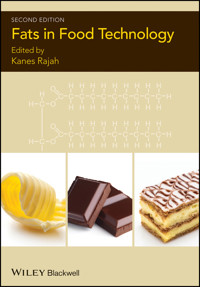
Fats in Food Technology E-Book
154,99 €
Mehr erfahren.
- Herausgeber: John Wiley & Sons
- Kategorie: Fachliteratur
- Sprache: Englisch
Fats are present in some form in the vast majority of processed foods we consume, as well as in many ‘natural’ products. Changes in consumer behaviour, centered around an increased emphasis on healthy food consumption, mean that it is more important than ever for food scientists to understand the properties, roles and behaviours that fats play in food and in diets.
Fats in Food Technology, Second Edition is an in-depth examination of the roles and behaviours of fats in food technology and the benefits that they impart to consumers. It considers both fats that are naturally present in foods (such as milk fat in cheese) and fats that have been added to improve physical, chemical and organoleptic properties (like cocoa butter in chocolate). Newly revised and updated, the book contains useful information on the market issues that have driven change and the disciplines that have helped to regulate the trade and use of fats and oils in food technology. Drawing on the recent literature as well as the personal R&D experiences of the authors, the book highlights those areas where potential efficiencies in processing and economy in the cost of raw materials can be made. Issues concerning health, diet and lifestyle are covered in dedicated chapters.
This book will be useful to anyone in industry and research establishments who has an interest in the technology of fat-containing food products, including scientists in the dairy, spreads, bakery, confectionery and wider food industries, as well those involved in the production of edible oils.
Sie lesen das E-Book in den Legimi-Apps auf:
Seitenzahl: 705
Veröffentlichungsjahr: 2014
Ähnliche




















Table of Contents
Title Page
Copyright
List of Contributors
Preface
Chapter 1: Physical properties of fats in food1
1.1 Introduction
1.2 Basic physical properties of fat crystals
1.3 Structure–function relations in food fats
1.4 Conclusion
References
Chapter 2: Bakery fats1
2.1 Introduction
2.2 Production of margarine and shortening
2.3 Crystallisation behaviour
2.4 Processing
2.5 Plastic bakery fats
2.6 The influence of emulsifiers in baking
2.12 Conclusion
Acknowledgement
References
Chapter 3: Water continuous emulsions
3.1 Introduction
3.2 Preparation of water continuous emulsions
3.3 Factors affecting water continuous emulsions
References
Chapter 4: Oil modification processes
4.1 Introduction
4.2 Hydrogenation
4.3 Interesterification
4.4 Fractionation
4.5 Discussion
References
Chapter 5: Fats for chocolate and sugar confectionery1
5.1 Introduction
5.2 Production and properties
5.3 Legislation and regulatory aspects
5.5 Filling applications
5.6 Problem areas
5.7 Nutritional aspects of confectionery fats
5.8 Conclusion
Acknowledgements
References
Chapter 6: Spreadable products
6.1 Introduction
6.2 Legislation
6.3 Emulsion technology
6.4 Process technology
6.5 Yellow fat blends
6.6 Flavoured butters
6.7 Non-yellow fat range
References
Chapter 7: Emulsifiers and stabilisers1
7.1 Introduction
7.2 Surface activity
7.3 Interface formation
7.4 Stabilisation
7.5 Food emulsifiers
7.6 The hydrophilic–lipophilic balance
7.7 Hydrocolloid stabilisers and thickeners
7.8 Applications
7.9 Regulatory aspects
References
Chapter 8: Food safety and quality issues of dairy fats
8.1 Introduction
8.2 Food-borne disease: the problem
8.3 Food safety and quality issues of dairy fats
8.4 Implementing the HACCP
8.5 Food safety and quality in dairy production
8.6 Future trends
References
Chapter 9: Culinary fats: solid and liquid frying oils and speciality oils1
9.1 Introduction
9.2 Salad and cooking oils
9.3 Frying fats
9.4 Oils for roasting nuts
9.5 Ghee
9.6 Vanaspati
9.7 Speciality oils
9.8 Conclusion
References
Appendix: Nomenclature for fatty acids and triglycerides
Index
This edition first published 2014 © 2014 by John Wiley & Sons, Ltd
Registered office: John Wiley & Sons, Ltd, The Atrium, Southern Gate, Chichester, West Sussex, PO19 8SQ, UK
Editorial officess: 9600 Garsington Road, Oxford, OX4 2DQ, UK
The Atrium, Southern Gate, Chichester, West Sussex, PO19 8SQ, UK
111 River Street, Hoboken, NJ 07030-5774, USA
For details of our global editorial offices, for customer services and for information about how to apply for permission to reuse the copyright material in this book please see our website at www.wiley.com/wiley-blackwell.
The right of the author to be identified as the author of this work has been asserted in accordance with the UK Copyright, Designs and Patents Act 1988.
All rights reserved. No part of this publication may be reproduced, stored in a retrieval system, or transmitted, in any form or by any means, electronic, mechanical, photocopying, recording or otherwise, except as permitted by the UK Copyright, Designs and Patents Act 1988, without the prior permission of the publisher.
Designations used by companies to distinguish their products are often claimed as trademarks. All brand names and product names used in this book are trade names, service marks, trademarks or registered trademarks of their respective owners. The publisher is not associated with any product or vendor mentioned in this book.
Limit of Liability/Disclaimer of Warranty: While the publisher and author(s) have used their best efforts in preparing this book, they make no representations or warranties with respect to the accuracy or completeness of the contents of this book and specifically disclaim any implied warranties of merchantability or fitness for a particular purpose. It is sold on the understanding that the publisher is not engaged in rendering professional services and neither the publisher nor the author shall be liable for damages arising herefrom. If professional advice or other expert assistance is required, the services of a competent professional should be sought.
Library of Congress Cataloging-in-Publication Data
Fats in food products
Fats in food technology / [edited by] Kanes K. Rajah.— 2e.
pages cm
New edition of: Fats in food products. 1994.
Includes index.
ISBN 978-1-4051-9542-3 (cloth)
1. Food— Composition. 2. Food— Fat content. I. Rajah, Kanes K. II. Title.
TP372.5.F38 2014
664′.07— dc23
2013029962
A catalogue record for this book is available from the British Library.
Wiley also publishes its books in a variety of electronic formats. Some content that appears in print may not be available in electronic books.
Cover image: www.istockphoto.com/floortje
www.istockphoto.com/plainview
www.istockphoto.com/juanmonino
Cover design by www.hisandhersdesign.co.uk
List of Contributors
Albert J. Dijkstra
St Eutrope-de-Born, France
Mark Farmer
ADMi, Rolle, Switzerland
Kanes K. Rajah
Dean, School of Business and Entrepreneurship, Professor of Entrepreneurial Behaviour and Innovation, Royal Agricultural University, Cirencester, Gloucestershire, UK
H. M. Premlal Ranjith
Director, Diotte Consulting & Technology Limited, Nantwich, Cheshire, UK
Kiyotaka Sato
Laboratory of Food Biophysics, Graduate School of Biosphere Science, Hiroshima University, Higashi-Hiroshima, Japan
Geoff Talbot
The Fat Consultant, Bedford, UK
Satoru Ueno
Laboratory of Food Biophysics, Graduate School of Biosphere Science, Hiroshima University, Higashi-Hiroshima, Japan
Paul Wassell
Food Nanotechnology Group, Environmental Quality and Food Safety Research Unit, University of Chester, Chester, UK; PVO Innovation Centre, Pasir Gudang, Johor Bahru, Malaysia
Upuli Wijewardene
ProtectFood, Nantwich, Cheshire, UK
Niall W. G. Young
Principal Scientist, DuPont Nutrition and Health, Brabrand, Denmark, and University of Chester, Chester, UK
Preface
This updated second edition is fresh and exciting in a number of ways. First, it is a book about fats in food technology—their role, behaviour and the benefits they impart to the foods we consume. Second, it is about fats that are ‘naturally present’ in foods (e.g. milk fat in cream) or fats that have been added to help with physical and chemical properties (e.g. cocoa butter in chocolate). Finally, it is a book which has useful information about market issues that have driven change and disciplines that have helped to regulate the trade and use of fats and oils in foods.
My initial challenge in the first edition was to find authors who could write to such exacting and wide-ranging requirement. I was privileged to be able to gather together an internationally respected team of authors from several countries, to contribute, either independently or in joint initiatives, a total of nine chapters. In this edition I have been most fortunate that all who still remain active in their specialisms agreed to join me in updating their respective chapters. To fill the gaps created by those who had retired I have been very fortunate in enlisting new authors who are all with senior-level commercial experience of R&D in oils and fats technology and having also direct exposure to technical developments in world markets.
Consequently, all chapters have been reviewed systematically; established products and processes have been investigated for updates while the latest developments have been introduced and new ideas are presented, not only from the recent literature but often from the personal R&D experiences of the authors. Where efficiencies in processing or economy in the costs of raw materials can be achieved, these have—either implicitly or explicitly, by the choice of appropriate examples or formulations—been discussed within the relevant chapters.
Authors have attempted to provide relevant market information in respect of regulation, legislation or directives currently enforced in the major markets, especially within the United States and Europe. Market trends and changes which facilitate a better understanding of the scope and potential for fat technology are also presented. In an integrated approach, the issues concerning greater consumer awareness of health, diet and lifestyle are interwoven into some of the relevant chapters, such as, typically, lower fat products and high moisture emulsions. The technology of non-aqueous fat systems has been brought up-to-date water-in-oil and oil-in-water emulsions are discussed far more extensively in this book than previously.
The book begins with a presentation of the physical properties of fats and emulsions in Chapter 1. Chapter 2, on bakery fats, deals with solid, fluid and powdered fats. New developments in water continuous emulsions and dairy cream technology are explained in Chapter 3. Cream liqueur and ice cream production processes are also included. Hydrogenation and fractionation, which are the most widely used techniques of fat modification, are covered as separate subjects in Chapter 4. Products from these processes often replace, complement or supplement each other. This is evident from the discussion and also in the examples seen in those chapters dealing with end-use, e.g. bakery, spreads and confectionery. Chapter 5 on confectionery products has been widened to cover both chocolate and sugar confectionery fats. Chapter 6 on spreadable products includes the results of specific secondary market research on important developments in butter, margarine and low fat spreads technology and packaging. The significant growth in fat-based sweet and savoury spreads is also acknowledged in this important chapter. The treatment of emulsifiers is comprehensive and Chapter 7 guides the reader through the technology of current products used in, for example, recipes and formulations to ensure that shelf-life, emulsion stability and anti-spattering properties are optimised. We have introduced a unique new chapter, Chapter 8 on ‘Food Safety and Quality Issues of Dairy Fats’ consists of the most up-to-date information on the subject. Finally, culinary fats appear as a separate chapter (Chapter 9) because they focus on some of the unique features and benefits of fats, frying oil, ghee and vanaspati and speciality fats in the kitchen and discuss these in terms of flavour, eating quality, texture, aroma and benefits to health.
This book should be helpful to anyone who is interested in the technology of fat-containing products. Food technologists in either the dairy industry or the edible oils industry and indeed the food industry generally should find that this volume provides important ideas for product and process development. For scientists in academic research establishments, the book offers important insights into some of the more significant scientific developments that have been commercialised. The book will also serve as a useful source of reference to traders and marketing personnel in the oils, fats and butter industries.
This has been yet again a major challenge and a creative experience for all of us. It has been possible only because those who participated in crafting both editions gave of their best, unflinchingly. My warmest thanks, therefore, to the following much valued colleagues who have retired but whose original chapters remain with new authors taking up the task to update: Tetsuo Koyano, John Podmore, Ralph E. Timms, David Robinson and Clyde E. Stauffer. I am saddened that Ian M. Stewart, a much admired and highly respected colleague passed away. He will be missed greatly. Finally, Timothy P. Guinee and Barry A. Law were unable to update their chapter on ‘Role of milk fat in hard and semihard cheeses’ and so their original chapter in the first edition remains as the reference point on the subject and is not included in this second edition. I record my gratitude to all our colleagues who had contributed to the first edition.
A special thanks to my fellow authors in this book for their hard work and for generously sharing their knowledge, insight and experience in producing such excellent chapters. Any perceived shortcomings in this book are entirely my own responsibility. I am equally grateful to Dr Graeme MacKintosh as the Publisher who invited me to undertake the first edition, and to the Commissioning Editor of this edition Mr Andrew Harrison and to Fiona Seymour—Senior Project Editor, who took over from him. Thank you to all on the Wiley team for your invaluable assistance and unstinting support at all times.
Finally, to the three special people in my life who make me still want to undertake such projects, to Heera, Tamara and Tara, thank you.
Chapter 1
Physical properties of fats in food1
Kiyotaka Sato and Satoru Ueno
Laboratory of Food Biophysics, Graduate School of Biosphere Science, Hiroshima University, Higashi-Hiroshima, Japan
1.1 Introduction
Oils and fats are important ingredients in a wide variety of manufactured foods, and constitute a significant part of food recipes. The major foods in which they are used are all discussed in detail in this volume. However, it is important to note that the forms in which oils and fats are made available to food manufacturers have changed significantly over the years, particularly since the 1960s, largely because of the major shifts that have taken place in consumer lifestyles and the increasing concerns with health, food safety and a balanced diet. Many of the food products that are now available to consumers reflect this new direction. Important examples arising out of the lipid research that has followed are trans-free fatty acids, reduced high-melting, in particular saturated, fats, very-low-yellow fat emulsions, spreadable butter, aerated fats, structured oils, molecularly designed structured fats with new nutritional advantages, and so on. All these initiatives have required an in-depth understanding of the behaviour of the fats concerned so that they can be used effectively as ingredients in food. Consequently, the study of their physical properties is of major interest and is covered in this chapter.
In general, fats form networks of crystal particles, maintaining specific polymorphic forms, crystal morphology and particle–particle interactions (Marangoni, 2005). The control of the physical properties of food fats has therefore been of importance in research efforts and can be considered under five headings:
clarification of molecular and crystal structures of triacylglycerols (TAGs) with different fatty-acid moieties (Kaneko
et al
., 1998; Kaneko, 2001);
crystallisation and transformation mechanisms of TAG crystals (Sato, 1996, 1999; Sato and Koyano, 2001; Sato and Ueno, 2005);
clarification of formation mechanisms of mesoscale and macroscale fat crystal network starting from nanoscale primary fat crystals (Acevedo
et al
., 2011);
rheological and texture properties that are dominated mainly by fat crystal networks (Boode
et al
., 1991; Marangoni and Hartel, 1998; Marangoni
et al
., 2012; Walstra
et al
., 2001);
influences of external factors such as shear, ultrasound irradiation, minor lipids on fat crystallisation kinetics (Martini
et al
., 2008; Mazzanti
et al
., 2011; Smith
et al
., 2011; Wright
et al
., 2000).
The first topic is of an introductory nature and so will not be elaborated in this chapter (for more details, see the cited references). The remaining four topics are related to observed systems of food fats, with which this chapter is mainly concerned.
The chapter begins with a brief review of the three basic physical properties of fats by collecting together recent work on the crystallisation and transformation of the fats in bulk and in emulsion states. We will then focus on fundamental aspects of the crystallisation and transformation of fats employed in real food systems, through describing the use of important examples, such as cocoa butter, palm oil and palm mid-fractions. Since these natural fats are multi-TAG systems, knowledge of the fundamental properties of pure TAGs composing the natural fats may be necessary, as will be argued. Those who wish to compare real fats with pure fats are directed to the literature (Himawan et al., 2006; Sato, 1996; Sato and Koyano, 2001; Sato and Ueno, 2001; Sato et al., 1999).
1.2 Basic physical properties of fat crystals
The physical properties of the food fats are influenced primarily by three factors: (1) polymorphism (structural, crystallisation and transformation behaviour); (2) the phase behaviour of fat mixtures; and (3) the rheological and textural properties exhibited by fat crystal networks. In this section we cover the fundamentals and look at recent research work on these three properties.
1.2.1 Polymorphic structures of fats
Polymorphism is defined as the ability of a chemical compound to form different crystalline or liquid crystalline structures. The melting and crystallisation behaviour will differ from one polymorph to another.
Table 1.1 summarises the basic physical properties of the three typical polymorphic modifications of α, β′ and β. Polymorph α is least stable, easily transforming to either the β′ form or the β form, depending on the thermal treatment. Polymorph β′, the meta-stable form, is used in margarine and shortening because of its optimal crystal morphology and fat crystal networks, which give rise to optimal rheological and texture properties. The most stable β form tends to form large and plate-like crystal shapes, resulting in poor macroscopic properties in shortening and margarine.
Table 1.1 Three typical polymorphic forms of fats and their main physical properties.
The three main polymorphs, α, β′ and β of fats, are defined in accordance with subcell structure: α polymorphs have a hexagonal subcell (H); β′ polymorphs have an orthorhombic–perpendicular subcell (O⊥); and β polymorphs have a triclinic–parallel subcell (T//) (Larsson, 1966; see Figure 1.1 (a)). The subcell structures can be determined most clearly by measuring X-ray diffraction (XRD) short spacing patterns of poly-crystalline samples.
Figure 1.1 Polymorphic structures of three typical forms of triacylglycerol (TAG). (a) Subcell structures and (b) chain length structures.
Figure 1.1 (b) shows the chain-length structure, illustrating the repetitive sequence of the acyl chains involved in a unit cell lamella along the long-chain axis (Larsson, 1972). A double chain-length structure (DCL) is formed when the chemical properties of the three acid moieties are the same or very similar. In contrast, when the chemical properties of one or two of the three chain moieties are largely different from those of the moieties, a triple chain-length (TCL) structure is formed because of chain sorting. The relevance of the chain-length structure is revealed in the mixing phase behaviour of the different types of the TAGs in the solid phase: when the DCL fats are mixed with the TCL fats, phase separation readily occurs. The chain length structures can be determined solely by measuring the XRD long spacing patterns of the poly-crystalline samples.
Lesen Sie weiter in der vollständigen Ausgabe!
Lesen Sie weiter in der vollständigen Ausgabe!
Lesen Sie weiter in der vollständigen Ausgabe!
Lesen Sie weiter in der vollständigen Ausgabe!
Lesen Sie weiter in der vollständigen Ausgabe!
Lesen Sie weiter in der vollständigen Ausgabe!
Lesen Sie weiter in der vollständigen Ausgabe!
Lesen Sie weiter in der vollständigen Ausgabe!
Lesen Sie weiter in der vollständigen Ausgabe!
Lesen Sie weiter in der vollständigen Ausgabe!




