


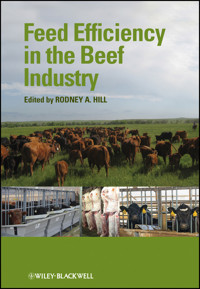
Feed Efficiency in the Beef Industry E-Book
144,99 €
Mehr erfahren.
- Herausgeber: John Wiley & Sons
- Kategorie: Wissenschaft und neue Technologien
- Sprache: Englisch
Feed Efficiency in the Beef Industry provides a thorough and concise overview of feed efficiency in beef cattle. It frames the great importance of feed efficiency to the industry and details the latest findings of the many scientific disciplines that intersect and aim to improve efficient and sustainable production of nutritious beef. The vast majority of production costs are directly tied to feed. With increased demand for grains to feed a rapidly increasing world population and to supply a new demand for alternative fuels, feed costs continue to increase. In recent years, the negative environmental impacts of inefficient feeding have also been realized; as such feed efficiency is an important factor in both economic viability and environmental sustainability of cattle production. Feed Efficiency in the Beef Industry covers a broad range of topics ranging from economic evaluation of feed efficiency to the physiological and genetic bases of efficient conversion of feed to high quality beef. Chapters also look at how a fuller understanding of feed efficiency is leading to new selective breeding efforts to develop more efficient cattle. With wide-ranging coverage from leading international researchers, Feed Efficiency will be a valuable resource for producers who wish to understand the complexities, challenges, and opportunities to reduce their cost of production, for students studying the topic and for researchers and professionals working in the beef industry.
Sie lesen das E-Book in den Legimi-Apps auf:
Seitenzahl: 794
Veröffentlichungsjahr: 2012
Ähnliche




















Contents
Cover
Title Page
Copyright
Dedication
Contributors
Foreword
Preface
Acknowledgments
Introduction
Reader Guide to Scope
Important Distinctions between Feed Efficiency Metrics and Methodologies and Their Strengths and Weaknesses
The Complexity of Feed Efficiency Concepts, Scientific Interpretation, and Some Consequences
The Role of New Technologies in Improving Feed Efficiency
The Opportunity
Chapter 1: Input Factors Affecting Profitability: a Changing Paradigm and a Challenging Time
Introduction
Influence of Input and Feed Costs on the Beef Production Industry
Evolving Factors Affecting Feed Cost in the Beef Production Industry (the Changing Marketplace for Feed Grains)
Drivers for Increased Focus on Feed Efficiency within the Beef Industry
Implications for Improved Efficiency of Feed Utilization in the United States (Based on Number of Beef Cattle in United States—Cow/Calf, Stocker, and Feedyard)
Chapter 2: Measuring Individual Feed Intake and Utilization in Growing Cattle
Introduction
Equipment and Facilities for Intake Measurement
Pretest Information
Age on Test
Adaptation Period
Test Period
Test Diets
Pen Stocking Rates
Measurement of Body Composition
Data Auditing
Alternative Measures of Feed Efficiency
Summary
Chapter 3: Producer Awareness and Perceptions about Feed Efficiency in Beef Cattle
Introduction
Approach and Description of the Social Surveys
Survey Results
General Discussion
Implications
Acknowledgments
Chapter 4: Feed Efficiency in Different Management Systems: Cow-Calf and in the Feedyard
Introduction
Measuring Intake and Efficiency
Feedlot Management Systems
Cow Energy Status and Intake
Heifer RFI and Mature Cow Efficiency
Summary
Chapter 5: Lessons from the Australian Experience
Introduction
The Trangie Project
Lessons Learnt on Measurement of Feed Intake and Efficiency
Industry Implementation and Test Standards
Conclusion
Chapter 6: Nutrition and Feed Efficiency of Beef Cattle
Introduction
Intake and Feed Efficiency Ranges within Beef Cattle
Balancing Postruminal Amino Acid Flow with Consumed Energy
Summary
Chapter 7: Genetic Improvement of Feed Efficiency
Genetic Improvement in Beef Cattle
Genetic Control of Feed Efficiency
Strategies for Genetic Improvement
Gaps in Our Knowledge
Conclusion
Chapter 8: Feed Efficiency and Animal Robustness
We Need Feed Efficient Animals
Selection for Feed Efficiency
Resources Allocation
Artificial Selection for High Production Efficiency
Selecting for Lower Maintenance Requirements
Robustness and Welfare
Conclusions
Chapter 9: Interactions with Other Traits: Reproduction and Fertility
Nutritional Regulation of Reproductive Endocrine Function
Factors Regulating Puberty
Effect of Heifer RFI on Fertility
Links between Stress, Feed Efficiency, and Fertility
Factors Regulating Cow Lifetime Productivity
Cow Lifetime Productivity and RFI
Effect of RFI on Bull Fertility
Conclusions and Implications
Chapter 10: Feed Efficiency Interactions with Other Traits: Growth and Product Quality
Introduction
Feed Efficiency and Growth
Feed Efficiency Relationships with Carcass or Product Quality
Conclusion
Chapter 11: Estimating Feed Efficiency of Lactating Dairy Cattle Using Residual Feed Intake
Feed Efficiency in the Context of Milk Production
Factors to Consider in Measuring RFI for Milk Production
Variation in RFI for Milk Production and Its Heritability
Phenotypic Differences between High and Low RFI Dairy Cows
Potential Impacts of Improved RFI for Milk Production on the Dairy Industry
Future Areas of Investigation
Chapter 12: Muscle and Adipose Tissue: Potential Roles in Driving Variation in Feed Efficiency
Introduction
Relative Amounts of Muscle and Fat—Relationship to Feed Efficiency
Muscle: Contribution to Variation in Feed Efficiency
Adipose Tissue: Contribution to Variation in Feed Efficiency
Conclusion
Chapter 13: Epigenetics and Effects on the Neonate That May Impact Feed Efficiency
Introduction
Developmental Programming
Epigenetics
Programming of Feed Efficiency
Transgenerational Impacts of Maternal Nutrition on Offspring
Conclusions
Chapter 14: Hormonal Regulation of Feed Efficiency
Introduction
Feed Intake: Signals to and from the Hypothalamus
Integration
Biological Markers of Feed Efficiency
Conclusion
Chapter 15: Variation in Metabolism: Biological Efficiency of Energy Production and Utilization That Affects Feed Efficiency
Introduction
Mitochondria
Mitochondrial Inefficiencies
Matching Cellular Needs to Growth, Development, and Activity
Mitochondria in the Phenotypic Expression of Feed Efficiency
Summary
Acknowledgments
Chapter 16: Modeling Feed Efficiency
Introduction
Predictive Models
Genetic Models
Mechanistic Models
Final Considerations
Index
This edition first published 2012 © 2012 by John Wiley & Sons, Inc.
Wiley-Blackwell is an imprint of John Wiley & Sons, formed by the merger of Wiley's global Scientific, Technical and Medical business with Blackwell Publishing.
Editorial offices:2121 State Avenue, Ames, Iowa 50014-8300, USA The Atrium, Southern Gate, Chichester, West Sussex, PO19 8SQ, UK] 9600 Garsington Road, Oxford, OX4 2DQ, UK
For details of our global editorial offices, for customer services and for information about how to apply for permission to reuse the copyright material in this book please see our website at www.wiley.com/wiley-blackwell.
Authorization to photocopy items for internal or personal use, or the internal or personal use of specific clients, is granted by Blackwell Publishing, provided that the base fee is paid directly to the Copyright Clearance Center, 222 Rosewood Drive, Danvers, MA 01923. For those organizations that have been granted a photocopy license by CCC, a separate system of payments has been arranged. The fee codes for users of the Transactional Reporting Service are ISBN-13: 978-0-4709-5952-7/2012.
Designations used by companies to distinguish their products are often claimed as trademarks. All brand names and product names used in this book are trade names, service marks, trademarks or registered trademarks of their respective owners. The publisher is not associated with any product or vendor mentioned in this book. This publication is designed to provide accurate and authoritative information in regard to the subject matter covered. It is sold on the understanding that the publisher is not engaged in rendering professional services. If professional advice or other expert assistance is required, the services of a competent professional should be sought.
Library of Congress Cataloging-in-Publication Data
Hill, Rodney A. Feed efficiency in the beef industry / edited by Rodney A. Hill. – 1st ed. p. cm. Includes bibliographical references and index. ISBN 978-0-470-95952-7 (hardback) 1. Cattle–Feed utilization efficiency. 2. Cattle–Feeding and feeds. 3. Beef industry. I. Title. SF203.H55 2012 636.2–dc23 2012009292
A catalogue record for this book is available from the British Library.
Wiley also publishes its books in a variety of electronic formats. Some content that appears in print may not be available in electronic books.
Disclaimer
The publisher and the author make no representations or warranties with respect to the accuracy or completeness of the contents of this work and specifically disclaim all warranties, including without limitation warranties of fitness for a particular purpose. No warranty may be created or extended by sales or promotional materials. The advice and strategies contained herein may not be suitable for every situation. This work is sold with the understanding that the publisher is not engaged in rendering legal, accounting, or other professional services. If professional assistance is required, the services of a competent professional person should be sought. Neither the publisher nor the author shall be liable for damages arising herefrom. The fact that an organization or Website is referred to in this work as a citation and/or a potential source of further information does not mean that the author or the publisher endorses the information the organization or Website may provide or recommendations it may make. Further, readers should be aware that Internet Websites listed in this work may have changed or disappeared between when this work was written and when it is read.
Dedication
This book is dedicated to all those who have shared their knowledge, collegiality, and support: my mentors, teachers, colleagues, and students. Above all, to my wife, family, and friends.
Contributors
Jason K. AholaColorado State UniversityPaul F. ArthurNew South Wales Department of Primary Industries, AustraliaJohn A. BasarabAlberta Agriculture and Rural Development, CanadaWalter G. BottjeUniversity of ArkansasGordon E. CarstensTexas A and M UniversityJoel S. CatonNorth Dakota State UniversityErin E. ConnorUSDA-ARS, BeltsvilleD.H. (Denny) Crews Jr.Colorado State UniversityMichael E. DavisThe Ohio State UniversityDan B. FaulknerUniversity of Illinois at Urbana-ChampaignCarolyn FitzsimmonsUniversity of Alberta, CanadaStephen P. FordUniversity of WyomingJohn B. HallUniversity of IdahoRobert M. HerdNew South Wales Department of Primary Industries, AustraliaBret W. HessUniversity of WyomingRodney A. HillUniversity of IdahoJana L. HutchisonUSDA-ARS, BeltsvilleStephanie KaneUniversity of IdahoMonty S. KerleyUniversity of MissouriTheresa A. KoktaUniversity of IdahoMartin G. MaquivarThe Ohio State UniversityMarcus McGeeUniversity of IdahoAllison M. MeyerUniversity of WyomingH. Duane NormanUSDA-ARS, BeltsvilleWendy M. RauwInstituto Nacional de Investigación y Tecnología Agraria yAlimentaria, SpainKeela M. RetallickUniversity of Illinois at Urbana-ChampaignLawrence P. ReynoldsNorth Dakota State UniversityRoberto SainzUniversity of California (Davis)Cassie M. WelshUniversity of IdahoRobert P. WettemannOklahoma State UniversityC. Scott WhisnantNorth Carolina State UniversityMacdonald P. WickThe Ohio State UniversityJ.D. WulfhorstUniversity of IdahoForeword
I first met Dr Hill at a BIF (Beef Improvement Federation) convention in 2009. I was impressed with his dedication and enthusiasm to coordinate meaningful change in researching, identifying, and providing selection tools for improving efficiency in cattle production. It is a passion our family has shared over three generations.
With this book, Dr. Hill and colleagues have provided a valuable service to the beef industry. This book, as a detailed anatomy of cattle efficiency, profiles where we are today and establishes the foundation for future efficiency research.
The timeliness of this book cannot be overstated. Over the past 5 years, the United States has consistently produced 25% of the world beef supply, while other world beef production has declined slightly year over year. In 2012, US beef production is predicted to decline by 5%. This is a disturbing statistic at a time when global population has surpassed 7 billion. By 2030, world population is forecasted to be over 8 billion, global demand for meat is expected to rise by 55%, and energy demand will increase by 40%. We must meet this increasing demand constrained to substantially the same cropland the world has cultivated since 1970.
This book comes at a time when the United States and world beef producers are challenged by many traditional and emerging issues such as:
Weather.Rising energy costs.Increasing nonagricultural use for grazing land and increasing competition for traditional feed sources.Complex government and international policies including a confounding US biofuel policy.These issues affect feed prices. Feed costs are directly related to 75% of the cost of producing finished cattle.
Cattle producers take the vast amount of land only suitable for grazing that God has blessed us with, and through grazing cattle, harvest those grasses, conserving land for future generations while at the same time producing a nutritious protein product. By understanding the many challenges faced by cattle producers in maintaining a sustainable business balanced by a strong commitment to animal welfare, a safe, healthy beef supply, and sound environmental stewardship, you will begin to appreciate that beef is one of the great success stories in food production.
For more than 50 years, it has been my family's commitment to identify genetics that have economic importance to the rancher, feeder, and consumer. In 2007, we invested heavily in technology developed by GrowSafe Systems Ltd to measure individual intake in young bulls and heifer calves. We now test about 1700 head a year, and the first offspring we fed from one of these high-efficiency bulls performed at the same level with 15% less intake. This improvement took a systematic, measured approach over time, but these results were unprecedented. To those who say we are a mature industry, I say we have just entered a new generation.
As you travel through the chapters of this book, you will better understand the importance of developing genetic traits for selection, such as RFI, that allow cattle producers to produce more effectively with less. Through this book, you will also come to appreciate the positive conservation and environmental impacts that selecting for efficiency traits such as RFI offer. I hope you appreciate Dr. Hill's commitment to consolidating groundbreaking research from leading scientists in the field of cattle efficiency, particularly as the scientific community faces reduced agricultural research funding.
As a beef producer, use the knowledge you gain to expand your operation's opportunity to improve efficiency. These are truly exciting times as product quality and production efficiency will be the profitability drivers that sustain our industry. Consider the tremendous opportunity we have in meeting today's and tomorrow's responsibilities to feed the world and enhance our natural resources in a sustainable and meaningful manner.
Leo McDonnellColumbus, Montana
Preface
As I write, in November 2011, we remain in the throes of a lingering worldwide recession that has affected business costs, changed markets, and challenged production models across many industries. The issues around feed efficiency in the beef industry remain complex and many perspectives are evolving and changing. An enlightening perspective that a beef industry colleague recently expressed is that there has never been a better time to embrace opportunities to excel.
I see that improving feed efficiency in the beef industry is a great example of such an opportunity. The issues and challenges we face in improving feed efficiency are driven by ever increasing knowledge of the underpinning science, competing economic forces, and inevitably industry politics. I also see and experience a broad array of interpretations of data and perspectives from industry representatives, producers, scientists, and others. Our beef industry is large and complex with a broad array of interests and priorities. Multiple sectors within the industry variously work in collaboration or compete for a greater share of profits. The players vary in the scale and scope of their influence from large multinational entities to single families and individuals working to improve profitability and success, or especially in the case of smaller operations, just seeking to maintain a fulfilling lifestyle.
The topic of feed efficiency in the beef industry is one that has slowly gained the notice of both scientists and the industry over the last two decades. However, during the past few years, the costs of feedstuffs and fuel (and energy generally) have risen to new highs and have undergone unprecedented volatility bringing feed efficiency to greater prominence.
For the beef producer, improving feed efficiency is a move away from thinking about the outputs from their enterprise, driving revenue, to thinking about taking control of costs. In one aspect, beef producers actually do have some level of control over how and how much they invest in inputs such as feed, whereas they have little or no control over the price they receive for their products. Thus, controlling feed costs is a pragmatic way for producers to improve profitability.
Scientists are intent on discovery and providing better approaches to improving feed efficiency. This is a complex, real-world problem that cannot be addressed by a single scientific discipline. The collaboration of many is essential to progress. The so-called hard sciences also need the collaboration of economists to understand costs, revenues, and profitability and social scientists to help us understand how and why producers either adopt new knowledge or why they may be reluctant to do so.
From my interactions with many producers and others in the broader beef industry, I know that scientists have a lot to learn, and I have benefited from the profound insights of people with practical experience and perspectives who have not seen the inside of a laboratory or pursued a college degree. As the editor of this book, I am deeply indebted to many from both outside and inside academe who have shared their knowledge or who have stimulated my thinking and helped me gain new insights.
In many respects, we are at the beginning of our understanding of the biological drivers of variation in feed efficiency. There is still much to learn. This volume is perhaps also a beginning—that is, it is a starting place for information on the topic and a resource that has brought many aspects, disciplines, and perspectives together.
Rodney A. Hill
Acknowledgments
Special thanks to Mr Leo McDonnell for reviewing the manuscript and expressing his thoughts in the foreword. To the many colleagues who have contributed to the book; your expertise and deep insights are truly special and are the intellectual foundations the sum of which provides the substance of our contribution herein to science and to the beef industry. I also wish to thank the expert review panel. From the outset, I made the decision that the added value of peer review would enhance the quality and rigor of the book. With the help of the Wiley-Blackwell staff, we were able to establish a system of double-blinded review, so that I, as editor (and chapter contributor), did not know the identity of the reviewers who were assigned to each chapter, nor was the identity of the authors revealed to the reviewers. We considered this approach an effective way to conduct a rigorous and constructive review of the submitted works.
To the many beef producers, industry representatives, students, colleagues, and others with whom I have discussed and debated aspects of feed efficiency, thank you for sharing your insights and helping me to greater understanding and enlightenment.
Also a special thank to Anna Ehler at Wiley-Blackwell who has provided valuable, ongoing support and guidance throughout the writing and editing phases of the project. Thanks to Justin Jeffryes also at Wiley-Blackwell. Justin and I first discussed this project several years ago. It was his encouragement that eventually got me moving and initiating the project. Finally, thanks to the readers: producers, industry representatives, students, scholars, and folks who find the topic of feed efficiency in the beef industry of interest.
I am deeply indebted to our panel of following eminent scientists:Those who reviewed one chapter:Dr Margaret BensonWashington State UniversityDr Carl HuntUniversity of IdahoDr Alan GrantVirginia Polytechnic UniversityDr Gregory LardyNorth Dakota State UniversityDr Richard NorelUniversity of IdahoThose who reviewed multiple chapters:Dr Larry BergerUniversity of Nebraska, LincolnDr Douglas HixonUniversity of WyomingDr James MalesOregon State UniversityDr Hutton OddyUniversity of New England, AustraliaIntroduction
Rodney A. Hill
Reader Guide to Scope
This book was conceived with the aim of providing a broad readership with information written by expert authors, with comprehensive coverage of the field. An important notion has been to provide information in a progression. The organization of the book is such that the early chapters are pitched with the assumption that the reader who has little scientific training could find interesting and useful information about feed efficiency in the beef industry. It is my hope that producers who have not yet had the opportunity to learn about the latest discoveries around feed efficiency in the beef industry will find the information useful. In progressing through the middle chapters, I anticipate that the reader would need a greater knowledge of some industry-specific information and further training in science. The latter chapters progress such that the reader would need advanced training in science to benefit from the information provided. Thus, my hope is that even lay readers with interest in the topic will find the early chapters informative and understandable while the middle chapters might be a stretch, but still provide greater insights and understanding. I expect those who have more specific industry knowledge, but not necessarily scientific training, will find the middle chapters readily understandable and informative.
In addition, for highly trained industry professionals, scientists, and graduate students, my hope is that the early chapters provide industry context as well as background that set the stage for the latter chapters. In the chapters that delve into the more mechanistic and basic science, I have encouraged the authors to directly point to some of the molecular mechanisms known to underpin variation in beef cattle feed efficiency. This is an emerging field and the biological drivers of this variation are only poorly understood. Thus I have also encouraged the authors to provide basic information that can suggest where the advances in understanding of underlying mechanisms may emerge. This also means that some speculation is included about which of these mechanisms might be important.
Important Distinctions between Feed Efficiency Metrics and Methodologies and Their Strengths and Weaknesses
Across the many topics covered in this book, the authors have dealt with feed efficiency in different contexts. Although there is mention of several different ways that scientists think about and approach the measurement of feed efficiency, there have been two different measures that have predominated across scientific enquiry and emphasized in this book. I provide a discussion of both and my perspectives on the strengths and weaknesses of each are presented below. The two quite different measures of feed efficiency are: (1) The ratio of the amount of feed (or more precisely quantity of nutrients) consumed, to the gain in animal weight over a set period. This can be termed feed conversion ratio (FCR) also termed feed:gain (F:G) and its mathematical inverse gain:feed (G:F). There are scientific and statistical analysis considerations and interpretation contexts that determine which of these may be preferred. (2) The other measure of feed efficiency is termed residual feed intake (also termed net feed intake or even net feed efficiency). These are identical. The term “residual” comes from the mathematic relationship of the measured feed efficiency of an individual animal to its “predicted” intake based on the population of animals in which it was evaluated. The feed efficiency of the population can be described by a mathematical relationship termed a regression. Thus, “residual” is really a mathematical term that refers to the difference between the amount of feed that the animal consumed and what it was predicted to consume based upon its size (weight) and its rate of weight gain.
The great strength of the ratio measurements noted in (1) above is that in a beef cattle management context, they convey important information about the performance of the particular set of animals that are being studied. Information that is immediately useful, describing animal performance (growth) in response to measured feed intake can provide estimates of the costs and benefits associated with that particular study. Traditionally in animal science and animal production, these ratio measurements have been recorded on a pen basis, so that feed intake for the entire pen is measured. Thus, the information has overall value for that specific pen group or may be used for comparison to equivalent replicate pen groups or, for example, to equivalent pens of animals offered a different diet. Unfortunately this approach does not provide any information about the individual variation of animal intake within the pen. As the reader of this book you will also learn, in considering the genetic potential of animals, or to make predictions about the performance of progeny from animals measured using ratio analysis, even when individual intakes are known, there are confounding issues. Thus, the ratio analysis is flawed as a genetic prediction tool.
On the other hand, the approach to efficiency measurement noted in (2) above: residual feed intake (RFI) is very well suited to use in genetic evaluation programs. This measurement exploits the large individual variation in feed intake for a given level of growth rate and animal size. The magnitude of this variation is large in beef cattle. Within a population of animals of the same class (e.g., a group of weaned heifers of the same age and breed and management group) the spread (variation) in feed intake of two animals gaining at the same rate can be 35% or more. Thus, there is huge scope for reducing the level of intake for the same level of performance (growth). The next strength of RFI is that as a genetic selection trait, it is largely independent of most other performance traits and thus can be relatively easily incorporated into a selection index. Thus, it can be possible to select for multiple desirable traits, and by including RFI, it is possible to select for feed efficiency without compromising other desirable traits. (Although not mentioned above, FCR or F:G is also highly correlated to growth rate and mature size. If these ratio traits were used in a selection context, coselection for larger frame size animals would result. This especially has a downside as heifers would also become larger, increasing time to puberty and decreasing the number of larger mature cows that could be run on a given body of feed or rangeland area. Overall this would lead to fewer calves produced for the same feed resource and negatively affect cow-calf production efficiency.) Another trait that is also confounded by its high correlation with gain and mature size is termed residual gain (RG), and it is similarly flawed as a selection tool as outlined for the ratio traits.
The other feature of RFI worth noting here is that it is moderately heritable. This means that there will be a response to selection that will result in improvement in feed efficiency of selectively bred animals. This also suggests that there are many other factors, both environmental (e) and the interaction of genetics with environmental effects (g × e) that contribute to variation in RFI. Thus, for scientists in the disciplines of nutrition or physiology, there is scope to understand the nutritional and physiological drivers of variation in RFI and to work on these to improve RFI for the benefit of the industry.
A caveat for use of RFI: There are two production factors that are known correlates and must be noted here. Feed intake is correlated to RFI. Thus, care in use of selection for lower RFI (desirable, more efficient animals) is needed to ensure that animals are not inadvertently coselected for lower feed intake. The other factor to mention is body composition that accounts for about 5% of the total variation in RFI. Animals that are RFI inefficient tend to be fatter than RFI-efficient animals that tend to be leaner. Scientists are strongly aware of this relationship and many now include a measure of body composition in the model that estimates RFI. This procedure eliminates the contribution of variation in body composition when calculating RFI within a contemporary group. However, awareness of these two correlates is important and ongoing monitoring for both level of feed intake and body composition is essential.
In considering disadvantages, for both ratio measurements and RFI, when feed intake of individual animals is a necessary piece of data, the cost of collecting this information is substantial. The advent of electronic equipment that allows individual intake of group-housed animals to be accurately recorded has been a boon to improving feed efficiency in the beef industry. The capital cost and upkeep costs of the equipment are such that (up until recently) feed intake testing has been limited to the research context. However, the industry drive and awareness of the potential savings that can be realized through selection for improved RFI is rapidly spreading. Recently, forward-thinking producers have established bull-test facilities that include individual feed intake measurement. The combination of research and commercial feed intake testing will accelerate progress. Although there is certainly a substantial upfront cost to testing, the reader of this book will discover that the potential return on investment is also substantial.
The Complexity of Feed Efficiency Concepts, Scientific Interpretation, and Some Consequences
Scientists are trained to build a healthy skepticism and we often vary in interpretation of data. I should point out that for the lay reader, scientists’ understanding of feed efficiency is framed by their specialist training and experience. For example, a nutritionist has a very different perspective from a quantitative geneticist.
Feed efficiency is a complex concept. To gain a complete understanding, specialist knowledge from many different scientific disciplines is needed and exchange of ideas among disciplines shapes our interpretations and perspectives. Scientists who are highly trained in one discipline have to rely on those with expertise in completely different disciplines to contribute as studies are designed, the data collected and interpreted, and new knowledge discovered. The apparent complexity of the concepts becomes greater as scientists with deep knowledge within their discipline probe their understanding at finer and deeper levels of biological detail. This is an established scientific approach to discovery. Scientists interpret the data and evolve their own perspectives from their discipline focus. This can sometimes lead to quite different and even opposing views. I believe that it is this complexity and variation in interpretation that has underpinned some of the scientific debates on aspects of the topic of feed efficiency and is typical of the scientific discovery process. Unfortunately, an unintended consequence is that different messages from different scientists can lead to confusion for industry, producers, and lay people.
As a scientist, I have a strong belief that the scientific method is robust and that additional research will shine clarifying lights as we learn more. This process will allow scientists to gain understanding at deeper levels and to resolve differences in perspective. This will also have a flow-on benefit in removing the unintended consequences referred to above.
Unfortunately, for an industry that is currently being affected by unprecedented increases in the cost of feedstuffs and energy and general volatility in costs, there is an urgent need to identify ways to reduce the cost of producing quality beef. This must be done using strategies that will achieve these cost reductions in a sustainable manner. As one of the experts in this field, having worked with the pros and cons of many different approaches to improving feed efficiency, I see the greatest strategic benefits for the industry in adopting RFI as a preferred metric. It has great advantages and potential for improvement in response to genetic selection and in response to improving the finer aspects of nutrition. As a physiologist, I also see that by improving and refining our knowledge of the physiological drivers of the variation in RFI, we can improve both management and genetic selection strategies.
The Role of New Technologies in Improving Feed Efficiency
There are at least two scientific disciplines that have huge potential to contribute to great advances in understanding and improving feed efficiency in beef cattle. Molecular physiology is the study of body systems at the molecular level. Genomics is the study of molecular interactions at the level of genes. These two disciplines have some overlap. At present there is some controversy about the contribution of the technologies that underpin these disciplines in improving understanding of feed efficiency, and certainly not all scientists agree. My perspective is that the technologies that inform these disciplines are advancing very rapidly and the power of analysis of new genomics and molecular physiology data is impressive. My prediction is that within the next few years, we will have substantial new knowledge and technical capacity that will allow us to link molecular physiology and genomics data to data generated from standardized RFI feed efficiency testing of animals, which will result in greater accuracy of estimates of genetic potential as well as improving our understanding of the genetic and physiological drivers of variation in feed efficiency. In fact, science is moving already in linking these elements together.
To be clear, my perspective is that feed intake/feed efficiency testing animals using a standardized protocol along with tester dedication to testing rigor will be essential and will be the “gold standard” for improving feed efficiency in the beef industry for many years to come. As noted above, the pace of advances in molecular technologies is impressive. Clearly, if molecular markers or major genes of effect can be identified, they will add to the knowledge base and potentially improve genetic prediction accuracy. The cost of animal testing is a concern for the industry and new technologies also have the potential to reduce the cost of accurate and reliable animal evaluation. My word of caution to the industry is to be sure that judgment of the value of a testing method should not be primarily linked to the cost of the test. Its value should be judged on the quality of the information it provides. This is a strategic perspective, vital for underpinning the long-term sustainability of the industry. A secondary consideration in evaluating a performance metric is its cost-benefit. This can be difficult to judge in an industry in which profit margins are narrow and today in a scenario in which costs of inputs and return on investment are both volatile. Despite the cost of testing animals for feed efficiency, I foresee that well into the future, molecular-level information will need to be regularly calibrated against animal testing to ensure that we continue to make progress in improving feed efficiency and that unintended drift in undesirable production or product quality attributes does not occur.
The Opportunity
Improving feed efficiency in the beef industry is an opportunity that has potential to benefit all sectors of the industry.
Many scientists across multiple disciplines are making discoveries and finding ways forward. There is great industry awareness of the opportunities and progressive thinkers out there are implementing and adopting feed efficiency to improve their businesses. This book brings together many of the aspects of the science that, perhaps for the first time, provide a ready reference and source for producers, students, and scholars. It is my hope that the text will also stimulate discussion in cattle barns, coffee shops, and classrooms that lead to further insights to improve our understanding of the underlying biological drivers of variation in feed efficiency and ultimately bring greater benefits to the beef industry.
1
Input Factors Affecting Profitability: a Changing Paradigm and a Challenging Time
Jason K. Ahola and Rodney A. Hill
Introduction
Since their creation in the 1960s, US beef cattle improvement programs have predominantly focused on improving output-related traits through genetic selection of beef seedstock cattle. Such traits historically included economically relevant weight and carcass traits by much of the seedstock industry and, more recently, fertility traits by a few select breed associations. However, during that time almost no emphasis was placed on cost-related traits, including feed intake, feed efficiency, and/or feed utilization associated with the output traits, based on the absence of genetic predictions for these traits by US beef breed associations (Rumph, 2005). The apparent lack of interest in selecting cattle based on economically relevant cost traits has probably been due to relatively low-priced feed inputs (at least up until late 2006) and high costs associated with individually measuring feed intake in cattle.
Because of inherent physiological differences, beef cattle are less efficient at converting grain to meat protein than other meat animal species (e.g., pork, poultry), thus each pound of beef protein requires a higher proportion of feed energy to produce it (Ritchie, 2001). Dickerson (1978) estimated that of all the dietary energy required to produce beef, only 5% is used for protein deposition in progeny that are slaughtered. Granted, most of the life-cycle energy used by beef cattle is acquired via forages unusable by monogastrics. However, the beef industry's efficiency is unfavorable when compared to 14% and 22% of dietary energy going to protein deposition in slaughter progeny in the pork and poultry production industries, respectively.
As a result, beef producers began to recognize the importance of identifying cattle that are genetically superior at converting feedstuffs to pounds of meat product. However, Ritchie (2001) pointed out that it's unreasonable for beef producers to expect to achieve the feed efficiency levels of competing monogastric species. Significant changes started to occur when feed prices began increasing in late 2006 when the US beef seedstock industry began a genetic evaluation program for feed intake and efficiency (BIF, 2010). It is assumed that this was caused by the fact that feed is the largest variable cost associated with the production of beef. Such genetic evaluation programs included the development of a uniform set of procedures for collecting individual feed intake data on seedstock cattle during a postweaning growth phase for use in the development of genetic predictions for feed intake and efficiency (BIF, 2010). A more comprehensive description of the feed intake guidelines being used by scientists working in genetic improvement of feed efficiency is presented in Chapter 2. However, it remains unclear how quickly and aggressively beef producers will increase emphasis on the importance of selecting for improved feed efficiency. If effective improvement in feed efficiency is to occur through genetic selection strategies, it is necessary for the industry to routinely collect raw feed intake data, to use these data to develop genetic predictions, and to incorporate predictions into selection programs.
Lesen Sie weiter in der vollständigen Ausgabe!
Lesen Sie weiter in der vollständigen Ausgabe!
Lesen Sie weiter in der vollständigen Ausgabe!
Lesen Sie weiter in der vollständigen Ausgabe!
Lesen Sie weiter in der vollständigen Ausgabe!
Lesen Sie weiter in der vollständigen Ausgabe!
Lesen Sie weiter in der vollständigen Ausgabe!
Lesen Sie weiter in der vollständigen Ausgabe!
Lesen Sie weiter in der vollständigen Ausgabe!
Lesen Sie weiter in der vollständigen Ausgabe!
Lesen Sie weiter in der vollständigen Ausgabe!
Lesen Sie weiter in der vollständigen Ausgabe!
Lesen Sie weiter in der vollständigen Ausgabe!
Lesen Sie weiter in der vollständigen Ausgabe!
Lesen Sie weiter in der vollständigen Ausgabe!
Lesen Sie weiter in der vollständigen Ausgabe!




