


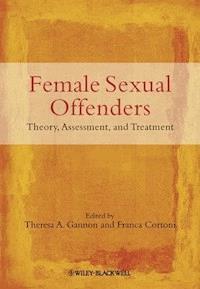
Female Sexual Offenders E-Book
44,99 €
Mehr erfahren.
- Herausgeber: John Wiley & Sons
- Kategorie: Geisteswissenschaft
- Sprache: Englisch
Featuring a collection of essays by leading experts, Female Sexual Offenders: Theory, Assessment and Treatment is the first book to bring together current research, clinical assessment, and treatment techniques of female sexual offenders into one accessible volume.
- Describes the most recent research data regarding female sexual offenders, covering such issues as female-perpetrated sexual abuse prevalence and juvenile offenders
- Includes an assessment of the risk of recidivism, international treatment initiatives, and a discussion on the use of the polygraph with female sexual offenders
- Features practitioner-focused essays which evaluate current assessment strategies, treatment needs, effectiveness, and processes for female sexual offenders
Sie lesen das E-Book in den Legimi-Apps auf:
Seitenzahl: 486
Veröffentlichungsjahr: 2010
Ähnliche




















Contents
Cover
Half Title Page
Title Page
Copyright
Dedication
About the Editors
List of Contributors
Preface
Acknowledgements
Chapter 1: Female Sexual Offenders: Theory, Assessment and Treatment – An IntroductionTheresa A. Gannon and Franca Cortoni
Chapter 2: Understanding the Prevalence of Female-Perpetrated Sexual Abuse and the Impact of That Abuse on VictimsJacqui Saradjian
Chapter 3: Theories of Female Sexual OffendingDanielle A. Harris
Chapter 4: The Juvenile Female Sexual Offender: Characteristics, Treatment and ResearchLisa L. Frey
Chapter 5: The Mental Health Needs of Female Sexual OffendersMyriam-Mélanie Rousseau and Franca Cortoni
Chapter 6: The Assessment of Female Sexual OffendersFranca Cortoni
Chapter 7: The Treatment Needs of Female Sexual OffendersHannah Ford
Chapter 8: A Review of Treatment Initiatives for Female Sexual OffendersKelley Blanchette and Kelly N. Taylor
Chapter 9: Using the Polygraph with Female Sexual OffendersPeggy Heil, Dominique Simons, and David Burton
Chapter 10: Working with Female Sexual Offenders: Therapeutic Process IssuesSherry Ashfield, Sheila Brotherston, Hilary Eldridge, and Ian Elliott
Chapter 11: Developments in Female Sexual Offending and Considerations for Future Research and TreatmentTheresa A. Gannon, Mariamne R. Rose, and Franca Cortoni
Index
Female Sexual Offenders
This edition first published 2010 © John Wiley & Sons Ltd.
Wiley-Blackwell is an imprint of John Wiley & Sons, formed by the merger of Wiley’s global Scientific, Technical, and Medical business with Blackwell Publishing.
Registered Office John Wiley & Sons Ltd, The Atrium, Southern Gate, Chichester, West Sussex, PO19 8SQ, UK
Editorial Offices The Atrium, Southern Gate, Chichester, West Sussex, PO19 8SQ, UK 9600 Garsington Road, Oxford, OX4 2DQ, UK 350 Main Street, Malden, MA 02148–5020, USA
For details of our global editorial offices, for customer services, and for information about how to apply for permission to reuse the copyright material in this book please see our website at www.wiley.com/wiley-blackwell.
The right of the author to be identified as the author of this work has been asserted in accordance with the UK Copyright, Designs and Patents Act 1988.
All rights reserved. No part of this publication may be reproduced, stored in a retrieval system, or transmitted, in any form or by any means, electronic, mechanical, photocopying, recording or otherwise, except as permitted by the UK Copyright, Designs and Patents Act 1988, without the prior permission of the publisher.
Wiley also publishes its books in a variety of electronic formats. Some content that appears in print may not be available in electronic books.
Designations used by companies to distinguish their products are often claimed as trademarks. All brand names and product names used in this book are trade names, service marks, trademarks or registered trademarks of their respective owners. The publisher is not associated with any product or vendor mentioned in this book. This publication is designed to provide accurate and authoritative information in regard to the subject matter covered. It is sold on the understanding that the publisher is not engaged in rendering professional services. If professional advice or other expert assistance is required, the services of a competent professional should be sought.
Library of Congress Cataloging-in-Publication Data
Female sexual offenders : theory, assessment, and treatment / edited by Theresa A. Gannon & Franca Cortoni. p. cm. Includes bibliographical references and index. ISBN 978-0-470-68344-6 (cloth) – ISBN 978-0-470-68343-9 (pbk.) 1. Female sex offenders. 2. Female sex offenders–Mental health. 3. Female sex offenders–Psychology. 4. Female sex offenders–Service for. I. Gannon, Theresa A. II. Cortoni, Franca. HV6557.F463 2010 364.15′3082–dc22
2010010080
A catalogue record for this book is available from the British Library.
Theresa A. Gannon: For Thomas Patrick Gannon ‘Uncle Pat’ (1921–2009).
Franca Cortoni: For my children, Sébastien and Alexandre.
About the Editors
Theresa A. Gannon, DPhil, CPsychol (Forensic) is Director of the MSc in Forensic Psychology and Senior Lecturer in Forensic Psychology at the University of Kent, UK. Theresa also works as a Chartered Consultant Forensic Psychologist specialising in sexual offenders at the Trevor Gibbens Unit; Forensic Psychiatry Services, Kent, UK. Theresa has published widely in the areas of both male- and female-perpetrated sexual offending and is interested in research relating to both the treatment needs and overall rehabilitation of sexual offenders. Theresa is lead editor of the book Aggressive Offenders’ Cognition: Theory, Research, and Treatment (John Wiley & Sons) along with Professor Tony Ward, Professor Anthony Beech and Dr Dawn Fisher, and co-editor of the book Public Opinion and Criminal Justice (Willan) along with Dr Jane Wood. Theresa is currently working on a sole authored book for Wiley-Blackwell entitled Sexual Offenders’ Cognition, Motivation, and Emotion. She also serves on the editorial boards of Aggression and Violent Behavior, British Journal of Forensic Practice, Sexual Abuse: A Journal of Research and Treatment, International Journal of Offender Therapy and Comparative Criminology, and is Associate Editor of Journal of Sexual Aggression.
Franca Cortoni, PhD, CPsych, received her PhD in clinical and forensic psychology from Queen’s University at Kingston, Canada. Formally with the Correctional Service of Canada, where she held positions as Director of Sexual Offender Programs, National Consultant on Women who Sexually Offend, and Director of Correctional Programs Research, Dr Cortoni is now with the School of Criminology at the Université de Montréal. She is also Associate Editor of the Journal of Sexual Aggression. Over the years, Dr Cortoni has worked with and conducted research on male and female offenders in a variety of Canadian and Australian penitentiaries and community settings. In addition, she has provided consultancy and training services in the assessment, treatment and management of male and female sexual offenders in Canada, Australia, the USA and England. Her audiences include parole officers, psychologists, criminologists, parole board members, police forces (including Interpol) and criminal court judges. Her research interests include factors associated with the development of sexual offending behaviour, risk assessment, treatment and management issues in both male and female sexual offenders. She has published and presented extensively in national and international forums on these topics.
List of Contributors
Sherry Ashfield began her career in the Probation Service (UK) in 1992, holding a number of prison and community posts where she developed her interest and expertise working with women who display harmful behaviour towards children. Sherry joined the Lucy Faithfull Foundation in 1999 and works as a principal practitioner in its Female Outreach Project. This project offers assessment, intervention and consultancy services to probation and prison staff working with female sex offenders. Sherry also provides assessments for the family courts and training focused around female sexual offending for many organisations including the Probation Service, the Prison Service and the National Organisation for the Treatment of Abusers (NOTA, UK).
Kelley Blanchette began working with the Research Branch, Correctional Service of Canada, in 1993. She completed her doctorate in forensic psychology at Carleton University in January 2005. During her graduate training, Dr Blanchette worked for 6 years as a supervisor at the Ottawa Detoxification Centre, completing assessments and referrals to treatment for alcohol and drug-addicted men and women. From 2000 to 2007, she was Director of Women Offender Research; in 2007 was National Manager, Violence Prevention Programs, and in 2008 was appointed as the Senior Director, Correctional Research. The primary focus of Dr Blanchette’s research has been women offenders. She has published extensively in peer-reviewed and government journals and co-authored a book entitled The Assessment and Treatment of Women Offenders (John Wiley & Sons). Dr Blanchette is an adjunct professor at Carleton University, and is currently working at Correctional Service of Canada as Director General in the Women Offender Sector.
Sheila Brotherston is Criminal Justice Services Director for Women and Young People with the Lucy Faithfull Foundation (LFF) in the UK. She joined LFF after working for 20 years in the probation service where she had experience in the development and delivery of sex offender programmes including a group work programme for female sex offenders at HMP Styal. She currently manages LFF’s work with female sex offenders and provides consultancy to probation and prison staff in working with female sex offenders. She also manages LFF’s work with young people in the secure estate including work with young women.
David Burton is a professor at Smith College School for Social Work in Northampton, MA. His current clinical work is at Northeastern Center for Youth and Families in Easthampton, MA, and with the MA Department of Youth Services. Dr Burton has worked in the field of sexual aggression for over 20 years, primarily as a clinician with adolescents and children. His research focuses on the childhood victimisation and aetiology of child, adolescent and adult sexual abusers – current research interests include trauma histories of sexual abusers, non-sexual criminality of sexual abusers, attachment, cognitive behavioural theory and treatment, pornography, substance abuse, self-cessation methods, evidenced based practice, effectiveness of treatment for adolescent sexual abusers, and racial discrimination of sexual abusers. Dr Burton has been published in several journals including Child Abuse and Neglect, Victims and Violence, Sexual Aggression, Evidenced Based Social Work, Smith College Studiesin Social Work and Sexual Abuse: A Journal of Research and Treatment. Dr Burton serves on the editorial boards of Child Abuse and Neglect & Sexual Abuse: A Journal of Research and Treatment and is the Associate Editor of Smith Studies.
Franca Cortoni is a clinical forensic psychologist. Formally with the Correctional Service of Canada, she now works at the School of Criminology at the Université de Montréal, Canada. Her clinical and research work has focused on both male and female sexual offenders. See ‘About the Editors’ section for more information about this editor/author.
Hilary Eldridge is Chief Executive of the Lucy Faithfull Foundation, a child protection charity preventing and working with child sexual abuse in the UK. She has worked with sex offenders and their families since 1975. She co-authors and monitors assessment and treatment programmes for adult male offenders, female offenders, young people and their families. Specialising in developing interventions to suit the specific needs of female sex offenders, she has published book chapters and has consulted to and provided training on this subject to a wide range of agencies. She is an honorary lecturer in Forensic Psychology at the University of Birmingham.
Ian Elliott is a research psychologist with the Lucy Faithfull Foundation, where he is engaged in projects relating to both female sexual offending and child pornography offences. Ian is researching a PhD at the University of Birmingham (UK), exploring the potential application of contemporary adult sexual offence theory to child pornography offences, and is also a Course Tutor in Forensic Psychology. He has published and presented research findings at both national and international conferences.
Hannah Ford is a clinical psychologist working in the West Midlands (UK) with young people in care, including those who are involved in sexual offending. Before moving to this role, Hannah worked for the Lucy Faithfull Foundation, contributing to the assessment and treatment of perpetrators of sexual offences against children, and completing a Home Office commissioned evaluation of national need for residential treatment provision for sexual offenders. She has a particular interest in women who commit sexual offences and has written a book and contributed chapters about this topic. She also has an interest in sexual offenders with intellectual disabilities and completed her doctoral research in this area.
Lisa L. Frey is an associate professor at the University of Oklahoma (OU) and the Director of the OU Counseling Psychology Clinic (USA). Dr Frey operated a private clinical and consulting practice for many years, where she specialised in working with female and male juvenile sexual offenders and victims of violence and abuse. Her research and teaching emphases have been shaped by her extensive practice background and by her feminist orientation. Dr Frey’s research interests are in the areas of delinquent youth, particularly delinquent and aggressive behaviour in girls; diversity issues; relational–cultural theory; and sociocultural influences on relational development and gender-role development.
Theresa A. Gannon is a senior lecturer in Forensic Psychology and Director of the MSc in Forensic Psychology at the University of Kent, UK. Theresa also works as a Chartered Consultant Forensic Psychologist. See ‘About the Editors’ section for more information about this editor/author.
Danielle A. Harris is an assistant professor in the Justice Studies Department at San Jose State University (USA). She received her doctorate in Criminology in 2008 from Griffith University, Australia. Prior to that, she completed a Masters degree in Criminology and Criminal Justice at the University of Maryland and a Bachelors Degree in Justice Studies at the Queensland University of Technology and the University of Westminster, London. She has presented at numerous conferences including ATSA, ASC and ACJS. Her research interests include many aspects of sexual offending: specialisation and versatility; the criminal career paradigm; female sexual offending; and related public policy.
Margaret ‘Peggy’ Heil is a licensed clinical social worker in the USA. She has over 20 years of experience developing and directing the Sex Offender Treatment and Monitoring Program at the Colorado Department of Corrections. She also provides training and consultation in the treatment and management of sexual offenders. In addition, she is a therapist representative on the Colorado Sex Offender Management Board, and is a past Executive Board Member of the Association for the Treatment of Sexual Abusers and the Colorado Coalition Against Sexual Assault. She has been involved in a number of studies and has authored professional articles and book chapters related to sexual offenders.
Mariamne R. Rose graduated with a BSc (Hons) in psychology in 2003. Following her degree she worked as an assistant psychologist in adult mental health settings and as a researcher on projects investigating prison mental health and female sexual offending. She has interviewed and conducted research with a number of female sexual offenders in the UK and is co-author of the Descriptive Model of Female Sexual Offending (with Theresa Gannon). She is currently working towards a Doctorate in Clinical Psychology at Royal Holloway, University of London, UK.
Myriam-Mélanie Rousseau is a licensed clinical social worker. She completed her Masters degree in social work at Laurentian University in Sudbury, Canada, and is a doctoral candidate at the School of Criminology at the Université de Montréal. Ms Rousseau works with the Sexual Abuse Centre for children and their families in Gatineau, Québec, Canada, where she provides clinical supervision to practitioners, conducts group therapy programmes, and provides family therapy to the youth and their families. She also provides consultation services to several mental health agencies and is a trainer in systemic family therapy.
Jacqui Saradjian is Consultant Clinical and Forensic Psychologist. She has conducted the UK’s largest research project into the lives, experiences and beliefs of women who sexually abuse children. She has also surveyed the impact of that abuse on their victims. She is currently employed by Cambridgeshire and Peterborough Foundation Trust as Clinical Director of the Fens Unit based in HMP Whitemoor, UK. This is a unit for the assessment and treatment of severely personality disordered men who are extremely dangerous. A high percentage of these men have been sexually abused by women.
Dominique Simons has conducted research for the Colorado Department of Corrections Sex Offender Treatment and Monitoring Program for 11 years. In addition to programme and treatment evaluation, she has consulted on projects regarding juvenile sexual offender recidivism, GLM/SRM treatment, and what works with sexual offenders in Colorado. She has presented and/or co-authored journal articles and book chapters with respect to the developmental experiences of sex offenders, process issues in sex offender treatment, the influence of therapist characteristics on treatment progress, attachment and the therapeutic relationship, crossover sexual offences, utilising polygraph as a risk assessment and treatment progress tool, formulating prevention strategies from aetiological models, prevalence and treatment of multiple paraphilias, the evaluation of GLM/SRM approach to treatment, childhood victimisation of sexual offenders and the prevalence of intimate partner rape among domestic violence and sexual offenders.
Kelly N. Taylor completed her doctorate in Psychology at the University of Ottawa, Canada, in 2008. Her dissertation research examined employment assessment, vocational interests and employment intervention with federally sentenced offenders in Canada. Dr Taylor has been working with the Correctional Service of Canada since 2000, with the majority of her time dedicated to research with women offenders. To date, her research in the area of women offenders has focused on mental health needs, risk assessment, therapeutic alliance between inmates and staff, security classification, programme evaluation, hostage-taking behaviour and gender differences in aggression. She is currently the Acting Senior Director of the Correctional Research Division and the Director of Women Offender Research.
Preface
Our ideas and enthusiasm for this edited collection have stemmed, in part, from our attendance at the Association for the Treatment of Sexual Abusers’ 27th annual conference (2008). Not only did this conference provide the forum for some interesting presentations regarding female sexual offenders (many of which were presented by some of the chapter authors in this book), but it also provided a forum for the editors of this book to discuss female sexual offending in depth. What became clear to us, over our discussions, was that although the female sexual offending field appeared to have developed enormously over the past decade, there were no books dedicated to the topic that outlined these core progressions. From this realisation, we began to approach leading professionals about whether they would be interested in writing a chapter for a book devoted to female sexual offenders. The response that we received was extremely encouraging; and as editors we feel privileged to edit a text of special interest to us, with such a group of enthusiastic and knowledgeable professionals. We hope that this book will promote further research and empirically based gender-informed assessment and treatment practices in an area that has just begun to gain momentum.
Theresa A. Gannon and Franca CortoniOctober 2009
Acknowledgements
We would like to acknowledge all of the individuals who have made this collection of chapters possible. First of all, thank you to all of the authors who took so much time and effort into writing their chapters. We would also like to thank all those at Wiley-Blackwell who gave advice and help with this piece of work from start to finish. In particular, thank you Clive Hollin for dealing positively with the initial enquiry about this book and for directions about possible avenues for publication of this book. Also, a big thank you to everyone at Wiley-Blackwell for supporting this book. In particular, thanks must go to Andrew Peart for his enthusiasm and support on this book and to Karen Shield for dealing with all our queries. Finally, thank you to Cheena Chopra for dealing with the copyediting associated with this book.
Chapter 1: Female Sexual Offenders: Theory, Assessment and Treatment – An Introduction
Theresa A. Gannon
University of Kent, Kent, UK
Franca Cortoni
Université de Montréal, Quebec, Canada
Research and treatment efforts with female sexual offenders appear to have gained substantial momentum in recent years. This is clearly evidenced by the selection of chapters available in this book. Only 10 years ago, it would have been difficult – perhaps impossible – to develop an edited volume of works dedicated solely to the research and treatment of female sexual offenders. More recently, however, we have witnessed an outbreak of research activity associated with investigating the treatment needs (Beech, Parrett, Ward & Fisher, 2009; Gannon, Hoare, Rose & Parrett, in press; Gannon & Rose, 2009; Nathan & Ward, 2002; Strickland, 2008), mental health correlates (Christopher, Lutz-Zois & Reinhardt, 2007; Fazel, Sjöstedt, Grann & Långström, 2008), offence styles (Gannon, Rose & Ward, 2008, 2010), sexual offence histories (Simons, Heil, Burton & Gursky), recidivism rates (Cortoni & Hanson, 2005; Cortoni, Hanson & Coache, 2009; Freeman & Sandler, 2008) and typologies (Sandler & Freeman, 2007; Vandiver & Kercher, 2004) associated with female sexual offending.
Perhaps the two most prominent questions on the lips of most professionals who work with female sexual offenders and indeed laymen who hear about female-perpetrated sexual abuse are: (1) To what extent are female sexual offenders similar to, and different from, male sexual offenders?; and (2) To what extent are female sexual offenders similar to, and different from, females who offend non-sexually? Clearly, we are unlikely to discover the answers to these all-encompassing questions overnight. In fact, the literature pertaining to male sexual offenders – although substantially more mature than that documented with female sexual offenders – still falls short of answering questions of parallel relevance to male sexual offending (see Laws & O’Donohue, 2008). Thus, professionals who work with female sexual offenders must remain patient, since it is likely to take some considerable time before the literature associated with female sexual offending reaches a level deemed to be acceptable for the convincing implementation of evidence-based practice.
Nevertheless, it is extremely heartening to witness the recent explosion of research interest in the topic of female sexual offending. It is unclear exactly what has prompted this recent and focused interest on this special population of sexual offenders. Female sexual offending has typically been reported as being relatively rare in comparison to male-perpetrated abuse (Gannon & Rose, 2008; O’Connor, 1987; Peter, 2009), and even very recent research suggests that the ratio of male to female sexual offenders is in the region of 20 : 1 (Cortoni et al., 2009). This estimate indicates that females account for around 5 per cent of all sexual abuse (Cortoni et al., 2009). Yet even at these levels, female-perpetrated abuse therefore accounts for a sizeable number of victims and offenders in need of clinical attention (see Cortoni & Gannon, in press). Furthermore, female-perpetrated abuse appears to have received more substantial recognition in recent years from professionals, the criminal justice system and the media (Cortoni et al., 2009; Gannon & Rose, 2008). It seems likely then, that this increased research attention on female sexual offenders is not coincidental. Rather, we believe that increased recognition of the phenomenon of female sexual abuse both professionally, and in the wider community, has resulted in more concerted research efforts – and associated funding – on female-perpetrated sexual abuse.
Lesen Sie weiter in der vollständigen Ausgabe!
Lesen Sie weiter in der vollständigen Ausgabe!
Lesen Sie weiter in der vollständigen Ausgabe!
Lesen Sie weiter in der vollständigen Ausgabe!
Lesen Sie weiter in der vollständigen Ausgabe!
Lesen Sie weiter in der vollständigen Ausgabe!
Lesen Sie weiter in der vollständigen Ausgabe!
Lesen Sie weiter in der vollständigen Ausgabe!
Lesen Sie weiter in der vollständigen Ausgabe!
Lesen Sie weiter in der vollständigen Ausgabe!
Lesen Sie weiter in der vollständigen Ausgabe!




