


Erhalten Sie Zugang zu diesem und mehr als 300000 Büchern ab EUR 5,99 monatlich.
- Herausgeber: Titan Books
- Kategorie: Abenteuer, Thriller, Horror
- Sprache: Englisch
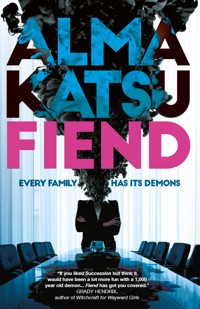
From a Goodreads Choice and Stoker Award® winning author, Succession meets The House That Horror Built by Christina Henry in this taut, fast-paced tale of sibling betrayal as the three heirs - the golden boy, the ferocious middle sister, the dilettante youngest child - to a powerful syndicate rush to fill the vacuum after their father falls critically ill, not realising the demonic forces he kept at bay. Some families have skeletons in their closets. This one has a demon in its boardroom. When Maris Berisha was nine years old, she heard something scratching at the walls of her family's penthouse. It felt like something malevolent was there, watching them. The Berisha family runs one of the largest import-export companies in the world, and they've always been lucky. Their rivals suffer strokes. Inconvenient buildings catch on fire. Earthquakes swallow up manufacturing plants, destroying harmful evidence. Things always seem to work out for the Berishas. They're blessed. At least that is what Zef, the patriarch, has always told his three children. And each of them knows their place in the family—Dardan, as the only male heir, must prepare to take over as keeper of the Berisha secrets, Maris's most powerful contribution, much to her dismay, will be to marry strategically, and Nora's job, as the youngest, is to just stay out of the way. But when things stop going as planned, and the family blessing starts looking more like a curse, the Berishas begin to splinter, each hatching their own secret scheme. They didn't get to be one of the richest families in the world without spilling a little blood, but this time, it might be their own.
Sie lesen das E-Book in den Legimi-Apps auf:
Seitenzahl: 302
Veröffentlichungsjahr: 2025
Das E-Book (TTS) können Sie hören im Abo „Legimi Premium” in Legimi-Apps auf:
Ähnliche




















Contents
Cover
Title Page
Leave us a Review
Copyright
Dedication
1
2
3
4
5
6
7
8
9
10
11
12
13
14
15
16
17
18
19
20
21
22
23
24
25
26
Acknowledgments
About the Author
“An absolutely wicked delight! Fiend ruined several nights’ sleep for me, which is the highest praise I can give a book. Damn you, Alma Katsu, please write another novel as quickly as possible. I’m bereft to be done with this one.”
KELLY LINK, Pulitzer Prize finalist and author of The Book of Love
“Succession meets Supernatural in this tale of greed and family dysfunction. Alma Katsu ventures into contemporary horror with panache.”
SILVIA MORENO-GARCIA, author of Mexican Gothic
“If you liked Succession but think it would have been a lot more fun with a 1,000 year old demon, then Alma Katsu’s Fiend has got you covered.”
GRADY HENDRIX, author of Witchcraft for Wayward Girls
“Fiend is Severance with claws. When ambition is entwined with an ancient demonic power, no one in the corporate world—or a mogul’s family—is safe. Alma Katsu reveals the monstrosity of power from every ugly angle, with plenty of scares and surprises. “
TANANARIVE DUE, author of The Reformatory
“Alma Katsu’s cunning cut-throat fable Fiend is a hostile takeover of your bookshelf, a sinister indictment on familial bloodlines and corporate affairs that slits through every other novel that dares unseat it as your next favorite read.”
CLAY MCLEOD CHAPMAN, author of Wake Up and Open Your Eyes
“Oozing with dread . . . Katsu presents a fast-paced story that will unite her fans across genres.”
Library Journal
“[I]n this haunting tale . . . Katsu’s exploration of the bloody price of privilege keeps the pages turning. It’s a supernaturally charged Succession that will have readers hooked.”
Publishers Weekly
“Fiend by Alma Katsu is a dark, cutthroat family drama of high-stakes wealth, unchecked ambition, and supernatural temptation, perfect for fans of Succession and The Fall of the House of Usher. I was transfixed by this modern Gothic masterpiece from one of my favorite voices in horror.”
SADIE HARTMANN, Bram Stoker Award®-winning author of 101 Horror Books to Read Before You’re Murdered
“A wickedly entertaining, dread-laced modern fable. Fiend is an unforgettable thrill ride that shocks and moves in equal measure. Magnificent.”
RACHEL HARRISON, author of Play Nice
“Every family has skeletons in the closet—some have something far more evil. Alma Katsu has created a modern-day fable of greed and power, a story we think we know, and turned it inside out with a wicked blend of horror and suspense.”
JENIFER MCMAHON, New York Times bestselling author of My Darling Girl and The Winter People
“Alma Katsu has staked her claim as one of the top names in both contemporary horror and twisty thrillers! With Fiend, she delivers a devilishly cunning, supernatural Succession that brings all her skills to bear! This one will unite Katsu’s readers, and earn her plenty more! Don’t miss it!”
CHRISTOPHER GOLDEN, New York Times bestselling author of The Night Birds and Road of Bones
“A mesmerizing tale, twisting generational wealth together with family trauma. . . greed is the plan and the monsters are everywhere.”
KAREN JOY FOWLER, author of Booth
“A family empire, a battle for ascendancy among the siblings, Fiend has the betrayal and intrigue of Succession with an added supernatural surprise. I tore through this book, a horror story about greed and power. Alma Katsu spins a great story, an amorality tale.”
VICTOR LAVALLE, author of Lone Women
Also by Alma Katsuand available from Titan Books
THE FERVOR
LEAVE US A REVIEW
We hope you enjoy this book – if you did we would really appreciate it if you can write a short review. Your ratings really make a difference for the authors, helping the books you love reach more people.
You can rate this book, or leave a short review here:
Amazon.co.uk,
Goodreads,
Waterstones,
or your preferred retailer.
Fiend
Print edition ISBN: 9781835414569
E-book edition ISBN: 9781835415368
Published by Titan Books
A division of Titan Publishing Group Ltd
144 Southwark Street, London SE1 0UP
www.titanbooks.com
First edition: September 2025
10 9 8 7 6 5 4 3 2 1
This is a work of fiction. All of the characters, organizations, and events portrayed in this novel are either products of the author’s imagination or are used fictitiously. Any resemblance to actual persons, living or dead (except for satirical purposes), is entirely coincidental.
© Alma Katsu 2025
Published by arrangement with the G.P. Putnam’s Sons, an imprint of Penguin Publishing Group, a division of Penguin Random House LLC. No part of this book may be used or reproduced in any manner for the purpose of training artificial intelligence technologies or systems. This work is reserved from text and data mining (Article 4(3) Directive (EU) 2019/790).
Alma Katsu asserts the moral right to be identified as the author of this work.
No part of this publication may be reproduced, stored in a retrieval system, or transmitted, in any form or by any means without the prior written permission of the publisher, nor be otherwise circulated in any form of binding or cover other than that in which it is published and without a similar condition being imposed on the subsequent purchaser.
A CIP catalogue record for this title is available from the British Library.
EU RP (for authorities only)eucomply OÜ, Pärnu mnt. 139b-14, 11317 Tallinn, [email protected], +3375690241
Designed and typeset in ITC Veljovic Std 9.75/13pt by Richard Mason.
To all the seven-year-olds whose soulsstarved waiting for parental love andapproval that never came
The fiend in his own shape is less hideous than when he rages in the breast of man.
—Nathaniel Hawthorne
Adversity makes men;prosperity makes men monsters.
—Victor Hugo
I'm not sure that I'm aware of any family in America that's more evil than yours.
—Rep. Jim Cooper (D-Tenn) at the2020 hearing of the US House OversightCommittee on the Sackler family’sinvolvement in the opioid crisis
THEN
“There’s something in the house,” nine-year-old Maris Berisha says to her twelve-year-old brother, Dardan.
He’s caught her in the servants’ quarters, where they have been expressly forbidden to go, ever. Not that she would want to go there, normally: the rooms are small and plain and dark, nothing like the rooms upstairs. The nicest penthouse in all of Manhattan, Maris overheard a society lady say to her mother, Olga, once, and her mother practically purred with pleasure. It was not an exaggeration, Maris knows. They live in a palace in the sky, fit for a king.
Dardan has dragged her to the laundry room and closed the door and now stands, hands on hips, in imitation of Olga, clearly expecting an explanation from her. But he is as white as the stack of Belgian sheets waiting to be ironed.
“I heard a noise. It sounded like something was tapping in the walls. I followed it down here,” Maris says, almost apologetically.
“It was probably a mouse. Or a rat. This is New York City. It’s an old building. There’re always noises.” He speaks quickly. He wants to sound confident like an adult, but there’s a waver in his voice.
“I’ve heard mice before. This is different.” She frowns. “You know there’s something here. You know it.”
“You think we’re haunted? Stop being such a baby.”
She narrows her eyes at him because he’s pretending. They talked, once, about the thing he claimed he saw. The unexplainable thing. Now he denies it happened.
“I’ve told you—only babies believe in ghosts and demons and magic. That only happens in fairy tales. When you grow up, you realize that none of that stuff exists.”
“What about the church?” The old Greek Orthodox church that they attend is the most magical place Maris knows. Stepping over the threshold is like being transported to an enchanted world. Every surface is carved, inscribed, or gilded. Long-suffering saints look down from triptychs on the walls. It smells of incense. The priests wear long robes festooned with embroidery and mumble in a secret language. “The priests say there are angels all around us . . .”
And if angels exist, then so do demons.
Dardan sneers. “The church is the worst. It’s just . . . superstition. You can’t put too much stock in all that. Dad says those old men live in another world, a world of made-up stories and groundless beliefs. It’s not real.” Dardan likes to think he’s all grown up, smarter than her, worldly-wise. But Maris wants to tell him, You’re just parroting Zef, you don’t know anything.
“It’s not just the priests who believe in ghosts.” She hesitates. She doesn’t want to get anyone in trouble, but she has this bit of proof . . . and Dardan is being so smug that she cannot resist throwing it in his face.
“Angelo told me somebody died in this very apartment. The people who owned it before us.” The words are spit out, triumphant. “He said one of the children shot himself. Found his father’s gun and shot himself in the head.”
Dardan laughs meanly. “Angelo? He’s just a doorman. He doesn’t know . . . He’s just trying to frighten you. Telling you a scary story, like at Halloween. But he shouldn’t be telling stories about kids killing themselves. That’s irresponsible.”
“It’s not a story. It’s true.”
But Dardan has already closed himself up. There’s no getting through to him now. “Nobody died in our apartment, Maris. Ask Mother—she’ll tell you.” He grabs her arm, opens the laundry room door, and marches her out. Up the servants’ staircase to the pretty part of the house, where Olga is talking to the housekeeper about the menu for dinner. Maids wielding feather dusters or carrying stacks of clean clothes give Maris the side-eye; she realizes she shouldn’t have violated their private space.
Dardan can deny it all he wants, but Maris knows there’s something bad in their home. Something malevolent. She feels it watching them, greedily. It’s stronger when their father visits on Sundays, but it is here with them all the time nonetheless. It is a bad feeling, and it is inescapable.
Maris is in the room when the building manager comes to see Olga. She’s playing, hidden from her mother’s view by a pair of enormous chairs. In this family, it’s better for children to be neither seen nor heard.
The building manager enters the room like a servant: he knows he doesn’t belong there. He smiles apologetically at Olga, hands clasped like a supplicant. “Mrs. Berisha, thank you for agreeing to see me, especially over such a trifling matter—”
“I don’t consider it trivial.” Her mother’s voice is icy.
“No, no, of course not. Please forgive me. I misspoke.” He changes tack. “Nevertheless . . . I would like to ask you to reconsider the request regarding Angelo.”
At the mention of the doorman, Maris freezes. She turns her head in their direction.
Angelo is one of the few workers in the building who will talk to residents’ children. The rest, Maris has found, keep them at arm’s length, refuse to engage, eye them frostily as they traipse through the lobby behind their parents on the way out to their waiting cars. But Angelo is different. He will crouch down to tell you a funny story or ask how it’s going in school or, if you’re wearing your soccer uniform, ask if you won the game. He is older, with kind eyes and a wistful smile, so shrunken that he swims in his burgundy doorman’s livery.
Though lately, he’s been acting differently. Strangely.
The building manager starts to wring his hands. “It’s because of the accident. You see, Angelo lost his only grandchild last year. It was a tragedy. You know how it is . . . Something like that can change a person. He’s still grieving and sometimes he says”—the man looks pained as he takes a deep breath—“inappropriate things.”
“He told one of my children that someone died in our apartment.” Olga’s voice has grown louder, shriller. “Now she’s afraid. She doesn’t want to live here.”
An exaggeration. Maris frowns to herself.
The building manager shakes his head no, no, no. “Very regrettable, Mrs. Berisha. I agree completely. But—Angelo has worked in this building for over forty years. He is our longest-tenured employee. He has dedicated his life to the well-being and security of the tenants. Whatever it is he’s going through, I’m sure it will pass.”
“Can you guarantee that? If your job depended on it?”
The building manager looks as though he is going to cry. “Please, Mrs. Berisha. If we let Angelo go, he won’t be able to find work. No one will hire a man his age. How will he support his family? How will they survive?”
There is a long moment of silence, but Maris does not feel the air thaw one iota. Finally, her mother says crisply, “That is not my concern. The safety of my family—that is my concern. Now, I believe I have made my wishes known, Mr. Perrotta. Good day.”
That evening, Olga sits on the edge of Maris’s bed and explains that the previous owners of the penthouse had been a childless couple, now living in Tuscany. “So, you see, it’s not true. Nobody has ever died in our home. There are no ghosts,” Olga says as she draws the covers up to Maris’s chin.
Maris sees her chance. “I understand. I’m okay. I really am. And . . . please forgive Angelo. Don’t send him away. He didn’t mean to scare me. Dardan shouldn’t have said anything to you.” Her brother is such a suck-up. Always looking for approval.
Olga has dimmed the bedside light and is walking to the door. “Nonsense, darling. Your brother was right to bring this to my attention. That’s his duty as the only son: to protect this family. To protect you.” She closes the door gently, leaving Maris alone.
It feels like the room is breathing as it watches her.
Watches and waits. The tapping noise starts again. As though whatever is making it is trying to send her a message.
As for Angelo, Maris never sees him again.
NOW
Maris luxuriates in her office on the penultimate floor of a Midtown high-rise. Her family name—BERISHA—beams over the city in giant, glittering letters.
The sign outside the door reads Special Adviser to the Chief of Strategy.
Her desk is a huge sheet of glass anchored with piles of papers and reports, scattered with a few high-end tchotchkes. A Clichy millefiori paperweight, a handful of insanely expensive fountain pens that she never uses. There are two laptops, closed, but no monitors, nothing to spoil her bird’s-eye view of Upper Manhattan. There are no photographs. No sentimental mementos, no talismans of affection to offer comfort during stressful moments.
Maris wears a smart Prada pantsuit. Her dark, wiry hair is tamed as best it can be to look professional, if not sleek. She sits with her chair rocked back at a leisurely angle, the heels of her Louboutin boots resting on the edge of the desk.
On the phone in Maris’s hand, a nearly naked man writhes on pale pink sheets. She recognizes those sheets. They are on her bed, where she left the nearly naked man a few hours ago.
He is handsome and painstakingly fit. Skin stretches tautly over the peaks and valleys of his chest and abdomen. He’s like a statue of a Greek god toppled on its side and wrapped in a pink toga.
If a statue came to life to masturbate.
“Are you watching this, baby?” he whispers. A single, perfectly oiled lock of black hair falls over his forehead. He closes his large doe eyes and slips a hand under the waistband of his pin-striped Parke & Ronen briefs.
She recognizes the underwear. They were a present from her.
Of course I’m watching, you slut. “I’m at work,” Maris growls. “I don’t have time for this—”
A lazy grin. “What do you mean, you don’t have time? You’re the boss lady.”
“I’m not the boss lady.” Yet.
She doesn’t turn it off, though. Ricardo is right. No one is going to stop her. No one ever comes to her office, not to demand so much as a minute of her time. Her father may have given her an impressive job title, but no one knows exactly what she does, including Maris herself. Which means she is free to do whatever she wants.
And the best use of her time at this very moment, it seems, is watching her little amuse-bouche jerk off.
She doesn’t say anything as he performs for her, moaning and writhing and arching his back, but it’s having the desired effect, making her tingle in all the right places. She’s thinking about calling it quits and trotting the five blocks to her apartment to join Ricardo on that massive, aircraft-carrier-sized bed . . .
And that is exactly when the glass door to Maris’s office flies back and her assistant, Keeley, bursts in.
Maris fumbles to shut off the phone.
Usually, Keeley keeps her expression completely neutral in front of Maris, but at this moment, her face is lit up like a child’s at Christmas. “Maris, you’re wanted in your father’s office—now!”
The words Maris has been waiting to hear.
She’s out the door in the blink of an eye, jogging toward the elevators. “What’s this about?” she asks Keeley, who tries to keep up with her boss on thick, stubby legs.
“They didn’t say. Just that you’re needed in the conference room.”
Keeley has fallen behind by the time Maris reaches the elevators. It’s only one flight up, but the special elevator will deposit her right in her father’s suite. The CEO’s suite. Maris is alone in the mirrored box, smoothing a few stray flyaways and checking her teeth and practicing her serious expression, the one she uses in the presence of her father’s advisers. The pleasant tingling grudgingly evaporates. What could Zef want? Maris tries to remember her father’s schedule, delivered by email every day by eight a.m. You’d think it would be exciting, running one of the largest import-export companies in the world, a company that rivals Koch Industries and Cargill, dwarfs Nucor and Daifuku. But Zef’s schedule was a daily disappointment: there were no tête-à-têtes with the G7 or midnight meetings with the mysterious cabal of CEOs purported to rule the world, and only rarely was he whisked away on the corporate jet. No, his schedule was much the same every day—one dreary appointment blurring into the next, and that’s if he comes into the office at all, as he often chooses to work out of his mansion a few blocks away—and so she stopped paying attention to it.
The doors to the special elevator open. Maris barrels through the waiting room and past her father’s executive assistant, a middle-aged woman named Cicely.
Cicely leaps up as Maris heads toward Zef’s office. “What are you doing, Maris?” There’s a warning high note in her voice. She fancies herself Zef’s watchdog.
“He asked for me,” Maris yells over her shoulder. She doesn’t slow down. She feels a drop of self-satisfaction, realizing that Cicely doesn’t know. Cicely likes to think she’s closer to Zef than anyone, that she knows Zef better than his own children. His wife.
Needless to say, on that glorious day when Zef is gone, Cicely will be history.
Maris passes glass walls that see into the conference room. There’s a group gathered around the table. Her father is in his usual seat at the head, hunkered down like a boulder. She is struck, as she is nearly every time she sees him, by how Middle Eastern he looks. The hawklike brow, prominent nose, piercing eyes. But he’s not; he’s one hundred percent Albanian, and he would tell you so proudly. (The birthplace of the blood feud! Zef likes to brag to strangers, but Maris is pretty sure this is not something to be proud of.)
To Zef’s right is Maris’s older brother, Dardan, first in line to inherit the throne. To Zef’s left is the head of their legal department, Walter Slocomb, a man who has worked for her father for as long as she can remember. On the other side of Walter is the head of corporate communications, Sally Bright. To Dardan’s left, Ajax Danielopoulos, the COO.
Their heads turn when they see Maris charge past them on the other side of the glass. Maris bursts through the last set of doors and stops to catch her breath, all eyes on her.
How prickly and cold those eyes are. You are not needed here, you are not welcome here. She is the odd one out again. Not part of the inner sanctum.
Not like Dardan.
She takes the seat at the opposite end from her father. His eyes are on her, too, but he’s not so forbidding.
“What did I miss?” Maris asks.
“We’ve got trouble,” Ajax answers.
Sally swivels toward Maris. The head of corporate communications is in her fifties, a large woman with short hair dyed platinum and oversized glasses. She dresses well, expensively, but her face sags like a wet paper bag. Surely plastic surgery could fix that, Maris thinks, but Sally Bright doesn’t seem the type. She is relatively new, having been hired away from a rival firm, and Maris hasn’t had a chance to get to know her. She has no desire to get to know her, anyway: spokespeople lie for a living. Maris has never trusted them.
“We just got word that a whistleblower will be testifying against Berisha before Congress tomorrow,” Sally says. Her face is all disdain, pinched mouth and furrowed brow. “He’s going to tell them that the company illegally bribed members of Congress to secure their approval for the takeover of Doma.”
Doma is short for Tovary Dlya Doma, a Russian import-export company. The purchase has been moving forward under the radar for months because this is not a good time to buy anything Russian. The war has complicated everything. When the possibility to acquire Doma came up, the general feeling at Berisha was that it shouldn’t be a problem. Doma isn’t an arms manufacturer. It doesn’t produce anything for the great and terrible Russian war machine. Doma is toasters and bedspreads and paper towels. Like most of Berisha International, Doma is a middleman, really. Dull as dishwater.
But that is not the whole story. After all, even soldiers eat toast.
“Who is the whistleblower? Do we know?” Maris asks.
Walter, the lawyer, grimaces. He looks rueful, almost apologetic. “I’m afraid it’s pretty bad. One of our lobbyists, a kid named Jack Hargrove. When he quit about six months ago, he told us he was leaving for other opportunities. These things happen.”
“And now he’s going to testify to Congress?” Dardan mutters. Everyone seems to be doing their best to ignore him.
“Why am I not hearing about this until today? The day before this traitor walks into Congress?” Zef erupts. A fist comes down on the table. Everyone jumps.
Walter gestures at the boss with his hands: Calm down.
“As Walter said, we had no reason to suspect that he was disgruntled,” Sally says. The lobbyists would be part of her department—though it appears Hargrove quit before Sally took over. No one could blame her.
“We should’ve kept tabs on him. Sloppy,” Zef shouts.
The main question someone should be asking—whether this allegation is true, if Berisha really paid bribes to senators and representatives to make sure the deal was approved—is not broached. Everyone knows the answer already.
“He didn’t do this by himself,” Ajax says. Maris has always liked Ajax, another longtime member of the team. She almost thinks of him as Uncle Ajax, he’s been around so long. He’s about her father’s age, has the same fireplug build, the same color skin and wiry black hair shot through with gray. He laces his fat, stumpy fingers together. “One of those political watchdog groups set this up. The Center for Open Government.”
“Goddamn do-gooders,” Walter mutters under his breath.
“Remind Hargrove that he signed an NDA. Tell him we’ll sue.” Dardan tries to push his way into the conversation again, but he looks miserable, like he knows the battle is already lost.
Walter looks unimpressed. Of course he would’ve thought of that already. He makes a dismissive gesture. “It doesn’t matter . . . An NDA doesn’t protect you in the execution of a crime.”
No one bursts out defensively, It’s a lie. We’re being set up. No: the room is somber. Everyone’s gaze is cast down to the table, or at their hands, or at pens tapped against blank legal pads. At length, Ajax turns to Zef and sighs. “The truth is, we suspect Andy Garrison is involved.”
Maris and Dardan watch as a familiar thundercloud rolls across their father’s brow.
In the electric stillness, Dardan is the only one who dares speak. “Well, Walter, you should have our lawyers call Garrison’s lawyers and tell him to back down.”
“Dardan.” Maris cannot keep sarcasm out of her voice. “Do you really think that’s going to work? Garrison won’t listen, not if he thinks he’s winning. And the testimony is scheduled for tomorrow, right? We need to take care of this tonight.”
Dardan glares at her from Zef’s elbow, but there’s not much of a threat in his eyes. Dardan’s handsome face is not capable of glowering; at best, he looks merely peevish. “It’s harassment. He’s had a personal vendetta against Zef for a long time, and this is clearly another attempt to further that vendetta.”
No one else speaks. They’re exchanging glances among themselves—Ajax, Walter, Sally—but no one dares look at Zef.
“So, I’ve only heard from my children . . . The rest of you have nothing to say?” Zef leaps up from his chair and begins pacing around the table like a wolf circling just beyond the reach of the campfire. “Nothing from the lawyers?” he says sarcastically to Walter, lone representative of the legion of attorneys employed by the company. “It is unacceptable that I am only finding out about this whistleblower now. You should have alerted me when he quit the company.” The magic of hindsight.
Walter turns, slowly and patiently, to Zef. He’s willingly stepping into a gale force wind. Taking one for the team. “As Sally explained, at the time, the relationship with Hargrove was amicable. We had no reason to believe he would do anything like this . . .”
“That’s bullshit.” Zef speaks so explosively that his spittle dots the table. “A man who would go to these lengths, who would go to my enemies and offer to speak before Congress? There would be signs. We should have seen it coming. You should have known.”
Now Walter turns away. There is no possible defense.
“You have all become too complacent!” Zef roars. He snatches up a water glass and hurls it at the wall. The high, sharp sound as it breaks is like a gunshot. Everyone flinches. “You’re supposed to be working for me. Protecting me.”
Nobody says anything. Ajax has his arms crossed over his barrel chest and is looking away. Walter traces one finger back and forth on the tabletop. Sally is quietly folding her eyeglasses. No one argues with Zef because he is right.
Zef looks over his shoulder at the three company officers, and seeing no change—hear no evil, see no evil, speak no evil—he gestures dramatically at the door. “Everybody out!” Relief floods the room as they push back their chairs and scramble to their feet. “Except Dardan and Maris.” He looks at them from under his brow, a brooding king. “You stay.” Maris’s chest swells with pride. There is nothing she likes better than her father asking her to remain while the others—the more experienced ones, the expensive ones—are sent away with their tails between their legs.
Zef waits until the doors have swung shut. Maris takes Walter’s seat, and she and her brother scoot closer to their father, who is bent over the table like a crone. “All right . . . I want you to tell me what you think we should do.”
Dardan swallows hard. He is weighing something in his head, but Maris already knows what he will say. “I still say we have the lawyers go to Garrison’s people and tell them to back off. We remind him that we need to keep it civil. If they go ahead with this, then the gloves are off—”
Maris can’t help herself. She snorts. “Sounds like a hollow threat to me.”
Dardan shakes his head at Maris behind his father’s back. You’re not helping.
She ignores him. She has Zef’s attention, and it makes her feel like she’s levitated above her seat. “The whistleblower testifies tomorrow. Tomorrow. There’s no time for dickering back and forth. We need to stop him.”
Zef’s gaze slides in her direction. “What do you propose we do?”
Ah. Here is where Maris comes up blank.
Time after time, whenever Berisha International—her father, for all intents and purposes—has gotten into a jam, fate has intervened. Problems have disappeared. Rivals have suffered tragedies and catastrophes. Unexpected deaths, strokes, vanished loved ones. Buildings have caught on fire. Earthquakes and tsunamis have swallowed up manufacturing plants. One bit of ancient family lore has a plague tearing through the village that housed a competitor’s main plant, killing most of its workers. The stories go back for hundreds of years.
Maris suspects there are secret files documenting how all this mayhem has been orchestrated. Undoubtedly, fixers have been retained, faithful men who toil in the shadows on Berisha’s behalf, poisoning rivals, planting plague-infested rats in the village church. None of this skullduggery has been shared with her, naturally. Not with the mere Special Adviser to the Chief of Strategy.
This is her opportunity to show her father how ruthless she can be. “We need to get rid of him. To make it so he doesn’t testify tomorrow. It’s the only way,” she continues. “You can’t let this happen. No congressmen will work with us again if we let this go public. It’ll be a disaster.”
On the other side of the table, Dardan makes a noise that sounds like air being let out of a balloon. He looks up to the ceiling. He’s lost.
Maris touches her father’s forearm. “You know I’m right.”
To her delight, he looks at her and nods.
* * *
Dardan doesn’t blow up at his sister until they’re out in the hallway. “I needed your support in there. We had a chance to calm him down. You should’ve backed me up.”
“You’re wrong, Dardan. Calming things down is not going to work in this case.”
“You have no idea what you’re talking about.”
She hates it when he says this to her. Lording his special privilege over her. His special place in the family.
She knows more than he thinks. At least she thinks she does.
“You’re really okay with this? What you just urged him to do? Because the blood will be on your hands.” He says this as they’re blowing past people working at their desks, people who look up briefly as they pass. Ears pricking up at the word blood.
“Oh, stop being so—” But she’s so upset and flustered, she can’t think of the right word, the word she means to say. Dramatic, that’s it. “You always have to be the good one,” she snaps. Goody two-shoes, that’s what she and her sister, Nora, say about Dardan behind his back. Though he wasn’t always: once, when he was young, he was terrible. Indulged like a little prince. A spoiled brat.
Somewhere along the way, however, he straightened out. Decided to become a paragon of virtue.
“Look, the whistleblower brought it on himself. We wouldn’t have to do this if he hadn’t gone to the enemy.” Maris hisses these last words. You don’t say the devil’s name aloud lest he appear. Andy Garrison.
“The whistleblower didn’t know what could happen, did he?” They are standing outside Dardan’s suite. He has a suite on the same floor as their father, on the same floor as the rest of the C-suite. A better view, his own restroom, a silk Safavid Polonaise carpet under his conference table (not quite the same as the two Polonaise carpets that sold for record prices at Christie’s, but still . . .), while Maris’s office, with its mysterious title, languishes downstairs on a corridor that nobody uses.
Maris gives her brother the smirk she has given him since they were children. Superior, knowing, calculated to infuriate. “He worked here. He should’ve known what he was getting into. He has no excuse.” Hundreds of years of vengeance—deaths, natural disasters—have borne witness: the Berishas are blessed by fate, protected by the gods. It’s why people have feared them for generations. For eons.
And only an idiot crosses them.
Dardan looks at her queerly, half in anger and half curious, as though he is trying to see into her skull to suss out what she is thinking. “I’m trying to change things around here, Maris,” he says at last. He sounds like an exasperated teacher trying to reason with his stupidest pupil. “It’s time we stopped doing things the old way. Zef won’t be around forever, you know. I’m telling you now: when he’s gone, things are going to be different.”
He’s trying to sound threatening, but it’s only because she’s won. Zef took her advice. Zef listened to her. Her smirk broadens. “I don’t think Zef would like the sound of that. It sounds like you’re plotting to replace him.”
Dardan lifts his chin. Maris thinks he’s going to be all whiny and accusatory, but he surprises her with a pained look. “You shouldn’t meddle like this, Maris. No matter what you think, you really don’t know what’s going on. If you knew what I know, you’d walk away. You’d be grateful that this shit show isn’t your responsibility. You’d be grateful that it’s been dumped in my lap.” Dardan opens the door to his office. “Take my advice. Quit the company. Do something else with your life. Anything else. While you still have your soul.” He shuts the door quietly in her face.
Well. Wasn’t that dramatic. So like Dardan. She stands outside his door, huffing. Of course he would say this: he’s trying to scare her away. He doesn’t have the backbone to run the company, but he knows she does, and he’s ashamed.
And he knows it’s only a matter of time before Zef comes to see this, too.
But it’s not just his inheritance. The company belongs to all of them. She grew up feeling just as bonded to it as Dardan. It’s her legacy, too.
Staring at Dardan’s door, she makes him a promise: she’s not going to be chased away so easily.
Dardan is at a party in a friend’s place, hoping to forget the trials of the day: the whistleblower, the threat hanging over the company, the argument with his sister.




