


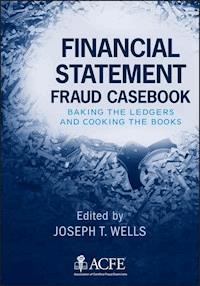
Financial Statement Fraud Casebook E-Book
63,99 €
Mehr erfahren.
- Herausgeber: John Wiley & Sons
- Kategorie: Fachliteratur
- Sprache: Englisch
A comprehensive look at financial statement fraud from the experts who actually investigated them This collection of revealing case studies sheds clear insights into the dark corners of financial statement fraud. * Includes cases submitted by fraud examiners across industries and throughout the world * Fascinating cases hand-picked and edited by Joseph T. Wells, the founder and Chairman of the world's leading anti-fraud organization ? the Association of Certified Fraud Examiners (ACFE) ? and author of Corporate Fraud Handbook * Outlines how each fraud was engineered, how it was investigated and how the perpetrators were brought to justice Providing an insider's look at fraud, Financial Statement Fraud Casebook illuminates the combination of timing, teamwork and vision necessary to understand financial statement fraud and prevent it from happening in the first place.
Sie lesen das E-Book in den Legimi-Apps auf:
Seitenzahl: 656
Veröffentlichungsjahr: 2011
Ähnliche




















Contents
Cover
Title Page
Copyright
Dedication
Preface
Chapter 1: Keep On Trucking
Atkins Trucking
Always Learning
Management by Intimidation
Dreading the News
About the Author
Chapter 2: Too Good to Be True?
Monarch
Surprise from the SEC
An Inexperienced Investigator and Bungled Due Diligence
A Few Unhappy Executives
About the Author
Chapter 3: Trust Us . . . We Wouldn't Lie to You
Growing Distribution
The New Client
Whom Can You Trust?
Justice Is Not Always Served
About the Author
Chapter 4: Rotten from the Core
Industry Trends
A Redirection of Energy
A Trickling Cash Flow
Comparing Claims to Reality
Imaginary Contract
Falling Like Dominoes
About the Authors
Chapter 5: The Broken Trust
An Important Call
The Confirmation
Very Slow Delivery
Disappearing Customers
The Straw That Broke the Camel's Back
Interviewing for Admission
Completing the Jigsaw Puzzle
About the Author
Chapter 6: The Perfect Family Business
A Sense of Entitlement
Welcome Home
Ungrateful Relatives
Into the Spotlight
Not an Ideal Deal
About the Author
Chapter 7: Auditor's Loyalty
Blissful Ventures
Revealing Comparisons
Trouble in Paradise
Passing the Torch
About the Author
Chapter 8: Easy Come, Easy Go
Picture-Perfect Start
Alarming Sales Tactic or Ideal Growth Strategy?
A Story Told Through E-Mails
Forsaking Responsibility for Growth
About the Author
Chapter 9: Organized Crime Is Not Just for the Usual Suspects
Growth and Ego
Mr. Forme Goes to Washington
Facing the Truth
Form over Substance
About the Author
Chapter 10: The Spinster and the Investment
Not Sly Enough
Within the Matrix
Change in Plans
Holiday Presents for One and All
Decisions and Consequences
About the Author
Chapter 11: This Might Sound Familiar . . .
Forming a Team
Out of Control
Fool Me Once . . .
Fool Me Twice . . .
Restating and Sentencing
About the Author
Chapter 12: Pulling the Strings
Hostile Takeovers
Acquisitions, Whistleblowers and Qui Tams
A National Investigation
The Final Cut
About the Author
Chapter 13: A Tale of Two Books
The Investigation Takes Off
Full Disclosure?
Too Little Too Late
About the Author
Chapter 14: The Family Man Behind Bars
An Anonymous Caller
Too Much Trust
Digging up an Audit Trail
Accountable Individuals
About the Author
Chapter 15: Net Capital Requirements
Surebet Securities
The DITs Were MIA
Officer Loan Account
Gertie's Recipe
Superstitious Rationalization
About the Author
Chapter 16: Delaying the Inevitable
Securitization of Loans
Early SOX Violation
Investigating a Bankruptcy
Bad Loan Workouts
The Process in Action
Collecting Collateral
Double-Pledging Assets
Outcome
About the Author
Chapter 17: Power and Corruption in the Publishing Industry
A True Success Story
Let's Make a Deal
One Thing Leads to Another
The Specifics
Secrets in the E-Mails
Old Habits Die Hard
About the Author
Chapter 18: It Starts and Ends at the Top
Growth and Decline
Creative Inventory Procedures
Unwelcome News
Undeliverable Promises
About the Author
Chapter 19: The Triple-Three
Establishing the Rules of Play
Drugs, Money and Rumors
The Importance of Planning
Loans in Default
Revealing Ratios
About the Author
Chapter 20: What Is 1 + 1? What Do You Want It to Be?
EZ Street
Friends and Family
Sorting Through the Mess
The Potato Chip Theory of Fraud
About the Author
Chapter 21: Take Two
Naiveté and Ego
Different Pieces of the Same Puzzle
Unpaid Suppliers
Dual Cash Accounts
The Cash Connection
Sizler Loses Again
About the Author
Chapter 22: Wade's WMD
Breakfast at Denny's
Men in Black
Interesting Patterns
The Chocolates
Falsified Documents
The Midnight Deposition
Confessions
The Outcome of the Investigation
About the Author
Chapter 23: Fraud Under the Sun
Bright Future
Suspicious Resignations
A Key Witness
Making Headlines
Packaging it for the Investors
About the Author
Chapter 24: Franklin County Contractors: A Case of Concealed Liabilities
Throwing Stones
Unexpected Job Duties
Escalating Debts
The End?
About the Author
Chapter 25: The Fall Man
Climbing the Social Ladder
C.Case
The Numbers Don't Add Up
Sales Deviations
Old Friends
Off-Hours Meeting
The Evidence in the E-Mail
The One Who Got Away
About the Author
Chapter 26: The Happy Life
Network of Collusion
Happy Beginnings
Performance Concerns
Client Meeting
Employee Tips
Lack of Controls
Tone at the Top
The Outcome of the Investigation
About the Author
Chapter 27: A Very Merry Fraud
New Holiday Traditions
New Year, New Investigations
Analysis and Exchange Rates
There's No Friend Like an Old Friend . . .
Worth the Wait
About the Author
Chapter 28: Missing Ingots
A Beacon of Hope
Declining Performance
The Cost Analysts
Working Hypotheses
Suspicious Vendors
About the Author
Chapter 29: When Silver Spoons Are Not Enough
Entrepreneurial Spirit
Forming a Case Theory
The Records Don't Lie
The Final Tally
About the Authors
Chapter 30: Sales Commission and Fraud Perpetration
New Management
Living the High Life
Too Busy to Comply?
Inflated Commissions
About the Author
Chapter 31: Like Two Sides of the Same Coin
Corporate Culture
Contradictions in Sales Returns
Generous Contracts
And the List Goes On . . .
Legal Advice
About the Author
Chapter 32: A President Illuminated
A Bright Future
An Unorthodox Executive Team
In Plain Sight
Out of the Rain
Lights Out?
About the Authors
Chapter 33: Trouble in Tallahassee
Starting Early
Top-Heavy Organization
What Happened in Vegas
Welcome Back
January 6
January 7
The Case Builds
And in the End . . .
About the Author
Glossary
Index
Copyright © 2011 by Association of Certified Fraud Examiners. All rights reserved.
Published by John Wiley & Sons, Inc., Hoboken, New Jersey.
Published simultaneously in Canada.
No part of this publication may be reproduced, stored in a retrieval system, or transmitted in any form or by any means, electronic, mechanical, photocopying, recording, scanning, or otherwise, except as permitted under Section 107 or 108 of the 1976 United States Copyright Act, without either the prior written permission of the Publisher, or authorization through payment of the appropriate per-copy fee to the Copyright Clearance Center, Inc., 222 Rosewood Drive, Danvers, MA 01923, (978) 750-8400, fax (978) 646-8600, or on the Web at www.copyright.com. Requests to the Publisher for permission should be addressed to the Permissions Department, John Wiley & Sons, Inc., 111 River Street, Hoboken, NJ 07030, (201) 748-6011, fax (201) 748-6008, or online at http://www.wiley.com/go/permissions.
Limit of Liability/Disclaimer of Warranty: While the publisher and author have used their best efforts in preparing this book, they make no representations or warranties with respect to the accuracy or completeness of the contents of this book and specifically disclaim any implied warranties of merchantability or fitness for a particular purpose. No warranty may be created or extended by sales representatives or written sales materials. The advice and strategies contained herein may not be suitable for your situation. You should consult with a professional where appropriate. Neither the publisher nor author shall be liable for any loss of profit or any other commercial damages, including but not limited to special, incidental, consequential, or other damages.
For general information on our other products and services or for technical support, please contact our Customer Care Department within the United States at (800) 762-2974, outside the United States at (317) 572-3993 or fax (317) 572-4002.
Wiley also publishes its books in a variety of electronic formats. Some content that appears in print may not be available in electronic books. For more information about Wiley products, visit our web site at www.wiley.com.
Library of Congress Cataloging-in-Publication Data:
Financial statement fraud casebook: cooking the books/edited by Joseph T. Wells.
p. cm.
Includes index.
ISBN 978-0-470-93441-8 (hardback); 978-1-118-07704-7 (ebk); 978-1-118-07705-4 (ebk); 978-1-118-07706-1 (ebk)
1. Misleading financial statements. 2. Fraud. I. Wells, Joseph T.
HV6768.F565 2011
363.25'0963–dc22
To the Gregor family, with love
Preface
Enron. Tyco. WorldCom. The South Sea Bubble. Ivar Kreuger. Equity Funding. While the first three of these infamous financial statement frauds may be burned into your memory, chances are the rest of them are not. Even so, efforts by executives and insiders to cook the books have a long and storied history. Let's take a closer look.
The South Sea Company was formed in England in 1711 by Lord Treasurer Robert Harley and a shady character named John Blunt. Because of Harley's political influence, the company was granted a monopoly for trading rights in Spanish South America. But his main purpose was an attempt to help his government pay for an enormous debt it had incurred during the War of the Spanish Succession, which did not end until 1713.
The essence of the deal was for the South Sea Company to assume nearly all of England's debt in exchange for stock. Since audited financial statements did not exist at the time, the company's insiders simply talked up the value of the stock and individual citizens put their life savings into the scheme. When the bubble eventually burst, it nearly bankrupted a proud nation.
Ivar Kreuger (1880–1932) was so rich that he also loaned money to countries—France, Spain, Romania and Poland—to help them rebuild the wreckage of the First World War. Although born in Sweden, Kreuger immigrated to the United States in the early twentieth century and made his fortune in matches. Before his death by suicide, Kreuger's corporation, the Swedish Match Company, owned four-fifths of the entire world supply. This was made possible by essentially the same method used by the South Sea Bubble: Kreuger, one of the richest men in the world at the time, made loans to nations in exchange for monopoly rights for match production.
However, all that glitters is not gold; Kreuger was a ruthless crook, not simply a monopolist. Money to fund wars was not cheap so the Match King raised additional capital by selling shares on the New York Stock Exchange until the Great Depression caused by the market crash. Only then—when Kreuger desperately needed cash—was it revealed that Ivar had created a dizzying maze of nearly 400 interconnected companies all with one common element: phony balance sheets and income statements at a time when audits were rare. Ivar Kreuger's response was to end his life with a 9mm pistol shot to the heart.
And at the heart of financial statement fraud is usually the corporate structure. By the late 1700s, there were only about 40 operating in the United States. By 1800, that had risen to 300. Today there are nearly 6 million corporations, which include about 17,000 public companies.
Although America's Black Friday uncovered a plethora of crooked corporate wrongdoing, the Securities and Exchange Acts of 1933 and 1934 addressed the problem head-on by requiring companies listed on the stock exchange to have certified audits. For a few decades, that strategy seemed to work.
But then came Stanley Goldblum (1927–) and the Equity Funding scandal that set public accounting on its ears. The company was formed in 1960 by Gordon McCormick to pool individual life insurance policies and to resell them to investors. His principal hire was a muscled, 6′2′′ Goldblum who had both a personal and business credo: to get as big as possible. Stanley acquired the company in late 1961 and soon went public. Because the concept of repooling insurance policies was new, it quickly became a Wall Street darling, with stock prices nearly doubling year-over-year. But there was one more reason the market price was so high: In order to sustain growth, Stanley wasn't just cooking the books; he was microwaving them.
To show his outrageous profits, all Goldblum really needed were phony insurance policies to fool the auditors. He even arranged for a few of the fake policy holders to “die” periodically so that the actuarial tables would not send out red flags. But once fraud starts in the executive suite, it's very hard to stop—much like a freight train with no brakes. The more phony policies created, the more Goldblum had to come up with. His solution? Create a department off-site whose sole duty was to create fake paperwork.
The auditors were among the biggest fools in this scam. By dutifully ticking and footing phony policies, they completely missed in 1972 that a full third of Equity Funding's $2.5 billion in assets didn't even exist. The fraud was finally unraveled when a former employee ratted out Goldblum's gang of thieves to a Wall Street reporter. Equity Funding went broke, Stanley Goldblum went to prison, and the international audit firm (which loudly protested that it was not responsible for detecting fraud) went back to work, shy of several hundred million dollars because of civil damages. Yes, Stanley and Equity Funding accomplished Goldblum's goal of getting big. But a bubble full of hot air is predestined to burst.
In response to the Equity Funding fraud, the American Institute of Certified Public Accountants (AICPA) formed the Commission on Auditor Responsibilities (referred to as the Cohen Commission) in 1974 and issued its final report in 1978. The Commission—and much subsequent auditing literature—had great difficulty in using the word “fraud,” preferring instead the term “irregularities.” But the report did grudgingly concede that the auditor should at least have some fraud-detection role and so the profession issued Statement on Auditing Standards (SAS) 16.
The external auditors have had a long and tortured history over their responsibilities, or lack thereof, in detecting fraud. The subject was first addressed in authoritative literature in the latter part of the nineteenth century with the publication of Auditing: A Practical Manual for Auditors by Lawrence R. Dicksee. He and other authors at the time took the position that the detection of fraud and errors was the main responsibility of auditors. That began to change when Robert H. Montgomery published the first edition of his seminal work, Montgomery's Auditing in 1912. (Montgomery was one of the original founders of what has now morphed into PriceWaterhouseCoopers.)
For several decades, the profession inched away from fraud detection and became more engrossed in reporting issues. It attempted to lay the responsibility for fraud on management, which is akin to asking the fox to guard the chicken house. The reason for the auditing industry's reluctance to accept a larger role in fraud detection can be described in one word: liability. The latter part of the twentieth century was littered with lawsuits over audit failures, many of them in the hundreds of millions of dollars.
The response of the profession was curious. Instead of educating itself about fraud detection, it decided that the public needed to be informed on what an audit could and couldn't accomplish. In 1988, the Auditing Standards Board issued nine Statements on Auditing Standards on what it termed “expectation gap” issues. Among them was SAS 53, which superseded SAS 16. This new standard still did not embrace the term “fraud” but it gradually inched up the auditor's duties. It wasn't until 1997, with the issuance of SAS 82, Consideration of Fraud in a Financial Statement Audit, that “the other F-word” was used in official literature. Once again, the profession begrudgingly took more responsibility.
The final statement as of this writing, SAS 99, was issued in 2002. It provided specific guidance for auditors in fulfilling their fraud-related responsibilities. So in about a quarter of a century, four fraud-related statements were released. For a profession that is oft criticized for moving at the speed of glaciers, that's lightning-quick action. But then came Enron, which cost investors hundreds of billions of dollars. The public and the U.S. Congress were outraged. That anger soon boiled over when WorldCom's Bernie Ebbers and Tyco's Dennis Kozlowski looted their corporate treasuries for hundreds of millions of dollars.
Congress decided, among other things, that the accounting profession had done a poor job in policing itself so it took away that responsibility with the passage of the Sarbanes-Oxley Act in 2002, which transferred auditing standards to the newly created Public Company Accounting Oversight Board (PCAOB), a creature of the SEC.
From the headlines around the world, one could conclude massive accounting frauds are the rule; not the exception. But that would be wrong. In the following pages, you will be exposed to the real world of financial statement frauds and quickly see that they come in all shapes and sizes—large, medium, small. And they are not the exclusive domain of the United States but rather occur in nearly every corner of the globe. These scams happen in public and private companies, nonprofits and even charities. Still, they have two common elements. First is that they are almost always committed by those in ultimate charge of their organizations. Second, nearly all were once legitimate entities but changed for the worse when they attempted to conceal poor financial performance.
These cases were not written by academics or historians viewing the situation from afar, but rather those directly involved in the investigation of the financial statement frauds. They are all members of the Association of Certified Fraud Examiners (ACFE), the largest antifraud organization in the world. The coauthors contributed their time and talent solely so that others could learn from their experiences. To protect privacy, key names have been changed. No one, including me, received a dime; all profits go to the ACFE Foundation, which provides scholarships to deserving students. They will become tomorrow's fraud fighters and need all the help we can give them.
Thanks go first to the coauthors of this book; we are all deeply indebted to them. Then comes the ACFE staff, especially Laura Hymes, who acted as project manager and principal editor. John Gill, Andi McNeal, Dawn Taylor and Amy Adler of the research department deserve special recognition. Finally, I'd be amiss if I didn't thank ACFE President and CEO Jim Ratley, Vice President Jeanette LeVie and Assistant to the Chairman Lindsay Fassauer. Their assistance has been invaluable.
What will happen next in financial statement fraud? If the past is any indication, we may be in for a rough ride. One unmistakable trend is that we have gone from investing in stocks to speculating on them. Current share price, not a company's future, is frequently king. That brings even more pressure on executives to meet short-term goals. Enforcement by regulatory agencies, while necessary, is inadequate and probably will remain so. Moreover, our population will continue to age until about the mid-twenty-first century. That means more investment in the market of retirement funds. Or put another way, the pool of money subject to manipulation will get bigger. A final unmistakable trend is that financial statement frauds over the past hundred years have gotten larger and more frequent. Don't expect that to change soon. But keep fighting the good fight; it does make a difference.
Dr. Joseph T. Wells, CFE, CPA
Austin, Texas
June 2011
Chapter 1
Keep On Trucking
Ralph Wilson
Jenny Baker was viewed by her associates as a brilliant CFO. She was known for her ability to predict the outcome of future uncertainties with startling accuracy. She was also known to be very demanding, even intimidating at times. Many of her staff had experienced one of her famous outbursts; consequently, they didn't always feel comfortable asking her many questions. She had started her career as a staff auditor for one of the Big Four accounting firms, where she specialized in the transportation industry and was well regarded for her understanding of the nuances of sometimes complex financial transactions.
Using her experience as a launching pad, Jenny had taken a job in regulatory accounting for a regional trucking firm and had moved quickly through the ranks to become the CFO. Not content with a regional firm, she had made several strategic career moves that finally landed her a job as vice president of finance at a national transportation company. During her tenure there, Jenny had gained the confidence of those around her, including the CEO and many of the directors on the company's board.
While pursuing her career, Jenny had also found time to marry and have two children; she even had three grandkids. When she wasn't working, she loved to spend time with her grandchildren; she would even plan her vacations as family events so that she could include them. She was in her mid-fifties, had a nice home, a country-club membership and was no longer driven to advance in her career. She was satisfied with where she was in life. Her long-term plan was to retire early and enjoy all of the things she had worked so hard to earn.
Atkins Trucking
Atkins Trucking Company had been founded in the late 1930s as the economy began to recover somewhat from the Great Depression. The company began as a local trucking firm in a major metropolitan area in the northeast. The founder, Daniel Atkins, had prided himself on delivering high-quality service and always pleasing the customer. Over the years, the company had acquired a reputation for integrity.
After World War II, the transportation industry really began to grow and Atkins Trucking expanded from a local operation to a regional firm and eventually became a national player in the field of transportation. As a result of the expanded transportation market and to recognize new service lines, the company had changed its name to Atkins Transportation Services. Because of family influence, however, the company remained closely held. The only public financing of company activities came from the debt markets. The company made regular use of commercial paper and occasionally issued bonds for long-term capital investments. Atkins Transportation employed 3,500 people concentrated at corporate headquarters, as well as in strategic transportation hubs located throughout the United States.
Always Learning
I was the internal audit director for Atkins Transportation Services. My department consisted of six employees, one of whom was designated as a special projects auditor. One of the things we liked to do was proactively look for fraud. We often undertook data mining to look for improper expenditures or unusual vendor relationships. Sarah Harrington, the special projects auditor, routinely brainstormed with me about new approaches for finding fraud. One day we received a brochure describing a forensic accounting class focusing on financial statement analysis. Since neither of us had taken such a class before, we signed up for it. It turned out to be a wise investment.
Lesen Sie weiter in der vollständigen Ausgabe!
Lesen Sie weiter in der vollständigen Ausgabe!
Lesen Sie weiter in der vollständigen Ausgabe!
Lesen Sie weiter in der vollständigen Ausgabe!
Lesen Sie weiter in der vollständigen Ausgabe!
Lesen Sie weiter in der vollständigen Ausgabe!
Lesen Sie weiter in der vollständigen Ausgabe!
Lesen Sie weiter in der vollständigen Ausgabe!
Lesen Sie weiter in der vollständigen Ausgabe!
Lesen Sie weiter in der vollständigen Ausgabe!
Lesen Sie weiter in der vollständigen Ausgabe!
Lesen Sie weiter in der vollständigen Ausgabe!
Lesen Sie weiter in der vollständigen Ausgabe!
Lesen Sie weiter in der vollständigen Ausgabe!
Lesen Sie weiter in der vollständigen Ausgabe!
Lesen Sie weiter in der vollständigen Ausgabe!
Lesen Sie weiter in der vollständigen Ausgabe!
Lesen Sie weiter in der vollständigen Ausgabe!
Lesen Sie weiter in der vollständigen Ausgabe!
Lesen Sie weiter in der vollständigen Ausgabe!
Lesen Sie weiter in der vollständigen Ausgabe!
Lesen Sie weiter in der vollständigen Ausgabe!
Lesen Sie weiter in der vollständigen Ausgabe!
Lesen Sie weiter in der vollständigen Ausgabe!
Lesen Sie weiter in der vollständigen Ausgabe!
Lesen Sie weiter in der vollständigen Ausgabe!
Lesen Sie weiter in der vollständigen Ausgabe!
Lesen Sie weiter in der vollständigen Ausgabe!
Lesen Sie weiter in der vollständigen Ausgabe!
Lesen Sie weiter in der vollständigen Ausgabe!
Lesen Sie weiter in der vollständigen Ausgabe!
Lesen Sie weiter in der vollständigen Ausgabe!
Lesen Sie weiter in der vollständigen Ausgabe!
Lesen Sie weiter in der vollständigen Ausgabe!




