


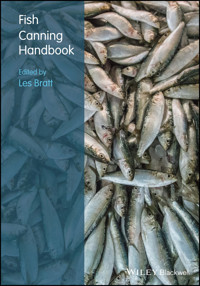
Fish Canning Handbook E-Book
174,99 €
Mehr erfahren.
- Herausgeber: John Wiley & Sons
- Kategorie: Fachliteratur
- Sprache: Englisch
Fish Canning Handbook
Fish Canning Handbook
Edited by Les Bratt
Canning continues to be an extremely important form of food preservation commercially, and canned fish represents a source of relatively inexpensive, nutritious and healthy food which is stable at ambient temperatures, has long shelf life and in consequence is eminently suitable for worldwide distribution. It is vitally important that all canning operations are undertaken in keeping with the rigorous application of good manufacturing practices if the food is to be safe at the point of consumption. This demands that all personnel involved in the management and operation of cannery operations have a competent understanding of the technologies involved, including the basic requirements for container integrity and safe heat sterilisation.
This book provides a source of up to date and detailed technical information for all those involved in the production of canned fish, from students thinking of entering the industry, to regulatory authorities with responsibility for official inspection, trading companies and retail organisations who purchase canned fish, as well as the manufacturers themselves. An exhaustive range of topics is covered in 15 chapters, including: the current global market; processing, packaging and storage operations; food safety and quality assurance; international legal requirements and laboratory analysis.
Also available from Wiley-Blackwell
Fishery Products: Quality, safety and authenticity
Edited by H. Rehbein and J. Oehlenschläger
ISBN 978-1-4051-4162-8
Handbook of Seafood Quality, Safety and Health Applications
Edited by C. Alasalvar, F. Shahidi, K. Miyashita and U. Wanasundara
ISBN 978-1-4051-8070-2
Fish Processing: Sustainability and new opportunities
Edited by G. Hall
ISBN 978-1-4051-9047-3
Sie lesen das E-Book in den Legimi-Apps auf:
Seitenzahl: 663
Veröffentlichungsjahr: 2010
Ähnliche




















Contents
Cover
Half Title Page
Title Page
Copyright
List of Contributors
Preface: review of the market for, and sources of, canned fish
Chapter 1 Legal requirements for producers selling canned fish into Europe
1.1 Introduction
1.2 Imports into the EU
1.3 General food law
1.4 Product-specific controls
1.5 Hygiene rules
1.6 Fishery products from outside the EU
1.7 Identification marking
1.8 Microbiological criteria
1.9 Labelling
1.10 Lot marking
1.11 Food contact materials
1.12 Additives
1.13 Flavourings
1.14 Contaminants
1.15 Pesticides
1.16 Veterinary medicinal products
1.17 Weights and measures
1.18 Warning
References
Chapter 2 Legal requirements for producers selling canned fish into North America
2.1 Introduction
2.2 Canned fish description
2.3 Why are regulations necessary?
2.4 Legal requirements and food safety
2.5 Regulatory systems in Canada and the United States
2.6 Canadian requirements
2.7 United States requirements
Chapter 3 HACCP systems for ensuring the food safety of canned fish products
3.1 Introduction
3.2 The HACCP Principles
3.3 Prerequisite programmes
3.4 How to set up and conduct an HACCP study for canned fish products
3.5 Implementation
3.6 ISO 22000
3.7 Conclusions
References
Appendix 1: Useful websites (for HACCP Guidance and including generic HACCP plans in some cases)
Appendix 2: Modular HACCP approach for the canning of tuna products, showing typical activities within each module
Appendix 3: Example of a tabular documentation format for prerequisite programmes
Appendix 4: Extract from a non-tabular format HACCP plan approach for can seaming (CCP 2)
Appendix 5: Extract of a tabular HACCP Chart for CCP 3 sterilisation and CCP 4 in the generic fish canning flow diagram
Chapter 4 National and international food safety certification schemes
4.1 Introduction
4.2 Food safety legislation
4.3 Food safety management systems
4.4 Certification: A brief overview
4.5 Hazard analysis critical control points
4.6 The Global Food Safety Initiative
4.7 A comparison of major global certification programmes for food safety
4.8 Summary of comparison of global certification programmes
Chapter 5 Fish quality
5.1 Introduction
5.2 Important fish species
5.3 Pollution aspects
5.4 Handling and transport
5.5 Spoilage factors
5.6 Reception and testing
5.7 Storage
5.8 Defrosting frozen fish
5.9 Fish preparation
5.10 Chemical indicators of quality
References
Chapter 6 Design and operation of frozen cold stores
6.1 Introduction
6.2 Factors affecting frozen storage life
6.3 Cold store design
6.4 Specification and optimisation of cold stores
6.5 Thawing
6.6 Conclusions
References
Chapter 7 Packaging formats for heat-sterilised canned fish products
7.1 Overview of the basic materials used for heat-sterilised fish packaging
7.2 Metal cans for heat sterilised-fish products
7.3 Plastic containers for heat-sterilised fish products
7.4 Glass containers for heat-sterilised fish products
Further reading
Chapter 8 Retorting machinery for the manufacture of heat-sterilised fish products
8.1 Introduction
8.2 Retorting equipment available
8.3 Technical features of horizontal batch retorts
8.4 General arrangement of a sterilising plant
8.5 Utilities required for batch retorts
8.6 The different usages of a retort
8.7 Legal steps to be taken when installing a new retort
Chapter 9 Management of thermal process
9.1 Role of the thermal process manager
9.2 Documentation of thermal process requirements
9.3 Maintaining and calibration of key instrumentation
9.4 Training of key staff
9.5 Review of production records
9.6 Managing non-conformance (process deviations)
9.7 Conclusion
References
Chapter 10 Principal causes of spoilage in canned fish products
10.1 The quality of raw materials
10.2 Hygiene and good manufacturing practice
10.3 Potential spoilage issues associated with canned fish products
10.4 Typical causes of spoilage in canned fish products
10.5 Types of spoilage
10.6 Microbiological examination of suspect spoilt cans
10.7 Microbiological investigations -- decision criteria
10.8 Conclusion
References
Chapter 11 Commercial sterility and the validation of thermal processes
11.1 Introduction
11.2 Temperature measurement systems
11.3 Processing vessels
11.4 Temperature distribution
11.5 Retort survey
11.6 Test loading
11.7 Data analysis
11.8 Heat penetration measurement
11.9 Commercial sterility and lethality
11.10 General method
11.11 Heat penetration experimental methods
11.12 Flexible packaging
11.13 Future developments and information
References
Other sources of information
Chapter 12 The quality department in a fish cannery
12.1 Avant-propos
12.2 The organisation and the scope of operations of the quality department
12.3 Quality assurance for the management of pre-requisite measures
12.4 Quality control
12.5 Establishment of a quality plan
12.6 Standard quality procedures
12.7 Training of quality staff against procedures
12.8 Handling of non-conforming materials
12.9 Establishment and monitoring of corrective actions
12.10 Legislative compliance
12.11 Research and development
12.12 Security
12.13 Conclusion
Acknowledgement
References
Chapter 13 The laboratory in a fish canning factory
13.1 Laboratory facilities
13.2 Chemical analyses
13.3 Microbiological testing
13.4 Analysis required for cannery water and retort cooling water
13.5 Swab testing
13.6 Incubation tests
13.7 Sterility tests
13.8 Laboratory accreditation
Further reading
Chapter 14 Cleaning and disinfection in the fish canning industry
14.1 Introduction
14.2 The cleaning process
14.3 Principles of cleaning
14.4 Open plant cleaning
14.5 Floor cleaning
14.6 Tray and rack washing machines
14.7 Principles of disinfection
14.8 Factors affecting disinfectant effectiveness
14.9 Choosing the right disinfectant
14.10 Where to disinfect
14.11 Types of disinfectants
14.12 Oxidising disinfectants
14.13 Non-oxidising disinfectants
14.14 Effects of time and concentration
14.15 Specific issues relating to fish canning operations
14.16 Cleaning management
14.17 Cleaning programme
References
Chapter 15 The canning factory
15.1 The fish canning factory: Introduction
15.2 Site selection
15.3 Factory design and construction
15.4 The principal areas of the factory
15.5 Services
References and suggestions for further reading
Index
Fish Canning Handbook
This edition first published 2010 © 2010 Blackwell Publishing Ltd
Blackwell Publishing was acquired by John Wiley & Sons in February 2007. Blackwell’s publishing programme has been merged with Wiley’s global Scientific, Technical, and Medical business to form Wiley-Blackwell.
Registered office John Wiley & Sons Ltd, The Atrium, Southern Gate, Chichester, West Sussex, PO19 8SQ, United Kingdom
Editorial offices 9600 Garsington Road, Oxford, OX4 2DQ, United Kingdom 2121 State Avenue, Ames, Iowa 50014-8300, USA
For details of our global editorial offices, for customer services and for information about how to apply for permission to reuse the copyright material in this book, please see our website at www.wiley.com/wiley-blackwell.
The right of the author to be identified as the author of this work has been asserted in accordance with the UK Copyright, Designs and Patents Act 1988.
All rights reserved. No part of this publication may be reproduced, stored in a retrieval system, or transmitted, in any form or by any means, electronic, mechanical, photocopying, recording or otherwise, except as permitted by the UK Copyright, Designs and Patents Act 1988, without the prior permission of the publisher.
Wiley also publishes its books in a variety of electronic formats. Some content that appears in print may not be available in electronic books.
Designations used by companies to distinguish their products are often claimed as trademarks. All brand names and product names used in this book are trade names, service marks, trademarks or registered trademarks of their respective owners. The publisher is not associated with any product or vendor mentioned in this book. This publication is designed to provide accurate and authoritative information in regard to the subject matter covered. It is sold on the understanding that the publisher is not engaged in rendering professional services. If professional advice or other expert assistance is required, the services of a competent professional should be sought.
Library of Congress Cataloging-in-Publication Data
Fish canning handbook / edited by Les Bratt. p. cm. Includes bibliographical references and index. ISBN 978-1-4051-8099-3 (hardback : alk. paper) 1. Canned foods–Sterilization. 2. Fishes–Preservation. 3. Canning and preserving. 4. Fishery products–Microbiology. 5. Canned fish products–Safety regulations–Europe. 6. Canned fish products–Safety regulations–North America. I. Bratt, L. (Les) TP371.35.F57 2010 664′.942–dc22
2010003296
A catalogue record for this book is available from the British Library.
List of Contributors
Les Bratt
Les Bratt (Food Technology) Ltd, Cleeve Prior,
Worcestershire, UK
Tony Garthwaite
Consultant Food Technologist, TG Associates,
Grimsby, UK
Joy Gaze
Microbiology Department, Campden BRI,
Chipping Campden, Gloucestershire, UK
John Hammond
Campden BRI, Chipping Campden,
Gloucestershire, UK
Christian James
Food Refrigeration and Process Engineering
Research Centre (FRPERC), The Grimsby
Institute (GIFHE), Grimsby, Lincolnshire, UK
Stephen J. James
Food Refrigeration and Process Engineering
Research Centre (FRPERC), The Grimsby
Institute (GIFHE), Grimsby, Lincolnshire, UK
Peter Littleton
Technical Services Manager, Holchem
Laboratories Ltd, Haslingden, Rossendale,
Lancashire, UK
Kenneth Lum
GMA/Food Products Association, Center for
Northwest Seafood, Seattle, WA, USA
Nick May
Campden BRI, Chipping Campden,
Gloucestershire, UK
Linda Nicolaides
Food Safety Specialist, Natural Resources
Institute, Greenwich, UK
Bev Page
Packaging Consultant, Ravenshead,
Nottingham, UK
Leila Radi
International Quality Control Corporation,
Rabat, Morocco
Geoff Shaw
Ellab UK Limited, Bawburgh, Norfolk, UK
Harriet Simmons
Technical Director for the Food Inspection
Services, National Britannia Ltd, Caerphilly
Business Park, Caerphilly, UK
Claude Vincent
STERIFLOW S.A.S., Paris, France
Alan Williams
Department of Food Manufacturing
Technologies, Campden BRI, Chipping
Campden, Gloucestershire, UK
Preface: review of the market for, and sources of, canned fish
Canning is a well-established and traditional means of providing food which is stable at ambient temperatures, has long shelf life and in consequence is eminently suitable for world-wide distribution. Canned fish is therefore exported from countries all over the world into the consumer markets of Europe and North America. The manufacturing of canned fish has provided, and continues to provide much-needed employment, individual incomes and the means for foreign currency exchange for developing countries, particularly in Southeast Asia, South America and the Indian Ocean.
Within the past 20 years or so there have been noticeable changes within the canned fish industry. The increased emphasis on food safety has given rise to better understanding of the process of heat sterilisation, together with ever-sophisticated equipment providing the means to measure that sterilisation; the introduction of the ISO 9000 Standard has led to the better organisation of Quality Management Systems in which responsibilities are better defined and understood; modern processing equipment with microprocessor control has provided the better regulation of temperatures and pressures during thermal processing; and the widespread adoption of HACCP systems has allowed companies to identify and concentrate their efforts on those matters contributing to product safety.
The changes that have occurred within the industry have also been due to long-term pressure from the retail and trading companies who provide audit of, and technical help to, their suppliers in order to ensure that food provided to their customers is safe. In recent years we have seen the introduction of numerous industry-led standards such as the International Food Standard or the British Retail Consortium Standard the requirements of which manufacturing companies are required to meet if they wish to supply to the major purchasing organisations in Europe or North America.
The introduction of new legislation has also taken place particularly within Europe. The three basic food hygiene regulations are:
852/2004 on the hygiene of foodstuffs;853/2004 laying down specific rules for food of animal origin; and854/2004 laying down the specific rules for the organisation of official controls on animal products intended for human consumption.Food business operators are effectively required to put in place, implement and maintain a permanent procedure, or procedures, based on HACCP principles.
Canned fish is seen as intrinsically healthy, convenient and tasty. The UK market for canned fish is currently worth some £ 474 million at retail, equivalent to 108 624 tonnes. Standard tuna products at 55% comprise the largest sector of this market, canned salmon is second with 20%, and the oily fish, sardines, mackerels and pilchards together comprise 13.8%. Added value tuna products now account for 5% of the canned fish category and have been a key driver for growth in recent years. Product innovation has been instrumental in providing new products launched to meet incremental consumer needs identified through consumer research.
This handbook is intended as a technical reference and help for all those fish canning companies wishing to meet the demands of the technically discerning retail and trading organisations and thus greatly increase their opportunities for export.
Les Bratt
Data source: AC Nielsen Scantrack 52w/e 24th January 2009.
1: Legal Requirements for Producers Selling Canned Fish into Europe
John Hammond
1.1 Introduction
The European Union (EU) represents a single market of nearly 500 million consumers across 27 Member States. Whilst large, it is less than half the size of India and a little more than one third of the size of China. The need to compete effectively with such global economies has been a major factor in the expansion of the EU over the last 50 years, from an initial Economic Community of just six Member States.
The EU remains first and foremost a ‘Common Market’ and in pursuit of this most of the food laws that apply in the 27 individual Member States have been developed and agreed by the EU.
As with most food law in well-developed market economies, the main functions of the controls are:
To protect the health of people, animals and plants;To ensure that consumers are not misled about the composition and origin of the food that they purchase;To support fair competition in order that well run businesses that meet their legal obligations are not put at a competitive disadvantage in comparison with companies that take a less rigorous approach to compliance; andTo promote free trade so that goods legally manufactured or imported into one Member State can then move freely across the entire EU.EU food law is part of a wider legislative framework that is designed to secure the free movement of people, services, capital and goods, including food and feed, throughout its Member States. The French term Acquis Communautaire is often used to denote the various treaties, regulations and directives passed by the European institutions, as well as judgements reached by the European Court of Justice. The elements that control the production and marketing of food and feed are described in this chapter.
But first it is necessary to understand and distinguish the different types of EU legal instruments.
Much of the earlier body of EU food law was developed in the form of Directives. As the term suggests, they directed Member State governments to give effect to the detailed requirements set out in the Directive, but crucially left Member States with the flexibility to adopt their own national legislation to achieve this. One potential disadvantage of this approach was that Member States might implement the Directive into their national legislation slightly differently, and that any divergences might then impede the free movement of goods, one of the original objectives of developing the legislation.
For this reason, therefore, in recent years most EU food laws have been made in the form of Regulations. These apply fully and equally in all Member States without the need for implementing legislation and thus without the danger of national variations. All that is normally required in national legislation is a simple legal instrument to provide for the execution and enforcement of the EU Regulation and to put in place a system of sanctions in cases of non-compliance.
1.2 Imports into The EU
Against this background, it is clear that the rules that apply to imports from countries outside the EU, often termed ‘third countries’, are vital to ensure the most complete possible protection of EU consumers and industries.
The controls placed on such imports differ according to the type of food concerned.
Commission Decision 2007/275/EC (European Union, 2007a) draws up a list of animals and animal products, including fish that are subject to controls at border inspection posts.
Commission Decision 2001/881/EC (European Union, 2001b), as amended, lists the designated Border Inspection Posts where official veterinarians undertake veterinary checks on live animals and animal products in conjunction with the competent authorities.
Each year, the infrastructure, equipment and working of each post are inspected by a Commission veterinary expert in cooperation with the competent national authorities.
Border Inspections Post checks are carried out in close cooperation with customs officials; the list of products subject to inspection is defined by reference to the combined nomenclature (CN) established by Council Regulation (EEC) No. 2658/87 (European Union, 1987) on the tariff and statistical nomenclature.
Lesen Sie weiter in der vollständigen Ausgabe!
Lesen Sie weiter in der vollständigen Ausgabe!
Lesen Sie weiter in der vollständigen Ausgabe!
Lesen Sie weiter in der vollständigen Ausgabe!
Lesen Sie weiter in der vollständigen Ausgabe!
Lesen Sie weiter in der vollständigen Ausgabe!
Lesen Sie weiter in der vollständigen Ausgabe!
Lesen Sie weiter in der vollständigen Ausgabe!
Lesen Sie weiter in der vollständigen Ausgabe!
Lesen Sie weiter in der vollständigen Ausgabe!
Lesen Sie weiter in der vollständigen Ausgabe!
Lesen Sie weiter in der vollständigen Ausgabe!
Lesen Sie weiter in der vollständigen Ausgabe!
Lesen Sie weiter in der vollständigen Ausgabe!
Lesen Sie weiter in der vollständigen Ausgabe!




