


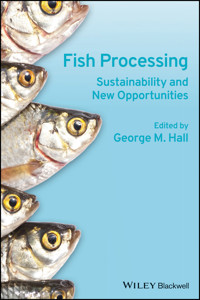
Fish Processing E-Book
170,99 €
Mehr erfahren.
- Herausgeber: John Wiley & Sons
- Kategorie: Fachliteratur
- Sprache: Englisch
This book seeks to address the challenges facing the international seafood industry via a two pronged approach: by offering the latest information on established technologies and introducing new ideas and technologies. An introductory chapter sets the tone for the book by presenting the background against which fish processing will exist in the near future. Chapter two looks at the environmental and sustainability issues relating to conventional fish processing, including processing efficiency and better use of the outputs currently considered wastes. The impact of mechanisation and computerisation on environmental sustainability is also addressed. Subsequent chapters examine the latest developments in established fish processing technologies such as canning, curing, freezing and chilling, with an emphasis on the environmental aspects of packaging and the process itself. In addition, quality and processing parameters for specific species, including new species, are described. The second part of the book gives authors the opportunity to introduce the potential technologies and applications of the future to a wider audience. These include fermented products and their acceptance by a wider audience; the utilisation of fish processing by-products as aquaculture feeds; and the use of by-products for bioactive compounds in biomedical, nutraceutical, cosmetic and other applications.
Sie lesen das E-Book in den Legimi-Apps auf:
Seitenzahl: 623
Veröffentlichungsjahr: 2011
Ähnliche




















Contents
Preface
Contributors
1 Introduction: Challenges to the Fish-Processing Industry in a Resource-Starved World
1.1 INTRODUCTION
1.2 SUSTAINABILITY TOOLS
1.3 CLIMATE CHANGE
1.4 THE CAPTURE FISHERY
1.5 CONTRIBUTION OF AQUACULTURE
1.6 INDUSTRIAL FISH PRODUCTION
1.7 IMPLICATIONS FOR THE PROCESSING INDUSTRY
1.8 CONCLUSION: SUSTAINABILITY IN THE FISH-PROCESSING INDUSTRY
REFERENCES
2 Canning Fish and Fish Products
2.1 PRINCIPLES OF CANNING
2.2 PACKAGING MATERIALS
2.3 PROCESSING OPERATIONS
2.4 CANNING OF SPECIFIC SPECIES
2.5 CONCLUSIONS
REFERENCES
3 Preservation by Curing (Drying, Salting and Smoking)
3.1 BASIC RELATIONSHIPS
3.2 DRYING
3.3 SALTING
3.4 SMOKING
3.5 POST-HARVEST LOSSES IN FISH SMOKING
3.6 SUSTAINABILITY ISSUES
REFERENCES
4 Freezing and Chilling of Fish and Fish Products
4.1 INTRODUCTION
4.2 FREEZING SYSTEMS
4.3 ENVIRONMENTAL IMPACT OF FREEZING OPERATIONS
4.4 LIFE CYCLE ASSESSMENT AND THE SUPPLY CHAIN
REFERENCES
5 Surimi and Fish Mince Products
5.1 INTRODUCTION
5.2 THE SURIMI PROCESS
5.3 FISH MINCE PROCESSING
REFERENCES
6 Sustainability Impacts of Fish-Processing Operations
6.1 INTRODUCTION
6.2 SUSTAINABILITY ISSUES
6.3 INDIVIDUAL PROCESSES
6.4 LIFE CYCLE ASSESSMENT
6.5 SUPPLY CHAIN ANALYSIS
6.6 CLEANER PRODUCTION
6.7 PROCESSING IN A CHANGING WORLD
REFERENCES
7 Sustainability of Fermented Fish Products
7.1 INTRODUCTION
7.2 PRINCIPLES OF THE FERMENTATION PROCESS
7.3 DEFINITION AND CLASSIFICATION OF FERMENTED FISH PRODUCTS
7.4 TYPES OF FERMENTED FISH PRODUCTS
7.5 QUALITY AND STANDARDS OF FERMENTED FISH PRODUCTS
7.6 SAFETY ISSUES RELATED TO FERMENTED FISH PRODUCTS
7.7 CONCLUSIONS
ACKNOWLEDGEMENTS
REFERENCES
8 On-board Fish Processing
8.1 INTRODUCTION
8.2 ON-BOARD PROCESSING
8.3 ADVANTAGES OF ON-BOARD PROCESSING
8.4 QUALITY ISSUES RELATED TO ON-BOARD PROCESSING
8.5 SUSTAINABLE ISSUES
ACKNOWLEDGEMENTS
REFERENCES
9 Fishmeal Production and Sustainability
9.1 INTRODUCTION
9.2 THE FISHMEAL PROCESS
9.3 SUSTAINABILITY ISSUES
9.4 ALTERNATIVES TO FISHMEAL
9.5 CONCLUSIONS
REFERENCES
10 Utilization of Fish Processing By-products for Bioactive Compounds
10.1 INTRODUCTION
10.2 RAW MATERIAL CHEMICAL COMPOSITION
10.3 PROTEIN HYDROLYSATES AND PEPTIDES
10.4 COLLAGEN AND GELATIN
10.5 OMEGA-3 POLYUNSATURATED FATTY ACID IN FISH
10.6 CONCLUDING REMARKS
ACKNOWLEDGEMENTS
REFERENCES
11 Life Cycle Assessment of Bulk Packaging Used to Transport Fresh Fish Products: Case Study
11.1 INTRODUCTION
11.2 UK FISHING INDUSTRY
11.3 LIFE CYCLE ASSESSMENT
11.4 CASE STUDY: RAINBOW SEAFOOD – EPS AND PP FISH BOXES
11.5 SYSTEM DESIGN
11.6 DATA ACQUISITION
11.7 LIFE CYCLE INVENTORY
11.8 LIFE CYCLE IMPACT ASSESSMENT
11.9 RESULTS AND RECOMMENDATIONS
11.10 CONCLUSIONS
ACKNOWLEDGEMENT
REFERENCES
Index
Food Science and Technology
This edition first published 2011 © 2011 Blackwell Publishing Ltd.
Blackwell Publishing was acquired by John Wiley & Sons in February 2007. Blackwell’s publishing programme has been merged with Wiley’s global Scientific, Technical, and Medical business to form Wiley-Blackwell.
Registered Office
John Wiley & Sons Ltd, The Atrium, Southern Gate, Chichester, West Sussex, PO19 8SQ, UK
Editorial Offices
9600 Garsington Road, Oxford, OX4 2DQ, UK
The Atrium, Southern Gate, Chichester, West Sussex, PO19 8SQ, UK
2121 State Avenue, Ames, Iowa 50014–8300, USA
For details of our global editorial offices, for customer services and for information about how to apply for permission to reuse the copyright material in this book please see our website at www.wiley.com/wiley-blackwell.
The right of the author to be identified as the author of this work has been asserted in accordance with the UK Copyright, Designs and Patents Act 1988.
All rights reserved. No part of this publication may be reproduced, stored in a retrieval system, or transmitted, in any form or by any means, electronic, mechanical, photocopying, recording or otherwise, except as permitted by the UK Copyright, Designs and Patents Act 1988, without the prior permission of the publisher.
Wiley also publishes its books in a variety of electronic formats. Some content that appears in print may not be available in electronic books.
Designations used by companies to distinguish their products are often claimed as trademarks. All brand names and product names used in this book are trade names, service marks, trademarks or registered trademarks of their respective owners. The publisher is not associated with any product or vendor mentioned in this book. This publication is designed to provide accurate and authoritative information in regard to the subject matter covered. It is sold on the understanding that the publisher is not engaged in rendering professional services. If professional advice or other expert assistance is required, the services of a competent professional should be sought.
Library of Congress Cataloging-in-Publication Data
Fish processing: sustainability and new opportunities/edited by George M. Hall.
p. cm.
Includes bibliographical references and index.
ISBN 978-1-4051-9047-3 (hardback: alk. paper) 1. Fishery processing. 2. Fishery technology.
I. Hall, George M., Dr.
SH335.F6276 2011
664′.94-dc22
2010011215
Preface
In writing a new volume on fish processing technology, it was thought appropriate to address the issue of sustainability as it affects the fish processing industry. These issues centre mainly on energy usage, water usage, effluents and by-product development opportunities for the industry. The world fisheries sector as a whole offers a good example of the difficulties in applying sustainability principles to a complex set of relationships.
The structure of this book follows the principle of dealing with the established processes first, covering canning, curing, freezing and surimi production. The later chapters look at new areas or those not usually included in conventional processing: fermented products, on-board processing, fish meal and oil production issues and high-value bioactive compounds. Three other linking chapters look at an introduction to the political and theoretical background to sustainability and fisheries; the use of life cycle assessment and supply chain approaches to measure the environmental impact of the fish processing industry; and, finally, a case study on the transport of fish in the United Kingdom.
Addressing the sustainability of the fish processing industry involves not just the technologies which could militate against environmental damage but also the economics and human societal imperatives behind them. Fish is food: providing nutrition and livelihoods for millions of people across the world. Because the fish processing industry sits between the fish producer and the consumer there is a need for influences from both sides to be considered. The aim of the book is to spark an interest not only in the technologies which can ensure a sustainable world fishery but also the contexts in which they operate. I hope there is much for the research academic, fish processor and social scientist to glean from the contents and take forward. The subtitle of the book, Sustainability and New Opportunities, is intended to show that the challenges of a sustainable industry are also opportunities for new product development and process innovation.
George M. Hall
Contributors
George M. Hall
Research Fellow, Centre for Sustainable Development, University of Central Lancashire, Preston, Lancs, UK
S. Kose
Department of Fisheries Technology & Engineering, Surmene Faculty of Marine Sciences, Karadeniz Technical University, Camburnu, Trabzon, Turkey
J. C. Ramirez-Ramirez
Unidad Academica de Medicina Vetrinaria y Zootecnia, Universidad Autonoma de Nayarit, Carretera Compostella-Chapalilla, Nayarit, Mexico
K. Shirai
Labaratorio Biopolimeros, Departamento de Biotecnologia, Universidad Autonoma Metropolitana, Mexico DF, Mexico
K. S. Williams
Centre for Waste Management, University of Central Lancashire, Preston, Lancs, UK
1
Introduction: Challenges to the Fish-Processing Industry in a Resource-Starved World
George M. Hall
1.1 INTRODUCTION
The overriding interest of this book is the sustainability of the fish-processing industry (FPI) by addressing the issues of efficient raw material utilization, energy usage, environmental impact, water usage, packaging and transport among others. However, the industry does not exist alone but, as with any processing industry, sits between the suppliers of the raw material and the consumer. Factors that affect either of these constituencies will have an impact on the processing sector. The size of the impact on the sustainability of the industry will depend on how wide the boundaries of the FPI are drawn. If the boundaries are drawn very narrowly, and just include the activities within the processing unit itself, the impact of outside influences will be very little. However, if the boundaries are drawn to include other activities, the impact will be greater – especially if the transport of raw material and finished products is taken into account.
This chapter will serve as an introduction to the later chapters on specific processes by giving the background to the current state of the World fisheries defined by supply and demand. How this, together with factors such as climate change, fossil fuel depletion and the current economic downturn, can be addressed will command the attention of the industry in the immediate future. All is not doom and gloom and an optimist will see the challenges as opportunities for diversification and process improvement.
1.1.1 Defining sustainability
Although seen as a fashionable sphere of activity today, sustainability, or Sustainable Development (SD), is a discipline that has long been of interest to scientists, technologists, politicians and business alike. Thomas Malthus in his Essay on the Principle of Population of 1798 proposed that the power of population increasing in a geometric ratio would outstrip the power of the earth to sustain mankind increasing in an arithmetic ratio. Thus a link was made between population and sustainability which became the centre of heated and prolonged argument over the policies which would alleviate the problem. In more recent times (1972), the United Nations (UN) held its first major conference on environmental issues entitled the ‘United Nations Conference on the Human Environment (the ‘Stockholm Conference’)’, which recognized political connotations, the ‘North-South Divide’, and environmental problems such as greenhouse gas emissions and depletion of the ozone layer. A major outcome was the setting up of the United Nations Environmental Programme (UNEP) with headquarters in Nairobi, the first UN agency in Africa. In 1980 the International Union for the Conservation of Nature, the World Wildlife Fund and UNEP published the World Environmental Strategy, which included the words ‘Sustainable Development’ in its subtitle (IUCN, 1980).
Consequently, the UN set up a commission in the 1980s to study the issues of global inequality and resource redistribution (World Commission on Environment and Development, 1987) which became known as the Brundtland Commission (after the Chair, Gro Harlem Brundtland, Prime Minister of Norway). The report (also known as ‘Our Common Future’) suggested that economic growth should be wedded to social equality and environmental protection. They also strongly promoted the idea of a sustainable level of world population as an issue to be tackled to achieve these goals. Their oft-quoted definition of SD is:
Sustainable Development is development which meets the needs of the present without compromising the ability of future generations to meet their own needs (World Commission on Environment and Development, 1987).
The SD debate often revolves around the meaning of ‘needs’, as opposed to ‘wants’, in society.
Overall, the Brundtland Commission report suggested that SD issues could be boiled down to the three principles mentioned above, which are environmental concerns, social justice and economics, and overstating the case for any one of these will not achieve SD. A judicious balance between these competing elements is regarded as the ‘Triple Bottom Line’ (TBL) for any enterprise (Figure 1.1). Achieving the TBL has been taken up by business through the adoption of practices under the ethos of ‘Corporate Social Responsibility’ (CSR) as a means to legitimize their activities. There is much debate about the sincerity, practicality and even the legitimacy of these models when applied across the spectrum of nations in view of their wealth, economic life style, cultural attitudes and legislative procedures.
Five years on from the Brundtland Commission, in 1992, the UN held the ‘United Nations Conference on Environment and Development’ (UNCED) in Rio de Janeiro (variously known as the ‘Rio Summit’ or the ‘Earth Summit’) to report on progress and to respond to new threats such as climate change. The meeting addressed the tensions between the need for environmental protection (proposed by the developed nations) and the desire of developing nations for the social and economic benefits enjoyed by the developed world. The rate of consumption of the Earth’s resources and population growth were also high on the agenda. Looked at in these terms the Rio Summit came up with a declaration that ‘the right to development must be fulfilled so as to equitably meet developmental and environmental needs of present and future generations’.
Lesen Sie weiter in der vollständigen Ausgabe!
Lesen Sie weiter in der vollständigen Ausgabe!
Lesen Sie weiter in der vollständigen Ausgabe!
Lesen Sie weiter in der vollständigen Ausgabe!
Lesen Sie weiter in der vollständigen Ausgabe!
Lesen Sie weiter in der vollständigen Ausgabe!
Lesen Sie weiter in der vollständigen Ausgabe!
Lesen Sie weiter in der vollständigen Ausgabe!
Lesen Sie weiter in der vollständigen Ausgabe!
Lesen Sie weiter in der vollständigen Ausgabe!
Lesen Sie weiter in der vollständigen Ausgabe!
Lesen Sie weiter in der vollständigen Ausgabe!




