Table of Contents
FISHER INVESTMENTS PRESS
Title Page
Copyright Page
Foreword
Preface
USING YOUR MATERIALS GUIDE
Acknowledgements
I - GETTING STARTED IN MATERIALS
Chapter 1 - MATERIALS BASICS
MATERIALS 101
COMMODITY PRICING BASICS
THE PRODUCTION PROCESS
Chapter 2 - A BRIEF HISTORY OF MATERIALS
THE INDUSTRIAL REVOLUTION
STRUCTURAL SHIFTS IN METALS SINCE THE INDUSTRIAL REVOLUTION
INDUSTRIALIZATION OF THE EMERGING MARKETS
Chapter 3 - MATERIALS SECTOR DRIVERS
KEY DRIVERS
DRIVERS AT WORK
CASE STUDY: COPPER
II - NEXT STEPS: MATERIALS DETAILS
Chapter 4 - MATERIALS SECTOR BREAKDOWN
GLOBAL INDUSTRY CLASSIFICATION STANDARD (GICS)
GLOBAL MATERIALS BENCHMARKS
METALS & MINING INDUSTRY
CHEMICALS
CONSTRUCTION MATERIALS
PAPER & FOREST PRODUCTS
CONTAINERS & PACKAGING
Chapter 5 - STAYING CURRENT
WHAT TO WATCH
Chapter 6 - CASE STUDY
THE BACKDROP
DEMAND GROWTH
SUPPLY CONSTRAINTS
THE GROWTH OF MERGERS AND ACQUISITIONS
III - THINKING LIKE A PORTFOLIO MANAGER
Chapter 7 - THE TOP-DOWN METHOD
INVESTING IS A SCIENCE
THE TOP-DOWN METHOD
TOP-DOWN DECONSTRUCTED
MANAGING AGAINST A MATERIALS BENCHMARK
Chapter 8 - SECURITY ANALYSIS
MAKE YOUR SELECTION
A FIVE-STEP PROCESS
IMPORTANT QUESTIONS TO ASK
Chapter 9 - MATERIALIZE YOUR PORTFOLIO Investing Strategies
STRATEGY 1: ADDING VALUE AT THE INDUSTRY AND SUB-INDUSTRY LEVEL
STRATEGY 2: ADDING VALUE AT THE SECURITY LEVEL
STRATEGY 3: ADDING VALUE IN A MATERIALS SECTOR DOWNTURN
STRATEGY 4: INVESTING IN COMMODITIES
Appendix A Materials Sector Resources
Appendix B Top 10 Materials Firms by Industry
Notes
Glossary
About the Authors
Index
FISHER INVESTMENTS PRESS
Fisher Investments Press brings the research, analysis, and market intelligence of Fisher Investments’ research team, headed by CEO and New York Times best-selling author Ken Fisher, to all investors. The Press will cover a range of investing and market-related topics for a wide audience—from novices to enthusiasts to professionals.
Books by Ken FisherThe Ten Roads to RichesThe Only Three Questions That Count100 Minds That Made the MarketThe Wall Street WaltzSuper Stocks
Fisher Investments SeriesOwn the WorldAaron Anderson
Fisher Investments On SeriesFisher Investments on EnergyFisher Investments on Materials
Copyright © 2009 by Fisher Investments. All rights reserved.
Published by John Wiley & Sons, Inc., Hoboken, New Jersey.
Published simultaneously in Canada.
No part of this publication may be reproduced, stored in a retrieval system, or transmitted in any form or by any means, electronic, mechanical, photocopying, recording, scanning, or otherwise, except as permitted under Section 107 or 108 of the 1976 United States Copyright Act, without either the prior written permission of the Publisher, or authorization through payment of the appropriate per-copy fee to the Copyright Clearance Center, Inc., 222 Rosewood Drive, Danvers, MA 01923, (978) 750-8400, fax (978) 750-4470, or on the web at www.copyright.com. Requests to the Publisher for permission should be addressed to the Permissions Department, John Wiley & Sons, Inc., 111 River Street, Hoboken, NJ 07030, (201) 748-6011, fax (201) 748-6008, or online at http://www.wiley.com/go/permissions.
Important Disclaimers: This book reflects personal opinions, viewpoints and analyses of the author and should not be regarded as a description of advisory services provided by Fisher Investments or performance returns of any Fisher Investments client. Fisher Investments manages its clients’ accounts using a variety of investment techniques and strategies not necessarily discussed in this book. Nothing in this book constitutes investment advice or any recommendation with respect to a particular country, sector, industry, security or portfolio of securities. All information is impersonal and not tailored to the circumstances or investment needs of any specific person.
Limit of Liability/Disclaimer of Warranty: While the publisher and author have used their best efforts in preparing this book, they make no representations or warranties with respect to the accuracy or completeness of the contents of this book and specifically disclaim any implied warranties of merchantability or fitness for a particular purpose. No warranty may be created or extended by sales representatives or written sales materials. The advice and strategies contained herein may not be suitable for your situation. You should consult with a professional where appropriate. Neither the publisher nor author shall be liable for any loss of profit or any other commercial damages, including but not limited to special, incidental, consequential, or other damages.
For general information on our other products and services or for technical support, please contact our Customer Care Department within the United States at (800) 762-2974, outside the United States at (317) 572-3993 or fax (317) 572-4002.
Wiley also publishes its books in a variety of electronic formats. Some content that appears in print may not be available in electronic books. For more information about Wiley products, visit our website at www.wiley.com.
Library of Congress Cataloging-in-Publication Data:
Fisher Investments.
Fisher Investments on materials / Fisher Investments with Brad W. Pyles, Andrew S. Teufel.
p. cm.—(Fisher Investments Press)
Includes bibliographical references and index.
eISBN : 978-0-470-62180-6
1. Mineral industries. 2. Chemical industries. 3. Forest products industry.
4. Raw materials. 5. Investments. I. Pyles, Brad W. II. Teufel, Andrew S. III. Title.
HD9506.A2F53 2009
338.2—dc22
2008040636
Foreword
I’m delighted to introduce Fisher Investments on Materials, the next investing guide from Fisher Investments Press—the first imprint ever from a money management firm. My firm places a heavy premium on investor and client education, making us, I believe, unusual in the industry. Not only in the market education tools and opportunities we provide clients, but in the belief investor education is vital to what we do. This imprint is simply an extension of our continual efforts to advance our own and others’ understanding of capital markets.
This particular series focuses on the standard economic sectors—from Energy to Consumer Staples to Industrials. We’ll cover all 10, plus some regions, and other specific market categories vital to today’s global investor.
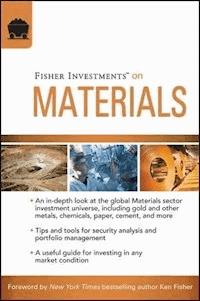
Many folks think Materials, then commodities, then immediately gold, particularly since gold was hot for much of this century’s first decade. Wrong! Thinking too small. Gold mining is part of Materials, but relatively not as important as you may think. This book covers the entire Materials universe—Metals & Mining (gold, of course, but also steel, aluminum, and other metals), Chemicals, Construction Materials, even Paper & Forest Products. The book provides a broad overview of the global sector’s industries and sub-industries, as well as sector history. It also discusses issues unique to Materials stocks: How important are emerging markets? What about geopolitics? Should you invest directly in commodities like gold?
But it also provides a framework for understanding the sector’s and its industries’ drivers so anyone—novices, hobbyists, even new professionals—can begin forming their own forward-looking sector analysis. And it provides an investing methodology—part of the same one used at my firm for making investing decisions—that can be used no matter the economic or market conditions.
What you won’t find here are hot stock tips. You won’t get a formula or a list of instructions on what to buy when. Such things don’t exist, and books purporting magic formulae are fiction. If you can just believe that, then the price of this book is worth it. Investing success only comes when you can know something others can’t, and this book is intended to help you do that. And though this book focuses on Materials, the concepts and methodology presented are applicable to other sectors and the broader market, to help you toward greater investing success your entire investing career. Enjoy the book, and enjoy the journey.
Ken Fisher CEO of Fisher Investments Author of the New York Times best seller, The Only Three Questions That Count
Preface
The Fisher Investments On series is designed to provide individual investors, students, and aspiring investment professionals the tools necessary to understand and analyze investment opportunities, primarily for investing in global stocks.
Within the framework of a “top-down” investment method (more on that in Chapter 7), each guide is an easily accessible primer to economic sectors, regions, or other components of the global stock market. While this guide is specifically on Materials, the basic investment methodology is applicable for analyzing any global sector, regardless of the current macroeconomic environment.
Why a top-down method? Vast evidence shows high-level, or “macro,” investment decisions are ultimately more important portfolio performance drivers than individual stocks. In other words, before picking stocks, investors can benefit greatly by first deciding if stocks are the best investment relative to other assets (like bonds or cash), and then choosing categories of stocks most likely to perform best on a forward-looking basis.
For example, a Technology sector stock picker in 1998 and 1999 probably saw his picks soar as investors cheered the so -called “New Economy.” However, from 2000 to 2002, he probably lost his shirt. Was he just smarter in 1998 and 1999? Did his analysis turn bad somehow? Unlikely. What mattered most was stocks in general, and especially US technology stocks, did great in the late 1990s and poorly entering the new century. In other words, a top-down perspective on the broader economy was key to navigating markets—stock picking just wasn’t as important.
Fisher Investments on Materials will help guide you in making top-down investment decisions specifically for the Materials sector. It shows how to determine better times to invest in Materials, what Materials industries and sub-industries are likelier to do best, and how individual stocks can benefit in various environments. The global Materials sector is complex, covering many sub-industries and countries, each with unique characteristics. Using our framework, you should be better equipped to identify their differences, spot opportunities, and avoid major pitfalls.
This book takes a global approach to Materials investing. Most US investors typically invest the majority of their assets in domestic securities; they forget America is less than half of the world market by weight—over 50 percent of investment opportunities are outside our borders. This is especially true in Materials. Many of the world’s largest Materials firms are based in foreign nations, including several in emerging markets. Since the vast majority of the world’s natural resources are located outside of the US and operated by non-US firms, it’s vital to have a global perspective when investing in Materials today.
USING YOUR MATERIALS GUIDE
This guide is designed in three parts. Part I, “Getting Started in Materials,” discusses vital sector basics and Materials’ high-level drivers. Here we’ll discuss Materials’ main drivers—basic materials prices—and provide eight simple questions to help you understand and form an opinion on any basic material. We’ ll also discuss additional drivers affecting the sector that ultimately drive Materials stock prices.
Part II, “Next Steps: Materials Details,” walks through the next step of sector analysis. We’ll take you through the global Materials sector investment universe and its diverse components. With so much focus on higher metal prices in recent years, it’s easy to forget Materials isn’t just about copper, gold, steel, and the other metals—though they are certainly important. There are currently 15 sub-industries within the global Materials sector. We take you through each in detail—including how they operate within the sector and what specifically drives each sub-industry—so you can analyze the current operating environment to choose which sub-industry will most likely outperform or underperform looking forward.
Part II also details where to find and how to interpret publicly available industry data to assist in your decision-making process. It’s possible to get the necessary data for making educated bets on basic material prices, sub-industries, and individual stocks using just a handful of websites and publications. You’ll learn how to critically look at a sector: what to look for, what resources you can use, what the challenges are.
Part III, “Thinking Like a Portfolio Manager, ” delves into a top-down investment methodology and individual security analysis. You’ ll learn to ask important questions like: What are the most important elements to consider when analyzing mining or chemical firms? What are the greatest risks and red flags? This book gives you a five-step process to help differentiate firms so you can identify ones with a greater probability of outperforming. We’ ll also discuss a few investment strategies to help determine when and how to overweight specific sub-industries within the sector.
Note: We’ve specifically kept the strategies presented here high level so you can return to the book for guidance no matter the market conditions. But we also can’t possibly address every market scenario and how markets may change over time. And, many additional considerations should be taken into account when crafting a portfolio strategy, including your own investing goals, your time horizon, and other factors unique to you. Therefore, you shouldn’t rely solely on the strategies and pointers addressed here, as they won’t always apply. Rather, this book is intended to provide general guidance and help you begin thinking critically not only the about Materials sector, but investing in general.
Further, Fisher Investments on Materials won’t give you a “silver bullet” for picking the right Materials stocks. The fact is the “right” Materials stocks will be different in different times and situations. Instead, this guide provides a framework for understanding the sector and its industries so that you can be dynamic and find information the market hasn’t yet priced in. There won’t be any stock recommendations, target prices, or even a suggestion whether now is a good time to be invested in the Materials sector. The goal is to provide you with tools to make these decisions for yourself, now and in the future. Ultimately, our aim is to give you the framework for repeated, successful investing. Enjoy.
Acknowledgments
A number of colleagues and friends deserve tremendous praise and thanks for helping make this book a reality. We would like to extend our tremendous thanks to Ken Fisher for providing the opportunity to write this book. Jeff Silk deserves our thanks for constantly challenging us to improve and presenting new and insightful questions as fast as we can answer them. Our colleagues at Fisher Investments also deserve tremendous thanks for continually sharing their wealth of knowledge, insights, and analysis. Without these people the very concept of this book would never have been possible.
We’d also like to thank Joseph Hall for turning every graph and table in this book from an idea into a reality. We owe a huge debt of gratitude to Michael Hanson and Lara Hoffmans, without whose guidance, patience, and editing contributions this book would not have been completed. We’d like to thank Dina Ezzat for her hard work, and thoroughness in editing and assistance with citations and sources. Evelyn Chea also deserves thanks for her eye for detail and editing contribution. Without Leila Amiri we would have been utterly lost in our attempts to implement graphics and images. Marc Haberman, Molly Lienesch, and Fabrizio Ornani were also instrumental in the creation of Fisher Investments Press, which created the infrastructure behind this book. Of course this book would also not be possible without our data vendors, so we owe a big thank you to Thomson Datastream, Thomson Reuters, Global Financial Data, and Standard & Poor’s. We’d also like to thank our team at Wiley for their support and guidance throughout this project, especially David Pugh and Kelly O’Connor.
Brad Pyles would also like to specifically thank Theodore Gilliland for assisting with his full-time research responsibilities while he was working on this book. Most importantly, however, he would like to thank his wife Tina for her never-ending patience, tolerance, love, and support, as this book could not have been completed without it.
I
GETTING STARTED IN MATERIALS
1
MATERIALS BASICS
A house, office building, car, paved road, manufacturing plant, power plant, TV, and computer all have one thing in common: None would be possible without the use of basic materials. Unless you’re living under a rock in the middle of the Amazon, you probably depend upon a variety of basic materials everyday. Modern society would not exist without them.
This book’s goal is to help you gain a basic understanding of the Materials sector, its components, drivers, challenges, and history, as well as be a general guide to Materials investing success. Wherever possible, we’ll also help you think critically about the sector to generate your own views, rather than just dictating a bunch of rules. Successfully investing in Materials companies does not require a PhD in chemistry or geology. What is important is a firm grasp of the laws of supply and demand, and understanding what drives the earnings and stock prices of Materials companies.
Lesen Sie weiter in der vollständigen Ausgabe!
Lesen Sie weiter in der vollständigen Ausgabe!
Lesen Sie weiter in der vollständigen Ausgabe!
Lesen Sie weiter in der vollständigen Ausgabe!
Lesen Sie weiter in der vollständigen Ausgabe!
Lesen Sie weiter in der vollständigen Ausgabe!
Lesen Sie weiter in der vollständigen Ausgabe!
Lesen Sie weiter in der vollständigen Ausgabe!
Lesen Sie weiter in der vollständigen Ausgabe!
Lesen Sie weiter in der vollständigen Ausgabe!
Lesen Sie weiter in der vollständigen Ausgabe!
Lesen Sie weiter in der vollständigen Ausgabe!
Lesen Sie weiter in der vollständigen Ausgabe!
Lesen Sie weiter in der vollständigen Ausgabe!
Lesen Sie weiter in der vollständigen Ausgabe!
Lesen Sie weiter in der vollständigen Ausgabe!
Lesen Sie weiter in der vollständigen Ausgabe!