


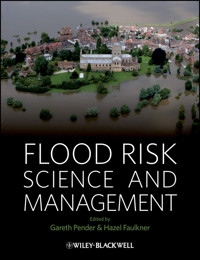
Flood Risk Science and Management E-Book
239,99 €
Mehr erfahren.
- Herausgeber: John Wiley & Sons
- Kategorie: Wissenschaft und neue Technologien
- Sprache: Englisch
Approaches to avoid loss of life and limit disruption and damage from flooding have changed significantly in recent years. Worldwide, there has been a move from a strategy of flood defence to one of flood risk management. Flood risk management includes flood prevention using hard defences, where appropriate, but also requires that society learns to live with floods and that stakeholders living in flood prone areas develop coping strategies to increase their resilience to flood impacts when these occur. This change in approach represents a paradigm shift which stems from the realisation that continuing to strengthen and extend conventional flood defences is unsustainable economically, environmentally, and in terms of social equity. Flood risk management recognises that a sustainable approach must rest on integrated measures that reduce not only the probability of flooding, but also the consequences. This is essential as increases in the probability of inundation are inevitable in many areas of the world due to climate change, while socio-economic development will lead to spiralling increases in the consequences of flooding unless land use in floodplains is carefully planned. Flood Risk Science and Management provides an extensive and comprehensive synthesis of current research in flood management; providing a multi-disciplinary reference text covering a wide range of flood management topics. Its targeted readership is the international research community (from research students through to senior staff) and flood management professionals, such as engineers, planners, government officials and those with flood management responsibility in the public sector. By using the concept of case study chapters, international coverage is given to the topic, ensuring a world-wide relevance.
Sie lesen das E-Book in den Legimi-Apps auf:
Seitenzahl: 1265
Veröffentlichungsjahr: 2010
Ähnliche




















Contents
Cover
Title Page
Copyright
Preface
Acknowledgements
Contributors
Foreword
Acronyms/Glossary of terms
Part 1: Introduction
Chapter 1: Setting the Scene for Flood Risk Management
The Changing Context of Modern Flood Risk Management
Characteristics of Modern Flood Risk Management
Flood Risk Management Decisions
Responding to Change
Policy and Human Dimensions of Flood Risk Management
A Blueprint for Modern Flood Risk Management
References
Part 2: Land Use and Flooding
Chapter 2: Strategic Overview of Land Use Management in the Context of Catchment Flood Risk Management Planning
Strategic Approach to Flood Risk Management Under Changing and Uncertain Conditions
Historical Context: Runoff Generation and Routing in Changing Landscapes and the Evidence for Impacts
Strategic Research Framework
Multiscale Experimentation in Support of Modelling and Prediction
Modelling, Predicting Impacts and Vulnerability Mapping
Discussion and Conclusions
References
Chapter 3: Multiscale Impacts of Land Management on Flooding
Introduction
The Pontbren Multiscale Experiment
Multiscale Modelling
Model Regionalization
Summary and Conclusions
Acknowledgements
References
Chapter 4: Managed Realignment: A Coastal Flood Management Strategy
Introduction
Setting Scheme Objectives
Selecting a Site for Realignment
Designing the Scheme
Obtaining Planning Approval and Consents
Undertaking the Construction Work
Monitoring and Evaluating Scheme Performance
Conclusions
Online Resources
References
Chapter 5: Accounting for Sediment in Flood Risk Management
Abstract
Background
Stream Power Screening Tool
River Energy Audit Scheme (REAS)
Sediment Impact Accounting Method embedded in Hydraulic Engineering Centre River Analysis System (HEC-RAS/SIAM)
Hydraulic Engineering Centre, River Analysis System (HEC-RAS) Version 4.0
iSIS Sediment and Issues in One-Dimensional Sediment Modelling
Cellular Automaton Evolutionary Slope and River Model (CAESAR)
Closure
Acknowledgements
References
Chapter 6: A Measured Step Towards Performance-Based Visual Inspection of Flood Defence Assets
Background
Aims and Objectives
Existing Method of Visual Inspection for Asset Condition
A Performance-Based Methodology for Visual Inspection
The Condition Indexing Process
Case Study
Site-Based Trials
Summary
References
Part 3: Flood Forecasting and Warning
Chapter 7: Advances in the Remote Sensing of Precipitation Using Weather Radar
Introduction
Multi-Parameter Radar and Dual-Polarization Measurements
Estimation of Precipitation Using Weather Radar
Algorithms to Estimate Rain from Radar Measurements
Problems Associated with the Estimation of Precipitation
Conclusions
Acknowledgement
References
Chapter 8: Artificial Intelligence Techniques for Real-Time Flood Forecasting
Abstract
Introduction
Integrating Fuzzy and Probabilistic Uncertainty
Learning Algorithms
Classification of Weather Radar Images
Time Series Modelling
Conclusions
References
Chapter 9: Real-Time Updating in Flood Forecasting and Warning
Introduction
Catchment Models
Recursive State and Parameter Updating
The Model and Its Parametric Identifiability
Data Assimilation and Adaptive Forecasting: An Illustrative Tutorial Example
Conclusions
Acknowledgements
References
Chapter 10: Coupling Meteorological and Hydrological Models for Real-Time Flood Forecasting
Part 4: Flood Modelling and Mitigation
Chapter 11: Data Utilization in Flood Inundation Modelling
Introduction
Data Requirements for Flood Inundation Modelling
Use of Data for Model Parameterization
Use of Remotely Sensed Flood Extent and Water Stage Measurements for Model Calibration, Validation and Assimilation
Conclusion and Future Research
References
Chapter 12: Flood Inundation Modelling to Support Flood Risk Management
Introduction: The Role of Modelling in Flood Risk Management
Modelling Methods
Recent, Ongoing and Future Research Challenges
Conclusions
References
Chapter 13: Integrated Urban Flood Modelling
Introduction
Surface Flow Model
Integrated Surface/Subsurface Flow Model
Case Studies
References
Part 5: Systems Modelling and Uncertainty Handling
Chapter 14: Distributed Models and Uncertainty in Flood Risk Management
The Requirement for Distributed Models in Flood Risk Management
The Evolution of Distributed Models in Hydrology and Hydraulics
Simplified Distributed Models
Calibration Issues in Using Distributed Models
Data Assimilation Issues in Using Distributed Models
Prediction Uncertainty in Distributed Models
Towards ‘Models of Everywhere'
References
Chapter 15: Towards the Next Generation of Risk-Based Asset Management Tools
Introduction
Future Uptake: Barriers and Facilitators
Conclusions
Acknowledgements
References
Overview of Asset Management
Better Asset Management: Rising to the Challenge
Asset Management Tools and Techniques: Key Features
Common/Central Databases
Understanding the Performance of an Individual Asset
System Analysis and Attributing Risk to Individual Assets
Developing Adaptive and Optimum Intervention Strategies
Review, Decide and Act
Chapter 16: Handling Uncertainty in Coastal Modelling
Introduction
Modelling and Prediction Techniques
Case study: Tidal Flow Prediction
Case Study: Statistical Modelling of Beaches
Case Study: Uncertainties in Morphological Models
Case Study: Risk Assessment of Cliff Erosion
Concluding Remarks
Acknowledgements
References
Part 6: Policy and Planning
Chapter 17: The Practice of Power: Governance and Flood Risk Management
Introduction
Conclusions
References
Sustainable Development and Governance
What is Governance?
Who Has Power?
The Differentiation of Interests and Power
What Must Governance Do?
Governance and Technology
Governance in Practice
Doing ‘Better’
Chapter 18: Stakeholder Engagement in Flood Risk Management
Introduction
What is Successful Stakeholder Engagement?
Conclusions
References
What is Stakeholder Engagement?
Who is a Stakeholder?
Why does Justice Matter?
What is Justice?
Is Justice Possible?
Procedural Justice
Social Relationships
Stakeholder Engagement as a Process
Chapter 19: Flood Risk Communication
Introduction
Communications between Science and Flood Risk Professionals
Intra-Professional Flood Risk Communication
Communications between Flood Risk Professionals and the Public
Summary
References
Chapter 20: Socio-Psychological Dimensions of Flood Risk Management
Introduction
References
A Framework for Analysing the Socio-Psychological Dimensions of Flood Risk Management
Preparation and Planning Before Flooding
Response and Relief During Flooding: Damage Control
Recovery after Flood
Mitigation Before and After: Adaptation
Individual and Societal Factors
Conclusions: New Directions for Flood Risk Management?
Acknowledgement
Chapter 21: Assessment of Infection Risks due to Urban Flooding
Introduction
Source
Pathways or Routes of Exposure
Receptors
Quantitative Microbial Risk Assessment (QMRA)
Discussion
Mitigating Exposure to Infection
Conclusions
References
Part 7: Case Studies
Chapter 22: Modelling Concepts and Strategies to Support Integrated Flood Risk Management in Large, Lowland Basins: Río Salado Basin, Argentina
Introduction
The Río Salado Basin
Flooding Mechanisms and Risks in Large Lowland Basins
Approaches and Techniques: The Role of Mathematical Modelling
Modelling Groundwater and Surface Water Interaction
A guide to Modelling Flooding in large lowland basins
Conclusions
Acknowledgements
References
Chapter 23: Flood Modelling in the Thames Estuary
Introduction
Flooding and the Thames Estuary
Extreme Water Levels
Flood Mapping
Flood Forecasting
TE2100: Strategic Flood Risk Management
Conclusions
Acknowledgements
References
Chapter 24: A Strategic View of Land Management Planning in Bangladesh
Introduction
Profile of Land Resources
Land Management Practices: Reconstruction of History
Physical Basis of Land Management in Bangladesh
Land Use Planning According to Land Types
Flood Management Practices in Bangladesh: Impacts on Land Use
Impacts and Issues
Concluding Remarks
Glossary
References
Chapter 25: Goals, Institutions and Governance: the US Experience
Dealing with Floods: From Colonies to Katrina
Setting a Direction
Institutions
Translating Policies into Action
Learning from the US Experience
References
Color Plates
Index
This edition first published 2011 © 2011 by Blackwell Publishing Ltd
Blackwell Publishing was acquired by John Wiley & Sons in February 2007. Blackwell's publishing program has been merged with Wiley's global Scientific, Technical and Medical business to form Wiley-Blackwell.
Registered office: John Wiley & Sons Ltd, The Atrium, Southern Gate, Chichester, West Sussex, PO19 8SQ, UK
Editorial offices: 9600 Garsington Road, Oxford, OX4 2DQ, UK
The Atrium, Southern Gate, Chichester, West Sussex, PO19 8SQ, UK
For details of our global editorial offices, for customer services and for information about how to apply for permission to reuse the copyright material in this book please see our website at www.wiley.com/wiley-blackwell.
The right of the author to be identified as the author of this work has been asserted in accordance with the UK Copyright, Designs and Patents Act 1988.
All rights reserved. No part of this publication may be reproduced, stored in a retrieval system, or transmitted, in any form or by any means, electronic, mechanical, photocopying, recording or otherwise, except as permitted by the UK Copyright, Designs and Patents Act 1988, without the prior permission of the publisher.
Designations used by companies to distinguish their products are often claimed as trademarks. All brand names and product names used in this book are trade names, service marks, trademarks or registered trademarks of their respective owners.The publisher is not associated with any product or vendor mentioned in this book. This publication is designed to provide accurate and authoritative information in regard to the subject matter covered. It is sold on the understanding that the publisher is not engaged in rendering professional services. If professional advice or other expert assistance is required, the services of a competent professional should be sought.
Library of Congress Cataloging-in-Publication Data
Flood risk science and management / edited by Gareth Pender ... [et al.].
p. cm.
Includes bibliographical references and index.
ISBN 978-1-4051-8657-5 (hardback)
1. Flood control. 2. Flood damage prevention. 3. Risk assessment. I. Pender, G. (Garry)
TC530.F585 2010
627'.4–dc22
2010017500
A catalogue record for this book is available from the British Library.
This book is published in the following electronic formats: ePDF 9781444324853; Wiley Online Library 9781444324846
Preface
Approaches to avoid loss of life and limit disruption and damage from flooding have changed significantly in recent years. There has been a move from a strategy of flood defence to one of flood risk management. Flood risk management includes flood prevention using hard defences, where appropriate, but also requires that society learns to live with floods and that stakeholders living in flood prone areas develop coping strategies to increase their resilience to flood impacts when these occur. This change in approach represents a paradigm shift which stems from the realisation that continuing to strengthen and extend conventional flood defences is unsustainable economically, environmentally, and in terms of social equity. Flood risk management recognises that a sustainable approach must rest on integrated measures that reduce not only the probability of flooding, but also the consequences. This is essential as increases in the probability of inundation are inevitable in many areas of the world due to climate change, while socio-economic development will lead to spiralling increases in the consequences of flooding unless land use in floodplains is carefully planned.
Recognizing the need for research to support this shift, funders of flood risk management research in the UK created the Flood Risk Management Research Consortium (FRMRC), a multi-institutional, multi-disciplinary consortium tasked with increasing the understanding of flooding by generating new and original science, to support improved flood risk management. The portfolio of activities included:
the short-term delivery of tools and techniques to support accurate flood forecasting and warning, improvements to flood management infrastructure and reduction of flood risk to people, property and the environment;the establishment of a programme of high quality science to enhance understanding of flooding and improve society's ability to reduce flood risk through the development of sustainable flood management strategies.The core content for this volume has been provided by members of the FRMRC. In addition, we have broadened the range of expertise by drawing on the international research community in flood management. Our intention is to provide an extensive and comprehensive synthesis of current international research in flood management, thereby, providing a multi-disciplinary reference text covering a wide range of flood management topics.
The book authors are at the very highest position in academic institutions researching Flood Risk Science and Management in the UK and elsewhere. The contents are organised into seven parts. Part 1 of the text develops a scene-setting overview of contemporary scientific and socio-economic challenges, drawing largely on the situation in Europe and the UK in particular. In Part 2, land-use management is explored as a strategic approach to flood risk reduction. Flood frequency changes consequent upon land-use modifications under current climatic and socio-economic ‘futures’ are explored, the multi-scale impacts of land management on flooding are developed further in the case study context of FRMRC's Pont Bren study area, a subcatchment of the river Severn in mid-Wales, UK (Chapters 2 & 3). In Chapter 4, the coastal management strategies of managed retreat, managed realignment and restoration are reviewed as approaches to coastal flood risk. The issues associated with sediment management in flood models and in management schemes are explored in Chapter 5, and flood defence and asset appraisal reviewed in Chapter 6.
In Part 3, flood forecasting and the issuing of warnings are both considered from a technical perspective. Chapters 7 and 8 look at advances in remote sensing; in Chapter 7 in relation to precipitation estimation using radar, and in Chapter 8 in relation to real-time flood forecasting. The challenges of updating forecasts in real-time is explored in Chapter 9, and the problems associated with coupling rainfall and run-off models are considered in Chapter 10.
Flood modelling, and the modelling of flood mitigation effects is the focus of Part 4. Chapter 11 covers data utilisation for modelling purposes, and Chapters 12 and 13 develop the algorithm for 1D-2D modelling in a range of settings. The tools available for handling uncertainties in models are outlined in Part 5. The risk-based approach is further developed in the context of asset management in Chapter 15, and in coastal modelling in Chapter 16.
In Part 6, policy and planning are both addressed from a predominantly socio-economic perspective. Governance issues (Chapter 17), the involvement of stakeholders in practice and management (Chapter 18), and the design of effective ways to target flood risk communications (Chapter 19) are considered first. Some of the psycho-social dimensions of Flood Risk Management are explored in Chapter 20, and health impacts of flooding in Chapter 21. The remaining chapters in Part 7 trace key case studies from a range of international settings.
This text covering Flood Risk Science and Management therefore provides an extensive and comprehensive synthesis of current research in flood management; developing a multi-disciplinary reference text covering a wide range of flood management topics. Its targeted readership is the international research community (from research students through to senior staff), as well as flood management professionals, such as engineers, planners, government officials and those with flood management responsibility in the public sector. By using the concept of case study chapters, international coverage is given to the topic, ensuring a world-wide relevance.
Acknowledgements
The research reported in all chapters except Chapters 1, 10, 17, 18, 20, 24 and 25 was undertaken in part by the Flood Risk Management Research Consortium (FRMRC). The FRMRC is supported by grants GR/S76304/01 and EP/F020511/1 from the Engineering and Physical Sciences Research Council, in partnership with the DEFRA/EA Joint Research Programme on Flood and Coastal Defence, UKWIR, OPW (Ireland), the Scottish Government and the Rivers Agency (Northern Ireland). This financial support is gratefully acknowledged. The consortium is also grateful to the Environment Agency for providing LiDAR the data and the Ordnance Survey for providing Mastermap® data to support the consortium's modelling activities. The many reviewers of the chapters here are thanked for their time, and generous attention to detail.
Gareth Pender and Hazel Faulkner
September 2010
Contributors
Tony Andryszewski Policy Manager, Environment Agency, Aztec House, Bristol, UK
Rodolfo Aradas, PhD Halcrow Group Ltd, Buenos Aires, Argentina
Barney N. Austin, PhD PE Director of Hydrologic Services, INTERA, Inc., Austin, TX, USA
Geoffrey L. Austin, MSc, PhD, FRSNZ Professor of Geophysics, Physics Department, University of Auckland, New Zealand
CAROLINE BALLARD, mE Research Assistant, Department of Civil and Environmental Engineering, Imperial College London, UK
Paul D. Bates, PhD Professor of Hydrology, School of Geographical Sciences, University of Bristol, UK
Geoff Baxter PhD Research Scientist - Flooding and Communities, Research, Monitoring and Innovation Evidence Directorate, Environment Agency, Cardiff, Wales, UK
Keith Beven, PhD Professor of Hydrology, Lancaster Environment Centre, Lancaster University, Lancaster, LA1 4YQ, UK
David S. Biedenharn, PhD Principal Investigator, Biedenharn Group, LLC, Vicksburg, MS 39180, USA
John Blanksby, DMS, CEng MICE Research Fellow, Department of Civil and Structural Engineering, University of Sheffield, UK
Andrew Brookes, PhD, FCIWEM, MIEMA, C.WEM, CENV, CSCI, CGEOG Divisional Director, Jacobs Engineering UK Ltd, 1180 Eskdale Road, Winnersh, Wokingham, RG14 5TU, UK
Nataliya S Bulygina, PhD Research Associate, Department of Civil and Environmental Engineering, Imperial College London, UK
Ian D. Cluckie, MSc., PhD, FRENG, CENG, FICE, FCIWEM, FRSA, FRMETSOC Professor and Pro-Vice-Chancellor (Science and Engineering), Swansea University, Wales, UK
Tom J. Coulthard, PhD Professor of Physical Geography, University of Hull, Hull, HU6 7RX, UK
Mark Dixon, FIMS, MBE Independent, West Mersea, Essex
Slobodan DjordjeviĆ, PhD Associate Professor of Hydraulic Engineering, Centre for Water Systems, College of Engineering, Mathematics and Physical Sciences, University of Exeter, UK
John Ewen, PhD School of Civil Engineering and Geosciences, Newcastle University, Newcastle upon Tyne, UK
Hazel Faulkner, MSc, PhD Professor of Environmental Management, Flood Hazard Research Centre, Middlesex University, UK
Lorna Fewtrell, PhD, FRSPH Centre for Research into Environment and Health, Aberystwyth University, Wales, UK
Zoe Frogbrook, PhD Advisor: Soils and Forestry, Environment Agency Wales, UK. Formerly at Centre for Ecology and Hydrology, Environment Centre Wales, Bangor, Wales, UK
Gerald E. Galloway, PhD, PE Professor of Engineering, Glenn L. Martin Institute, University of Maryland, USA
Stanford Gibson, PhD Research Hydraulic Engineer, Hydrologic Engineering Center, Davis, CA 95616, USA
Nigel J.D. Graham, MSc, PhD, DIC, SCD, FICE, FICHEME, FCIWEM, CENG, CSCI, CENV Professor of Environmental Engineering, Department of Civil and Environmental Engineering, Imperial College, London, UK
Colin Green, MA Professor of Geography, Flood Hazard Research Centre, Middlesex University, UK
Jim W. Hall, PhD, CENG, FICE Professor of Earth Systems Engineering, School of Civil Engineering and Geosciences, Newcastle University, Newcastle upon Tyne, UK
J. Barrie Holden, CChem, MRSC Innovation Programme Manager, Anglian Water Services Ltd, Peterborough, UK
JosÉ Horrillo-Caraballo, PhD Research Fellow, School of Engineering, University of Plymouth, UK
Bethanna M Jackson, PhD Lecturer in Hydrology and Water Resources, School of Geography, Environment and Earth Sciences, Victo, ria University of Wellington, New Zealand. Formerly at Imperial College London, UK
David Kay, PhD Professor of Environment and Health, Centre for Catchment and Coastal Research and Centre for Research into Environment and Health, Hydrology and River Basin Dynamics Research Group, IGES, Aberystwyth University, Wales, UK
Malik Fida Abdullah Khan CEGIS, Dhaka, Bangladesh
Jonathan Lawry, PhD Professor of Artificial Intelligence, Department of Engineering Mathematics, University of Bristol, Queen's Building, University Walk, Bristol, UK
Charles D. Little Jr, PE Research Hydraulic Engineer, US Army Corps of Engineers, Engineer Research & Development Center, Vicksburg, MS 39180, USA
Gavin Long, PhD Research Associate, Department of Civil Engineering, University of Nottingham, UK
Luke Lovell, MSc Halcrow, Swindon, UK
Čedo MaksimoviĆ, PhD Professorial Research Fellow, Centre for Urban Water, Department of Civil and Environmental Engineering, Imperial College London, UK
Miles R. Marshall, PhD Teaching Fellow in Physical Geography, School of Geography, Environment and Earth Sciences, Victoria University of Wellington, New Zealand. Formerly at Imperial College London, UK
David C. Mason, PhD Reader, NERC Environmental Systems Science Centre, University of Reading, UK
Michael J. Mawdesley, PhD Associate Professor, Department of Civil Engineering, The University of Nottingham, UK
Simon McCarthy, PhD Researcher, Flood Hazard Research Centre, Middlesex University, UK
Daniel R. McCulloch formerly Department of Engineering Mathematics, University of Bristol, Queen's Building, University Walk, Bristol, UK
Neil McIntyre, PhD Reader, Department of Civil and Environmental Engineering, Imperial College London, UK
David M. Mooney, PhD, PE Program Engineer, San Joaquin River Restoration Project, Bureau of Reclamation, Sacramento, CA 95825, USA
Ainun Nishat, PhD IUCN-World Conservation Union, Dhaka, Bangladesh
Bushra Nishat Institute of Water Modelling, Bangladesh
Sylvain NÉelz, PhD Former Lecturer, School of the Built Environment, Heriot-Watt University, Edinburgh, Scotland, UK
Enda O'Connell, PhD Professor of Water Resources Engineering, School of Civil Engineering and Geosciences, Newcastle University, Newcastle upon Tyne, UK.
Greg O'Donnell, PhD Catchment Change Network, School of Civil Engineering and Geosciences, Newcastle University, Newcastle upon Tyne, UK
AdriÁn Pedrozo-Acuña, PhD Investigador, Instituto de Ingeniería, Universidad Nacional Autónoma de México, Mexico
Gareth Pender, PhD, CENG, FICE, FCIWEM, FRSE Professor of Environmental Engineering, School of the Built Environment, Heriot-Watt University, Edinburgh, Scotland, UK
Edmund Penning-Rowsell, MA, PhD Professor of Geography, Flood Hazard Research Centre, Middlesex University, UK
Nicholas J. Randon Artificial Intelligence Group, Department of Engineering Mathematics, University of Bristol, BS8 1TR, UK
Dominic E. Reeve, PhD, CMATH, FIMA, FICE Professor of Coastal Dynamics, School of Engineering, University of Plymouth, UK
Brian Reynolds, PhD Senior Water Quality Scientist, Centre for Ecology and Hydrology, Environment Centre Wales, Bangor, Wales, UK
Adrian J. Saul, PhD, FICE Yorkshire Water Chair of Water Engineering, Pennine Water Group, University of Sheffield, Department of Civil and Structural Engineering, Sheffield, UK
Paul Sayers, PhD Principal Partner, Sayers and Partners, Watlington, UK
Guy J-P. Schumann, PhD GWR Fellow, School of Geographical Sciences, University of Bristol, UK
Colin Scott, MSc ABP Marine Environmental Research (ABPmer), UK
Paul Shucksmith, MSc Graduate student, Atmospheric Physics Group, University of Auckland, New Zealand
Jonathan Simm Hydraulics Research Wallingford Ltd, Wallingford, UK
Keren Smith, PhD Centre for Research into Environment and Health, Aberystwyth University, Wales, UK
Philip J. Soar, PhD, CENV, CSCI, CWEM, MCIWEM Senior Lecturer in Physical Geography, University of Portsmouth, Portsmouth, PO1 3HE, UK
Luke Sutherland-Stacey, MSc Graduate student, Atmospheric Physics Group, University of Auckland, New Zealand
Sue Tapsell, MA Head of Flood Hazard Research Centre, Middlesex University, London, UK
Owen Tarrant Environment Agency, Bristol, UK
Colin R. Thorne, PhD Professor and Chair of Physical Geography, University of Nottingham, Nottingham, NG7 2RD, UK
Ian Townend, CEng, CMarSci, FICE, FIMarEst, MCIWEM HR Wallingford, Howbery Park, Wallingford; and University of Southampton, UK
Sylvia Tunstall, MA Senior Researcher, Flood Hazard Research Centre, Middlesex University, UK
Michael Wallis Hydraulics Research Wallingford Ltd, Wallingford, UK
Marco J. Van de Wiel, PhD University of Western Ontario, London, Ontario, N6A 5C2, Canada
Nicholas P. Wallerstein, PhD Post Doctoral Research Associate, School of the Built Environment, Heriot-Watt University, Edinburgh, EH14 4AS, UK
Chester C. Watson, PhD Principal Investigator, Biedenharn Group, LLC, 1917 Cottonwood Point Drive, Fort Collins, CO 80525, USA
Howard S. Wheater, MA, PhD, FRENG, FICE, CENG Professor of Hydrology, Department of Civil and Environmental Engineering, Imperial College, London, UK
Jon Wicks, PhD Halcrow, Swindon, UK
Duncan Wishart, MSc, PhD, MCIWEM, CWEM, CENV, CSCI Principal Geomorphologist, Jacobs Engineering UK Ltd, 1 City Walk, Leeds, LS11 9DX, UK
Nigel G. Wright, BSc, PhD, CENG, FHEA, FASCE, FICE Professor of Water and Environmental Engineering, University of Leeds, UK
Peter C. Young, MSc (Loughborough), MA, PhD (CANTAB), WHF, CENG Professor Emeritus, Lancaster Environment Centre, University of Lancaster, Lancaster, LA1 4YQ, UK; Adjunct Professor, Fenner School of Environment and Society, Australian National University, Canberra, Australia; Visiting Professor, School of Electrical Engineering & Telecommunications, University of New South Wales, Sydney, Australia
Foreword
Flooding is an important issue in the UK; over £200 billion worth of assets are at risk around British rivers and coasts, and those risks are likely to increase in the future due to climate change. To assist in managing these risks the joint Defra/EA Flood and Coastal Erosion Risk Management Research and Development Programme (FCERM) aims to ensure the development of high-quality R&D outputs that provide the evidence required for sustainable flood and coastal erosion risk management policy, process and delivery.
In 2004, the programme managers entered into an agreement with the Engineering and Physical Sciences Research Council (EPSRC), the Natural Environment Research Council (NERC), the Scottish Parliament and UK Water Industry Research (UKWIR), to fund the interdisciplinary Flood Risk Management and Research Consortium. The rationale behind this innovative joint funding arrangement was to combine the strengths of fundamental and near-market researchers and research philosophies in a truly multi-disciplinary programme. The research portfolio was designed to address medium-term issues in flood science and engineering, while being consistent with the objectives of the overall FCERM programme.
This volume is underpinned by the outcomes from the consortium's research programme and I am delighted to provide this foreword. The editors have been successful in collecting together key research papers from consortium members and their international collaborators, to produce a monograph of important scientific findings set within a multi-disciplinary context.
Flood Risk Science and Management therefore supports the goal of improved flood and coastal erosion risk management in both a UK and an international setting. This book makes a significant contribution to the Environment Agency's task of improving definitions of flood risk and meeting the challenges of defining and coping with the uncertainties that flooding brings for UK flood managers.
David Rooke MBE, BSc(Hons), CEng, FICE, FCIWEM
Acting Director of Flood and Coastal Risk Management
Environment Agency
Rio House
Waterside Drive
Aztec West
BRISTOL
BS32 4UD
Acronyms/Glossary of terms
AAD
Annual Average Damage
ADCP
Acoustic Doppler Current Profiler
ADI
Alternating Direction Implicit
AMit
Asset Management IT System
AOD
Above Ordnance Datum
AR model
Auto Regressive model
ARMA modelling
Auto Regressive Moving Average modelling
ASAR
Advanced Synthetic Aperture Radar
ASMITA
Aggregated Scale Morphological Interaction between a Tidal Basin and the Adjacent Coast
AUDACIOUS
Adaptable Urban Drainage – addressing Change in Intensity, Occurrence and Uncertainty in Stormwater
BaRE
Bayesian Recursive Estimator
BGS
British Geological Survey
BODC
British Oceanographic Data Centre
CAESAR
Cellular Automaton Evolutionary Slope and River Model
CCA
Canonical Correlation Analysis
CD
Chart Datum
CEH
Centre for Ecology and Hydrology
CES
Conveyance Estimation System
CFD
Computational Fluid Dynamics
CFX
Commercial computational fluid dynamics programme used to simulate fluid flow in a variety of applications.
CI
Condition Index
CIRIA
Construction Industry Research & Information Association
CIWEM
The Chartered Institution of Water & Environment Management
CSO
Chief Scientist Office
DBM
Data Based Mechanistic
DEFRA
Department of Environment, Food & Rural Affairs
DEM
Digital Elevation Model
DEM
Dynamic Emulation Model
DETR
Department of Environment, Transport & the Regions
DOS
Disk Operating System
DPSIR
Drivers, Pressures, States, Impacts, Responses
DSD
Drop Size Distribution
DSM
Digital Surface Model
DTM
Digital Terrain Model
DYNIA
DYNamic Indentifiability Analysis
EA
Environment Agency
EAD
Expected Annual Damage
ECMWF
European Centre for Medium range Weather Forecasting
EKF
Extended Kalman Filter
EnKF
Ensemble Kalman Filter
ENO
Essentially Non-Oscillatory
ENVISAT (satellite)
Environmental satellite
EO
Earth Observation
EOF
Empirical Orthogonal Function
ERS-2
European Remote Sensing Satellite
ESA
European Space Agency
FEPA
Food & Environmental Protection Act
FI
Failure Likelihood Index
FRF
Field Research Facility
FRMRC
Flood Risk Management Research Consortium
FRSM
Rapid Flood Spreading Method
FTT
French Tide Table
GAs
Genetic Algorithms
GCM
Generator-Coordinate-Method
GIS
Geographic Information System
GLUE
Generalised Likelihood Uncertainty Estimation
GNU
Computer operating system
GPS
Global Positioning System
GRW
Generalised Random Walk
GSM
Global System for Mobile (communications)
HEC-RAS
Hydraulic Engineering Centre – River Analysis System
HMA
Heterogeneous Missions Accessibility
HRU
Hydrological Response Unit
HYMOD model
A 5-parameter conceptual rainfall runoff model.
Hypsometry
The establishment of elevations or altitudes
ICESat (satellite)
Ice, Cloud and Land Elevation satellite
InHM
Integrated Hydrological Model
INS
Inertial Navigation System
InSAR
Interferometric Synthetic Aperture Radar
IR
Infrared
IV
Instrumental Variable
JFLOW
A multiscale two-dimensional (2D) dynamic flood model
KF
Kalman Filter
LAT
Lowest Astronomical Tide
LDT
Linguistic Decision Tree
LID
Low impact development
LiDAR
Light Detection & Ranging Data
LISFLOOD – FP
A 2-dimensional hydrodynamic model specifically designed to simulate floodplains inundation in a computationally efficient manner over complex topography
LISFLOOD (model)
a GIS-based distributed model for river basin scale water balance and flood simulation
LSEs
Limit State Equations
LSPs
Land Surface Parameterisations
LWC
Liquid Water Content
MCMC
Markov Chain Monte Carlo
MCS
Monte Carlo Simulation
MDSF2
Modelling Decision Support Framework
MIKE SHE
Dynamic, user-friendly modelling tool that can simulate the entire land phase of the hydrologic cycle
MISR
Multiangle Imaging Spectroradiometer
ML
Maximum likelihood
MLE
Multiple Linking Elements
MODIS
Moderate Resolution Imaging Spectroradiometer
MOPS
Moisture Observation Pre-processing System
MUSCL
Monotonic Up-Stream Centred Schemes for Conservation Laws
NaFRA
National Flood Risk Analysis
NCAR
National Centre for Atmospheric Research
NERC
Natural Environment Research Council
NFCDD
National Flood & Coastal Defence Database
NFFS
National Flood Forecasting System
NOAA
National Oceanic & Atmospheric Administration
NWP
Numerical Weather Prediction
OMS
Object Modelling System
Open FTA
Open Fault Tree Analysis
PAMS
Performance-based Asset Management System
PF
Particle Filter
PF
Performance Features
PV (damage)
Present Value
QPBRRM (model)
Quasi Physically-Based Rainfall Runoff model
QPF
Quantitative Precipitation Forecasting
RAFT
Risk Assessment Field-based Tool
RASP
Risk Assessment of Flood & Coastal Defence for Strategic Planning
RCM
Relative Confidence Measure
REAS
River Energy Audit Scheme
REW
Representative Elementary Watershed
RHI (scan)
Range Height Indicator
RHS
Royal Horticultural Society
RIV
Refined Instrumental Variable
RLS
Recursive Least Squares
RMS
Root Mean Square
RMSE
Root mean squared Error
RPE
Recursive Prediction Error
RW
Random Walk
SAC
Special Area of Conservation
SAR
Synthetic Aperture Radar
SDPR
State Dependent Parameter Regression
SEPA
Scottish Environment Protection Agency
SHE
Système Hydrologique Européen
SHETRAN
A three-dimensional, coupled surface/subsurface, physically-based, spatially-distributed, finite-difference model for coupled water flow, multifraction sediment transport and multiple, reactive solute transport in river basins
SIAM
Sediment Impact Assessment Model
SIPSON (model)
Simulation of Interaction between Pipe flow and Surface Overland flow in Networks
SLURP (model)
Semi-distributed Land Use-based Runoff Processes
SMHI
Sveriges Meteorolgiska och Hydrologiska Institut (Swedish)
SOBEK
1-dimensional and 2-dimensional instrument for flood forecasting, drainage systems, irrigation systems, sewer overflow etc
SRTM
Shuttle Radar Topography Mission
SSSI
Site of Special Scientific Interest
SUDS
Sustainable Drainage Systems
SWMP
Surface Water Management Plans
SWOT
Surface Water Ocean Topography
TF
Transfer Function
TIN
Triangular Irregular Network
TUFLOW software
a one-dimensional and two-dimensional flood and tide simulation software
TVD
Total Variation Diminishing
TVP
Time Variable Parameter
UIM
Urban Integrated Model
UKF
Unscented Kalman Filter
UKWIR
UK Water Industry Research
USACE
United States Army Corps of Engineers
VPR
Vertical Reflectivity of Precipitation
VPR
Vertically Pointing Radar
VRP
Vertical Reflectivity Profile
WaPUG
The Urban Drainage Group of the CIWEM
WRIP
Weather Radar Information Processor
WSP
Whole Systems Partnership
Part 1
Introduction
Chapter 1
Setting the Scene for Flood Risk Management
Jim W. Hall and Edmund C. Penning-Rowsell
The Changing Context of Modern Flood Risk Management
A major shift in approaches to the management of flooding is now underway in many countries worldwide. This shift has been stimulated by severe floods, for example on the Oder (Odra; 1997), Yangtze (1998), Elbe (Labe; 2002), Rhône (2003), in New Orleans (2005), on the Danube (2006) and in the UK (2000, 2007 and 2009). Also important has been a recognition of the relentless upward global trend in vulnerability to flooding and hence losses (Munich Re Group 2007), as well as threats from the potential impacts of climate change on flood frequency. In this context this chapter examines the main characteristics of the emerging approach to flood risk management, as a prelude to the more detailed exploration of methods and models that follows in this volume.
Whilst recent floods have been a stimulus for changing flood risk management policy and practice in the UK (Johnson 2005; Penning-Rowsell 2006), the notion of an integrated risk-based approach to flood management is in fact well established (National Academy of Engineering 2000; National Research Council 2000; Sayers et al. 2002; Hall et al. 2003c). Methods for probabilistic risk analysis have been used for some years in the narrower context of flood defence engineering (CUR/TAW 1990; Vrijling 1993; USACE 1996; Goldman 1997). Indeed the notion of risk-based optimization of the costs and benefits of flood defence was laid out in van Dantzig's (1956) seminal analysis.
Lesen Sie weiter in der vollständigen Ausgabe!
Lesen Sie weiter in der vollständigen Ausgabe!
Lesen Sie weiter in der vollständigen Ausgabe!
Lesen Sie weiter in der vollständigen Ausgabe!
Lesen Sie weiter in der vollständigen Ausgabe!
Lesen Sie weiter in der vollständigen Ausgabe!
Lesen Sie weiter in der vollständigen Ausgabe!
Lesen Sie weiter in der vollständigen Ausgabe!
Lesen Sie weiter in der vollständigen Ausgabe!
Lesen Sie weiter in der vollständigen Ausgabe!
Lesen Sie weiter in der vollständigen Ausgabe!
Lesen Sie weiter in der vollständigen Ausgabe!
Lesen Sie weiter in der vollständigen Ausgabe!
Lesen Sie weiter in der vollständigen Ausgabe!
Lesen Sie weiter in der vollständigen Ausgabe!
Lesen Sie weiter in der vollständigen Ausgabe!
Lesen Sie weiter in der vollständigen Ausgabe!
Lesen Sie weiter in der vollständigen Ausgabe!
Lesen Sie weiter in der vollständigen Ausgabe!
Lesen Sie weiter in der vollständigen Ausgabe!
Lesen Sie weiter in der vollständigen Ausgabe!
Lesen Sie weiter in der vollständigen Ausgabe!
Lesen Sie weiter in der vollständigen Ausgabe!
Lesen Sie weiter in der vollständigen Ausgabe!
Lesen Sie weiter in der vollständigen Ausgabe!
Lesen Sie weiter in der vollständigen Ausgabe!
Lesen Sie weiter in der vollständigen Ausgabe!
Lesen Sie weiter in der vollständigen Ausgabe!
Lesen Sie weiter in der vollständigen Ausgabe!
Lesen Sie weiter in der vollständigen Ausgabe!
Lesen Sie weiter in der vollständigen Ausgabe!
Lesen Sie weiter in der vollständigen Ausgabe!




