


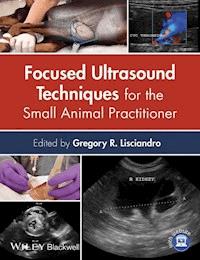
Focused Ultrasound Techniques for the Small Animal Practitioner E-Book
98,99 €
Mehr erfahren.
- Herausgeber: John Wiley & Sons
- Kategorie: Fachliteratur
- Sprache: Englisch
Focused Ultrasound Techniques for the Small Animal Practitioner offers a highly practical guide to incorporating abbreviated ultrasound exams into the veterinary practice. Focused point-of-care exams are an effective way to quickly detect conditions and complications not readily apparent through the physical exam, laboratory diagnostics, or radiographic findings. Encompassing all the information needed to begin performing these techniques, Focused Ultrasound Techniques for the Small Animal Practitioner is a useful tool for improving patient outcomes in clinical practice. Covering focused exams in all body systems, the book also outlines the principles of interventional radiology, medical documentation, and the basic fundamentals of using an ultrasound machine. A companion website offers 87 video clips of AFAST, TFAST, and Vet Blue examinations with normal, abnormal, and incidental findings at www.wiley.com/go/lisciandro/ultrasound. Focused Ultrasound Techniques for the Small Animal Practitioner is an essential purchase for veterinary practitioners and specialists wanting to implement these techniques in their veterinary practice.
Sie lesen das E-Book in den Legimi-Apps auf:
Seitenzahl: 800
Veröffentlichungsjahr: 2013
Ähnliche




















Contents
CONTRIBUTORS
ACKNOWLEDGEMENTS
INTRODUCTION TO FOCUSED ULTRASOUND FOR THE SMALL ANIMAL PRACTITIONER
Terminology
Reference
ABOUT THE COMPANION WEBSITE
CHAPTER ONE: FOCUSED—BASIC ULTRASOUND PRINCIPLES AND ARTIFACTS
Introduction
Basic Ultrasound Principles
Basic Artifacts
Basic Scanning
Deciding on an Ultrasound Machine
Image Optimization Using the Big 4 Knobs
Presets, Abdominal, Cardiac, Small Parts, etc.
Alternate Imaging Tools
On The Horizon
Recording Ultrasonographic Findings, Labeling Still Images
Ultrasound Machine and Probe Care
Setting up an Ultrasound Program
Pearls and Pitfalls, the Final Say
References
CHAPTER TWO: THE ABDOMINAL FAST3 (AFAST3) EXAM
Introduction
What AFAST3 and AFS Can Do
What AFAST3 and AFS Cannot Do
Indications for the AFAST3 and AFS Exam
Objectives of the AFAST3 and AFS Exam
How to Do an AFAST3 Exam
Naming and Order of the AFAST3 Views
AFAST3 Diaphragmatico-Hepatic View
The AFAST3 Spleno-Renal View
The AFAST3 Cysto-Colic View: The Little Fib
The AFAST3 Hepato-Renal View: The Big Lie
The AFAST3-applied Abdominal Fluid Scoring System
Use of AFAST3 and Abdominal Fluid Score in Non-Traumatic Bleeding Subsets of Patients
The Use of AFAST3 and Abdominal Fluid Score in Non-Bleeding Subsets of Patients
Use of AFAST3 and Abdominal Fluid Score in Penetrating Trauma
The Use of AFAST3 for Anaphylaxis in Dogs
The Use of AFAST3 and its DH View for Pericardial Effusions
Incidental Findings During AFAST3
Documenting AFAST3 Findings in Medical Records
Pearls and Pitfalls, the Final Say
References
CHAPTER THREE: FOCUSED OR COAST3—LIVER AND GALLBLADDER
Introduction
What the Focused Liver and Gallbladder Exam Can Do
What the Focused Liver and Gallbladder Exam Cannot Do
Indications for the Focused Liver and Gallbladder Exam
Objectives of the Focused Liver and Gallbladder Exam
Ultrasound Settings and Positioning
How to Do the Focused Liver and Gallbladder Exam
Ultrasonographic Findings in a Normal Focused Liver and Gallbladder Exam
Clinical Significance and Implications of Abnormal Focused Liver and Gallbladder Findings
The Routine Add-on of AFAST3 and its Abdominal Fluid Scoring System
Pearls and Pitfalls, the Final Say
References
CHAPTER FOUR: FOCUSED OR COAST3—SPLEEN
Introduction
What the Focused Spleen Exam Can Do
What the Focused Spleen Exam Cannot Do
Indications for the Focused Spleen Exam
Objectives of the Focused Spleen Exam
Patient Positioning and Probe Selection
How to Do the Focused Spleen Exam
Ultrasonographic Findings in a Normal Spleen
Clinical Significance and Implications of Abnormal Findings
The Routine Add-on of AFAST3 and its Abdominal Fluid Scoring System
Pearls and Pitfalls, the Final Say
References
CHAPTER FIVE: FOCUSED OR COAST3—KIDNEYS
Introduction
What the Focused Kidney Exam Can Do
What the Focused Kidney Exam Cannot Do
Indications for the Focused Kidney Exam
Objectives of the Focused Kidney Exam
Patient Positioning and Probe Selection
Patient Preparation
How to Do the Focused Kidney Exam
Ultrasonographic Findings in a Normal Kidney
Clinical Significance and Implications of Abnormal Kidney Findings
The Addition of the Focused Urinary Bladder Exam
The Routine Add-on of AFAST3 and its Abdominal Fluid Scoring System
Pearls and Pitfalls, the Final Say
References
CHAPTER SIX: FOCUSED OR COAST3—URINARY BLADDER
Introduction
What the Focused Urinary Bladder Exam Can Do
What the Focused Urinary Bladder Exam Cannot Do
Indications for the Focused Urinary Bladder Exam
Objectives of the Focused Urinary Bladder Exam
Patient Positioning and Probe Selection
How to Do the Focused Urinary Bladder Exam
Ultrasonographic Findings in a Normal Urinary Bladder
Artifacts Associated with the Focused Urinary Bladder Exam
Clinical Significance and Implications of Abnormal Urinary Bladder Findings
The Addition of the Focused Kidney Exam
The Routine Add-on of AFAST3 and its Abdominal Fluid Scoring System
Pearls and Pitfalls, the Final Say
References
CHAPTER SEVEN: FOCUSED OR COAST3—GASTROINTESTINAL AND PANCREAS
Introduction
What a Focused Gastrointestinal Tract and Pancreas Exam Can Do
What a Focused Gastrointestinal Tract and Pancreas Exam Cannot Do
Indications for the Focused Gastrointestinal Tract and Pancreas Exam
Objectives of the Focused Gastrointestinal Tract and Pancreas Exam
Patient Positioning and Probe Selection
Scanning Technique
Focused Gastrointestinal Tract and Pancreas Findings and their Significance
Pearls and Pitfalls, the Final Say
References
CHAPTER EIGHT: FOCUSED OR COAST3—REPRODUCTIVE
Introduction
What the Focused Reproductive Exam Can Do
What the Focused Reproductive Exam Cannot Do
Indications for Focused Reproductive Exam
Objectives of the Focused Reproductive Exam
Reproductive Conditions of the Female
Patient Positioning and Probe Selection for the Female
Imaging the Normal Uterus
Dystocia
Cystic Endometrial Hyperplasia—Pyometra Complex
Reproductive Conditions of the Male
Pearls and Pitfalls, the Final Say
References
CHAPTER NINE: THE THORACIC FAST3 (TFAST3) EXAM
Introduction
What TFAST3 Can Do
What TFAST3 Cannot Do
Indications for the TFAST3 Exam
Objectives of the TFAST3 Exam
Ultrasound Settings and Probe Preferences
How to Do a TFAST3 Exam
Performing the TFAST3 Exam
Performing the TFAST3 Chest Tube Site Part of the Exam
Findings at the TFAST3 Chest Tube Site View
Diagnosis of Pneumothorax
The Search for the “Lung Point” and the Degree of Pneumothorax Historically
The Wet Lung vs. Dry Lung Concept
The Presence of Subcutaneous Emphysema and TFAST3 Imaging
Performing the TFAST3 Pericardial Part of the Exam
Performing the TFAST3 Diaphragmatico-Hepatic (DH) Fifth View
Findings at the TFAST3 Pericardial Site View
Determining Pleural from Pericardial Effusion
Determining the Presence of Cardiac Tamponade
The Use of the Diaphragmatico-Hepatic View for Pericardial Effusions
Characterization of Pleural and Pericardial Effusions
The Use of the Diaphragmatico-Hepatic View for Types of Diaphragmatic Herniation
Determining Volume Status and Contractility by the Left Ventricular Short-Axis View
The Use of M-mode for Lung Ultrasound
TFAST3 Revised to Now Include the Vet BLUE Lung Scan
TFAST3 Summary of Views and their Clinical Utility
Documenting TFAST3 Findings in Medical Records
Pearls and Pitfalls, the Final Say
References
CHAPTER TEN: THE VET BLUE LUNG SCAN
Introduction
What Vet BLUE Can Do
What Vet BLUE Cannot Do
Indications for the Vet BLUE Exam
Objectives of the Vet BLUE Exam
Ultrasound Settings and Probe Preferences
How to do a Vet BLUE Exam
Performing the Vet BLUE
Lung Ultrasound Findings: Dry Lung, Wet Lung, Shred Sign, Tissue Sign, and Nodule(s) Sign
Pneumothorax, A-lines Without a Glide Sign
Recording Vet BLUE Findings
Case-Based Vet BLUE Patterns and Their Clinical Relevance
Dry Lung vs. Wet Lung Concept and Basic Lung Ultrasound Signs and Differentials
The Clinical Relevance of Vet BLUE and Left-Sided Heart Failure and Volume Overload
The Use of M-mode and Power Doppler for Lung Ultrasound
The Future of Lung Ultrasound in Small Animals
Pearls and Pitfalls, the Final Say
References
CHAPTER ELEVEN: FOCUSED OR COAST3—ECHO (HEART)
Introduction
What Focused ECHO Can Do
What Focused ECHO Cannot Do
Indications for the Focused ECHO Exam
Objectives of the Focused ECHO Exam
Ultrasound Settings and Probe Preferences
How to do a Focused ECHO Exam
Performing the Focused ECHO Exam and the Three Main ECHO Windows
Focused ECHO Findings in Common Cardiac Diseases
Pearls, Pitfalls, the Final Say
References
CHAPTER TWELVE: FOCUSED OR COAST3—CENTRAL VENOUS AND ARTERIAL LINE PLACEMENT, BIG ARTERIES, AND VEINS
Introduction
What the Focused Central Venous and Arterial Line Placement, Big Arteries, and Veins Can Do
What the Focused Central Venous and Arterial Line Placement, Big Arteries, and Veins Cannot Do
Indications for Focused Central Venous and Arterial Line Placement, Big Arteries, and Veins
Objectives for Focused Central Venous and Arterial Line Placement, Big Arteries, and Veins
Placement of an US-Guided Central Venous Jugular Catheter (CVC)
How to Place an US-guided Central Venous Jugular Catheter
Placement of Ultrasound-Guided Femoral Arterial Catheters and Sampling
How to Place an Ultrasound-Guided Femoral Arterial Catheter or Obtain an US-Guided Femoral Artery Sample
General Comments Regarding Transverse vs. Longitudinal Orientation
Arterial Thromboembolism and Deep Venous Thrombosis
Pearls and Pitfalls, the Final Say
References
CHAPTER THIRTEEN: FOCUSED OR COAST3—PEDIATRICS
Introduction
What Focused Pediatrics Can Do
What Focused Pediatrics Cannot Do
Indications for Focused Pediatrics Exam
Objectives for Focused Pediatrics Exam
Equipment
Patient Preparation
Ultrasound of the Normal Pediatric Abdomen
Common Pediatric Abdominal Disorders
Metabolic Conditions of the Pediatric Patient
Genitourinary Disorders
Pearls and Pitfalls, the Final Say
References
CHAPTER FOURTEEN: FOCUSED OR COAST3—EYE
Introduction
What the Focused Eye Exam Can Do
What the Focused Eye Exam Cannot Do
Indications for the Focused Eye Exam
Objectives of the Focused Eye Exam
Ultrasound Settings
Patient Eye Preparation
How to Do the Focused Eye Exam
Ultrasonographic Findings in a Normal Eye
Clinical Significance and Implications of Abnormal Findings
Pearls and Pitfalls, the Final Say
References
CHAPTER FIFTEEN: FOCUSED OR COAST3—MUSCULOSKELETAL
Introduction
What the Focused Musculoskeletal Exam Can Do
What the Focused Musculoskeletal Exam Cannot Do
Indications for the Focused Musculoskeletal Exam
Objectives of the Focused Musculoskeletal Exam
Patient Positioning and Probe Selection
How to Do the Focused Musculoskeletal Exam
Ultrasonographic Normal Findings in a Focused Musculoskeletal Exam
Clinical Significance and Implications of Abnormal Findings
Pearls and Pitfalls, the Final Say:
References
CHAPTER SIXTEEN: FOCUSED OR COAST3—CARDIOPULMONARY RESUSCITATION (CPR), GLOBAL FAST (GFAST3), AND THE FAST-ABCDE EXAM
Introduction
What the Focused CPR (GFAST3) and the FAST-ABCDE Can Do
What the Focused CPR (GFAST3) and the FAST-ABCDE Cannot Do
Indications for Focused CPR (GFAST3) and the FAST-ABCDE Exam
Objectives of the Focused CPR (GFAST3) and the FAST-ABCDE Exam
Ultrasound Settings, Probe Preferences, and Patient Positioning
How to do the Focused CPR and the FAST-ABCDE Exam
Clinical Significance and Implications of Abnormal Focused CPR (GFAST3) and FAST-ABCDE Exam Findings
Pearls and Pitfalls, the Final Say
References
CHAPTER SEVENTEEN: INTERVENTIONAL ULTRASOUND-GUIDED PROCEDURES
Introduction
Pericardiocentesis
Thoracocentesis
Abdominocentesis
Modified Ultrasound-Guided Diagnostic Peritoneal Lavage (MUG-DPL)
Pearls and Pitfalls, the Final Say
References
APPENDIX I SETTING UP AN ULTRASOUND PROGRAM
Introduction
APPENDIX II GOAL-DIRECTED TEMPLATES FOR MEDICAL RECORDS
Abdominal Focused Assessment with Sonography for Trauma, Triage, and Tracking (AFAST3)
Chapter 3: Focused or Cageside (COAST3)–Liver and Gallbladder
Chapter 4: Focused or Cageside (COAST3)—Spleen
Chapter 5: Focused or Cageside (COAST3)—Kidney
Chapter 6: Focused or Cageside (COAST3)—Urinary Bladder
Chapter 7: Focused or Cageside (COAST3)–Gastrointestinal and Pancreas
Chapter 8: Focused or Cageside (COAST3)—Reproductive
Chapter 9: Thoracic FAST3 (TFAST3)
Chapter 10: The Vet Blue Lung Scan (VBLS or Vet Blue)
Chapter 11: Focused or Cageside (COAST3)—Echo (Heart)
Chapter 13: Focused or Cageside (COAST3)—Pediatrics
Chapter 14: Focused or Cageside (COAST3)—Eye
Chapter 16: Focused CPR—Global FAST3 (GFAST3) and FAST-ABCDE
APPENDIX III ABBREVIATIONS, TERMINOLOGY, AND GLOSSARY
Abbreviations
Terminology and Glossary
APPENDIX IV QUICK REFERENCES OF NORMAL VALUES AND RULES OF THUMB
Chapter 2: Abdominal FAST3 (AFAST3)
Chapter 3: Focused or Cageside (COAST3)—Liver and Gallbladder
Chapter 4: Focused or Cageside (COAST3)—Spleen
Chapter 5: Focused or Cageside (COAST3)—Kidney
Chapter 6: Focused or Cageside (COAST3)—Urinary Bladder
Chapter 7: Focused or Cageside (COAST3)— Gastrointestinal and Pancreas
Chapter 8: Focused or Cageside (COAST3)—Reproductive
Chapter 9: Thoracic FAST3 (TFAST3)
Chapter 10: Vet BLUE
Chapter 11: Focused or Cageside (COAST3)—ECHO (Heart)
Chapter 13: Focused or Cageside (COAST3)—Pediatrics
Chapter 16: Focused or COAST3—CPR and the FAST-ABCDE Exam
Reference
APPENDIX V ULTRASOUND RESOURCES AND COMPANIES
Online Resources for Ultrasound Training
Online Access to the General Practitioner Ultrasound Group
Veterinary Ultrasound Companies
Index
This edition first published 2014 © 2014 by John Wiley & Sons, Inc
Editorial Offices1606 Golden Aspen Drive, Suites 103 and 104, Ames, Iowa 50010, USAThe Atrium, Southern Gate, Chichester, West Sussex, PO19 8SQ, UK9600 Garsington Road, Oxford, OX4 2DQ, UK
For details of our global editorial offices, for customer services and for information about how to apply for permission to reuse the copyright material in this book please see our website at www.wiley.com/wiley-blackwell.
Authorization to photocopy items for internal or personal use, or the internal or personal use of specific clients, is granted by Blackwell Publishing, provided that the base fee is paid directly to the Copyright Clearance Center, 222 Rosewood Drive, Danvers, MA 01923. For those organizations that have been granted a photocopy license by CCC, a separate system of payments has been arranged. The fee codes for users of the Transactional Reporting Service are ISBN-13: 978-1-1183-6959-3/2014.
Designations used by companies to distinguish their products are often claimed as trademarks. All brand names and product names used in this book are trade names, service marks, trademarks or registered trademarks of their respective owners. The publisher is not associated with any product or vendor mentioned in this book.
The contents of this work are intended to further general scientific research, understanding, and discussion only and are not intended and should not be relied upon as recommending or promoting a specific method, diagnosis, or treatment by health science practitioners for any particular patient. The publisher and the author make no representations or warranties with respect to the accuracy or completeness of the contents of this work and specifically disclaim all warranties, including without limitation any implied warranties of fitness for a particular purpose. In view of ongoing research, equipment modifications, changes in governmental regulations, and the constant flow of information relating to the use of medicines, equipment, and devices, the reader is urged to review and evaluate the information provided in the package insert or instructions for each medicine, equipment, or device for, among other things, any changes in the instructions or indication of usage and for added warnings and precautions. Readers should consult with a specialist where appropriate. The fact that an organization or Website is referred to in this work as a citation and/or a potential source of further information does not mean that the author or the publisher endorses the information the organization or Website may provide or recommendations it may make. Further, readers should be aware that Internet Websites listed in this work may have changed or disappeared between when this work was written and when it is read. No warranty may be created or extended by any promotional statements for this work. Neither the publisher nor the author shall be liable for any damages arising herefrom.
Library of Congress Cataloging-in-Publication Data
Focused ultrasound techniques for the small animal practitioner / edited by Gregory R. Lisciandro. p. cm. Includes bibliographical references and index.
ISBN 978-1-118-36959-3 (cloth : alk. paper) – ISBN 978-1-118-40388-4 (epdf) – ISBN 978-1-118-40389-1 (epub) – ISBN 978-1-118-40390-7 (emobi) – ISBN 978-1-118-76077-2 1. Veterinary ultrasonography. I. Lisciandro, Gregory R., editor of compilation. [DNLM: 1. Ultrasonography–methods. 2. Ultrasonography–veterinary. 3. Animal Diseases–ultrasonography. 4. Pets. 5. Veterinary Medicine–methods. SF 772.58] SF772.58.F63 2013 636.089′607543–dc23
2013026487
A catalogue record for this book is available from the British Library.
Wiley also publishes its books in a variety of electronic formats. Some content that appears in print may not be available in electronic books.
Cover image: top left image and bottom left image © Alice MacGregor Harvey, Medical Illustrator, North Carolina State College of Veterinary Medicine.
Cover design by Matt Kuhns
DEDICATION
To my grandparents Sam and Bernice Long and John and Mary Lisciandro; my parents Richard and Judy and siblings Denise, Kim, Kelly, and John; and most especially my lovely wife Stephanie and our children Noah, Hannah, Sarah, and Joshua for their patience, encouragement, and inspiration; and lastly the good Lord for making the textbook and all its many variables miraculously fall in place to its completion.
CONTRIBUTORS
Andrea Armenise, DVMWINFOCUS Veterinary Care Section Coordinatorwww.winfocus.orgOspedale Veterinario Santa FaraBari, Italy
Tomas W. Baker, MSDepartment of Surgery and Radiological SciencesSchool of Veterinary MedicineUniversity of CaliforniaDavis, California
Søren Boysen, DVM, Dipl. ACVECCAssociate Professor, Faculty of Veterinary MedicineDepartment of Veterinary Clinical and Diagnostic SciencesUniversity of CalgaryCalgary, Canada
Scott Chamberlin, DVM Resident, Emergency and Critical CareCollege of Veterinary Medicine and Biomedical SciencesColorado State UniversityFort Collins, Colorado
Jane Cho, DVM, Dipl. ACVOVeterinary Eye Specialists, PLLCArdsley, New York
Autumn P. Davidson DVM, MS, Dipl. ACVIMDepartment of Medicine and EpidemiologySchool of Veterinary MedicineUniversity of CaliforniaDavis, California
Teresa DeFrancesco, DVM, Dipl. ACVECC, Dipl. ACVIM (Cardiology)Professor, College of Veterinary MedicineNorth Carolina State UniversityRaleigh, North Carolina
Robert M. Fulton, DVMResident, TheriogenologyBetty Baugh’s Animal ClinicRichmond, Virginia
Jennifer Gambino, DVMClinical InstructorDepartment of Diagnostic Imaging, Animal Health CenterMississippi State University College of Veterinary MedicineStarkville, Mississippi
Gregory R. Lisciandro, DVM, Dipl. ABVP, Dipl. ACVECCConsultant, Hill Country Veterinary SpecialistsChief of Emergency Medicine and Critical Care, Emergency Pet Center, Inc.San Antonio, [email protected]
Stephanie Lisciandro, DVM, Dipl. ACVIMConsultant, Hill Country Veterinary SpecialistsStaff Internist, Mission Veterinary SpecialistsSan Antonio, Texas
Sarah Young, DVMMobile UltrasonographerEcho Service for PetsOjai, California
ACKNOWLEDGEMENTS
Words cannot express my eternal gratitude to Drs. Mike Lagutchik, Kelly Mann, Geoffrey Fosgate, and Andra Voges for their efforts; doctors; technicians; Mr. Adrian Ford and Dr. Tom Hanna of the Emergency Pet Center, Inc., for enthusiastically helping complete novel clinical research in a private practice setting; and Robert Whitaker, who believed in the abbreviated ultrasound format and gave me a beginning in training veterinarians in these focused assessment with sonography for trauma (FAST) techniques.
The following individuals made significant contributions to the textbook: Nancy Place, MS, Association of Medical Illustrators, who provided much of the illustrative artwork in the Abdominal FAST, Thoracic FAST, and Vet BLUE chapters; Alice MacGregor Harvey, medical illustrator, North Carolina State College of Veterinary Medicine, who provided the illustrative artwork in Chapter 11; Dr. Maria Hey, who formatted and arranged all of the book’s images; Dr. Jennifer Gambino, who additionally helped with editing chapters 3 and 5; Dr. Sarah Young, who provided many of the excellent ultrasound images and reviewed portions of the manuscript; Guy Hammond of Veterinary Imaging, for ultrasound machine/equipment support and his leadership in creating the General Practice Ultrasound Group (GPUS) made up of Drs. John Mattoon, Marti Moon, Sarah Young, Ron Kelpe and myself; Dr. Warren “Sherm” Mathey who read nearly the entire manuscript; Dr. Søren Boysen, for his tireless support, encouragement, and constructive criticism from the very beginning of our FAST start in 2005; Erica Judisch, Susan Engelken, and the entire Wiley Blackwell team for their patience and support; and Dr. Stephanie Lisciandro for her additional time and efforts in the editing process.
Finally, thank you to each of the chapter authors, Andrea Armenise, Tomas Baker, Søren Boysen, Jane Cho, Scott Chamberlin, Autumn Davidson, Teresa DeFrancesco, Robert Fulton, Jennifer Gambino, and Stephanie Lisciandro, who not only believe in the potential for abbreviated ultrasound exams to make a significant positive impact on veterinary medicine, but who also generously gave their time and expertise in making this project possible. To them, I am forever grateful.
INTRODUCTION TO FOCUSED ULTRASOUND FOR THE SMALL ANIMAL PRACTITIONER
Gregory R. Lisciandro
The translational study from the human to the veterinary patient regarding the focused assessment with sonography for trauma (FAST) exam by Dr. Søren Boysen in 2004 has opened the veterinary imaging world’s eyes to legitimate non-radiologist use of abbreviated ultrasound exams. Such exams are of utmost importance because they are safe (no radiation) and non-invasive, allowing point-of-care evaluation of short-duration with limited patient restraint. These ultrasound interrogations also carry the potential to answer clinically important questions that remain enigmatic by using traditional means of physical examination, laboratory findings, and radiographic imaging. Moreover, by using abbreviated ultrasound exams, patients have the potential to survive because traditionally occult life-threatening disease was historically missed without using ultrasound. By using abbreviated ultrasound exams, disease may be detected on our terms rather than the disease’s in the midst of traditionally less sensitive means, and the delay of scheduling formal or complete ultrasound exams or other advanced imaging studies is avoided. In human medicine, the so-called turf wars between who should and should not be conducting ultrasound studies has been somewhat mitigated by the realistic impression that abbreviated exams not only detect disease in a more timely manner, but also keep patients alive by better directing care. As more patients survive, the need for formal or complete ultrasound studies or other advanced imaging techniques increases. In other words, the human and veterinary radiologist to the contrary may become even busier.
The readers of this text should review the following sections to optimize the didactic potential of our textbook. We welcome feedback (woodydvm91@yahoo.com; www.fastvet.com) from your experiences as general practitioners and emergency and critical care veterinarians on the front lines of veterinary medicine.
Terminology
For a grasp of some of the concepts described below and throughout the subsequent chapters, let’s define a few things.
The Abbreviated Ultrasound Exam
With the sudden eruption of bedside ultrasound exams by non-radiologists in human medicine, terminology has become convoluted, but generally the term “bedside” seems to be winning out. For example, a bedside gallbladder exam will be called just that, with its objectives being to answer simple clinical questions to help expediently guide the clinical course and to trigger the possible need for more formal (or complete) ultrasound examinations or other advanced imaging. On the other hand, the veterinary bedside lung ultrasound exam (called Vet BLUE) is similarly performed, however, it has been given an acronym. For clarity and to prevent an onslaught of terminology in veterinary medicine, we will use a limited number of terms.
Abbreviated ultrasound exams may be termed either “focused X” or “focused Y” exams, as suggested by the General Practitioner’s Ultrasound Group (GPUS Group, www.gpultrasound.org) (see Appendix V for Internet access to the document). Such exams also may be referred to analogously as in the human literature, replacing “bedside” with “cageside.” Thus, a “cageside organ assessments for trauma, triage, and tracking” may be turned into the acronym “COAST3” and similarly used as a “COAST3 X” or “COAST3 Y” exam with the “T3” standing for trauma, triage, and tracking (monitoring) subsets of veterinary patients. The “T3” has been previously proposed in the veterinary literature regarding the use abdominal FAST (AFAST) and thoracic FAST (TFAST) exams (Lisciandro 2011). Thus, the terms AFAST3 and TFAST3 seem best suited for use in many non-trauma subsets of veterinary patients for triage and tracking.
Importantly, the standardization of veterinary terminology gives absolute clarity among colleagues as to the exact exam format being performed. The accepted use of these veterinary terms has been previously proposed for preventing an onslaught of terms in veterinary medicine (avoiding what has occurred in human medicine) (Lisciandro 2011).
The terminology for radiologist-performed exams in human medicine has generally taken on the term “formal” abdominal ultrasound or “formal” echocardiography. The use of “diagnostic” is not adequate and should be discouraged in veterinary medicine because any abbreviated ultrasound exam format may be “diagnostic.” Rather than use the term “formal,” consistent with human terminology, we use the term “complete,” as suggested by the GPUS Group. Thus, the terminology for veterinarians is as follows for the abdominal cavity and thorax, respectively: “complete abdominal ultrasound” and “complete echocardiography.”
Recording Findings of the Focused, COAST3 and FAST3 Exams
The authors of this textbook acknowledge that each of these abbreviated ultrasound exams will evolve over time as to the diagnostic abilities in terms of their sensitivity, specificity, and accuracy. At this time, the best way to study results seems to be through template, goal-driven, formatted entries for medical records. In a bold attempt, by using both our experiences and those of the GPUS Group, such examples have been listed in the Appendices (Appendix II) and should be reviewed (and we encourage their use) by our readers.
Echogenicity: The Whites, Grays, and Blacks of Ultrasound
The jargon of ultrasound can be intimidating to the novice non-radiologist ultrasonographer. Clarity may be accomplished through acknowledging that ultrasound is the opposite of what tissues appear as on radiographic studies (our brain needs to reformat itself). For example, and very simplistically, air is white on ultrasound and black on radiographs. Bone is black (shadows) on ultrasound and white on radiographs. The ultrasound terms describing whites, grays, and blacks are referred to as hyperechoic, hypoechoic, and anechoic, with the terms “relative to X” and “relative to Y” used to further describe ultrasound imaging when detail is somewhere in between (Figure 1). For example, the spleen is hyperechoic (brighter ) when compared to the left kidney. A few definitions:
Figure 1.Illustration of degrees of echogenicity, ranging from anechoic (darkest [black]) to hyperechoic (lightest [white]).
Anechoic (pure black): Occurs when no ultrasound waves are reflected back to the receiver. Thus, normal urine, normal bile, transudates, and blood all are purely anechoic (black).
Hypoechoic (shades of gray): Occurs when variable degrees of the ultrasound waves are reflected back to the receiver. Thus, all soft tissues that are not fully aerated are described relative to other distinct tissues; for example, the liver is hypoechoic (darker than) relative to the spleen.
Hyperechoic (whites, bright whites): Occurs when all or nearly 100% of ultrasound waves are reflected back to the receiver. Thus, bone, stone (metals), and air are strong reflectors, resulting in hyperechoic interfaces with either shadowing, comet-tail artifacts, ultrasound lung rockets, or reverberation artifact projected distally.
Isoechoic (same echogenicity): Occurs when tissues are the same shades of gray. For example, if the liver is isoechoic to the spleen, then they are the same echogenicity (same shades of gray).
Directional Terms for Orientation
Longitudinal and sagittal: The term longitudinal refers to orientation parallel to the spine or long-axis of the patient’s body. The term sagittal refers to the longitudinal axis of the respective deeper structure being evaluated. For example, the superficial jugular vein is imaged in longitudinal, whereas the deeply located right kidney (angled and not parallel to the body’s long-axis) is imaged in sagittal planes (parallel to the right kidney’s long-axis). The terms are often used interchangeably (or arguably misused); however, by appreciating that both terms are in their own right long-axis views, directional communication between veterinarians seems to be clear by use of either term. The probe marker is directed toward the patient’s head.
Transverse: The term transverse refers to orientation 90 degrees to the long-axis of the structure being evaluated. The probe marker is turned to the left (or counterclockwise) to the patient’s right side (if in dorsal recumbency or right lateral recumbency).
With that said, let’s get on with Chapter 1. And remember, focused and FAST3 saves lives.
Reference
Lisciandro GR. 2011. Abdominal and thoracic focused assessment with sonography for trauma, triage, and monitoring in small animals. J Vet Emerg Crit Care 21(2):104–122.
ABOUT THE COMPANION WEBSITE
This book is accompanied by a companion website:
www.wiley.com/go/lisciandro/ultrasound
The website includes a video bank containing more than 80 videos.
CHAPTER ONE
FOCUSED—BASIC ULTRASOUND PRINCIPLES AND ARTIFACTS
Robert M. Fulton
Introduction
Turn on the machine. Apply coupling gel. Start scanning. In the realm of the busy veterinary general practice, emergency clinic, or intensive care unit, that statement really sums up the basic use of ultrasound. Just as natural as it is for us to take the stethoscope from around our neck and place it on a patient’s thorax, so should be picking up the ultrasound probe and placing it on the patient. No wonder that ultrasonography has been appropriately dubbed both “an extension of the physical exam” and the “modern stethoscope” (Rozycki 2001; Filly 1988). Really, one doesn’t need a whole lot of instruction to start scanning; however, as for a lot of things in life, the devil is in the details. Proper imaging technique and understanding its limitations are the keys to accurate image interpretation of diagnostic ultrasound.
The focus of this chapter is a fairly brief review of the basic physics and principles of ultrasound including the more common problematic artifacts. For interested readers, there are more comprehensive textbooks dedicated to the physics and interpretation of ultrasound imaging (Nyland 2002; Penninck 2002).
What Focused Basic Ultrasound Principles and Artifacts Can Do
Provide a basic review of ultrasound physics, image formation, common artifacts, and ultrasound systematics
Provide a basic understanding of how artifacts are formed to allow better interpretation of the ultrasound image
What Focused Basic Ultrasound Principles and Artifacts Cannot Do
Cannot provide an in-depth discussion of ultrasound physics, principles, and artifacts
Indications
Provide a basic understanding of ultrasound physics, principles, and artifacts for the non-radiologist veterinarian
Objectives
Provide an understanding of the basic fundamentals of ultrasound physics and how they relate to image formation
Provide an understanding of how basic ultrasound artifacts are formed to avoid misinterpretation
Provide a review of basic ultrasound systematics including image orientation and storage and machine and probe care
Basic Ultrasound Principles
The ultrasound (US) machine consists of two main parts, the probe and the processor. The probe is the “brawn” and the processor the “brains” of the operation. The probe has two main functions: first, to generate a sound wave (acts as a transmitter); second, to receive a reflected sound wave (acts as a receiver). The processor, located within the mainframe, takes these incoming signals and turns them into a useful image.
The transmitter and receiver functions of the transducer do not occur simultaneously, but rather sequentially. When placed under mechanical stress the ceramic crystals in the transducer generate a voltage. This process, known as the piezoelectric effect, occurs during the receiving phase, which is when returning sound waves strike the transducer. When an external voltage is applied to the crystals they exhibit the reverse phenomenon and undergo a small mechanical deformation. The subsequent release of this energy generates the ultrasound wave. This is known as the reverse piezoelectric effect. World War I saw the first practical use of the piezoelectric effect in the development of sonar using a separate sound generator and detectors (Coltera 2010).
Lesen Sie weiter in der vollständigen Ausgabe!
Lesen Sie weiter in der vollständigen Ausgabe!
Lesen Sie weiter in der vollständigen Ausgabe!
Lesen Sie weiter in der vollständigen Ausgabe!
Lesen Sie weiter in der vollständigen Ausgabe!
Lesen Sie weiter in der vollständigen Ausgabe!
Lesen Sie weiter in der vollständigen Ausgabe!
Lesen Sie weiter in der vollständigen Ausgabe!
Lesen Sie weiter in der vollständigen Ausgabe!
Lesen Sie weiter in der vollständigen Ausgabe!
Lesen Sie weiter in der vollständigen Ausgabe!
Lesen Sie weiter in der vollständigen Ausgabe!
Lesen Sie weiter in der vollständigen Ausgabe!
Lesen Sie weiter in der vollständigen Ausgabe!
Lesen Sie weiter in der vollständigen Ausgabe!
Lesen Sie weiter in der vollständigen Ausgabe!
Lesen Sie weiter in der vollständigen Ausgabe!
Lesen Sie weiter in der vollständigen Ausgabe!
Lesen Sie weiter in der vollständigen Ausgabe!
Lesen Sie weiter in der vollständigen Ausgabe!
Lesen Sie weiter in der vollständigen Ausgabe!
Lesen Sie weiter in der vollständigen Ausgabe!




