


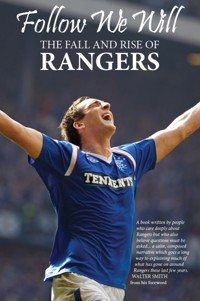
Follow We Will E-Book
Erhalten Sie Zugang zu diesem und mehr als 300000 Büchern ab EUR 5,99 monatlich.
- Herausgeber: Luath Press
- Kategorie: Lebensstil
- Sprache: Englisch
The financial collapse of Rangers has regularly been described as the biggest story in the history of Scottish sport. Takeover battles, police investigations and court cases dominated the front and back pages of Scottish newspapers and provoked much debate on social media: football was often a secondary concern. Rangers fans were forced to learn about the business side of the game in circumstances that could never have been imagined during earlier eras of regular success. It's safe to say the last 18 months have been difficult ones for the followers of the Light Blues. Follow We Will: The Fall and Rise of Rangers describes and analyses, from a Rangers perspective, all the relevant issues and events from an unprecedented period in the history of Scottish football. It praises the precious few heroes and identifies the many obstacles the club has had to face. This is the story of how the world's most successful football club found itself in the Third Division and the loyalty that started to propel it back to the top. All royalties arising from sales of this book will be donated to the Rangers Charity Foundation
Sie lesen das E-Book in den Legimi-Apps auf:
Seitenzahl: 381
Veröffentlichungsjahr: 2013
Das E-Book (TTS) können Sie hören im Abo „Legimi Premium” in Legimi-Apps auf:
Ähnliche




















COLIN ARMSTRONGis a lifelong Rangers supporter and a former columnist for both theRangers Newsand the Rangers match-day programme. He contributed to the bookTen Days That Shook Rangers(Fort, 2005) and has written extensively on the subject of Rangers for other publications includingWhen Saturday ComesandThe Rangers Standard. Born in Glasgow, he now lives in Falkirk with his wife, Shona, and their children, Connor and Sophie.
IAIN DUFF is an award-winning journalist with almost twenty years of experience writing for publications in both England and Scotland. He joined Glasgow’sEvening Timesas a news reporter in 1995 and two years later became the paper’s chief reporter at the age of 25. The same year he won the prestigious UK Press Gazette Scoop of the Year award and was nominated as Scotland’s young journalist of the year. He later joined the Press Association where he was Scottish editor for six years. His books includeFollow on: Fifty Years of Rangers in Europe(Fort, 2006) andTemple of Dreams: The Changing Face of Ibrox(DB Publishing, 2008).
DAVID EDGARwas the spokesman for the Rangers Supporters Trust from 2005 to 2010, during which time he campaigned on a number of issues regarding the stewardship of the club under Sir David Murray. He played an active role in speaking out against what many Rangers fans saw as unflattering coverage in the mainstream media. His book on Rangers over the last 30 years21st Century Blue: Being a Bear in the Modern World(DB Publishing, 2010) is a funny and often controversial look at the club throughout an unforgettable era. He is currently the host ofHeart and Hand – the Rangers Podcast, a light-hearted weekly look at Scottish Football.
W STEWART FRANKLINis co-founder ofThe Rangers Standard, a former Rangers Supporters Trust board member and co-owner of Gersnet.co.uk. He has been taking an active part in the Rangers supporting community for several years. In addition to administrating his own site, Stewart has written articles forSTVSport andThe Heraldas well as appearing onTVand radio. A Rangers season ticket holder of 15 years, he can be found bouncing away beside the rest of the Blue Order ‘every other Saturday’.
JOHN DC GOWis a freelance writer who is a co-founder ofThe Rangers Standardand a regular contributor toESPNon Scottish football and RangersFC. He has contributed to football magazines such as theAway Endand non-football current affairs magazineScottish Review. He is particularly interested in studying sectarianism, both in ending the backward form of hatred and in how it relates to freedom of speech, censorship and Rangers.
CHRIS GRAHAMis a co-founder ofThe Rangers Standardand writer forSeventy2magazine andThe Copland Road Organization(CRO). He has made numerous appearances onScotland Tonightand has also appeared onNewsnight Scotland,Reporting Scotland,STVNewsandThe Rising(a RangersTVdocumentary) to discuss a variety of Rangers-related issues. He has appeared onBBCRadio, written about Rangers for theScotland on Sundayand made guest appearances on Rangers podcasts. A season ticket holder at Ibrox, he was part of the Rangers Supporters Trust campaign to encourage fan participation in the Rangers share issue.
ROSS EJ HENDRY is a lifelong supporter of Rangers FC. He lives in Toronto, Canada and is a member of the Toronto Central Rangers Supporters Club. He is a standing member of theWe Are The PeoplePodcast which was established in 2008 and was the first podcast fully dedicated to the trials and triumphs of Rangers FC. He is currently a director with a global company specialising in brand and commercial development, route to market optimisation and installation of brand/market combinations.
DAVID KINNON is a Scottish Chartered Accountant, licensed insolvency practitioner and Johnstone Smith Professor of Accountancy within the University of Glasgow Business School. His professional experience covers board-level positions within listed and private-equity backed companies. For over 20 years he has advised on business reorganisation and financial restructuring matters, working internationally, based in London. Of the many great Rangers players seen over years of supporting the Club, including as a debenture holder from the Club Deck, Richard Gough and Brian Laudrup are his all-time favourites.
ALASDAIR McKILLOP is a co-founder ofThe Rangers Standardand writer forSeventy2magazine. He is a regular contributor to the online current affairs magazineScottish Reviewwhere he writes about sport and politics. He is a contributor toBigotry, Football and Scotland(Edinburgh University Press, 2013).
GAIL RICHARDSON is a popular blogger and prominent member of the online Rangers community. She is a member of the Rangers Supporters Trust which promotes fan ownership. A lifelong Rangers fan, she attended her first game at Ibrox when she was six years old.
CALVIN SPENCE was previously the Deputy Northern Ireland Secretary of the British Medical Association. His expertise lies in the field of Employment Law, Industrial Relations and Human Resources, and although retired, he continues to provide management consultancy services to General Practitioners and Hospital Trusts within the Northern Ireland Health & Social Care system. A Rangers fan for over 38 years, he continues to travel from Belfast to watch the team. He is a regular contributor toRangers MediaandThe Rangers Standard.
RICHARD WILSON was born in Glasgow and spent almost 10 years atThe Sunday Times Scotland, as deputy sports editor, then staff sports writer. In 2002, he won the Jim Rodger Memorial Award for best young sports writer. In 2003, at the Scottish Press Awards, he was named Sports Writer of the Year and he has regularly been nominated in the Sports Feature Writer of the Year category. He now writes extensively about football, and occasionally boxing and golf, forThe HeraldandSunday Heraldand is the author ofInside the Divide: One City, Two Teams… The Old Firm(Canongate, 2012).
Follow We Will
The Fall and Rise of Rangers
Edited by
W STEWART FRANKLIN, JOHN DC GOW
CHRIS GRAHAM and ALASDAIR McKILLOP
LuathPress Limited
EDINBURGH
www.luath.co.uk
First published 2013
eBook published 2013
ISBN (print): 978-1-908373-68-7
ISBN (eBook): 978-1-909912-00-7
The authors’ right to be identified as author of this book under the Copyright, Designs and Patents Act 1988 has been asserted.
© The contributors
Luath Press is an independently owned and managed publishing company and is not aligned to any political party or grouping. The views expressed in this book are those of the contributors named.
To Beverley, Amira and Ziara – courage, inspiration and love provided for on a daily basis. Also for my parents, William and Sheena – I could not have asked for better guidance. Finally in remembrance of my brother Ian – hugely missed but never forgotten.
Stewart Franklin
I dedicate this book to Jessica and Harry who I love very much. Also love and thanks to my parents, Maureen and Hendry, my sister Mary, big Iain and wee Iain, Murdy, Christine, Robert, Lisa, Frances and my Gran.
John DC Gow
To Siobhan and Archie for their love and patience. Also to my parents for a lifetime of good advice, love and support.
Chris Graham
To Natalie and my parents Carol and Graham for everything and with love always. And to my granda Dan McKillop – truly one of the Clyde’s finest.
Alasdair McKillop
Contents
Author Bio
Title Page
Copyright
Dedications
Acknowledgements
Foreword by Walter Smith
Foreword by Graham Walker
Glossary
Introduction
CHAPTER I
From Crash to Cash… and beyond
DAVID KINNON
CHAPTER II
Rescuing Rangers: From Whyte to Green
CALVIN SPENCE
CHAPTER III
Social Media and the Rangers Ownership Battle
W STEWART FRANKLIN
CHAPTER IV
Where are all the Rangers Men?
COLIN ARMSTRONG
CHAPTER V
Taking on the Establishment: Rangers and the Scottish Football Authorities
CHRIS GRAHAM
CHAPTER VI
Succulent Lamb or Inaccurate Spam? Rangers and the Media
CHRIS GRAHAM
CHAPTER VII
We Were the People
ALASDAIR McKILLOP
CHAPTER VIII
We Don’t Do Walking Away
IAIN DUFF
CHAPTER IX
Behind the Convenient Myth of Sporting Integrity
GAIL RICHARDSON
CHAPTER X
The Perfect Storm
JOHN DC GOW
CHAPTER XI
Foundations for the Future
ROSS EJ HENDRY
CHAPTER XII
Rousing the Rangers Family
DAVID EDGAR
CHAPTER XIII
Time for Followers to become Leaders
RICHARD WILSON
Also available from Luath Press
Luath
Acknowledgements
As editors, our burden has been lessened considerably by the excellent work and good humour of the people who contributed chapters to this book. We asked a lot of them but, like any great team, they rose to the occasion. To all of them we offer our sincere thanks. We feel it is appropriate to take this opportunity to thank all those who have taken the time to contribute toThe Rangers Standardsince it was launched in June 2012. If the site has a good name then it’s because of the quality of the work produced by the Rangers community in general. We are simply in the fortunate position of being able to publish some of it. A special mention goes to those non-Rangers fans who have offered a different take on developments, particularly Dr Andrew Sanders and Harry Reid who have taken the plunge on more than one occasion. When dealing with Scottish football, it is useful to be reminded that friendly disagreement is still possible. In addition, Harry played a vital role in the early stages of this project and it might not have become what it is without his intervention.
Our good friend Graham Campbell acted as an unofficial editor by offering helpful comments and constructive criticism on more than one draft of this book. This assistance has to be added to all the wise advice and encouragement he has supplied over the past year. Working with two other good friends has been both an honour and, at times, an educational experience. In many ways, we follow in their footsteps. Our thanks to them are no less genuine because they aren’t named here; we’re confident they will know who they are.
Gordon Irvine has frequently been a source of both inspiration and incredible information over the past year. He has gone down some very interesting rabbit holes on behalf of the Rangers support. Dialogue with Scott Reid played an important part in shaping the arguments put forward in one chapter which he subsequently commented on. Cameron Stewart and Kenny Robertson cast a critical eye over the book and probably saved us from a bit of trouble. Amanda Ferguson kindly spoke to a few people on our behalf in the early stages and Andy McGowan gets a mention here despite earning it by dubious means.
Shane Nicholson and Peter Ewart fromThe Copland Road Organization,James Donaldson fromSeventy2magazine, Stuart MacLean of Red and Black Rangers, Peter Smith of STV and Robert Boyle, the club’s Social Media Officer, all gave us their time and thoughts and the book is considerably better as a result. Bill Murray, a man who did so much to encourage serious writing about Rangers and Celtic, read and commented on one of the chapters from his base on the other side of the world. His vast experience observing Glasgow’s Giants and his distance from the current bitterness of Scottish football mean he still has an invaluable sense of perspective.
Lee Wallace, in addition to being an outstanding player who was loyal to the club at its lowest ebb, sat down for an interview despite being under no obligation to do so. He also provided one of the iconic moments in the dark months after administration by celebrating his goal against Celtic with a passion that was football at its very best. Legend status is fast approaching. Rangers’ Press Officer Carol Patton did her utmost to facilitate a meeting with a member of the playing squad and was a generous host at Murray Park. Also at the club, James Traynor helped in a number of ways despite a heavy workload and Stephen Kerr helped to arrange a launch none of us were expecting. We are grateful to both for their assistance. We were delighted when Connal Cochrane, the manager of the Rangers Charity Foundation, agreed to accept the authors’ proceeds stemming from this book to support the charity’s valuable work.
Willie Vass let us use two of the many photographs from his wonderful collection at a friendly price. All Rangers fans should take the time to wander through his meticulously organised archives which are readily available online. They will become a priceless asset for future generations trying to get a sense of what it was like following Rangers on this remarkable journey.
Gavin MacDougall, Kirsten Graham and Louise Hutcheson were our stalwarts at Luath Press. Four novices require more time and attention than one but they were more than up to the challenge. The finished product is testimony to their skill and professionalism. Thanks too for all the coffee and for letting us share your view from Castlehill.
Foreword by Walter Smith
THE RANGERS STORY is one that continues to attract interest from more than just the club’s fans. This is a tale which fascinates so many no matter which clubs they support, or even which sports they prefer, and this level of interest is further proof of just how massive Rangers really are and not just in Scotland.
Television crews and journalists from all around the globe have been dispatched to Ibrox and Murray Park to report on the club which refused to be killed off.
And these journalists have been amazed by what they have found. They have marvelled at the unbreakable spirit and passion of a vast army of supporters as well as the commitment and belief of the Rangers staff. They have all endured and they will, I am certain, see their club return to the pinnacle of Scottish football.
But of course the club continues to be beset by controversy and there are times, probably because of the catastrophic consequences caused by the actions of a few, when you feel as though it has always been this way. It’s as though we have been under siege and constantly fighting and struggling just to stay alive.
However, when you stand back, take a moment and draw breath, reality returns and it is possible to see this club for what it is. It is massive. It’s proud. And it is still here, far from down and out.
This club has shown it’s true strengths in the last few years when many others would have buckled and folded. We didn’t because we know what we are and who we are. We are Rangers and we will prevail because of our spirit and belief.
We can talk about our failings, as you will find in this book written by people who care deeply about Rangers but who also believe questions must be asked. This a book about Rangers and the troubles we are enduring but it is a book which also highlights how important and powerful this club remains.
Significantly, attitudes towards Rangers are examined within these pages and while you will not agree with each author’s views on certain issues or individuals it is thought provoking. There are parts I would dispute and comments on one or two individuals with which I might take issue but then this continually evolving Rangers story divides opinion.
But the truth of what happened should not be split or diced into parts so small that we can no longer see what actually happened.
With that in mind a group of people, Rangers fans, have taken it upon themselves to detail what occurred and ask questions. It is a worthy and valid exercise as we continue our journey back to full rehabilitation and if nothing else this read should warn us we must be more vigilant than ever before.
We know through first-hand experience that there are people out there, predators you might say of one or two, who saw Rangers as a way to make a quick gain. They are gone and Rangers are still here.
That we are is testament to the people who work at Ibrox and Murray Park but the fans can feel especially proud. Without them Rangers would have gone under and the manner in which they rallied should never be forgotten or dismissed. Our supporters have been and continue to be in a league of their own and I am immensely proud of what they have achieved.
There are still many obstacles to be overcome but Rangers, I am certain, will continue their upward path although progress will be smoother and quicker as soon as off-field distractions are dealt with properly. Again, I’m sure these problems will be solved and Rangers will return to the top healthier and probably also the most transparent club in the country.
As Rangers fans that’s what we all wish and hope for and it would be good if anyone who wants to invest in or back this club in any way could bear this in mind. Rangers and their fans have suffered enough but all that has gone before has made us stronger and more determined to ensure the safety and future of this club. Questions will be asked and suspicions aroused no matter who steps forward and that can’t be a bad thing.
Some financial institution, some individual might hold more shares than anyone else but no matter who owns what or how much in terms of shares, this club belongs to the supporters. This club isn’t for the pleasure of a few, it is for the masses and that should not be forgotten.
It might be a long time before Rangers fans trust fully in anyone claiming to have the club’s best interests at heart and that is understandable. It is for the directors and investors to prove they are worthy of backing because the fans don’t have to prove anything to anyone. They have shown their loyalty and love for Rangers and they are the ones who keep the club alive no matter who comes to or goes from the boardroom.
This club has been scrutinised at various levels over the last few years in particular and no doubt Rangers will continue to be examined in the years ahead, which will be no bad thing. But let’s please have intelligent debate rather than the ill-informed nonsense that’s been filling newspapers, websites and airwaves.
Reasoned debate about our club has been substituted by gossip, which in the minds of too many quickly becomes fact, but at least this book attempts to bring balance and objectivity back into play. The major issues and controversies are covered within these pages by people who share a common agenda: They simply want to record what has happened in recent times in a clear and coherent fashion.
They deal with EBT, CVA, SFL, FTTT, SFA, RFFF, SPL and other acronyms which have become part of the language when talking about Rangers but this is very much a calm, composed narrative which goes a long way to explaining much of what has gone on around the club over these last few years. A lot of what has been written in the MSM (mainstream media, I believe) has been outlandish and inaccurate but this book is more than that.
Read it and see for yourselves.
Walter Smith
Rangers Chairman
Foreword by Graham Walker
IN THE AFTERMATH of Rangers going into administration, a traumatised support struggled to come to terms with the crisis. Confusion abounded. There was widespread disbelief that matters could have reached such a point. Emotions swung from despair to defiant optimism and back again as putative saviours emerged only to retreat to the shadows. Perhaps unsurprisingly given the huge size of Rangers’ fan base, there was a variety of groups expressing different views on what had befallen the club and different prescriptions about how it might recover. However, clear-sighted analysis was in short supply.
It was therefore salutary that there should appear a new fans’ website, calledThe Rangers Standard, committed to helping the club back to its feet but in a spirit of critical inquiry and unsparing self-examination. The site brought together a group of dedicated and highly knowledgeable supporters whose reflections and perspectives are featured in this volume along with those of others with similar expertise and communication skills. All of them are owed a vote of thanks by the Rangers support as a whole for their robust advocacy and passionate rejoinders to those who have rejoiced in the club’s trials.
TheStandardquickly became one of the most authoritative forums for Rangers fans after it launched in 2012. It provided a channel for fans to respond to events in a controlled, measured and insightful manner at a time when anger, disillusionment, fear and downright panic were never far away. On top of the acute feelings of betrayal felt by fans towards those who had run their club into the ground was piled the ordeal of enduring the spiteful response of so many connected with the Scottish game and beyond in wider society. In some ways the latter ordeal was the worst: few fans quite expected the volume of hostility that materialised, and many friendships were sorely tested, and in some cases severed. Knee jerk gloating over a rival’s troubles is to be expected; the reaction to Rangers’ plight was on an altogether deeper level of antagonism. It signalled a broad-based willingness to scapegoat Rangers for the ills of the Scottish game, and reflected the extent to which many had bought into the characterisation of the club as an institution largely responsible for the religious intolerance in Scottish society. Blaming Rangers was a facile and convenient way for many people to avoid facing the deep-seated problems of Scottish football, and to account for the phenomenon of sectarianism that was concurrently a political and media fetish. Many no doubt convinced themselves, if the posts on websites and blogs are any guide, that the demise of Rangers would actually be for the good of Scottish football, and would rid Scotland of its supposed sectarianism
‘shame’. Contributors to theStandardsite, which insisted on lengthy, properly argued pieces, took to task such shallow and bigoted assertions, and the chapter in this book by John DC Gow deserves to be read by anyone interested in dispassionately examining and exploring the sectarianism question in relation to Rangers and to Scottish society as opposed to using it to bolster tribal prejudice.
However, theStandardhas not merely been a vehicle for contributors to defend the club. It is also a site that has encouraged fans to consider the changes that need to occur if Rangers are to recover their position as the premier sporting institution in Scotland. Such changes do not just refer to the enormous challenges on the field of play; they also involve re-assessment of the club’s role in society, its values, what it ought to stand for, its identity. Here theStandardhas sought contributions from people with no allegiance to Rangers and in some cases a plain dislike of the club. However, as long as the contributors in question presented well-reasoned arguments and did not resort to the gratuitous abuse so prevalent elsewhere, such pieces were viewed as important challenges to the beliefs and assumptions of Rangers fans regarding their club and its image, and timely nudges towards self-criticism and greater awareness of why resentments had built up.
Thus distinguished commentators and academics like Harry Reid and Alan Bairner raised pertinent points about Rangers’ Protestant identity. Was the unsympathetic reaction of fans of non Old Firm teams, asked Bairner, a sign that such fans had resented what they saw as the hijacking of the Scottish Presbyterian tradition for the cause of Ulster Loyalism? No Rangers fan who cares about his or her club should dismiss such a question. Similarly, why have some Rangers fans, in their legitimate desire to defend their British allegiances, sought at the same time to disparage the Scottish national content of that compound identity? It is through theStandardand other blogs and through reading much-needed books such as this one, that fans might attempt to grapple with questions that pose dilemmas and maybe require hard choices.
At the time of writing Rangers’ troubles persist. Again fans are unable to get straight answers to questions about ownership, investment, and future direction. Just as it is the club’s supporters who have been hurt most of all by what has happened and just as it is those supporters who have ensured its survival by their magnificent show of loyalty, perhaps only when the fans whose voices can be heard so compellingly in these pages hold a controlling stake will Rangers truly prosper. Only then might the club ‘follow follow’ the shining example set by its founders, the lads who had a dream and nothing to back it except determination and desire.
Graham Walker
Professor of Political History at Queen’s University Belfast and Co-author ofThe Official Biography of Rangers
Glossary
ADMINISTRATION: An insolvency procedure under which court-appointed Administrators attempt to preserve the company as a going concern, or to get a better return for the creditors than by liquidation.
BDO: The firm of which Malcolm Cohen and James Stephen, Joint Liquidators of RFC 2012 Limited (In Liquidation), formerly The Rangers Football Club PLC, are partners. As Joint Liquidators, they will collect in all monies and sell all remaining assets, and use proceeds to pay a dividend to creditors. They have wide-ranging powers to investigate the circumstances surrounding the financial collapse of the company.
BIG TAX CASE (BTC): The popular name used when referring to the dispute with HM Revenue and Customs over the administration of Employee Benefit Trusts. This is a dispute between RFC 2012 and HMRC.
COMPANY VOLUNTARY ARRANGEMENT (CVA): An agreement proposed by a company to its creditors under which creditors agree to accept a pence-in-the-pound payment in full and final settlement of the monies owed. The CVA proposed by the Joint Administrators with the financial support of Charles Green’s consortium failed in June 2012 because HM Revenue and Customs voted against it.
DUFF & PHELPS: The firm of which Paul Clark and David Whitehouse are partners; they were appointed Joint Administrators of The Rangers Football Club PLC in February 2012.
EMPLOYEE BENEFIT TRUST (EBT): A discretionary trust for the benefit of employees used by Oldco Rangers between 2002 and 2010. Their use was the subject of the First Tier Tax Tribunal proceedings and a Scottish Premier League Commission chaired by Lord Nimmo Smith.
FIRST TIER TAX TRIBUNAL (FTTT): The body which heard Rangers’ appeal against a tax bill from HM Revenue and Customs over the use of EBTs. The tribunal found in favour of Rangers in the vast majority of cases, determining EBT payments to be payments to beneficiaries other than the player. Payments to the player from the trust under the EBT arrangements were held to be loans as opposed to remuneration and therefore not liable for tax in the form of PAYE and NI. HM Revenue and Customs have appealed the verdict.
INSOLVENCY: A company is insolvent when it cannot pay its debts as they fall due or where the company’s assets are less than its liabilities, with no prospect of that being reversed.
LIQUIDATION: The insolvency process under which a company ceases to trade, and under which Liquidators sell the assets of the company and distribute the proceeds to creditors.
OLDCO RANGERS: RFC 2012 Limited (In Liquidation), formerly Rangers Football Club PLC: the company which owned and operated the Club until the company entered into Administration.
‘NO TO NEWCO’: A movement comprising non-Rangers fans who opposed Rangers re-entry into the Scottish Premier League. It was mainly an online movement.
RANGERS: The football club founded in 1872 now operated by Rangers International Football Club PLC.
RANGERS FANS FIGHTING FUND (RFFF): Prominent fundraising body comprising fans and senior Rangers figures. It paid some small creditors and provided the funds for a QC and solicitor to attend the SPL Commission chaired by Lord Nimmo Smith.
RANGERS SUPPORTERS TRUST (RST): One of the three main Rangers fans organisations. It exists to promote fan ownership and raised £250,000 during the Initial Public Offering of shares in December 2012 through the Buy Rangers campaign.
RED AND BLACK RANGERS: A fan-led campaign to raise money for Rangers by selling scarves and using the money to buy tickets for games at Ibrox.
SCOTTISH FOOTBALL ASSOCIATION (SFA): Scottish football’s governing body which ‘exists to promote, foster and develop the game at all levels’. Stewart Regan is the chief executive.
SCOTTISH FOOTBALL LEAGUE (SFL): The football body responsible for the operation of the First, Second and Third Divisions in Scottish football. David Longmuir is the chief executive. Rangers were admitted to the Third Division as an associate member following a 25–5 vote in July 2012.
SCOTTISH PREMIER LEAGUE (SPL): The top league in Scottish football from the 1998–9 season onwards. Neil Doncaster, the chief executive, was the key SPL figure throughout the Rangers crisis.
THE BLUE KNIGHTS: A consortium of Rangers-supporting businessmen, fronted by former Rangers director Paul Murray, bidding for the assets of the company in administration. The group was widely considered the popular choice among Rangers fans.
TICKETUS: A London-based firm, part of Octopus Investments, that bulk buys tickets in advance for events and collects the proceeds when the tickets are sold to the public. Craig Whyte sold three years’ worth of Rangers season tickets as part of £26.7m deal to fund his takeover. At one stage, the firm was a member of The Blue Knights consortium before the contract put in place by Whyte was terminated by the Joint Administrators after application to the Court and Ticketus became the second largest creditor of The Rangers Football Club PLC.
Introduction
WITH A 141-year history which has been characterised by the almost compulsive accumulation of silverware and accolades, Rangers are the world’s most domestically successful football club. To date, they have won 54 Scottish League titles, 33 Scottish Cups and 27 Scottish League Cups, plus the European Cup Winners’ Cup in 1972.
In previous eras, the club did much to spread the game through pioneering tours of North America, and Scotland once basked in the reflected glory of triumphs over the best England and the Soviet Union had to offer. From the late 1980s until 2011, one man dominated the club as majority shareholder and long periods as chairman: Sir David Murray. His arrival in 1988 has been well chronicled and the important part played by Graeme Souness is common knowledge. Working in conjunction with Souness and Walter Smith, Murray brought steel and ambition to Ibrox.
The club became an extension of the personality of the man who had excelled in the world of business, with everything that usually entails. He was competitive and eager for a place among the elite in any context. Murray oversaw a period of remarkable success, with Rangers matching Celtic’s record of nine successive league championships between 1989 and 1997. Great players such as Richard Gough, Ally McCoist, Brian Laudrup and Paul Gascoigne evoked memories of previous eras of Rangers dominance and suggested a return to the natural order of things after a long period of underachievement.
The pursuit of European success became all-consuming once the thrill of dominating Scottish football diminished towards the end of the 1990s. Murray devoted unprecedented resources to the task and the highly regarded Dutch manager Dick Advocaat was employed to spend them. There is little doubt that the calibre of player was impressive and Ibrox regulars grew accustomed to watching teams illuminated by the likes of Arthur Numan, Ronald de Boer and the precociously talented Barry Ferguson. But European success remained stubbornly elusive despite a few captivating performances. There wasn’t even a run comparable to that seen in 1992–3 when a predominantly Scottish side managed by Walter Smith made it to within one game of the inaugural Champions League final. The wilful abandonment of traditional Scottish frugalness was best symbolised by the £12m acquisition of Tore André Flo in November 2000. The Norwegian striker was by no means a bad player but the outlay underlined both a loss of perspective and financial gambling in the rundown casino that was Scottish football. Indeed it was during Advocaat’s tenure as manager that Rangers began making payments to players though Employee Benefit Trusts (EBTs), at the time an entirely legal tax minimisation scheme introduced to the club by Murray International Holdings (MIH). The use of EBTs would continue until they were outlawed under new legislation passed in 2010 but they would go on to play a critical role in the public perception of Rangers’ wrong-doing when the financial reckoning arrived in early 2012.
Such excess naturally resulted in a debilitating hangover and subsequent managers were forced to deal with the symptoms. Rangers were left financially vulnerable by the big spending of the Advocaat era. Managers such as Alex McLeish and Walter Smith, upon his return to the club in 2007, had to manage both a downsizing process and the expectations of a support that didn’t always grasp the new reality. Sir David Murray quit as Rangers chairman in 2002 but continued as owner. He returned to his former role in 2004 after his company, MIH, was compelled to underwrite a £57m share issue with the club’s debts standing at £74m. A third place finish in 2005–6, albeit a season that also saw Rangers become the first Scottish side to reach the last 16 of the Champions League, testified to the perilous position of the club as painfully as any balance sheet. Walter Smith returned to Ibrox in 2007 and a fantastic UEFA Cup run the following year was all the more distinguished because it was achieved with arguably the weakest Rangers side in two decades. Murray again stood down as chairman in 2009 and was replaced by Alastair Johnston. This was also the year that Smith secured the first of three successive league titles. His sides in this period may have been more dogged and determined than scintillating but they had the same will to win that characterised earlier Rangers teams.
During an interview in 2010, Smith confirmed the suspicions of many when he said the Lloyds Banking Group was running Rangers Football Club. The debt was still unnerving, even more so when added to the confirmation in April of that year that Her Majesty’s Revenue and Customs (HMRC) was investigating the use of EBTs. It was reported that a bill for as much as £50m might be forthcoming. This case would be the subject of much speculation, based on little real knowledge, for another two years. This speculation had a detrimental effect on Sir David Murray’s attempts to sell the club, something he was openly trying to do. In April 2011, a further tax liability of £2.8m was revealed, stemming from the use of a discounted option scheme, which some players were part of, between 1999 and 2003. The following month, after a protracted period of what was referred to at the time as due diligence, it was announced that Motherwell-born businessman Craig Whyte had purchased MIH’s 85.3 per cent shareholding in Rangers for the nominal sum of £1. This went against the concerns of members of the board who had investigated Whyte and met him and his advisors on several occasions. A 15 page report outlining these concerns was prepared for Murray but didn’t have the effect its authors desired. The deal was contingent on Whyte accepting any liability resulting from the First Tier Tax Tribunal which was hearing Rangers’ appeal on the tax owing from the administration of the EBT scheme. He also undertook to settle the outstanding debt with the bank, which stood at £18m, provide £9.5m of new money for capital expenditure and player acquisition, and to pay the £2.8m owed to HMRC.
Whyte had an obscure business background, with few achievements of note that might have allowed interested observers to get a handle on him. The circumstances surrounding this transaction have yet to be revealed in their totality. It has been suggested that pressure was applied in favour of the sale by Lloyds Banking Group and former board members Paul Murray and Alastair Johnston have been among those calling for serious scrutiny of the actions of Donald Muir who they considered the bank’s representative on the board of The Rangers Football Club PLC towards the end of the Murray era. At the time of writing, some of these matters are being investigated by Strathclyde Police and the liquidators BDO. It would later be revealed that Whyte had made a deal with Ticketus to pay off the outstanding £18m debt to Lloyds and his calamitous lack of genuine resources would eventually drag Rangers into the mire of an insolvency event.
On 14 February 2012, Rangers appointed Duff & Phelps as Administrators following a contest with HMRC at the Court of Session. It was revealed that HMRC had lodged a petition to force administration over the non-payment of PAYE and VAT since Whyte’s takeover. For fans, the administration process seemed to have only two speeds, bewilderingly fast or frustratingly slow. Professor David Kinnon provides an expert analysis of the events and missed opportunities of this period in chapter I. He also tackles fundamental questions including whether insolvency was inevitable and, based on recent financial information, what the future might hold for Rangers. It was not only the fans who had to contend with a fluid and unpredictable situation. Prospective bidders vied with each other for the favour of the Administrators and supporters who often knew little or nothing about them. In chapter II Calvin Spence charts the ebbs and flows of this process which saw former unknowns become headline makers overnight. Stewart Franklin considers the role of social media in relation to the ownership contest, with key contributions from journalists and club figures who understood its integral role in shaping the story, in chapter III.
Among the corporate carnage, there was a simpler football grievance. In chapter IV, Colin Armstrong recalls the pain that was caused by the dismantling of a successful team. Few of the players opted to remain with the club as it began its journey back to the top from the basement of Scottish football; this was despite many being considered ‘Rangers men’. The way these departures were conducted hurt many fans. Those who decided to stay were lauded as heroes and stalwarts but it was hard to avoid the conclusion that playing for Rangers was no longer the honour it had once been. With the departure of much of the playing squad, Ally McCoist assumed even more importance as a source of continuity.
It was a source of frustration to many Rangers fans that the Scottish football authorities often seemed content to act as the spanner in the works. Chris Graham outlines a series of bizarre decisions that weakened the position of the club in chapter V. In his second chapter (VI), he considers the friction between elements of the media on the one hand and the club and fans on the other. Rangers’ fans were often given cause to believe that certain journalistic standards had become secondary to the need to play catch-up with a narrative shaped by new media. This was occasionally obvious in the form of simple pettiness but also in more serious forms such as prejudgement of guilt and disregard for known facts. On 12 June 2012, HMRC announced their intention to reject a Company Voluntary Arrangement (CVA) that would have seen an exit from administration agreed with the creditors. This came as a surprise as the Administrators had repeatedly implied that HMRC would be open to such an outcome despite precedent suggesting the opposite. Two days later, the assets of The Rangers Football Club PLC were purchased for £5.5m by a consortium fronted by Charles Green. The old company being placed into liquidation signalled the start of a period of intense confrontation between various stakeholders in Scottish football.
It was obvious that, for the time being at least, Rangers fans could only rely on each other. Duty and loyalty became the watchwords once again and, as Alasdair McKillop argues in chapter VII, it was the fans that helped to rebuild Rangers. In the process, it was demonstrated that there was much about the club worth celebrating. Any sense of siege mentality was secondary to the need to support the club – a rededication was called for. Estranged fans, such as Iain Duff writing in chapter VIII, suddenly fell in love with the club again as the excitement of the Souness era was rekindled by supporters queuing in huge numbers to buy season tickets It became clear that the narrative spread by blogs such asRangers Tax Case(RTC) was exerting a disproportionate influence on people’s understanding of what was going on at Ibrox. Terms such as ‘financial doping’, ‘cheating’ and ‘sporting integrity’ became commonplace as the situation became morally overheated. At times, social media flirted with collapsing under the weight of all the grandstanding. The absence of important decisions from SPL Commissions and Tax Tribunals was no impediment to stating Rangers were guilty of something, probably everything, with absolute, self-satisfied authority. Rangers fans were expecting few favours from fans of other teams, but, in this atmosphere, even empathy seemed to be in short supply. As Gail Richardson discusses in chapter IX, the level of animosity directed at the club and fans was painful and even had the potential to strain relationships between close friends. John DC Gow argues that much of the hatred directed at the club was the result of it being falsely painted as the main source of sectarianism in Scotland, and he contends in chapter X that Rangers FC need to change that image by openly leading the anti-sectarian debate.
The time of spending big on players of questionable value should be truly over but how, then, does a club like Rangers remain successful? This is one of the many challenges facing the management team. At boardroom level, there is a need to maximise revenue streams to ensure the club remains on a sound financial footing. International markets look to be one potential source of growth but building a global profile for a Scottish football club is a daunting prospect. It is these issues and more that Ross E.J. Hendry tackles in chapter XI.
The legacy of this period for the fans remains to be seen but it is certainly desirable that it leads to a culture of activism and scrutiny, with the splits of the past rendered meaningless by what has been endured. David Edgar contends that this is certainly one possible outcome, while also believing that Rangers fans will adopt an uncompromising attitude towards the rest of Scottish football. Countering the effects of a long period of disenfranchisement will not be easy but neither are the fans powerless to shape the future of the club.The Heraldjournalist Richard Wilson concludes by arguing in chapter XIII that lessons must be learned and opportunities grasped, with fan ownership an apparently logical outcome of this period. In the meantime, those responsible for the financial and footballing fate of the club also need to consider what lessons can be learned from 2012 and the preceding years.
This is the story of how one of the most successful clubs in world football ended up in the Scottish Third Division and how some of the most loyal fans in the world defended it and helped it overcome unprecedented challenges.
W Stewart Franklin
John DC Gow
Chris Graham
Alasdair McKillop
CHAPTER I
From Crash to Cash… and beyond
DAVID KINNON
THROUGHOUT THE HISTORY of The Rangers Football Club, famous names have left their imprint. McNeil, Meiklejohn, Struth, Waddell, Greig, Gough and more inspire enduring respect for their great achievements. But not all names are remembered in such a positive light. One name in particular – Craig Whyte – has become notorious since the club was almost obliterated under his rule. Another name – Charles Green – sparks debate and arouses like and dislike, trust and distrust, gratitude and scepticism in equal measure. This chapter looks at the impact of these most recent names in the club’s history, the financial crash and appraises the subsequent recovery.
The bare facts are simple. Whyte’s acquisition by questionable means on 9 May 2011 set off a chain of events in 2011 and 2012 that propelled the club in a spiral towards disaster. Charles Green and a financial consortium created a new holding company, acquired the club, raised over £20m of fresh equity in challenging markets and saw stage one of the recovery completed by winning the Third Division championship of season 2012–13. At the time of writing Green has just stood down as Chief Executive of Rangers International Football Club PLC. The pot continues to boil.




