


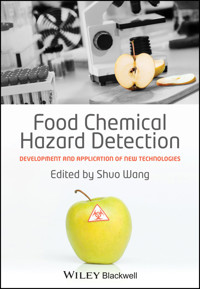
Food Chemical Hazard Detection E-Book
151,99 €
Mehr erfahren.
- Herausgeber: John Wiley & Sons
- Kategorie: Fachliteratur
- Sprache: Englisch
Food chemical safety remains a serious concern to the food industry. Risks such as adulteration, the existence
of toxic and allergenic compounds in foods, and poor regulation of postharvest processing indicate that food chemical safety is not fully guaranteed. With the increasing trend of globalization in the import and export of food products, the importance of employing accurate and reliable analytical instruments to rapidly detect chemical hazards in foods has become paramount. In recent years, many new applications for using a range of analytical methods to detect food chemical hazards have emerged. Food Chemical Hazard Detection: Development and Application of New Technologies aims to cover the major developments and applications in this field.
With a far-reaching scope, this book includes sections dedicated to chromatography tandem mass spectrometry, immunoassay, biophotonics, nanotechnology, biosensors and microfluidic based “lab-on-a-chip”. A team of expert authors from major academic institutions in the USA, Canada and China bring a wealth of research experiences to bear in this major new work, which will be required reading for anyone interested in food chemical hazards and their effective detection and intervention strategies.
Food Chemical Hazard Detection: Development and Application of New Technologies is aimed at a diverse audience, including food safety testing laboratories, scientists and managers in the global food supply chain, academic institutions, governmental regulatory agencies and food safety training providers. Readers will receive not only the fundamentals about different detection techniques, but will also gain insights into the current and future applications of each technique.
Sie lesen das E-Book in den Legimi-Apps auf:
Seitenzahl: 658
Veröffentlichungsjahr: 2014
Ähnliche




















Table of Contents
Cover
Title Page
Copyright
List of contributors
Preface
Section I: Chromatography–tandem mass spectrometry
Chapter 1: Recent developments in gas chromatography–mass spectrometry for the detection of food chemical hazards
1.1 The combination of gas chromatography and mass spectrometry
1.2 Analysis of pesticide residues in foods
1.3 Analysis of contaminants formed during food processing
1.4 Analysis of environmental contaminants
1.5 Analysis of contaminants from packaging materials
1.6 Nitrite
Summary
Abbreviations
References
Chapter 2: Recent developments in liquid chromatography–mass spectrometry for the detection of food chemical hazards
2.1 Introduction to food safety detection by liquid chromatography–mass spectrometry
2.2 Principles and current technology of LC–MS
2.3 Applications of LC–MS in food safety detection
2.4 Conclusion
Abbreviations
References
Section II: Immunoassays
Chapter 3: State of the art immunoassay developments and application to food chemical hazards
3.1 Development and use of immunoassay to monitor food chemical hazards
3.2 Design and synthesis of haptens
3.3 Antibody production
3.4 Immunoassay formats
3.5 Sample preparation from various matrices
3.6 Conclusion
References
Chapter 4: Molecularly imprinted polymers (MIPs) – an emerging technique for chemical hazard determination
4.1 Introduction
4.2 Preparation of molecularly imprinted polymers
4.3 Molecularly imprinted solid-phase extraction modes
4.4 Applications of MISPE in food chemical hazard determination
4.5 Conclusion and outlook
References
Section III: Biophotonics
Chapter 5: Recent developments in infrared spectroscopy for the detection of food chemical hazards
5.1 A brief introduction to infrared spectroscopy and its application in the food industry
5.2 Application of IR spectroscopy to detect chemical adulterants in foods
5.3 Application of IR spectroscopy to detect mycotoxins in foods
5.4 Application of IR spectroscopy to detect pesticides in foods
5.5 Application of IR spectroscopy to detect antibiotic residues in foods
5.6 Tips for reporting results
5.7 Trends in IR instrumentation
5.8 Trends in further applications of chemometrics to analyze IR spectra
5.9 Conclusion
References
Chapter 6: Recent developments in Raman spectroscopy for the detection of food chemical hazards
6.1 Introduction
6.2 Detection of chemicals in simple solvents
6.3 Detection of chemicals in food matrices
6.4 Conclusion and outlook
References
Section IV: Nanotechnology
Chapter 7: Engineered nanoparticles (ENPs): applications, risk assessment, and risk management in the agriculture and food sectors
7.1 Introduction
7.2 Naturally occurring nanoparticles
7.3 Nanoparticle engineering
7.4 Engineered nanoparticles (ENPs)
7.5 Applications of ENPs in the agriculture and food sectors
7.6 Nanosensors
7.7 Impacts of ENPs on the environment
7.8 Risk assessment and risk management of ENPs in food technology
7.9 Future trends
References
Chapter 8: Nanotechnology and its applications to improve the detection of chemical hazards in foods
8.1 Introduction
8.2 Nanomaterials used in sensors
8.3 Chemical hazards in foods
8.4 Conclusion
References
Section V: Biosensors
Chapter 9: Microfluidics “lab-on-a-chip” system for food chemical hazard detection
9.1 Microfluidics and “lab-on-a-chip”
9.2 Fluid mechanics at the microscale
9.3 Microfabrication technologies
9.4 Detection techniques
9.5 Representative applications in the detection of chemical hazards in foods
9.6 Future perspectives
References
Chapter 10: Colorimetric biosensor for food chemical hazards detection
10.1 Introduction
10.2 Detection of hazardous chemicals in foods using colorimetric biosensors based on bio-nanomaterials
10.3 Conclusion
Acknowledgments
References
Index
End User License Agreement
Pages
xi
xii
xii
xiv
3
4
5
6
7
8
9
10
11
12
13
14
15
16
17
18
19
20
21
22
23
24
25
26
27
28
29
30
31
32
33
34
35
36
37
38
39
40
41
42
43
44
45
46
47
48
49
50
51
53
54
55
56
57
58
59
60
61
62
63
64
65
66
67
68
69
70
71
72
73
74
75
76
77
78
79
80
81
82
83
84
85
86
87
88
89
90
91
92
93
94
95
96
97
98
99
100
101
102
105
106
107
108
109
110
111
112
113
114
115
116
117
118
119
120
121
122
123
124
125
126
127
128
129
130
131
132
133
134
135
137
138
139
140
141
142
143
144
145
146
147
148
149
150
151
152
153
154
155
156
157
158
159
160
161
162
163
164
165
166
167
168
169
170
171
175
176
177
178
179
180
181
182
183
184
185
186
187
188
189
191
192
193
194
195
196
197
198
199
200
201
202
203
204
205
206
209
210
211
212
213
214
215
216
217
218
219
220
221
222
223
224
225
226
227
228
229
230
231
232
233
234
235
236
237
238
239
240
241
242
243
244
245
246
247
249
250
251
252
253
254
255
256
257
258
259
260
261
265
266
267
268
269
270
271
272
273
274
275
276
277
278
279
280
281
282
283
284
285
286
287
288
289
291
292
293
294
295
296
297
298
299
300
301
302
303
304
305
306
307
308
309
310
311
312
313
315
316
317
318
319
320
321
322
323
324
325
326
327
Guide
Table of Contents
List of Illustrations
Figure 1.1
Figure 1.2
Figure 2.1
Figure 2.2
Figure 3.1
Figure 3.2
Figure 3.3
Figure 4.1
Figure 4.2
Figure 4.3
Figure 4.4
Figure 4.5
Figure 4.6
Figure 4.7
Figure 4.8
Figure 4.9
Figure 5.1
Figure 5.2
Figure 5.3
Figure 5.4
Figure 5.5
Figure 6.1
Figure 6.2
Figure 6.3
Figure 6.4
Figure 6.5
Figure 6.6
Figure 6.7
Figure 6.8
Figure 6.9
Figure 6.10
Figure 7.1
Figure 7.2
Figure 7.3
Figure 8.1
Figure 8.2
Figure 8.3
Figure 8.4
Figure 9.1
Figure 9.2
Figure 9.3
Figure 9.4
Figure 9.5
Figure 10.1
Figure 10.2
Figure 10.3
Figure 10.4
Figure 10.5
List of Tables
Table 1.1
Table 3.1
Table 3.2
Table 3.3
Table 7.1
Table 7.2
Table 7.3
Table 7.4
Table 7.5
Table 7.6
Table 7.7
Table 9.1
Table 9.2
Table 9.3
Table 10.1
Food Chemical Hazard Detection
Development and Application of New Technologies
Shuo Wang
College of Food Engineering and Biological Technology, Tianjin University of Science and Technology, Tianjin, China
This edition first published 2014 © 2014 by John Wiley & Sons, Ltd
Registered office: John Wiley & Sons, Ltd, The Atrium, Southern Gate, Chichester, West Sussex, PO19 8SQ, UK
Editorial offices: 9600 Garsington Road, Oxford, OX4 2DQ, UK
The Atrium, Southern Gate, Chichester, West Sussex, PO19 8SQ, UK
111 River Street, Hoboken, NJ 07030-5774, USA
For details of our global editorial offices, for customer services and for information about how to apply for permission to reuse the copyright material in this book please see our website at www.wiley.com/wiley-blackwell.
The right of the author to be identified as the author of this work has been asserted in accordance with the UK Copyright, Designs and Patents Act 1988.
All rights reserved. No part of this publication may be reproduced, stored in a retrieval system, or transmitted, in any form or by any means, electronic, mechanical, photocopying, recording or otherwise, except as permitted by the UK Copyright, Designs and Patents Act 1988, without the prior permission of the publisher.
Designations used by companies to distinguish their products are often claimed as trademarks. All brand names and product names used in this book are trade names, service marks, trademarks or registered trademarks of their respective owners. The publisher is not associated with any product or vendor mentioned in this book.
Limit of Liability/Disclaimer of Warranty: While the publisher and author(s) have used their best efforts in preparing this book, they make no representations or warranties with respect to the accuracy or completeness of the contents of this book and specifically disclaim any implied warranties of merchantability or fitness for a particular purpose. It is sold on the understanding that the publisher is not engaged in rendering professional services and neither the publisher nor the author shall be liable for damages arising herefrom. If professional advice or other expert assistance is required, the services of a competent professional should be sought.
Library of Congress Cataloging-in-Publication Data
Wang, Shuo, 1969-
Food chemical hazard detection : development and application of new technologies / Shuo Wang.
pages cm
Includes bibliographical references and index.
ISBN 978-1-118-48859-1 (cloth)
1.Food adulteration and inspection. 2.Hazardous substances. I.Title.
TX531.W36 2014
363.19'264--dc23
2013046772
A catalogue record for this book is available from the British Library.
Wiley also publishes its books in a variety of electronic formats. Some content that appears in print may not be available in electronic books.
Cover image: © Shutterstock/luchschen
Cover image: © Shutterstock/Shots Studio
Cover design by Meaden Creative
List of contributors
Qiliang Deng
College of Science
Tianjin University of Science and Technology
Tianjin
China
Jinxing He
College of Food and Bioengineering
Shandong Polytechnic University
Jinan
China
Lili He
Department of Food Science
University of Massachusetts
Amherst, MA
USA
Mengshi Lin
Food Science Program
Division of Food Systems and Bioengineering
University of Missouri
Columbia, MO
USA
Xiaonan Lu
Food, Nutrition and Health Program
Faculty of Land and Food Systems
University of British Columbia
Vancouver, BC
Canada
Mahmoudreza Ovissipour
School of Food Science
Washington State University
Pullman, WA
USA
Barbara A. Rasco
School of Food Science
Washington State University
Pullman, WA
USA
Shyam S. Sablani
Biological Systems Engineering
Washington State University
Pullman, WA
USA
Syamaladevi M. Roopesh
Biological Systems Engineering
Washington State University
Pullman, WA
USA
Jianlong Wang
College of Food Science and Engineering
Northwest Agriculture and Forestry University
Yangling
Shaanxi
China
Shuo Wang
College of Food Engineering and Biological Technology
Tianjin University of Science and Technology
Tianjin
China
Xianghong Wang
College of Food Science and Technology
Agricultural University of Hebei
Baoding
Hebei
China
Jie Xu
Department of Mechanical Engineering
Washington State University
Vancouver, WA
USA
Hongyan Zhang
College of Life Science
Shandong Normal University
Jinan
China
Renbang Zhao
College of Food Science and Technology
Agricultural University of Hebai
Baoding
Hebei
China
H. Susan Zhou
Department of Chemical Engineering
Worcester Polytechnic Institute
Worcester, MA
USA
Preface
Food chemical safety is still a priority for both the food industry and academia. Innovative methods are critical to improving the determination of the potential chemical hazards in food products. Because the food system is complicated, effective separation and detection tools are both essential requirements. A recent trend is to minimize the detection tools and also to make them more user-friendly.
In this book, we focus on introducing different analytical technologies and their application to the detection of food chemical hazards. Therefore, the overall approach is based on “technique” rather than “categories of analytes.” Specifically, this book is aimed to provide up-to-date information and knowledge about cutting-edge methodologies to food scientists and technologists and also other professional staff in the areas of chemistry, biochemistry and food regulation.
The book is divided into five sections: I. Chromatography–tandem mass spectrometry; II. Immunoassays; III. Biophotonics; IV. Nanotechnology; and V. Biosensors. Two chapters are included in each section to present detailed descriptions.
In Section I, gas chromatography (Chapter 1) and liquid chromatography (Chapter 2) are introduced individually as separation techniques, coupled with mass spectrometry for the detection of trace levels of chemical hazards in foods. So far, chromatography coupled with mass spectrometry is still the confirmatory technique used in most institutions and government agencies to determine and validate food chemical safety.
Section II first introduces the extensively used immunoassays in detail and then reviews recent progress in this technique and its application to detect food chemical hazards (Chapter 3). Additionally, molecularly imprinted polymers (MIPs) represent a novel technique to be employed as an efficient means to extract and separate chemical analytes from complicated matrices such as foods and the principle of this technique is related to the classical “antigen–antibody recognition” theory (Chapter 4).
In Section III, biophotonics is presented as a novel technique employed to detect food chemical hazards. Infrared spectroscopy, especially Fourier transform infrared (FT-IR) spectroscopy, is introduced in Chapter 5. Both near-infrared (NIR) and mid-infrared (MIR) spectroscopy are covered because NIR spectroscopy has been widely used in the food industry as an online system to detect food analytes and MIR spectroscopy is still used in the laboratory as a routine diagnostic tool. Complementary Raman spectroscopy is introduced in Chapter 6. This technique has been booming in the recent years, especially coupled with nanotechnology to generate the technique surface-enhanced Raman scattering (SERS) spectroscopy.
Section IV considers nanotechnology and its application to the detection of food chemical hazards. In Chapter 7, the application, risk assessment, and risk management of engineered nanoparticles in agriculture and food sectors are introduced first. “Nano” has become a very popular and active research area in food science in recent years; however, there are still many contradictory arguments, and a general introduction is critical for readers to understand the “pros and cons.” In Chapter 8, nanotechnology and its application to improve the detection limit of different analytical tools are presented. For example, quantum dots have been validated as a very unique tool for the detection of trace levels of chemical analytes.
In Section V, microfluidics-based “lab-on-a-chip” is first introduced as a novel system to detect trace levels of chemical hazards (Chapter 9). This technique has significant importance to in-field studies, especially for developing countries that do not possess ideal laboratory conditions (optimum instrumentation, air conditioning, etc.) to perform detection. Apart from fluorescence, recent detection instruments coupled with a “lab-on-a-chip” system are also summarized. For example, laser technology has been incorporated into this microfluidics system for the detection of chemical contaminants. The final chapter (Chapter 10) introduces colorimetric biosensors. Aptamers and G-quadruplex DNAzyme are introduced as the major signal conversion factors for colorimetric biosensors.
As the Director of the National Key Laboratory of Food Nutrition and Safety in China and also the Editor of this book, I anticipate that the current developments in each of the individual technologies presented in this book will assist the more rapid, reliable and precise determination of chemical hazards in food systems.
Without exception, my first thanks have to go to all of the authors of the ten chapters in this book. They were very tolerant of the numerous requests from me as Editor and from the publisher. The Wiley team also deserve my sincere thanks for keeping the writing and editing of this book on the right track. Finally, I offer deep thanks to my wife and my son for being understanding of the many hours spent away from them during the reviewing and editing of the various chapters.
Shuo WangPresident of Tianjin University of Science and TechnologyDirector of National Key Laboratory of Food Nutrition and Safety,Ministry of Education of China
Section I
Chromatography–tandem mass spectrometry
Chapter 1Recent developments in gas chromatography–mass spectrometry for the detection of food chemical hazards
Renbang Zhao
College of Food Science and Technology, Agricultural University of Hebei, Baoding, Hebei, China
1.1 The combination of gas chromatography and mass spectrometry
1.1.1 Introduction
Gas chromatography–mass spectrometry (GC–MS) is a synergistic combination of the high-resolution separation of the components of a mixture with selective and sensitive mass detection. The term “hyphenation” or “tandem” is widely used to describe the possible combination of two or more instrumental analytical methods in a single run. GC separates chemical mixtures into individual components while MS identifies/quantifies the components at a molecular level.
In 1957, Holmes and Morrell demonstrated the first coupling of GC with MS (Holmes and Morrell, 1957), shortly after the development of gas–liquid chromatography (James and Martin, 1952), and it became commercially available in 1967.
The coupling of a gas chromatograph and a mass spectrometer in GC–MS allows a much more accurate chemical identification than applying either technique alone (Figure 1.1). The role of the GC technique is to separate the components from a complex mixture and identify or quantify those components. In order to identify the components, the retention characteristics of an unknown component/analyte are compared with those of reference materials determined under identical experimental conditions. Even if the retention characteristics of an unknown and a reference material are identical, the two compounds may not be the same, because there are so many compounds involved and this affects the specific retention characteristics.
Figure 1.1 Photograph of a modern gas chromatograph
MS can identify compounds with a high degree of confidence, but it may require a very pure sample or standard. If a compound is part of a complex mixture, the mass spectrum obtained will contain ions from all of the compounds in the mixture, resulting in the identification being challenging. The combination of the two processes allows specific compounds separated by GC to be introduced into the mass spectrometer which can then be identified. In particular, those compounds with similar or identical retention characteristics in GC having different molecular or fragment masses in MS can be differentiated.
1.1.2 Basic gas chromatography
GC is more than 60 years old (James and Martin, 1952) and is a unique and versatile technique. In its initial stages of development, it provided separation and quantitative analysis for sample components both volatile at the temperatures used to achieve separation and thermally stable (Martin and Synge, 1941). However, it has also been applied to a wide range of nonvolatile compounds that can be conveniently converted into volatile derivatives. As an analytical tool, GC can be used to separate and analyze gaseous, liquid, or solid samples in some instances. The techniques of derivatization or pyrolysis GC can be utilized if the sample to be analyzed is nonvolatile.
Lesen Sie weiter in der vollständigen Ausgabe!
Lesen Sie weiter in der vollständigen Ausgabe!
Lesen Sie weiter in der vollständigen Ausgabe!
Lesen Sie weiter in der vollständigen Ausgabe!
Lesen Sie weiter in der vollständigen Ausgabe!
Lesen Sie weiter in der vollständigen Ausgabe!
Lesen Sie weiter in der vollständigen Ausgabe!
Lesen Sie weiter in der vollständigen Ausgabe!
Lesen Sie weiter in der vollständigen Ausgabe!
Lesen Sie weiter in der vollständigen Ausgabe!
Lesen Sie weiter in der vollständigen Ausgabe!
Lesen Sie weiter in der vollständigen Ausgabe!
Lesen Sie weiter in der vollständigen Ausgabe!
Lesen Sie weiter in der vollständigen Ausgabe!
Lesen Sie weiter in der vollständigen Ausgabe!




