


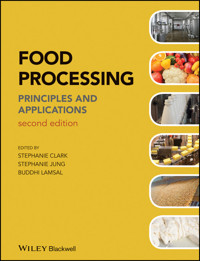
Food Processing E-Book
154,99 €
Mehr erfahren.
- Herausgeber: John Wiley & Sons
- Kategorie: Fachliteratur
- Sprache: Englisch
FOOD PROCESSING
Food Processing: Principles and Applications, Second Edition is the fully revised new edition of this best-selling food technology title. Advances in food processing continue to take place as food scientists and food engineers adapt to the challenges imposed by emerging pathogens, environmental concerns, shelf life, quality and safety, as well as the dietary needs and demands of humans. In addition to covering food processing principles that have long been essential to food quality and safety, this edition of Food Processing: Principles and Applications, unlike the former edition, covers microbial/enzyme inactivation kinetics, alternative food processing technologies as well as environmental and sustainability issues currently facing the food processing industry.
The book is divided into two sections, the first focusing on principles of food processing and handling, and the second on processing technologies and applications. As a hands-on guide to the essential processing principles and their applications, covering the theoretical and applied aspects of food processing in one accessible volume, this book is a valuable tool for food industry professionals across all manufacturing sectors, and serves as a relevant primary or supplemental text for students of food science.
Sie lesen das E-Book in den Legimi-Apps auf:
Seitenzahl: 1776
Veröffentlichungsjahr: 2014
Ähnliche




















CONTENTS
Cover
Title page
Copyright page
List of Contributors
1 Principles of Food Processing
1.1 Processing of foods: an introduction
1.2 Unit operations in food processing
1.3 Thermophysical properties, microbial aspects, and other considerations in food processing
1.4 Common food preservation/processing technologies
1.5 Other food processing/preservation technologies
1.6 Emerging issues and sustainability in food processing
1.7 Conclusion
References
2 Thermal Principles and Kinetics
2.1 Introduction
2.2 Methods of thermal processing
2.3 Microorganisms
2.4 Thermal kinetics
2.5 Thermal process establishment
2.6 Thermal process calculation
2.7 Thermal process validation
2.8 Process monitoring and control
2.9 Emerging processing technologies
2.10 Future trends
References
3 Separation and Concentration Technologies in Food Processing
3.1 Introduction
3.2 Physical separation of food components
3.3 Processes involving phase separation
3.4 Membrane separations
3.5 Sustainability of separation technologies in food processing
References
4 Dehydration
4.1 Introduction
4.2 Drying and food quality
4.3 Hot air drying
4.4 Drying theory
4.5 Drying equipment
4.6 Analysis of dryers
4.7 Sustainability
4.8 Conclusion
References
Further reading
5 Chilling and Freezing of Foods
5.1 Introduction to the food cold chain
5.2 Effect of refrigeration on food safety and quality
5.3 Blanching
5.4 Principles of refrigeration systems
5.5 Heat transfer during chilling and freezing
5.6 Chilling and freezing systems
5.7 Chilled and frozen storage systems
5.8 Chilled and frozen transport systems
5.9 Refrigerated retail display systems
5.10 Recommended temperatures
5.11 Refrigeration and the environment
5.12 Specifying, designing, and commissioning refrigeration systems
5.13 Conclusion
References
6 Fermentation and Enzyme Technologies in Food Processing
6.1 Introduction
6.2 Fermentation culture requirements
6.3 Fermentation technologies
6.4 Downstream processing
6.5 Fermented foods
6.6 Enzyme applications
6.7 Sustainability
6.8 Concluding remarks and future trends
References
7 Alternative Food Processing Technologies
7.1 Introduction
7.2 Alternative thermal processing technologies
7.3 Alternative non-thermal processing technologies
7.4 Sustainability and energy efficiency of processing methods
7.5 Conclusion
References
8 Nanotechnology for Food
8.1 Introduction
8.2 Biosensing
8.3 Packaging
8.4 Nanotechnology and sustainability
8.5 Summary
References
9 Sustainability and Environmental Issues in Food Processing
9.1 Introduction
9.2 Sustainable food processing drivers
9.3 Environmental impact of food processing
9.4 Green technologies: examples in the food processing industry
9.5 Environmental sustainability assessment methods
9.6 Conclusion
References
10 Food Safety and Quality Assurance
10.1 Introduction
10.2 Elements of total quality management
10.3 Hazard Analysis Critical Control Point (HACCP) system
10.4 Sanitary processing conditions
10.5 Supporting prerequisite programs
10.6 Product quality assurance
10.7 Conclusion
References
11 Food Packaging
11.1 Introduction
11.2 Functions of food packaging
11.3 Packaging systems
11.4 Materials for food packaging
11.5 Other packaging types
11.6 Sustainable food packaging
References
12 Food Laws and Regulations
12.1 Introduction
12.2 The regulatory status of food ingredients and additives
12.3 Adulteration and misbranding
12.4 The global food trade: risk from adulterated and misbranded foods
12.5 US Department of Agriculture programs
12.6 Environmental Protection Agency programs
12.7 The Food Safety Modernization Act
12.8 Summary
References
13 Crops – Cereals
13.1 Introduction
13.2 Industrial corn processing for food uses
13.3 Industrial wheat processing for food uses
13.4 Sustainability of corn and wheat processing
References
14 Crops – Legumes
14.1 Introduction
14.2 Technologies involved in legume processing
14.3 Traditional processing technologies
14.4 Modern processing technologies
14.5 Ingredients from legumes
14.6 Novel applications
14.7 Conclusion
References
15 Processing of Fruit and Vegetable Beverages
15.1 Introduction
15.2 Juices
15.3 Nectars
15.4 Clean-in-place
15.5 Conclusion
References
Further reading
16 Fruits and Vegetables – Processing Technologies and Applications
16.1 Raw materials
16.2 Basic processing
References
17 Milk and Ice Cream Processing
17.1 Introduction
17.2 Physical and chemical properties of milk constituents
17.3 Milk handling
17.4 Dairy product processing
17.5 US regulations for milk and milk products
17.6 Sustainability of the dairy industry
17.7 Conclusion
References
18 Dairy – Fermented Products
18.1 Introduction
18.2 Consumption trends
18.3 Production of starters for fermented dairy foods
18.4 Biochemical basis of lactic fermentation for flavor and texture generation
18.5 Yogurt
18.6 Cultured (or sour) cream
18.7 Cheeses
18.8 Sustainability efforts in whey processing
References
19 Eggs and Egg Products Processing
19.1 Introduction
19.2 Shell egg formation
19.3 Structure of eggs
19.4 Chemical composition of eggs
19.5 Shell egg processing
19.6 Further processing of eggs and egg products
19.7 Liquid egg products
19.8 Pasteurization
19.9 Desugarization
19.10 Dehydration
19.11 Egg further processing (value-added processing)
19.12 Sustainability
19.13 Conclusion
Acknowledgments
References
20 Fats and Oils – Plant Based
20.1 Introduction
20.2 Sources, composition, and uses of plant-based fats and oils
20.3 Properties of plant-based fats and oils
20.4 Nutritional areas of interest
20.5 Degradation of plant-based fats and oils
20.6 General handling considerations
20.7 Recovery of oils from their source materials
20.8 Refining
20.9 Modification of plant-based fats and oils
20.10 Packaging and postprocessing handling
20.11 Margarine processing
20.12 Mayonnaise processing
20.13 Sustainability
References
21 Fats and Oils – Animal Based
21.1 Introduction
21.2 Raw materials
21.3 Land animals
21.4 Processing methods
21.5 EU legislation
21.6 Safety
21.7 Characteristics and quality
21.8 Applications
21.9 Health aspects
21.10 Sustainability
21.11 Conclusion
References
22 Aquatic Food Products
22.1 Introduction
22.2 Aquatic plants and animals as food
22.3 Cultivation, harvesting, and live handling – reducing stress and maintaining quality
22.4 Animal welfare issues in fisheries
22.5 Harvesting methods and effect on quality
22.6 Reducing stress in live handling
22.7 Fishing methods
22.8 Refrigerated products
22.9 Freezing and frozen products
22.10 Surimi and surimi analog products
22.11 Curing, brining, smoking, and dehydration
22.12 Additives and edible coatings
22.13 Roes and caviar
22.14 Other non-muscle tissues used as food
22.15 Fish meal and protein hydrolyzates, and fish oil
22.16 Sustainability
22.17 Summary
References
23 Meats – Beef and Pork Based
23.1 Introduction
23.2 Beef and pork characteristics and quality
23.3 General categories of beef and pork processing
23.4 Equipment needed in beef and pork processing
23.5 Beef and pork processing and HACCP
23.6 Sustainability
References
24 Poultry Processing and Products
24.1 Poultry processing
24.2 Turkey processing
24.3 Duck processing
24.4 Microbiology and food safety
24.5 Sustainable poultry production and processing
24.6 Conclusion
Supplemental Images
Index
Eula
List of Tables
Chapter 01
Table 1.1 Decimal reduction time (D value, min) of selected pathogenic and spoilage microorganisms found in food material
Table 1.2 Water activity values in different food products
Chapter 02
Table 2.1 D and z values of important microorganisms
Table 2.2 D
c
and z
c
values for enzymes and quality attributes (Lund, 1975)
Chapter 03
Table 3.1 Summary of the types of filtration equipment used in food processing
Table 3.2 Requirements for solvent extraction of oils
Table 3.3 Dielectric constant of solvents used for extraction
Table 3.4 Characteristics of commercially available membranes
Table 3.5 Typical performance parameters of pressure-driven membrane processes
Lesen Sie weiter in der vollständigen Ausgabe!
Lesen Sie weiter in der vollständigen Ausgabe!
Lesen Sie weiter in der vollständigen Ausgabe!
Lesen Sie weiter in der vollständigen Ausgabe!
Lesen Sie weiter in der vollständigen Ausgabe!
Lesen Sie weiter in der vollständigen Ausgabe!
Lesen Sie weiter in der vollständigen Ausgabe!
Lesen Sie weiter in der vollständigen Ausgabe!
Lesen Sie weiter in der vollständigen Ausgabe!
Lesen Sie weiter in der vollständigen Ausgabe!
Lesen Sie weiter in der vollständigen Ausgabe!
Lesen Sie weiter in der vollständigen Ausgabe!
Lesen Sie weiter in der vollständigen Ausgabe!
Lesen Sie weiter in der vollständigen Ausgabe!
Lesen Sie weiter in der vollständigen Ausgabe!
Lesen Sie weiter in der vollständigen Ausgabe!
Lesen Sie weiter in der vollständigen Ausgabe!
Lesen Sie weiter in der vollständigen Ausgabe!
Lesen Sie weiter in der vollständigen Ausgabe!
Lesen Sie weiter in der vollständigen Ausgabe!
Lesen Sie weiter in der vollständigen Ausgabe!
Lesen Sie weiter in der vollständigen Ausgabe!
Lesen Sie weiter in der vollständigen Ausgabe!
Lesen Sie weiter in der vollständigen Ausgabe!
Lesen Sie weiter in der vollständigen Ausgabe!
Lesen Sie weiter in der vollständigen Ausgabe!
Lesen Sie weiter in der vollständigen Ausgabe!
Lesen Sie weiter in der vollständigen Ausgabe!
Lesen Sie weiter in der vollständigen Ausgabe!
Lesen Sie weiter in der vollständigen Ausgabe!




