


Erhalten Sie Zugang zu diesem und mehr als 300000 Büchern ab EUR 5,99 monatlich.
- Herausgeber: Independent Thinking Press
- Kategorie: Bildung
- Sprache: Englisch
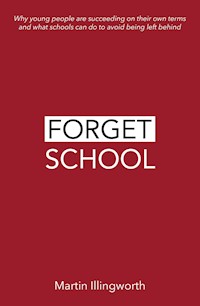
Written by Martin Illingworth, Forget School: Why young people are succeeding on their own terms and what schools can do to avoid being left behind is a wide-reaching, engaging enquiry into the things that young people actually need from their education. Schools are at a crossroads: either they respond to the real world of change, challenges and possibilities that face young people, or they become irrelevant. Young people need to network effectively, manage their finances responsibly, and be digitally proficient and alert to the world around them. If schools do not adapt their provision to nurture these capabilities, then today's youth will increasingly turn to alternative sources to seek out the education they need. Drawing on the experiences of young self-employed adults, Martin Illingworth's Forget School shares key insights into the ways in which education can be recalibrated to better support young people. In doing so he provides practical suggestions around how schooling culture, curriculum design and pedagogical approaches can be reconfigured in readiness for the emerging shifts and trends in 21st century life and employment. Martin sheds light on how young people perceive school's current provision, and offers greater insight into what they think needs to change if education is to work for generations to come. He also explores the importance of digital proficiency in the 21st century and how young people, as digital natives, both acquire it and leverage its benefits independently of school instruction. Essential reading for anyone working in education.
Sie lesen das E-Book in den Legimi-Apps auf:
Seitenzahl: 263
Veröffentlichungsjahr: 2020
Das E-Book (TTS) können Sie hören im Abo „Legimi Premium” in Legimi-Apps auf:
Ähnliche

















A
Praise for Forget School
This book is a timely reminder to us not that we should forget school but that we should remember to ask ourselves what it is that young people most need to learn today and where best they can do this, both in school and beyond.
Bill Lucas, co-author of Educating Ruby: What Our Children Really Need to Learn
In Forget School, Martin Illingworth offers an accurate snapshot of a peculiar and trying phase in human history. By rounding up and extrapolating from the survival techniques of some of those who have managed to hack a living from the carcass of the status quo, Martin provides a timely insight into the novel work practices that may soon constitute the new normal.
Toby Newton, Head of School, International College Hong Kong
Forget School has the daring and the danger of a protest poster in a totalitarian state – it makes you feel as if you are reading about an educational revolution. Illingworth’s voice is at once prophetic and provocative; the voices of his young interviewees authentic and persuasive.
This book should be required reading for all of us who claim an interest in the education of young people in the 21st century.
Mick Connell, PGDE English Tutor, School of Education, the University of Sheffield
Forget School raises questions that need to be asked about education and schooling before we lose sight of the wonders of learning and the joys of the teaching profession. It reminds us of the privileged position all teachers are in when faced with youngsters desperate to learn and to grow. B
Our curriculum offer should teach children to think, form opinions, evaluate, criticise and explore and experiment. Teachers, parents and students ultimately want the same thing: to be happy, confident and successful. In this book Martin Illingworth shines a light on what that could and should be like.
Martin offers a reminder to the profession that we need to be brave and bold, real and authentic and connected to the young people and the world they inhabit. As teachers we wear the badge of ‘expert’, and Martin prompts us to reconsider what our perception of that role is and should be.
Reading Forget School reminds me not only why I became a teacher but why I have continued to love the profession. And ‘education’ is most definitely only the starting point.
Katy Hodges, SENCO and English teacher
This book is revelatory, inspiring and confirmatory. The voices of young adults reverberate throughout with revelations and sharp insights on their struggles to adapt to the complexities and challenges of a world beyond school that, after years of formal education, they left with a ‘currency’ they couldn’t cash and a lack of ‘real world’ skills.
Real inspiration in this book comes firstly from the voices of those young people that continue to thrive against the odds and, secondly, from the vision portrayed by Martin Illingworth of an alternative, vibrant, modern educational provision that embraces the modern world, rather that stubbornly ignores it.
Forget School also confirms, with real lucidity, what many within the education world think, and what their instincts as professionals have told them for years – namely that the education system is not fit for purpose and is genuinely damaging to the development of our young people.
John Oswald, Head of Humanities, Allestree Woodlands School
Why young people are succeeding on their own terms and what schools can do to avoid being left behind
FORGET SCHOOL
Martin Illingworth
gThis book is dedicated to my own grown up children – Adam, Laurie and Amy – and all the beautiful spirits of the young people who have contributed their perspectives on life and energy here.
Also, for Rachel, who made me a room to write in.
How then to put the case for greater quality without appearing to compromise ‘standards’ in such a toxic political climate? That is the task.
Melissa Benn1
A wake-up call to teachers and school leaders, strengthening their arm when it comes to fighting for a better curriculum and also challenging them to do what they can to stretch the curriculum to make it relevant. Teachers can make things happen if they have a will, courage and an understanding of what and why to change.
Ian Gilbert2
Kids are perceptive. They know when things aren’t just fine and dandy.
Roger Daltrey3
1 Melissa Benn, Life Lessons: The Case for a National Education Service (London: Verso, 2018), p. 111.
2 Personal correspondence with the author.
3 Roger Daltrey, My Story: Thanks a Lot Mr Kibblewhite (London: Blink Publishing, 2018), p. 9.
Preface
INTRODUCTORY REMARKS
I can’t understand why people are frightened of new ideas. I’m frightened of the old ones.
John Cage1
As a society we are still sending children to school. We have decided that this is of value and we make all children go. We talk about education – a broad and vague concept. The children go to school and often are not told why it is of value or what they will get from the process.2 And what do they get? Five live broadcasts a day disappearing into the ether but recorded on parchment with quill. Schooling does not show our children enough of the beauty of their lives now or the potential of what is to come. This is because, as far as I can see, the children are there to serve the school, not the other way around. The school has to compete with the one down the road for a label that says it is a success. This is based on the unpleasant assumption that we want our kids to do better than their kids3 – a vile basis upon which to educate them all. This is why exams have come to be all-consuming. The examinations should, in reality, be no more than a iithermometer reading of how things are going with a child’s education.
Towering fences supposedly keep the adult world out of the school grounds (which is a huge shame). Perhaps in reality, though, they keep the children in. There is often nowhere to run or to feel the wind on your face at break time, and lunchtimes have been staggered to keep the children apart. The most compliant and middle-class children are on the school council, tinkering with the status quo, whilst the least compliant are flattened in isolation booths.
The task most days is to guess what the teacher wants to hear and then remember it. The teachers just need the children to pass their exams so that they can keep their jobs. The tests examine what they already know and so are of very limited value and the teachers have long since stopped being allowed to write or reinvigorate the curriculum. Children have access to existing knowledge through the phones in their back pockets, but phones are taboo and shunned in school. Most of what is to be remembered turns out to be of no further use. The world has moved on (several times) and schools have been left behind.
Children’s suitability for the adult world is decided by the tests that measure the narrowest range of a child’s capacities. When children leave school, they have formed lifelong opinions about how clever they are. Most have decided that they are not. Their futures are hugely uncertain, but we continue to tell children that if they work hard and pass their exams then they will get a good job and a happy life.4
The government appears to be largely disinterested in schools and schooling. This is part of a wider disinterest in youth at the moment. The ubiquity of the internet means that iiithe government has lost control of information and resorts to an outdated curriculum to assert some kind of control over what citizens are taught to think and know. But the young now have the tools to know better. They need new skills and new ways of thinking. Schools are at a crossroads: respond to the real world of change, challenges and possibilities that face our young, or become irrelevant.
The signs indicating that the young have lost respect for schooling are everywhere. They have learnt the limited value of the curriculum and the associated tests and they are turning their backs on the whole thing. We can’t afford to waste their time any longer.
Do you recognise this polemic? Does it ring true with you? Does it make you cross? Let’s talk about it.
My purpose here is to get you thinking about the way in which our young people will encounter a whole new set of circumstances as they enter their adult lives and how we might need to change what we offer in schools to help them succeed.
The invention of the printing press created a seismic change in our language and, by extension, in our society. Literacy began to spread and information became more freely available. With greater access to information came new ways of thinking, new ways of being. The limiting factor of this invention, as remains the case with many more recent ones, was the need for physical resources. The printing press required paper. The camera relied on film paper. Sound recordings relied on wax cylinders and vinyl. Now a digital age is upon us and we no longer need physical resources with which to store writing, images and sound – provided we have the increasingly ubiquitous devices which allow us to access them. These things can ‘live’ in the cloud and be conjured up at any time. The speed of change has accelerated.
The internet and, more specifically, artificial intelligence (AI) are heralding a speed and scope of change of proportions ivthat we cannot easily fathom. We invented machines that at first extended our ability to be safe and informed. Now those machines are becoming cleverer than those who invented them. How we deal with the issues and concerns that this new technology raises, and how we make use of such advances, will be crucial in how humans prosper going forward. The future is always supposed to be some distant time yet to be, but the future has arrived, and we are not yet prepared for it.
Our education system was built in an era when we needed to spread information. Now we have so much information that we are struggling to know how to deal with it all. We still look to measure student achievement by what the pupil ‘knows’ and by how much they can retain and remember, but new technology has made this approach to learning virtually redundant.5 We all have the information at our fingertips. What is important now is that we build an educational system that places less value on declarative knowledge (knowing and retaining information) and more on procedural knowledge (the capacity to make use of that information). At the moment, I think that we are failing to properly educate our young, but we seem to be getting away with it because the young are educating themselves through the new technological opportunities that they have. The young are beginning to ignore the generation that went before them, because that generation has shied away from confronting change head-on. In truth, young people have learnt about the tool of communication known as the internet and have mastered its use without any formal instruction or ‘education’. But as constant access to the internet becomes commonplace and fewer and fewer people remember a time when it was not a natural part of living, we need to be alert to its hazards. Much can be achieved online, but much can go wrong. These are exciting but dangerous times and we need to support our children to understand their relationship with the world around them.
vI think one implication of the digital age is that, in thirty or so years, there may well be no physical schools. We will have stopped gathering children of a similar age together to feed them a one-size-fits-all curriculum, regardless of who they are, where they live and their interests. How we measure a child’s capacities will also need to change. Examinations are no longer fit for function: we need a new way to support people on their lifelong learning journeys.6 Just as we no longer rely on physical copies of texts, images and sounds, I suspect we no longer need physical schools. If you think this is crazy talk, consider whether you think that the system we have now will be appropriate in the coming age of automation, artificial intelligence, Blockchain, and virtual and augmented realities.
For those young people who are aspirant and confident enough to take opportunities that present themselves, there are an abundance to be grasped. The expectations of the young are broad: they are the most informed and well-travelled generation ever.7 Whilst we must acknowledge that the playing field is far from level (something which we’ll discuss at numerous points), I believe that the statement ‘most informed and well-travelled generation ever’ is true for the young at every economic level. Their access to information and resources is unprecedented, and fairly democratic. This changes what young people expect of life. Each generation watches the next changing and adapting according to how they want to live – and my interviewees’ generation is moving away from the last (mine) at the most accelerated rate ever seen. The young receive information, ideas and perspectives in all sorts of new forms, most notably, of course, through the viinternet. This has reshaped how they see themselves and their potential place in the world.
Melissa Benn’s eloquent and well-informed Life Lessons: The Case for a National Education Service documents the government’s failure to deliver an education system that is fit for purpose.8 Governments’ and schools’ attempts to be the fonts and gatekeepers of knowledge are over. Schools need to look again at their offer. The young need to network, they need to communicate effectively over digital mediums,9 they need to manage money and they need to be alert to the world around them. There are new pressures on their mental stability, pressures that diminish the joy of childhood and the sense of readiness – when the time comes – to be a mindful individual and a responsible and caring citizen. If the system does not respond quickly then the young will no longer see any relevance to their schooling. This dissatisfaction is already growing.
Children go to school because they have to. The adult generation has agreed that this is what happens. There follows an assumption that what children receive – their education – is worth having. In listening to my successful young interviewees talking about their lives and their businesses, I am increasingly persuaded that we can no longer assume that the current ‘education’ on offer in our schools is the best that we can provide. Not even close. One young person who I interviewed as part of my research, a barber, said:
‘When I left school, I had no idea how much money I needed to make a decent living … but I knew that plants need sunshine and water to grow.’
viiThink of this. What if going to school were optional? What do you imagine the take-up would be? For those children who choose not to come along, what do you imagine they would give as reasons for non-attendance? Do you think that they would say that they don’t want to learn or that they don’t want to learn in the way in which school chooses to offer learning? What do you think they would see as relevant and useful to their lives now and in the future? And for those who would still attend, what would they say is useful?
Schools have been left behind because they are operating with a crowd-control mentality. Investment in schools has focused on providing new buildings and on controlling how children conduct themselves in them. Do up your tie, wear your blazer unless you are told you can take it off, stand in line, be in a house system: these things are ephemeral side issues – the structural devices of a school. Little proper attention has been paid to what is taught and its value to the child in school today or to the citizen they will be tomorrow. The way in which our society operates and the values that it hopes to share have changed and are in a cycle of constant further change. What do we tell the children? This is the most important question of them all.
The internet means that access to information has become hugely democratic and knowledge has been taken out of the control of governments and their purveyors of culture: schools. Children can now learn as they choose. They are able to make choices about what and when to learn. They tend to choose on a need-to-know basis and want to learn right here, right now. They like to multi-source, preferring sound and image over print. This is not the model prevalent in schools. There is a growing tension between the ways in which schools teach and the ways in which children want to learn. Alongside this, schools have become a much smaller part of the ecosystem of a child’s potential learning. The school curriculum has to compete with wider opportunities to find things out. Unfortunately for teachers, this throws light on the out-of-date curriculum that they are being asked to viiideliver.10 When we decry the death of reading (‘Kids never read these days’, which, by the way, is nonsense. They read loads more than they did when I was at school. Try taking their phones off them and see just how badly they want to read – the issue is that we are reluctant to class consuming messages and online content as ‘reading’). What we are really talking about is the downturn in reading – at length – of novels and non-fiction texts. But that old-fashioned means of story-making is now competing with Fortnite, and with Facebook, and with FIFA, and with films, and with FaceTiming your friends. There are so many choices, so why choose the one that the previous generation is insisting upon?
The dominant model of school education is that of passive, non-participatory reception of old knowledge that is to be remembered and then demonstrated in a test of memory. That is not how the young choose to learn in their own time and it is not how society at large operates. The curriculum is lagging behind culture. Schools become both symptom and cause of low aspiration, of downward pressure on children, causing unhappiness and spreading dis-ease. Children are offered a diet of knowledge retention, remembering facts that go largely unexplained in terms of why they are being learnt or what their use will be.
In choosing to write about what I see as the real crisis in education, I am seeking to support the work of teachers. Teachers remain the only real stable resource in the classroom and their work is as vital as ever. I have been a schoolteacher and educator for a long time and I am frustrated by the ways in which educating children is constantly being taken out of our hands. I am an insider who thinks that we all need a wake-up call and that those best placed to deliver it are our children. We need to listen to what they are telling us about the schooling they have received. Look at the way in which, in recent years, schoolchildren have ignored their teachers and ixprotested on our streets about climate change.11 They see more value in a day spent finding their individual and collective voices on the streets than in a day spent in the classroom. I think that many would agree with them.
If things are not right and you stay quiet, then they will never change. Change in our school curriculum will only occur when we insist upon it. Otherwise, our power to insist may very well be taken away because children will no longer afford us the authority to talk to them.
We (by which I mean teachers, leaders, educationalists, etc.) can debate (a generous description of some exchanges) with each other on Twitter and other such forums. Ultimately though, our children will take their education off somewhere safer. If you can’t see the sense in the argument I’m putting forward, or you think I am plainly wrong, then at least reading this book will give you the chance to think about what you want for your children’s futures. It’s okay for you to disagree, but please listen to the young people whose voices fill these pages. They are full of life, full of energy (sometimes a different energy to the one that we require in our classrooms) and I think that they need our help. They need advocates and we are well placed to be those people.
… don’t rely on the adults too much. Most of them mean well, but they just don’t understand the world.
Yuval Noah Harari12
The questions being asked, and the issues being addressed, in education today are just too small. In-fights over funding, over types of schools, over local and national control, and xover exam content fail to see the future coming. We need to be pursuing the answers to much bigger questions, such as:
What should the functions of the curriculum be in the 21st century?What subjects/topics (that are not on the syllabus) would young people like to study?Are there subjects that we should add to the school curriculum that are not currently taught?What skills and proficiencies does society actually need the young to have right now?Where are the lines to be drawn between essential and specialised knowledge? For instance (and to start an argument!), to what age (if at all) should you be taught science as a compulsory subject?In what ways do we actually use our ability to read today? Does this have an implication for how reading and text is approached in schools?What is important and relevant in each subject? What do children need to know in fifteen years’ time when they are the new adult population taking our society forward?How can we broaden and diversify the curriculum so that everyone feels that the education they receive is about them? (Edexcel have made a start on this with their additions to reading lists for GCSE English.)How should we record a child’s journey through education?It is clear that we need to replace exams, but how do we best ‘measure’ children’s developing capacities?How are we going to approach AI and electronic devices so that we get the best possible use from them?It’s potentially difficult to do, but how are we going to promote confidence and well-being in our school curriculum?xiIf there is no level playing field, how will we support those who are disadvantaged?In what ways will your pupils be ‘richer’ when they leave your school? You could ask yourself this question after every lesson if you want a good guide as to whether it was worth doing or not.There is a good deal of new research into the brain and, more specifically, into how we learn. How will we train teachers to have a working knowledge of the latest neuroscientific thinking?Consider where you are as a teacher – and where your department or key stage and school are – in relation to answering some of these questions. The questions around curriculum are big but they need addressing right now. The nature of the help that our young need in understanding who they are and in thinking about the life they want for themselves now and in the future has changed. Children’s ‘poor’ behaviour is symptomatic of the fact that schools are becoming redundant in the learning that they offer – and bickering over other purported causes won’t solve the issue. Children’s ‘poor’ behaviour is fundamentally telling us that these children are uncomfortable with the curriculum that they are being offered, not because it is unfamiliar and difficult and they are scared of it – as some would have us believe – but because it is clear that it does not match their needs. Not anymore. We must do something about it.
xii1 John Cage quoted by Richard Kostelanetz in Conversing with Cage, 2nd edn (New York and London: Routledge, 2003), p. 221.
2 Most of the young people who I interviewed in the process of researching this book felt that they would have got more from school if it were clearer what they were personally getting from the experience. Few were actively thinking about what was to be gained.
3 During a September INSET day, I once listened to a head teacher celebrating the fact that his school had ‘beaten’ another school in the town in the GCSE results. This does not seem to me to be in the spirit of wanting all our children to achieve. Exams as an assessment, of course, need some people to fail to justify their existence.
4 There is a good deal of evidence to suggest that a degree isn’t as valued by employers as it once was. See, as a starting point, Liz Burke, University Degrees ‘Irrelevant’ to Big Employers, news.com.au (29 January 2016). Available at: https://www.news.com.au/finance/work/careers/university-degrees-irrelevant-to-big-employers/news-story/8a0340dd2b8e70e35b8ce3302c8d0cc5.
5 And this observation is far from new. See, for example, Murray Wardrop, Learning by Heart Is ‘Pointless for Google Generation’, The Telegraph (2 December 2008). Available at: https://www.telegraph.co.uk/education/primaryeducation/3540852/Learning-by-heart-is-pointless-for-Google-generation.html.
6 Toby Baker and Laurie Smith, The Beginning of the End of Exams, Nesta (3 December 2018). Available at: https://www.nesta.org.uk/feature/ten-predictions-2019/beginning-end-exams/.
7 Millennials travel more than any other age group and the amount of travelling that they do is increasing. See The Blue Swan Daily, Targeting UK Millennials? New Insight Shows They Will Take and Spend More on Leisure Trips During 2019 in Spite of the Clouds Over Brexit (20 March 2019). Available at: https://blueswandaily.com/targeting-uk-millennials-new-insight-shows-they-will-take-and-spend-more-on-leisure-trips-during-2019-in-spite-of-the-clouds-over-brexit/.
8 Benn, Life Lessons.
9 Jacob Snelson, The Digital Necessity, Medium (4 August 2017). Available at: https://medium.com/digital-society/the-necessity-of-technology-85462f953910.
10 Victoria Fenwick, Are We Creating a Generation of Forrest Gumps?, TES (2 August 2019). Available at: https://www.tes.com/news/are-we-creating-generation-forrest-gumps.
11 Patrick Knox, Youth Climate March: Thousands of Student Climate Change Protesters Descend on Central London in Record-Breaking Turnout, The Sun (24 May 2019). Available at: https://www.thesun.co.uk/news/9145737/fridays-for-future-climate-change-protesters-110-countries/.
12 Yuval Noah Harari, 21 Lessons for the 21st Century (London: Jonathan Cape, 2018), p. 266.




