


17,99 €
Mehr erfahren.
- Herausgeber: Independent Thinking Press
- Kategorie: Bildung
- Sprache: Englisch
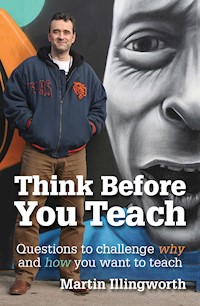
When was the last time you took a moment to pause and really think about your teaching? Think Before You Teach is purposefully full of questions: the openings of discussions to have, first with yourself and then, maybe later, with your colleagues. It doesn't promise all the answers. And it doesn't tell you what to teach. But it will ask you to think about why you want to teach and how you are going to teach. Arrive at school in the morning armed with a clear sense of why you are there and how you will have an impact on the hopes of your students. Regardless of government policies or school initiatives you remain the most important factor in the learning of your students. The students know it and they are looking to you for a lead. You are the key resource in the room; thinking about how to employ this resource is vital. Take a moment and give yourself that time and space to think. Teachers think about a lot on a daily basis: the curriculum, classroom practice, assessment, tests and exams, data, lesson planning etc. They think about Ofsted and policy and pressure. There are also the big things to think about. In a changing world what is our purpose as educators? Technology and the internet have changed the knowledge/skills debate. How do we equip digital natives for the future? What is your personal philosophy? To tackle these questions, teachers need hope, humour, imagination and motivation: Martin offers this in scores.For anybody thinking of entering the teaching profession, student teachers, teacher trainers, NQTs and teachers of all levels of experience. The book explores the various teacher training routes - School Direct, Teach First, PGCE - and the questions teachers should be asking about the path they have taken and their continuing professional development (CPD) needs. By raising questions about pedagogy, good practice, values and responsibilities, to name but a few, Martin encourages all teachers to become reflective practitioners and rediscover their passion.
Das E-Book können Sie in Legimi-Apps oder einer beliebigen App lesen, die das folgende Format unterstützen:
Veröffentlichungsjahr: 2015
Ähnliche













ForR,M,A,L,A
Contents
Acknowledgements
On my team
In a time when we need influential and thoughtful educators, I would like to thank those influential and thoughtful people who have inspired me to develop as an educator; who have listened to me, taken a chance on me, and who have backed me (even when they hadn’t a clue what I was ranting on about).
I have named here educators in the widest sense of the word. Here are head teachers, curriculum leaders, independent thinkers, teacher trainers, experts, local education authority (LEA) advisors, authors, consultant speakers and classroom teachers. But each is an educator. Some taught me to shut up and listen, some taught me to speak up, and all of them opened my eyes to what I might achieve.
If your school had all of my team on board, you’d have a brilliant school.
Thank you.
Foreword
In his 2013 paper ‘Exposing the intricacies of pre-service teacher education’,1 Australian academic Neil Hooley suggests: ‘In the main … the current generation of teachers has only known neoliberal economics and the prevailing demands of market values in education.’
This is significant. And it is one of the reasons Martin is exhorting new teachers to think before they teach in this important book.
In the ‘old days’, which Hooley puts at being before the 1980s, things were a little different. It was in the 1980s that the neoliberal ideas of Milton Friedman started to gain impetus in the USA and then the UK, ushered in by Ronald Reagan and Margaret Thatcher respectively. (Ideas that had been tested first in the US-backed brutality of Pinochet’s dictatorship in Chile.) Prior to then, education in England had been, albeit briefly, about community, collegiality, cooperation and the great comprehensive ideal of teaching children from all backgrounds and of all abilities together. Of course, this system had many flaws, and there are as many people looking back on their schooldays in despair as there are those who hark back to a Golden Age of comprehensive education when milk was free and the daughters of factory managers rubbed up against the sons of factory workers (without ever quite making it to the same social circles as the offspring of shopkeepers).
But then children changed. They became numbers.
What the Conservative Party started, New Labour continued with gusto, championed by Michael ‘What’s wrong with counting beans?’ Barber and his ‘deliverology’ principles. Then educational improvement, leadership and assessment truly became a numbers game. In the unofficial motto of management consultants McKinsey & Company, where Barber later worked: ‘Everything can be measured, and what is measured can be managed.’
‘Education, education, education’ became the process by which teachers implemented the practices of government experts to generate data sets that would tell the world, through league tables, how well they were doing. Notice that what was not called into question were the practices sent down from on high. They were immutable and people like Barber, and Tony Blair, were convinced of their own righteousness. As Sir Tim Brighouse is quoted as saying of Barber: ‘I’ve always enjoyed bouncing ideas around with him. But I could never be as convinced as he is that my ideas are right.’2
In other words, if schools and teachers failed to deliver, the failure was theirs. Let the naming and shaming begin.
In this model, parents became ‘consumers’, ‘choice’ became their way of telling schools exactly what they thought of them, and ‘competition’, the neoliberals’ magic wand of choice, became the weapon that would force schools to improve. Market values reigned and education improved. Michael Barber’s graphs said so.
One aspect of neoliberal doctrine is what is called ‘rational selfishness’ – the idea that if everyone looks after themselves then everyone will benefit. It’s a bit like driving a car in Italy, where you are advised to never use the rear-view mirror. Just watch the front of your car and, as long as everyone else does the same, you will get to work without incident.3 It is using such a system that will ensure, as Gove pointed out to the parliamentary subcommittee on education,4 that all schools will become above average. Next up, the committee interviews Ayn Rand and Franz Kafka on why disabled people should try harder.
It is with this model that teachers entering the classroom today have grown up, one in which they too have been numbers in the schools market, numbers that have been translated into data that have made their school ‘better’ than the school down the road. A system where inputs – the pre-packaged curriculum – and outputs – measurable data such as exam results – have been what education is all about.
But this is not what education is all about. Children are what education is all about.
This book is Martin’s call to put the living, beating, topsy-turvy, unpredictable, infuriating, ultimately lovable child’s heart back into a process that seems to have pursued the counting of beans at the expense of what really counts. It is his way of imploring all teachers, not just new ones, never to lose sight of the child in the classroom because, if we do, then we miss the opportunities, here and now, to make that classroom a magical place, with memories that will last long after the test scores have been forgotten. It is a book written by someone who has observed the way that schools have gone, who has witnessed great people ground down by bad policy, and who has seen the life being sucked out of a process that should be all about celebrating life. Now, through his role in university-based teacher education, he is able to see a bigger picture still – not only the metaphorical cliff we are throwing children over, but also a better, more humane, more inclusive and more deeply satisfying way forward.
Systems Thinking guru John Seddon has been a vocal critic of Barber’s deliverology, in all its many guises, across public services in this country and abroad for many years. He calls it out for what it is: a ‘top-down method by which you undermine achievement of purpose and demoralize people’.5 There is a place for numbers but you, the child and the moment should always come first. Or, put another way: use your data to improve your children, not the other way round. By encouraging new teachers to embrace a more reflective approach – and reminding practising teachers to reconnect with the core emotive reason they came into the job – Martin is not taking us back to some past time of shoddy practice, like rerunning the football-match scene from Kes over and over. Rather, he is trying to move us forward to a time where teachers are continually striving to be the best they can be in a way that never loses sight of the child in front of them, the moment they are sharing, the community in which they are working, or – importantly – their own humanity.
So, please, there’s a great deal at stake: think before you teach.
Ian Gilbert
1 N. Hooley, Exposing the intricacies of pre-service teacher education: Incorporating the insights of Freire and Bourdieu. Review of Education 1(2) (2013): 125–158.
2 Quoted in P. Wilby, Mad professor goes global. Guardian, Tuesday 14 June 2011. Available at: http://www.theguardian.com/education/2011/jun/14/michael-barber-education-guru.
3 Road traffic accident death rate per 100,000 in UK – 4.8. Road traffic accident death rate per 100,000 in Italy – 8.4 (World Health Organization, 2011).
4 Uncorrected transcript of oral evidence: (Q98) Chair: One is: if ‘good’ requires pupil performance to exceed the national average, and if all schools must be good, how is this mathematically possible?Michael Gove: By getting better all the time. (Q99) Chair: So it is possible, is it?Michael Gove: It is possible to get better all the time. (Q100) Chair: Were you better at literacy than numeracy, Secretary of State?Michael Gove: I cannot remember. Available at: http://www.publications.parliament.uk/pa/cm201012/cmselect/cmeduc/uc1786-i/uc178601.htm.
5 Common Core: Education without representation. Top ten scariest people in education reform #7: Sir Michael Barber. Available at: https://whatiscommoncore.wordpress.com/2013/03/23/top-ten-scariest-people-in-education-reform-7-sir-michael-barber-cea-pearson/.
Introduction
I became a teacher nearly twenty-five years ago. I trained to teach at the University of Hull, gaining a Postgraduate Certificate in Education (PGCE) in Secondary English and Physical Education (PE). At the time, I thought there was much to be learned and that I was on a path that would lead me to some ‘teacherly’ state; that I would one day reach a position where I was a ‘teacher’. On my teaching practice placement, at the wonderful Withernsea High School in East Yorkshire, I naively thought that when we closed our doors and lessons began that the teachers were all pretty much doing the same thing. It has taken me many years to realise that this teacherly state does not exist in some finite place, and that teachers are working in myriad ways. You can’t become a ‘teacher’ and then just plateau along through your career. The world is constantly changing and the notion of what teaching might be is dragged along on the back of that change (no one could argue that the system of education is forging ahead!).
What I am offering you here is a book of pre-teaching thinking. I am not going to tell you what to teach (I wouldn’t presume to know what is going to work best for your kids and I bet there are loads of people at your school queuing up to tell you what to teach!) but I am going to ask you to think about why you want to teach and how you are going to teach. This book is also designed to support you to think about what you want to make of your career in teaching; raising your head past the confines of your classroom and your school.
While there is that queue of line managers (the folk that say they are learning to walk!) telling you what to do, there are far fewer asking you to think about why you teach. This is a very important question. To my mind, it is a much more important question than what you are going to teach. Regardless of government policies or school initiatives, you remain the most important factor in the learning of your students. The students know it, and they are looking to you for a lead (they never bring Ofsted an apple or want to show them a picture of a hedgehog they have rescued!). You are the resource in the room; thinking about how best to employ this resource is vital.
The basic unit of a conversation is a turn. You have a go, I have a go. We build understanding together. Equally, the basic unit of a lesson is the narrative relationship that you build with your students over the week, over the unit of work, over the year together. That set of conversations builds incrementally to the relationships that exist in the room and in the school corridors. All ‘learning’ stems from this context.
Reflective practitioners keep thinking through why and how they teach. Having taught for so long, I have seen governments, educational initiatives and policies come and go many times in my career. I have had to respond to these changes, but I have also had to think about their value to me and to my students. Do I do what I am told even though I know it isn’t the best thing for my students? Or do I find ways of making what I am supposed to be doing more engaging and useful for students? The second question here is surely what lesson planning is founded on: engagement and purpose. In your classroom, you must be the one who knows what is required and how best to engage the children in your care. The first part of the book is about thinking through your classroom practice.
You will find a good deal of concern in this book about the ways in which your positivity around teaching is being challenged by the current state of the English education system. I think that you need to reflect on the things that are getting in the way of you being the best teacher that you can be; and, by extension, offering the most valuable education that your students could hope for. Ultimately, though, I want to support you in maintaining that positivity that teachers need to bring to the classroom. We must offer children an education of hope; that their lives right now have purpose and delight, and that the future is looking bright.
During the book I will swap the noun that I use for the young people in your classes. Sometimes I will call them students, sometimes learners, sometimes children; this is not sloppy, but purposeful. We all need to remember sometimes that we are working with children (not little exam-takers who must reach the ‘level’ ascribed by the data monkey!).
Today, education generally, and quite rightly, focuses on the learning of the student. Even Ofsted is now looking to judge the impact of a lesson rather than the methodology of the teacher. But what about you and your career? What about your contribution to your subject? What about your contribution to your school? What about your contribution to your own professional development? Ask not what you can do for your school but what your school can do for you … The second part of this book asks you to raise your head from all the books that need marking, and the lesson planning for next week. How are you making sure that you are a teacher even when the bell rings and the lesson is over? And how are you prioritising yourself in all the hurly-burly of school days? You won’t always be at the same school. How adaptable will you be in a new set of circumstances in your new school?
Please accept what follows as the opening of discussions to have, first with yourself and then, maybe later, with your colleagues. This book is purposefully full of questions. In truth, I want you to provide the answers to the majority of these questions. That is the point of the book. Answer the questions posed and I think that you will be further forward with understanding where you are as a teacher and where you want to go next. Before each section I have listed the questions that appear there. Pre-teaching thinking is all about arriving at school in the morning armed with a clear sense of why you are there and how you will have an impact on the hopes of your students.
Teaching is an intense job and you need to step back sometimes and think through why you are doing the things that you are doing. I hope that in reading this book you will be able to give yourself that time and space to think.
Part One: Your classroom practice
1
Being a teacher
Are the things that are important to you just as important to the children?
Where do these things fit in with their lives and with the society changing around them?
Schools are coercive institutions (children have to go!) and children understand the ‘game’ of schooling. When they first meet you, children know you are the teacher. They know that the school is on your side. You are the one at the front, trusted to lead the students through their learning. And, until you prove to be a threat to that learning, the students will let you be the teacher.
It is your behaviour that will generally set the tone for the room. Teaching is not a noun, it is something that you do: looking, chatting, smiling, praising and telling stories. Your positivity and energy are infectious. Children will believe in you simply because you are the teacher. Your word will be taken as truth in any dispute.
‘Miss, how do you spell … See, told you!’




