


0,49 €
Niedrigster Preis in 30 Tagen: 1,99 €
Niedrigster Preis in 30 Tagen: 1,99 €
Mehr erfahren.
- Herausgeber: Booksell-Verlag
- Kategorie: Sachliteratur, Reportagen, Biografien
- Sprache: Englisch
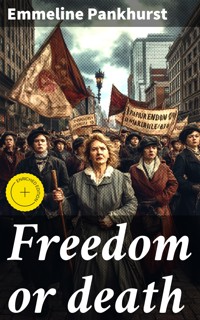
In "Freedom or Death," Emmeline Pankhurst offers a fiery and impassioned treatise on the struggle for women's suffrage in early 20th century Britain. The book is a blend of memoir and political manifesto, characterized by its direct prose and emotional fervor. Pankhurst's use of vivid anecdotes serves to illustrate the personal and societal stakes involved in the suffragette movement. Set against the backdrop of a patriarchal society that dismisses women's voices, her work captures the urgency and desperation of the campaign, making a compelling argument for moral and political equality. The literary style reflects the tumultuous context of the suffrage movement, utilizing persuasive rhetoric that galvanizes support for the cause while also illuminating the sacrifices made by countless women. Emmeline Pankhurst, a prominent suffragist and founder of the Women's Social and Political Union (WSPU), was deeply influenced by her experiences as a woman in a male-dominated society. Her relentless activism came at great personal cost, including imprisonment and the loss of her family life. Driven by a profound desire for justice and equality, Pankhurst's personal narrative infuses her writing with authenticity and urgency, connecting her experiences to the broader feminist struggle of the time. "Freedom or Death" is an essential read for anyone interested in the history of civil rights, feminism, and social change. Pankhurst's passionate cry for justice not only resonates with contemporary themes of empowerment but also serves as an inspiring call to action. Engaging and thought-provoking, the book invites readers to confront the ongoing fight for equality, making it a compelling addition to any scholarly exploration of women's rights. In this enriched edition, we have carefully created added value for your reading experience: - A succinct Introduction situates the work's timeless appeal and themes. - The Synopsis outlines the central plot, highlighting key developments without spoiling critical twists. - A detailed Historical Context immerses you in the era's events and influences that shaped the writing. - An Author Biography reveals milestones in the author's life, illuminating the personal insights behind the text. - A thorough Analysis dissects symbols, motifs, and character arcs to unearth underlying meanings. - Reflection questions prompt you to engage personally with the work's messages, connecting them to modern life. - Hand‐picked Memorable Quotes shine a spotlight on moments of literary brilliance. - Interactive footnotes clarify unusual references, historical allusions, and archaic phrases for an effortless, more informed read.
Das E-Book können Sie in Legimi-Apps oder einer beliebigen App lesen, die das folgende Format unterstützen:
Veröffentlichungsjahr: 2020
Ähnliche

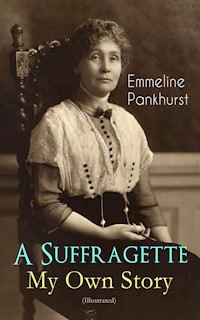










Freedom or death
Table of Contents
Introduction
A voice forged in prisons and on platforms insists that the choice before a society that denies women political rights is stark: a future of freedom shared by all, or the slow death of justice and civic life.
Freedom or Death is regarded as a classic because it distills an entire movement’s urgency into a lucid, commanding act of rhetoric that still reverberates across political writing and feminist thought. Its language is direct, its purpose unmistakable, and its moral architecture transparent, making it a touchstone for students of oratory and social change. Enduring themes of citizenship, conscience, and lawful rebellion give the piece a permanence beyond its immediate occasion. By compressing complex arguments into compelling moral clarity, it established a benchmark for persuasive prose that later activists, essayists, and historians have engaged, echoed, and taught.
Authored by Emmeline Pankhurst, leader of Britain’s Women’s Social and Political Union, the text originated as a speech delivered in November 1913 in Hartford, Connecticut, and has since been circulated widely in print as an address-turned-essay. Composed in the late Edwardian period, it captures the British suffrage campaign at its most contentious, when constitutional appeals had repeatedly failed. Pankhurst uses the platform to explain the stakes of enfranchisement and to present the political crisis with force and restraint. Modern editions often present this speech as a standalone work, inviting readers to engage it as a complete, self-contained argument.
At its core, Freedom or Death sets out the case for women’s suffrage by placing the struggle within a broader tradition of political rights and responsibilities. Pankhurst elucidates why conventional methods had proved inadequate and why more assertive tactics emerged, while affirming the ethical ground of the movement’s aims. Without rehearsing every episode, she frames militancy as a response to prolonged exclusion and state resistance, and she invites international audiences to understand both the logic and the lived reality of the campaign. The result is a clear map of motives, aims, and principles rather than a catalogue of incidents.
Pankhurst’s purpose is to persuade, to educate, and to dignify the claims of those who risked liberty for a vote they did not yet possess. She seeks to correct misconceptions about suffragettes, articulate the moral calculus behind civil disobedience, and shift the debate from tactics alone to the nonnegotiable right at stake. Addressing listeners abroad as well as at home, she builds solidarity without sacrificing specificity, anchoring her case in universally intelligible ideals of citizenship and justice. The intent is not mere provocation, but transformation: to move readers from spectatorship to understanding, and from understanding to recognition of political equality.
As literature, the piece demonstrates how disciplined structure and keen rhetorical technique can serve a political end without diminishing complexity. Pankhurst orchestrates momentum with careful pacing, using accumulation, contrast, and refrain-like emphasis to make arguments memorable. Vivid imagery of constraint and release clarifies abstract ideas, while measured appeals to reason, character, and feeling keep the work balanced. The voice is authoritative but not aloof, personal yet emblematic, allowing the text to function both as testimony and as public philosophy. This fusion of lived experience and principled argument is a major reason for its lasting place in the canon of political prose.
The historical context is decisive. Early twentieth-century Britain saw suffragists pursue constitutional methods for decades with limited effect, while suffragettes escalated to civil resistance as governments strengthened surveillance and punishment. Imprisonment and hunger strikes became part of the movement’s landscape, alongside restrictive legislation such as the 1913 measure widely known as the Cat and Mouse Act. Freedom or Death speaks from within this crucible, translating urgency into an intelligible framework for those distant from London’s streets or Parliament’s debates, and situating the British campaign within a wider history of struggles for enfranchisement and recognition.
Contemporaries recognized the address as more than a single occasion; its publication and reprinting gave it a life beyond the hall where it was first delivered. As a written text, it traveled across borders and decades, entering classrooms, anthologies, and archives of feminist thought and public speaking. It invited debate over methods while reshaping the terms on which those methods were judged, emphasizing the legitimacy of aims and the failures of existing remedies. Its continued circulation reflects its dual function: a documentary window into the suffrage era and a crafted work of argumentation that stands on literary merit.
The influence of Freedom or Death can be traced in the cadence and structure of later protest writing and in the training of speakers who study it as a model of clarity under pressure. It demonstrates how moral urgency can be voiced without sacrificing coherence, and how personal testimony can be universalized without erasing specificity. By showing that persuasive prose can be at once disciplined and incendiary, it helped legitimize the essay and the speech as instruments of democratic change. Its presence in syllabi and movement literatures attests to its role as a template for principled advocacy.
For contemporary readers, the text’s resonance lies in its handling of dilemmas that persist: how to respond to systemic exclusion, when to escalate protest, and how to weigh order against justice. The work offers no easy formulas, but models a way of reasoning in public, measuring actions against the horizon of rights rather than convenience. In an age attentive to intersectional struggles and global solidarities, its insistence on shared citizenship and equal voice remains urgent. It also illuminates the mechanics of persuasion, useful to anyone seeking to build coalitions or to assess the ethics of political tactics.
Themes interlace: liberty as a lived condition, not a gift; the dignity of participation in lawmaking; the cost of resistance; the ethics of disruption; and the responsibility of governments to remedy, not entrench, injustice. The prose evokes determination and moral steadiness, summoning empathy without sentimentality. Readers encounter a voice that argues rather than supplicates, insisting on equality as a matter of right. Stylistically, the piece balances fervor with composure, an equilibrium that keeps it readable across time. Its energy is not rage for its own sake, but disciplined conviction harnessed to a carefully articulated political horizon.
Freedom or Death endures because it unites historical witness with a lucid theory of democratic obligation, guiding readers through the logic of a movement while refusing to separate means from ends. It is a classic not only of feminist literature but of civic argument, reminding us that rights expand when voices insist on being heard. Returning to it today clarifies debates about protest, authority, and consent, and renews the intuition that democracy depends on participation by all. Pankhurst’s address remains compelling because it offers courage with rigor, urgency with measure, and a vision of freedom large enough to include everyone.
Synopsis
Freedom or Death presents Emmeline Pankhurst’s case for militant suffrage as delivered in her 1913 address, expanded to outline the logic, sequence, and aims of the Women’s Social and Political Union. Speaking to an American audience, she sets the political scene in Britain, where women are excluded from the vote despite taxation, civic duty, and legal obligations. She frames the campaign as a political war compelled by state resistance. The title expresses the stark choice she believes confronts women: accept subordination or risk life and liberty to secure citizenship. The work’s purpose is to explain methods, justify escalation, and appeal for understanding of a conflict she argues the government can end at any time.
Pankhurst begins with the long history of constitutional agitation for women’s suffrage. For decades, petitions, deputations, and measured advocacy sought inclusion on the same terms as men. She recounts repeated government assurances that did not materialize, bills introduced and then delayed or defeated, and the limited legal status of women across property, employment, and marriage. Early efforts by suffragists to assist sympathetic political parties yielded no lasting results. This record of patience and disappointment forms the foundation of her argument that conventional methods proved inadequate. By emphasizing both the longevity and restraint of prior efforts, she positions militancy not as a first resort but as a compelled response to persistent exclusion.




