


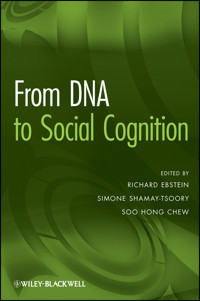
From DNA to Social Cognition E-Book
136,99 €
Mehr erfahren.
- Herausgeber: John Wiley & Sons
- Kategorie: Wissenschaft und neue Technologien
- Sprache: Englisch
Decision-making is an integral part of our daily lives. Researchers seek a complete understanding of the decision-making process, including the biological and social basis and the impact of our decisions. From DNA to Social Cognition fills a gap in the literature that brings together the methods, perspectives, and knowledge of the geneticists, neuroscientists, economists, and psychologists that are integral to this field of research. The editors’ unique expertise ensures an integrated and complete compilation of materials that will prove useful to researchers and scientists interested in social cognition and decision-making.
Sie lesen das E-Book in den Legimi-Apps auf:
Seitenzahl: 560
Veröffentlichungsjahr: 2011
Ähnliche




















Table of Contents
Cover
Title page
Copyright page
CONTRIBUTORS
INTRODUCTION
SOCIAL COGNITION
THE MOLECULAR TOOLBOX FOR RESEARCH IN SOCIAL COGNITION
ACKNOWLEDGMENTS
PART 1: EMPATHY: NEURAL BASES AND GENETIC CORRELATES
1.1 GENES RELATED TO AUTISTIC TRAITS AND EMPATHY
ACKNOWLEDGMENTS
1.2 THE BEHAVIORAL GENETICS OF HUMAN PAIR BONDING
1.2.1 INTRODUCTION
1.2.2 BIOLOGY AND GENETICS OF MATING BEHAVIOR
1.2.3 DISCUSSION
1.3 BRAIN NETWORKS SUPPORTING EMPATHY
1.3.1 MULTIPLE PROCESSES SUPPORTING EMPATHY
1.3.2 BRAIN NETWORKS INVOLVED IN SHARED REPRESENTATIONS OF EMOTIONS
1.3.3 BRAIN NETWORKS INVOLVED IN THEORY OF MIND
1.3.4 BRAIN NETWORKS INVOLVED IN SELF-REFERENTIAL PROCESSING AND SELF-OTHER DISTINCTION
1.3.5 SUMMARY AND OUTLOOK
1.4 THE HUMAN MIRROR NEURON SYSTEM AND SOCIAL COGNITION
1.4.1 INTRODUCTION
1.4.2 THE MNS AND SOCIAL EXPERIENCES
1.4.3 THE MNS AND EMPATHY
1.4.4 THE MNS AND SOCIAL GROUP AFFILIATIONS
1.4.5 THE MNS, LANGUAGE, AND EMBODIED SEMANTICS
1.4.6 SHARED REPRESENTATIONS BEYOND THE MNS
1.4.7 THE MNS AND OTHER SOCIAL NETWORKS
1.4.8 CONCLUSION AND FUTURE DIRECTIONS
1.5 MOTIVATIONAL ASPECTS OF FUTURE THINKING IN THE VENTROMEDIAL PREFRONTAL CORTEX
1.5.1 IMAGINING EMOTIONAL EVENTS IN THE NEAR AND DISTANT FUTURE
1.5.2 EPISODIC FUTURE THINKING AND PERSONAL GOALS
1.5.3 SEEING ONE’S PERSONAL FUTURE THROUGH ROSE-COLORED GLASSES
1.5.4 FEELING CONNECTED TO FUTURE SELVES AND DECISION MAKING
1.5.5 CONCLUSION
ACKNOWLEDGMENTS
PART 2: MORAL NEUROSCIENCE AND EMOTION
2.1 CONTRIBUTIONS OF THE PREFRONTAL CORTEX TO SOCIAL COGNITION AND MORAL JUDGMENT PROCESSES
2.1.1 PFC FUNCTIONAL ANATOMY AND CONNECTIVITY
2.1.2 CONTRIBUTIONS OF THE PFC TO SOCIAL COGNITIVE AND MORAL JUDGMENT PROCESSES
2.1.3 THE INTERACTION BETWEEN IMPLICIT AND EXPLICIT PROCESSES IN THE PFC
2.1.4 CONCLUSIONS
2.2 EMOTION AND MORAL COGNITION
2.2.1 PSYCHOLOGICAL STUDIES
2.2.2 NEUROLOGICAL PATIENT STUDIES
2.2.3 BRAIN IMAGING STUDIES
2.2.4 CONCLUSION
2.3 THE NEUROANATOMICAL BASIS OF MORAL COGNITION AND EMOTION
2.3.1 INTRODUCTION
2.3.2 THE NEUROANATOMICAL BASIS OF MORAL MOTIVATIONS
2.3.3 THE NEUROANATOMICAL BASIS OF SOCIOMORAL KNOWLEDGE
2.3.4 THE NEUROANATOMICAL BASIS OF MORAL REASONING AND DECISION MAKING
2.3.5 CONCLUSIONS AND OUTLOOK
2.4 ENVY AND SCHADENFREUDE: THE NEURAL CORRELATES OF COMPETITIVE EMOTIONS
2.4.1 THE EMOTIONAL REACTIONS TO SOCIAL COMPARISON
2.4.2 ENVY AND SCHADENFREUDE—AN EVOLUTIONARY PERSPECTIVE
2.4.3 SOCIAL COMPARISON BASED EMOTIONS
2.4.4 NEURAL SUBSTRATES OF COMPETITIVE EMOTIONS: ENVY AND SCHADENFREUDE
2.4.5 THE NEUROCHEMICAL BASES OF SOCIAL COMPARISON BASED EMOTIONS
2.4.6 CONCLUSION: A NEURAL LINK BETWEEN SOCIAL COMPARISON BASED EMOTIONS
PART 3: GENES AND DECISION MAKING
3.1 THE SOMATIC MARKER FRAMEWORK AND THE NEUROLOGICAL BASIS OF DECISION MAKING
3.1.1 INTRODUCTION
3.1.2 A BRIEF HISTORICAL PERSPECTIVE
3.1.3 OUTLINE OF THE SOMATIC MARKER HYPOTHESIS
3.1.4 TESTING THE SOMATIC MARKER HYPOTHESIS
3.1.5 EMOTION MAY NOT ALWAYS BE BENEFICIAL TO DECISION MAKING
3.1.6 CRITIQUE OF THE SOMATIC MARKER FRAMEWORK
3.1.7 CONCLUSION
3.2 A MODEL OF THE INITIAL STAGES OF DRUG ABUSE: FROM REINFORCEMENT LEARNING TO SOCIAL CONTAGION
3.2.1 INDIVIDUAL FACTORS LEADING TO RISK OF ADDICTION
3.2.2 SOCIAL FACTOR LEADING TO RISK OF ADDICTION
3.2.3 A UNIFIED MODEL FOR THE JOINT EFFECT OF INDIVIDUAL SENSITIVITY AND SOCIAL EXPOSURE
3.2.4 ACCOUNTING FOR DRUG ABUSE IN FORMULAS: THE EXPECTANCY-VALENCE MODEL
3.2.5 CONCLUSIONS AND IMPLICATIONS
3.3 EXTRINSIC EFFECTS AND MODELS OF DOMINANCE HIERARCHY FORMATION
3.3.1 MODELS OF EXTRINSIC EFFECTS
3.3.2 WINNER/LOSER EFFECTS
3.3.3 WINNER AND LOSER EFFECTS AND INDIVIDUAL RECOGNITION
3.3.4 BYSTANDER EFFECTS
3.3.5 JOINT EFFECTS
3.3.6 EXTRINSIC EFFECTS AND MERGING HIERARCHIES
3.3.7 EMPIRICAL STUDIES: THE CASE OF THE GREEN SWORDTAIL
3.3.8 DISCUSSION AND FUTURE DIRECTIONS
3.4 COMPLEX SOCIAL COGNITION AND THE APPRECIATION OF SOCIAL NORMS IN PSYCHIATRIC DISORDERS: INSIGHTS FROM EVOLUTIONARY GAME THEORY
3.4.1 INTRODUCTION
3.4.2 EVOLUTIONARY ASPECTS OF COOPERATION
3.4.3 ONTOGENETIC ISSUES OF COOPERATION
3.4.4 ASSESSMENT OF COOPERATION USING GAME-THEORETICAL APPROACHES
3.4.5 NEURONAL CORRELATES OF SOCIAL COGNITION AND COOPERATION
3.4.6 COOPERATION IN PSYCHOPATHOLOGICAL CONDITIONS
3.4.7 SUMMARY AND FUTURE DIRECTIONS
3.5 FROM NEUROECONOMICS TO GENETICS: THE INTERTEMPORAL CHOICES CASE AS AN EXAMPLE
3.5.1 WHAT IS NEUROECONOMICS
3.5.2 MODELING INTERTEMPORAL CHOICES
3.5.3 NEUROECONOMICS AND INTERTEMPORAL CHOICES
3.5.4 FUTURE RESEARCH SHOULD USE DISCOUNT RATES AS PHENOTYPES IN GENETIC STUDIES
3.5.5 OTHER FACTORS AFFECTING INDIVIDUAL’S TIME PREFERENCES
Index
Color Plates
Copyright © 2011 by Wiley-Blackwell. All rights reserved
Published by John Wiley & Sons, Inc., Hoboken, New Jersey
Published simultaneously in Canada
No part of this publication may be reproduced, stored in a retrieval system, or transmitted in any form or by any means, electronic, mechanical, photocopying, recording, scanning, or otherwise, except as permitted under Section 107 or 108 of the 1976 United States Copyright Act, without either the prior written permission of the Publisher, or authorization through payment of the appropriate per-copy fee to the Copyright Clearance Center, Inc., 222 Rosewood Drive, Danvers, MA 01923, (978) 750-8400, fax (978) 750-4470, or on the web at www.copyright.com. Requests to the Publisher for permission should be addressed to the Permissions Department, John Wiley & Sons, Inc., 111 River Street, Hoboken, NJ 07030, (201) 748-6011, fax (201) 748-6008, or online at http://www.wiley.com/go/permissions.
Limit of Liability/Disclaimer of Warranty: While the publisher and author have used their best efforts in preparing this book, they make no representations or warranties with respect to the accuracy or completeness of the contents of this book and specifically disclaim any implied warranties of merchantability or fitness for a particular purpose. No warranty may be created or extended by sales representatives or written sales materials. The advice and strategies contained herein may not be suitable for your situation. You should consult with a professional where appropriate. Neither the publisher nor author shall be liable for any loss of profit or any other commercial damages, including but not limited to special, incidental, consequential, or other damages.
For general information on our other products and services or for technical support, please contact our Customer Care Department within the United States at (800) 762-2974, outside the United States at (317) 572-3993 or fax (317) 572-4002.
Wiley also publishes its books in a variety of electronic formats. Some content that appears in print may not be available in electronic formats. For more information about Wiley products, visit our web site at www.wiley.com.
Library of Congress Cataloging-in-Publication Data:
Ebstein, Richard P., 1943-
From DNA to social cognition / Richard Ebstein, Simone Shamay-Tsoory, Soo Hong Chew.
p. cm.
Includes index.
ISBN 978-0-470-54396-2 (cloth)
1. Cognitive neuroscience. 2. Affective neuroscience. 3. Social perception. 4. Decision making. 5. Genetic psychology. I. Shamay-Tsoory, Simone. II. Chew, Soo Hong, 1954- III. Title.
QP360.5.E27 2012
612.8′233–dc22
2011008254
oBook ISBN: 978-1-118-10180-3
ePDF ISBN: 978-1-118-10178-0
ePub ISBN: 978-1-118-10179-7
CONTRIBUTORS
Itzhak Aharon, Interdisciplinary Centre, Herzliya, Israel
Liza Aziz-Zadeh, The Brain and Creativity Institute, University of Southern California, Los Angeles, California
Simon Baron-Cohen, Autism Research Centre, Department of Psychiatry, University of Cambridge, Cambridge, U.K.
Antoine Bechara, Department of Psychiatry, Faculty of Medicine, and Desautels Faculty of Management, McGill University, Montreal, Quebec, Canada, and Department of Psychology, and Brain and Creativity Institute, University of Southern California, Los Angeles, California
Sacha Bourgeois-Gironde, Institut Jean-Nicod (ENS-EHESS), Paris, France
Martin Brüne, Research Department of Cognitive Neuropsychiatry and Psychiatric Preventive Medicine, LWL University Hospital, Ruhr-University Bochum, Germany
Bhismadev Chakrabarti, Centre for Integrative Neuroscience and Neurodynamics, School of Psychology and Clinical Language Sciences, University of Reading, Reading, U.K., and Autism Research Centre, Department of Psychiatry, University of Cambridge, Cambridge, U.K.
Arnaud D’Argembeau, Department of Psychology, University of Liège, Belgium
Matthew Druen, Department of Biology, University of Louisville, Louisville, Kentucky
Lee Alan Dugatkin, Department of Biology, University of Louisville, Louisville, Kentucky
Jonathan Dvash, University of Haifa, Haifa, Israel
Chad E. Forbes, Imaging Sciences Training Program, Radiology and Imaging Sciences, Clinical Center and National Institute of Biomedical Imaging and Bioengineering, Bethesda, MD
Jordan Grafman, Traumatic Brain Injury Research Laboratory, Kessler Foundation Research Center, West Orange, NJ
Ellen Greimel, Child Neuropsychology Section, Department of Child and Adolescent Psychiatry, Psychosomatics and Psychotherapy, University Hospital of the RWTH, Aachen, Germany, and Cognitive Neurology Section, Institute of Neuroscience and Medicine (INM-3), Research Center, Jülich, Germany, and Department of Child and Adolescent Psychiatry and Psychotherapy, University Hospital of the RWTH, Aachen, Germany
Michael Koenigs, Department of Psychiatry, University of Wisconsin—Madison, Madison, Wisconsin
Gilly Koritzky, Technion—Israel Institute of Technology, Haifa, Israel
Sook-Lei Liew, The Brain and Creativity Institute, University of Southern California, Los Angeles, California, and The Division of Occupational Science & Occupational Therapy, University of Southern California, Los Angeles, California
Adi Luria, Technion—Israel Institute of Technology, Haifa, Israel
Jorge Moll, Cognitive and Behavioral Neuroscience Unit, D’Or Institute for Research and Education, Rio de Janeiro, Brazil
Ricardo de Oliveira-Souza, Cognitive and Behavioral Neuroscience Unit, D’Or Institute for Research and Education, Rio de Janeiro, RJ, Brazil, and Gaffrée e Guinle University Hospital, Rio de Janeiro, RJ, Brazil
Joshua C. Poore, Cognitive Neuroscience Section, National Institute of Neurological Disorders and Stroke, National Institutes of Health, Bethesda, MD
Martin Schulte-Rüther, Child Neuropsychology Section, Department of Child and Adolescent Psychiatry, Psychosomatics and Psychotherapy, University Hospital of the RWTH Aachen, Germany, and Cognitive Neurology Section, Institute of Neuroscience and Medicine (INM-3), Research Center, Jülich, Germany
Simone G. Shamay-Tsoory, University of Haifa, Haifa, Israel
Hasse Walum, Department of Medical Epidemiology and Biostatistics, Karolinska Institutet, Stockholm, Sweden
Lars Westberg, Department of Pharmacology, Institute of Neuroscience and Physiology, University of Gothenburg, Gothenburg, Sweden
Julia Wischniewski, Research Department of Cognitive Neuropsychiatry and Psychiatric Preventive Medicine, LWL University Hospital, Ruhr-University Bochum, Germany
Eldad Yechiam, Technion—Israel Institute of Technology, Haifa, Israel
Roland Zahn, The University of Manchester, School of Psychological Sciences, Neuroscience and Aphasia Research Unit, Manchester, U.K., and Cognitive and Behavioral Neuroscience Unit, D’Or Institute for Research and Education, Rio de Janeiro, Brazil
INTRODUCTION
RICHARD P. EBSTEIN,1 MIKHAIL MONAKHOV,2 POH SAN LAI,3 AND SIMONE G. SHAMAY-TSOORY4
1Psychology Department, National University of Singapore, Singapore & Psychology Department, Hebrew University, Jerusalem, Israel
2Research Fellow, Department of Economics, Faculty of Arts and Social Sciences, National University of Singapore & Department of Paediatrics, National University Hospital
3Human Molecular Genetics Laboratory, Department of Paediatrics, National University of Singapore
4University of Haifa, Haifa, Israel
SOCIAL COGNITION
Social cognition refers to the processes that subserve behavior in relating to conspecifics. Although social cognitive processes draw on many of the same brain structures involved in perception, cognition, and behavior more generally, Adolphs (2009) suggests three prominent differences that differentiate human social cognition from other cognitive processes and from that of other species: (1) the ability to shift one’s conscious experience to places and times outside the here-and-now, and into the viewpoint of another mind; (2) the association of our evaluation of others with strong moral emotions that motivate particular aspects of social behavior, such as altruistic punishment; and (3) the ability to use these capabilities flexibly as a function of context, across considerable time intervals, and with the help of a prodigious episodic memory that helps us to keep track of a large number of other individuals and their past behavior. These processes are the core mechanisms of cooperativity, altruism, and other aspects of prosocial behavior, as well as the mechanisms for coercion, deception, and manipulation of conspecifics.
In recent years, the neural basis of social cognition has been the subject of intensive study in both human and nonhuman primates. Recent exciting and provocative findings attempt to combine for the first time genetic and social neuroscience by using a translational genetic approach. Integrating social neuroscience with genetics may pave the way for exploring the neural mechanisms for human social behavior and elucidate our understanding regarding the potential genetic risk for disorders that involve dysfunctional social behavior such autism and schizophrenia.
Part 1: Empathy: Neural Basis and Genetic Correlates
The first part of this book will focus on the neuroanatomical, neurchemical, and genetic basis for empathy. In Chapter 1.1, Chakrabarti and Baron-Cohen provide an overview of genetic studies of empathy and other trait measures of autism spectrum conditions (ASC). Three neurocognitive theories of ASC are presented: foetal androgen theory, neural connectivity theory, and social-emotional responsivity theory. The authors describe two studies conducted in their laboratory, one on autistic traits and empathy and one on Asperger Syndrome (AS). In these studies, nine candidate genes were identified, some of which are associated with autistic traits in the general population and/or AS. These genes fall into the three functional categories related to sex-steroid synthesis and metabolism, neural development and connectivity, and social-emotional responsivity, providing some support for the three theories of autism. Several of these genes have been also found to be involved in pair bonding. In Chapter 1.2, Walum and Westberg review the genetic influences of pair bonding. Specifically, the authors focus on the neuropeptides oxytocin (OT) and vasopressin (AVP), which have been found to correlate with affiliative behavior and social bonding. It is suggested that pair bonds could be induced by similar stimulation as the one facilitating the bond between a mother and her offspring. Furthermore, the authors show evidence that the mesolimbic dopamine reward system is highly involved in pair bonding in animals. Therefore they suggest that the individual motivation to engage in pair bonds is an effect of activation of reward centers. In Chapter 1.3, Schulte-Rüther and Greimel take a neurobiological approach to empathy, investigating the cognitive components and the neural substrates of these components. The authors emphasize three core aspects of the definition of empathy: (1) an affective response, (2) a cognitive mechanism allowing for perspective taking, and (3) the ability to maintain a self–other distinction. The authors review evidence from studies investigating the brain networks mediating these aspects of empathy. Perspective taking was consistently identified with a neural network that entails the medial prefrontal cortex (MPFC), the temporoparietal junction (TPJ), and the temporal pole. Brain networks involved in the ability to differentiate one’s own feelings and mental states from those of other people include dorsal and ventral subregions of the MPFC along with temporoparietal regions, such as the right inferior frontal gyrus and the TPJ. Finally it is suggested that the affective response to another may be mediated by the mirror neuron system MNS—including the inferior frontal gyrus and the posterior parietal cortex. This system is further explored by Liew and Aziz-Zadeh in Chapter 1.4. In this chapter, the role of the putative MNS in human-social cognition is reviewed. Specifically, the authors focus on the role of the frontoparietal neural network known as the (MNS) in empathy through the process of simulation. These neurons are thought to match incoming visual information about another’s actions to one’s own motor representations, possibly allowing the observer to understand the other’s action. Nevertheless, the authors argue that the function of these regions may extend from understanding the actions of others to developing conceptualizations of actions. As stated, although the MNS is referred to as processing the affective aspects of empathy, frontal regions are suggested to process perspective-taking abilities. These abilities allow an individual to shift one’s conscious experience to places and times outside the here-and-now. Chapter 1.5 focuses on the motivational aspects of episodic future thinking. The ability to simulate possible future events mentally is a complex cognitive activity that has been linked to social cognitive processes such as mentalizing. D’Argembeau reviews recent functional neuroimaging findings that suggest that the ventromedial prefrontal cortex (vmPFC) may play a key role in these motivational aspects of episodic future thinking. Furthermore, evidence shows that the vmPFC is involved especially in imagining future situations that are relevant to people’s personal goals, particularly situations that refer to possible rewarding experiences. Finally, the author suggests that a major function of the vmPFC during episodic future thinking is to assign a personal value to future event representations, thereby promoting personal goal achievement.
Lesen Sie weiter in der vollständigen Ausgabe!
Lesen Sie weiter in der vollständigen Ausgabe!
Lesen Sie weiter in der vollständigen Ausgabe!
Lesen Sie weiter in der vollständigen Ausgabe!
Lesen Sie weiter in der vollständigen Ausgabe!
Lesen Sie weiter in der vollständigen Ausgabe!
Lesen Sie weiter in der vollständigen Ausgabe!
Lesen Sie weiter in der vollständigen Ausgabe!
Lesen Sie weiter in der vollständigen Ausgabe!
Lesen Sie weiter in der vollständigen Ausgabe!
Lesen Sie weiter in der vollständigen Ausgabe!
Lesen Sie weiter in der vollständigen Ausgabe!
Lesen Sie weiter in der vollständigen Ausgabe!
Lesen Sie weiter in der vollständigen Ausgabe!
Lesen Sie weiter in der vollständigen Ausgabe!
Lesen Sie weiter in der vollständigen Ausgabe!




