


45,99 €
Mehr erfahren.
- Herausgeber: John Wiley & Sons
- Kategorie: Wissenschaft und neue Technologien
- Sprache: Englisch
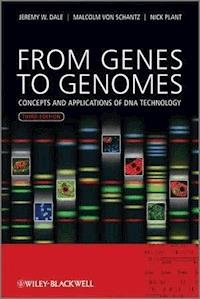
The latest edition of this highly successful textbook introduces the key techniques and concepts involved in cloning genes and in studying their expression and variation.
The new edition features:
- Increased coverage of whole-genome sequencing technologies and enhanced treatment of bioinformatics.
- Clear, two-colour diagrams throughout.
- A dedicated website including all figures.
Noted for its outstanding balance between clarity of coverage and level of detail, this book provides an excellent introduction to the fast moving world of molecular genetics.
Sie lesen das E-Book in den Legimi-Apps auf:
Seitenzahl: 630
Veröffentlichungsjahr: 2011
Ähnliche

















Contents
Cover
Title Page
Copyright
Preface
1: From Genes to Genomes
1.1 Introduction
1.2 Basic molecular biology
1.3 What is a gene?
1.4 Information flow: gene expression
1.5 Gene structure and organisation
1.6 Refinements of the model
2: How to Clone a Gene
2.1 What is cloning?
2.2 Overview of the procedures
2.3 Extraction and purification of nucleic acids
2.4 Detection and quantitation of nucleic acids
2.5 Gel electrophoresis
2.6 Restriction endonucleases
2.7 Ligation
2.8 Modification of restriction fragment ends
2.9 Plasmid vectors
2.10 Vectors based on the lambda bacteriophage
2.11 Cosmids
2.12 Supervectors: YACs and BACs
2.13 Summary
3: Genomic and cDNA Libraries
3.1 Genomic libraries
3.2 Growing and storing libraries
3.3 cDNA libraries
3.4 Screening libraries with gene probes
3.5 Screening expression libraries with antibodies
3.6 Characterization of plasmid clones
4: Polymerase Chain Reaction (PCR)
4.1 The PCR reaction
4.2 PCR in practice
4.3 Cloning PCR products
4.4 Long-range PCR
4.5 Reverse-transcription PCR
4.6 Quantitative and real-time PCR
4.7 Applications of PCR
5: Sequencing a Cloned Gene
5.1 DNA sequencing
5.2 Databank entries and annotation
5.3 Sequence analysis
5.4 Sequence comparisons
5.5 Protein structure
5.6 Confirming gene function
6: Analysis of Gene Expression
6.1 Analysing transcription
6.2 Methods for studying the promoter
6.3 Regulatory elements and DNA-binding proteins
6.4 Translational analysis
7: Products from Native and Manipulated Cloned Genes
7.1 Factors affecting expression of cloned genes
7.2 Expression of cloned genes in bacteria
7.3 Yeast systems
7.4 Expression in insect cells: baculovirus systems
7.5 Mammalian cells
7.6 Adding tags and signals
7.7 In vitro mutagenesis
7.8 Vaccines
8: Genomic Analysis
8.1 Overview of genome sequencing
8.2 Next generation sequencing (NGS)
8.3 De novo sequence assembly
8.4 Analysis and annotation
8.5 Comparing genomes
8.6 Genome browsers
8.7 Relating genes and functions: genetic and physical maps
8.8 Transposon mutagenesis and other screening techniques
8.9 Gene knockouts, gene knockdowns and gene silencing
8.10 Metagenomics
8.11 Conclusion
9: Analysis of Genetic Variation
9.1 Single nucleotide polymorphisms
9.2 Larger scale variations
9.3 Other methods for studying variation
9.4 Human genetic variation: relating phenotype to genotype
9.5 Molecular phylogeny
10: Post-Genomic Analysis
10.1 Analysing transcription: transcriptomes
10.2 Array-based methods
10.3 Transcriptome sequencing
10.4 Translational analysis: proteomics
10.5 Post-translational analysis: protein interactions
10.6 Epigenetics
10.7 Integrative studies: systems biology
11: Modifying Organisms: Transgenics
11.1 Transgenesis and cloning
11.2 Animal transgenesis
11.3 Applications of transgenic animals
11.4 Disease prevention and treatment
11.5 Transgenic plants and their applications
11.6 Transgenics: a coda
Glossary
Bibliography
General books
Laboratory manuals
Special topics
Websites
Index
This edition first published 2012 © 2012 by John Wiley & Sons, Ltd.
Wiley-Blackwell is an imprint of John Wiley & Sons, formed by the merger of Wiley's global Scientific, Technical and Medical business with Blackwell Publishing.
Registered office John Wiley & Sons, Ltd, The Atrium, Southern Gate, Chichester, West Sussex, PO19 8SQ, UK
Editorial offices 9600 Garsington Road, Oxford, OX4 2DQ, UK The Atrium, Southern Gate, Chichester, West Sussex, PO19 8SQ, UK 111 River Street, Hoboken, NJ 07030-5774, USA
For details of our global editorial offices, for customer services and for information about how to apply for permission to reuse the copyright material in this book please see our website at www.wiley.com/wiley-blackwell.
The right of the author to be identified as the author of this work has been asserted in accordance with the UK Copyright, Designs and Patents Act 1988.
All rights reserved. No part of this publication may be reproduced, stored in a retrieval system, or transmitted, in any form or by any means, electronic, mechanical, photocopying, recording or otherwise, except as permitted by the UK Copyright, Designs and Patents Act 1988, without the prior permission of the publisher.
Designations used by companies to distinguish their products are often claimed as trademarks. All brand names and product names used in this book are trade names, service marks, trademarks or registered trademarks of their respective owners. The publisher is not associated with any product or vendor mentioned in this book. This publication is designed to provide accurate and authoritative information in regard to the subject matter covered. It is sold on the understanding that the publisher is not engaged in rendering professional services. If professional advice or other expert assistance is required, the services of a competent professional should be sought.
Library of Congress Cataloging-in-Publication Data
Dale, Jeremy, Professor. From genes to genomes : concepts and applications of DNA technology / Jeremy W. Dale, Malcolm von Schantz, and Nick Plant. – 3rd ed. p. ; cm. Includes bibliographical references and index. ISBN 978-0-470-68386-6 (cloth) – ISBN 978-0-470-68385-9 (pbk.) I. Schantz, Malcolm von. II. Plant, Nick. III. Title. [DNLM: 1. Genetic Engineering. 2. Cloning, Molecular. 3. DNA, Recombinant. QU 450] LC classification not assigned 660.6′5–dc23
2011030219
A catalogue record for this book is available from the British Library.
This book is published in the following electronic formats: ePDF 9781119953159; ePub 9781119954279; Mobi 9781119954286
Preface
The first edition of this book was published in 2002. By the time of the second edition (2007) the emphasis had moved away from just cloning genes, to embrace a wider range of technologies, especially genome sequencing, the polymerase chain reaction and microarray technology. The revolution has continued unabated, indeed even accelerating, not least with the advent of high-throughput genome sequencing. In this edition we have tried to introduce readers to the excitement engendered by the latest developments – but this poses a considerable challenge. Our aim has been to keep the book to an accessible size, so including newer technologies inevitably means discarding some of the older ones. Some might maintain that we could have gone further in that direction. Some methods that have been kept are no longer as important as they once were, and maybe there is an element of sentimentality in keeping them – but there is some virtue in retaining a balance so that we can maintain a degree of historical perspective. There is a need to understand, to some extent, how we got to the position we are now in, as well as trying to see where we are going.
The main title of the book, From Genes to Genomes, is derived from the progress of this revolution. It also indicates a recurrent theme within the book, in that the earlier chapters deal with analysis and investigation at the level of individual genes, and then later on we move towards genome-wide studies – ending up with a chapter directed at the whole organism.
Dealing only with the techniques, without the applications, would be rather dry. Some of the applications are obvious – recombinant product formation, genetic diagnosis, transgenic plants and animals, and so on – and we have attempted to introduce these to give you a flavour of the advances that continue to be made, but at the same time without burdening you with excessive detail. Equally important, possibly more so, are the contributions made to the advance of fundamental knowledge in areas such as developmental studies and molecular phylogeny.
The purpose of this book is to provide an introduction to the concepts and applications of this rapidly moving and fascinating field. In writing it, we had in mind its usefulness for undergraduate students in the biological and biomedical sciences (who we assume will have a basic grounding in molecular biology). However, it will also be relevant for many others, ranging from research workers and teachers who want to update their knowledge of related areas to anyone who would like to understand rather more of the background to current controversies about the applications of some of these techniques.
Jeremy W. DaleMalcolm von SchantzNick Plant
1
From Genes to Genomes
1.1 Introduction
The classical approach to genetics starts with the identification of variants that have a specific phenotype, i.e., they differ from the wildtype in some way that can be seen (or detected in other ways) and defined. For Gregor Mendel, the father of modern genetics, this was the appearance of his peas (e.g., green versus yellow, or round versus wrinkled). One of the postulates he arrived at was that these characteristics assorted independently of one another. For example, when crossing one type of pea that produces yellow, wrinkled peas with another that produces green, round peas, the first generation (F1) are all round and yellow (because round is dominant over wrinkled, and yellow is dominant over green). In the second (F2) generation, there is a 3 : 1 mixture of round versus wrinkled peas, and independently a 3 : 1 mixture of yellow to green peas.
Of course Mendel did not know why this happened. We now know that if two genes are located on different chromosomes, which will segregate independently during meiosis, the genes will be distributed independently amongst the progeny. Independent assortment can also happen if the two genes are on the same chromosome, but only if they are so far apart that any recombination between the homologous chromosomes will be sufficient to reassort them independently. However, if they are quite close together, recombination is less likely, and they will therefore tend to remain associated during meiosis. They will therefore be inherited together. We refer to genes that do not segregate independently as linked; the closer they are, the greater the degree of linkage, i.e., the more likely they are to stay together during meiosis. Measuring the degree of linkage (linkage analysis) is a central tool in classical genetics, in that it provides a way of mapping genes, i.e., determining their relative position on the chromosome.
Bacteria and yeasts provide much more convenient systems for genetic analysis, because they grow quickly, as unicellular organisms, on defined media. You can therefore use chemical or physical mutagens (such as ultraviolet irradiation) to produce a wide range of mutations, and can select specific mutations from very large pools of organisms – remembering that an overnight culture of Escherichia coli will contain some 109 bacteria per millilitre. So we can use genetic techniques to investigate detailed aspects of the physiology of such cells, including identifying the relevant genes by mapping the position of the mutations.
For multicellular organisms, the range of phenotypes is even greater, as there are then questions concerning the development of different parts of the organism, and how each individual part influences the development of others. However, animals have much longer generation times than bacteria, and using millions of animals (especially mammals) to identify the mutations you are interested in is logistically impossible, and ethically indefensible. Human genetics is even more difficult as you cannot use selected breeding to map genes; you have to rely on the analysis of real families, who have chosen to breed with no consideration for the needs of science. Nevertheless, classical genetics has contributed extensively to the study of developmental processes, notably in the fruit fly Drosophila melanogaster, where it is possible to study quite large numbers of animals, due to their relative ease of housing and short generation times, and to use mutagenic agents to enhance the rate of variation.
However, these methods suffered from a number of limitations. In particular, they could only be applied, in general, to mutations that gave rise to a phenotype that could be defined in some way, including shape, physiology, biochemical properties or behaviour. Furthermore, there was no easy way of characterizing the nature of the mutation. The situation changed radically in the 1970s with the development of techniques that enabled DNA to be cut precisely into specific fragments, and to be joined together, enzymatically –techniques that became known variously as genetic manipulation, genetic modification, genetic engineering or recombinant DNA technology. The term ‘gene cloning’ is also used, since joining a fragment of DNA with a vector such as a plasmid that can replicate in bacterial cells enabled the production of a bacterial strain (a clone) in which all the cells contained a copy of this specific piece of DNA. For the first time, it was possible to isolate and study specific genes. Since such techniques could be applied equally to human genes, the impact on human genetics was particularly marked.
The revolution also depended on the development of a variety of other molecular techniques. The earliest of these (actually predating gene cloning) was , which enabled the identification of specific DNA sequences on the basis of their sequence similarity. Later on came methods for determining the sequence of these DNA fragments, and the polymerase chain reaction (PCR), which provided a powerful way of amplifying specific DNA sequences. Combining those advances with automation, plus the concurrent advance in computer power, led to the determination of the full genome sequence of many organisms, including the human genome, and thence to enormous advances in understanding the roles of genes and their products. In recent years, sequencing technology has advanced to a stage where it is now a routine matter to sequence the full genome of many individuals, and thus attempt to pinpoint the causes of the differences between them, including some genetic diseases.
Lesen Sie weiter in der vollständigen Ausgabe!
Lesen Sie weiter in der vollständigen Ausgabe!
Lesen Sie weiter in der vollständigen Ausgabe!
Lesen Sie weiter in der vollständigen Ausgabe!
Lesen Sie weiter in der vollständigen Ausgabe!
Lesen Sie weiter in der vollständigen Ausgabe!
Lesen Sie weiter in der vollständigen Ausgabe!
Lesen Sie weiter in der vollständigen Ausgabe!
Lesen Sie weiter in der vollständigen Ausgabe!
Lesen Sie weiter in der vollständigen Ausgabe!
Lesen Sie weiter in der vollständigen Ausgabe!
Lesen Sie weiter in der vollständigen Ausgabe!
Lesen Sie weiter in der vollständigen Ausgabe!




