


30,99 €
Mehr erfahren.
- Herausgeber: John Wiley & Sons
- Kategorie: Wissenschaft und neue Technologien
- Sprache: Englisch
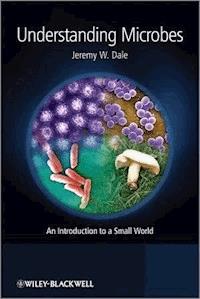
We can’t see them, but microbes are the dominant form of life on Earth. They make up half of the world’s biomass. They were here billions of years before we were, and they will be here after we are gone. Without their activity, life as we know it would be impossible. Even within our own bodies, there are ten times as many bacterial cells as human cells. Understanding Microbes provides a clear, accessible introduction to this world of microbes.
As well as looking at a selection of infectious diseases, including how they are prevented and treated, the book explores the importance of microbes in the environment, in the production and preservation of food, and their applications in biotechnology.
This lively and engaging book provides the basics of microbiology, in a contemporary context. It will be equally useful for students across the biological, environmental and health sciences, and for the curious reader wanting to learn more about this fascinating subject.
- A highly-readable, concise introduction to the basics of microbiology placed in the context of the very latest developments in molecular biology and their impact on the microbial world.
- Numerous real-world examples range from how cows digest grass to the role of microbes in cancer and the impact of climate change
- Well-illustrated in full colour throughout.
- Written by an Author with a proven track record in teaching, writing and research.
Sie lesen das E-Book in den Legimi-Apps auf:
Seitenzahl: 510
Veröffentlichungsjahr: 2012
Ähnliche

















Contents
Cover
Title Page
Copyright
Preface
Chapter 1: The Background
1.1 Meet the Cast
1.2 Food for Microbes
1.3 Basic Molecular Biology
Chapter 2: Microbes and Health
2.1 Microbes in the Body
2.2 Defences Against Infection
Chapter 3: Microbial Infections
3.1 Diseases of the Past
3.2 Diseases of the Present
3.3 Opportunist Infections
3.4 ‘New’ Diseases
3.5 Animal Diseases
Chapter 4: Prevention and Cure
4.1 Epidemics
4.2 Antibiotics
Chapter 5: Microbes and Food – Friend and Foe
5.1 Food Spoilage
5.2 Food Preservation
5.3 Fermented Foods
5.4 Food Poisoning and Food-Borne Diseases
Chapter 6: Microbes and the Environment
6.1 Water
6.2 Soil
6.3 Plants
6.4 Biodegradation
6.5 Extreme Environments
Chapter 7: Microbial Evolution – Genes and Genomes
7.1 Evolution and Inheritance
7.2 Horizontal Gene Transfer
7.3 Variation in Gene Expression
7.4 Gene Cloning and Sequencing
Chapter 8: Microbial Development and Communication
8.1 Cell Division
8.2 Motility
8.3 Biofilms
8.4 Quorum Sensing
8.5 Bacterial Sporulation
8.6 Multicellular Behaviour
8.7 Biological Clocks
Chapter 9: Microbial Biotechnology – Practical Uses of Microbes
9.1 Amino Acids
9.2 Biofuels
9.3 Microbes and Metals
9.4 Oil Spills
9.5 Sewage and Water Treatment
9.6 Antibiotics and other Medical Products
9.7 Vaccines
9.8 Proteins
Chapter 10: Controversies and Speculations
10.1 Evolution and the Origins of Life
10.2 Is there Life elsewhere in the Universe?
10.3 Creating new Life
10.4 Is it safe? Assessment of Risk, Risk Versus Benefit
10.5 Superbugs and Killer Viruses
10.6 Microbes and Climate Change
10.7 Microbes and Non-Infectious Diseases
10.8 Epilogue
Appendix 1: Explanations
A1.1 Monomers and Polymers
A1.2 Enzymes and Catalysis
Appendix 2: Abbreviations and Terminology
A2.1 Abbreviations and jargon
A2.2 Numbers
A2.3 Units
Appendix 3: Further Reading
Introductory Level
Special Topics
More Serious Reading
Subject Index
Index of Names
This edition first published 2013 © 2013 by John Wiley & Sons, Ltd
Wiley-Blackwell is an imprint of John Wiley & Sons, formed by the merger of Wiley's global Scientific, Technical and Medical business with Blackwell Publishing.
Registered office: John Wiley & Sons, Ltd, The Atrium, Southern Gate, Chichester, West Sussex, PO19 8SQ, UK
Editorial offices: 9600 Garsington Road, Oxford, OX4 2DQ, UK
The Atrium, Southern Gate, Chichester, West Sussex, PO19 8SQ, UK
111 River Street, Hoboken, NJ 07030-5774, USA
For details of our global editorial offices, for customer services and for information about how to apply for permission to reuse the copyright material in this book please see our website at www.wiley.com/wiley-blackwell.
The right of the author to be identified as the author of this work has been asserted in accordance with the UK Copyright, Designs and Patents Act 1988.
All rights reserved. No part of this publication may be reproduced, stored in a retrieval system, or transmitted, in any form or by any means, electronic, mechanical, photocopying, recording or otherwise, except as permitted by the UK Copyright, Designs and Patents Act 1988, without the prior permission of the publisher.
Designations used by companies to distinguish their products are often claimed as trademarks. All brand names and product names used in this book are trade names, service marks, trademarks or registered trademarks of their respective owners. The publisher is not associated with any product or vendor mentioned in this book. This publication is designed to provide accurate and authoritative information in regard to the subject matter covered. It is sold on the understanding that the publisher is not engaged in rendering professional services. If professional advice or other expert assistance is required, the services of a competent professional should be sought.
Library of Congress Cataloging-in-Publication Data
Dale, Jeremy (Jeremy W.)
Understanding microbes: an introduction to a small world / Jeremy Dale.
pages cm
Includes bibliographical references and index.
ISBN 978-1-119-97880-0 (hardback) – ISBN 978-1-119-97879-4 (paper) 1. Microorganisms–Textbooks. 2. Microbiology–Textbooks. I. Title.
QR41.2.D35 2013
579–dc23
2012032317
A catalogue record for this book is available from the British Library.
Wiley also publishes its books in a variety of electronic formats. Some content that appears in print may not be available in electronic books.
Preface
I suspect that you already know more about microbes than you think you do. You will have heard about microbes that cause disease, and you probably know that yeast is used in making bread, wine and beer, and that yoghurt contains ‘friendly bacteria’. You may have noticed lichens on stones or the bark of trees; and even familiar fungi such as mushrooms can be considered as a form of microbe. However, the subject of microbes goes far beyond that. You may not know that there are ten times more bacteria in your intestines than there are human cells in your body, nor that microbes make up 50 per cent of the world's biomass and carry out as much photosynthesis as all the land plants combined. You may not be aware that, in the depths of the oceans, there are microbes that will only grow at temperatures above the normal boiling point of water, nor that up to 20 per cent of cancers are caused by viruses, nor that some ants cultivate fungal gardens to digest the plant material they bring back to their nest. Nor, indeed, that for the first two billion years of life on Earth, there were only microbes.
The purpose of this book is to introduce you to this ‘small world’ – a world which, although we don't realize it, is dominated by microbes. They were here long before we were, and they will be here after we have gone. Climate change may succeed in eliminating many of the forms of life we see around us, but the bacteria will survive.
Clearly, in a book this size, I cannot cover all of these aspects of microbial activity thoroughly. So, rather than reducing the subject to a set of lists, I decided to adopt a more selective approach. Some topics are dealt with at length, where I felt there was an interesting story to tell – and, conversely, a lot of topics are left out altogether, or dealt with rather briefly. Thus, this is not a systematic textbook, and I am sure that my colleagues will grumble about the omissions.
At the same time, to try to keep it accessible to a wider readership, I have tried to cut out unnecessary jargon and technical detail. It does get a bit technical in the molecular biology section (as a molecular biologist, I couldn't resist the temptation!) – but with the justification that these techniques have told us so much about what goes on that some understanding of them is needed. For example, you have to know a bit about genome sequencing to appreciate how we know that over 99 per cent of the microbes in the ocean were previously totally unknown. I hope you enjoy the result and that you come away feeling you want to find out more.
Finally, I owe a great debt of gratitude to my wife Angela, not only for tolerating me shutting myself away for days on end, but also for nobly reading right through a draft version, from the viewpoint of a non-microbiologist, and making many valuable suggestions. In the traditional manner, I have to absolve her from responsibility for any errors there might be, for which I have to be answerable.
Jeremy W. Dale
1
The Background
1.1 Meet the Cast
The main point about microbes is that they are very small. Their one unifying feature is that they are too small to be seen without the aid of a microscope – although even that definition, as we will see later on, is blurred at the edges, as some of the ‘microbes’ I will consider are actually quite big. Within the basic definition, there is a substantial range of diversity. You will probably have heard of some of these microbes, such as the influenza virus or the bacterium known as MRSA, as they regularly make the news because they inflict themselves on us. Others may also be familiar because of their everyday role in fermentation – think of the yeasts that are needed for the production of bread, wine and beer, and the ‘friendly’ bacteria that are used for yogurt making. As we will see later on, there are very many more examples of a wide range of microbes that are of direct importance to us, both in disease (and health) and economically.
But this is only the tip of an enormous iceberg. Microbes are all around us, in vast numbers and diversity, especially in soil and water. It has been estimated that the world has 1031 bacteria – that's 1 with 31 zeros after it – with a total biomass greater than all the plants and animals combined (and that is just the bacteria, before we add in the other microbes – viruses, fungi, algae and protozoa). They play a massive role in shaping our environment, including fixing carbon and nitrogen from the air – and, by degrading organic matter, in releasing these elements again into the air. Our knowledge of the diversity of microbes in the environment has increased enormously in recent years. Molecular techniques that we will encounter in a later chapter have shown that most (perhaps 99 per cent) of these organisms were previously totally unknown and have never been grown in the laboratory.
We can begin the story in the 17th century, in Holland. Antonie van Leeuwenhoek was born in Delft, in 1632. After an apprenticeship with a cloth merchant, he set up his own drapery business and became a prosperous and influential citizen of Delft. Having seen the magnifying glasses used by textile merchants for examining the cloth, he developed an interest in the use of lenses and started to make his own as a hobby. Although his ‘microscopes’ were simple by modern standards – consisting of just a single lens – the superb quality of his lenses, and his skill and patience in using them, enabled him to make many important observations. These included the first descriptions of microscopic single-celled organisms (which he called ‘animalcules’), which he reported to the Royal Society in London in 1676.
These observations met with a considerable amount of scepticism but, eventually, after much further investigation, his achievements were recognized and he became a Fellow of the Royal Society in 1680. He continued to make many further detailed observations, such as the description of bacteria in plaque from teeth, until shortly before his death in 1723. Unfortunately, he kept secret some of the crucial details as to how he made his lenses, so, with his death, that part of the story came to an end.
However, others had also developed and used microscopes at around that time. Robert Hooke (1635–1703) is perhaps best known today for his study of the elasticity of materials, described by the mathematical relationship we still know as Hooke's Law. But that was far from the total of his interests or achievements, which ranged from experimental science to architecture. The part of his work we are concerned with here was his role in the development of the compound microscope (which, like a modern microscope, contained two lenses rather than the single lens used by van Leeuwenhoek).
Lesen Sie weiter in der vollständigen Ausgabe!
Lesen Sie weiter in der vollständigen Ausgabe!
Lesen Sie weiter in der vollständigen Ausgabe!
Lesen Sie weiter in der vollständigen Ausgabe!
Lesen Sie weiter in der vollständigen Ausgabe!
Lesen Sie weiter in der vollständigen Ausgabe!
Lesen Sie weiter in der vollständigen Ausgabe!
Lesen Sie weiter in der vollständigen Ausgabe!
Lesen Sie weiter in der vollständigen Ausgabe!
Lesen Sie weiter in der vollständigen Ausgabe!
Lesen Sie weiter in der vollständigen Ausgabe!
Lesen Sie weiter in der vollständigen Ausgabe!
Lesen Sie weiter in der vollständigen Ausgabe!
Lesen Sie weiter in der vollständigen Ausgabe!




