


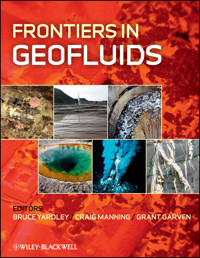
Frontiers in Geofluids E-Book
91,99 €
Mehr erfahren.
- Herausgeber: John Wiley & Sons
- Kategorie: Wissenschaft und neue Technologien
- Sprache: Englisch
Frontiers in Geofluids is a collection of invited papers chosen to highlight recent developments in our understanding of geological fluids in different parts of the Earth, and published to mark the first ten years of publication of the journal Geofluids. The scope of the volume ranges from the fundamental properties of fluids and the phase relationships of fluids encountered in nature, to case studies of the role of fluids in natural processes. New developments in analytical and theoretical approaches to understanding fluid compositions, fluid properties, and geological fluid dynamics across a wide range of environments are included. A recurrent theme of research published in Geofluids is the way in which similar approaches can be applied to geological fluids in very different settings and this is reflected in the diverse range of applications of fluid studies that are included here. They include deep groundwater flow, hydrocarbons in faulted sedimentary basins, hydrothermal ores, and multiphase flow in mid-ocean ridge systems. Other topics covered are geothermal waters, crustal metamorphism, and fluids in magmatic systems. The book will be of great interest to researchers and students interested in crustal and mantle fluids of all sorts.
Sie lesen das E-Book in den Legimi-Apps auf:
Seitenzahl: 1080
Veröffentlichungsjahr: 2011
Ähnliche




















CONTENTS
List of Contributors
Frontiers in geofluids: introductionG. Garven, C. E. Manning and B. W. D. Yardley
Aqueous fluids at elevated pressure and temperatureA. Liebscher
Thermodynamic model for mineral solubility in aqueous fluids: theory, calibration and application to model fluid-flow systemsD. Dolejš and C. E. Manning
Metal complexation and ion association in hydrothermal fluids: insights from quantum chemistry and molecular dynamicsD. M. Sherman
Role of saline fluids in deep-crustal and upper-mantle metasomatism: insights from experimental studiesR. C. Newton and C. E. Manning
Potential of palaeofluid analysis for understanding oil charge historyJ. Parnell
Spatial variations in the salinity of pore waters in northern deep water Gulf of Mexico sediments: implications for pathways and mechanisms of solute transportJ. S. Hanor and J. A. Mercer
Faults and fault properties in hydrocarbon flow modelsT. Manzocchi, C. Childs and J. J. Walsh
Hydrostratigraphy as a control on subduction zone mechanics through its effects on drainage: an example from the Nankai Margin, SW JapanD. M. Saffer
The interplay of permeability and fluid properties as a first order control of heat transport, venting temperatures and venting salinities at mid-ocean ridge hydrothermal systemsT. Driesner
Using seafloor heat flow as a tracer to map subseafloor fluid flow in the ocean crustA. T. Fisher and R. N. Harris
The potential for abiotic organic synthesis and biosynthesis at seafloor hydrothermal systemsE. Shock and P. Canovas
Permeability of the continental crust: dynamic variations inferred from seismicity and metamorphismS. E. Ingebritsen and C. E. Manning
Hydrologic responses to earthquakes and a general metricChi-Yuen Wang and Michael Manga
The application of failure mode diagrams for exploring the roles of fluid pressure and stress states in controlling styles of fracture-controlled permeability enhancement in faults and shear zonesS. F. Cox
Rates of retrograde metamorphism and their implications for crustal rheologyB. W. D. Yardley, D. E. Harlov and W. Heinrich
Fluids in the upper continental crustKurt Bucher and Ingrid Stober
Fluid-induced processes: metasomatism and metamorphismA. Putnis and H. Austrheim
Fluid flows and metal deposition near basement ⁄cover unconformity: lessons and analogies from Pb–Zn–F–Ba systems for the understanding of Proterozoic U depositsM.-C. Boiron, M. Cathelineau and A. Richard
Magmatic fluids immiscible with silicate melts: examples from inclusions in phenocrysts and glasses, and implications for magma evolution and metal transportVadim S. Kamenetsky and Maya B. Kamenetsky
Index
Frontiers in Geofluids
This edition first published 2011 © 2011 by Blackwell Publishing LtdOriginally published as Volume 10, Numbers 1-2 of Geofuids
Blackwell Publishing was acquired by John Wiley & Sons in February 2007. Blackwell’s publishing program has been merged with Wiley’s global Scientific, Technical and Medical business to form Wiley-Blackwell.
Registered OfficeJohn Wiley & Sons Ltd, The Atrium, Southern Gate, Chichester, West Sussex, PO19 8SQ, UK
Editorial Offices9600 Garsington Road, Oxford, OX4 2DQ, UKThe Atrium, Southern Gate, Chichester, West Sussex, PO19 8SQ, UK111 River Street, Hoboken, NJ 07030-5774, USA
For details of our global editorial offices, for customer services and for information about how to apply for permission to reuse the copyright material in this book please see our website at www.wiley.com/wiley-blackwell.
The right of the author to be identified as the author of this work has been asserted in accordance with the UK Copyright, Designs and Patents Act 1988.
All rights reserved. No part of this publication may be reproduced, stored in a retrieval system, or transmitted, in any form or by any means, electronic, mechanical, photocopying, recording or otherwise, except as permitted by the UK Copyright, Designs and Patents Act 1988, without the prior permission of the publisher.
Designations used by companies to distinguish their products are often claimed as trademarks. All brand names and product names used in this book are trade names, service marks, trademarks or registered trademarks of their respective owners. The publisher is not associated with any product or vendor mentioned in this book. This publication is designed to provide accurate and authoritative information in regard to the subject matter covered. It is sold on the understanding that the publisher is not engaged in rendering professional services. If professional advice or other expert assistance is required, the services of a competent professional should be sought.
Library of Congress Cataloguing-in-Publication Data has been applied for.
ISBN 978-1-4443-3330-5
A catalogue record for this book is available from the British Library.
This book is published in the following electronic formats: ePDF 978-1-4443-9488-7; Wiley Online Library 978-1-4443-9490-0; ePub 978-1-4443-9489-4
CONTRIBUTORS
H. Austrheim
Physics of Geological Processes, University of Oslo, Oslo, Norway
M.-C. Boiron
G2R, Nancy Université CNRS, CREGU, Vandoeuvre lés Nancy, France
Kurt Bucher
Institute of Geosciences, Geochemistry, University of Freiburg, Freiburg, Germany
P. Canovas
GEOPIG, School of Earth & Space Exploration Arizona State University, Tempe, AZ, USA
M. Cathelineau
G2R, Nancy Université, CNRS, CREGU, Vandoeuvre lés Nancy, France
C. Childs
Fault Analysis Group, UCD School of Geological Sciences, University College Dublin, Dublin, Ireland
S. F. Cox
Research School of Earth Sciences, The Australian National University, Canberra, ACT, Australia
D. Dolejš
Bayerisches Geoinstitut, University of Bayreuth, Bayreuth, Germany and Institute of Petrology and Structural Geology, Charles University, Praha, Czech Republic
T. Driesner
Department of Earth Sciences, ETH Zurich, Switzerland
A. T. Fisher
Earth and Planetary Sciences Department and Institute for Geophysics and Planetary Physics, University of California, Santa Cruz, CA, USA
G. Garven
Department of Geology, Tufts University, Medford, MA, USA
J. S. Hanor
Department of Geology and Geophysics, Louisiana State University, Baton Rouge, LA, USA
D. E. Harlov
Section 3.3, Chemistry and Physics of Earth Materials, Deutsches GeoForschungsZentrum, Telegrafenberg, Potsdam, Germany
R. N. Harris
College of Oceanic and Atmospheric Sciences, Oregon State University, Corvallis, OR, USA
W. Heinrich
Section 3.3, Chemistry and Physics of Earth Materials, Deutsches GeoForschungsZentrum, Telegrafenberg, Potsdam, Germany
S. E. Ingebritsen
US Geological Survey, Menlo Park, CA, USA
Maya B. Kamenetsky
ARC Centre of Excellence on Ore Deposits and School of Earth Sciences, University of Tasmania, Hobart, Tas., Australia
Vadim S. Kamenetsky
ARC Centre of Excellence on Ore Deposits and School of Earth Sciences, University of Tasmania, Hobart, Tas., Australia
A. Liebscher
Centre for CO2 Storage, Helmholtz Centre Potsdam, German Research Centre for Geosciences GFZ, Telegrafenberg, Potsdam, Germany
Michael Manga
Department of Earth and Planetary Science, University of California, Berkeley, CA, USA
C. E. Manning
Department of Earth and Space Sciences, University of California, Los Angeles, CA, USA
T. Manzocchi
Fault Analysis Group, UCD School of Geological Sciences, University College Dublin, Dublin, Ireland
J. A. Mercer
Department of Geology and Geophysics, Louisiana State University, Baton Rouge, LA, USA
R. C. Newton
Department of Earth and Space Sciences, University of California, Los Angeles, CA, USA
J. Parnell
Department of Geology and Petroleum Geology, University of Aberdeen, Aberdeen, UK
A. Putnis
Institut fur Mineralogie, University of Munster, Munster, Germany
A. Richard
G2R, Nancy Universite, CNRS, CREGU, Vandoeuvre les Nancy, France
D. M. Saffer
Department of Geosciences, The Pennsylvania State University, University Park, PA, USA
D. M. Sherman
Department of Earth Sciences, University of Bristol, Bristol UK.
E. Shock
GEOPIG, School of Earth & Space Exploration and Department of Chemistry & Biochemistry, Arizona State University, Tempe, AZ, USA
Ingrid Stober
Institute of Geosciences, Geochemistry, University of Freiburg, Freiburg, Germany
J. J. Walsh
Fault Analysis Group, UCD School of Geological Sciences, University College Dublin, Dublin, Ireland
Chi-Yuen Wang
Department of Earth and Planetary Science, University of California, Berkeley, CA, USA
B. W. D. Yardley
School of Earth and Environment, University of Leeds,Leeds, UK
INTRODUCTION
Frontiers in geofluids: introduction
This set of papers was originally published electronically as a special double issue of Geofluids to mark the tenth anniversary of the launch of the journal. For this volume, we sought to bring together a collection of papers spanning a range of topics to which the role of fluids in the Earth is central. Geofluids was founded to help emphasise the common ground between fluid processes that take place in different geological settings, and to provide an outlet for research that considers the interactions of chemical and physical processes. While we cannot pretend to provide a comprehensive coverage of all the important recent advances, we are delighted to have been able to bring together some excellent and wide-ranging new science that continues in this tradition.
The first four articles all concern our fundamental theoretical and experimental understanding of essentially aqueous fluids. Liebscher provides an overview of the properties of water-rich fluid systems and how these are affected by solutes, while noting the remaining limitations in the experimental database. Dolejs and Manning present the first comprehensive study to produce a more flexible alternative to the HKF model for aqueous electrolytes, better suited to the range of compositions and conditions encountered in nature, while Sherman shows how modern computational power means that some fundamental problems in natural fluid chemistry can be addressed from first principles using quantum chemistry and molecular dynamics. In the final article in this section, Newton and Manning review recent experimental results for lower crustal conditions and present new data to quantify the importance of dissolved salts for the solubility of the major rock-forming elements, Si and Al, and for a range of important Ca-minerals.
The second group of articles relate to a specific geological setting where fluid processes are of the highest importance: sedimentary basins. Parnell provides a concise review of the use of hydrocarbon fluid inclusions to understand the evolution of reservoirs through time and the relationships between fluid stages and mineral cements. He shows in particular how this approach has contributed to understanding the oil charge history of the North Sea and UK Atlantic margin. Hanor and Mercer describe the behaviour of saline waters and their distribution in the Gulf of Mexico, and show how salinity differences arising through salt dissolution can dictate flow patterns. They also explore the likely impacts of salt on the potential of the region as a source of methane hydrates. The article by Manzocchi, Childs and Walsh reviews how faults affect the flow of fluids, in particular hydrocarbons, in siliciclastic basins, and also comment on the extent to which current industry practice for evaluating the effects of faults is actually grounded in science.
A third group of article deals with fluid processes in oceanic settings. Saffer has modelled the lateral variations along the Nankai margin of Japan and shown that large scale variations along strike in the taper angle of the accretionary wedge can be linked back to lithological variations from more turbidite-rich sequences to mudrocks. The lithology affects the development of fluid overpressure and the draining of the subduction zone fault, which in turn influences the overall geometry of the wedge. The interplay between permeability, heat flow and discharge characteristics at mid-ocean ridges is explored by Driesner. His results support some findings from terrestrial geothermal systems: high temperature discharges, and the highest fluid salinities, may be associated with low fluid fluxes, while large discharges at relatively low temperatures may in fact dominate the removal of heat. Fisher and Harris take three specific examples of mid-ocean ridge settings to explore the controls on heat loss. The relative importance of conductive heat loss is variable, and specific features of the basement geology can serve to target fluid flow and hence heat loss. Hydrothermal vents are also of likely significance for both abiotic and metabolic organosynthesis and this is explored by Shock and Canovas. Different patterns of mixing of seawater with different hydrothermal fluids can lead to different evolutionary paths, but in general, the mixing favours formation of organic compounds from inorganic reactants. Hence, microbes could produce components of biomolecules simply by catalysis of reactions that are already energetically favoured.
A fourth group of articles deals with the continental crust. Ingebritsen and Manning present a crustal-scale overview of permeability and argue that while there is a power-law relation between permeability and depth in tec-tonically active continental crust, some regions exhibit markedly higher permeabilities, probably as transients, while stable crust may decay to lower permeability. The specific issue of the relationship of hydrologic response to earthquake activity is discussed by Wang and Manga. They demonstrate that, in the intermediate and far-field, changes in groundwater flow are linked to changes in permeability which arise in response to cyclic deformation and oscillatory flow. The relationships between faulting and flow at depth is explored by Cox, who shows how fluid pressure and stress influence failure modes and hence the styles of permeability enhancement and vein development, in both mineralized and unmineralized systems. Fluid flow coupled to deformation often introduces water into high grade crystalline basement rocks which undergo retrogression. Yardley, Harlov and Heinrich present the results of experiments designed to measure the rate at which high grade rocks undergo retrogression under mid- to lower-crustal conditions, and conclude that water infiltrated along fine cracks is likely to be rapidly consumed. The article by Bucher and Stober addresses deep groundwaters found in crystalline basement rocks today by tunnelling and drilling. They argue that in areas of high relief such as the Alps, such waters are of relatively low TDS because of flushing by meteoric water, whereas much more saline brines may evolve where the hydraulic gradients are less. Migration of fluids can lead to mineralogical and chemical changes (metasomatism) in a wide variety of crustal settings, and Putnis and Austreheim explore some diverse examples of metasomatism on a range of scales. They are able to demonstrate that, while aqueous fluids partly act as a catalyst to permit minerals to react, they can also influence the course of the reaction through a thermodynamic role.
The final section comprises two interdisciplinary articles that deal with ore deposits and draw on a range of aspects of fluids. Boiron, Cathelineau and Richard review the fluid systems that give rise to ore deposits near the unconformity between sedimentary basins and their underlying crystalline basement. They contrast the Proterozoic unconformity uranium deposits with younger base metal deposits that develop in similar settings, and conclude that there are many similarities in both the nature of the fluids and the flow patterns that give rise to mineralization. Kamenetsky and Kamenetsky evaluate fluid processes at the other temperature extreme of ore formation, associated with magmatism. They present evidence from inclusions to document the development of immiscibility as magmas cool, and evaluate the importance of immiscibility for magma chamber processes, including degassing and the partitioning of metals.
Although we have grouped the articles for convenience, we believe that the true value of the collection arises from the basic new data presented, from the insight into the interactions between physical and chemical processes, and from the opportunity they provide to take ideas developed in a field where particular types of observation or measurement may be possible to understand processes in different settings or at different times, where different types of data may be available.
G. GARVEN1, C. E. MANNING 2 and B. W. D. YARDLEY3
1Department of Geology, Tufts University, Medford, MA,USA; 2Department of Earth and Space Sciences, University of California, Los Angeles, CA, USA;3School of Earth and Environment, University of Leeds, Leeds, UKCorresponding author: B. W. D. YardleySchool of Earth and Environment,University of Leeds,Leeds LS2 9JT, UK.
Email: B. W. D. [email protected].
Tel: +44 113 343 5227. Fax: +44 113 343 5259.




