


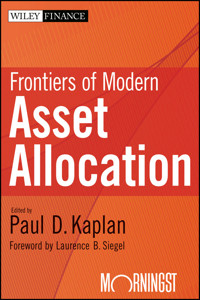
Frontiers of Modern Asset Allocation E-Book
60,99 €
Mehr erfahren.
- Herausgeber: John Wiley & Sons
- Kategorie: Fachliteratur
- Serie: Wiley Finance Editions
- Sprache: Englisch
Innovative approaches to putting asset allocation into practice Building on more than 15 years of asset-allocation research, Paul D. Kaplan, who led the development of the methodologies behind the Morningstar Rating(TM) and the Morningstar Style Box(TM), tackles key challenges investor professionals face when putting asset-allocation theory into practice. This book addresses common issues such as: * How should asset classes be defined? * Should equities be divided into asset classes based on investment style, geography, or other factors? * Should asset classes be represented by market-cap-weighted indexes or should other principles, such as fundamental weights, be used? * How do actively managed funds fit into asset-class mixes? Kaplan also interviews industry luminaries who have greatly influenced the evolution of asset allocation, including Harry Markowitz, Roger Ibbotson, and the late Benoit Mandelbrot. Throughout the book, Kaplan explains allocation theory, creates new strategies, and corrects common misconceptions, offering original insights and analysis. He includes three appendices that put theory into action with technical details for new asset-allocation frameworks, including the next generation of portfolio construction tools, which Kaplan dubs "Markowitz 2.0."
Sie lesen das E-Book in den Legimi-Apps auf:
Seitenzahl: 559
Veröffentlichungsjahr: 2011
Ähnliche




















Contents
Cover
Series
Title Page
Copyright
Dedication
Foreword
ARE STOCKS RISKY IN THE LONG RUN?
SURVIVAL BIAS: DID YOU KNOW IN ADVANCE THAT THE UNITED STATES AND UNITED KINGDOM WOULD SUCCEED?
SAMPLE PERIOD BIAS: WERE THE PAST 200 YEARS REALLY TYPICAL?
Introduction
A Note on Expected Return and Geometric Mean
MATHEMATICAL FORMULATION
NUMERICAL EXAMPLES
Acknowledgments
PART ONE: Equities
EQUITY STYLES AS ASSET CLASSES
FLAWS OF FUNDAMENTAL INDEXATION
ESTIMATION ISSUES
CHAPTER 1: Purity of Purpose: How Style-Pure Indexes Provide Useful Insights
THE PAST TO PRESENT
THE STATE OF THE ART
WHAT REALLY MATTERS
WHAT THIS MEANS FOR INVESTORS
CONCLUSION
CHAPTER 2: Investing in Europe with Style
U.S. STYLE: A HISTORY
STYLE INVESTING IN EUROPE
INTRODUCING MORNINGSTAR EUROPEAN STYLE INDEXES
CHAPTER 3: Why Fundamental Indexation Might—or Might Not—Work
THE INDEPENDENCE ASSUMPTION
WHY FUNDAMENTAL INDEXATION MIGHT WORK
THE VALUE BIAS
TOWARD A BETTER WEIGHTING METHOD
CONCLUSION
APPENDIX 3A: DERIVATION OF OPTIMAL COMBINATION OF FUNDAMENTAL AND MARKET VALUES
CHAPTER 4: The Fundamental Debate: Two Experts Square Off on the Big Issues Surrounding Fundamentally Weighted Indexes
CHAPTER 5: Collared Weighting: A Hybrid Approach to Indexing
COLLARED WEIGHTING METHODOLOGY
DATA
IMPACT OF COLLARING
PERFORMANCE
TURNOVER AND IMPACT COSTS
CONCLUSION
APPENDIX 5A: THE MATHEMATICS OF COLLAR WEIGHTING
APPENDIX 5B: FUNDAMENTAL MEASURES OF COMPANY SIZE
CHAPTER 6: Yield to Investors? A Practical Approach to Building Dividend Indexes
BACK TO BASICS
APPLYING THE PRINCIPLES
A NEW APPROACH
THE AVAILABLE-DIVIDEND PHILOSOPHY
VALUE OF SCALABILITY
TURNOVER
CHOOSING THE RIGHT TOOLS
CONCLUSION
CHAPTER 7: Holdings-Based and Returns-Based Style Models
REVIEW OF STYLE ANALYSIS
OVERVIEW OF THIS STUDY
THE MORNINGSTAR EQUITY-STYLE MODEL
RETURNS-BASED STYLE ANALYSIS
DATA AND CALCULATIONS
RESULTS
REASONS WHY RETURNS-BASED STYLE ANALYSIS MIGHT BREAK DOWN
CONCLUSION
APPENDIX 7A: CONFIDENCE REGIONS FOR ESTIMATE STYLE CENTROIDS
CHAPTER 8: Estimates of Small Stock Betas Are Much Too Low
FIRM SIZE AND BETA ESTIMATION
BETA AS A PREDICTOR OF RETURNS
BETA AND THE SIZE EFFECT
CONCLUSION
CHAPTER 9: A Macroeconomic Model of the Equity Risk Premium
METHODOLOGY
DATA
REGRESSION RESULTS
THE COST OF CAPITAL
CONCLUSION
PART TWO: Fixed Income, Real Estate, and Alternatives
CHAPTER 10: Good and Bad Monetary Economics, and Why Investors Need to Know the Difference
GOOD NEWS IS BAD NEWS?
MYTHS ABOUT MONEY, INFLATION, AND THE ECONOMY
WHY BAD MONETARY ECONOMICS THRIVES IN THE POPULAR IMAGINATION
GOOD ECONOMICS VERSUS BAD ECONOMICS IN GENERAL
GOOD AND BAD MONETARY ECONOMICS
HOW MONETARY ECONOMICS BECAME CONFUSED
THE RETURN OF SOUND MONETARY ECONOMICS AMONG ACADEMIC ECONOMISTS
WHAT MONETARY ECONOMICS REALLY SAYS
CHAPTER 11: Inflation, Gilt Yields, and Economic Policy
CHAPTER 12: Reverse Mean-Variance Optimization for Real Estate Asset-Allocation Parameters
ASSUMPTIONS AND INPUTS
MARKET-CAP WEIGHTS
GEOMETRIC AND ARITHMETIC MEANS
RESULTS
CHAPTER 13: The Long and Short of Commodity Indexes
NO SUCH THING AS COMMODITY BETA
NOT ALL INDEXES ARE ALIKE
SOURCES OF EXCESS RETURN
THE SPOT COMMODITY MARKETS
THE FUTURES MARKET
THE STORAGE MARKET
THE STORAGE MARKET AND THE SLOPE OF THE FUTURES PRICE CURVE
BUILDING A BETTER STRATEGY
THE IMPORTANCE OF TERM STRUCTURE AND CORRESPONDING LINKING FACTOR
THE CONSTRUCTION OF THE LONG/SHORT COMMODITY INDEXES
HOW THEY STACK UP
THE LONG AND SHORT OF IT
CHAPTER 14: Less Alpha and More Beta Than Meets the Eye
CHAPTER 15: Venture Capital and its Role in Strategic Asset Allocation
DATA
THE MODEL
ESTIMATION OF AVERAGE RETURN, STANDARD DEVIATION, AND CORRELATION
RESULTS
CONCLUSION
PART THREE: Crashes and Fat Tails
CHAPTER 16: One-and-a-Quarter Centuries of Stock Market Drawdowns
TRUTH IN NUMBERS
CHAPTER 17: Stock Market Bubbles and Crashes: A Global Historical and Economic Perspective
THE U.S. RECORD
THE U.K. RECORD
THE JAPANESE RECORD
DRAWDOWNS DURING THE LONG BOOM (1982 TO 2007)
WHY DO CRASHES OCCUR?
ECONOMIC THOUGHT AND FINANCIAL CRISES
2007 TO 2009 CRASH
WHAT HAVE WE LEARNED?
CHAPTER 18: Déjà Vu All Over Again
MEASURING RISK: THE STANDARD MODEL
AN ALTERNATIVE APPROACH: LOG-STABLE DISTRIBUTIONS
RISK MEASURES VERSUS RISK MODELS
CONCLUSION
CHAPTER 19: Déjà Vu Around the World
MODELING RISK: THE STANDARD MODEL
AN ALTERNATIVE APPROACH: LOG-STABLE DISTRIBUTIONS
RISK MEASURES
CONCLUSION
APPENDIX 19A: LOG-STABLE ANALYSIS
CHAPTER 20: Getting a Read on Risk: A Discussion with Roger Ibbotson, George Cooper, and Benoît Mandelbrot on the Crisis and Risk Models
PART FOUR: Doing Asset Allocation
CHAPTER 21: Does Asset-Allocation Policy Explain 40 Percent, 90 Percent, or 100 Percent of Performance?
FRAMEWORK
DATA
QUESTIONS AND ANSWERS
CONCLUSION
CHAPTER 22: Asset-Allocation Models Using the Markowitz Approach
ASSUMPTIONS OF MEAN-VARIANCE ANALYSIS
ILLUSTRATION OF MEAN-VARIANCE ANALYSIS
OBJECTIVE FUNCTIONS
CAVEATS AND CONCLUSION
CHAPTER 23: Asset Allocation with Annuities for Retirement Income Management
THE SIMULATION APPROACH TO WITHDRAWAL MODELS
LITERATURE REVIEW
A MODEL WITHOUT ANNUITIES
ADDING ANNUITIES TO THE MODEL
EXTENSIONS TO THE MODEL
SUMMARY
APPENDIX 23A: MODELING INFLATION
CHAPTER 24: MPT Put Through the Wringer: A Debate Between Steven Fox and Michael Falk
CHAPTER 25: Updating Monte Carlo Simulation for the Twenty-First Century
AN EARLY APPLICATION OF MONTE CARLO SIMULATION TO ASSET ALLOCATION
IBBOTSON AND SINQUEFIELD WITHOUT MONTE CARLO SIMULATION
A TWENTY-FIRST CENTURY UPDATE
IMPLICATIONS FOR TOMORROW
WHERE TO FIND IT
APPENDIX 25A: TECHNICAL DETAILS ON DISTRIBUTION STRINGS
CHAPTER 26: Markowitz 2.0
GOING SUPERSONIC
THE FLAW OF AVERAGES
ADDING AFTERBURNERS
THE SCENARIO APPROACH
REWARD OVER THE LONG TERM
DOWNSIDE OF STANDARD DEVIATION
SCENARIOS VERSUS CORRELATION
ULTRASONIC STATISTICAL TECHNOLOGY
THE NEW EFFICIENT FRONTIER
APPENDIX 26A: TECHNICAL DETAILS OF MARKOWITZ 2.0
CHAPTER 27: What Does Harry Markowitz Think?
DE FINETTI'S SCOOP
“IT'S JIMMIE SAVAGE'S SON!”
ASSET-ALLOCATION INFRASTRUCTURE
APPLYING SCENARIOS TO PORTFOLIOS
Afterword
About the Author
Index
Founded in 1807, John Wiley & Sons is the oldest independent publishing company in the United States. With offices in North America, Europe, Australia and Asia, Wiley is globally committed to developing and marketing print and electronic products and services for our customers' professional and personal knowledge and understanding.
The Wiley Finance series contains books written specifically for finance and investment professionals as well as sophisticated individual investors and their financial advisors. Book topics range from portfolio management to e-commerce, risk management, financial engineering, valuation and financial instrument analysis, as well as much more.
For a list of available titles, please visit our Web site at www.WileyFinance.com.
Copyright © 2012 by Morningstar, Inc. All rights reserved.
Published by John Wiley & Sons, Inc., Hoboken, New Jersey. Published simultaneously in Canada.
No part of this publication may be reproduced, stored in a retrieval system, or transmitted in any form or by any means, electronic, mechanical, photocopying, recording, scanning, or otherwise, except as permitted under Section 107 or 108 of the 1976 United States Copyright Act, without either the prior written permission of the Publisher, or authorization through payment of the appropriate per-copy fee to the Copyright Clearance Center, Inc., 222 Rosewood Drive, Danvers, MA 01923, (978) 750-8400, fax (978) 646-8600, or on the Web at www.copyright.com. Requests to the Publisher for permission should be addressed to the Permissions Department, John Wiley & Sons, Inc., 111 River Street, Hoboken, NJ 07030, (201) 748-6011, fax (201) 748-6008, or online at http://www.wiley.com/go/permissions.
Limit of Liability/Disclaimer of Warranty: While the publisher and author have used their best efforts in preparing this book, they make no representations or warranties with respect to the accuracy or completeness of the contents of this book and specifically disclaim any implied warranties of merchantability or fitness for a particular purpose. No warranty may be created or extended by sales representatives or written sales materials. The advice and strategies contained herein may not be suitable for your situation. You should consult with a professional where appropriate. Neither the publisher nor author shall be liable for any loss of profit or any other commercial damages, including but not limited to special, incidental, consequential, or other damages.
For general information on our other products and services or for technical support, please contact our Customer Care Department within the United States at (800) 762-2974, outside the United States at (317) 572-3993 or fax (317) 572-4002.
Wiley also publishes its books in a variety of electronic formats. Some content that appears in print may not be available in electronic books. For more information about Wiley products, visit our web site at www.wiley.com.
Library of Congress Cataloging-in-Publication Data:
Kaplan, Paul D.
Frontiers of modern asset allocation / Paul D. Kaplan. -- 1st ed.
p. cm. -- (Wiley finance series)
Includes bibliographical references and index.
ISBN 978-1-118-11506-0 (cloth); ISBN 978-1-118-17299-5 (ebk); ISBN 978-1-118-17300-8 (ebk); ISBN 978-1-118-17301-5 (ebk)
1. Portfolio management. 2. Investments. I. Title.
HG4529.5.K36 2012
332.6–dc23 2011029303
ISBN 978-1-118-11506-0
To my children, Ruth, Rachel, and Benjamin. And to all LGBT people everywhere who serve investors.
Foreword
The breadth and depth of the articles in this book suggest that Paul Kaplan has been thinking about markets for about as long as markets have existed. That's not true, of course; he's only 50. And, in fact, having preceded him into this world and having been the first employee of Ibbotson Associates in 1979, I experienced the pleasure of having Paul work for me in the early years of that organization. We were a small firm, we were young, and we were usually broke—the ideal conditions for pushing the frontiers of knowledge to make new discoveries and bring them to market.
The discovery for which Ibbotson Associates (now a part of Morningstar, Inc.) first became known was the long-run return on equities and the tremendous superiority of that return to the returns of fixed-principal assets, at least in the United States and for the period over which the return was measured (1926 to the present). (The fixed-principal assets with which Ibbotson was concerned were corporate and government bonds, Treasury bills, and a hypothetical asset returning the rate of consumer price inflation: “Stocks, Bonds, Bills, and Inflation.”) In other words, Ibbotson Associates, drawing on work by Roger Ibbotson and Rex Sinquefield,1 estimated the equity risk premium—the extra return that investors had received for taking the risks involved in holding stocks instead of one of the riskless-asset proxies enumerated above. Note the tense of the language: “that investors had received.” Ibbotson Associates estimated the ex post or realized equity risk premium.
FIGURE F.1 Growth of $1 Invested in U.S. Stocks and Bonds on Dec. 31, 1870
Sources: Stocks: Cowles Foundation at Yale University, 1871–1925; Morningstar (2011) 1926–2010. Stocks are all NYSE issues (1871–1925), S&P 90 (1926–February 1957), S&P 500 (March 1957–2010). Bonds: Homer (1977) Treasury bonds, 1871–99; corporate bonds, 1900–25; Morningstar (2011) long-term Treasury bonds, 1926–2010. For 1871–1925, yields reported in Homer (1977) were converted to total returns assuming a 20-year maturity.
The stability of the equity risk premium, as thus measured, was remarkable. Looking at Figure F.1, which covers the period from 1871 through 2010, the cumulative index line for stocks looks almost straight. The illusion of no risk for long-term equity investors is so powerful that only a Scrooge would point out that the downward wiggle between 1929 and 1932 represented an 89 percent loss of value. And no matter how far backward in time one extended the study, the line still appeared straight. Adding Harold Cowles’ data for 1871 to 1925, which are already incorporated in Figure F.1, to Ibbotson's data for 1926 to the present only made the line straighter. Adding in G. William Schwert's data for 1802 to 1870 (not shown) has the same effect.2 What does change as you vary the time window is the return on bonds, so the equity risk premium over bonds does change, a little.
Hadn't anyone before Ibbotson Associates, or Roger Ibbotson and Rex Sinquefield, estimated the equity risk premium? Of course the thought had occurred to many, but the preexisting methodology—to use a kind of Dividend Discount Model (DDM) for the aggregate of all stocks in the market—gave forecasts, or estimates of the ex ante or expected risk premium, not backward looks at history. Hindsight showed that DDM-based forecasts had been much too low. A typical DDM estimate of the forward-looking, or expected, equity risk premium over bonds was in the range of 2 to 3 percent.3 In contrast, Ibbotson Associates showed that stocks had out-returned intermediate-term Treasury bonds by much more, 5.4 percent, using 1926 to 1979 as the measurement period (1979 being very early in the history of the firm).
Drawing on a variety of logical arguments, Ibbotson Associates supported the use of the historically achieved risk premium as the best forecast of the future, and subsequent events supported this method. By 1999, the historical (1926 to 1999) equity risk premium over bonds had swelled slightly, to 5.7 percent, as the bull market in equities outpaced the contemporaneous bull market in bonds. (These numbers are all compound annual returns, or geometric means. The Ibbotson forecasts used arithmetic means; in other words, they said that the future arithmetic mean risk premium would equal the past arithmetic mean. But this is a minor technical point.)
The Ibbotson forecasts became the linchpin of financial planning, asset allocation for institutions, cost-of-capital estimation, and a host of other practices. The equity risk premium is arguably the most important single variable in finance, because it helps you plan ahead and decide how much to save and invest, and Ibbotson found what appeared to be a reliable estimator of it.
Why were the original DDM forecasts too low? One reason is that they assumed that future repricing—change in the valuation (say, price/earnings ratio) of the market—would be zero. But in an environment of falling interest rates, repricing is not zero. Stocks were very cheap in 1979, partly because interest rates were historically high. Equities have a longer duration than intermediate Treasury bonds, so falling interest rates helped stocks more than they helped bonds. (Whether falling interest rates were part of investors’ expectations in, say, 1979 is a question that is unlikely to be resolved, but it is plausible to suppose that they were.) Additional light is shed on the low prices of equities in the late 1970s in a classic article by Modigliani and Cohn (1979). Another factor is that corporate profit growth surprised on the upside in the 1980s and 1990s, as takeovers, the threat of takeovers, and other factors caused companies to focus more carefully on maximizing shareholder value.
But these trends clearly couldn't continue forever. As the economist Herbert Stein said, any trend that cannot continue forever won’t. The bear markets of 2000 to 2002 and 2007 to 2009 shaved away a good portion of the historical realized risk premium, even when the measured period begins in 1926. The fact that bonds rallied strongly during most of the bear-market period further eroded the historical equity risk premium.
The events of the 2000s have had a tremendous impact on the prevailing thinking (including Ibbotson’s) about the equity risk premium. Most notably, the original Ibbotson method has been shown to be procyclical, when what is needed is a forecast method that is either countercyclical or not cyclical at all.
A procyclical forecast is one that extrapolates past trends forward. An example of a procyclical forecast is as follows: The more baseball games that the Chicago Cubs win, the more games that the Cubs are expected to win. Maybe the Cubs have gotten better at playing ball or maybe some other factor is at play. At any rate, such a forecast is not ridiculous. Some teams improve over a given time period while others deteriorate, and an increased percentage of wins is evidence that the team has in fact improved its skills and will continue its winning ways. (Realists, of course, understand that the Cubs will never really be any good.)
If the stock market has a winning streak, however, it is just becoming more expensive, suggesting that further returns will be lower, not higher! Although fundamentals, such as corporate profits, can change, I am speaking of stock price changes not explained by changes in fundamentals. Bondholders know this better than equity holders. If the price of a 5 percent Treasury bond rises because yields have fallen to 4 percent, do bond investors expect the past high returns to continue, or do they expect to now earn 4 percent? Even fairly naïve bond investors expect the latter.
As the stock market soared in the late 1990s causing the historical average equity risk premium to increase, rate-of-return forecasts using the Ibbotson method also became larger (because the forecasts embodied the future-equals-past assumption). Thus, forecasts that were reasonable in 1974 or 1979, and that were vindicated by later results, seemed extravagantly optimistic at the price levels that prevailed in 1999. Because the market's price/earnings ratio (P/E) had risen from less than 10 in 1979 to well over 20 in 1999, the future-equals-past method implied a further doubling of the P/E every 20 years into the indefinite future. Such a forecast is obviously not reasonable.
So what, at bottom, was wrong with the future-equals-past method? It not only assumed that the future would resemble the past but that the market is fairly priced. In a certain circle, the idea that the overall market might be mispriced was too politically incorrect in the 1970s and 1980s to be seriously considered and to make its way into forecasts. But by the late 1990s, the strong form of the efficient market hypothesis was no longer in vogue; the market could be over- or underpriced. And if the market is substantially mispriced, you have to use a different forecasting method, one that includes the current price as an input. The DDM fits this criterion, and the past 15 years or so have seen a return to the DDM for forecasting the equity risk premium. We will return to the modern use of the DDM shortly.
To Morningstar's (and Ibbotson’s) credit, the firm now uses multiple methods, including the future-equals-past method, a version of the DDM, and a method (Ibbotson and Chen 2003) that combines aspects of both.
ARE STOCKS RISKY IN THE LONG RUN?
Let's examine my earlier observation a little more closely. Figure F.1 gives a powerful illusion of no risk in the stock market.
Now that we've seen where the beginning and end points in Figure F.1 are, we can draw a straight line through them (or a best-fit regression line through the full data set) and see that whenever there is a deviation from the straight path, the market eventually snaps back to it and crosses it. Thus, there's no risk to the truly long-term investor. Returns are self-evidently mean reverting; if you wait long enough, you'll earn the long-run average return!
Well, maybe not. A little logic shows that returns must be in some sense mean reverting. If extraordinarily good returns cause stocks to become overpriced, they are more likely to be followed by poor ones, and vice versa. But wait a minute. Although there's risk in the deviations around the line, as 1929 to 1932 and more recent episodes demonstrate, the biggest risk comes from the fact that we didn't know in advance what the slope of the line would be. In other words, you don't know what the mean you're reverting to is. And you never will.
Ibbotson Associates, or Roger Ibbotson and Rex Sinquefield, never themselves said that stocks were riskless or almost riskless in the long run. To the contrary, their method emphasized the risk of stocks by drawing wide confidence bands around the forecast means. That stocks are riskless (or have low risk) if you wait long enough is a misunderstanding of Ibbotson and Sinquefield, promoted by others. Those who adhere to that misunderstanding sometimes use Ibbotson and Sinquefield's data to support their cause, but they shouldn’t.
SURVIVAL BIAS: DID YOU KNOW IN ADVANCE THAT THE UNITED STATES AND UNITED KINGDOM WOULD SUCCEED?
A number of investigators, including Roger Ibbotson himself in his collaboration with Gary Brinson,4 pointed out that historically based forecasts of long-run rates of return may be biased because one is observing only markets that were lucky enough to have survived. This principle is best illustrated relative to a hypothetical portfolio of country index funds, purchased at the beginning of the last century, when there were no developed markets, and Europe, North and South America, and other parts of the world were bursting with emerging markets. (See Figure F.2.) As it turned out, an investor who held funds in the United States, the United Kingdom, and a few other small countries would have enjoyed uninterrupted equity markets up to the present, but investors who bought in Germany, Japan, Russia, Austria-Hungary, China, and so forth would not have. All of these countries now have stock markets, but, at some point, the investor would have lost everything and, in order to remain an investor, would have had to inject new capital earned in the labor market. I developed this theme and William Goetzmann of Yale has applied it to everything under the sun.5
FIGURE F.2 How Global Investment Opportunities in 1900 Fared
This observation implies that the return achieved after the fact by investors in the U.S. or U.K. equity index is an overestimate of the return they expected before the fact. In other words, the U.S. or U.K. result is one of the better outcomes an investor in 1900 might have hoped for. Most investors fared much worse. That such a wide range of outcomes was not only possible but likely must have been known by investors in 1900, a date when the U.S. Civil War and various upheavals in Europe were within living memory. Thus, the expected return on equities is almost surely lower than the historical number. Fama and French (2000) appear to have confirmed this conjecture by using the Dividend Discount Model to estimate the returns that U.S. investors expected or required at each point in historical time; they come up with an equity risk premium of about 3 percent.
SAMPLE PERIOD BIAS: WERE THE PAST 200 YEARS REALLY TYPICAL?
Another likely source of upward bias in using historical returns as forecasts comes from the time period that was studied. Although Roger Ibbotson and Rex Sinquefield originally studied only the time period from 1926 to 1974, they and others extended the period both backward (to 1802, in the case of Schwert) and forward (to the present), and found that the extended results confirmed the 1926–1974 finding of a high equity risk premium. It was comforting to those expecting a high equity premium that, no matter what period you looked at, you got roughly the same result. But is a 210-year look at history really long enough? Angus Maddison, who estimated global GDP data from the year one (that's right, the beginning of the Christian era) through the present, would say no. His celebrated work shows that human economic progress was painfully slow—with annual per capita real GDP growth rates of 0.0 percent to 0.1 percent—until about 1820, when the rate zoomed, approaching 2 percent on a global basis (Maddison 2007).
Note that the period during which humanity made almost all of its economic progress—1820 to the present—is almost identical with the period from which the very long estimate of the historical equity premium is taken. No wonder the number is high.
Now, we could get into interesting debates about whether Shakespeare's London or Mozart's Vienna had really experienced no economic progress relative to London and Vienna a millennium earlier. Although Professor Maddison (1926–2010) is no longer around to answer the question, I think he would tell us that these civilizations really had experienced growth, but that they are outliers and that his estimates of almost-zero growth in almost all countries for almost all of human history are correct.
FIGURE F.3 The World in 1800
Source: gapminder.org. Used by permission.
Hans Rosling, a Swedish statistician who has become popular for his lively computer animations of economic history, would probably agree.6Figure F.3 shows Rosling's mapping of countries in 1800 according to their real GDP per capita and their life expectancy. All of the countries had real GDPs per capita of less than $3,000 (in today's dollars)—roughly that of India now. The United Kingdom had the highest GDP, followed by the Netherlands and then the fledgling United States. All of the countries had life expectancies of 40 years or less. (The bubble representing each country is drawn with its area proportional to that country's population.)
Figure F.4 is the same map, but showing data as of 2009. The sickest country today (Zimbabwe) has a longer life expectancy than the healthiest country in 1800. Regrettably, the poorest countries today are still poorer than the richest country in 1800, but most countries, including many considered developing or in the emerging markets, are much richer than the richest were in 1800.
FIGURE F.4 The World in 2009
Source: gapminder.org. Used by permission.
This progress did not take place evenly. The Western countries, Japan, and a few others first pulled ahead in what I would like to call the Great Decompression (roughly 1820 to 1945), wherein the rich and healthy left the poor and sick far behind. Then, starting about 1945, a Great Recompression began, with the poor and sick moving dramatically toward the rich and healthy upper-right portion of the graph. Sub-Saharan Africa represents most of the laggards, but Africa will develop, too; we are seeing particularly fast movement in that direction right now. The world is becoming, on average, moderately rich. Amazingly, the world average per capita GDP today, about $10,500, is equal to the U.S. per capita GDP around 1940, when the United States (despite the then-recent Great Depression) was the richest country in the world and a First World society by any reasonable standard.
For those who become depressed reading the news, these observations may seem like no more than an enjoyable digression. But they bear directly on the issue we've been discussing all along: This two-century spasm of material and bodily improvement is exactly the period over which we've measured the equity risk premium. Would that it could happen over and over in the future, but it can’t.
As noted earlier, the Dividend Discount Model, or DDM, had long existed at the time Roger Ibbotson and Rex Sinquefield did their seminal work and also gave forecasts of the return on equities. The DDM, reduced to its simplest form, says that investing in a stock is like owning a savings account. That portion of earnings that is not spent (on capital improvements, paid out as dividends, and so forth) is added to the stock's fundamental value. As the fundamental value of a stock rises, so does its market value. Ibbotson, in a personal communication, even once told me that he thought that the DDM gave the theoretically best forecasts, because it is forward-looking and, if the dividend growth rate estimate is correctly formed, avoids the survival and procyclicality biases, and other measurement errors, of the future-equals-past method.
The DDM, however, wasn't widely used in forecasting of long-run rates of return on market benchmarks because forecasts of the dividend growth rate were (and are) notoriously inaccurate. It seemed as difficult to forecast the dividend growth rate—needed for a DDM estimate of the expected return on the stock market—as to forecast the stock market total return itself; so why bother?
In 1984, however, Jeffrey Diermeier (then of First Chicago Investment Advisors) pointed out, in the course of cowriting an article with Ibbotson and me, that corporate profits cannot reasonably be expected to grow indefinitely as a share of gross domestic product; otherwise, corporate profits will soon be larger than the entire economy, which cannot happen (Diermeier, Ibbotson, and Siegel 1984). Thus, the long-run growth rate of real (inflation-adjusted) GDP—which, in the United States, has been about 3 percent—is also likely to be a good estimate of the real growth rate of aggregate corporate earnings and, by extension, of dividends. One can use this information to rough-in a forecast of the stock market:
The numerical estimate represents conditions in early 2011. We'd add an extra one-half point to reflect the likelihood that the dividend yield, long depressed by tax policy, will rise over time. This is the expected return on all corporations, including those privately held, and is not calculated on a per-share basis. The estimate then needs to be diluted (reduced) somewhat to reflect the fact that companies need to issue new shares over time in order to raise enough capital to grow at the rates they expect; and to recognize any difference in expected growth rates between corporations in general and those in a particular capitalization-weighted benchmark (say, the S&P 500). Any expected change in valuation (the price/earnings or price/dividend ratio) also needs to be included; we've assumed no such change. While these adjustments can be complex, 7 percent seems like a good current estimate of the expected geometric mean equity return. This number is lower than that produced by the future-equals-past method.
The use of a DDM with a link to GDP to estimate equity returns did not become widely accepted after my 1984 article with Diermeier and Ibbotson. One reason is that the low forecasts it gave were not vindicated by subsequent results; the higher future-equals-past forecasts were more on the money for quite a number of years. But today, DDM-based equity forecasts with a link to GDP are commonplace, and among investment professionals, they have largely supplanted the future-equals-past method. (Some financial planners and other participants in the retail investment market still place strong emphasis on future-equals-past.) Robert Arnott, Clifford Asness, Peter Bernstein, Richard Grinold, and Kenneth Kroner, among others, have refined the DDM (and argued for its logical superiority) to the point where one can refer without irony to a DDM counter-revolution.7 The state of the art for estimating expected equity returns has come full circle.
Here, I've done the easy work. I've looked at two methods of forecasting aggregate equity returns, in excess of bonds, and have suggested that a method with a link to expected aggregate economic growth is more likely to give good forecasts than a method with no such link (but with a link to events of the past, whether those events were expected or surprising). In the ensuing volume, Paul Kaplan does the hard work of investigating issues with much more subtlety than those I've touched on here. The reader will find great benefit and profit in reading it.
LAURENCE B. SIEGELWilmette, IllinoisFebruary 2011
Laurence B. Siegel is research director of the Research Foundation of CFA Institute and senior advisor to Ounavarra Capital LLC.
NOTES
1. Ibbotson and Sinquefield (1976).
2. Schwert (1990).
3. In addition to the well-known published literature on the equity risk premium, I recommend Grinold and Kroner (2002), and Leibowitz, Hammond, and Siegel (2011).
4. Ibbotson and Brinson (1993).
5. For example, see Brown, Goetzmann, and Ross (1995).
6. Professor Rosling's web site is www.gapminder.org. The software used to generate Figures F.3 and F.4 is available as a free download from the web site.
7. Grinold and Kroner (2002) was already cited. See also Arnott and Bernstein (2002) and Asness (2000).
REFERENCES
Arnott, Robert D., and Peter L. Bernstein. 2002. “What Risk Premium Is ‘Normal’?” Financial Analysts Journal 58: 64–85.
Asness, Clifford S. 2000. “Stocks vs. Bonds: Explaining the Equity Risk Premium.” Financial Analysts Journal 56: 96–113.
Brown, Stephen J., William N. Goetzmann, and Stephen A. Ross. 1995. “Survival.” Journal of Finance 50: 853–873.
Diermeier, Jeffrey J., Roger G. Ibbotson, and Laurence B. Siegel. 1984. “The Supply of Capital Market Returns.” Financial Analysts Journal 40: 74–80.
Fama, Eugene F., and Kenneth R. French. 2000. “Forecasting Profitability and Earnings.” Journal of Business 73: 161–175.
Grinold, Richard C., and Kenneth F. Krone. 2002. “The Equity Risk Premium.” Investment Insights 5. www.cfapubs.org/userimages/ContentEditor/ 1141674677679/equity_risk_premium.pdf.
Homer, Sidney L. 1977. A History of Interest Rates. 2nd ed. New Brunswick, NJ: Rutgers University Press.
Ibbotson, Roger G., and Gary P. Brinson. 1993. Global Investing: The Professional's Guide to the World Capital Markets. New York: McGraw-Hill, Inc.
Ibbotson, Roger G., and Peng Chen. 2003. “Long-Run Stock Returns: Participating in the Real Economy.” Financial Analysts Journal 59: 88–98.
Ibbotson, Roger G., and Rex A. Sinquefield. 1976. “Stocks, Bonds, Bills, and Inflation: Year-by-Year Historical Returns (1926–1978).” Journal of Business 49: 11–47.
Leibowitz, Martin L., P. Brett Hammond, and Laurence B. Siegel, editors. 2011. Equity Risk Premium Forum II (January 13). Forthcoming from the Research Foundation of CFA Institute. www.cfapubs.org/loi/rf.
Maddison, Angus. 2007. Contours of the World Economy, 1–2030AD: Essays in Macro-Economic History. Oxford: Oxford University Press. Maddison's data (which are copyrighted) are available as a free download at www.ggdc.net/maddison/Historical_Statistics/horizontal-file_02-2010.xls.
Modigliani, Franco, and Richard A. Cohn. 1979. “Inflation, Rational Valuation, and the Market.” Financial Analysts Journal 35: 24–44.
Morningstar, Inc. 2011. Ibbotson Stocks, Bonds, Bills, and Inflation (SBBI) Classic Yearbook. Chicago: Morningstar, Inc.
Schwert, William G. 1990. “Indexes of United States Stock Prices from 1802 to 1987.” Journal of Business 63: 399–426.
Introduction
In our analyses the [portfolio weights] might represent individual securities or they might represent aggregates such as, say, bonds, stocks and real estate.
—Harry Markowitz (Markowitz 1952)
I think the most important thing that happened between 1959 [i.e., when Markowitz (1959) was published] and the present is the notion of doing your analysis on asset classes in the first instance. This has become part of the infrastructure that we now rely on. In 1959, I had a theory. I had a rationale, and so on. Now, we have an industry.
—Harry Markowitz (Markowitz, Savage, and Kaplan 2010)
The asset-allocation paradigm—in which a portfolio is first divided up among a set of asset classes and then separately managed within each asset class—is the nearly universal approach to asset management. Putting this simple idea into practice, however, raises many issues, among them:
How should the asset classes be defined? In particular, should equities be divided up based on investment style, geography, or other factors?Should asset classes be represented by market-value-weighted indexes or should other principles be used to create representative portfolios?How do actively managed funds fit into asset-class mixes?Should an optimization model be used to help determine the asset-class mix? If so, is the mean-variance model the right model or should another approach be used?How can inputs to the mean-variance model (expected returns, standard deviations, and correlations) be estimated for illiquid asset classes or asset classes that have small amounts of market data?How should market crashes and fat tails in return distributions be taken into account in asset-allocation models?What is the contribution of asset-allocation policy to overall portfolio performance, as opposed to market-timing and security selection?When building a retirement portfolio, how does an asset-allocation model account for regular withdrawals to fund a retiree's expenditures?How can Monte Carlo simulation be used effectively as an asset-allocation-modeling tool?How can complicated asset-allocation models be made more interactive and graphical, and thus more accessible and powerful to investors?I have spent much of my 20-year career tackling these questions—first, as a researcher with Ibbotson Associates then for Morningstar. In this book, I gather what I believe to be my best answers—articles I have written or co-written that seek to understand the theories and practicalities of building asset-allocation models to create suitable investment portfolios.
However, I did not arrive at these answers all by myself. One of the best things about my job is that I get to discuss these issues with the leading thinkers in economics and finance. And although we don't always agree, these discussions always lead me to a greater understanding of the issues at hand. Therefore, I also include several of my interviews with intellectuals such as the late Benoît Mandelbrot, who challenged the conventional approach to asset-class modeling back when it all started, and Harry Markowitz, the father of portfolio theory.
One of the reasons that many of the issues in the asset-allocation discussion are so controversial is that asset allocation is an inherently active approach to asset management. The only truly passive approach to asset allocation is holding a market-value-weighted portfolio of asset classes at all times. Although it is common practice to hold market-valued portfolios within asset classes (especially equities), rarely is such an approach recommended for doing asset allocation, at least in practice. Setting asset-class weightings not aligned with the market is betting against the market.
I organize the articles into four general topics:
I. Equities
II. Fixed Income, Real Estate, and Alternatives
III. Crashed and Fat Tails
IV. Doing Asset Allocation
At the head of each group of articles, I provide an overview. The overviews bring together the common themes among the articles within each section and throughout the book. Except for slight edits, each article appears as it did when it was originally published. Although I wrote many of these articles years ago, the reader should still find their main points applicable to today's investing environment.
Unless the reader has a clear understanding of the distinction between expected return and geometric mean, I highly recommend reviewing the following note before reading the main body of the articles.
REFERENCES
Markowitz, Harry M. 1952. “Portfolio Selection.” Journal of Finance 7:77–91.
Markowitz, Harry M. 1959. Portfolio Selection: Efficient Diversification of Investments. New York: John Wiley & Sons.
Markowitz, Harry M., Sam Savage, and Paul D. Kaplan. 2010. “What Does Harry Markowitz Think?” Morningstar Advisor (June/July) [Chapter 27].
A Note on Expected Return and Geometric Mean
Paul D. Kaplan
The focus of mean-variance analysis, as formulated by Harry Markowitz (1952), is the tradeoff between expected return and standard deviation. Many investors are unfamiliar with the concept of expected return as used by Markowitz and confuse it with geometric mean. This is because in Markowitz's investment model, the expected return is the relevant measure of reward. For long-term investors, however, what matters is the long-term rate of portfolio growth, or the geometric mean.
Lesen Sie weiter in der vollständigen Ausgabe!
Lesen Sie weiter in der vollständigen Ausgabe!
Lesen Sie weiter in der vollständigen Ausgabe!
Lesen Sie weiter in der vollständigen Ausgabe!
Lesen Sie weiter in der vollständigen Ausgabe!
Lesen Sie weiter in der vollständigen Ausgabe!
Lesen Sie weiter in der vollständigen Ausgabe!
Lesen Sie weiter in der vollständigen Ausgabe!
Lesen Sie weiter in der vollständigen Ausgabe!
Lesen Sie weiter in der vollständigen Ausgabe!
Lesen Sie weiter in der vollständigen Ausgabe!
Lesen Sie weiter in der vollständigen Ausgabe!
Lesen Sie weiter in der vollständigen Ausgabe!
Lesen Sie weiter in der vollständigen Ausgabe!
Lesen Sie weiter in der vollständigen Ausgabe!
Lesen Sie weiter in der vollständigen Ausgabe!
Lesen Sie weiter in der vollständigen Ausgabe!
Lesen Sie weiter in der vollständigen Ausgabe!
Lesen Sie weiter in der vollständigen Ausgabe!
Lesen Sie weiter in der vollständigen Ausgabe!
Lesen Sie weiter in der vollständigen Ausgabe!
Lesen Sie weiter in der vollständigen Ausgabe!
Lesen Sie weiter in der vollständigen Ausgabe!
Lesen Sie weiter in der vollständigen Ausgabe!
Lesen Sie weiter in der vollständigen Ausgabe!
Lesen Sie weiter in der vollständigen Ausgabe!
Lesen Sie weiter in der vollständigen Ausgabe!
Lesen Sie weiter in der vollständigen Ausgabe!
Lesen Sie weiter in der vollständigen Ausgabe!
Lesen Sie weiter in der vollständigen Ausgabe!
Lesen Sie weiter in der vollständigen Ausgabe!
Lesen Sie weiter in der vollständigen Ausgabe!
Lesen Sie weiter in der vollständigen Ausgabe!
Lesen Sie weiter in der vollständigen Ausgabe!
Lesen Sie weiter in der vollständigen Ausgabe!




