


6,99 €
1,99 €
Niedrigster Preis in 30 Tagen: 6,99 €
1,99 €
Niedrigster Preis in 30 Tagen: 6,99 €
Mehr erfahren.
- Herausgeber: Lübbe
- Kategorie: Fantasy und Science-Fiction
- Serie: Frontiersmen
- Sprache: Englisch
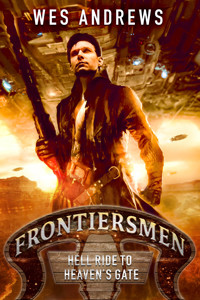
One ship. One crew. One hell of a run.
Welcome to the edge of the galaxy—where the stars are lawless, the jobs are dirty, and survival is just another hustle.
John Donovan is a Frontiersman: smuggler, pilot, and professional debtor. He'll haul anything for the right price—cargo, cattle, fugitives, even a preacher with secrets too big to pray away. When a desperate job takes him through the forbidden space of the warlike Peko, Donovan figures it's just another high-risk run.
He couldn’t be more wrong.
Between hostile aliens, scavenger pirates, and a haunted luxury cruiser adrift in the void, Donovan and his mismatched crew are in for the ride of their lives. And as the bullets start flying and the air gets thin, one thing becomes clear:
Getting to Heaven’s Gate may just be a one-way ticket to hell.
FRONTIERSMEN: HELL RIDE TO HEAVEN’S GATE is the explosive start to a gripping space western series—perfect for fans of Firefly and The Mandalorian. Fast-paced, character-driven, and packed with frontier grit.
Smuggle fast. Shoot straight. Don’t look back.
Wes Andrews, born in 1977, has sat on the back of a horse, carried a Colt on his hip, and slept in boots night after night. When he's not writing novels, he watches old movies, roams through nature, or plays cards with rough men. He lives with his wife and animals in a sleepy town in the south and is delighted that people are no longer forced to settle their neighborhood disputes on the street at noon.
That aside, Wes Andrews is the pseudonym of an award-winning author who has also written for the Star Trek franchise. And although none of the above is a lie, it should not be taken too seriously.
Das E-Book können Sie in Legimi-Apps oder einer beliebigen App lesen, die das folgende Format unterstützen:
Seitenzahl: 479
Veröffentlichungsjahr: 2025
Ähnliche











Contents
Cover
Contents
About the book
Title
Quote
- 1 -
- 2 -
- 3 -
- 4 -
- 5 -
- 6 -
- 7 -
- 8 -
- 9 -
- 10 -
- 11 -
- 12 -
- 13 -
- 14 -
- 15 -
- 16 -
- 17 -
- 18 -
- 19 -
- 20 -
- 21 -
- 22 -
- 23 -
- 24 -
- 25 -
- 26 -
- 27 -
- 28 -
- 29 -
- 30 -
- 31 -
Acknowledgments
The author
Copyright
About the book
One ship. One crew. One hell of a run.
Welcome to the edge of the galaxy — where the stars are lawless, the jobs are dirty, and survival is just another hustle.
John Donovan is a Frontiersman: smuggler, pilot, and professional debtor. He’ll haul anything for the right price — cargo, cattle, fugitives, even a preacher with secrets too big to pray away. When a desperate job takes him through the forbidden space of the warlike Peko, Donovan figures it’s just another high-risk run.
He couldn’t be more wrong.
Between hostile aliens, scavenger pirates, and a haunted luxury cruiser adrift in the void, Donovan and his mismatched crew are in for the ride of their lives. And as the bullets start flying and the air gets thin, one thing becomes clear: Getting to Heaven’s Gate may just be a one-way ticket to hell.
WES ANDREWS
FRONTIERSMEN
Hell Ride to Heaven’s Gate
Translated by Ben Stowers
For John Ford & John Wayne,without whom the U.S. Western movie genrewould be missing quite a lot.
And for S. T. & J. C. K.,the original Frontiersmen.
– 1 –
High noon … Why did it always have to be high noon?
John Donovan squinted and blinked up at the blazing, yellowish-white sun of Briscoll. It was what the locals here called a mild spring day: nearly ninety degrees in the shade. A light easterly wind was blowing, driving dust across the rocky wasteland, where nothing lived except the towering brown cacti that stood together in clusters taller than a man, drawing the last water from the barren soil. And it was hard to say if there was really any life in those.
“Why did I get myself into this mess?” John muttered to no one in particular — he was the only person for miles around.
His gaze wandered to the Fargo Ti27, a two-seater land glider with a small cargo platform between conical outer engines, parked about twenty yards behind him and slowly heating up in the sun. John was tempted to walk over, get in, and simply disappear. But that wasn’t an option. He had to settle this thing with Benson. Here and now. Like a man. At high noon.
John’s right hand slid down the front of his gray, knee-length coat, pushing it open to reveal the revolver hanging in a brown leather holster at his hip. His fingers brushed over the smooth grip. It was a good weapon. Sure, it was old. But there was nothing wrong with that, as far as John was concerned. He’d never buy a modern pistol with a laser targeting system and automatic magnetic field correction. Even a monkey could shoot with those — but only if the sensitive electronics didn’t fail, which happened regularly.
Unreliable tools were no good for life in the frontier worlds. Out here, if something broke that couldn’t be fixed with a regular toolkit and some basic knowledge of electronics and mechanics, you were done for. John trusted quality, traditional workmanship, which was why he carried the twelve-shot Santhe CG — and why he still flew a Cambria class freighter.
Some called John old-fashioned because of this. Maybe he was. He put his trust in weapons, spacecraft, and moral principles that had proven themselves over time. This mindset hadn’t failed him yet — although it did occasionally cause him some inconvenience, like having to deal with a man like Benson in the desert at high noon.
A dust cloud became visible, rapidly approaching from between the rock formations on the horizon, which jutted into the cloudless sky as if they’d been forced through the hard-baked earth from below with a giant hammer. A faint rumbling accompanied it, the engines of a heavy glider. Judging by the irregular stuttering of the engine, the machine wasn’t in great shape.
The dust cloud disappeared in a hollow, and when it re-emerged, John could make out the vehicle itself. It was a robust-looking, enclosed model with windows hidden behind makeshift metal blinds, allowing driver and passengers to look out through narrow slits. Benson was evidently the kind of guy who anticipated an ambush behind every rock.
However, he was apparently not the kind of guy who took care of his equipment. A crust of dust and oil coated the glider, and the howling engines suggested that the filters were clogged and urgently needed replacing. The front right repulsion field projector also seemed to be damaged, given the way the bulky vehicle bobbed slightly as it glided across the plain. John was surprised by the condition of the vehicle. He wouldn’t have expected this from Benson. Maybe the glider didn’t belong to him — or maybe it was the fleet vehicle he used for dirty dealings like this.
With a final roar of the engine, the glider pushed between a trio of cacti and a few boulders near the foot of the ridge that rose up behind them. Benson had picked the time, but the location had been John’s choice. As a man at least occasionally concerned with his own well-being, he had chosen a place with an escape route that offered more cover than the flat wasteland.
The engine noise changed as the vehicle shifted into neutral. The driver’s door flipped open, and Benson stepped out. A stocky man with dark gray hair and coarse features, he owned a large oil field on Briscoll’s main continent. That didn’t automatically make him unlikeable. The reason John couldn’t stand him — and the animosity was mutual — was that wherever Benson showed up, he acted as if that world belonged to him.
That’s how it was last night at Mako’s Tavern, where John had been trying to relax and have a beer with his crew. Unfortunately, the evening was spoiled when Benson showed up in a bad mood and started harassing the staff.
Maybe John should have stayed out of it. It was Mako’s problem what Benson did in his establishment. But John was just as old-fashioned when it came to standards of behavior as he was in his choice of weapons and spacecraft. When a man behaved like an idiot in a bar while everyone else was trying to enjoy some peace and quiet, he had to expect a fist in his face. And John’s fist was exactly what Benson got. Three beers and a job gone wrong may have given John a little more motivation to put the uncouth industrialist in his place, but readjusting Benson’s angular chin had been the right thing to do — even if it had resulted in this unpleasant rendezvous at high noon.
“Donovan.”
Benson donned his wide-brimmed hat as he got out of the vehicle. He wore a shirt, jacket, and denim pants, and a revolver hung from his wide belt. Benson might be a businessman, but on planets like Briscoll, that didn’t mean wearing fancy suits and carrying briefcases.
“Benson,” John replied. His hand rested on the grip of the Santhe CG. He was as ready for this confrontation as he could be.
“I’m surprised you showed up,” said Benson.
John sized him up through narrowed eyes. “Why? You figure I’m a coward?”
“You and your people are tramps,” Benson answered with a shrug, “and we all know what tramps are like. First they talk big. Then they sneak off to the nearest freighter and make themselves scarce.”
“Sorry to disappoint.”
“Not at all. It saves me the trouble of hunting you down.” The industrialist rubbed his clean-shaven chin. “Last chance, Donovan. If you feel like apologizing for your behavior in the bar, now would be a good time.”
As if to emphasize his words, the rear hatches of the glider opened, and two more men stepped out. One had a lean build, a face covered in stubble, and a furtive look in his blue eyes. The other was carrying several pounds too many around his midriff and immediately began sweating in the hot midday sun. Both were holding rifles.
“Three against one, huh?” John growled as he scrutinized the men. “Not very sporting.”
“I’m not here for pleasure. I’m here to get even,” Benson replied.
“Well, I guess it’s not your lucky day.”
Benson’s expression darkened. “So, you won’t back down?”
“On the contrary, you should have brought a few more men.” John permitted himself a thin, mocking smile.
“Shoot him!” Benson snarled and yanked his revolver from his belt.
His men aimed their rifles at John, but he had already anticipated this and had drawn his revolver before a single barrel was pointed at him. Two shots cracked in rapid succession. Benson flinched and dropped his revolver as John’s bullet hit him in the right arm. The lanky man collapsed with a cry as the second bullet caught him in the left thigh.
The sweaty man returned fire, but John was already diving sideways for cover. He landed on the dusty ground and rolled behind one of the tough, brown cacti. More shots rang out, and pieces of the thick trunk flew past John’s ears. He returned fire blindly, pulling his head in and raising his left arm to speak into the communicator strapped to his wrist. “Hobie? Now would be real good. Hobie!”
He received no answer.
Cursing quietly, he crouched down and peered around the cactus. The sweaty man shot in his direction, and John quickly pulled back. A brief glance had been enough to assess the situation. It wasn’t very encouraging.
Benson and the lanky man had sought cover behind the heavy glider and were now taking aim at him from their shielded positions behind the nose cone. The sweaty man ducked behind the engines at the rear. They all had a clear line of fire to John’s hiding place, and to get to his own vehicle, he would have to cross a good twelve yards of open terrain.
John fired two more shots to keep his enemies from getting too bold, and then lifted his communicator again. “Hobie? Come on, partner, you’ve had your fun. Answer me already.”
Nothing but static came out of the device. John considered switching from short-range radio to the planetary communication network to reach the Mary-Jane Wellington, but it would take at least fifteen minutes for Kelly to get the ship here. By then, this shootout would be over, one way or another.
“Okay, John, think,” he admonished himself.
He took another quick look at his enemies and fired four shots in rapid succession to keep their heads down. A warning light on the grip flashed yellow. Two shots left; then, he’d have to replace the cylinder.
John’s attention turned to the glider, which was hovering in the air, unsteady even at idle, due to its damaged repulsion field projector. He had an idea. Usually, there wasn’t much to gain by shooting at a vehicle’s repulsion field units with an ordinary revolver. For one thing, they were protected by heavy armor plating that a small-caliber weapon couldn’t penetrate, and for another, it wasn’t easy to hit the robust projectors in a way that would actually disable them.
But John was more than just a good shot. His customized revolver had spent several hours on ship mechanic Hobie’s workbench, and the weapon had a couple of aftermarket settings not provided by the manufacturer. For one, the power of the induction coils could be increased beyond the recommended level. It put considerable strain on the power cell and risked ruining the coils, but the penetrating power of such shots was impressive.
“All or nothing,” John growled, turning the custom dial mounted on the side of the Santhe CG all the way up. He crouched down and waited five long seconds until the status indicator showed that the power cell had boosted the charge to the capacitors.
Benson and his people weren’t shooting quite as enthusiastically as they had been moments ago. Apparently, they had realized that their weapons couldn’t get through Briscoll’s bone-dry, rock-hard flora. As long as John stayed behind the cactus, he was relatively safe. However, he had no intention of remaining there.
He took a deep breath and exhaled loudly. He had only one shot. After that, in their current setting, the capacitors would take five seconds to recharge. Five seconds lying in the dust without cover fire during a shootout was an eternity. And if the induction coils actually burned out, John would look pretty stupid. Besides a knife he kept in his boot, a four-shot Colt Minimum stuck in the back of his belt kept only for emergencies at very short range, and a rifle over in the Fargo, he had no other weapons.
John braced himself. Then, he suddenly whirled away from his cover, dropped to the ground, aimed, and fired. The revolver howled in his hands, and the projectile shot from the overheated barrel. Faster than the blink of an eye, it bridged the distance to Benson’s glider and struck the front skirt. There was a bang, and before Benson or his men realized what had happened, the glider’s front right side slumped toward the ground. It immediately began drifting into a sluggish right turn as the now-uneven repulsion of the three remaining force-field units pushed the vehicle sideways.
Benson and his men shouted and jumped out of the way of the stray vehicle. John took advantage of the diversion to power down the Santhe, and when the sweaty man jumped out from the rear, John aimed his last shot at him. He hit the thug directly in the chest. The man toppled backward without uttering a sound, his body slamming down on the baked earth.
Not keen on waiting for Benson and his remaining companion to recover from their surprise, John rolled back behind cover. He picked himself up and ejected the empty cylinder, then quickly reached into his coat pocket, pulled out a replacement cylinder, and clicked it into place. He rotated it once to make sure it was properly inserted. Then he risked a glance past the cactus trunk to reassess the situation.
The glider was headed slowly toward the boulders at the foot of the ridge. Only Benson’s hat was visible. He was apparently trying to climb into the vehicle from the passenger side to stop it. His associate, whom John had hit in the leg, was hurriedly limping in the other direction to seek cover behind the nearby stand of cacti. While doing so, he kept his rifle aimed in John’s direction and fired off a rapid succession of shots.
It suddenly became clear to John that this wasn’t a skilled marksman — just a fierce-looking guy who had been handed a weapon. Barely halfway to his destination, the man pulled the trigger and was rewarded with an empty click. God might forgive such mistakes, but John couldn’t afford to. He shot, only aiming for the guy’s arm. It was enough to incapacitate him. Killing a defenseless person would be dishonorable, even in combat.
John turned his attention back to the glider. The vehicle had stopped. Apparently, Benson had managed to get it under control. The industrialist was nowhere to be seen. The metal blinds mounted in front of the windows concealed him from view. John lowered his revolver, but stayed behind cover. A man who had already deceived him once couldn’t be trusted not to try another dirty trick.
“Benson!” he called out. “It’s over! Your men are down. Let’s end this, man to man. Or we both go home. Your choice.”
Nothing happened. The sweaty man lay motionless in the dust. The lanky one had slunk behind the trio of cacti. And the bulky glider, its front end sagging, hovered over the landscape, about twelve yards away from John.
“Benson!” John called again. “Listen …”
At that moment, the glider’s engine roared to life, and the vehicle lurched forward. Sparks flew from the metal skirt as it scraped over rocks, but Benson had the heavy vehicle under control. It stayed on course — heading directly toward the cactus behind which John stood.
“Oh, damn it,” John growled.
He quickly considered his options. Running away wasn’t one of them. He could never outrun the glider or reach higher ground where it couldn’t follow. He had only one choice. Grimly, he raised the revolver. There was no time to increase the voltage. He had to make do with the firepower he had.
The first shot ricocheted off the glider’s hull. So did the second. From John’s angle, the viewing slits between the metal blinds looked even narrower than before. The glider came ever closer, over a ton of accelerating metal. If Benson hit John, it would be over. If he missed, he would turn around and make another attempt. This was John’s only chance. He kept shooting. Third bullet, fourth. With the glider less than seven yards away, the fifth bullet shattered the glass. The vehicle shuddered.
Bull’s eye! John rejoiced.
He threw himself sideways, to be on the safe side, but the glider veered in the other direction, heading toward the rocks at the foot of the hills. There was a crash and clatter as it collided head-on with one of the large boulders. The second front repulsion-field projector failed, and the vehicle hit the ground hard.
Lying in the dust, John turned around and wiped his mouth with the back of his hand. Then he got to his feet and marched toward the crashed glider. The driver’s door had sprung open, revealing Benson slumped over the steering wheel, his hat dented. His shirt was turning red at his left shoulder. It had been a clean shot. John holstered his revolver. The guy wouldn’t give him any more trouble.
“Hey, Benson!” John called.
He stepped up and pulled the man away from the steering wheel. The industrialist fell back heavily into the padded driver’s seat. His expression was dazed, and there was a gash on his forehead.
“I figure it really is over now. You took enough of a beating, and I have more important things to take care of.” John was thinking of a serious conversation he wanted to have with a certain person.
“Go to hell, tramp,” Benson spat weakly. He seemed barely conscious, but that didn’t stop him from hurling insults.
“Charming,” John replied. “I should really let you die. But it’s lunchtime, and that would spoil my appetite. So, count yourself lucky, pal.”
He reached past Benson and grabbed his weapon, which had slipped down beside the seat. John wasted no time in ejecting the cylinder and throwing the revolver behind him into the landscape. Then he activated the glider’s emergency beacon.
“Your people should pick you up within twenty minutes,” he said. “Unless they’re all at lunch, too.”
John stepped back from the vehicle and turned away.
Then, as if suddenly remembering something, he turned back to Benson. “Oh, and just so you know,” he growled. “Me and my people ain’t tramps.” He clenched his right hand into a fist. “We’re frontiersmen!”
The blow he dealt Benson was heartfelt and gave him more satisfaction than the entire preceding shootout. Without a word, Benson slumped in his seat, his eyes rolling back.
John nodded with satisfaction. Then, he turned his back on Benson and left.
– 2 –
Basically, Briscoll wasn’t much of a planet. Located just within the habitable zone of the Yellowstone System, it orbited its yellow star so closely that the world mainly consisted of sandy, rocky deserts. If it weren’t for a few algae-rich oceans in between, there would probably never have been enough atmosphere to allow for colonization. Native life was almost non-existent. However, a few hardy grass species had settled here, more or less unintentionally introduced by visitors. They didn’t really make the world any more beautiful, but Briscoll hadn’t been colonized for its wonderful landscape. It had vast mineral resources — oil especially existed in wasteful abundance, suggesting that the planet had been a greener place long ago.
Briscoll’s inhabitants were as rough as its landscape. They were mostly laborers, pioneers, and fortune hunters, and all of them were just here for the money. No one wanted to grow old on Briscoll. Even the planet’s largest settlement, Williamsport, pompously referred to by some as the capital, looked makeshift.
The only remarkable thing about this sprawling mess of low stone buildings and container housing was the spaceport from which the city derived its name. It consisted of a leveled plain north of the city, about half of which was used for purely industrial purposes. Dozens of tankers, large and small, stood on the landing field, waiting to be filled with crude oil and taken to the large refinery ships in orbit. The other half of the spaceport was open to anyone who had enough Union dollars on their card to pay the docking fees.
Briscoll was conveniently located between two fairly stable transit fields. Besides, lots of the people who lived here earned good money in the oil fields, but couldn’t do much with it in their desert world. For this reason, Williamsport attracted all sorts of traveling folk, from theater troupes to flying brothels, traveling cinema operators to liquor dealers. And of course, countless so-called “free freight” pilots came and went, always hoping to make a quick buck off of departing workers, smuggled goods from the core worlds, or a few expropriated barrels of oil.
Like everywhere else in the universe, there was no guarantee of success here. So visitors regularly got stranded on Briscoll, broke, with no prospect of continuing their journey anytime soon. As John steered his land glider through the busy streets south of the spaceport, he fervently hoped he and his crew wouldn’t end up like that. The Texaferm power block in their ship’s converter chamber wasn’t completely decayed yet, but it wouldn’t get them much farther. And acquiring a new block of the blue gold that powered all modern space travel wasn’t possible, given their currently strained finances.
Why the hell did I trust the information on those medication crates? He cursed himself.
As they had discovered when they tried to sell their not-quite-legitimately acquired core world medicines on Briscoll, someone had tampered with the seals on the crates and set the expiration date back ten years — which meant none of the long-since ineffective medications were worth more than the glass ampoules they’d come in. Of course, John had complained to their contact about this, but he had shrugged and said he only brought business partners together. The details of the deal weren’t his responsibility. The shady hospital employee who had sold John and his crew this junk was doubtless keeping a low profile now, and hunting him down to beat every lost dollar out of him was a luxury they couldn’t afford. And so they were stuck out here — only for a few days so far, but those days could easily turn into weeks and months if they didn’t come up with a plan.
Scowling, John steered the land glider between two three-story buildings and around an open freight-handling area, onto the landing strip. He drove at a leisurely pace along one of the secure access roads that ran between the ships’ landing zones, heading to the eastern edge of the spaceport, where the Mary-Jane Wellington stood. To the left and right, crews supported by port service staff were busy loading or unloading their ships. A group of local customs officials had marched over to a box-shaped tanker. Next to an aging passenger transporter was a truck delivering supplies and fuel. And over by a smaller, private vessel that vaguely resembled a crouching crab, two oil-smeared men were tinkering around, engaged in a lively debate about which cooling cable belonged in which socket.
As the grayish-brown Cambria-class freighter John had called home for many years came into view, he felt his mood instinctively brighten. He was still angry at Hobie for abandoning him in the desert, and he would let the ship’s mechanic know that in no uncertain terms. But the sight of the ship took the edge off of the ill humor that had come over him on the way over as he’d been brooding over their awful situation.
The Mary-Jane Wellington was not an elegant ship. She lacked the sleek lines of a pleasure yacht or the aggressive features of a battle cruiser. Two bulky cargo holds were positioned to the left and right of a central cabin with a defiantly protruding cockpit, giving the ship the appearance of a sumo wrestler crouched and ready. In addition, the stout ship featured a quartet of powerful primary engines in the stern, four smaller braking thrusters at the bow, two escape pods hanging beneath her like offspring clinging to their mother’s belly, and a proliferating sensor cluster on top that definitely hadn’t come from the manufacturer’s catalog, but which — along with the enhanced propulsion — had saved John’s and his crew’s hides more than once by warning them of danger before it was breathing down their necks.
If you anthropomorphized the Mary-Jane, you might think of her as one of those pioneer women way out on the frontier: weather-beaten, dependable, and indestructible. She was a little more robust than the classic ideal of beauty, and her skin was scarred. But John wouldn’t have traded her for anything in the galaxy, even if some crazy millionaire had offered him a brand-new Starhauler freighter for her. We belong together, old girl, he thought. You look after me, and I look after you.
As he got closer, John could see that the ramp to the port-side cargo hold was lowered. Aleandro, the youngest and newest member of John’s crew, was sitting in a lounger at the foot of the ramp. This twenty-year-old vagabond had signed on at Loredo a few months ago, after his entire family had allegedly been killed in a gang war, and he had just wanted to get away from home.
Whether the story was true or just designed to tug on John’s heartstrings, he didn’t know. Initially, he hadn’t wanted to hire Aleandro. However, the youngster with the shoulder-length hair, pale gray headband, and scruffy beard, who looked like he’d come straight from an artists’ commune, had turned out to be a real wizard when it came to maintaining and operating computers and other delicate electronics. Since he was a good complement to Hobie, the mechanic, and because John had never been good at turning down eager young pups, Aleandro had been hired for a trial period. So far, John hadn’t regretted it.
The boy held a data pad in his hand. He’d probably tapped into the spaceport’s local network. In front of him stood a Peko in brown coveralls, who seemed to be talking to him. If he were a customer, John might have set aside his aversion to this particular specimen of green-skinned, black-haired nonhuman. But the guy looked more like a supplicant.
In essence, the recent history of the Peko was a bitter joke. The remarkably humanlike aliens — incidentally the only other intelligent life forms humanity had encountered in all their years in space — had sought first contact with Earth to engage in peaceful trade. Their Texaferm reactors and advanced transit field technology had allowed humanity to leap out of its own galactic backyard. Humanity had thanked the Peko with the expansionist enthusiasm characteristic of John’s species. Exploitation and violence had pushed back the pitiably good-natured Peko farther and farther, while humanity, driven by greed and megalomania, had colonized planet after planet.
By now, the Peko had learned their lesson and adapted to their new galactic neighbors. Many had become bitter, hostile creatures who saw humans as a plague that should never have been given the keys to space exploration. Most of them now lived in isolation on special worlds that the Core Worlds Union Government had generously left to them. Others still tried to somehow reconcile their own culture with that of humans. Most of these optimists eventually wound up stranded in places like Briscoll.
“Hey, Aleandro!” John called out as he drove up. “What does the Peko want?”
John avoided looking at the alien. He couldn’t handle another pair of puppy-dog eyes right now.
“Hey, Captain.” Aleandro lazily raised a hand in greeting. “The green man is looking for work.”
“Tell him we don’t have any ourselves,” John said gruffly, revving the glider’s engine briefly and driving up the ramp into the cargo hold with a flourish. “Is Hobie here?” he asked over his shoulder.
“In the mess, I think,” replied the young computer specialist.
John parked the glider beside two crates of provisions in the otherwise depressingly empty cargo hold. It was an area measuring about 26 by 100 feet, 20 feet high, with metal walkways and a rail system for a crane running along the ceiling. The cargo hold had no independent climate control, which meant it could only transport goods that were either stored in special containers or could withstand the ship’s climate. Many freight pilots had switched to more modern ships in recent years. John didn’t mind. He didn’t want things on board that might develop toxic fumes under normal pressure and average temperatures, or things that multiplied uncontrollably in an oxygen-rich atmosphere, or that might threaten to explode.
He strode across the room and opened the hatch to the living quarters on the Mary-Jane.
“Welcome back, John,” a disembodied female voice greeted him from the ship’s intercom.
“Thanks,” John grunted as he walked down the short corridor to the mess hall.
“You sound tense, John,” the AI remarked. “Is something bothering you?”
“I’ll tell you later.”
“Of course, John. You know I’m always here for you.”
“Yes, I know, Mary-Jane.”
With a crackle on the line, the ship’s AI took her leave.
Even more than the Cambria-class freighter itself, the Mary-Jane was an anachronism. The adaptive central ship system with a simulated personality had been developed at a time when journeys between the stars were still long and lonely. She and her kind served not only as control programs for all onboard systems, but also as ship psychologists — someone who would listen when you couldn’t or didn’t want to talk to anyone else.
Normally, the Cambria class didn’t have any AI. But Mary-Jane had already been on board when John was hired by old Captain Sturges about ten years ago. Hobie once told him that she had already been installed when he first set foot on the ship forty years ago. None of them knew how old the Mary-Jane really was.
To this day, computer specialists argued about where programming ended with AIs and where possibly something like an actual intelligence, a digital consciousness, might begin, one that could emerge from many years of operational experience. John didn’t think about it. As far as he was concerned, Mary-Jane was as valuable a member of his crew as anyone else. He would never even consider replacing her with a personality-free, modern central system.
He reached the mess hall and looked around. The heart of the ship was a manageable space sinking into cozy chaos. Along one wall stretched a galley, separated from the rest of the mess by a counter. In a corner on the opposite side was a seating niche with a round poker table covered with green felt, inherited from Captain Sturges, who had played many a game there. The room was dominated by a large dining table bolted to the floor, along with eight chairs — four for the standard crew, the rest for potential passengers.
Technically, there were eight passenger spots — all four quarters had bunk beds. With the container cabins that Hobie had once set up in the starboard cargo hold, they could double this capacity. However, in the event of full occupancy, the fact that some passengers would have to make do with folding chairs or eating in shifts was not the biggest problem. The very small bathroom on the Mary-Jane was the main limitation. This was just one of the reasons John preferred to transport grain, machine parts, or, at a stretch, a hundred head of cryogenically frozen cattle rather than people.
The mess hall appeared empty at first glance, but John heard a clattering noise by the counter, and the next minute Hobie emerged from behind it, holding up a can of white beans with a triumphant grin on his wrinkled face. A half-smoked cigar stub was clamped between his broad teeth. It wasn’t lit, as smoking wasn’t allowed on board.
“Hobie!” John snapped without preamble.
“Oh, hello, John,” the Mary-Jane’s mechanical engineer replied, removing the cigar from his mouth.
Pat Hobel was coming up on sixty years of age. He was short and stocky, with thinning, graying hair that he often hid under a crumpled cap. The man was as much a part of the ship’s inventory as their virtual companion and the poker table. He had served under Captain Sturges for many years, and after his death — and that of Fat Mike — on that fatal night over Harrington, Hobie had decided to continue his service with John. Normally he was a reliable soul, the best man you could hope for with a sawed-off shotgun in hand when trouble was brewing. But today he had failed, and John wanted to know why.
“Where were you?”
“What do you mean, where was I?” Hobie countered. “I was here, on the ship.”
“Will you explain to me why you were on the ship when I was expecting you outside of town, where you were supposed to back me up against Benson?”
Hobie looked mildly surprised. “Oh, that was today?”
“That was …” John trailed off in disbelief. “Is that your excuse?”
Hobie shrugged and looked around for a can opener. “What can I say? I thought your duel was tomorrow.”
John’s right fist clenched instinctively. “I … I could kill you, Hobie.” His expression contorted. “No, I couldn’t, because then I wouldn’t have a mechanic.” He pointed a finger warningly at his partner. “But assuming you weren’t the only mechanic who understands Mary-Jane’s engines, if ‘That was today?’ was your only excuse, then I’d kill you.”
Hobie rolled his eyes. “Take it easy, John. We had everything under control.”
“Did we?”
“Kelly was out in the wilderness covering your back.”
“Really? I saw no signs of that.”
The ship’s mechanic pointed with his can of beans past John. “There she is. You can discuss it with her yourself.”
“You bet I will. Kelly!” John spun around to see the only female on his small crew — apart from Mary-Jane — entering the mess through one of the two doors.
“Hey, John, you’re back already. That was fast. I figured you’d have a victory beer or three at Mako’s Tavern.”
John ignored the dig. “Hobie says you were my backup out there.”
The young, blonde woman was actually too intelligent and too good-looking to be working on such an old rust bucket.
“Right,” she said laconically. She walked over to the counter and leaned against it. “Hmm, are we having beans tonight?”
“I was thinking more of a late lunch,” Hobie replied. “All I’ve had today is a cup of coffee.”
“I’m not done with you, sweetheart,” John growled. “While you were allegedly covering my back, where exactly were you?”
Kelly turned to face him again, tilted her head to one side, and looked at him impassively. “Up on the ridge to your left, with the sniper rifle.”
“And did you have no ammunition, or why didn’t you intervene when three guys started shooting at me?”
“I figured you had those guys under control.”
“It felt different down there to me.”
“Well …” Kelly paused, reached behind the counter, and pulled out an apple.
To this day, John didn’t really understand why she was so keen to fly on the Mary-Jane as a jack-of-all-trades. She was originally from the core worlds, where she had studied medicine. But at some point, she claimed, she had gotten tired of all that. She dropped out of her studies shortly before graduation and set off to explore the universe.
That she had managed to learn something during her years at university was John’s great fortune. Because the evening when she had literally stumbled upon him, he had been lying in an alley behind a bar, bleeding out from a gunshot wound. She had helped him, and in return, he had offered her a place on his ship.
For a few weeks, there had been a strange atmosphere on board because neither of them knew if they might become a couple. To release the tension, they’d decided to go on a date and spend a night together. The next morning, they had agreed that it felt better to just be friends. Although Kelly’s friendship apparently didn’t extend to saving him from a shootout.
“You know,” she said, while chewing a bite of the apple, “maybe you deserved to be left hanging.”
“How am I supposed to take that?” John asked.
“You started the fight in the bar, didn’t you?”
“That’s debatable, but it doesn’t matter anyway. Benson had two friends with him, which wasn’t what we’d agreed on. They didn’t wait to see if their boss could handle me alone. They just did their jobs and opened fire.”
Kelly raised the index finger of the hand holding the apple. “Glad you mentioned it, because I’m getting tired of you running your big mouth and getting us into messes we have to clean up, and — I want to emphasize this part — without getting paid for the job, because — and I want to emphasize this part, too — the ship’s funds have been basically exhausted for weeks.”
John leaned on one of the chairs at the dining table and grimaced. “Ouch, that was a low blow. I thought we were a team and stood by each other.”
Kelly’s expression darkened. “Then stand by your team, John Donovan. Instead of picking fights with people in bars, go and get jobs. Earn some money, so Hobie doesn’t have to hold the Mary-Jane together with spit and the dirt from under his fingernails. Then maybe I could buy some ammunition for my rifle and have your back next time.”
John raised his eyebrows in surprise. “We have no ammunition left for the sniper rifle?”
Kelly gave him a piercing look.
“I withdraw the question.”
He pushed away from the chair and began to pace slowly up and down the mess.
“Listen, I’m sorry, okay?” he said, raising his hands in a conciliatory gesture. “Maybe I shouldn’t have started a fight in Mako’s Tavern, although that bastard Benson badly needed to be taught a lesson.” He looked at Hobie and Kelly, his face now serious. “I promise to restrain myself from now on. No more stupid remarks at the wrong moment. And I’ll take care of the money situation, too. Today. I swear.”
Kelly shook her head. “Oh, John, forget it,” she said, with a certain weariness in her voice that he sure didn’t like.
“No, really,” he insisted. “I’ll land us a job today.”
Hobie put down the can of beans and pulled a watch with a torn strap from one of the tool pockets on his vest. “Let’s see, it’s two-thirty.” He winked at John. “Could be worse. If we were on Hades, you’d only have two and a half hours left. Here, you have nine and a half. That said, I checked the bulletin board over at the port authority just this morning. Didn’t look too good.”
“I said I’d do it, and I’ll keep my word,” said John, determined. “You’ll see. John Donovan is always good for a surprise.”
Kelly’s expression softened, and a smile played on her lips. “I won’t disagree with you there.”
– 3 –
The Fargo’s engine had barely cooled down as John backed the glider out of the Mary-Jane’s cargo hold again. He drove down the loading ramp and swung the glider around.
“Are you heading out again, Captain?” asked Aleandro, who was now by himself, sitting in front of the ship. The Peko guy had left.
“Yes,” John replied from inside his glider. “We need new contracts. Have a look in the data network and see if anyone needs a fast ship with a dependable crew.”
Aleandro shook his head. “Hobie already asked me to do that a few hours ago. There’s a lull on Briscoll. The oil wells seem to have dried up.”
“Take another look,” John instructed him. “And don’t be too picky. We need the money.”
Aleandro tapped his forehead in a casual salute. “Will do, Cap.”
“Good. See you later.”
John accelerated, and the glider zoomed away.
His first stop was the low, rectangular building of the spaceport authority. There was very little activity there in the early afternoon, when it was too hot to conduct business. Williamsport wouldn’t really come alive until evening. But John didn’t want to wait that long.
He parked in the lot in front of the building and marched over to the notice boards hanging to the right of the main entrance. On the more sophisticated core worlds, these information centers were typically alcoves with touchscreens, where you could access various services and enter search queries. In a place like Briscoll, a bulletin board was a literal wooden board or hard insulation panel where people could pin up messages on scraps of paper.
The section of bulletin board claimed by the spaceport authority still maintained some semblance of order. New regulations, service fees, and up-to-date news for travelers were posted here. John spotted a travel warning that hadn’t been there the day before. A wiry old man in simple, drab clothing and a dusty hat was standing in front of it. He looked like one of those rare optimists who ran a farm on Briscoll, and he was reading the notice with interest.
“Oklahoma Sector, huh?” said John.
The old man turned his head and nodded. “Yes, sir. Things are heating up out there again. The Peko from Kendaui are giving the Space Cavalry trouble. There have already been several attacks on freight convoys and patrols.”
John frowned. “I thought Kendaui was being monitored by the Union and was peaceful.”
“That’s been true for the last three years. But a new konya has emerged. The guy is supposed to be a smart cookie. And he’s not fond of humans. His name is Geonoj.”
“Geonoj?” repeated John. “I’ve heard that name before. Wasn’t he the guy who caused a lot of trouble around New Hessen last year? I thought the Union military had smoked him and his bush warriors out.”
“Apparently not, sir,” said the old man. “It’s here in black and white: Geonoj is back.” He tapped the notice with the crooked index finger of his calloused hand.
“Great,” grumbled John. “Then I guess I’ll be steering clear of the Oklahoma Sector for a while.”
“That would be wise.” The old man tugged at the brim of his hat. “Good day to you, sir.”
With that, he trudged off.
John turned his attention to the section of the board reserved for public use. This side was much more chaotic. Freighter captains trying to sell surplus goods; freelance pilots, mechanics, and day laborers offering their services; a music group announcing their final shows before leaving Briscoll; and the owner of a small oil well seeking a woman interested in sharing a “simple but honest life” with him. There were few requests for freight or passenger transport, and those that John found didn’t match the Mary-Jane’s profile.
“Flying a Universal Unity congregation to Bénodet,” he muttered to himself. “No thanks.” Kelly’s occasional sermons were enough for him. Besides, they couldn’t accommodate the forty believers unless they quartered them on cots in the cargo hold with mobile sanitation units.
The other offers weren’t much better. Either the Mary-Jane was too small, or she was too big. John preferred not to carry a cargo of chemicals. And he lacked the necessary optimism and cash to deal in five hundred cubic canisters of fuel, allegedly in demand on the outer core world of Ariana — described as “a sure thing!” in the ad.
A young woman was seeking passage to Heaven’s Gate, one of the four settled frontier planets in the Oklahoma Sector. John snorted and wished her luck, which she was going to need now that the port authority had reported Peko activity in that area.
“So, we do it the hard way,” he grumbled, turning away from the notice boards.
Publicly advertised offers made up less than half of the jobs to be found around a spaceport. There was always demand for those ready and willing to fly their ship from one world to another without asking too many questions. Such discreet business dealings, however, were conducted in other locations — in the back alleys and back rooms of Williamsport.
This wasn’t John’s first time on Briscoll, but he still wasn’t too familiar with the town. Maybe Mako could help him out. Surely he wouldn’t hold last night’s minor incident against John. He’d only been standing up for Mako’s staff, after all. John decided to start there in his search for job opportunities of questionable legality.
As he turned to go back to his glider, he saw a man leaning against it, a slim figure dressed in black — despite the sun blazing high overhead in a bright blue sky — his face plunged into shadow by a black hat. John didn’t need to see the ebony revolver grip protruding from the holster on the man’s left hip to know who he was looking at. The guy’s hands rested casually on the edge of the glider, and he was gazing at something near the toes of his boots with an air of boredom.
John’s mouth felt dry. He briefly considered turning around and sneaking away. But the man wouldn’t leave, that much was certain. So he might as well face him. Maybe, he tried to convince himself, the manjust happened to be in the area and had stopped to say hello.
John approached and stopped a few steps away from the glider.
“Santander,” he said, noting with relief that his voice didn’t betray his agitation.
The man raised his head. A tanned face appeared beneath the brim of the hat. Gray eyes fixed on John, and thin lips beneath a well-groomed mustache twisted into a smile that could never be mistaken for friendly. The man had a toothpick between his teeth, which he slowly removed with his right hand before he began to speak in a voice that was almost a whisper. “John Donovan. So nice to run into you again.”
“Forgive me if I don’t share that sentiment, Santander,” John replied gruffly. “What do you want here?”
“I don’t want anything, Donovan,” said Santander. “But Martell wants to talk to you.”
John had been expecting this, but hearing it from Santander’s mouth made it uncomfortably real.
“Tell him I don’t have the cash yet. But it’s just a matter of time. I’m working on something lucrative right now. As soon as that pays off, he’ll get his money.”
“Why don’t you tell him yourself?” Santander suggested.
John felt his gut contract. “Darius Martell is on Briscoll?”
Santander smiled his false smile again and gestured at the glider. “Please. It won’t take long.”
John gave an exaggerated nod. To cover his unease, he grumbled, “I hope so. I have important business to attend to.”
John got into the driver’s seat of the Fargo, and Santander flicked away his toothpick and climbed in on the passenger’s side. In that moment, John could have taken him by surprise and overpowered him, despite Santander’s notoriety in certain circles. But what good would it have done? It wouldn’t clear his debt with Martell, and next time, instead of sending his hit man to invite John for a chat, he might just ambush and shoot him. Men like Darius Martell, the mob boss from Constitution, would always find a way — unless you finished him off personally. And even then, the executor of his estate might be obliged to put out a hit, according to instructions in Martell’s will.
“Where to?” John asked grumpily.
He was desperately waiting for this day to produce something positive.
“Just drive,” said Santander. “I’ll direct you.”
John dutifully started the engine and steered the glider off the spaceport grounds. With brief gestures and words, Santander guided him westward, in the direction of one of Williamsport’s two entertainment districts. It was the more exclusive of the two, where champagne was sometimes served in addition to beer and whiskey, and where the women had a certain class. Naturally, neither day laborers nor ordinary fortune hunters were among the clientele. This was where oil barons brought their off-world business contacts for dinner, where the landowning aristocracy met to discuss day-to-day politics, and where, in some back rooms, people gambled for high stakes — both figuratively and literally.
Santander instructed John to park the Fargo in front of a two-story establishment called Starry Nights — presumably a saloon with a brothel attached. The large sign above the door wasn’t illuminated yet, and curtains were drawn across the windows. The venue would come to life once night fell on Williamsport.
“Fancy joint,” John grumbled, just for the sake of saying something. “I didn’t know Martell ran a brothel on Briscoll. A new acquisition?”
Santander smirked. “This way, please.” He gestured toward the three steps leading up to the entrance.
The door was unlocked, and after a nod from his escort, John entered. The barroom, which occupied most of the ground floor, was more tastefully furnished than most John had set foot in. The tabletops were fine imitation wood, and there were numerous booths with burgundy upholstered seats. The bar on the wall to the right looked well stocked, though the bar itself was relatively short, suggesting that guests at Starry Nights were served at their tables. At the rear was a stage with a catwalk that extended several yards into the room. Even without the pretty swings and grandiose décor reminiscent of a twinkling starry sky, John could take a guess at the kind of shows on offer here after dark.
The room was cavernously empty now. The bar was unstaffed, and the stage deserted. But two bored-looking men sat at a table near the door. Their gray suit jackets were unbuttoned, revealing cream-colored shirts stretched across barrel chests. On the table stood two open bottles of beer. Beside them lay two revolvers, which John recognized as Hephaistos Hammers. Not very accurate, but they packed enough power to knock a small man off his feet. Ideal for thugs, which these two obviously were.
Santander gave them a brief nod, then escorted John past the right side of the stage to a curtain, behind which a staircase led up to the next floor. They found themselves in a narrow corridor with numerous doors leading off it. Behind some, quiet voices could be heard. So, some Starry Nights residents were at home after all.
A door opened, and a young woman wearing nothing but a towel stepped into the corridor barefoot, with wet hair. She was startled to see Santander and John, but since she had already closed the door behind her, she chose to press on and quickly scampered past them. A scent like desert flowers wafted after her.
They turned a corner and came to a door at the end of the corridor, in front of which sat another suited thug, who looked like he lifted ships’ engines in his spare time. On his knees lay a sawed-off shotgun, and in hands the size of frying pans was a magazine on big-game hunting on the frontier worlds. When he saw Santander and John approaching, he lowered the electronic magazine and reached up to a small comm device on his left lapel. “Santander is back,” he reported gruffly. “With a visitor.”
“Send them in,” came the authoritative reply from the device.
The guard grunted an acknowledgment and nodded to Santander, who opened the door without knocking and entered the room. John hesitated briefly. He was mildly alarmed at the number of personnel obviously trying to compensate for other shortcomings with large guns. But what choice did he have, other than to venture deeper into the lion’s den with an unwaveringly confident grin? When Darius Martell wanted something from you, you’d better comply — especially when you owed him hard Union dollars. John summoned his courage and stepped across the threshold.
“John Donovan,” Martell greeted him as they entered the room.
Judging by the furnishings, it must have been the Starry Nights manager’s office. Three people were already present. Martell himself had taken a seat behind a broad desk that dominated the far side of the room. He was a slight man in an expensive, stiff-collared suit, with a narrow, angular face behind old-fashioned, thick-lensed glasses. At first glance, he seemed no more threatening than a tax official, but an ice-cold intellect glittered in his gray eyes. Those eyes never smiled, even when his lips curved upward, as they did now.
To one side of him stood a slim, pale woman about John’s age, in a blue-gray suit, her blonde hair severely combed back and rimless glasses perched on her pretty nose. She held a data pad in her hands and wore a radio receiver in her right ear. The look with which she surveyed John was decidedly neutral, as if nothing happening here concerned her personally — which was probably true.
The third person in the room looked decidedly unhappy. A stocky man of around sixty, whose meticulously combed hair failed to conceal his receding hairline, and who looked as nervous as if he were the one who had just been hauled in front of Martell. John assumed this was the manager of Starry Nights, who had been ordered to stay and observe the way business was conducted under the leadership of the notorious Darius Martell.
“Mr. Martell,” John replied after glancing around the room. “How are things? Still raking in the profits?”
Without being asked, he took one of the chairs in front of the desk, turned it backward, and straddled it, arms casually folded on the backrest. The gesture was an attempt to preserve a shred of self-respect. They had summoned him, like a delinquent student being called to the principal’s office. John had no choice in the matter, but he’d be damned if he was going to grovel before this self-satisfied bastard.
Martell didn’t even acknowledge his guest’s impertinence.
“Thanks for asking, Mr. Donovan,” he answered. “I can’t complain. A few of my investments still need a gentle guiding hand. That’s why I’m here on Briscoll. But I’m confident those will soon be a steady source of satisfaction for me too. Won’t they, Hansen?”
“Yes, Mr. Martell,” the stocky manager hurriedly agreed. “The staff will do their very best.”
“I know,” said Martell.
A shiver ran down John’s spine. As always, Martell’s tone was calm, almost unnaturally benign. The man never raised his voice, never lost his composure. He even sounded polite when issuing death sentences.
“I’m flying on to Bénodet tonight,” he continued. “However, an attentive employee drew my attention to your ship at the spaceport, Mr. Donovan, and I saw that as the perfect opportunity to attend to another one of my investments.”
“All right, all right,” John muttered. “I know I still owe you money.”
“Not exactly a small sum,” Martell noted, “at least by your standards.”
“Tell me something I don’t know.”
“Gladly.” Martell folded his hands on the desk and leaned forward slightly. “Please give my regards to your crew and tell them they would do well to get their affairs in order. I’ll be staying at the Crown Plaza in Victoriaville on Bénodet for a week, and if I don’t have the twenty thousand Union dollars in front of me when I leave there in eight days, I’ll kill your crew first, Donovan, and then you. I think we’ll start with your girlfriend, the charming blonde. What’s her name again? Kerry?”
“Kelly,” John said through gritted teeth.
Martell nodded and smiled. “Right. Kelly.”
“And she’s not my girlfriend.”
“Whatever you say. In any case, she means less to me than she does to you. Which makes her the perfect leverage.” Martell cast a quick glance at the Starry Nights manager. “Does your imitation-gold pocket watch have a countdown function, Mr. Hansen?”
The gray-haired man reached into his vest pocket, from which hung a golden watch chain. “Yes, of course, Mr. Martell.”
Martell extended his hand. “Hand it over.”
Hansen hesitated only for a second, then pulled out the watch and detached the chain from his vest. He looked very unhappy. Imitation or not, the watch seemed to mean something to him, which was probably why Martell had demanded it — one of his perverse power games.
The crime boss casually pressed a few buttons on the watch.




