


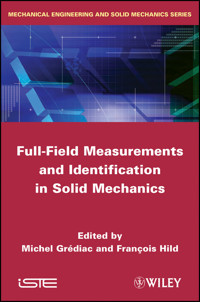
Full-Field Measurements and Identification in Solid Mechanics E-Book
181,99 €
Mehr erfahren.
- Herausgeber: John Wiley & Sons
- Kategorie: Fachliteratur
- Sprache: Englisch
This timely book presents cutting-edge developments by experts in the field on the rapidly developing and scientifically challenging area of full-field measurement techniques used in solid mechanics - including photoelasticity, grid methods, deflectometry, holography, speckle interferometry and digital image correlation. The evaluation of strains and the use of the measurements in subsequent parameter identification techniques to determine material properties are also presented. Since parametric identification techniques require a close coupling of theoretical models and experimental measurements, the book focuses on specific modeling approaches that include finite element model updating, the equilibrium gap method, constitutive equation gap method, virtual field method and reciprocity gap method. In the latter part of the book, the authors discuss two particular applications of selected methods that are of special interest to many investigators: the analysis of localized phenomenon and connections between microstructure and constitutive laws. The final chapter highlights infrared measurements and their use in the mechanics of materials. Written and edited by knowledgeable scientists, experts in their fields, this book will be a valuable resource for all students, faculties and scientists seeking to expand their understanding of an important, growing research area
Sie lesen das E-Book in den Legimi-Apps auf:
Seitenzahl: 765
Veröffentlichungsjahr: 2012
Ähnliche




















Contents
Foreword
Introduction
Bibliography
Chapter 1 Basics of Metrology and Introduction to Techniques
1.1. Introduction
1.2. Terminology: international vocabulary of metrology
1.3. Spatial aspect
1.4. Classification of optical measurement techniques
1.5. Bibliography
Chapter 2 Photoelasticity
2.1. Introduction
2.2. Concept of light polarization
2.3. Birefringence phenomenon
2.4. The law of optico-mechanics
2.5. Several types of polariscopes
2.6. Measurement of photoelastic constant C
2.7. Analysis by image processing
2.8. Post-processing of photoelastic parameters
2.9. Three-dimensional photoelasticity
2.10. Conclusion
2.11. Bibliography
Chapter 3 Grid Method, Moiré and Deflectometry
3.1. Introduction
3.2. Principle
3.3. Surface encoding
3.4. Moiré
3.5. Phase detection
3.6. Sensitivity to out-of-plane displacements
3.7. Grid defects
3.8. Large deformation/large strain
3.9. Fringe projection
3.10. Deflectometry
3.11. Examples
3.12. Conclusion
3.13. Bibliography
Chapter 4 Digital Holography Methods
4.1. Introduction
4.2. Basics of wave optics
4.3. Basics of digital holography
4.4. Basics of digital holographic interferometry
4.5. Digital holographic interferometry with spatial multiplexing
4.6. Digital color holography applied to three-dimensional measurements
4.7. Conclusion
4.8. Acknowledgment
4.9 Bibliography
Chapter 5 Elementary Speckle Interferometry
5.1. Introduction
5.2. What is speckle interferometry?
5.3. Optical point of view
5.4. Mechanical point of view: specific displacement field components
5.5. Phase extraction
5.6. Dynamic deformations and vibrations
5.7. Setup calibration
5.8. Specifications and limits
5.9. Final remarks, outlook and trends
5.10. Bibliography
Chapter 6 Digital Image Correlation
6.1. Background
6.2. Surface and volume digital image correlation
6.3. Errors and uncertainties
6.4. Stereo-correlation or 3D-DIC
6.5. Conclusions
6.6. Bibliography
Chapter 7 From Displacement to Strain
7.1. Introduction
7.2. From measurement to strain
7.3. Differentiation: difficulties illustrated for a one-dimensional example
7.4. Approximation methods
7.5. Behavior of the reconstruction methods
7.6. Selection criterion for the filtering parameters
7.7. Taking the time dimension into consideration
7.8 Concluding remarks
7.9 Bibliography
Chapter 8 Introduction to Identification Methods
8.1. Introduction
8.2. Identification and inversion: a conceptual overview
8.3. Numerical methods based on optimization
8.4. Methods specifically designed for full-field measurements: an overview
8.5. Conclusion
8.6. Bibliography
Chapter 9 Parameter Identification from Mechanical Field Measurements using Finite Element Model Updating Strategies
9.1. Introduction
9.2. Finite element method
9.3. Updating a finite element model for parameter identification
9.4. Applications, results and accuracy
9.5. Conclusion
9.6. Bibliography
Chapter 10 Constitutive Equation Gap
10.1. Introduction
10.2. CEG in the linear elastic case: heterogeneous behavior and full-field measurement
10.3. Extension to elastoplasticity
10.4. Formulations based on the Legendre–Fenchel transform
10.5. Suitable formulations for dynamics or vibration
10.6. Conclusions
10.7. Bibliography
Chapter 11 The Virtual Fields Method
11.1. Introduction
11.2. General principle
11.3. Constitutive equations depending linearly on the parameters: determination of the virtual fields
11.4. Case of constitutive equations that do not linearly depend on the constitutive parameters
11.5. Conclusion
11.6. Bibliography
Chapter 12 Equilibrium Gap Method
12.1. Theoretical basis
12.2. Finite difference implementation
12.3. Finite element implementation
12.4. Application to beam theory: local buckling
12.5. Simultaneous identification of stiffness and loading fields
12.6. Spectral sensitivity and reconditioning
12.7. Damage
12.8. Application to a biaxial test carried out on a composite material
12.9. Exploitation of measurement uncertainty
12.10. Conclusions
12.11. Bibliography
Chapter 13 Reciprocity Gap Method
13.1. Introduction
13.2. The reciprocity gap method
13.3. Identification of cracks in electrostatics
13.4. Crack identification in thermoelasticity using displacement measurements
13.5. Conclusions and perspectives
13.6. Bibliography
Chapter 14 Characterization of Localized Phenomena
14.1. Introduction
14.2. Definitions and properties of the localized phenomena being considered
14.3. Available methods for the experimental characterization of localized phenomena
14.4. Localization kinematics: a case study
14.5. The use of enriched kinematics
14.6. Localization of the discontinuity zone
14.7. Identification of fracture parameters
14.8. Conclusion
14.8. Bibliography
Chapter 15 From Microstructure to Constitutive Laws
15.1. Introduction
15.2. General problem
15.3. Examples of local field characterization
15.4. First example: elastic medium with microstructure
15.5. Second example: crystal plasticity
15.6. Conclusions
15.7. Bibliography
Chapter 16 Thermographic Analysis of Material Behavior
16.1. Introduction
16.2. Thermomechanical framework
16.3. Metrological considerations
16.4. Heat diffusion models and identification methods
16.5. Concluding comments and prospects
16.6. Bibliography
List of Authors
Index
First published 2013 in Great Britain and the United States by ISTE Ltd and John Wiley & Sons, Inc.
Apart from any fair dealing for the purposes of research or private study, or criticism or review, as permitted under the Copyright, Designs and Patents Act 1988, this publication may only be reproduced, stored or transmitted, in any form or by any means, with the prior permission in writing of the publishers, or in the case of reprographic reproduction in accordance with the terms and licenses issued by the CLA. Enquiries concerning reproduction outside these terms should be sent to the publishers at the undermentioned address:
ISTE Ltd
27-37 St George’s Road
London SW19 4EU
UK
www.iste.co.uk
John Wiley & Sons, Inc.
111 River Street
Hoboken, NJ 07030
USA
www.wiley.com
© ISTE Ltd 2013
The rights of Michel Grédiac and François Hild to be identified as the author of this work have been asserted by them in accordance with the Copyright, Designs and Patents Act 1988.
Library of Congress Control Number: 2012946445
British Library Cataloguing-in-Publication Data
A CIP record for this book is available from the British Library
ISBN: 978-1-84821-294-7
Foreword
From May through to early July 2011, I had the good fortune to visit colleagues at LMT-Cachan in Paris, France and see first-hand developments that they have recently been pioneering in the integration of full-field experimental measurement techniques with solid models. After attending the CNRS summer school entitled “Identification Procedures Using Full-Field Measurements: Applications in Mechanics of Materials and Structures”, it was clear that faculty members are not only carrying out cutting-edge research, but also that they are translating their novel developments into academic course material at a remarkable rate. Over an intense one-week period, topics such as the reciprocity gap method, equilibrium gap method, constitutive equation gap method, virtual fields method, thermal source identification and many other similar topics were taught and applications completed for each topic.
This book on full-field measurements and identification in solid mechanics, edited by two world-class scientific investigators, Prof. Michel Grédiac and Prof. François Hild, is a natural and timely presentation of cutting-edge developments by experts in the field. Initially presenting various full-field measurement techniques used in solid mechanics, including photoelasticity, grid methods, deflectometry, holography, speckle interferometry and digital image correlation, the authors move smoothly into the evaluation of strains and the use of the measurements in subsequent parameter identification techniques to determine material properties. Since parametric identification techniques require a close coupling of theoretical models and experimental measurements, the authors focus on specific modeling approaches that include (a) finite element model updating, (b) the equilibrium gap method, (c) the constitutive equation gap method, (d) the virtual field method, and (e) the reciprocity gap method. In the latter part of the treatise, the authors discuss two particular applications of selected methods that are of special interest to many investigators: the analysis of localized phenomenon and connections between microstructure and constitutive laws. The final chapter highlights infrared measurements and their use in the mechanics of materials.
Taken as a whole, this book is a rich source of information on a rapidly developing and scientifically challenging area, the integration of experimental measurements with physically relevant models for parameter identification in materials and structures. Written and edited by knowledgeable scientists proficient in their areas of expertise, the monograph will be a valuable resource for all students, faculty and scientists seeking to expand their understanding of an important, growing research area.
Prof. Michael A. SuttonUniversity of South CarolinaUSAOctober 2012
Introduction
Chapter written by M. GRÉDIAC and F. HILD.
Non-contact full-field measurement techniques are increasingly being used in the experimental mechanics community. Such systems involve cameras, dedicated image-processing software and, in some cases, various types of more or less sophisticated optical setups. In all these cases, the goal is to measure the spatial distributions of various types of physical quantity, such as displacements, strains and temperatures, on the surface of specimens subjected to a given load, and even in their bulk in some cases. These fields can subsequently be postprocessed to identify parameters for material models.
In this context, the aim of this book is twofold. First, it proposes to describe the main features of the most popular types of full-field displacement and strain measurement techniques, which often remain poorly understood by engineers and scientists in the experimental mechanics field. It also seems relevant to closely associate the use of such types of data for material characterization purposes with the presentation of the measurement techniques themselves. Second, it analyzes numerical procedures that enable researchers and engineers to identify parameters governing constitutive equations. Any new user of full-field measurement techniques is often surprised by the wealth of data provided by such systems compared to classic measurement means, such as displacement transducers or strain gauges, which only provide a limited amount of data for comparison. This raises the question of the use of these data in a wise and rational manner. In particular, the fact that quasi-continuous information, rather than isolated measurements, must be processed requires a sound theoretical framework as well as robust numerical tools. Hence, controlling any identification procedure based on full-field measurements and assessing its global performance requires a clear overview simultaneously of purely experimental and theoretical aspects.
It is worth mentioning that some measurement techniques are not really recent because their fundamentals were described several decades ago. Their diffusion was, however, strongly hindered for a long time because of the tedious procedures used at that time for storing, handling and processing the images they provide. In addition, the emergence and outstanding success of the finite element method attracted the majority of the community toward purely numerical problems, thus leaving experimental issues as secondary.
Two combined events have progressively contributed toward changing this situation. First, camera technology dramatically evolved in the early 1980s, especially with the advent of the charge-coupled device (CCD) and complementary metal-oxide-semiconductor (CMOS) sensors. Second, such cameras can be connected to personal computers, whose capabilities also began to increase at more or less the same time. Combined, these two events caused the above-mentioned drawbacks concerning image handling and processing to disappear gradually, and gave rise to the revival of “old” experimental techniques as well as the emergence of new techniques such as digital image correlation, thus paving the way for a new research field called photomechanics.
The first contributions naturally dealt with issues related to the actual performances of such techniques and their successive and numerous improvements, which were partly the logical consequence of advances in camera or computer technology. Many studies were also devoted to the use of full-field measurement techniques as even more powerful tools for studying particular problems in the mechanics of materials and structures. These studies generally share a common feature, namely the fact that local events are detected and studied. This was quite new for an experimental mechanics community accustomed to classic measurement instruments such as strain gauges or displacement transducers. Except in some particular cases, such devices are generally unable to give a clear understanding of the heterogeneous strain fields that occur in many situations. However, this type of information is very useful to obtain more insights into the global response of structures or tested samples.
A noteworthy aspect of heterogeneous strain fields is the fact that the number of constitutive parameters governing them is generally greater than those driving homogenous strain fields. Hence, pushing forward this idea of analyzing full-field measurements to detect specific phenomena, having displacement or strain fields available, measuring the applied load and knowing a priori the geometry of the specimen opens the way for the identification of the parameters of constitutive equations using this type of information. Because heterogeneous strain fields are being processed, the problem here is that no direct link generally exists between displacement or strain components measured at a given point, applied load and the constitutive parameters sought. Therefore, it is necessary to develop or use specific numerical tools that will allow us to tackle this issue, thus leading to the establishment of new links between experimental and computational mechanics. This also fully justifies the fact that this book closely associates the presentation of full-field measurement techniques with numerical strategies used to identify constitutive parameters by processing the measured fields they provide.
In this context, two main parts can be distinguished in this book.
The first part mainly deals with the description of full-field measurement techniques used in experimental solid mechanics. Metrological issues related to such techniques are addressed in Chapter 1. It is followed by Chapter 2 devoted to one of the oldest techniques: photoelasticity. Four techniques suitable for full-field displacement measurements are then described in the following chapters, namely the grid method (Chapter 3), holography (Chapter 4), speckle interferometry (Chapter 5) and digital image correlation (Chapter 6). Because the raw quantities provided by these techniques are generally displacement fields, Chapter 7 specifically deals with strain evaluation, therein closing the first part.
Identification techniques suitable for full-field measurements are introduced and discussed in the second part of the book. These techniques are the finite element model updating method (Chapter 9), the constitutive equation gap method (Chapter 10), the virtual fields method (Chapter 11), the equilibrium gap and the reciprocity gap methods (Chapters 12 and 13). First, after Chapter 8 in which these different techniques are introduced and compared, the next chapters address them in turn. Two chapters then deal with some particular applications, namely the analysis of localized phenomena (Chapter 14) and the link between microstructures and constitutive equations (Chapter 15). The final chapter (Chapter 16) deals with infrared measurements for which both experimental and identification issues are addressed at the same time to take into account the specificities of this technique.
It must be emphasized that it would have been unrealistic, even dangerous, to rank the different techniques presented in this book in terms of performance. In general, each of these techniques has its own advantages and limitations. Hence, any potential user should rather consider that they form a panel of complementary measurement and identification tools rather than competing techniques. In this context, having access to all the information on these topics should help any user to make his/her own choices in a given context. We hope that this book will be useful for this purpose.
To conclude the introduction, let us note that this book was initially written in the language of Molière [GRÉ 11], and was the result of many discussions within the “full-field measurements and identification in solid mechanics” research network (GDR 2519), created under the auspices of the French Research Council (CNRS) in 2003. Many of the contributing authors of the book are still affiliated with this network.
Bibliography
[GRÉ 11] GRÉDIAC M., HILD F. (eds), Mesures de champs et identification en mécanique des solides, Traité MIM, Hermes-Lavoisier, Paris, France, 2011.
Chapter 1
Basics of Metrology and Introduction to Techniques
Chapter written by André CHRYSOCHOOS and Yves SURREL.
1.1. Introduction
Full-field optical methods for kinematic field measurement have developed tremendously in the last two decades due to the evolution of image acquisition and processing. Infrared (IR) thermography has also dramatically improved due to the extraordinary development of IR cameras. Because of their contactless nature, the amount of information they provide, their speed and resolution, these methods have enormous potential both for the research lab in the mechanics of materials and structures and for real applications in industry.
As for any measurement, it is essential to assess the obtained result. This is the area of metrology. The ultimate goal is to provide the user with as much information as possible about the measurement quality. We deal with a specific difficulty for the quality assessment of the optical methods that arises precisely from their full-field nature. The metrology community is far more familiar with point-wise or average scalar measurements (length, temperature, voltage, etc.). Currently, the metrology of full-field optical methods is not yet fully settled. However, the wide dissemination of these techniques will only efficiently occur when users have a clear understanding of how they can characterize the measurement performances of the equipment that vendors put on the market.
First, the goal of this chapter is to present some basic elements and concepts of metrology. It is by no means exhaustive, and only aims at presenting the basics of the domain in a simple way, so that the researchers, users, developers and vendors can exchange information based on well-established concepts. Second, we will rapidly present the different optical techniques based on their main characteristics (how information is encoded, interferential or not, etc.).
It should be noted that optical measurement techniques exhibit a non-negligible amount of complexity. Figure 1.1 outlines the typical structure of a measurement chain that leads from a physical field to a numerical measurement field using a camera. It can be seen that there are many steps required to obtain the final result that the user is interested in, and numerous parameters that may impair the result and effects are involved at each step. Most importantly, there are usually numerical postprocessing stages that are often “black boxes” whose metrological characteristics or impact may be difficult or even impossible to obtain from the supplier of the equipment in the case of commercial systems.
Figure 1.1.Outline of the many steps involved in a measurement chain using a camera
1.2. Terminology: international vocabulary of metrology
1.2.1. Absolute or differential measurement
In any scientific domain, terminology is essential. Rather than enumerating the main terms to use (precision, sensitivity, resolution, etc.), let us try to adopt the final user point of view. What are the questions he generally asks, and in which context? There are, in fact, not so many questions, and each of them leads naturally to the relevant metrological term(s):
1) Is the obtained result “true”, “exact” and “close to reality”? How to be confident in the result?
2) Is the equipment “sensitive”? Does it see small things?
These two questions lie behind the separation of metrology into two distinct domains, within which the metrological approach will be different: absolute measurement and differential measurement.
1.2.1.1. Absolute measurement
Here, we seek the “true” value of the measurand (the physical quantity to measure), for example to assess that the functional specifications of a product or system are met. Dimensional metrology is an obvious example. The functional quality of a mechanical part will most often depend on the strict respect of dimensional specifications (e.g. diameters in a cylinder/piston system). The user is interested in the deviation between the obtained measurement result and the true value (the first of the two questions above). This deviation is called the measurement error. This error is impossible to know, and here is where metrology comes in. The approach used by metrologists is a statistical one. It will consist of evaluating the statistical distribution of the possible errors, and characterizing this distribution by its width, which will represent the average (typical) deviation between the measurement and the true value. We generally arrive here at the concept of measurement uncertainty, which gives the user information about the amount of error that is likely to occur.
Lesen Sie weiter in der vollständigen Ausgabe!
Lesen Sie weiter in der vollständigen Ausgabe!
Lesen Sie weiter in der vollständigen Ausgabe!
Lesen Sie weiter in der vollständigen Ausgabe!
Lesen Sie weiter in der vollständigen Ausgabe!
Lesen Sie weiter in der vollständigen Ausgabe!
Lesen Sie weiter in der vollständigen Ausgabe!
Lesen Sie weiter in der vollständigen Ausgabe!
Lesen Sie weiter in der vollständigen Ausgabe!
Lesen Sie weiter in der vollständigen Ausgabe!
Lesen Sie weiter in der vollständigen Ausgabe!
Lesen Sie weiter in der vollständigen Ausgabe!
Lesen Sie weiter in der vollständigen Ausgabe!
Lesen Sie weiter in der vollständigen Ausgabe!
Lesen Sie weiter in der vollständigen Ausgabe!
Lesen Sie weiter in der vollständigen Ausgabe!
Lesen Sie weiter in der vollständigen Ausgabe!




