


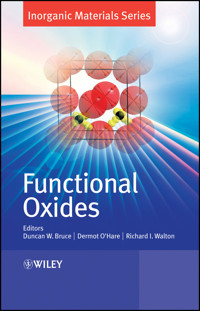
Functional Oxides E-Book
98,99 €
Mehr erfahren.
- Herausgeber: John Wiley & Sons
- Kategorie: Fachliteratur
- Serie: Inorganic Materials Series
- Sprache: Englisch
Functional oxides have a wide variety of applications in the electronic industry. The discovery of new metal oxides with interesting and useful properties continues to drive much research in chemistry, physics, and materials science.
In Functional Oxides five topical areas have been selected to illustrate the importance of metal oxides in modern materials chemistry:
- Noncentrosymmetric Inorganic Oxide Materials
- Geometrically Frustrated Magnetic Materials
- Lithium Ion Conduction in Oxides
- Thermoelectric Oxides
- Transition Metal Oxides - Magnetoresistance and Half-Metallicity
The contents highlight structural chemistry, magnetic and electronic properties, ionic conduction and other emerging areas of importance, such as thermoelectricity and spintronics.
Functional Oxides covers these complex concepts in a clear and accessible manner providing an excellent introduction to this broad subject area.
Sie lesen das E-Book in den Legimi-Apps auf:
Seitenzahl: 548
Veröffentlichungsjahr: 2011
Ähnliche




















Contents
Cover
Half Title page
Title page
Copyright page
Inorganic Materials Series Preface
Preface
List of Contributors
Chapter 1: Noncentrosymmetric Inorganic Oxide Materials: Synthetic Strategies and Characterisation Techniques
1.1 Introduction
1.2 Strategies Toward Synthesising Noncentrosymmetric Inorganic Materials
1.3 Electronic Distortions
1.4 Properties Associated With Noncentrosymmetric Materials
1.5 Outlook – Multifunctional Materials
1.6 Concluding Thoughts
Acknowledgements
References
Chapter 2: Geometrically Frustrated Magnetic Materials
2.1 Introduction
2.2 Geometric Frustration
2.3 Real Materials
2.4 Concluding Remarks
References
Chapter 3: Lithium Ion Conduction in Oxides
3.1 Introduction
3.2 Sodium and Lithium β-Alumina
3.3 Akali Metal Sulfates and the Effect of Anion Disorder on Conductivity
3.4 Lisicon and Related Phases
3.5 Lithium Conduction in Nasicon-Related Phases
3.6 Doped Analogues of LiZr2(PO4)3
3.7 Lithium Conduction in the Perovskite Structure
3.8 Lithium-Containing Garnets
References
Chapter 4: Thermoelectric Oxides
4.1 Introduction
4.2 How to Optimise Thermoelectric Generators (TEG)
4.3 Thermoelectric Oxides
4.4 Conclusion
Acknowledgements
References
Chapter 5: Transition Metal Oxides: Magnetoresistance and Half-Metallicity
5.1 Introduction
5.2 Magnetoresistance: Concepts and Development
5.3 Half-Metallicity
5.4 Oxides Exhibiting Half-Metallicity
5.5 Magnetoresistance and Half-Metallicity of Double Perovskites
5.6 Spintronics – The Emerging Magneto-Electronics
5.7 Summary
Acknowledgements
References
Index
Functional Oxides
Inorganic Materials Series
Editors:
Professor Duncan W. Bruce
Department of Chemistry, University of York, UK
Professor Dermot O’Hare
Chemistry Research Laboratory, University of Oxford, UK
Dr Richard I. Walton
Department of Chemistry, University of Warwick,
Series Titles
Functional Oxides
Molecular Materials
Porous Materials
Low-Dimensional Solids
Energy Materials
This edition first published 2010 © 2010 John Wiley & Sons, Ltd
Registered office John Wiley & Sons Ltd, The Atrium, Southern Gate, Chichester, West Sussex, PO19 8SQ, United Kingdom
For details of our global editorial offices, for customer services and for information about how to apply for permission to reuse the copyright material in this book please see our website at www.wiley.com.
The right of the author to be identified as the author of this work has been asserted in accordance with the Copyright, Designs and Patents Act 1988.
All rights reserved. No part of this publication may be reproduced, stored in a retrieval system, or transmitted, in any form or by any means, electronic, mechanical, photocopying, recording or otherwise, except as permitted by the UK Copyright, Designs and Patents Act 1988, without the prior permission of the publisher.
Wiley also publishes its books in a variety of electronic formats. Some content that appears in print may not be available in electronic books.
Designations used by companies to distinguish their products are often claimed as trademarks. All brand names and product names used in this book are trade names, service marks, trademarks or registered trademarks of their respective owners. The publisher is not associated with any product or vendor mentioned in this book. This publication is designed to provide accurate and authoritative information in regard to the subject matter covered. It is sold on the understanding that the publisher is not engaged in rendering professional services. If professional advice or other expert assistance is required, the services of a competent professional should be sought.
The publisher and the author make no representations or warranties with respect to the accuracy or completeness of the contents of this work and specifically disclaim all warranties, including without limitation any implied warranties of fitness for a particular purpose. This work is sold with the understanding that the publisher is not engaged in rendering professional services. The advice and strategies contained herein may not be suitable for every situation. In view of ongoing research, equipment modifications, changes in governmental regulations, and the constant flow of information relating to the use of experimental reagents, equipment, and devices, the reader is urged to review and evaluate the information provided in the package insert or instructions for each chemical, piece of equipment, reagent, or device for, among other things, any changes in the instructions or indication of usage and for added warnings and precautions. The fact that an organization or Website is referred to in this work as a citation and/or a potential source of further information does not mean that the author or the publisher endorses the information the organization or Website may provide or recommendations it may make. Further, readers should be aware that Internet Websites listed in this work may have changed or disappeared between when this work was written and when it is read. No warranty may be created or extended by any promotional statements for this work. Neither the publisher nor the author shall be liable for any damages arising herefrom.
Library of Congress Cataloging-in-Publication Data
Functional oxides / edited by Duncan W. Bruce, Dermot O'Hare, Richard I. Walton.p. cm.Includes bibliographical references and index.ISBN 978-0-470-99750-51. Organic oxides.2. Inorganic compounds. I. Bruce, Duncan W. II. O’Hare, Dermot. III. Walton, Richard IQD181.O1F87 2010546′.7212—dc22
2009041495
A catalogue record for this book is available from the British Library.
ISBN: 978-0-470-99750-5 (Cloth)
Inorganic Materials Series Preface
Back in 1992, two of us (DWB and DO’H) edited the first edition of Inorganic Materials in response to the growing emphasis and interest in materials chemistry. The second edition, which contained updated chapters, appeared in 1996 and was reprinted in paperback. The aim had always been to provide the reader with chapters that, while not necessarily comprehensive, nonetheless gave a first-rate and well-referenced introduction to the subject for the first-time reader. As such, the target audience was from first-year postgraduate student upwards. Authors were carefully selected who were experts in their field and actively researching their topic, so were able to provide an up-to-date review of key aspects of a particular subject, whilst providing some historical perspective. In these two editions, we believe our authors achieved this admirably.
In the intervening years, materials chemistry has grown hugely and now finds itself central to many of the major challenges that face global society. We felt, therefore, that there was a need for more extensive coverage of the area and so Richard Walton joined the team and, with Wiley, we set about a new and larger project. The Inorganic Materials Series is the result and our aim is to provide chapters with a similar pedagogical flavour but now with much wider subject coverage. As such, the work will be contained in several themed volumes. Many of the early volumes concentrate on materials derived from continuous inorganic solids, but later volumes will also emphasise molecular and soft matter systems as we aim for a much more comprehensive coverage of the area than was possible with Inorganic Materials.
We approached a completely new set of authors for the new project with the same philosophy in choosing actively researching experts, but also with the aim of providing an international perspective, so to reflect the diversity and interdisciplinarity of the now very broad area of inorganic materials chemistry. We are delighted with the calibre of authors who have agreed to write for us and we thank them all for their efforts and cooperation. We believe they have done a splendid job and that their work will make these volumes a valuable reference and teaching resource.
DWB, YorkDO’H, OxfordRIW, WarwickJanuary 2010
Preface
Metal oxides, particularly those containing one or more transition elements, for many years have been the foundation of solid-state inorganic chemistry. Here, the synthetic skill to manipulate the reactivity of diverse chemical elements, often at extreme temperatures and pressures, went hand-in-hand with developments in structural characterisation, including both spectroscopic and diffraction methods. A very good, and indeed already well-documented example, is the case of the cuprate superconductors, discovered in the early 1980s, which led to increasing complex structural chemistry and which continues to push the frontiers of knowledge of electronic properties of the solid-state. The interplay between the synthetic and structural work of chemists and the property measurement and theory of physicists led to the rapid development in understanding of a unique group of materials. When one also considers the role of the materials scientist in device fabrication of such electronic materials, the area is seen to be truly interdisciplinary.
Oxides continue to be the focus of much attention, and increasingly the area is driven by target properties. In this volume we have been largely concerned with properties arising from electronic structure but other applications, in catalysis or in optical media, are equally as important and are researched equally actively. The role of the chemist in synthesis is still paramount, and indeed it is very apparent that the scope for novel compositions and structures is far from being exhausted. More than ever the goal of a particular desirable property and the need to understand structure–property relationships is always in mind in contemporary research.
A complete review of the field of oxides would probably be impossible in a single volume, so instead we have selected five topical areas of functional oxides that illustrate their importance in modern materials chemistry. These highlight structural chemistry, magnetic properties, electronic properties, ionic conduction but also other emerging areas of importance in energy, such as thermoelectricity.
We approached five leading groups at the cutting edge of research to review these representative areas of functional oxides. We are very pleased that they agreed to write chapters for us, and that they have done such a good job in clearly explaining complex topics in an accessible way. We hope you will agree that these chapters provide an excellent introduction to what is an international field of great breadth.
DWB, YorkDO’H, OxfordRIW, WarwickJanuary 2010
List of Contributors
Edmund Cussen Department of Pure and Applied Chemistry, University of Strathclyde, Glasgow, Scotland
John E. Greedan McMaster University, Department of Chemistry, Hamilton, Ontario, Canada
Martha Greenblatt Department of Chemistry and Chemical Biology, Rutgers University, New Jersey, USA
P. Shiv Halasyamani Department of Chemistry, University of Houston, Houston, Texas, USA
Sylvie Hébert Laboratoire CRISMAT, UMR 6508 CNRS et ENSICAEN, Caen Cedex, France
Antoine Maignan Laboratoire CRISMAT, UMR 6508 CNRS et ENSICAEN, Caen Cedex, France
Tapas Kumar Mandal Department of Chemistry and Chemical Biology, Rutgers University, New Jersey, USA
Lesen Sie weiter in der vollständigen Ausgabe!
Lesen Sie weiter in der vollständigen Ausgabe!
Lesen Sie weiter in der vollständigen Ausgabe!
Lesen Sie weiter in der vollständigen Ausgabe!
Lesen Sie weiter in der vollständigen Ausgabe!
Lesen Sie weiter in der vollständigen Ausgabe!




