


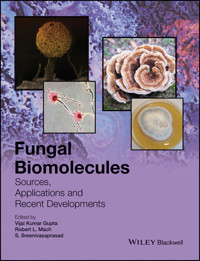
Fungal Biomolecules E-Book
136,99 €
Mehr erfahren.
- Herausgeber: John Wiley & Sons
- Kategorie: Wissenschaft und neue Technologien
- Sprache: Englisch
Fungi have an integral role to play in the development of the biotechnology and biomedical sectors. The fields of chemical engineering, Agri-food,Biochemical, pharmaceuticals, diagnostics and medical device development all
employ fungal products, with fungal biomolecules currently used in a wide range of applications, ranging from drug development to food technology and agricultural biotechnology. Understanding the biology of different fungi in diverse ecosystems, as well as their biotropic interactions with other microorganisms, animals and plants, is essential to underpin effective and innovative technological developments.
Fungal Biomolecules is a keystone reference, integrating branches of fungal product research into a comprehensive volume of interdisciplinary research. As such, it:
reflects state-of-the-art research and current emerging issues in fungal biology and biotechnology
reviews the methods and experimental work used to investigate different aspects of fungal biomolecules
provides examples of the diverse applications of fungal biomolecules in the areas of food, health and the environment
is edited by an experienced team, with contributions from international specialists
This book is an invaluable resource for industry-based researchers, academic institutions and professionals
working in the area of fungal biology and associated biomolecules for their applications in food technology, microbial and biochemical process, biotechnology, natural products, drug development and agriculture.
Sie lesen das E-Book in den Legimi-Apps auf:
Seitenzahl: 1167
Veröffentlichungsjahr: 2015
Ähnliche




















CONTENTS
Cover
Title page
Copyright page
Contributors
Foreword
Preface
Section 1: Fungi as cell factories
Chapter 1: Fungal biofilms: An overview
1.1 Biofilm: Definition and basic concepts
1.2 Fungi and fungal biofilms
References
Chapter 2: Fungal biomolecules for the food industry
2.1 Introduction
2.2 Enzymes
2.3 Citric acid and other organics
2.4 Exopolysaccharides
2.5 Flavours and aromas
2.6 Engineering of biomolecules
2.7 Concluding remarks
Acknowledgements
References
Chapter 3: Fungal biocatalysts in the textile industry: Whole-cell systems in real textile wastewater treatment
3.1 Introduction
3.2 Fungal degradation in axenic conditions
3.3 Real textile wastewaters
3.4 Scale-up to large-volume reactors
3.5 Immobilization of fungal biomass
3.6 Fungal treatment integration in existing WWTPs
3.7 Conclusion
References
Chapter 4: Discovery of fungal enzymes and pathways
4.1 Applications of fungal enzymes
4.2 Importance of elucidating fungal biosynthetic pathways
4.3 Modern bioprospecting
4.4 Outlook
References
Chapter 5: Fungal laccase in the textile industry
5.1 Introduction
5.2 Fungal laccases
5.3 Potential applications of fungal laccases in the textile industry
5.4 Major hurdles to further development from laboratory trials
References
Section 2: Production of recombinant peptides
Chapter 6: Lignocellulose-degrading enzymes: An overview of the global market
6.1 Introduction
6.2 The global market for industrial enzymes
6.3 Lignocellulose-degrading enzymes
6.4 The biorefinery concept for lignocellulose-degrading enzymes
6.5 Final remarks
References
Chapter 7: Recent advancements in the role of volatile organic compounds from fungi
7.1 Definition and classification of VOCs
7.2 Chemotaxonomy of fungal VOCs
7.3 Role of VOCs in fungal growth and development
7.4 Fungal VOCs in microbial interactions
7.5 VOCs in fungal–plant interactions
7.6 Fungal VOCs in multitrophic interactions
7.7 Concluding remarks
Acknowledgements
References
Chapter 8: Peptaibiotics and peptaibols from fungi
8.1 Introduction
8.2 Alamethicin, the most extensively studied peptaibol
8.3 Nomenclature and classification of peptaibols and peptaibiotics
8.4 Fungi producing peptaibiotics
8.5 Non-ribosomal biosynthesis of peptaibiotics
8.6 Regulation of biosynthesis of peptaibiotics
8.7 Properties and biological activities of peptaibiotics
8.8 Conclusions
Acknowledgements
References
Section 3: Fungal secondary metabolites and synthesis
Chapter 9: Biosynthesis of silver nanoparticles by fungi
9.1 Introduction
9.2 Synthesis of silver NPs
9.3 Physicochemical characterization of silver NPs
9.4 Conclusions
References
Chapter 10: Fungal biomolecules as modulators of growth and pathogenesis
10.1 Introduction
10.2 Fungal biomolecules: Various potential applications and need for identification of novel bioactive molecules using innovative strategies
10.3 Fungal biomolecules: Role in inter-species chemical communication and impact on ecological balance
10.4 Novel fungal biomolecules: Need for future development
References
Chapter 11: Fungi as a source of antitumour agents
11.1 Introduction
11.2 Current therapy for tumours
11.3 Antitumour agents from nature
11.4 Fungi as antitumour agent
11.5 What component in fungi is the source of antitumour action?
References
Chapter 12: Fungal mycotoxins: An overview
12.1 Introduction
Lesen Sie weiter in der vollständigen Ausgabe!
Lesen Sie weiter in der vollständigen Ausgabe!
Lesen Sie weiter in der vollständigen Ausgabe!
Lesen Sie weiter in der vollständigen Ausgabe!
Lesen Sie weiter in der vollständigen Ausgabe!
Lesen Sie weiter in der vollständigen Ausgabe!
Lesen Sie weiter in der vollständigen Ausgabe!
Lesen Sie weiter in der vollständigen Ausgabe!
Lesen Sie weiter in der vollständigen Ausgabe!
Lesen Sie weiter in der vollständigen Ausgabe!
Lesen Sie weiter in der vollständigen Ausgabe!
Lesen Sie weiter in der vollständigen Ausgabe!
Lesen Sie weiter in der vollständigen Ausgabe!
Lesen Sie weiter in der vollständigen Ausgabe!
Lesen Sie weiter in der vollständigen Ausgabe!
Lesen Sie weiter in der vollständigen Ausgabe!
Lesen Sie weiter in der vollständigen Ausgabe!
Lesen Sie weiter in der vollständigen Ausgabe!
Lesen Sie weiter in der vollständigen Ausgabe!
Lesen Sie weiter in der vollständigen Ausgabe!
Lesen Sie weiter in der vollständigen Ausgabe!
Lesen Sie weiter in der vollständigen Ausgabe!
Lesen Sie weiter in der vollständigen Ausgabe!
Lesen Sie weiter in der vollständigen Ausgabe!
Lesen Sie weiter in der vollständigen Ausgabe!
Lesen Sie weiter in der vollständigen Ausgabe!
Lesen Sie weiter in der vollständigen Ausgabe!
Lesen Sie weiter in der vollständigen Ausgabe!
Lesen Sie weiter in der vollständigen Ausgabe!
Lesen Sie weiter in der vollständigen Ausgabe!
Lesen Sie weiter in der vollständigen Ausgabe!
Lesen Sie weiter in der vollständigen Ausgabe!
Lesen Sie weiter in der vollständigen Ausgabe!
Lesen Sie weiter in der vollständigen Ausgabe!
Lesen Sie weiter in der vollständigen Ausgabe!
Lesen Sie weiter in der vollständigen Ausgabe!




