


90,99 €
Mehr erfahren.
- Herausgeber: John Wiley & Sons
- Kategorie: Wissenschaft und neue Technologien
- Serie: Geophysical Monograph Series
- Sprache: Englisch
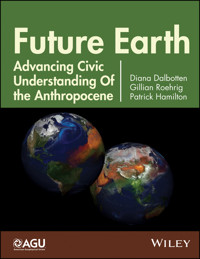
Earth now is dominated by both biogeophysical and anthropogenic processes, as represented in these two images from a simulation of aerosols. Dust (red) from the Sahara sweeps west across the Atlantic Ocean. Sea salt (blue) rises into the atmosphere from winds over the North Atlantic and from a tropical cyclone in the Indian Ocean. Organic and black carbon (green) from biomass burning is notable over the Amazon and Southeast Asia. Plumes of sulfate (white) from fossil fuel burning are particularly prominent over northeastern North America and East Asia. If present trends of dust emissions and fossil fuel burning continues in what we call the Anthropocene epoch, then we could experience high atmospheric CO2 levels leading to unusual warming rarely experienced in Earth's history. This book focuses on human influences on land, ocean, and the atmosphere, to determine if human activities are operating within or beyond the safe zones of our planet's biological, chemical, and physical systems. Volume highlights include: * Assessment of civic understanding of Earth and its future * Understanding the role of undergraduate geoscience research and community-driven research on the Anthropocene * Effective communication of science to a broader audience that would include the public, the K-12 science community, or populations underrepresented in the sciences * Public outreach on climate education, geoscience alliance, and scientific reasoning Future Earth is a valuable practical guide for scientists from all disciplines including geoscientists, museum curators, science educators, and public policy makers.
Sie lesen das E-Book in den Legimi-Apps auf:
Seitenzahl: 479
Veröffentlichungsjahr: 2014
Ähnliche




















CONTENTS
Cover
Series page
Title page
Copyright page
Contributors
Preface
Acknowledgments
1 Welcome to the Anthropocene
1.1. THE ANTHROPOCENE AND LAND
1.2. THE ANTRHOPOCENE AND THE OCEAN
1.3. THE ANTHROPOCENE AND THE ATMOSPHERE
1.4. THE ANTHROPOCENE AND HUMANITY
1.5. THE RACE IS ON
REFERENCES
2 The Anthropocene and the Framework for K–12 Science Education
2.1. INTRODUCTION
2.2. THE GENESIS AND GROUNDING OF THE FRAMEWORK
2.3. OVERALL GOAL
2.4. CRITICAL FRAMEWORK ELEMENTS
2.5. RECOMMENDATIONS FOR DESIGNING STANDARDS AND CURRICULUM
2.6. CONCLUSION
REFERENCES
3 Teacher Professional Development in the Anthropocene
3.1. TEACHER PROFESSIONAL DEVELOPMENT
3.2. EXAMPLES OF TEACHER PROFESSIONAL DEVELOPMENT PROGRAMS
3.3. CONNECTING GEOSCIENTISTS AND EDUCATORS
3.4. ACKNOWLEDGMENTS
REFERENCES
4 Climate Literacy and Scientific Reasoning
4.1. WHAT IS SCIENTIFIC REASONING?
4.2. WHY IS SCIENTIFIC REASONING IMPORTANT IN CLIMATE CHANGE EDUCATION?
4.3. HOW CAN APPLYING SCIENTIFIC REASONING ENHANCE CLIMATE LITERACY?
4.4. CONCLUSIONS
REFERENCES
5 Evaluation and Assessment of Civic Understanding of Planet Earth
5.1. DEFINING EVALUATION AND ASSESSMENT
5.2. THE IMPORTANCE OF EVALUATION AND ASSESSMENT FOR CIVIC UNDERSTANDING INITIATIVES
5.3. COGNITIVE, AFFECTIVE, AND BEHAVIORAL CONSIDERATIONS
5.4. A BRIEF REVIEW OF ASSESSMENT INSTRUMENT TYPES
5.5. CURRENT ASSESSMENT PRACTICES IN GEOSCIENCE EDUCATION
5.6. RECOMMENDATIONS FOR ASSESSMENT BEST PRACTICES
5.7. AGENDA FOR FUTURE ASSESSMENT EFFORTS
REFERENCES
6 Community-Driven Research in the Anthropocene
6.1. INTRODUCTION
6.2. MIND THE GAP
6.3. CLOSING THE GAP
6.4. COMMON ELEMENTS OF COMMUNITY-DRIVEN SCIENCE
6.5. A FEW EXAMPLES
6.6. CONCLUSION
6.7. EPILOGUE
REFERENCES
7 Geoscience Alliance
7.1. THE GEOSCIENCE ALLIANCE
7.2. UNDERREPRESENTATION OF NATIVE AMERICANS IN THE GEOSCIENCES
7.3. GEOSCIENCE ALLIANCE GOALS
7.4. BACKGROUND OF THE GEOSCIENCE ALLIANCE
7.5. THE GEOSCIENCE ALLIANCE NATIONAL CONFERENCES
7.6. INCORPORATING TRADITIONAL KNOWLEDGE IN GEOSCIENCE EDUCATION
7.7. REMOVING BARRIERS TO BROADENING PARTICIPATION IN UNDERGRADUATE AND GRADUATE EDUCATION
7.8. CULTURALLY APPROPRIATE, NATIVE-FOCUSED ASSESSMENT AND EVALUATION FOR THE GEOSCIENCES
7.9. CONTINUING ISSUES
7.10. FUTURE OF THE GEOSCIENCE ALLIANCE
REFERENCES
8 New Voices
8.1. CONSIDERATIONS FOR PLANNING AN INCLUSIVE UNDERGRADUATE RESEARCH OPPORTUNITY PROGRAM
8.2. TEACHING STUDENTS ABOUT THE ANTHROPOCENE IN RESEARCH EXPERIENCES
8.3. THREE UNDERGRADUATE RESEARCH EXPERIENCES RELATED TO THE ANTHROPOCENE
REFERENCES
9 Shaping the Public Dialogue on Climate Change
9.1. PUBLIC UNDERSTANDING OF CLIMATE CHANGE
9.2. THE POTENTIAL OF INFORMAL SCIENCE EDUCATION
9.3. DEVELOPING A NATIONAL STRATEGY
9.4. THE NATIONAL NETWORK FOR OCEAN AND CLIMATE CHANGE INTERPRETATION
9.5. RESULTS TO DATE
9.6. LEGACY AND SUSTAINABILITY
9.7. ACKNOWLEDGMENTS
REFERENCES
10 Opportunities for Communicating Ocean Acidification to Visitors at Informal Science Education Institutions
10.1. METHODOLOGY
10.2. KEY FINDINGS
10.3. IMPLICATIONS FOR COMMUNICATING OCEAN ACIDIFICATION
10.4. CONCLUSION
REFERENCES
11 City-Wide Collaborations for Urban Climate Education
11.1. CITIES AND CLIMATE CHANGE
11.2. CLIMATE CHANGE EDUCATION AT THE CITY SCALE
11.3. CLIMATE AND URBAN SYSTEMS PARTNERSHIP
11.4. CURRENT PROGRESS AND FUTURE WORK OF CUSP
REFERENCES
12 On Bridging the Journalism/Science Divide
12.1. HARD NEWS … AND EXPLANATORY JOURNALISM
12.2. TIPS FOR SCIENTISTS IN WORKING WITH MEDIA
12.3. RESOURCES FOR SCIENTISTS IN DEALING WITH MEDIA AND VICE VERSA
REFERENCES
Supplemental Images
INDEX
End User License Agreement
List of Tables
Chapter 03
Table 3.1 Critical Levels of Professional Development Evaluation
Chapter 05
Table 5.1 Summary of Qualitative Assessments Applicable to Educational Settings
Table 5.2 Summary of Quantitative Assessments Applicable to Educational Settings
Table 5.3 Assessment Websites of Relevance to Civic Understanding of the Anthropocene
List of Illustrations
Chapter 05
Figure 5.1 Visual of indexing of common terms used in previous two paragraphs. Created using http://www.wordle.net/.
Figure 5.2 Likert-type item from the New Ecological Paradigm Scale of
Dunlap et al
. [2000].
Figure 5.3 Multiple-choice question from the Geoscience Concept Inventory.
Chapter 06
Figure 6.1 A schematic tracing the different paths for connecting science and society. A key distinction is who participates in defining the scientific question, and this distinction flows into whether science results are pushed out from scientists or pulled into community priorities. For color detail, please see color plate section.
Chapter 09
Figure 9.1 NNOCCI logic model, showing the relationships among project inputs, activities and outcomes. For color detail, please see color plate section.
Figure 9.2 NNOCCI has identified 212 ISEIs with an ocean theme or focus as potential participants; the goal is to reach 150 of these. For color detail, please see color plate section.
Chapter 10
Figure 10.1 Only 1.5 percent of aquarium and science museum visitors disagreed with the statement, “
Learning how to help conserve the ocean and its animals makes this a better place to visit
,” which a clear indication of the public’s interest in learning how to be a part of conservation solutions. For color detail, please see color plate section.
Guide
Cover
Table of Contents
Begin Reading
Pages
ii
iii
iv
vii
viii
ix
1
2
3
4
5
6
7
9
10
11
12
13
14
15
16
17
19
20
21
22
23
24
25
26
27
28
29
30
31
32
33
34
35
36
37
38
39
40
41
42
43
44
45
46
47
48
49
50
51
52
53
54
55
56
57
58
59
60
61
62
63
64
65
66
67
68
69
70
71
72
73
74
75
77
78
79
80
81
82
83
84
85
86
87
88
89
90
91
92
93
94
95
96
97
99
100
101
102
103
104
105
106
107
108
111
112
113
114
115
116
117
118
119
121
122
123
124
125
126
127
128
129
130
131
Geophysical Monograph Series
Recurrent Magnetic Storms: Corotating Solar Wind Streams
Bruce Tsurutani, Robert McPherron, Walter Gonzalez, Gang Lu, José H. A. Sobral, and Natchimuthukonar Gopalswamy (Eds.)
Earth’s Deep Water Cycle
Steven D. Jacobsen and Suzan van der Lee (Eds.)
Magnetospheric ULF Waves: Synthesis and New Directions
Kazue Takahashi, Peter J. Chi, Richard E. Denton, and Robert L. Lysak (Eds.)
Earthquakes: Radiated Energy and the Physics of Faulting
Rachel Abercrombie, Art McGarr, Hiroo Kanamori, and Giulio Di Toro (Eds.)
Subsurface Hydrology: Data Integration for Properties and Processes
David W. Hyndman, Frederick D. Day-Lewis, and Kamini Singha (Eds.)
Volcanism and Subduction: The Kamchatka Region
John Eichelberger, Evgenii Gordeev, Minoru Kasahara, Pavel Izbekov, and Johnathan Lees (Eds.)
Ocean Circulation: Mechanisms and Impacts—Past and Future Changes of Meridional Overturning
Andreas Schmittner, John C. H. Chiang, and Sidney R. Hemming (Eds.)
Post-Perovskite: The Last Mantle Phase Transition
Kei Hirose, John Brodholt, Thorne Lay, and David Yuen (Eds.)
A Continental Plate Boundary: Tectonics at South Island, New Zealand
David Okaya, Tim Stem, and Fred Davey (Eds.)
Exploring Venus as a Terrestrial Planet
Larry W. Esposito, Ellen R. Stofan, and Thomas E. Cravens (Eds.)
Ocean Modeling in an Eddying Regime
Matthew Hecht and Hiroyasu Hasumi (Eds.)
Magma to Microbe: Modeling Hydrothermal Processes at Oceanic Spreading Centers
Robert P. Lowell, Jeffrey S. Seewald, Anna Metaxas, and Michael R. Perfit (Eds.)
Active Tectonics and Seismic Potential of Alaska
Jeffrey T. Freymueller, Peter J. Haeussler, Robert L. Wesson, and Göran Ekström (Eds.)
Arctic Sea Ice Decline: Observations, Projections, Mechanisms, and Implications
Eric T. DeWeaver, Cecilia M. Bitz, and L.-Bruno Tremblay (Eds.)
Midlatitude Ionospheric Dynamics and Disturbances
Paul M. Kintner, Jr., Anthea J. Coster, Tim Fuller-Rowell, Anthony J. Mannucci, Michael Mendillo, and Roderick Heelis (Eds.)
The Stromboli Volcano: An Integrated Study of the 2002–2003 Eruption
Sonia Calvari, Salvatore Inguaggiato, Giuseppe Puglisi, Maurizio Ripepe, and Mauro Rosi (Eds.)
Carbon Sequestration and Its Role in the Global Carbon Cycle
Brian J. McPherson and Eric T. Sundquist (Eds.)
Carbon Cycling in Northern Peatlands
Andrew J. Baird, Lisa R. Belyea, Xavier Comas, A. S. Reeve, and Lee D. Slater (Eds.)
Indian Ocean Biogeochemical Processes and Ecological Variability
Jerry D. Wiggert, Raleigh R. Hood, S. Wajih A. Naqvi, Kenneth H. Brink, and Sharon L. Smith (Eds.)
Amazonia and Global Change
Michael Keller, Mercedes Bustamante, John Gash, and Pedro Silva Dias (Eds.)
Surface Ocean–Lower Atmosphere Processes
Corinne Le Quèrè and Eric S. Saltzman (Eds.)
Diversity of Hydrothermal Systems on Slow Spreading Ocean Ridges
Peter A. Rona, Colin W. Devey, Jérôme Dyment, and Bramley J. Murton (Eds.)
Climate Dynamics: Why Does Climate Vary?
De-Zheng Sun and Frank Bryan (Eds.)
The Stratosphere: Dynamics, Transport, and Chemistry
L. M. Polvani, A. H. Sobel, and D. W. Waugh (Eds.)
Rainfall: State of the Science
Firat Y. Testik and Mekonnen Gebremichael (Eds.)
Antarctic Subglacial Aquatic Environments
Martin J. Siegert, Mahlon C. Kennicut II, and Robert A. Bindschadler
Abrupt Climate Change: Mechanisms, Patterns, and Impacts
Harunur Rashid, Leonid Polyak, and Ellen Mosley-Thompson (Eds.)
Stream Restoration in Dynamic Fluvial Systems: Scientific Approaches, Analyses, and Tools
Andrew Simon, Sean J. Bennett, and Janine M. Castro (Eds.)
Monitoring and Modeling the
Deepwater Horizon
Oil Spill: A Record-Breaking Enterprise
Yonggang Liu, Amy MacFadyen, Zhen-Gang Ji, and Robert H. Weisberg (Eds.)
Extreme Events and Natural Hazards: The Complexity Perspective
A. Surjalal Sharma, Armin Bunde, Vijay P. Dimri, and Daniel N. Baker (Eds.)
Auroral Phenomenology and Magnetospheric Processes: Earth and Other Planets
Andreas Keiling, Eric Donovan, Fran Bagenal, and Tomas Karlsson (Eds.)
Climates, Landscapes, and Civilizations
Liviu Giosan, Dorian Q. Fuller, Kathleen Nicoll, Rowan K. Flad, and Peter D. Clift (Eds.)
Dynamics of the Earth’s Radiation Belts and Inner Magnetosphere
Danny Summers, Ian R. Mann, Daniel N. Baker, Michael Schulz (Eds.)
Lagrangian Modeling of the Atmosphere
John Lin (Ed.)
Modeling the Ionosphere-Thermosphere
Jospeh D. Huba, Robert W. Schunk, and George V Khazanov (Eds.)
The Mediterranean Sea: Temporal Variability and Spatial Patterns
Gian Luca Eusebi Borzelli, Miroslav GaCiC, Piero Lionello and Paola Malanotte-Rizzoli (Eds.)
Geophysical Monograph 203
Future Earth—Advancing Civic Understanding of the Anthropocene
Diana DalbottenGillian RoehrigPatrick Hamilton
Editors
This Work is a co-publication between the American Geophysical Union and John Wiley & Sons, Inc.
This Work is a co-publication between the American Geophysical Union and John Wiley & Sons, Inc.
Published under the aegis of the AGU Books Board
Brooks Hanson, Director of PublicationsRobert van der Hilst, Chair, Publications CommitteeRichard Blakely, Vice Chair, Publications Committee
© 2014 by the American Geophysical Union, 2000 Florida Avenue, N.W., Washington, D.C. 20009For details about the American Geophysical Union, see www.agu.org.Published by John Wiley & Sons, Inc., Hoboken, New JerseyPublished simultaneously in Canada
No part of this publication may be reproduced, stored in a retrieval system, or transmitted in any form or by any means, electronic, mechanical, photocopying, recording, scanning, or otherwise, except as permitted under Section 107 or 108 of the 1976 United States Copyright Act, without either the prior written permission of the Publisher, or authorization through payment of the appropriate per-copy fee to the Copyright Clearance Center, Inc., 222 Rosewood Drive, Danvers, MA 01923, (978) 750-8400, fax (978) 750-4470, or on the web at www.copyright.com. Requests to the Publisher for permission should be addressed to the Permissions Department, John Wiley & Sons, Inc., 111 River Street, Hoboken, NJ 07030, (201) 748-6011, fax (201) 748-6008, or online at http://www.wiley.com/go/permission.
Limit of Liability/Disclaimer of Warranty: While the publisher and author have used their best efforts in preparing this book, they make no representations or warranties with respect to the accuracy or completeness of the contents of this book and specifically disclaim any implied warranties of merchantability or fitness for a particular purpose. No warranty may be created or extended by sales representatives or written sales materials. The advice and strategies contained herein may not be suitable for your situation. You should consult with a professional where appropriate. Neither the publisher nor author shall be liable for any loss of profit or any other commercial damages, including but not limited to special, incidental, consequential, or other damages.
For general information on our other products and services or for technical support, please contact our Customer Care Department within the United States at (800) 762-2974, outside the United States at (317) 572-3993 or fax (317) 572-4002.
Wiley also publishes its books in a variety of electronic formats. Some content that appears in print may not be available in electronic formats. For more information about Wiley products, visit our web site at www.wiley.com.
Library of Congress Cataloging-in-Publication Data
Future Earth : advancing civic understanding of the anthropocene / Diana Dalbotten, Patrick Hamilton, Gillian Roehrig, editors. pages cm. – (Geophysical monograph series) Includes bibliographical references and index. ISBN 978-1-118-85430-3 (hardback)1. Geological time. 2. Global environmental change. 3. Communication in science. I. Dalbotten, Diana, 1959– editor of compilation. II. Hamilton, Patrick, 1958– editor of compilation. III. Roehrig, Gillian, 1968– editor of compilation. QE508.F88 2014 304.2–dc232013050492
Cover image: NASA Goddard Space Flight CenterCover design by Modern Alchemy LLC
CONTRIBUTORS
Lauren B. AllenGraduate Student Learning Research & Development CenterUniversity of Pittsburgh Pittsburgh, Pennsylvania Daniel A. BaderResearch Analyst Center for Climate Systems Research Columbia University New York Antony BertheloteHydrology Program Director Salish Kootenai College Natural Resources Department Pablo, Montana Devarati BhattacharyaDoctoral Candidate STEM Education Center Department of Curriculum and Instruction University of Minnesota St. Paul, Minnesota Nievita Bueno WattsDirector of Academic ProgramsCenter for Coastal Margin Observation & PredictionInstitute of Environmental HealthOregon Health & Sciences UniversityPortland, Oregon Kevin CrowleyProfessor Learning Research & Development CenterUniversity of Pittsburgh Pittsburgh, Pennsylvania Fred N. FinleyAssociate Professor STEM Education Center Department of Curriculum and Instruction University of MinnesotaSt. Paul, Minnesota Emily Geraghty WardAssistant Professor of Geology Rocky Mountain College Billings, Montana Vanessa GreenDirector of Higher Education and Diversity Center for Coastal Margin Observation & Prediction Institute of Environmental HealthOregon Health & Sciences UniversityPortland, Oregon Rebecca Haacker-SantosSOARS Program Director, Head of Undergraduate Education UCAR Science Education University Corporation for Atmospheric Research Boulder, Colorado Rita Mukherjee HoffstadtVice President, Education and Visitor Experience San Antonio Children’s Museum San Antonio, Texas Radley M. HortonAssociate Research Scientist Center for Climate Systems Research Columbia University New York Melinda HowardDoctoral Student Department of Curriculum and Instruction University of Idaho–Coeur d’Alene Anne KernAssociate Professor, Science Education Department of Curriculum and Instruction University of Idaho–Coeur d’Alene Julie C. LibarkinGeocognition Research Lab Department of Geological Sciences Michigan State University East Lansing, Michigan Shiyu LiuDepartment of Educational Psychology University of Minnesota Minneapolis, Minnesota Douglas MeyerPrincipal Bernuth & Williamson Washington, D.C.
Bill MottDirector The Ocean Project Providence, Rhode Island Rajul E. PandyaThriving Earth Exchange American Geophysical UnionWashington, D.C.University Corporation for Atmospheric ResearchBoulder, Colorado Wendy SmytheK’ah Skaahluwaa Center for Coastal Margin Observation & Prediction Institute of Environmental HealthOregon Health & Sciences UniversityPortland, Oregon Steven SnyderExecutive Director Reuben H. Fleet Science Center San Diego, California William SpitzerVice President Programs, Exhibits, and Planning New England Aquarium Boston, Massachussetts Mervyn TanoPresident International Institute for Indigenous Resource Management Denver, Colorado Keisha VarmaAssistant Professor Department of Educational Psychology University of Minnesota Minneapolis Bud WardEditor, The Yale Forum on Climate Change & The Media Suzanne Zurn-BirkhimerAssociate Professor Saint Joseph’s College Department of Mathematics Rensselaer, Indiana
Preface
When I was 10, I rushed into my family’s living room Christmas morning to find a Sears and Roebuck telescope with my name on it. The perfect gift! At the time, I fantasized perpetually about exploring the unknown landscapes of Earth’s nearest planetary neighbors. I promptly ventured out into the frigid December nights of 1968 and trained my new toy on Venus and Mars.
More than 40 years ago, scientists knew only a tiny fraction of what we know now about our nearest neighbors in the solar system, and so it was still possible for me to imagine a sultry world hidden beneath the dense clouds of Venus and envision ethereal creatures drifting through the thin atmosphere of Mars. As an adult, I now know better. Venus’ supercharged hothouse atmosphere creates a surface environment of such intense heat and pressure as to make Death Valley at its most extreme seem like an alpine retreat. And the intensely cold and almost airless reality of Mars makes Antarctica seem like Tahiti by comparison.
So although each is beautiful and intriguing in its own way, Earth’s closest neighbors in the solar system are remarkably inhospitable to human life. Also, even though they are close astronomically speaking, they are quite inaccessible in human terms. About 50 percent of all missions to Mars have failed.
Through the application of incredibly ingenious technologies and techniques, astronomers to date have confirmed 1074 planets orbiting other stars, with the count surely to rise rapidly in the near future. The scientific evidence increasingly points to planets being abundant in our galaxy, but these worlds beyond our solar system are ridiculously distant from Earth.
So here we are—working, playing, living, dying on a planet that is astonishingly conducive to life and now home to 7.1 billion people (with 9 billion expected by 2050). It is as if all of us were residing on a small ship in the midst of a vast ocean without end. No safe harbors are apparent, no verdant islands available for resupply and no other ships anywhere in sight if we begin taking on water. We are solely accountable for our circumstances.
We now live in a world being thoroughly reconfigured by human activity. Humans move more earth and rock annually that all rivers and glaciers combined. Humans fix more nitrogen than all microbial activity on the planet. Humans also currently appropriate nearly 40 percent of all terrestrial primary plant productivity. Humans are now such dominant agents of change that the term Anthropocene is used to describe this new geologic epoch in Earth’s history.
Humans have initiated global changes that will reverberate for millennia, yet the misconception that the Earth is somehow too big and robust to be much influenced by human actions is a common one. We have the means to address the planetary challenges we collectively have set in motion. The future of Earth will be decided by human decision making, either by default or by design. What do we want our future Earth to be?
Patrick Hamilton, 2014
Diana DalbottenDirector of Diversity and Broader Impacts, National Center for Earth-SurfaceDynamics, St. Anthony Falls Laboratory, University of Minnesota, Minneapolis, Minnesota
Patrick HamiltonProgram Director, Global Change InitiativesScience Museum of Minnesota, Saint Paul, Minnesota
Gillian RoehrigAssociate Director and Associate Professor,STEM Education Center, University of Minnesota, Minneapolis, Minnesota
Acknowledgments
Cover illustration: NASA Goddard Space Flight Center. This simulation used the Goddard Earth Observing System Model, Version 5 (GEOS-5) and the Goddard Chemistry Aerosol Radiation and Transport (GOCART) Model. GEOS-5 development is funded by NASA’s Modeling, Analysis, and Prediction Program. An animation of the September 1, 2006 to March 17, 2007 aerosol simulation is available at http://sos.noaa.gov/Datasets/dataset.php?id=369.
This volume was made possible with the support of the National Science Foundation through the National Center for Earth-surface Dynamics (EAR-0120914) and the Future Earth Initiative (DRL-0741760). Any opinions, findings, and conclusions or recommendations expressed in this publication are those of the author(s) and do not necessarily reflect the views of the National Science Foundation.
1Welcome to the Anthropocene
Patrick Hamilton
Program Director, Global Change Initiatives, Science Museum of Minnesota, Saint Paul, Minnesota
Whether we and our politicians know it or not, Nature is party to all our deals and decisions, and she has more votes, a longer memory, and a sterner sense of justice than we do.
—Wendell Berry
Over the past several decades, numerous independent lines of research conducted by thousands of researchers around the world have accumulated into a scientific body of evidence documenting that we all now live in a world being substantially reconfigured by human activity [Pearce, 2007]. As humans we have already set in motion global changes that will propagate for millennia [Thompson et al., 2004]. Climate change as a result of releases of heat-trapping gases into the atmosphere is just one profound manifestation of this human-dominated planet that we all share. As of the writing of this chapter (January 2013), Anthropocene is not yet an official stratigraphic term, but it is being used with increasing frequency in both refereed publications and popular media to describe a new geologic epoch in Earth history [Crutzen and Stoermer, 2000].
The onset of the Anthropocene is a profound scientific realization, but it is not yet a widely shared new global paradigm. The dilemma of the Anthropocene is how evident it is to the geoscientific community while being little known at best to the general public. Public awareness of humanity as the dominant agent of global change significantly lags the scientific research, to the detriment of public policy efforts to stave off further undesirable planetary changes while preparing for those that are now unavoidable. It is not that most citizens are unwilling to accept the notion that humans now surpass natural processes in driving global change, but that many have not yet encountered it and those who have are often unsure of its significance. To geoscientists trained to consider global change in the context of vast stretches of geologic time, the planetary transformations that humans have set in motion are abrupt and without precedence in the geologic record [Alley, 2011]. No individual species in the history of this planet has come close to the domination of Earth now exercised collectively by all 7.1 billion humans, but to most people alive today our exceptional circumstances are merely the only reality they have ever known.
A multiplicity of innovations and solutions are needed at all scales of society for people to survive and thrive on a human-dominated planet. A more secure future is attainable if individuals and societies are open to new ways of achieving a high quality of life that reduces pressures on global environmental systems. A fundamental first step toward the creation of a more sustainable future is a broader societal realization that humanity has crossed a major threshold from being merely an inhabitant of Earth to being its leading architect and engineer. A number of articles and books have made strong and effective scientific cases for why humans no longer reside in the Holocene Epoch but rather in the Anthropocene one. This chapter, too, seeks to make the case for the Anthropocene but with a somewhat different tack. It will make the case for the Anthropocene in ways more in keeping with how those not trained in the geosciences experience the world around them.
In 2009, 29 international geoscientists collaborated on the creation of a consensus document intended to summarize the cumulative impact of humanity on the planet [Rockström et al., 2009]. Nine key global systems were delineated of which seven were quantified. The purpose of this exercise was to formulate a scientific consensus on whether human activities were operating within or beyond the safe zones of our planet’s biological, chemical, and physical systems. This chapter will not expound on the safe operating spaces for these nine planetary systems but rather will briefly survey major human influences on three prominent features of our planet: the 29 percent of Earth that is land, the other 71 percent that is covered by ocean, and the atmosphere that envelopes them both.
1.1. THE ANTHROPOCENE AND LAND
Buy land. They ain’t making any more of the stuff.
—Will Rogers
Perhaps no transformation of our planet is more apparent to the casual human eye than land use. Cities are particularly striking human alterations of landscapes but in fact occupy a small portion of all land on the planet, only about 2 percent [Henderson-Sellers and McGuffie, 2012]. Agriculture has a giant global footprint. Forty percent of all ice-free land is committed already to growing our crops and raising our livestock. Croplands cover 1.53 billion hectares, which is an area comparable in size to all of South America, and pastures cover 3.38 billion hectares, which is an area similar in size to Africa [Global Landscapes Initiative, 2013].
Agriculture’s dominance is evident on virtually any flight across every continent, except Antarctica. From where I live (Saint Paul, Minnesota, United States), window seats on flights reveal vast landscapes of cropland and pastureland for nearly 1,600 km (1,000 miles) in almost every direction, interrupted only by cities and towns, highways and railways, rivers and lakes, and occasional woodlands. The diverse mosaics of plant and animal communities that blanketed North America several hundred years ago have been replaced in enormous areas with a highly simplified plant ecology. In 2012 in the United States, just two plant species, corn and soybean, were planted on 70 million hectares, which an area larger than the state of California and comparable in size to entire countries (e.g. Sweden, Morocco, Papua New Guinea, or Uzbekistan).
So although North America encompasses biomes from tropical rainforests in the Yucatan of Mexico to Arctic tundra in northern Canada, much of the continent now lacks ecological integrity because many native plant and animal species face great difficulties in moving or migrating across human-engineered landscapes to reach other suitable habitats. For many plant and animal species, North America is no longer a landmass but ecologically more analogous to a vast archipelago of islands (some large, some tiny) separated from one another by seas of human-dominated landscapes of cities and transportation corridors, but especially croplands. This situation is true to greater or lesser degrees for all other continents on Earth, excluding Antarctica. Losses of terrestrial plant and animal species resulting from human activities are already high and are accelerating. Some extinction resulted from overharvesting, hunting species to extinction, or from introduced diseases or pests, but the vast majority of extinction has been and will continue to be as a result of loss of suitable habitat, unless we make major changes to agriculture.
The conversion of native lands to agriculture, particularly the species-rich tropical rainforests and savannas, must end. The gaps need to be closed between the yields on our best farms and low-yielding croplands with comparable climates and soils. Water, fertilizer, and energy must be consumed with much greater efficiency, especially given that 100 percent of freshwater resources are already dedicated to agriculture in many areas. Because much of the grain grown in the United States and Western Europe goes to fattening livestock, a reduction in eating meat could free up enormous quantities of calories for human consumption. Another huge gain in feeding the world could be achieved by reducing the 30 percent of food produced on the planet that currently is wasted in rich countries primarily by consumers and in poorer countries chiefly by failed crops, pest-infested stockpiles, or bad infrastructure and markets. Agriculture must be reimagined and reengineered on a massive scale if we are to stave off a mass extinction of plant and animal species and feed a world of nine billion people in 2050 [Foley, 2011].
1.2. THE ANTRHOPOCENE AND THE OCEAN
It is a curious situation that the sea, from which life first arose, should now be threatened by the activities of one form of that life.
—Rachel Carson
The ocean is home to some of the most remote and inaccessible ecosystems on the planet. Vast portions of the deep ocean remain unexplored and likely contain a high percentage of the organisms on Earth that have yet to be scientifically described. As terrestrial animals, the ocean that covers 71 percent of our planet can seem removed from our daily lives and thus largely safeguarded from significant human impact, although about 44 percent of the world’s population lives within about 160 km (100 miles) of the sea and most of the world’s megacities (those with populations 10 million or more) with a cumulative total of more than 2.5 billion inhabitants are along coasts [UN Atlas, 2010].
These dense coastal concentrations of people heavily impact continental shelves and slopes. Coastal populations, furthermore, tend to be especially concentrated where rivers enter the ocean. These marine environments are impacted not only by coastal populations but also by the cumulative pollution load delivered by rivers and generated by human activities throughout watersheds that may drain millions of square kilometers of the interiors of continents. But human impacts now extend well beyond the coastal margins of continents.
Rapid advances in technology in recent decades have made it possible for humans to extract seafood and oil and gas from areas long considered inaccessible. Almost every fishery on the planet presently is being fished at or above what fishery scientists consider the maximum sustainable yield. Oil-drilling platforms now are capable of operating in 2 km (1.25 miles) of water to extract oil located below the seafloor. The rapid demise of summer sea ice in recent years likely means that the Arctic Ocean, once largely inhospitable to commercial activity, will see greatly increased pressure from the fishing, oil and gas extraction, and shipping industries in the near future. In addition to fishing and energy extraction industries, thousands of cargo ships now regularly ply intensively traveled shipping lines across the Atlantic, Pacific, and Indian Oceans with their concomitant noise, water, and air pollution.
The most pervasive human impact on the global ocean, however, is the result of human alterations of the atmosphere. Carbon dioxide (CO2) and other heat-trapping gases released by human activities are enhancing the retention of heat near the Earth’s surface. This process is raising temperatures over the continents, but the vast majority of the heat has been accumulating in the ocean. Scientists using different tools and different methods come up with differing ranges of upper ocean temperature increases since 1994, but all agree that the temperature of the upper ocean has been rising [Lyman et al., 2010].
Ocean temperature increases have several implications. Water expands as it warms, so the absorption of heat by the ocean is contributing directly to sea level rise. Warming ocean water also appears to be melting the undersides of ice shelves along the coasts of the Antarctic Peninsula that help retard the flow of continental glaciers into the Southern Ocean. The increasing frequency of ice shelf collapses enables inland glaciers to flow more rapidly into the ocean, speeding up the delivery of ice and therefore water to the global ocean, further exacerbating sea level rise.
A warming ocean also means more heat energy potentially available for the formation of storms. The evidence is strong that the amount of water vapor in the atmosphere is increasing and causing precipitation to increase around the planet. The conversion of liquid water into water vapor and the eventual condensation of this vapor back into a liquid entail the absorption and release of enormous quantities of energy. This energy drives the global atmospheric circulation and spawns storm formation. The implications for the frequency and intensity of tropical cyclones in a warming world are still uncertain, but several billion people and trillions of dollars of infrastructure already are crowded onto coasts vulnerable to powerful storms.
To date, about 20 percent of the CO2 released by human activities has been dissolving into the global ocean, which has had the beneficial effect of retarding the pace of global warming. The warming of the upper ocean, however, has significant long-term implications for the ability of the ocean to continue to absorb a substantial amount of anthropogenic CO2. The amount of CO2 that can remain in solution declines as water warms. This is evident in a glass of a carbonated beverage such as a soft drink. When pouring a glass, an effervescent froth quickly forms and then dissipates as CO2 escapes from the liquid in response to the much lower outside ambient pressure as compared to inside the bottle. But after this initial release of CO2, bubbles then continue to form on the bottom and sides of the glass as the liquid warms and its ability to store dissolved gases declines. As the upper ocean continues to warm, its ability to absorb CO2 will decrease and with it, the ability of the ocean to ameliorate human-induced global warming. The potential exists, furthermore, that if ocean temperatures rise high enough, some of the CO2 now in solution may instead be released back into the atmosphere, further exacerbating global climate change.
Human releases of CO2 into the atmosphere are not only warming the global ocean but also changing its chemistry. When dissolved into water, CO2 forms carbonic acid. Seltzer water, also known as club soda, is water with high concentrations of CO2 dissolved into it. Pour a glass of seltzer and set it on a table. Over time much of the CO2 will outgas and the pH of the water will rise as its acidity declines. As humans add CO2 to the atmosphere, this process is operating in reverse on a global scale. CO2 in the atmosphere is dissolving into the global ocean, producing carbonic acid, resulting in a decline in pH, and a rise in acidity of ocean waters everywhere.
Since the industrial revolution began, surface ocean pH is estimated to have dropped by slightly more than 0.1 units on the pH scale, from 8.179 to 8.069. Although this change might seem trivial, it represents a significant drop in pH because pH is measured on a logarithmic scale. This process of ocean acidification will continue and accelerate if human emissions of CO2 continue their present upward trajectory. Scientists are scrambling to understand the implications of ocean acidification on marine life, but much already is known about how tiny changes in pH can have large impacts on the availability of the carbonate that many marine creatures, most notably corals, require to build their shells.
Human arterial blood must maintain a slightly alkaline pH of 7.41. With even slight variations from this level, there is virtually no part of the human body that will not suffer adverse and even life-threatening consequences. Humanity is in the process of altering the pH of the entire global ocean. It is impossible to know all of the consequences of this massive chemical experiment, but it can not end well for marine ecosystems everywhere if acidification is allowed to proceed unimpeded.
The only way to address ocean acidification is to dramatically reduce CO2 emissions. Discussions regarding intentionally altering climate on a global scale to counteract the effects of human-caused increases in greenhouse gases (geoengineering) are increasing in scientific and political circles as apprehensions grow about the worsening effects of climate change. Although geoengineering the climate is theoretically possible, geoengineering the chemistry of the entire global ocean is not. In light of the vulnerability of the global ocean to excessive atmospheric CO2 concentrations, geoengineering our way out of the escalating climate crisis may buy us some time, but on its own, it will ultimately fail to secure an enduring future for humanity.
1.3. THE ANTHROPOCENE AND THE ATMOSPHERE
One thing we do know about the threat of climate change is that the cost of adjustment only grows the longer it’s left unaddressed.
—Jay Weatherill
CO2 is an elusive gas. Colorless, odorless, and tasteless, it defies direct human experience. And it is present in the atmosphere in minute concentrations, only a few hundred parts per million. Oxygen and nitrogen, which together comprise 98 percent of the atmosphere, are by comparison about 500 and 2,000 times more abundant than CO2.
Why does the increase of this trace gas from 280 parts per million (ppm) in the early 1800s to 392 ppm today cause such apprehension among atmospheric scientists? How can this gas have an outsized influence on the atmosphere? CO2 and a few other trace gases in low concentrations in the atmosphere do what the vastly more abundant nitrogen and oxygen do not; they absorb and reradiate long-wave radiation (heat energy) emitted by the Earth’s surface. The steady increase in atmospheric CO2 means that more and more heat energy is not radiating out into space but rather is being retained, increasing the temperature of the lower atmosphere, the global ocean, and the continents.
Human activities, principally burning of fossil fuel and clearing of forests, are responsible for dramatic and ongoing increases in the concentrations of this trace gas in the atmosphere. The carbon in coal, oil, and natural gas has been locked away in geologic formations for millions, tens of millions, and in some instances, even several hundred million years. Humans now are extracting it from the earth, combining it with atmospheric oxygen in a chemical reaction that produces heat and light (energy) and then permitting the resulting molecules composed of one carbon atom and two oxygen atoms (O-C-O) to escape into the atmosphere. If present trends continue, the vast majority of fossil fuels formed over unbelievably long stretches of geologic time will be extracted and burned in only a few hundred years and humanity could push atmospheric CO2 to levels not experienced on Earth in hundreds of thousands or even millions of years.
Vast quantities of CO2 move between the atmosphere and biosphere on an annual basis. In particular, plants draw CO2 out of atmosphere in the Northern Hemisphere when they photosynthesize during spring and summer, resulting in a small drop in atmospheric CO2 during the growing season and then release this CO2 back into the atmosphere as they die and decay during fall and winter. Atmospheric CO2 then experiences a slight rebound. Atmospheric CO2 had been remarkably stable at around 280 parts per million since the last Ice Age ended about 10,000 years ago despite enormous annual fluxes of CO2 between the atmosphere and biosphere.
With the onset of the Industrial Revolution and large-scale burning of fossil fuels and clearing of land for agriculture, humans have been releasing CO2 at a rate faster than physical, chemical, and biological processes can remove it from the atmosphere. A healthy human body is capable of metabolizing small, regular infusions of alcohol, but the physical and psychological manifestations of intoxication appear when alcohol is ingested faster than it can be detoxified by the liver. Humans are binging on carbon and so the concentration of CO2 in the atmosphere is rising rapidly, altering Earth’s energy balance, which in turn is causing the atmosphere to behave in increasingly aberrant ways.
The atmosphere is immensely complicated, but at its simplest conception, it is a heat engine. In thermodynamics, a heat engine is a system that converts heat energy into mechanical work by bringing a working substance from a high temperature state to a lower temperature state. An automobile’s internal combustion engine is an example of a heat engine. Burning gasoline produces hot, rapidly expanding gases that drive the movement of the pistons and this motion gets translated to a drive shaft that then turns the wheels of the vehicle. The atmosphere too is a heat engine. Differences in solar energy input between the equator and the poles and between continents and oceans result in differences in temperature. Differences in temperature cause changes in pressure and the resulting winds transport air, water vapor, and heat energy around the planet.
The atmosphere is much more complex than an internal combustion engine but a basic principle is common to both systems: if additional energy is added, they must behave differently. With an automobile, stepping on the accelerator delivers more gasoline faster to the pistons, resulting in larger and more frequent explosions within the pistons and as a result, the car moves faster. Evidence is accumulating that the addition of more heat energy to the atmosphere has set in motion two fundamental changes in its behavior. The warming of the planet is accelerating the hydrological cycle, which is the process whereby water evaporates from the ocean, condenses into clouds, and then falls as precipitation only to resume the cycle all over again. The warming of the planet also is slowing the circulation of weather systems. Because of a variety of factors, polar regions are warming faster than equatorial ones, resulting in a lessening of temperature gradients and therefore pressure gradients and winds.
The retention of additional heat by the atmosphere is causing it to behave differently in ways apparent not only to climate scientists but also to casual observers. In Minnesota, winter temperatures are rising (especially nighttime lows), extreme rainfall events are increasing in frequency and intensity as are droughts, and the number of days per year with extremely high dew points is increasing. These changes have implications for all facets of the state’s enterprises—agriculture, forestry, public and private infrastructure and investment—and are likely to continue and accelerate in coming decades because global emissions of CO2 continue to rise. Agreements to radically reduce global CO2 emissions in coming decades must be reached soon, lest changes to the global climate system be set in motion that will severely test the ingenuity of our highly intertwined and interdependent planetary human enterprise. But even if agreements are reached to mitigate CO2 releases, we must acknowledge that sufficient quantities of this and other heat-trapping gases already have accumulated in the atmosphere to ensure climate change for decades and centuries into the future. Citizens individually and collectively need to take steps to adapt to climate change.
Although climate scientists have reached consensus on the basic fact that climate change is under way, the specific rates and degrees of change as well as the distribution of impacts are still incompletely understood. Interviews with 14 leading climate science experts suggest that over the next 20 years, research will be able to achieve only modest reductions in the degree of uncertainty about climate change and its impacts [Zickfeld et al., 2010]. Uncertainty about climate change presents not only scientific challenges but also social, political, and economic quandaries [Sarewitz et al., 2000]. Individuals and societies will need to make decisions about climate change with less-than-certain knowledge to guide them. Climate change will be unfair and unpredictable. Making decisions under conditions of increasing climate uncertainty will be the new normal.
1.4. THE ANTHROPOCENE AND HUMANITY
It was the best of times, it was the worst of times, it was the age of wisdom, it was the age of foolishness, it was the epoch of belief, it was the epoch of incredulity….
—Charles Dickens, A Tale of Two Cities
The enormous pace of changes set in motion by human activities is without parallels in the geologic record. Never in Earth’s 4.5-billion-year history has one species so thoroughly dominated the chemical, physical, and biological processes of the planet as humans do now, and we are in the process of not only transforming our planet but also ourselves. Earth now is home to the smartest, healthiest, wealthiest, best educated, most creative, innovative, and connected population in history.
The IQs of people in many parts of the world have risen steadily since standardized IQ testing began in the 1930s. For example, a Dutch citizen of average intelligence in 1982 would have been considered a near genius in 1952 [
Flynn
, 2012]. The reasons for this increase in IQ continue to be researched and debated but regardless of its genesis, this phenomenon is a major global asset at a time when people everywhere individually and collectively must make more, better, and faster decisions about environmental issues.
People, especially children, still needlessly die of easily preventable and treatable diseases, and AIDS has had devastating impacts on countries around the world, especially those in southern Africa. But lost in the sea of news about unnecessary death and suffering is the fact that global life expectancy at birth is now nearly 70 years of age, a dramatic increase from 53 years in 1960 [
World Bank
, 2013a]. This stunning improvement not only provides billions of individuals around the world with precious additional years of life but also ensures that many no longer die in the prime of their lives. All of the rest of us benefit from their accumulated experience, knowledge, and wisdom.
The global economy generated nearly $70 trillion in goods and services in 2011. Although gross world product (GWP) has many deficiencies in terms of actually measuring the economic well-being and social welfare of people, it is nonetheless a startlingly indication of the sheer productivity of our collective global human enterprise. Income inequalities are rising in both developed and developing countries and debates are fierce in the United States and other countries about the appropriate role of governments in people’s lives, but never in the history of humanity have so many people been so affluent. Twenty-seven percent of the global population was considered middle class in 2009. This figure is projected to rise to about 60 percent by the year 2030 [
Pezzini
, 2012].
Education levels continue to rise steadily in most developed countries and are accelerating rapidly in many developing regions, especially east and south Asia. Around the world, 400 million people now hold college degrees—a population almost as large as that of the entire North American continent. Globally, the average number of years of schooling for people at least 15 years of age has more than doubled since 1950 to 7.76 years [
Barro and Lee
, 2010]. Economic output increases about 2 percent for each additional year in a population’s schooling [
Wilson
, 2010]. Particularly striking is how the abilities of countries to address multiple problems, such as economic development, social welfare, environmental sustainability, and more, rise rapidly when girls gain opportunities to advance as far academically as possible [
Tembon and Fort
, 2008].
Digital technology has set in motion an unprecedented transformation of the human experience. In 2012, 2.4 billion people (one out of three on the planet) had access to the Internet [
Internet World Stats
, 2012], and a year previously, mobile cellular telephone subscriptions worldwide exceeded six billion, which is nearly one for every person on Earth [
World Bank
, 2013b]. As of September 2012, Facebook had one billion members. Its rapid and continual growth ensures that Facebook’s membership in the next year or two likely will eclipse the population of China, the world’s most populous nation. The consequence of global Internet and phone connectivity has been an explosion in human collaboration, innovation, and creativity. Music, video, images, and ideas now regularly attract the attention of enormous global audiences almost instantly.
Humanity has the intellectual, educational, financial, creative, and collaborative assets necessary to manage the challenges of the Anthropocene. What has not yet arisen is an interconnected world view that we all are dependent on one another to keep Earth, which is the only planet known to be capable of supporting human life, a productive and secure shared home for ourselves and all the other species on which we depend. Global environmental consciousness is growing and maturing as our digital technology makes it increasingly possible for virtually anyone anywhere to become cognizant of the large-scale, adverse changes manifesting themselves both in their immediate environs and elsewhere in the world. But will an interconnected world view arise fast enough and gain sufficient political, economic, and social traction soon enough to set humanity on a new course?
1.5. THE RACE IS ON
Fasten your seatbelts, it’s going to be a bumpy night.—Bette Davis as Margo Channing in All About Eve, 1950
We are in the midst of a tortoise and hare race. Humanity has set in motion global environmental changes that now will unfold over the coming years, decades, centuries, and millennia. Our challenge is to rapidly develop a global awareness of our circumstances and race ahead if we are to avert further undesirable environmental changes while adapting to those now unavoidable. The difference between our current global situation and the fable of the tortoise and the hare is that once we finally get into the race, we will be in it forever. Trying to manage a highly complex but finite planet and simultaneously balance the wants and needs of billions of people will be a never-ending responsibility for all current and future generations.
In coming years, it will become increasingly clear to a rapidly growing number of intelligent, well-educated, and connected people around the world that global environmental deterioration unfortunately will be a pervasive reality of their lives, given the large-scale changes that humans have already initiated and the current lack of a global consensus to address them. The social and psychological implications of this realization are unknown. Will citizens turn away from seemingly intractable global environmental change issues or recommit themselves to working to create a better world for future generations?
Many thoughtful, intelligent, and committed professionals in all walks of life are deeply engaged in the work of raising awareness that humanity now surpasses natural processes in driving global change. This book can give voice only to a few authors, but the ones in the following chapters were sought out because of the impressive range of their knowledge, expertise, and experience. Anthropocene education and outreach is by its nature multidisciplinary because it must encompass many fields of scientific inquiry and challenging to categorize because the most successful efforts are often eclectic in their approaches. A book, however, must have some form and structure, and so the editors of this publication have endeavored to group the contents according to the intended audiences and participants while acknowledging that this categorization is imperfect.
Chapters 2 and 3 investigate the teaching of Anthropocene concepts in K–12 formal educational settings, with emphases on standards and curriculum, teacher professional development, and assessment and evaluation. Chapters 4 and 5 explore how to enhance the scientific reasoning of the public to improve climate literacy and how we evaluate and assess the effectiveness of efforts to enhance civic understanding of the Anthropocene. Chapters 6 and 7 delve into efforts to engage with social groups often underserved by the geoscience community through participatory, community-based research efforts and through the building of research capacity on Native American reservations. Chapter 8 turns attention back to formal education but at the undergraduate level with deliberations on Anthropocene curriculum and faculty resources and the role of undergraduate research. Informal science education is the focus of Chapters 9 through 11 with an emphasis on the development and implementation of regional and national collaborations involving multiple institutions to reach large public audiences. And Future Earth concludes with Chapter 12, which reflects on bridging the divide between science and journalism.
This book seeks to be both informative and hopeful. The intention is that readers gain both knowledge and perspective and the encouragement to initiate, expand, and leverage other Anthropocene education efforts. People require hope if they are to persevere in any endeavor. They need to believe that their individual efforts when multiplied and leveraged by those of many others can achieve desired outcomes. Advancing civic understanding of the Anthropocene will require a careful and nuanced balancing act. People need to understand and appreciate the implications of the truly daunting global environmental challenges facing us all, but they also require evidence and examples that humanity can find a path to an enduring prosperity. We need to celebrate, promote, and publicize progress along this journey, while never forgetting that humanity has embarked on a new everlasting relationship with Earth, its only home.
REFERENCES
Alley, R. (2011),
Earth: The Operators’ Manual
, W. W. Norton & Company, NewYork.
Barro, R. J., and J. W. Lee (2010), A new data set of educational attainment in the world, 1950–2010, The National Bureau of Economic Research: NBER Working Paper No. 15902, April 2010, retrieved October 22, 2013, from
http://www.nber.org/papers/w15902
.
Crutzen, P. J., and E. F. Stoermer (2000), The “Anthropocene,”
Global Change Newsletter
, 41: 12–13.
Flynn, J. R. (2012),
Are We Getting Smarter? Rising IQ in the Twenty-First Century
, Cambridge University Press, New York.
Foley, J. (2011), Can we feed the world and sustain the planet?
Sci. Am
., November, 60–65.
Global Landscapes Initiative (2013), Institute on the environment, University of Minnesota, retrieved October 22, 2013, from
http://environment.umn.edu/gli/
.
Henderson-Sellers, A., and K. McGuffie (2012),
The Future of the World’s Climate
, Elsevier, Waltham, Mass.
Internet World Stats (2012), Internet users in the world distribution by world regions 2012 Q2, retrieved October 22, 2013, from
http://www.internetworldstats.com/stats.htm
.
Lyman, J. M., S. A. Good, V. V. Gouretski, M. Ishii, G. C. Johnson, et al. (2010), Robust warming of the global upper ocean,
Nature
, 465, 334–337, retrieved October 22, 2013, from
http://www.nature.com/nature/journal/v465/n7296/pdf/nature09043.pdf
.
Pearce, F. (2007),
With Speed and Violence: Why Scientists Fear Tipping Points in Climate Change
, Beacon, Boston.
Pezzini, M. (2012), An emerging middle class, OECD Yearbook, retrieved October 22, 2013 from
http://www.oecdobserver.org/news/fullstory.php/aid/3681/An_emerging_middle_class.html
.
Rockström, J., W. Steffen, K. Noone, A. Persson, F. S. Chapin, et al. (2009), A safe operating space for humanity,
Nature
, 461, 472–475.
Sarewitz, D., R. A. Pielke, Jr., and R. Byerly, Jr. (Eds.) (2000),
Prediction: Science, Decision Making, and the Future of Nature
, Island Press, Washington, D. C.
Tembon, M. and L. Fort (Eds.) (2008),
Girls’ Education in the 21st Century: Gender Equality, Empowerment and Economic Growth
, The World Bank, Washington, D.C.
Thompson, S. L., B. Govindasamy, A. Mirin, K. Caldeira, C. Delire, et al. (2004), Quantifying the effects of CO
2
-fertilized vegetation on future global climate and carbon dynamics,
Geophys. Res. Letters
, 31 (23): L23211.
UN Atlas (2010), 44 percent of us live in coastal areas, retrieved October 22, 2013, from
http://coastalchallenges.com/ 2010/01/31/un-atlas-60-of-us-live-in-the-coastal-areas/
.
Wilson, D. (2010), College graduates to make global economy more productive: Chart of the day, Bloomberg.com, May 18, retrieved October 22, 2013, from
http://www.bloomberg.com/news/2010-05-18/college-graduates-to-make-global-economy-more-productive-chart-of-the-day.html
.
World Bank (2013a), Life expectancy at birth, retrieved October 22, 2013, from
https://www.google.com/publicdata/ explore?ds=d5bncppjof8f9_&met_y=sp_dyn_le00_in&tdim=true&dl=en&hl=en&q=global%20lifespan%20trends
.
World Bank (2013b), Mobile cellular subscriptions, retrieved October 22, 2013, from
http://search.worldbank.org/data?qterm=phone&language=EN&format=html
.
Zickfeld, K., M. Granger Morgan, D. J. Frame, and D. W. Keith (2010), Expert judgments about transient climate response to alternative future trajectories of radiative forcing.
Proc. Natl. Acad. Sci. USA
, 107(28), 12451–12456.
2The Anthropocene and the Framework for K–12 Science Education
Fred N. Finley
Associate Professor, STEM Education Center, Department of Curriculum and Instruction, University of Minnesota, St. Paul, Minnesota
2.1. INTRODUCTION
A Framework for K–12 Science Education: Practices, Crosscutting Concepts, and Core Ideas [National Research Council (NRC), 2012] is considered to be the most current and compelling guide available for science education across the various disciplines. The future of Earth Science education, and within that, teaching about the Anthropocene is likely to depend in large part on the ability of the Earth Science community to apply the framework. Applying the framework requires understanding the genesis, goals, and state of the current effort. Thus, an analysis and description of the essential components of the framework is provided first.
Analyses, discussion, and elaboration of recommendations about the use of the framework also will be needed. The United States has a history going back to the 1890s of developing well-grounded recommendations that never realized their potential in practice. The image that comes to mind is one of a life-giving rain storm over a parched landscape where one can see the rain falling but also sees it is not reaching the ground. The recommendations from many well-grounded framework-like reports have not reached the ground. A part of the problem is that we often do not consider what is implied by the recommendations and do not consider what elaborations are needed. This lack of elaboration results in overgeneralized and oversimplified applications.
Once we have analyzed, discussed, and elaborated on the basic recommendations, we perhaps can design, research and evaluate, and revise standards, curriculum, instruction, and assessments in ways that will reach the ground. If we succumb to the temptations to overgeneralize and oversimplify recommendations related to the framework we will waste time, money, and public support for the teaching of the Earth Sciences. The Framework for K–12 Science Education deserves a better fate.




