


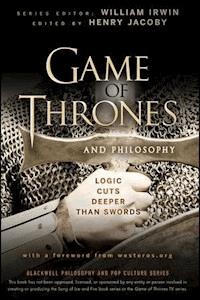
Game of Thrones and Philosophy E-Book
17,99 €
Mehr erfahren.
- Herausgeber: John Wiley & Sons
- Kategorie: Geisteswissenschaft
- Serie: The Blackwell Philosophy and Pop Culture Series
- Sprache: Englisch
An in-depth look at the philosophical issues behind HBO's Game of Thrones television series and the books that inspired it George R.R. Martin's New York Times bestselling epic fantasy book series, A Song of Ice and Fire, and the HBO television show adapted from it, have earned critical acclaim and inspired fanatic devotion. This book delves into the many philosophical questions that arise in this complex, character-driven series, including: Is it right for a "good" king to usurp the throne of a "bad" one and murder his family? How far should you go to protect your family and its secrets? In a fantasy universe with medieval mores and ethics, can female characters reflect modern feminist ideals? * Timed for the premiere of the second season of the HBO Game of Thrones series * Gives new perspectives on the characters, storylines, and themes of Game of Thrones * Draws on great philosophers from ancient Greece to modern America to explore intriguing topics such as the strange creatures of Westeros, the incestuous relationship of Jaime and Cersei Lannister, and what the kings of Westeros can show us about virtue and honor (or the lack thereof) as they play their game of thrones Essential reading for fans, Game of Thrones and Philosophy will enrich your experience of your favorite medieval fantasy series.
Sie lesen das E-Book in den Legimi-Apps auf:
Seitenzahl: 464
Veröffentlichungsjahr: 2012
Ähnliche




















CONTENTS
Foreword
A Raven from House Wiley
Acknowledgments
Introduction
Part One: “You Win or you Die”
Chapter 1: Maester Hobbes Goes to King’s Landing
You are Selfish and Dangerous
The Realm Needs a King
Hobbes Takes the Maester’s Chain
The Horrors of War
Robert’s Rebellion
Lion and Direwolf, Dragon and Leviathan
Chapter 2: It is a Great Crime to Lie to a King
Lying and Deceiving in Westeros
Lord Stark’s Lies
Is Lying Worse than Deceiving?
Betraying Trust and Shifting Responsibility
The Ruses of War
Bad Consequences and Broken Oaths
Chapter 3: Playing the Game of Thrones
Virtù and Fortuna
The Downfall of Kings
Morality and Dependency
Always Wear a Mask
Those Who Make Their Own Luck
A Final Lesson
Chapter 4: The War in Westeros and Just War Theory
The Justness of Resorting to War
Just Cause
Right Intention
Proper Authority
Last Resort
Probability of Success
Proportionality of Loss versus Gain
Justness in Conducting War
Discrimination between Combatants and Noncombatants
Appropriate Treatment of Prisoners of War
No Reprisals
Respect the Rights of the State’s Own Citizens
A Just War?
Part Two: “The Things I Do For Love”
Chapter 5: Winter Is Coming!
“Is the Honorable Person Happy?”
“Is the Devious Person Happy?”
“I Do Not Know Which of You I Pity Most”
“Life is Not a Song, Sweetling. You May Learn That One Day to Your Sorrow”
“When You Play the Game of Thrones, You Win or You Die. There Is No Middle Ground”
What Game of Thrones Teaches Us about Happiness
Chapter 6: The Death of Lord Stark
“If the Wicked Do Not Fear the King’s Justice Then You Have Put the Wrong Man in Office”
“The Day Will Come When you Need Them to Respect you, Even Fear you a Little”
“Most Men Would Rather Deny a Hard Truth Than Face It”
Threats to the Realm
“The Madness of Mercy”
Chapter 7: Lord Eddard Stark, Queen Cersei Lannister
“You Never Could Lie for Love nor Honor, Ned Stark”
The Madness of Mercy—The Price of Honesty
“When you Play the Game of Thrones, You Win or You Die”: The Rewards of Egoism
“And Pray That He is the Man I Think He is”
“How Are you Any Different from Robert, or Me, or Jaime?”
Chapter 8: It Would Be a Mercy
“Give Me a Good Clean Death”
“You Love Your Children, Do you Not?”
“When Will He Be as He Was?”
“This is Not Life”
Part Three: “Winter is Coming”
Chapter 9: Wargs, Wights, and Wolves That Are Dire
What is It Like to Be a Direwolf?
Wargs and Consciousness
Descartes and Direwolves
Wargs Again
What about the Wights?
Back to the Wights
Chapter 10: Magic, Science, and Metaphysics in A Game of Thrones
Let’s Get Physical
Science in A Game of Thrones
Magic and Causation
Science and Magic in Westeros
Magic and Metaphysics
Chapter 11: “You Know Nothing, Jon Snow”
Not Knowing That You Know Nothing
What Even a Blind Man Can See
Calibrating Confidence in What We (Don’t) Know
Justified True Belief
A Trip to King’s Landing
Back to the Wall
The Horn of Winter
Chapter 12: “Why is the World So Full of Injustice?”
Is the Problem of Evil Really a Problem?
But What is Evil?
Augustine and Catelyn Defend the Faith of the Seven
Problems with the Solutions
David Hume and the Impotence of the Old Gods
Blaming the Gods for Natural Evil
R’hllor and Natural Evil
Gods Don’t Care about Men
Part Four: “The Man Who Passes the Sentence should Swing the Sword”
Chapter 13: Why Should Joffrey Be Moral If He Has Already Won the Game of Thrones?
The World Will Be Exactly As You Want It to Be (“Lord Snow”)
A Man with Great Ambition and No Morals, I Wouldn’t Bet against Him (“Fire and Blood”)
The Truth Will Be What You Make It (“Lord Snow”)
You’ve a Long Way to Travel and In Bad Company (“Fire and Blood”)
Our Way is the Old Way (“Winter is Coming”)
I Must Be One of the Few Men in This City Who Doesn’t Want to Be King (“Fire and Blood”)
Chapter 14: The Moral Luck of Tyrion Lannister
The Virtues and Vices of Tyrion Lannister
It’s Out of the King’s Hand’s Hands
The Many Faces of Moral Luck
Kant to the Rescue?
Moral Luck and the Last Laugh
Chapter 15: Dany’s Encounter with the Wild
To Each His Own?
Moral Relativism
The Diversity of Ethical Codes
Love and Incest
Moral Relativism
The Dothraki Wedding Ceremony
Pillage and Plunder
The Morality of the Seven Kingdoms and Beyond
Chapter 16: “There Are No True Knights”
The Dark Side of Chivalry
Chivalry is Misguided
Sansa and her Songs
The Death of Modern Chivalry: Good Riddance
Women, Not Wards: What Has Humanity Made of the Human Female?
Part Five: “Stick them With the Pointy End”
Chapter 17: Fate, Freedom, and Authenticity in A Game of Thrones
The Freedom to Be or Not to Be
Que Sera, Sera (What Will Be, Will Be)
Fulfilling Fate
Becoming Who You Are
Chapter 18: No One Dances the Water Dance
Virtues and the Good Life
Martial Arts and Virtues
The Water Dance
Zen and the Sword Master from Braavos
Ninjutsu and the Faceless Men
The Faceless Dance of Virtue
Chapter 19: The Things I Do For Love
What is Game Theory?
House Rules
Eros’s Aim
The Nature of the Game
The Dwarf’s Gamble: Non-Zero-Sum Games and Repeated Play
Through the Eyes of Love
Chapter 20: Stop the Madness!
The Archaeologist and the Mad Fool
Pointing a Finger at the Crazies
Meet the Mayor of Crazytown
We Had to Murder the Mad Murderer!
Technologies of the Self
Am I Sane? I Think I Am. . . . I Think I Am. . . . I Think I Am. . . .
Everything is Dangerous
Contributors
Index
The Blackwell Philosophy and Pop Culture Series
Series Editor: William Irwin
24 and Philosophy
Edited by Jennifer Hart Weed, Richard Davis, and Ronald Weed
30 Rock and Philosophy
Edited by J. Jeremy Wisnewski
Alice in Wonderland and Philosophy
Edited by Richard Brian Davis
Arrested Development and Philosophy
Edited by Kristopher Phillips and J. Jeremy Wisnewski
The Avengers and Philosophy
Edited by Mark D. White
Batman and Philosophy
Edited by Mark D. White and Robert Arp
Battlestar Galactica and Philosophy
Edited by Jason T. Eberl
The Big Bang Theory and Philosophy
Edited by Dean Kowalski
The Big Lebowski and Philosophy
Edited by Peter S. Fosl
The Daily Show and Philosophy
Edited by Jason Holt
Family Guy and Philosophy
Edited by J. Jeremy Wisnewski
Final Fantasy and Philosophy
Edited by Jason P. Blahuta and Michel S. Beaulieu
Game of Thrones and Philosophy
Edited by Henry Jacoby
The Girl with the Dragon Tattoo and Philosophy
Edited by Eric Bronson
Green Lantern and Philosophy
Edited by Jane Dryden and Mark D. White
Heroes and Philosophy
Edited by David Kyle Johnson
House and Philosophy
Edited by Henry Jacoby
The Hunger Games and Philosophy
Edited by George Dunn and Nicolas Michaud
Inception and Philosophy
Edited by David Johnson
Iron Man and Philosophy
Edited by Mark D. White
Mad Men and Philosophy
Edited by James South and Rod Carveth
Metallica and Philosophy
Edited by William Irwin
The Office and Philosophy
Edited by J. Jeremy Wisnewski
South Park and Philosophy
Edited by Robert Arp
Spider-Man and Philosophy
Edited by Jonathan Sanford
Terminator and Philosophy
Edited by Richard Brown and Kevin Decker
True Blood and Philosophy
Edited by George Dunn and Rebecca Housel
Twilight and Philosophy
Edited by Rebecca Housel and J. Jeremy Wisnewski
The Ultimate Harry Potter and Philosophy
Edited by Gregory Bassham
The Ultimate Lost and Philosophy
Edited by Sharon Kaye
Watchmen and Philosophy
Edited by Mark D. White
X-Men and Philosophy
Edited by Rebecca Housel and J. Jeremy Wisnewski
Copyright © 2012 by John Wiley & Sons. All rights reserved
Published by John Wiley & Sons, Inc., Hoboken, New Jersey
Published simultaneously in Canada
No part of this publication may be reproduced, stored in a retrieval system, or transmitted in any form or by any means, electronic, mechanical, photocopying, recording, scanning, or otherwise, except as permitted under Section 107 or 108 of the 1976 United States Copyright Act, without either the prior written permission of the Publisher, or authorization through payment of the appropriate per-copy fee to the Copyright Clearance Center, 222 Rosewood Drive, Danvers, MA 01923, (978) 750-8400, fax (978) 646-8600, or on the web at www.copyright.com. Requests to the Publisher for permission should be addressed to the Permissions Department, John Wiley & Sons, Inc., 111 River Street, Hoboken, NJ 07030, (201) 748-6011, fax (201) 748-6008, or online at http://www.wiley.com/go/permissions.
Limit of Liability/Disclaimer of Warranty: While the publisher and the author have used their best efforts in preparing this book, they make no representations or warranties with respect to the accuracy or completeness of the contents of this book and specifically disclaim any implied warranties of merchantability or fitness for a particular purpose. No warranty may be created or extended by sales representatives or written sales materials. The advice and strategies contained herein may not be suitable for your situation. You should consult with a professional where appropriate. Neither the publisher nor the author shall be liable for any loss of profit or any other commercial damages, including but not limited to special, incidental, consequential, or other damages.
For general information about our other products and services, please contact our Customer Care Department within the United States at (800) 762-2974, outside the United States at (317) 572-3993 or fax (317) 572-4002.
Wiley also publishes its books in a variety of electronic formats and by print-on-demand. Some content that appears in standard print versions of this book may not be available in other formats. For more information about Wiley products, visit us at www.wiley.com.
ISBN 978-1-118-16199-9 (paper); ISBN 978-1-118-20605-8 (ebk);
ISBN 978-1-118-20606-5 (ebk); ISBN 978-1-118-20607-2 (ebk)
FOREWORD
Elio M. Garcia and Linda Antonsson
“The man who passes the sentence should swing the sword.”
“Love is the bane of honor, the death of duty.”
“When you play the game of thrones, you win or you die.”
With phrases like these, George R. R. Martin’s A Game of Thrones reveals not only a powerful sense of drama, a rich setting, and complex characters, but an understanding that at the heart of his story—of any great story—lies conflict. Martin often cites William Faulkner’s statement that the only story worth telling is that of “the human heart in conflict with itself,” and that conflict appears again and again throughout the Song of Ice and Fire series in a way that seemed unprecedented in the epic fantasy genre back in 1996 when the first novel was published. Whether the conflict entailed one lonely, misshapen dwarf’s efforts to survive in a society that looks down on him, a friend’s struggle to keep an irresponsible king on his throne, or a mother’s choice between her family and her duty, Martin presented the moral complexity of people and societies that breathed reality. Though inspired by the likes of J. R. R. Tolkien—father of the epic fantasy—Martin took a different path, and opened the door for a wave of new writers who explore characters and settings with an eye toward the darker side of human nature and society.
When it was announced that George R. R. Martin’s series of fantasy novels, A Song of Ice and Fire, would be adapted by HBO in Game of Thrones, it caused a great deal of excitement and speculation among fans who had been following the saga for a decade. Casting, budgets, shooting locations, special effects—these subjects and more were up for discussion. Yet at the heart of all of these questions was a single, overriding concern for most fans: How much fidelity would the show maintain to Martin’s novel, not only in terms of plot and characters, but in tone and themes? The first season came and went, and now we know that the producers largely stayed faithful on all levels, weaving together a drama that combined elements of the heroic epic with a moral scale that covered the range from the saintly to the monstrous.
Readers often cite the moral complexity of the novels as being a key part of their enjoyment, alluding to characters painted in “shades of gray.” Previous works of epic fantasy tended to operate with a straightforward moral compass where the antagonist was some variety of evil “Dark Lord” and the protagonists were defined by their opposition to this evil character based on their obvious moral goodness. In contrast, Martin’s series has been written with no dark lord to speak of, instead focusing the narrative on the dynastic conflicts that rend the Seven Kingdoms apart beneath the shadow of a looming catastrophe. That catastrophe may be created by nefarious creatures and it may be the ultimate end point of the narrative, but Martin’s choice to keep his eyes on the very human characters, with their very human flaws, was done well enough to win him legions of fans who appreciated the so-called “gritty realism” of the narrative.
Some of the post-Martin fantasists seem to pursue “grittiness” for the sake of grittiness—and that certainly is one approach among many. But it’s hard to find in some of these works the human core of the story. In contrast, Martin keeps a sharp focus on his characters, and though they suffer greatly at times, it tastes all the sweeter when they triumph. When they struggle, we struggle with them: Eddard Stark’s struggle with questions of honor and honesty, Jon Snow’s struggle to choose between vows and love, Tyrion Lannister’s effort to win his father’s approval because he has so little else. The inner conflict is absolutely integral to the weight of the story, to making A Song of Ice and Fire—and now Game of Thrones—such popular works. These and other questions—of ethics, political philosophy, and more—are the fulcrum on which the entire story turns. Despite the fact that many of the problems presented in the novel and on the screen are couched in the quasi-medieval context of lords and castles and personal honor, there’s a relevance to the way the characters wrestle with choices that do not seem so dissimilar to choices that we are faced with on a daily basis.
George R. R. Martin’s writing is ripe for introspection and consideration, not merely as examples of masterfully told popular literature, but as a genuine exploration of human nature in uncertain times. To provide some avenues for illumination, Game of Thrones and Philosophy presents essays on topics that run the gamut of philosophical topics, from ethics to metaphysics to political philosophy. Eric Silverman interrogates Plato’s views on virute and happiness, seen through the lense of Ned Stark’s and Cersei Lannister’s very different life strategies. Henry Jacoby explores the topic of consciousness in a series where magically created wights and supernatural direwolves exist. Richard Littman imagines Hobbes as a maester, looking on Westeros and considering the question of who should rule. These essays are just a few examples, of course; as Martin might write, there are “many and more” to engage with.
And all this, thanks to the sudden image Martin received one day back in 1991, while trying to write a science fiction novel: a huge wolf, found dead amidst summer snow. From such small beginnings, something great came, something worth reading, worth enjoying, worth examining.
A RAVEN FROM HOUSE WILEY
Editor’s Note on Spoilers
Many of the philosophical quandaries of this series cannot be discussed without looking at events across the five books of the Song of Ice and Fire series that have been published at the time of this writing. However, we understand that some readers are fans of the HBO series and don’t want to be spoiled for events beyond the first season. Therefore, with that in mind, you may wish to delay reading chapters 3, 11, 12, 14, 18, and 20 until you’ve read further into the series; the rest are safe and relatively spoiler-free.
All citations for the first four books are from the Bantam Dell mass market paperback editions, and, of course, the citations for the fifth book are from the 2011 hardcover edition.
Episodes from the television series are referenced by their titles in the text.
Acknowledgments
How I Was Spared from Having to Take the Black
If it had not been for all the generous help I received while working on this book, my honor surely would have been compromised. Therefore, I wish to thank the following:
First, Ser William Irwin, the Lord of Pop Culture, provided constant support, encouragement, and maesterly advice throughout. Without him, there would be no Game of Thrones and Philosophy; I can’t imagine anyone doing a better job as series editor. Great to work with you, as always, Bill.
Also from House Wiley, I was fortunate to work with, first, Lady Ellen Wright, whose in-depth knowledge of A Song of Ice and Fire made for much enjoyable speculation on what might happen next in the series. Then, I was happy to be able to finish the project with Lady Connie Santisteban and Ser John Simko, who were wonderful to work with on House and Philosophy and continued to be so here. Thank you all.
My fellow philosophers—true maesters all—authored terrific essays that reflect both their expertise and their love of the source material. I’m proud to have worked with them.
My longtime friend, Ser Robin of House Riebe in the North (it’s been how long since I’ve seen you?), read everything I wrote and improved everything I wrote with detailed comments and suggestions. I looked forward to reading every raven he sent—always fun and instructive, as he is himself.
My good friend and colleague Ser John of House Collins provided helpful suggestions on my mind and metaphysics chapter and was always willing to listen and help out with any difficulties I had while working on this volume. I always appreciate and benefit from our discussions.
I want to thank two long-distance friends and colleagues as well. Ser David Kyle of House Johnson, a trusted associate of the Lord of Pop Culture, contributed valuable suggestions on Lord Schoone’s chapter on evil. And Lady R. Shannon of House Duval, “The Wonderninja,” not only wrote a very fine chapter of her own, but graciously shared her wisdom concerning Eastern philosophy and martial arts, and in so doing, enabled my Water Dance chapter to go on dancing.
I’m especially grateful to Lord Elio M. Garcia and Lady Linda Antonsson for contributing their beautifully written foreword. They perfectly captured why the works of George R. R. Martin are, in their words “worth reading, worth enjoying, and worth examining.” Their wonderful website, westeros.org, as well as another great site, winter-is-coming.net, entertained me, kept me updated on all the Game of Thrones news while I was working on this volume, and were there for me to always make sure I had my facts straight!
And speaking of George R. R. Martin, without him there would, of course, be no book to write. Thank you, ser, for my all-time favorite books. And further thanks go to everyone at HBO who bought it all to life, better than I could have imagined or hoped for.
My brother Alan, now a retired Lord, provided good humor and enthusiastic support throughout, and I thank him for that and for everything else he does for me. Like Tyrion (his favorite character), he’s exceedingly clever; I doubt that I could beat him at cyvasse.
Finally, my wife, Kathryn, the Lady of the Looms. Born in Craven County (I’m not making this up), but certainly no craven. As proof, she puts up with me. As long as I have you, it matters not that winter is coming.
INTRODUCTION
So What if Winter Is Coming?
Henry Jacoby
Winter is coming; the Wall may not hold, and the Others may kill us all. Yes, all men must die—valar morghulis, as they say in Braavos.
In Braavos, they also tell us valar dohaeris—all men must serve. So shall we serve the gods? Or those who rule? What good is serving anyone if winter is indeed coming? Maybe we should just drink wine and sing a few choruses of “The Bear and the Maiden Fair.”
The House Words of the Starks remind us that we must be vigilant, and even though the future may be grim, we should hold our heads high . . . at least while we still have them. We have our honor, our duty; we can yet lead meaningful lives. As Ygritte told Jon Snow, all men must die, but first we’ll live. He knows nothing, that Jon Snow.
“Fear cuts deeper than swords.” This is a lesson Arya learned well from her Braavosi sword master. The words become a recurring refrain in her mind whenever she needs to find some inner strength and push on. They can help us, too. And here’s another lesson: “Logic cuts deeper than swords.” When wielded properly, swords can be used against an enemy. Logic, likewise, can be a powerful weapon. When applied correctly, logic can disarm or defeat opponents—or at least their arguments—and usually without too much loss of blood. While swords can defend our bodies, logic indeed goes deeper, defending our ideas, our beliefs, our values—the things that define who we are and how we see ourselves in relation to the rest of reality. Socrates said that no evil can befall a good person. One’s body can be harmed easily enough by swords, but not the inner self. The person of virtue and integrity has a soul in harmony that stands steadfast against desires and influence.
Yes, fear cuts deeper than swords, but so does logic. In philosophy, one has to learn not to fear where logic leads. All men must serve, and philosophers serve the truth. The authors in this volume have done just that. No tongues were ripped out, no fingers removed; the truth was fearlessly pursued. Maybe Hobbes would’ve made a great maester; maybe chivalry is a bad thing; maybe Robb’s war isn’t so just after all; maybe Arya can teach us about Zen; and you know, Ned really would have benefited from reading Machiavelli. Speaking of reading, in A Dance with Dragons, the master himself tells us that “a reader lives a thousand lives. . . . The man who never reads only one.”1
So get to it. Winter will be here before you know it.
NOTE
1. George R. R. Martin, A Dance with Dragons (New York: Bantam Books, 2011), p. 452.
PART ONE
“YOU WIN OR YOU DIE”
Chapter 1
MAESTER HOBBES GOES TO KING’S LANDING
Greg Littmann
Who should rule in the Seven Kingdoms of Westeros? It’s the fundamental question underlying Game of Thrones and the entire Song of Ice and Fire saga. Lannister armies, bristling with pikes, march north from Casterly Rock in support of young King Joffrey. The royal House Baratheon divides against itself, as the brothers Stannis and Renly each lay claim to the Iron Throne. In Winterfell Robb Stark is declared king in the North, subject to none, and in the Iron Islands, the grim fleets of the Greyjoys sail out to take the North for themselves. Meanwhile, in the distant eastern lands of the Dothraki, Daenerys Targaryen, last survivor of a dynasty that has ruled the Seven Kingdoms for three hundred years, raises a horde of fearless mounted nomads to reconquer her homeland and restore the Targaryen dragon to the throne.
Lesen Sie weiter in der vollständigen Ausgabe!
Lesen Sie weiter in der vollständigen Ausgabe!
Lesen Sie weiter in der vollständigen Ausgabe!
Lesen Sie weiter in der vollständigen Ausgabe!
Lesen Sie weiter in der vollständigen Ausgabe!
Lesen Sie weiter in der vollständigen Ausgabe!
Lesen Sie weiter in der vollständigen Ausgabe!
Lesen Sie weiter in der vollständigen Ausgabe!
Lesen Sie weiter in der vollständigen Ausgabe!
Lesen Sie weiter in der vollständigen Ausgabe!
Lesen Sie weiter in der vollständigen Ausgabe!
Lesen Sie weiter in der vollständigen Ausgabe!
Lesen Sie weiter in der vollständigen Ausgabe!
Lesen Sie weiter in der vollständigen Ausgabe!
Lesen Sie weiter in der vollständigen Ausgabe!
Lesen Sie weiter in der vollständigen Ausgabe!
Lesen Sie weiter in der vollständigen Ausgabe!
Lesen Sie weiter in der vollständigen Ausgabe!
Lesen Sie weiter in der vollständigen Ausgabe!
Lesen Sie weiter in der vollständigen Ausgabe!
Lesen Sie weiter in der vollständigen Ausgabe!
Lesen Sie weiter in der vollständigen Ausgabe!
Lesen Sie weiter in der vollständigen Ausgabe!
Lesen Sie weiter in der vollständigen Ausgabe!
Lesen Sie weiter in der vollständigen Ausgabe!




