


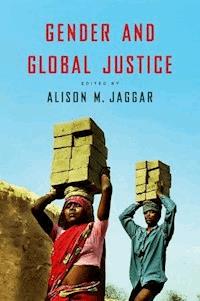
Gender and Global Justice E-Book
18,99 €
Mehr erfahren.
- Herausgeber: John Wiley & Sons
- Kategorie: Geisteswissenschaft
- Sprache: Englisch
Issues of global justice have received increasing attention in academic philosophy in recent years but the gendered dimensions of these issues are often overlooked or treated as peripheral. This groundbreaking collection by Alison Jaggar brings gender to the centre of philosophical debates about global justice.
The explorations presented here range far beyond the limited range of issues often thought to constitute feminists’ concerns about global justice, such as female seclusion, genital cutting, and sex trafficking. Instead, established and emerging scholars expose the gendered and racialized aspects of transnational divisions of paid and unpaid labor, class formation, taxation, migration, mental health, the so-called resource curse, and conceptualizations of violence, honor, and consent. Jaggar's introduction explains how these and other feminist investigations of the transnational order raise deep challenges to assumptions about justice that for centuries have underpinned Western political philosophy.
Taken together the pieces in this volume present a sustained philosophical engagement with gender and global justice. Gender and Global Justice provides an accessible and original perspective on this important field and looks set to reframe philosophical reflection on global justice.
Sie lesen das E-Book in den Legimi-Apps auf:
Seitenzahl: 423
Veröffentlichungsjahr: 2014
Ähnliche




















Table of Contents
Cover
Title page
Copyright page
Acknowledgments
Notes on Contributors
Introduction: Gender and Global Justice: Rethinking Some Basic Assumptions of Western Political Philosophy
0.1 Philosophical questions of distributive justice
0.2 Western political philosophy from the sixteenth to mid-twentieth centuries
0.3 Western political philosophy after World War II
0.4 Philosophical work on justice at the global level
0.5 Philosophical work on global gender justice
0.6 An introduction to the chapters in this volume
1: Transnational Cycles of Gendered Vulnerability: A Prologue to a Theory of Global Gender Justice
1.1 Some troubling worldwide gender disparities
1.2 Five inadequate philosophical responses to transnational gender disparities
1.3 Transnational cycles of gendered vulnerability
1.4 What is the philosophical value added by introducing the idea of transnational cycles of gendered vulnerability into global justice theory?
2: Transnational Women's Collectivities and Global Justice
2.1 Introduction
2.2 Background assumptions
2.3 Agents of justice claims in nationalism and cosmopolitanism
2.4 Transnational women's collectivities: having, making, and advocating justice claims
2.5 Conclusion
3: The Moral Harm of Migrant Carework: Realizing a Global Right to Care
3.1 The purpose and scope of the inquiry
3.2 The commodification of caregiving
3.3 The moral significance of transnational carework
3.4 The gender question
3.5 The harm of the GHT and the “relational self”
3.6 Human rights and the right to care
3.7 Conclusion
4: Transnational Rights and Wrongs: Moral Geographies of Gender and Migration
4.1 Introduction
4.2 Transnational migration and gender justice
4.3 Indonesian overseas migrants: transnational feminist approaches
4.4 Domestic gender justice is global gender justice: rethinking the scales of “global” justice
5: Global Gender Injustice and Mental Disorders
5.1 Gender and global injustice
5.2 Socio-economic injustice and postpartum depression
5.3 Hermeneutical injustice and eating disorders
5.4 The hermeneutical obscuring of the political context of women's distress
5.5 Conclusion
6: Discourses of Sexual Violence in a Global Context
6.1 “Consent”
6.2 “Honor” crimes
6.3 “Victim”
6.4 Conclusion
7: Reforming Our Taxation Arrangements to Promote Global Gender Justice
7.1 Introduction
7.2 Some problems with our taxation and accounting arrangements and a few solutions
7.3 Dues to protect global public goods and tackle global poverty
7.4 Gender justice and taxation
7.5 Global taxes and promoting gender equity: which options are best?
7.6 Some issues concerning global taxes for here and now
7.7 Summary of main conclusions
8: Gender Injustice and the Resource Curse: Feminist Assessment and Reform
8.1 The resource curse
8.2 Feminist revision
8.3 Normative assessment of the resource curse
8.4 Feminist normative assessment
8.5 Feminist reform
8.6 Conclusion
Bibliography
Index
Copyright © Alison M. Jaggar 2014
The right of Alison M. Jaggar to be identified as Author of this Work has been asserted in accordance with the UK Copyright, Designs and Patents Act 1988.
First published in 2014 by Polity Press
Polity Press
65 Bridge Street
Cambridge CB2 1UR, UK
Polity Press
350 Main Street
Malden, MA 02148, USA
All rights reserved. Except for the quotation of short passages for the purpose of criticism and review, no part of this publication may be reproduced, stored in a retrieval system, or transmitted, in any form or by any means, electronic, mechanical, photocopying, recording or otherwise, without the prior permission of the publisher.
ISBN-13: 978-0-7456-6376-0
ISBN-13: 978-0-7456-6377-7(pb)
ISBN-13: 978-0-7456-7976-1(epub)
ISBN-13: 978-0-7456-7975-4(mobi)
A catalogue record for this book is available from the British Library.
The publisher has used its best endeavours to ensure that the URLs for external websites referred to in this book are correct and active at the time of going to press. However, the publisher has no responsibility for the websites and can make no guarantee that a site will remain live or that the content is or will remain appropriate.
Every effort has been made to trace all copyright holders, but if any have been inadvertently overlooked the publisher will be pleased to include any necessary credits in any subsequent reprint or edition.
Hye-Ryoung Kang's “Transnational Women's Collectivities and Global Justice” first appeared in Journal of Social Philosophy 39, no 3 (2008). Copyright © 2008 by John Wiley and Sons Ltd. Reprinted with the permission of The Copyright Clearance Center, on behalf of John Wiley & Sons Ltd.
The following selections first appeared, in slightly different form, in Philosophical Topics, Vol. 37, No. 2 (Fall 2009): Alison M. Jaggar, “Introduction: The Philosophical Challenges of Global Gender Justice” and “Transnational Cycles of Gendered Vulnerability: A Prologue to a Theory of Global Gender Justice”; Linda Martín Alcoff, “Discourses of Sexual Violence in a Global Framework”; Gillian Brock, “Reforming our Taxation Arrangements to Promote Global Gender Justice”; Rachel Silvey, “Transnational Rights and Wrongs: Moral Geographies of Gender and Migration”; and Eva Feder Kittay, “The Moral Harm of Migrant Carework: Realizing a Global Right to Care.” Copyright © 2010 by the Board of Trustees of the University of Arkansas. Reprinted with the permission of The Permissions Company, Inc., on behalf of the University of Arkansas Press, www.uapress.com.
For further information on Polity, visit our website: www.politybooks.com
Acknowledgments
This book has its roots in a workshop on global gender justice held in Oslo in May, 2008, under the auspices of the Centre for the Study of Mind in Nature. The workshop was the first of its kind within the discipline of philosophy. As the organizer of the Oslo workshop, I am extremely grateful for the generous support of the Centre first in hosting the workshop and later in continuing to support my work preparing this book.
My own chapters in the book benefited considerably from comments by the Centre's Christel Fricke and other participants in the workshop. In addition, a number of colleagues and students at the University of Colorado at Boulder gave generous feedback on my chapters. I am indebted to: Eamon Aloyo, Cory Aragon, Lorraine Bayard de Volo, David Boonin, Robert Buffington, Amandine Catala, Anne Costain, Stephen Emedi, Barrett Emerick, Chelsea Haramia, Hye-Ryoung Kang, Deepti Misri, Celeste Montoya, April Shaw, and Scott Wisor.
Many thanks to the wonderful people at Polity, especially editors Emma Hutchinson, who encouraged me to undertake this book, and Sarah Lambert, who was very helpful while Emma was on leave. I also owe thanks to an excellent production team, including Clare Ansell, Susan Beer, Tim Clark, and Glynis Baguley. Annaleigh Curtis created the index with her customary efficiency and speed.
As always, my family has been supportive, especially my partner David Jaggar who has continued to maintain his high vegetarian culinary standards. I can't thank him enough for his constant encouragement over so many decades.
Notes on Contributors
Linda Martín Alcoff is Professor of Philosophy at Hunter College and the Graduate School, CUNY. She is a past President of the American Philosophical Association, Eastern Division. Her writings have focused on social identity and race, epistemology and politics, sexual violence, Foucault, Dussel, and Latino issues in philosophy. Her book, Visible Identities: Race, Gender and the Self (Oxford University Press, 2006), won the Frantz Fanon Award for 2009. She is originally from Panama, but lives today happily in Brooklyn. For more information go to www.alcoff.com.
Gillian Brock is Associate Professor of Philosophy at the University of Auckland in New Zealand. Her most recent work has been on global justice and related fields. She is the author of Global Justice: A Cosmopolitan Account (Oxford University Press, 2009) and editor or co-editor of Current Debates in Global Justice, The Political Philosophy of Cosmopolitanism, Necessary Goods: Our Responsibilities to Meet Others' Needs, and Global Heath and Global Health Ethics, and other titles are forthcoming. She has published over 100 peer-reviewed papers in journals such as Ethics, Canadian Journal of Law and Jurisprudence, American Philosophical Quarterly, the Monist, and the Journal of Social Philosophy. She holds editorial positions with a number of journals and book series. She is an Associate Editor for the journal Politics, Philosophy and Economics.
Abigail Gosselin is Associate Professor of Philosophy at Regis University in Denver, Colorado. She is the author of Global Poverty and Individual Responsibility (Lexington, 2009) as well as articles on human rights, addiction, epistemological limitations of memoirs, and problems with globalizing scientific conceptions of mental disorders. In addition, she has published articles on teaching discernment and teaching ethics from a feminist perspective (co-authored). Her current work examines the epistemological processes by which we develop our understandings of mental disorders and analyzes the justice implications of these conceptualizations.
Alison M. Jaggar is a College Professor of Distinction in Philosophy and Women and Gender Studies at the University of Colorado at Boulder. She is also Research Co-ordinator at the University of Oslo's Centre for the Study of Mind in Nature. She is the author and editor of many books and articles and recipient of many awards and fellowships. Jaggar was a pioneer in feminist philosophy and in recent years she has worked to introduced gender as a category of analysis into the philosophical debate on global justice. In addition, Jaggar is exploring the potential of a naturalized approach to moral epistemology for addressing moral disputes in contexts of inequality and cultural difference.
Hye-Ryoung Kang is Assistant Professor in the Philosophy Department and Faculty Associate in the Women Studies Program at the University of Nevada, Reno. She obtained her PhD in Philosophy and the Graduate Certificate in Women and Gender Studies from the University of Colorado at Boulder. She specializes in social and political philosophy with special emphasis on theories of social justice, human rights, and laws in the global context. Her current research interest is in global justice from a transnational feminist perspective.
Eva Feder Kittay is Distinguished Professor of Philosophy and Senior Fellow, Center for Medical Humanities, Compassionate Care, and Bioethics at Stony Brook University. Her authored books include Metaphor (Clarendon Press, 1985) and Love's Labor (Routledge, 1999). In her numerous articles, edited books and special issue journals in feminist philosophy, feminist ethics and disability, she has helped to develop these emerging areas of philosophical inquiry and introduced previously neglected topics, such as carework and cognitive disability.
Rachel Silvey is Associate Professor of Geography at the University of Toronto. She received her PhD from the University of Washington, Seattle. Her research interests include gender studies, Indonesia, migration, critical development studies, and transnational Islam. She has published widely on gender and migration in Indonesia in both disciplinary and interdisciplinary journals and collected volumes. She is co-editor (with Isabella Bakker) of Beyond States and Markets: The Challenges of Social Reproduction (Routledge, 2008). She has received funding from the National Science Foundation, the Fulbright New Century Scholars Program, and the Social Sciences and Humanities Research Council of Canada.
Scott Wisor received his PhD in philosophy from the University of Colorado at Boulder, and served for three years as a Research Fellow at Australian National University on the project “Measuring Poverty and Gender Disparity.” He has published on the resource curse, international trade, social valuation, and global poverty, often from a feminist perspective. His first book is Measuring Global Poverty: Toward a Pro-Poor Approach (Palgrave Macmillan, 2011).
Introduction
Gender and Global Justice: Rethinking Some Basic Assumptions of Western Political Philosophy1
Alison M. Jaggar
0.1 Philosophical questions of distributive justice
Concerns about the gendered dimensions of global justice have been articulated only recently within the discipline of philosophy. In this introductory essay, I explain how raising such concerns brings into question some of the most basic assumptions of Western political philosophy. I begin by situating reflections on global gender justice in the context of earlier philosophical thought about justice.
Central to justice is the idea of moral balance. Broadly speaking, to be concerned about justice is to be interested in assuring that all claimants should give and receive whatever they are justly due. Normative debate among political philosophers focuses on how the abstract idea of what is justly due should be interpreted substantively and applied in practice.
Western philosophers usually distinguish three main branches of justice, corresponding to three main types of concerns. One branch, retributive justice, addresses questions regarding the appropriate punishment of wrongdoers. A second branch, reparative justice, addresses questions of how to correct or rectify past wrongs. The third branch, distributive justice, addresses questions concerning the fair distribution of the benefits and burdens of participating in a co-operative enterprise. This is the branch that has received most attention from Western philosophers and the essays in this volume mostly fall within this category, although it should be noted that questions of retributive and reparative justice also have gender dimensions and can also be raised in global contexts.
Alternative normative theories of distributive justice are structured as sets of answers to several framing questions. Those questions are, briefly: where, when, who, what, and how?
Any convincing answer to these questions requires a rationale. In other words, it requires addressing the further question, Why? Philosophical theories of justice not only offer answers to the central questions of justice but—like all theories—they also explain why they advocate these particular answers.
0.2 Western political philosophy from the sixteenth to mid-twentieth centuries
Lesen Sie weiter in der vollständigen Ausgabe!
Lesen Sie weiter in der vollständigen Ausgabe!
Lesen Sie weiter in der vollständigen Ausgabe!
Lesen Sie weiter in der vollständigen Ausgabe!
Lesen Sie weiter in der vollständigen Ausgabe!
Lesen Sie weiter in der vollständigen Ausgabe!
Lesen Sie weiter in der vollständigen Ausgabe!
Lesen Sie weiter in der vollständigen Ausgabe!
Lesen Sie weiter in der vollständigen Ausgabe!
Lesen Sie weiter in der vollständigen Ausgabe!




