


Gender History Across Epistemologies E-Book
21,99 €
Mehr erfahren.
- Herausgeber: John Wiley & Sons
- Kategorie: Geisteswissenschaft
- Serie: Gender and History Special Issues
- Sprache: Englisch
Gender History Across Epistemologies offers broad range of innovative approaches to gender history. The essays reveal how historians of gender are crossing boundaries - disciplinary, methodological, and national - to explore new opportunities for viewing gender as a category of historical analysis.
- Essays present epistemological and theoretical debates central in gender history over the past two decades
- Contributions within this volume to the work on gender history are approached from a wide range of disciplinary locations and approaches
- The volume demonstrates that recent approaches to gender history suggest surprising crossovers and even the discovery of common grounds
Sie lesen das E-Book in den Legimi-Apps auf:
Seitenzahl: 942
Veröffentlichungsjahr: 2013
Ähnliche




















Contents
Cover
Series
Title Page
Copyright
Notes on Contributors
Introduction: Gender History Across Epistemologies
Notes
Chapter 1: Master Narratives and the Wall Painting of the House of the Vettii, Pompeii
The house and its owners
Slavery and freedom
The House of the Vettii in scholarship
Houses, painting, myth and gender
Case study: ancient slavery, sexuality and the House of the Vettii
The master gaze
Masochism
Conclusions and implications
Notes
Chapter 2: ‘More Beautiful than Words & Pencil Can Express’: Barbara Bodichon’s Artistic Career at the Interface of her Epistolary and Visual Self Projections
Bodichon’s personal papers: archival contingencies
Bodichon’s letters and paintings: a hybrid performative self-constitution
Bodichon’s artistic identity at the intersection of her epistolary and visual self-projections
Bodichon’s unresolved artistic self and the production of historical knowledge
Notes
Chapter 3: Public Motherhood in West Africa as Theory and Practice
Notes
Chapter 4: Profiling the Female Emigrant: A Method of Linguistic Inquiry for Examining Correspondence Collections
Introduction
What is a corpus?
Background remarks
The LOUGH corpus
The starting point – simple frequency data
Words and frequencies
Words in context: n-grams and clusters
From quantitative to qualitative: concordance lines
Discussion and conclusions
Notes
Chapter 5: Beyond Constructivism?: Gender, Medicine and the Early History of Sperm Analysis, Germany 1870–1900
Social constructivism, gender history and the one-sex/two-sex narrative
‘Cherchez l’homme’ – male sterility and the making of sperm testing, 1860–1890
Collecting sperm, compromising morals and compiling statistics (loop 1)
Gynaecologists as andrologists (loop 2)
Patients (loop 3)
Conclusion
Notes
Chapter 6: ‘I Just Express My Views & Leave Them to Work’: Olive Schreiner as a Feminist Protagonist in a Masculine Political Landscape with Figures
Introduction
Olive Schreiner’s ‘characteristic shrewdness’ – Walker’s case for influence
‘If … a law were passed, that you, John X. Merriman, were not a fit & proper human being’ – influence across Schreiner’s letters and her published writings
‘Always give your enemies what they don’t want!’ – marks upon the text
Doing things with letters: the performative character of Schreiner’s epistolary activities and influence
A feminist protagonist in a masculine political landscape: on influence and separate spheres
Notes
Chapter 7: Gender without Groups: Confession, Resistance and Selfhood in the Colonial Archive
Between groups and individuals – perils of distraction in southern Africa
Adaima’s story – the complete document
Adaima’s story – text, context and ephemeral knowledge
Conclusions
Notes
Chapter 8: The Power of Renewable Resources: Orlando’s Tactical Engagement with the Law of Intestacy
Notes
Chapter 9: The Politics of Gender Concepts in Genetics and Hormone Research in Germany, 1900–1940
Sex/gender, nature/culture and Mother Nature’s ‘political correctness’
Gender politics in the sciences
Gender at the workplace
Chromosomes and gender equality
Interactive or hierarchical binary?
Chromosomes and the binary, inheritable sex difference
‘Intersexes’ – reconciling sex difference in embryology and genetics
Sex hormones and the binary again
Conclusion
Notes
Chapter 10: The Language of Gender in Lovers’ Correspondence, 1946–1949
The collection
Migrant letters
Gender and the epistolary source
Gender and language
Conclusion
Notes
Chapter 11: Gender-Bending in El Teatro Campesino (1968–1980): A Mestiza Epistemology of Performance
Historiography of the teatrista: shifting analysis from script to stage
Bending the gender roles of the teatristas: Socorro Valdez’s masculine calavera
Bending the gender roles of the teatristas: gender-neutral calaveras
Bending the gender roles of the teatristas: ‘en unas pocas centurias, the future will belong to the mestiza’
Moving toward a mestiza discourse on Teatro Campesino’s teatristas
Notes
Chapter 12: Changing Paradigms in Migration Studies: From Men to Women to Gender
Histories and historiographies of immigration
Gender
The figures
Representations
The impact of gender on migration
The impact of migration on gender
Gendered categories of understanding
Notes
Chapter 13: Reconsidering Categories of Analysis: Possibilities for Feminist Studies of Conflict
Current feminist approaches to studying conflict
Disrupting categorical boundaries: positionality, affect and understanding
Sensibilities and political acts: Iran’s activist citizens from 1980 to 1988
The Islamic Republic of Iran at war: nation-building, heteronormativity and war tactics
The body and polity formation: physically contesting state and societal nation-building projects
Politics of local masculinities: unmaking the protector identity of the male warrior
Politics of local femininities: nationhood, gender and eroticism
Concluding thoughts
Notes
Chapter 14: An Epistemology of Collusion: Hijras, Kothis and the Historical (Dis)continuity of Gender/Sexual Identities in Eastern India
Colonial ethnology: investigating the truth of the eunuch
Postcolonial ethnography: an intersectional epistemology of hijras
Translocal consolidations: relating hijra and kothi emergence
Dhurani, dhunuri, hijra: translocal subcultures in West Bengal
Gharanas go public: consolidating the hijra
The rise of the kothi
From informal to institutional networks
The translocal standardisation of subcultural language
Conclusion: collusion and (dis)continuity
Notes
Index
Gender and History Special Issue Book Series
Gender and History, an international, interdisciplinary journal on the history of femininity, masculinity, and gender relations, publishes annual special issues which are now available in book form.
Bringing together path-breaking feminist scholarship with assessments of the field, each volume focuses on a specific subject, question or theme. These books are suitable for undergraduate and postgraduate courses in history, sociology, politics, cultural studies, and gender and women's studies.
Titles in the series include:
Gender History Across Epistemologies Edited by Donna R. Gabaccia and Mary Jo Maynes
Gender and the City before Modernity Edited by Lin Foxhall and Gabriele Neher
Historicising Gender and Sexuality Edited by Kevin P. Murphy and Jennifer M. Spear
Homes and Homecomings: Gendered Histories of Domesticity and Return Edited by K. H. Adler and Carrie Hamilton
Gender and Change: Agency, Chronology and Periodisation Edited by Alexandra Shepard and Garthine Walker
Translating Feminisms in China Edited by Dorothy Ko and Wang Zheng
Visual Genders, Visual Histories: A special Issue of Gender & History Edited by Patricia Hayes
Violence, Vulnerability and Embodiment: Gender and History Edited by Shani D'Cruze and Anupama Rao
Dialogues of Dispersal: Gender, Sexuality and African Diasporas Edited by Sandra Gunning, Tera Hunter and Michele Mitchell
Material Strategies: Dress and Gender in Historial Perspective Edited by Barbara Burman and Carole Turbin
Gender, Citizenships and Subjectivities Edited by Kathleen Canning and Sonya Rose
Gendering the Middle Ages: A Gender and History Special Issue Edited by Pauline Stafford and Anneke B. Mulder-Bakker
Gender and History: Retrospect and ProspectEdited by Leonore Davidoff, Keith McClelland and Eleni Varikas
Feminisms and InternationalismEdited by Mrinalini Sinha, Donna Guy and Angela Woollacott
Gender and the Body in the Ancient MediterraneanEdited by Maria Wyke
Gendered Colonialisms in African HistoryEdited by Nancy Rose Hunt, Tessie P. Liu and Jean Quataert
This edition first published 2013 Originally published as Volume 24, Issue 3 of Gender & History Chapters © 2013 The Authors. Book compilation © 2013 Blackwell Publishing Ltd.
Blackwell Publishing was acquired by John Wiley & Sons in February 2007. Blackwell's publishing program has been merged with Wiley's global Scientific, Technical, and Medical business to form Wiley-Blackwell.
Registered Office John Wiley & Sons Ltd, The Atrium, Southern Gate, Chichester, West Sussex, PO19 8SQ, United Kingdom
Editorial Offices 350 Main Street, Malden, MA 02148-5020, USA 9600 Garsington Road, Oxford, OX4 2DQ, UK The Atrium, Southern Gate, Chichester, West Sussex, PO19 8SQ, UK
For details of our global editorial offices, for customer services, and for information about how to apply for permission to reuse the copyright material in this book please see our website at www.wiley.com/wiley-blackwell.
The rights of Donna R. Gabaccia and Mary Jo Maynes to be identified as the authors of the editorial material in this work has been asserted in accordance with the UK Copyright, Designs and Patents Act 1988.
All rights reserved. No part of this publication may be reproduced, stored in a retrieval system, or transmitted, in any form or by any means, electronic, mechanical, photocopying, recording or otherwise, except as permitted by the UK Copyright, Designs and Patents Act 1988, without the prior permission of the publisher.
Wiley also publishes its books in a variety of electronic formats. Some content that appears in print may not be available in electronic books.
Designations used by companies to distinguish their products are often claimed as trademarks. All brand names and product names used in this book are trade names, service marks, trademarks or registered trademarks of their respective owners. The publisher is not associated with any product or vendor mentioned in this book. This publication is designed to provide accurate and authoritative information in regard to the subject matter covered. It is sold on the understanding that the publisher is not engaged in rendering professional services. If professional advice or other expert assistance is required, the services of a competent professional should be sought.
Library of Congress Cataloging-in-Publication Data
Gender history across epistemologies / edited by Donna R. Gabaccia and Mary Jo Maynes. pages cm “Originally published as Volume 24, Issue 3 of Gender & History.” Includes bibliographical references and index. ISBN 978-1-118-50824-4 (pbk.) 1. Sex role–History. 2. Gender identity–History. 3. Women–Identity–History. 4. Women–History. I. Gabaccia, Donna R., 1949– II. Maynes, Mary Jo. III. Gender & history HQ1075.G4632 2013 305.309–dc23
2012048065
A catalogue record for this book is available from the British Library.
Cover image: Postcard (At the Golden Gate) 2009 Cover design by: Nicki Averill Design
NOTES ON CONTRIBUTORS
Christina Benninghaus is an Affiliated Research Scholar at the Department of History and Philosophy of Science at Cambridge University, where she conducts research on the history of infertility. Since receiving her PhD from the European University Institute in Florence in 1994, she has taught German and European history at Halle, Bielefeld and Bochum. Her areas of specialisation include gender history and the history of youth. A social and cultural historian by training, she has become increasingly interested in the history of science and medicine.
Sonia Cancian is lead scholar of the Digitising Immigrant Letters project at the University of Minnesota’s Immigration History Research Center. In Montreal, she is affiliated with Concordia University’s History Department and the Simone de Beauvoir Institute. Dr Cancian is the author of Families, Lovers, and their Letters: Italian Postwar Migration to Canada (Winnipeg: University of Manitoba Press, 2010). She is currently editing a collection of love letters written by migrants and non-migrants to be published by McGill-Queen’s University Press.
Helen Dampier studied at Rhodes University in South Africa and obtained her doctorate from the University of Newcastle, UK. Her research interests focus on life writing and also historiography and its claims, and she is currently a Senior Lecturer in History at the School of Cultural Studies, Leeds Metropolitan University.
Aniruddha Dutta is a PhD candidate in Feminist Studies and Development Studies at the University of Minnesota, with research interests in globalisation, social movements and media studies. Dutta’s dissertation, ‘Globalizing through the Vernacular: The Making of Indian Sexual Minorities within Gender/Sexual Transnationalism’, studies gender/sexual identity and rights-based politics at the interface of subaltern queer subcultures and the transnational development industry.
Donna R. Gabaccia is Professor of History at the University of Minnesota. She is author of many books and articles on immigrant life in the US, on gender, class and labour (Foreign Relations: Global Perspectives on U.S. Immigration, Princeton: Princeton University Press 2012), on food studies (We Are what Eat: Ethnic Food and the Making of Americans, Cambridge: Harvard University Press, 1998) and on Italian migration around the world (Italy’s Many Diasporas, Seattle: University of Washington Press, 2000). Gabaccia also teaches and publishes about migration in world history, has longstanding interests in interdisciplinary methodologies and served as president of the Social Science History Association in 2008. Her ongoing research includes an interdisciplinary collaboration that seeks to explain the so-called ‘feminisation’ of international migration and an individual research project that asks why the United States, almost alone among the many countries formed through international migration, labels itself proudly as a nation of immigrants.
Nancy L. Green is Professor (directrice d’études) of History at the École des Hautes Études en Sciences Sociales (Paris) and a specialist of migration history, comparative methods and French and American social history. Her most recent book (edited with Marie Poinsot) was Histoire de l’immigration et question coloniale en France (Paris: Documentation françhiaise, 2008).
Meredith Heller is a doctoral candidate in theatre and feminist studies at the University of California, Santa Barbara. Her dissertation focuses on the signification of gender, sex and identity in US gender-bending stage acts. Her research interests are feminist performance, gender and body theory, queer, transgender and sexuality studies and drag.
Christopher J. Lee is an Assistant Professor of History at the University of North Carolina at Chapel Hill. He is the editor of Making a World After Empire: The Bandung Moment and Its Political Afterlives (Athens: Ohio University Press, 2010). He is currently completing a book on British-ruled Central Africa that is under contract with Duke University Press.
Mary Jo Maynes is a Professor in the Department of History at the University of Minnesota. She is a historian of modern Europe with interests in comparative and world history. Her specialities include: European social and cultural history, history of the family, history of women and gender and personal narratives as historical sources. Her recent books include: The Family: A World History (Oxford: Oxford University Press, 2012), Telling Stories: The Use of Personal Narratives in the Social Sciences and History (Ithaca: Cornell University Press, 2008) and Secret Gardens, Satanic Mills: Placing Girls in European History (Bloomington: Indiana University Press, 2004).
Jamie L. McDaniel is Assistant Professor of English at Pittsburg State University in Kansas. His research focuses on cultural constructions of gender normativity and propriety in legal, economic, political, cinematic and literary discourses. He has an article on property and economic recognition in Jean Rhys’s novels forthcoming in the Journal of Liberal Arts and Sciences, as well as an examination of the connections among disability, trauma and gendered deviance in Italian horror films forthcoming in Culture, Medicine, and Psychiatry. He is currently preparing a biography of the contemporary British writer, Penelope Fitzgerald.
Emma Moreton is a Senior Lecturer in the Department of English and Languages at Coventry University, where she teaches undergraduate and postgraduate modules in literary stylistics and corpus linguistics. She is currently in the fourth year of a PhD at the University of Birmingham. Her research interests include Text Encoding Initiative (TEI) markup as a means of digitally representing historical documents and using corpus methods to investigate immigrant letter collections.
Shirin Saeidi’s research concentrates on gender, conflict and the state in the Middle East. Her doctoral thesis, entitled ‘Hero of Her Own Story: Gender and State Formation in Contemporary Iran’, was recently defended at the University of Cambridge. Saeidi’s 2010 article ‘ Creating the Islamic Republic of Iran: Wives and Daughters of Martyrs, and Acts of Citizenship’, Citizenship Studies 14 (2010) was selected as the editor’s choice article of the edition. She is currently conducting archival and ethnographic research on the experiences of Afghan refugees in Iran.
Dr Helga Satzinger is a biologist, historian of science and Reader in the Department of History at University College London (UCL). She was previously an Assistant Professor at the Centre for Interdisciplinary Women and Gender Studies (ZIFG) at Technical University Berlin (1997–2004) and a reader at the Wellcome Trust Centre for the History of Medicine at UCL (2005–2011).
Lorelle Semley is the author of Mother Is Gold, Father Is Glass: Gender and Colonialism in a Yoruba Town (Bloomington: Indiana University Press, 2011). She is Assistant Professor of History at the College of the Holy Cross where she teaches African, African diaspora and gender history. Her current book examines black citizenship during the French colonial empire.
Beth Severy-Hoven received her PhD in Ancient History and Mediterranean Archaeology from Berkeley, CA, and teaches Classics at Macalester College. Following her 2003 book, Augustus and the Family at the Birth of the Roman Empire (New York and London: Routledge, 2003), she has begun to focus her research on slavery and Petronius’ Satyrica.
Meritxell Simon-Martin is a PhD candidate at the Centre for the History of Women’s Education, University of Winchester. She is the author of ‘Letter Exchange in the Life of Barbara Leigh Smith Bodichon: the First Female Suffrage Campaign in Britain Seen through her Correspondence’ in Claudette Fillard and Françoise Orazi (eds), Exchanges and Correspondence: The Construction of Feminism (Newcastle: Cambridge Scholars Publishing, 2010).
Liz Stanley is Chair of Sociology at the University of Edinburgh, Director of the University’s Centre for Narrative and Auto/Biographical Research (NABS) and Principal Investigator of the Olive Schreiner Letters Project (www.oliveschreinerletters.ed.ac.uk and www.oliveschreiner.org). Recent research has focused on aspects of memory-making, with her most recent book Mourning Becomes… Post/Memory and Commemoration of the South African War published in the UK and USA by Manchester University Press and in South African by Wits University Press. A feminist theorist who engages with lots of practical action, her work more generally has theorised the auto/biographical genre and been concerned with operationalising a feminist epistemology.
Introduction: Gender History Across Epistemologies
Donna R. Gabaccia and Mary Jo Maynes
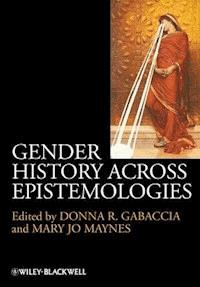
The cover image, Postcard (At the Golden Gate) 2009, is Ruth Claxton’s re-working of a Victorian oil painting by Valentine Cameron Prinsep. Prinsep’s original evokes orientalist fantasies of the languorous, passive and submissive woman of the East and embodies the masculine gaze so pervasive in western art. Claxton’s pointed slashing gives the formerly passive subject a gaze of her own, and a sharp one at that. She still looks downward, but the passivity suggested by her stance is contested by the potential for her instantly to turn her gaze toward the viewer; with beams emanating from her eyes, she has become the gazer, the seer. At the same time, Claxton’s alteration draws critical attention to the embodied stereotype of the eastern female. It leads us to notice the performance of gender: underneath the lush exterior, the hyper-feminine draperies and bracelets, who is actually there? Viewed this way, the image provokes epistemological insights even as it re-represents gender stereotypes. The familiar gendered image becomes ambiguous and indeterminate. The once passive object of scrutiny, in becoming the viewer, focuses our attention on the relationship between knowledge and perspective that has long held a central place in feminist epistemology. Thus Postcard (At the Golden Gate) 2009 provides a perfect point of entry into a special issue of Gender & History devoted to the theme of ‘Gender History across Epistemologies’.
Epistemological critiques – questions about how we know what we know – are intrinsic to gender history. Indeed, the claim that all knowledges are views from somewhere has been a core insight of modern western feminist theory since its emergence in the 1960s. This claim, in sum, has insisted that the perspective of the knower shapes what he or she looks at, sees and ultimately can know. Questioning the claim to objective truth prevalent in many disciplines, feminists undertook analyses of masculinist biases inherent in theory and practice in many fields of knowledge. Parallel critiques that subsequently emerged within disciplinary fields leapt over their borders and thus contributed to a wider awareness of perspectivity as a key element of feminist epistemology.
Feminist historians, in bringing a gendered perspective into history, in deploying gender as an analytic category and in studying it as an historical construct, have nevertheless proceeded from a variety of epistemological frameworks and used a correspondingly wide range of methods, developed through debate as well as through interdisciplinary borrowing.1 Among these debates, the most pervasive and epistemologically profound is undoubtedly the one, dating to the mid-1980s, that posited ‘gender history’ as a non-essentialist alternative to ‘women’s history’. This debate, which in turn reflected the wider postmodern critique of the practices of social history, continued into the 1990s, when cultural and social historians’ research practices and ways of knowing seemed starkly different and when the interdisciplinary alliances of the two groups of historians seemed to diverge particularly sharply.
These disputes began with calls for deconstructing the category of ‘woman’, based on the assertion that the category ‘woman’ does not exist pre-discursively – that is, ‘woman’ is not an objective, trans-historical category rooted in biology, but rather that categories like ‘woman’ are constructed in and through human culture and especially language.2 Drawing on and pushing beyond post-structuralist philosophers, historian Joan Scott’s enormously influential work initiated an ongoing historiographical interest in gender as a pervasive signifier of power relations; indeed, in the eyes of many subsequent historians of gender, the history of sexual difference came to centre on the cultural processes, especially as manifest in language and systems of representation, whereby meaning is created and power legitimised.3 Implicit in much of this work was a critique of prior feminist historical scholarship that had instead sought to limn dimensions of female experience and trace women’s exercise of historical agency even under changing and diverse conditions of male domination. Cultural historians argued that such histories naturalised rather than challenged sexual difference, especially when sexual difference was in effect reduced to a biological category.
Throughout the 1990s, the shift to discourse analysis was welcomed and practiced in some circles, but also resisted and analysed.4 Treating gender and sex primarily as cultural constructions inspired many new approaches to historical scholarship; however, many feminist historians continued to insist on the importance of analysing how gender related to a material world they posited as existing independently of language, and others worried about the potential for the turn to gender history to undermine feminist political efforts built around the political identity ‘women’. In the eyes of some feminist historians, furthermore, making women’s experiences more visible seemed quite compatible with the cultural project of examining ‘[t]he process whereby … difference was constituted’.5 Perhaps, as Scott later concluded, gender history seemed so exciting in the 1990s precisely because of ‘its radical refusal to settle down, to call even a comfortable lodging a “home”’.6
This refusal to settle down, we would suggest, still describes the varied epistemological premises of scholars in gender history. However, except when making programmatic statements or engaging directly in debate, historians of gender often leave their epistemological groundings implicit rather than explicit. Ignoring these differences does not make them go away, and the aim of this special issue is to examine how various ways of knowing operate in current historical research on gender and, through specific examples, to draw to the surface lurking questions of epistemological clash, convergence or, perhaps, reconciliation.
Since epistemological disputes have been an ongoing feature of gender history, why do we offer a special issue on ‘Gender Histories across Epistemologies’ at this particular moment? This special issue reflects our conviction that recent approaches to gender history suggest surprising crossovers and even common grounds that debaters of the 1990s did not imagine. Indeed, most of the authors in this special issue, while referring to earlier controversies, do not feel obliged to position themselves exclusively within them. Most, instead, chip passages through or detour around older impasses. Often they incorporate into their analyses insights seemingly based on multiple ways of knowing, including some – for example quantitative data analysis generally associated with positivist approaches – that were once viewed as incompatible or irreconcilable with the premises of gender history.
This is not to say that differing ways of knowing, differing methods and differing disciplinary instincts have lost their power. For example, some of the cross-epistemological conversations we were looking to encourage did not materialise. In particular, and despite the invitation in this issue’s call for papers for work employing quantitative methods, we received only two submissions centring on the use of quantitative data: Nancy Green’s discussion of gender in migration history in the United States and France and Emma Moreton’s linguistic analysis of a corpus of migrant letters. While these two authors demonstrate how they reconcile gender analysis and quantitative methods, the larger project of bringing empiricist epistemologies into conversation with gender history still appears to be daunting, though not impossible.
Moreover, we saw evidence of the continuing power of disciplinary frames, for example, throughout the complex editorial process that created this special issue. The authors whose work is included come from a wide range of disciplinary or inter-disciplinary locations including, in addition to history: classics, gender/sexuality studies, education, English literature, history of science and medicine, linguistics, sociology and theatre studies. Each submission was sent to outside reviewers, and in the vast majority of cases the topics addressed made it necessary to engage reviewers from at least two different disciplines. As we soon discovered, however, reviewers offered more than usually divergent evaluations of the paper they had been asked to review. A typical outcome was trenchant critique from one reader and enthusiastic encouragement from the other. As editors, we insisted that authors respond to the whole range of comments which, in turn, posed challenges for almost all authors in revising their articles for publication. Although we are pleased with the generosity of the authors in responding so positively to radically different readings and evaluations of their work, we cannot help but observe that powerful scepticism is still likely to be expressed when scholars cross boundaries or attempt to bridge or complement theories, methods or assumptions that still define the disciplines, whether or not the underlying issue is epistemological.
Collectively the essays in this special issue suggest how, and with what consequences, historians of gender are crossing disciplinary, methodological, national, linguistic, historiographical, temporal and generational divides; in doing so they are building on past debates while exploring new opportunities for resolving them. They do this, first, by reminding feminist historians to query gender as a category of analysis, just as much as they do other categories, as Jeanne Boydston advocated in her influential 2008 essay published in this journal.7 For example, Beth Severy-Hoven, in her analysis of wall art in ancient Pompeii, reminds us not only that we should avoid undue assumptions about what gender means transhistorically, but also to be cautious about the place of gender – vis-á-vis other – dynamics at work in a particular situation. Similarly, Shirin Saeidi’s research on nationalism and gender in recent Iranian history has led her to rethink her presumptions and the analytic role of gender: ‘gender and sexuality can simultaneously be categories, questions and tools’, she argues. This messiness and interdependence marks as ‘methodologically impractical any prescription for prioritising or de-prioritising gender as a category’.8
They do this, too, by engaging with and historicising earlier debates and moments of gender scholarship, by mobilising their acknowledgment of epistemological difference to understand better the intellectual and political genealogies of gender history and by recognising the dialectical processes that mark the evolution of fields of scholarship, while also questioning what is possible or constructive in terms of cross-epistemological conversations at the current moment of gender history. Readers can thus draw on the collected articles to ponder epistemological questions in a range of ways. Several articles can be usefully read for their explicit focus on knowledge production as a gendered historical process. The related articles by Helga Satzinger and Christina Benninghaus, for example, speak closely to each other on the theme of scientific research on sex, gender and reproduction. Helga Satzinger’s article about research on genetics and hormones in Germany in the early twentieth century explores the gendered character of the ‘scientific method’ at multiple levels: by documenting the gender order that scientists observed at the cellular level; by examining the research lab as a gendered workplace and by noting ideological debates about gender that infused the scientists’ social and political worlds. Satzinger, in turn, sees her investigation as contributing to epistemology in the realm of historiography as well as that of science: ‘[b]y unravelling the politics of multiple gender concepts in the sciences of the early twentieth century’, Satzinger writes, ‘I hope to link the history of the scientific study of sex difference with gender historians’ work on multiplicities of genders and their continuous renegotiation’.9
Christina Benninghaus, who focuses her contribution on a related problem in the history of science and medicine – namely, research on infertility in late-nineteenth and early-twentieth-century Germany – takes a quite different approach. While cognisant of the interplay among cultural presumptions that shaped knowledge production, such as the role of male doctors’ expectations in their interactions with patients or questions of propriety surrounding the collection of sperm samples, Benninghaus draws on evidence of medical research practices in the framework of Bruno Latour’s actor-network theory (ANT) to question prevailing grand narratives that chart the triumph of a ‘two-sex model’ and emphasise the historical pathologisation of the female body. Following Latour’s suggestions, Benninghaus connects the history of the instruments and procedures used in science and medicine with a wide range of actors interested in questions of infertility. She includes not only medical doctors and researchers, but also patients and their spouses, media and the wider public, and examines the various ‘loops’ that build the large network in which the understanding of, and practices around, infertility evolved. Gender still plays a large role in this analysis, but not the same role that has heretofore prevailed. According to Benninghaus, gender provided ‘a contemporary set of ideas about masculinity, femininity and sex difference’ that was ‘used as a resource, explanation and argument by those negotiating infertility’.10 For all of their differences, both authors problematise in provocative ways the relationship between scientific knowers constructing knowledge about sex and gender and their objects of study; the articles’ purview includes scientific instruments and microscopic entities along with the human actors who more commonly populate historical narratives.
In a very different realm – a study of nationalism, citizenship and gendered violence in Iran in the 1980s – Shirin Saeidi also calls for explicit attention to processes of knowledge production in her contribution. She does so both by developing a critique of the overly generalised conceptions – such as the gendered nature of nationalism and nation building projects – that circulate in the field of feminist conflict studies, and also by problematising her own relationship to the women she interviewed in her research process. Probing that relationship can reorient the researcher. On another front, Saeidi calls attention to aspects of the interviews and memoirs she discusses that resonate through a surprisingly large number of other articles in this issue: in her analysis, words are not ‘mere words’ but also performances, actions in their own right ‘used to express interviewees’ disapproval of, or allegiance to, reformist or conservative political movements in Iran. At the same time, and perhaps outside of their intentions, they were also displaying how state-sponsored associations between gender, sexuality and the nation during war might be acted upon on the ground’.11
Pursuing this theme of words as performances, we are struck by authors’ recurrent questioning of what counts as action and how to read and interpret words as forms of action. While obviously echoing the call for attention to language at the core of earlier epistemological debates, these newer approaches proceed from quite distinct ways of reading words and texts. Benninghaus, for example, describes three different types of readings she deploys when approaching the sources: ‘using texts, statistics and published cases to grasp a “reality” otherwise not accessible, understanding them as communication at least partly structured by intentions and reading them as representations, as texts reflecting contemporary ways of thinking’.12 However, the articles based on research on letters (the process involved in producing this issue yielded four such studies) perhaps provide the most pointed illustration of different ways of reading. They can productively be read in juxtaposition with one another to explore the kind of knowledge that letters can yield; by reading across these articles, we can literally read across epistemologies.
Liz Stanley and Helen Dampier use the letters of the white South African writer Olive Schreiner to assess her political influence. They begin their inquiry with large epistemological questions that might pertain to any historical inquiry: ‘[w]ith what certainty can knowledge claims about the past be advanced? Can cause and effect links be demonstrated … And if … [they] … can, then what is appropriate and sufficient evidence to convincingly show this?’ To make claims about cause and effect in the question of Schreiner’s political influence, Stanley and Dampier reconstruct and then analyse what they term ‘the Schreiner epistolarium’ – a corpus of extant letters that ‘has interesting characteristic features, presences and absences’.13 They depart from the ways that historians have often read letters – that is, within an epistemological framework in which letters are largely understood in terms of their reference to events in the author’s life. When historians read letters this way, they tend to see them as problematic sources because of their perspectivity and their embeddedness in very particular relationships. Instead, Stanley and Dampier emphasise the ‘performative character’ of Schreiner’s letters by demonstrating through their examples how ‘these letters in and of themselves changed things’. The supposed deficiencies of letters when viewed as representations of past events, through this new way of reading, are transformed into strengths ‘because they provide an analytical purchase on understanding context and its dynamics’.14 The new way of approaching these particular documents, the authors suggest, opens up new possibilities for observing the operation of agency on the margins – in this case, marginality defined by gender and imperial power.
Emma Moreton starts her analysis of a large corpus of Irish emigrant letters with a critique that echoes that of Stanley and Dampier in some respects. She points to the usual way of analysing such letters primarily as representational and based upon reading the words to interpret the author’s meaning with reference to its broader social or cultural context. Some scholars, Moreton notes, have looked at linguistic patterns in letters, focusing for example on exemplary linguistic strategies or word patterns. Moreton makes a distinction between this type of approach and her own approach – corpus linguistics. Her more systematic linguistic analysis of a corpus of letters, a quantitatively large though necessarily partial subset of an unspecifiable universe of letters (here echoing in some respects Stanley and Dampier’s ‘epistolarium’), reminds us that studies that employ other methods of reading letters often rest on unexamined assumptions about the place of a given letter in the social, cultural or epistolary context in which it is embedded. Although we can know many things from the careful reading of single letters, we cannot know how representative they are of ‘letters’ more generally, or even of a particular correspondence.
Therefore, Moreton argues, to make strong knowledge claims about gendered language based on a huge body of sources such as emigrant letters, an alternative approach is necessary, one that, like Stanley and Dampier’s, treats letters as ‘acts’ rather than as representations. However, in contrast to Stanley and Dampier’s approach, Moreton ‘decontextualises the components of language’. The ‘way of knowing’ that Moreton describes and employs – corpus linguistics – offers an alternative way of reading letters based on data collection from large numbers of texts. Her analysis assesses frequencies of usages of words or terms and distributional patterns, and moves back and forth between the individual letter and the group of letters, ‘noticing what is typical or unusual about one text when compared with many texts’. The point of this way of reading is not to capture lived experience. It aims, rather, to distance the analyst from lived experience, ‘taking language out of its flow and reality, freezing it and rearranging it to give “new perspectives on the familiar”’.15 Moreton matches her methodology closely to the types of knowledge claims she seeks to make and prove based on the body of letters. Claims about how we know what we know are thus central to both of these articles; each presents and defends a distinctive epistemology for reading gender history in/into letters.
For Sonia Cancian letters also perform actions; in the particular case of the migrant letters she examines, they are exercises in identity building and in maintaining a human relationship. The letter writers create and sustain a long-distance relationship through letters that draw upon, work with and sometimes reformulate specific cultural models. Their gender ideologies are drawn variously from opera, the folk conventions of their Italian villages or new behaviours they encounter (for example, hunting in Canada). But Cancian reads them not merely for how they reveal the operation of gender ideology, but also as evidence of ‘the myriad ways in which the writers push these ideologies in one way or another’.16 The letters are doing important work that constructs gender in a particular social relationship.
The fourth contributor who works with letters, Meritxell Simon-Martin, tacks back and forth between letters and paintings in her analysis of British feminist Barbara Bodichon’s self-construction as a female artist. Like the other authors we have discussed, Simon-Martin conceives of her approach to both types of sources as an alternative to a simply empirical reading. She does not treat the letters as an archive from which knowledge about Bodichon can be plucked. Parallel to the ways of reading presented by Cancian and Stanley and Dampier, Simon-Martin emphasises the performative dimensions of the Bodichon letters and their usefulness as a point of entry, not into Bodichon’s authentic self, but rather into her ongoing project of self presentation – and specifically of her self-presentation as a female artist. Bodichon’s letter writing ‘is not an expression of the self’, Simon-Martin argues, but ‘[r]ather the self-narrating subject is an effect of the autobiographical act; [Bodichon] is partially constituted through the act of letter writing’. Additionally, we should add, Simon-Martin interprets even Bodichon’s self-categorisation in sources such as the 1880 census and her marriage certificate – sources that are so often treated as repositories of facts – as acts of self-construction. She points to such declarations as especially important for women ‘afflicted with the curse of amateurism’ that was a component of nineteenth-century bourgeois femininity.17 By declaring her profession as artist in official records, Bodichon challenged the limits of this gender ideology.
Simon-Martin views Bodichon’s paintings as another site of the same project of self-construction, a site marked by distinctive generic characteristics. Bodichon at times uncritically adopts the conventions of these artistic genres. For example, her picture Sisters Working in our Fields is ‘embedded in the systems of signification on which Bodichon drew to produce it. Most notably, Bodichon’s public self-projection as a landscapist specialised in Algeria is complicit with discourses on orientalism’. Nevertheless, as in her writings, Bodichon was also capable of re-appropriating discourse. Her choice to create landscape paintings ‘permitted Bodichon to redefine the category of female artist: she claimed landscapes as a legitimate theme for a woman painter and asserted her right to paint en plein air’.18
Simon-Martin’s article is not the only one here that moves away from epistemological terrains of relative familiarity to historians accustomed to working with written records, in order to explore ways of knowing that instead – as with the woman lounging at the Golden Gate – require them to turn their gaze upon images. Beth Severy-Hoven’s analysis of the wall paintings of an ancient home in Pompeii offers, literally, a new way of seeing the apparently gendered perspectivity operating in this particular historical context. As she argues, ‘[i]n this ancient Italian home – and I suggest in many others – a master gaze significantly inflects the male one’. Rather than reading the images separately and in a straightforward fashion as ‘masculine’, Severy-Hoven looks at ‘the comparisons and contrasts called for by the formal compositions and juxtapositions of the paintings themselves’ to read out of them ‘the status of the owners as masters’. While she notes the ‘vast cultural and epistemological gap between twentieth-century Euro-American psychoanalytic theory and ancient Italian concepts and experiences of gender and sexuality’, identifying that gap allows her to see in images of torture, suffering and sexual submission resonances of the slave/master relationship rather than a straightforward mechanism of gender differentiation.19
To mention one final example of experimentation with knowing based on attentiveness to the visual, Meredith Heller’s analysis of the Teatro Campesino between 1968 and 1980 draws upon a range of sources including written texts, but important aspects of her argument rest on exploring what she calls ‘mestiza performance practices’. This takes her into the realm of reading photographs, fliers and other visual media to illustrate ‘instances of male/female, non-female, androgynous, sexless and otherworldly genderbending performance by Chicanas’.20 By ‘gazing’, Heller is able to ‘see’ the agency and resistance of the female performers in a theatre group that has frequently been studied as an example of how gendered relationships of power remained peripheral to the group’s effort to tackle and challenge racial and ethnic hierarchies and inequities.
Besides offering creative epistemological approaches to textual and visual sources, this special issue also highlights the extent to which, in the decades since gender history’s emergence, it has moved from being a largely western project to becoming a global project. Many of the articles here point strongly to the complexities of grappling with global geopolitical dimensions of ‘how we know what we know’, once again echoing the revisionism we can see in the Postcard (At the Golden Gate) 2009.
Within history, historiographical knowledge has tended to develop within frameworks designated by time (such as ‘ancient’ or ‘medieval’ or ‘modern’) and space (ranging from the scale of village micro-histories to world histories). Arguably, the nation-state has because of its ideological and institutional clout been a strong influence on the historiography of the modern world, but it is not the only such organising principle of historiography even if it is probably the most familiar one. Within national historiographies, particular research traditions, sources, languages and theoretical orientations have shaped what has been considered knowable about the past. Comparing across national or temporally-defined historiographies thus calls attention to each field’s peculiarities. The intellectual ferment characteristic of the late-imperial and postcolonial era has brought an explicit geopolitical critique to national historiographies, as well as to many other ways of knowing about the past. It has pushed historians to be more alert to the global geopolitical and extra-national influences on historical ways of knowing, even regarding such seemingly local, intimate or subjective arenas as gender relations or gender identity formation. This critique has been a defining element in some subfields, such as postcolonial African history. More recently it has begun to inform metropolitan historiographies as well.
It is noteworthy that we find relatively little evidence in these articles of projects defined by national historiographies of the traditional sort. To some extent this reflects the fact that many of the authors are not, by disciplinary training, historians; but even those authors who are trained as historians more often cross than respect historiographical boundaries. Lorelle Semley’s contribution presents an argument about ‘public mothering’ that explicitly calls attention to distinctive conceptualisations of gender and mothering that operate in western feminist theory and historiography as opposed to West African history and historiography. As a North American doing research in Africa she struggles to develop a gender analysis that does not force the lives of individual African women into categories developed by North American or European historians of gender or empire. To explore what she sees as distinctive ways of conceptualising relations between gender and power that do not presume a ‘public/private’ divide as conceptualised in the west, Semley must in turn defy geographically defined borders of investigation. Her article first takes up questions of African historiography through a conceptual lens developed in North America before again circling back to Africa and then returning to Semley’s North American classrooms.
For Nancy L. Green, focusing on migration, the transnational has also always been an important terrain of analysis. Her article poses the problem of the nation state in a way that highlights questions of epistemology through comparative historiography. Certainly she cites differences in national trends in migration, but closer to the heart of her claims are provocative comparisons about the questions upon which historians have focused in two different national-historiographic contexts and how these questions in turn have structured understandings of the role of gender in migration history. To offer one example of her thinking along these lines, Green notes that ‘[a]s assumptions about assimilation (through the 1960s in the United States, through the 1970s in France) gave way to enquiries about ethnicity in the United States and the “droit à la différence” (the right to be different) in France, researchers asked few questions about the gendered meanings of those terms’.21 Concepts embedded in historiography, in other words, followed temporal shifts in nationally specific political debates. The place of gender in these historiographies also resonated at times with the transnational flow of ideas and at times with national-historiographic peculiarities. Comparative convergences and divergences of this sort call to our attention both general and nationally specific political projects that have shaped how we know what we know about migration history.
Modern nation states have – as Green notes – routinely tracked and counted mobile people, creating an archive from which historians in France and the United States are only now beginning to produce gendered knowledge (about states, labour markets, communities and individuals). Green’s discussion of feminist historians who work quantitatively with this archive suggests how empirically-oriented social historians attempt to come to terms with the binary of ‘male’ and ‘female’ which is constitutive of the data they use. Green suggests how we can know gender even when presented with fixed binaries, for example by paying attention to variations in the numbers of male and female migrants. To explain these variations one must explore the gendering of state policies, educational and family systems and labour markets in both sending and receiving societies. It is not, then, the sex of migrants that explains variations in their numbers relative to each other, but rather gender relations deduced in part from those numbers.
A significant cluster of essays in this collection point to paths scholars take as they attempt to escape the ‘gaze’ of nation-states, their archive-building bureaucracies and the national historiographies they have shaped. One provocative approach is to seek out or to construct archives that document the perspectives of border-crossers, including but not limited to the type of migration history that Green describes. Viewing gender history from the perspective of migrants and other travellers allows scholars to challenge the ‘nationality’ of their subjects, their analytic categories and their ideas, as well as to problematise their own relations to their research subjects. We would like to note three different types of ‘border crossing’ that come into focus in several of the articles: first, research projects that track the movements of historical actors across borders; second, research that brings the researchers themselves into cross-border relationships with research subjects and third, and closely related to the second, research situations that problematise the practice of carrying analytic concepts of gender across borders.
People who cross borders are complicated subjects of historical study. Nation-states have created most of the main categories through which their mobility has been documented historically. They have usually distinguished emigrants sharply from immigrants (categories that are important not only to Green but also, for example, to Moreton’s analysis of the letter-writing Lough sisters) as well as from refugees or exiles (including, for example, several of the Jewish scientists studied by Satzinger). For modern states, the categories of emigrants, immigrants and refugees/exiles are salient and consequential in their implications for biopolitical projects of nation building (with desirable immigrants viewed as potential additions and emigrants as potential losses to the ‘body politic’). As politically salient categories, border-crossers’ movements have, in turn, been subject to state construction and scrutiny, creating massive archives which incorporate the gaze of the nation state.
On the other hand, upper-class ‘travellers’ – such as Barbara Bodichon, as analysed by Meritxell Simon-Martin – have not always been scrutinised by border police or documented in the same category as ‘migrants’. Yet they too crossed borders – not only national boundaries, but also the borders of metropole/colony, race and culture. By reflecting on the historical experiences of various types of travellers – including those who cycled repeatedly through the same places or those who left home again and again, only to return, sometimes multiple times – the epistemological and historiographical consequences of border crossing can be more fully explored. As historians examine gender history from the perspective of border crossing they begin to see how nation states, their archives and their historiographies render the mobile as interesting but also often threatening aberrations from an imagined and sedentary human ‘normalcy’. Male mobility typically has provoked different official concerns than female mobility. Even more deeply, crossing political boundaries often entails crossing gender systems as well, thus calling attention to their instability, their cultural specificity and their malleability. Alertness to the ideological filters inherent in state archives documenting mobility is critical to using them to study gender; moreover, the use and sometimes even the scholarly assemblage of novel types of archives can produce knowledge that is less moulded by states, and that therefore sheds new light on the relationship between mobility and gender.
The usual categories deployed by the nation state – notably the distinction between the sedentary and the mobile, the emigrant and the immigrant – disappear almost entirely in Sonia Cancian’s analysis of letters exchanged between two lovers from north-eastern Italy, Loris Palma and Antonietta Petris. Both lovers moved over the course of their relationship and both were undoubtedly ‘counted’ by one set of authorities or another as emigrants and as immigrants, but these categories were not the operative ones for them. Both certainly felt consequences when one moved and the other remained temporarily in place. Their communication through an unfolding epistolary relationship (first, within Italy, and then across the ocean separating Canada and Italy) continually repositioned them metaphorically in time and space; in their communication with each other, they sometimes looked temporally forward (into the future) and sometimes temporally backwards (towards the past), sometimes (spatially) away from their current location and sometimes (spatially) towards it.
Letter writing mediated – or perhaps, as Cancian suggests, even constructed – their personal relationship, allowing each correspondent to experience their communication as a continuation or unfolding of their earlier, brief, face-to-face contacts. Cancian’s careful reading of the emotionally charged and, despite the distance, intimate world created through the letters demonstrates an epistemological paradox: the dynamic construction of gender ideologies apparent here is knowable only because of the mobility and separation of the two lovers. They wrote, as Cancian says, only when ‘intimate face-to-face conversations, and ordinary, world-making discourse were no longer possible’.22 Had their face-to-face relationship continued, in fact, their subjectivities, their use of language and the gendering of their communication about emotions, dreams, memories and imagined futures would have been subsequently knowable – if at all – only in a very different way, through retrospection, for example, as captured through oral histories. But, as Cancian’s analysis makes clear, neither the original relationship nor the historian’s reconstruction of it would have been the same. If corpus linguistics, which Emma Moreton employs in her study of the Irish immigrant letter writers, is always ‘about making comparisons’, Cancian’s exploration of gendered intimacy and emotion is possible only because an implied comparison (in this case with the face-to-face relationships of sedentary people who need no letters in order to construct meaning and intimacy) is impossible.23 As Cancian’s work suggests, border crossings and the separation of persons involved in intimate relationships that they sometimes demand offer particularly fruitful sites for seeing the dynamics of gender relations; intimacy across separation sets the context for putting thoughts down on paper that otherwise would not have taken this more permanent form. Moreover, border-crossers inevitably confront multiple ideologies of gender, thus pushing them to ‘see’ gender more explicitly than they might have, had they stayed home, and challenging a prior understanding of sex or gender that might have just seemed ‘natural’.
In Jamie McDaniel’s analysis of Virginia Woolf’s Orlando, border crossing plays a central, if metaphoric, role. The article focuses on a well-known feminist classic’s main character, who crossed borders of time, gender and sex. Read in juxtaposition with Stanley and Dampier, Green or Cancian, McDaniel’s article reveals how border crossings facilitated Orlando’s adoption of a new epistemology of property and propriety. Writing as a literary scholar, McDaniel calls attention to his decision to reconsider what he considers ‘the value that literary scholarship places on a kind of critical detachment from its objects of inquiry’. Rejecting that stance, McDaniel views Virginia Woolf’s extensively analysed text through immersion in the epistemologies that Woolf herself mobilised in writing Orlando. McDaniel calls his choice ‘epistemological doubling’.24 By epistemological doubling, McDaniel intends more than the mere blending or juxtaposition of differing ways of knowing; here, epistemological doubling means self-consciously adopting and mimicking the ways of knowing adopted by Woolf herself – e.g. literary analysis, a gendered legal history of property and biographies of both an individual (Orlando) and the British nation.
In adopting multiple and shifting epistemological stances, McDaniel becomes a biographer of Woolf – one who can see linkages among Woolf’s personal biography, her intellectual positions and British national history more broadly. Woolf’s engagement with the writer Vita Sackville-West’s loss of her house and lands and her corresponding interest in women’s property rights (which were under debate at the time she wrote) interact with Orlando’s biography and developing thoughts about property as the fictional character lives and travels with the ‘gipsies’. In adopting Woolf’s ‘preoccupation with looking back’ through time, through Orlando’s long and complex biography and through the history of property relations, McDaniel is able to ‘revisit narratives of national and gender identity’ – narratives that excluded women and the propertyless – and to redefine what marked Woolf and Orlando as British women.25Orlando itself becomes a work of fiction that tells a history of the British nation and not just a biography of its main character. Woolf’s most important work of fiction tells this story in a way that reveals Woolf’s dawning realisation that women’s writings themselves constitute valuable property, and once again, we note, calling attention to words as actions.
Olive Schreiner also moved across borders – both those between the colony of South Africa and the metropole and those defined by race and gender within South Africa. As a border crosser privileged by reason of her race and status as a writer, Schreiner was able to ‘translate’ developments in colonial South Africa for British citizens in the metropole. But she could do this so effectively, Stanley and Dampier suggest, in part because she had left South Africa to live in Britain and had then experienced the shock of viewing her own society – ‘the slow pace of life in the white enclave and the narrowness of white people’s lives and opinions’, a nation of ‘Philistines’ – from new perspectives as an outsider after her return from Britain.26 Conversely, her fame in the metropole gave her credibility in the colony that would otherwise have been unlikely.
Crossing borders in the research process can also have profound epistemological implications. Sometimes this can result from as common a practice as translation. For example, historian of science Helga Satzinger points to the challenge of translation across languages most forcefully when she writes about the problematic use in the English language of the term ‘gender’ when writing the history of biological sex difference in Germany. Satzinger notes that ‘in the German-language “Geschlechterforschung” (gender studies) there is no need for the explicit sex-gender distinction in order to indicate the realm of socially-constructed “gender”’.27 As a native-speaker of German, Satzinger is able not only to see how the term ‘gender’ carries a distinctive relationship to biological sex difference in English and in German, she is able to mobilise the linguistic difference between German and English languages in order to probe the history of scientific research on gender and sex at the turn of the twentieth century. The problem that Satzinger points to – that is, the particularity of the sex/gender distinction as it has come to operate in English is not just a problem for German speakers but indeed for speakers of a large number of languages. Furthermore, precisely because the meaning and resonance of the word ‘gender’ differs across languages, gender history itself has, at times, become associated with historical practice in the Anglo-American scholarly world, and resisted as such elsewhere, another very important reminder of the power of words and the geopolitical dimensions of border crossing.
Border crossing also raises the important issue of when and how the scholar’s relationship to his or her subject shapes the knowledge created. Whether or not insider and outsider researchers produce distinctive knowledges is an issue that has long engaged researchers who study colonised peoples, migrants and racial minorities, where it has been understood both as defining the politics (and identity politics) implicit in scholarship and as a very broad epistemological question. Shirin Saeidi reports that the informants she interviewed for her study of the lives of non-elite Iranians during the Iraq/Iran war of the 1980s expected her to cultivate an emotional understanding of them in order to bridge the gap between her assumptions and categories of analysis and their ways of narrating their own memories of life in war-torn Iran. Her informants’ sharp emotional reactions to some of her questions and observations revealed her ‘unconscious perspectives, as respondents demanded recognition of their emotional positionality towards me’. Her border crossing into Iran and other places where Iranians lived in exile, and also into the personal realm of her interviewees’ lives, challenged the analytic categories she took with her to the field. ‘I became accustomed to continually moving’, she writes, ‘between people, feelings, claims and ideas during interviews and archival work until the specific complexities at issue became apparent – not depictions of gender and sexual categories as I understood them through my own history, solidarities and education’.28 Although Cancian does not explicitly address this issue in her essay, she also describes a research process in which she is both an insider and an outsider to the Italian migrant letter writers who are the object of her investigation. Cancian’s endnotes indicate how crucial her relationship to the female letter writer, Antonietta Petris, has been to the development of this scholarly project. As a tri-lingual Canadian of recent Italian origin, living in Montreal, Cancian can claim status as an insider but is simultaneously someone who through her education has travelled outside that community, only to return to it as a researcher. This process was critical to Cancian’s acquiring access to the letters and even to her ability to read and understand them – distinguishing, for example, standard Italian from the dialects of north-eastern Italy. Without establishing a personal and ongoing trusting relationship with Petris, Cancian could not have made visible to others the struggles over gender and intimacy between the two young, letter writing lovers of the post-war period.
Scholars who venture across borders carry with them their own ideas of gender. Essays focused on Iran, India, Malawi and Benin all raise questions about how well concepts of gender and methods of gender analysis travel. ‘North-South’ border crossings are particularly charged in a postcolonial context where the hierarchically organised global systems of power of the nineteenth and twentieth centuries still live on in contemporary ways of knowing. As already noted, Shirin Saeidi documents her rethinking of concepts of gender she carried into the field. Christopher Lee’s investigation led him to doubt the utility of the usual categories of social historical and gender analysis in his efforts to make sense of an incident he discovered in the National Archives of Malawi. Working from an archived text from the early twentieth century, Lee’s close reading of the violent conflict documented within it between an unidentified European man and an African woman called Adaima, while seemingly highly idiosyncratic, nevertheless allowed him to see with vivid clarity the personal experiences of inter-racial sexual relations that often occurred under colonial rule. At the same time, western (or northern) analytic categories, including gender, possess limitations for explaining the meaning or significance of Adaima’s violent outbursts. They do not reveal her motivations nor, as Lee argues, should her experience be read as representative of the lives of other women. The European man’s fear of Adaima and his recourse to colonial authorities also remain somewhat puzzling. What is the gendering of power revealed in this idiosyncratic story? In short, the ‘vast cultural and epistemological gaps’ that Severy-Hoven sees separating modern western readers from ancient Pompeii also continue to complicate conversations across modern geopolitical and cultural borders as well.29 At present, satisfactory ‘translation’ across the north/south divide remains elusive.




