


41,99 €
Mehr erfahren.
- Herausgeber: John Wiley & Sons
- Kategorie: Wissenschaft und neue Technologien
- Sprache: Englisch
Shortlisted for the HE Bioscience Teacher of the Year Award 2019: Kevin O'Dell, Author of Genetics? No Problem!
The analysis and interpretation of data is fundamental to the subject of genetics and forms a compulsory part of the undergraduate genetics curriculum. Indeed, the key skills that a genetics student requires are an ability to design and understand experimental strategies and to use problem-solving skills to interpret experimental results and data. Genetics? No Problem! provides students with a graded set of problems that aim to enthuse, challenge and entertain the reader.
The book is divided into three sections – introductory; intermediate and advanced – each with 10 problems. For first level students there will be short genetics problems embedded in a wide range of scenarios, such as murder mysteries. As the book progresses, the stories will get longer and the science will get progressively more complex to challenge final year students and enable the reader to identify genetic disease in obscure organisms as well as designing and testing treatments and cures.
Genetics? No Problem!:
- Takes a unique, innovative approach that provides students with a set of graded problems designed to develop both their skills, and their ability to tackle problems with confidence
- Includes problems embedded in a narrative, written in an interesting, informative and entertaining style by an Author with a proven track record in teaching, research and communication
- Is well illustrated in full colour throughout.
The book will prove invaluable to all students of genetics across a range of disciplines needing to get to grips with the analysis and interpretation of data that is fundamental to the subject.
Sie lesen das E-Book in den Legimi-Apps auf:
Seitenzahl: 622
Veröffentlichungsjahr: 2017
Ähnliche



















GENETICS? NO PROBLEM!
Kevin O’Dell
School of Life Sciences, University of GlasgowGlasgow, UK
This edition first published 2017 © 2017 by John Wiley & Sons Ltd
Registered OfficeJohn Wiley & Sons Ltd, The Atrium, Southern Gate, Chichester, West Sussex, PO19 8SQ, UK
Editorial Offices9600 Garsington Road, Oxford, OX4 2DQ, UKThe Atrium, Southern Gate, Chichester, West Sussex, PO19 8SQ, UK111 River Street, Hoboken, NJ 07030‐5774, USA
For details of our global editorial offices, for customer services and for information about how to apply for permission to reuse the copyright material in this book please see our website at www.wiley.com/wiley‐blackwell.
The right of Kevin O’Dell to be identified as the author of this work has been asserted in accordance with the UK Copyright, Designs and Patents Act 1988.
All rights reserved. No part of this publication may be reproduced, stored in a retrieval system, or transmitted, in any form or by any means, electronic, mechanical, photocopying, recording or otherwise, except as permitted by the UK Copyright, Designs and Patents Act 1988, without the prior permission of the publisher.
Designations used by companies to distinguish their products are often claimed as trademarks. All brand names and product names used in this book are trade names, service marks, trademarks or registered trademarks of their respective owners. The publisher is not associated with any product or vendor mentioned in this book.
Limit of Liability/Disclaimer of Warranty: While the publisher and author(s) have used their best efforts in preparing this book, they make no representations or warranties with respect to the accuracy or completeness of the contents of this book and specifically disclaim any implied warranties of merchantability or fitness for a particular purpose. It is sold on the understanding that the publisher is not engaged in rendering professional services and neither the publisher nor the author shall be liable for damages arising herefrom. If professional advice or other expert assistance is required, the services of a competent professional should be sought.
Library of Congress Cataloging‐in‐Publication data applied for:
ISBN (Hardback): 9781118833889ISBN (Paperback): 9781118833872
A catalogue record for this book is available from the British Library.
Wiley also publishes its books in a variety of electronic formats. Some content that appears in print may not be available in electronic books.
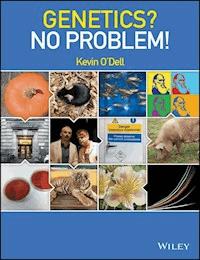
Cover image: Mouse © Frances Jones Psychofish © Hayley Patterson Zombiology Institute © Time‐Tastical Productions Doug and Kevin © Time‐Tastical Productions Hazardous cupboard © Kevin O’Dell Pig © Kevin O’Dell Petri Dish © Kevin O’Dell Tiger © Del Bonds Strawberry Biomass Graph © Kevin O’Dell All other images from Public Domain
Cover design by Dan Jubb
Foreword
I start teaching my first year genetics course at University College London by saying ‘I am a geneticist, and my job is to make sex boring’. The students look rather baffled, but after twenty or so lectures, I can tell that they heartily agree. It’s not that genetics is of its nature uninteresting – for as every biologist knows there are plenty of good stories about inherited disease, mutation, inbreeding, evolution and much more – but the unfortunate fact is that genetics has been, even from its earliest days, a quantitative subject. For too many of today’s students, the Q word makes them quail, and as I am fighting through the analysis of pedigrees, linkage mapping, population genetics, heritability, inbreeding coefficients and the like, I can see at least part of my audience’s eyes glaze over.
This book should brighten them up again. Instead of just slogging through reams of figures in a lecture or a tutorial, each of its many exercises is embedded in a narrative, from illegitimacy to murder and from Bengal Tigers to guinea pigs. Genetics? No Problem! is not about the tedious accumulation of fact (although any science without fact is a house built on sand), but about a series of worked problems that lay the foundations upon which a sturdy factual edifice can be built. The book goes from the elementary to the advanced, and from plant flower colours to the mythic inhabitants of Titan – one of Saturn’s moons – taking in some equally fanciful Scottish creatures (albino haggis anyone?) on the way.
Some of the examples may stretch a reader’s imagination – but that is what modern biology itself has done, again and again. This book will work best in consort with examples from the real rather than the imagined world and many of its exercises are close to those used by investigators of viral infection, circadian rhythms and much more. As a catalyst for discussions and exercises about what was described to me when I was a student as ‘genetical thinking’ (although it was never explained as clearly as this book does quite what that might be), even a few small aliquots of its contents will go a long way.
Professor Steve Jones FRS, University College London, UK
Preface
The analysis and interpretation of data is fundamental to understanding genetics and forms a compulsory part of the undergraduate genetics curriculum. Among the key skills that a genetics student requires are (a) an ability to design and understand experimental strategies and (b) problem‐solving skills to interpret those experimental results and data. In my experience, students often find this rather difficult and a little bit scary. Problems in standard textbooks are usually apologetically tacked onto the end of chapters and are always presented in a rather dry way. So, to help engage the students, I have embedded the problems in short narratives.
This is exclusively a problem‐solving genetics textbook. There is no formal descriptive material included, other than an introduction to provide clear instructions on how to use the book. I want to enthuse, challenge and entertain the reader in an informative manner, and a key to this is getting the reader to think for themselves. The genetics problems are embedded in stories that will, I hope, be amusing and entertaining.
The book is divided into three sections: introductory, intermediate and advanced. For first level students there will be short genetics problems embedded in a wide range of scenarios, such as murder mysteries and, as the book progresses, the stories will get longer and the science will get progressively more complex so that final year students will be identifying genetic disease in obscure organisms as well as designing and testing treatments and cures.
The problem‐solving approach is in the format of real scientific research, as many questions are about the students analysing some data, proposing a model that interprets that data, and then devising an experimental strategy that tests their model. I hope that the book will encourage students to take responsibility for their own learning by requiring them to go and find appropriate information for themselves.
Kevin O’Dell
Acknowledgements
Nobody in science works in glorious isolation, and this book could never have been written without the support of family, friends and colleagues. When I arrived in Glasgow over twenty‐five years ago, I was fortunate to have the chance to work with two very talented researchers, Howy Jacobs and Kim Kaiser, and two hugely inspirational lecturers, Roger Sutcliffe and Richard Wilson. I owe the four of you a great deal. The Genetics Degree team at Glasgow have been a pleasure to work with over the years, and their contribution to this book cannot be underestimated. In particular, comments from Mark Bailey, Joe Gray and Darren Monckton have always been welcome, even though it may not have felt like this at the time. In addition, the support and encouragement from Rob Aitken in the School of Life Sciences at Glasgow is hugely appreciated. I should also thank the students. It's been great fun and without you there would be many more typos and incomprehensible questions. Finally, and most importantly, I'd like to thank Christine, Adam and Annie, who make everything so worthwhile.
Kevin O’Dell
How to Use this Book
When I was at school I was lucky enough to have a couple of biology teachers who could make even the driest bit of biology absolutely fascinating. Somehow they could dress the material in a context that would bring it spectacularly to life. I can’t exactly explain why an essay entitled ‘Why can’t amoeba grow to the size of a number 207 double‐decker bus?’ is much more interesting than the more traditional ‘Why are amoeba small?’, especially as 95% of the answer is going to be the same, but I would work a lot harder at the former than the latter. Mr Quilley and Ms Grounds have a lot to answer for!
The other thing that I’ve discovered after 25 years of teaching genetics at the University of Glasgow, is that the very best students are the ones who can work things out for themselves. So over the years we’ve been progressively moving away from traditional lectures and trying different ways of getting students to do things for themselves. One of the best ways of doing that is problem solving, and that is what this book is all about.
How do the very best students become the next generation of world‐class researchers? It’s not because they can remember some complex formula, or the precise spelling of the Latin name for an obscure disease, or even because they can draw the exact chemical structure of every amino acid. It’s because they have a good broad understanding of their subject, the ability to find information from appropriate sources, to have ideas and hypotheses about how things might work, and the energy, intelligence and enthusiasm to test those ideas. In the end, it’s all about problem solving.
This book is all about developing your problem‐solving skills. For those of you on a standard three‐year undergraduate degree programme, you’ll find ten problems targeted at level one, ten more for level two and another ten pitched at final year students. Many of these are based on problem‐solving sessions we’ve had with the genetics students at the University of Glasgow, whilst others are slightly modified versions of their exams (though don’t let that put you off).
The key is to have a go at the problems and see how far you get. Don't be disappointed if you don’t understand something and don’t be afraid of getting things wrong. Nobody understands everything first time, and if any teaching isn’t challenging, it’s probably not actually worth doing! It may well be the case that you’ll have to look things up, but that’s exactly what the career scientists would do. If you know more at the end of a question than you did at the start, then progress has been made.




