


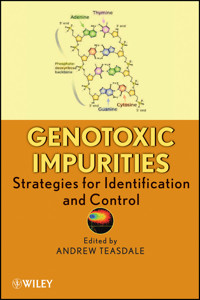
Genotoxic Impurities E-Book
134,99 €
Mehr erfahren.
- Herausgeber: John Wiley & Sons
- Kategorie: Wissenschaft und neue Technologien
- Sprache: Englisch
This book examines genotoxic impurities and their impact on the pharmaceutical industry. Specific sections examine this from both a toxicological and analytical perspective. Within these sections, the book defines appropriate strategies to both assess and ultimately control genotoxic impurities, thus aiding the reader to develop effective control measures. An opening section covers the development of guidelines and the threshold of toxicological concern (TTC) and is followed by a section on safety aspects, including safety tests in vivo and vitro, and data interpretation. The second section addresses the risk posed by genotoxic impurities from outside sources and from mutagens within DNA. In the final section, the book deals with the quality perspective of genotoxic impurities focused on two critical aspects, the first being the analysis and the second how to practically evaluate the impurities.
Sie lesen das E-Book in den Legimi-Apps auf:
Seitenzahl: 793
Veröffentlichungsjahr: 2011
Ähnliche




















Table of Contents
Cover
Table of Contents
Title page
Copyright page
FOREWORD
PREFACE
CONTRIBUTORS
Part 1: DEVELOPMENT OF GENOTOXIC IMPURITIES GUIDELINES AND THE THRESHOLD OF TOXICOLOGICAL CONCERN CONCEPT
CHAPTER 1 HISTORICAL OVERVIEW OF THE DEVELOPMENT OF GENOTOXIC IMPURITIES GUIDELINES AND THEIR IMPACT
1.1 INTRODUCTION
1.2 CPMP—POSITION PAPER ON THE LIMITS OF GIs—2002
1.3 GUIDELINE ON THE LIMITS OF GIs—DRAFT, JUNE 2004
1.4 PHRMA (MUELLER) WHITE PAPER
1.5 FINALIZED GUIDELINE ON THE LIMITS OF GIs—JUNE 2006
1.6 ISSUES ASSOCIATED WITH IMPLEMENTATION
1.7 SWP Q&A DOCUMENT
1.8 FDA DRAFT GUIDELINE
1.9 OTHER RELEVANT GUIDANCE
1.10 CONCLUSIONS
CHAPTER 2 DEVELOPMENT OF THE THRESHOLD OF TOXICOLOGICAL CONCERN CONCEPT AND ITS RELATIONSHIP TO DURATION OF EXPOSURE
2.1 HISTORY AND DEVELOPMENT OF THRESHOLD OF TOXICOLOGICAL CONCERN (TTC)
2.2 CURRENT APPLICATIONS OF THE TTC CONCEPT
2.3 GROUP CHEMICALS AND LINEAR EXTRAPOLATION AT LOW DOSE
2.4 CUMULATION VERSUS ADDITION
2.5 CONCLUSIONS AND PERSPECTIVES
Part 2: EVALUATION OF GENOTOXIC RISK FROM A PRECLINICAL PERSPECTIVE
CHAPTER 3 GENETIC TOXICITY TESTING TO QUALIFY ALERTING IMPURITIES
3.1 INTRODUCTION
3.2 IN VITRO GENOTOXICITY TESTS
3.3 IN VIVO GENOTOXICITY TESTS
3.4 DNA BINDING ASSAYS
3.5 TEST PERFORMANCE
3.6 TEST STRATEGY
GLOSSARY
CHAPTER 4 USE OF STRUCTURE ACTIVITY RELATIONSHIP (SAR) EVALUATION AS A CRITICAL TOOL IN THE EVALUATION OF THE GENOTOXIC POTENTIAL OF IMPURITIES
4.1 INTRODUCTION
4.2 METHODOLOGY
4.3 VALIDATION
4.4 CONCLUSION
CHAPTER 5 COMPOUND-SPECIFIC RISK ASSESSMENTS FOR GENOTOXIC IMPURITIES: EXAMPLES AND ISSUES
5.1 INTRODUCTION
5.2 EVALUATION PROCESS
5.3 ANILINE (CAS NO. 62-53-3)
5.4 COMPARISON OF PERMITTED DAILY EXPOSURES (PDE) LIMITS DESCRIBED IN INTERNATIONAL CONFERENCE ON HARMONISATION (ICH) Q3C GUIDELINE AND QUANTITATIVE CANCER RISK ESTIMATES
5.5 OVERALL CONCLUSIONS
5.6 APPENDIX
CHAPTER 6 HUMAN GENOTOXIC METABOLITES: IDENTIFICATION AND RISK MANAGEMENT
6.1 INTRODUCTION
6.2 PREDICTING HUMAN METABOLITES
6.3 GENOTOXIC METABOLITES DISCOVERED IN EARLY CLINICAL DEVELOPMENT
6.4 GENOTOXIC METABOLITES DISCOVERED IN LATE CLINICAL DEVELOPMENT
Part 3: PERSPECTIVE ON RISK POSED BY GENOTOXIC IMPURITIES
CHAPTER 7 GENOTOXIC THRESHOLDS
7.1 INTRODUCTION TO GENOTOXIC DOSE RESPONSES
7.2 MECHANISMS BEHIND THRESHOLDS
7.3 CONCLUSIONS
ACKNOWLEDGMENTS
CHAPTER 8 GENOTOXIC IMPURITIES: A RISK IN PERSPECTIVE
8.1 INTRODUCTION
8.2 FACTORS IMPACTING ON DNA DAMAGE
8.3 NATURAL DEFENSE MECHANISMS
8.4 ELECTROPHILES AND OXIDANTS IN FOOD
8.5 FOOD AND BEVERAGE TREATMENT
8.6 REACTIVE ALDEHYDES
8.7 EPOXIDES
8.8 NITROSO/N-NITROSO
8.9 HERBAL PRODUCTS
8.10 CONCLUSION
ACKNOWLEDGMENTS
Part 4: ASSESSMENT OF GENOTOXIC RISK: QUALITY PERSPECTIVE
CHAPTER 9 STRATEGIES FOR THE EVALUATION OF GENOTOXIC IMPURITY RISK
9.1 INTRODUCTION
9.2 SCOPE
9.3 GI RISK ASSESSMENT PROCESS
9.4 CONCLUSION
9.5 ACKNOWLEDGMENTS
9.6 CASE STUDIES
CHAPTER 10 ANALYSIS OF GENOTOXIC IMPURITIES: REVIEW OF APPROACHES
10.1 INTRODUCTION
10.2 SULFONATE ESTERS
10.3 ALKYL HALIDES AND CHLOROFORMATES
10.4 EPOXIDES AND HYDROPEROXIDES
10.5 HYDRAZINES AND HYDRAZIDES
10.6 N-NITROSO
10.7 AROMATIC AMINES
10.8 ALDEHYDES
10.9 TECHNOLOGY TRANSFER
10.10 GENERAL DISCUSSION
ACKNOWLEDGMENTS
CHAPTER 11 DEVELOPMENT OF A STRATEGY FOR ANALYSIS OF GENOTOXIC IMPURITIES
11.1 INTRODUCTION
11.2 ACCESS TO KNOWLEDGE AND INFORMATION
11.3 TECHNICAL UNDERSTANDING
11.4 BUSINESS REQUIREMENTS
11.5 METHOD VALIDATION
11.6 SUMMARY
ACKNOWLEDGMENTS
CHAPTER 12 STRATEGIC APPROACHES TO THE CHROMATOGRAPHIC ANALYSIS OF GENOTOXIC IMPURITIES
12.1 INTRODUCTION
12.2 INSTRUMENTATION
12.3 ALKYL HALIDES AND ARYL HALIDES
12.4 SULFONATES
12.5 S- AND N-MUSTARDS
12.6 MICHAEL REACTION ACCEPTORS
12.7 EPOXIDES
12.8 HALOALCOHOLS
12.9 AZIRIDINES
12.10 ARYLAMINES AND AMINOPYRIDINES
12.11 HYDRAZINES
12.12 ALDEHYDES AND KETONES
12.13 CONCLUSIONS
ACKNOWLEDGMENTS
CHAPTER 13 ANALYSIS OF GENOTOXIC IMPURITIES BY NUCLEAR MAGNETIC RESONANCE SPECTROSCOPY
13.1 INTRODUCTION TO NMR
13.2 WHY IS NMR AN INSENSITIVE TECHNIQUE?
13.3 HOW COULD NMR BE USED FOR TRACE ANALYSIS?
13.4 WHAT CAN BE DONE TO MAXIMIZE SENSITIVITY?
13.5 CASE STUDIES
13.6 CONCLUSION
CHAPTER 14 MECHANISM AND PROCESSING PARAMETERS AFFECTING THE FORMATION OF SULFONATE ESTERS: SUMMARY OF THE PRODUCT QUALITY RESEARCH INSTITUTE STUDIES
14.1 INTRODUCTION
14.2 REACTION MECHANISM
14.3 ANALYTICAL METHODOLOGY
14.4 EXPERIMENTAL PROTOCOL
14.5 EXPERIMENTAL RESULTS
14.6 CONCLUSIONS
ACKNOWLEDGMENTS
CHAPTER 15 ASPECTS TO CONSIDER WHEN LOW-LEVEL ACTIVE PHARMACEUTICAL INGREDIENT/DRUG PRODUCT DEGRADANTS HAVE THE POTENTIAL FOR GENOTOXICITY
15.1 INTRODUCTION
15.2 APPROACHES TO UNDERSTANDING LOW-LEVEL DEGRADANT FORMATION
15.3 OTHER CONSIDERATIONS
15.4 CASE STUDY
15.5 OVERALL CONCLUSIONS
Index
Color Plates
Copyright © 2010 by John Wiley & Sons, Inc. All rights reserved
Published by John Wiley & Sons, Inc., Hoboken, New Jersey
Published simultaneously in Canada
No part of this publication may be reproduced, stored in a retrieval system, or transmitted in any form or by any means, electronic, mechanical, photocopying, recording, scanning, or otherwise, except as permitted under Section 107 or 108 of the 1976 United States Copyright Act, without either the prior written permission of the Publisher, or authorization through payment of the appropriate per-copy fee to the Copyright Clearance Center, Inc., 222 Rosewood Drive, Danvers, MA 01923, (978) 750-8400, fax (978) 750-4470, or on the web at www.copyright.com. Requests to the Publisher for permission should be addressed to the Permissions Department, John Wiley & Sons, Inc., 111 River Street, Hoboken, NJ 07030, (201) 748-6011, fax (201) 748-6008, or online at http://www.wiley.com/go/permissions.
Limit of Liability/Disclaimer of Warranty: While the publisher and author have used their best efforts in preparing this book, they make no representations or warranties with respect to the accuracy or completeness of the contents of this book and specifically disclaim any implied warranties of merchantability or fitness for a particular purpose. No warranty may be created or extended by sales representatives or written sales materials. The advice and strategies contained herein may not be suitable for your situation. You should consult with a professional where appropriate. Neither the publisher nor author shall be liable for any loss of profit or any other commercial damages, including but not limited to special, incidental, consequential, or other damages.
For general information on our other products and services or for technical support, please contact our Customer Care Department within the United States at (800) 762-2974, outside the United States at (317) 572-3993 or fax (317) 572-4002.
Wiley also publishes its books in a variety of electronic formats. Some content that appears in print may not be available in electronic formats. For more information about Wiley products, visit our web site at www.wiley.com.
Library of Congress Cataloging-in-Publication Data:
Genotoxic impurities: strategies for identification and control / edited by Andrew Teasdale.
p. ; cm.
Includes bibliographical references and index.
ISBN 978-0-470-49919-1 (cloth); ISBN 978-0-470-93475-3 (ePub)
1. Genetic toxicology. 2. Drugs–Toxicology. I. Teasdale, Andrew.
[DNLM: 1. Mutagenicity Tests–methods. 2. Drug Toxicity–prevention & control. 3. Mutagens–adverse effects. 4. Mutagens–analysis. 5. Toxicogenetics–methods. QU 450 G3353 2011]
RA1224.3.G463 2011
616'.042–dc22
2010025374
FOREWORD
Since the turn of the millennium, the issue of genotoxic impurities (GIs) has perhaps been one of the most emotive issues facing the industry. Certainly, in advance of the formal publication of the finalized guideline, the impact was significant, resulting in, for example clinical holds, while issues were addressed. Even when the finalized guideline was published, there remained considerable concern and uncertainty. These focused on both the context of the guideline (e.g. is it appropriate to look to apply very tight controls to pharmaceuticals when the overall genotoxic burden is vast in comparison?) and its implementation (i.e. how should it be interpreted and/or applied?).
As well as the controversy and uncertainty surrounding the guideline, it is clear that GIs occupy an almost unique position of having equal significance in terms of safety and quality. Thus, to address the challenges posed in implementing the guideline, it is necessary to adopt a multidisciplinary strategy that draws in expertise from many functions. Primary within these are the safety and chemistry functions.
Given both the level of concern and the complexity of the issue, it is timely that this book has been developed, especially as we potentially move into a new phase, with this being a proposed International Conference on Harmonization (ICH) topic.
It is hoped that this book will provide to the reader an objective commentary on the guideline as a whole, addressing both the fundamental principals and the practical implementation of the guideline. In doing so, it should provide a holistic overview of all aspects, both safety and quality, appropriately linking them together in a coherent way to provide specific, practical advice.
It is my hope that this book could in some way serve to help both industry and regulators alike, and by doing so, enable them to work together to address GI-related issues. Through this process, it is also my own hope that such a dialogue will eventually allow emerging data (e.g. evidence for the existence of thresholds) to be examined in a scientifically sound manner.
Dr. Peter Moldeus, VP Global Safety Assessment, AstraZeneca
PREFACE
When I was asked to develop a book focused on genotoxic impurities (GIs), I was both excited and at the same time slightly daunted by the prospect. I quickly realized the very significant challenge that lay ahead, given the almost unique position held by GIs. As anyone involved in this area will realize, addressing GIs is a complex issue that requires the consideration of both quality and safety matters, and the resolution of any associated problems needs a holistic approach based on the effective combination of skills from both these areas. It was therefore critical that the book address both aspects in a comprehensive manner, and to do this, I realized, would require the contribution of experts in both fields. That I feel I have been able to achieve this in the book is due to the excellent response I got from key individuals in the fields concerned. I am indebted to them for contributing to this work.
Given the complexity of the issue of GIs, it was also important that the book provide advice on the practical interpretation of regulatory guidelines covering GIs, and that this should be objective, making it useful for both industry and regulators alike. That the guideline has been controversial is clear; however, I have endeavored to present the information provided in the book in a way that deliberately avoids turning it into simplistic and emotive criticism of the regulatory position.
The book is divided into specific parts, each focused on a specific aspect of GIs. Part I focuses on the development of the guideline and the derivation of the threshold of toxicological concern (TTC). This provides an understanding of the history behind the development of regulatory guidance and of the key concept of a TTC. I believe this is critical in understanding the current position of the regulatory guidelines.
Part II is focused on safety aspects. It examines how an impurity might be evaluated using structure activity relationship (SAR) data to assess the potential for mutagenicity. Within this part, there is also an examination of the safety tests, both in vitro and in vivo, used in the experimental evaluation of the genotoxic potential of impurities. Each test is examined in terms of the end point of the test, what it specifically indicates in terms of genetic toxicity, and the strengths and weaknesses of the test. This also examines how such tests might be combined to define a strategic approach to testing.
The next chapter in Part II looks at how other safety data, including carcinogenicity data (i.e. other than simple in vitro Ames test data) might be utilized to define alternative limits to those defined by the TTC. In doing so, it also examines the challenges faced in the application of such data. Part II concludes with an evaluation of the challenges faced when addressing a GI that is also a metabolite, examining both the practical challenges faced when identifying such metabolites and how to assess risk when such a metabolite is discovered. This in particular examines how data derived from adsorption, distribution, metabolism, and elimination (ADME) animal studies can be used to assess the risk posed.
Part III contains two chapters that provide a perspective on the risk posed by GIs. The first chapter within this part examines the risk in context with exposure to genotoxic material from other sources. The second examines the relatively new but increasing evidence of thresholds even for mutagens that act directly on DNA, examining the implications of these discoveries, in particular how this might be developed further to improve our general understanding of the concept, beyond the limited number of GIs for which at present such data exist.
Part IV examines GIs from a quality perspective. This focuses on two critical aspects: the analysis of GIs and the evaluation of the likelihood of their presence at levels of concern.
Chapter 9 covers how the potential risk posed by GIs in terms of carryover might be practically assessed, examining the critical factors associated with such an assessment through a series of case studies. Chapters 10–13 focus specifically on the analysis of GIs, examining both the practical and strategic aspects of such analysis, again providing practical examples wherever possible.
The final chapters of Part IV look at the specific issue of sulfonate esters and their effective control and the issue of GIs formed as a result of the degradation of drug substance and/or drug product, in both cases outlining how this might be practically evaluated.
I would finally like to pay tribute to all the authors who have contributed to this work, for their dedication throughout the writing process and for the quality of their input. Without their contribution, there would be no book. I hope that as a reader you are able to share this sentiment, and that ultimately, the book is of value to you within this subject area.
The final word, though, must go to my family, my wife, and my son for their support and understanding over the time I have worked on this book. One day, perhaps, my son will understand why I have written a book about “genie-toxic” imps, as he calls it!
Andrew Teasdale
CONTRIBUTORS
Andrew Baker, AstraZeneca, Leicester, United Kingdom
Alessandro Brigo, F. Hoffman-La Roche AG, Basel, Switzerland
Frank David, Research Institute for Chromatography, Kortrijik, Belgium
Shareen Doak, Swansea University, Wales, United Kingdom
Krista Dobo, Pfizer, Groton, CT, USA
David Elder, GlaxoSmithKline, Hertfordshire, United Kingdom
Simon Fenner, AstraZeneca, Bristol, United Kingdom
Susanne Glowienke, Novartis, Basel, Switzerland
James Harvey, GlaxoSmithKline, Hertfordshire, United Kingdom
Catrin Hasselgren, AstraZeneca, Mölndal, Sweden
Charles Humfrey, AstraZeneca, Alderley Park, United Kingdom
Karine Jacq, Research Institute for Chromatography, Kortrijk, Belgium
Gareth Jenkins, Swansea University, Wales, United Kingdom
George Johnson, Swansea University, Wales, United Kingdom
Alan P. McKeown, Pfizer, Kent, United Kingdom
Lutz Müller, F. Hoffman-La Roche AG, Basel, Switzerland
Mike O’Donovan, AstraZeneca, Alderley Park, United Kingdom
Ron Oglivie, Pfizer, Kent, United Kingdom
James Parry, Swansea University, Wales, United Kingdom
Andrew Phillips, AstraZeneca, Cheshire, United Kingdom
Pat Sandra, Research Institute for Chromatography, Kortrijk, Belgium
Andrew Teasdale, AstraZeneca, Leicester, United Kingdom
Gerd Vanhoenacker, Research Institute for Chromatography, Kortrijk, Belgium
Don Walker, ex. Pfizer, Sandwich, Kent, United Kingdom
Part 1: DEVELOPMENT OF GENOTOXIC IMPURITIES GUIDELINES AND THE THRESHOLD OF TOXICOLOGICAL CONCERN CONCEPT
CHAPTER 1
HISTORICAL OVERVIEW OF THE DEVELOPMENT OF GENOTOXIC IMPURITIES GUIDELINES AND THEIR IMPACT
Ron Ogilvie and Andrew Teasdale
1.1 INTRODUCTION
To enable a thorough understanding of the current regulatory position relating to genotoxic impurities (GIs), it is first important to consider the history behind the events that led up to this point and their context. Like many events, the exact point at which concerns relating to the potential presence of GIs in pharmaceuticals first emerged is difficult to determine. At the time that ICH Q3 guidelines were constructed, only passing reference was made to compounds of “unusual toxicity” and the potential need for limits tighter than those defined by the guidelines. Although the term “genotoxic” is not specifically mentioned, many have taken this to refer to impurities that are genotoxic.
The first public evidence of specific regulatory concern relating to GIs was an article published within PharmEuropa in 2000,1 which drew attention to the potential risk of formation of sulfonate esters as a result of a combination of sulfonic acids in alcoholic solution as part of a salt formation process. At this point, this publication was merely a call for “further information”; it being part of an attempt to better understand the extent of any risk involved. The publication is now seen as a landmark event, signaling a new era of focus on genotoxic impurity risk assessment and control.
In 2002, a position paper relating to GIs was published by the Committee for Proprietary Medicinal Products (CPMP*) on behalf of the European Medicines Evaluation Agency (EMEA) Safety Working Party (SWP) for comments in December 2002.2 Outlined below is an evaluation of this first draft position paper, and an assessment of its later significance in the context of the finalized EU guideline.
1.2 CPMP—POSITION PAPER ON THE LIMITS OF GIs—2002
1.2.1 Scope/Introduction
Within the introduction to the position paper, it was made clear that the need for such guidance was due to the fact that control over levels of genotoxic residues was not adequately addressed through existing ICH guidance.
The format of the position paper was similar to that of the final guideline, it being set out in a series of sections, which addressed the issue of GIs from both a toxicological and quality perspective. The key points from those sections are described below.
1.2.2 Toxicological Background
Within the position paper, genotoxic compounds were split into two categories:
1. Genotoxic compounds, for which sufficient evidence existed to support a thresholded mechanism.
(A thresholded mechanism is one for which a clearly discernable limit exists, below which no significant toxicological effect is observed. Several examples were given within the paper of mechanisms of genotoxicity for which a thresholded mechanism may exist, including, for example, topoisomerase inhibition, inhibition of DNA synthesis, and overload of defense mechanisms.)
2. Genotoxic compounds without sufficient evidence for a thresholded mechanism.
The position paper stated that such thresholds were either unlikely to exist, or would be difficult to prove for DNA-reactive chemicals.
This categorization of GIs, on the basis of a mechanistic understanding of toxicological action, has remained in place in the finalized guideline, and the belief that DNA reactive compounds have no threshold remains widely held.
1.2.3 Pharmaceutical (Quality) Assessment
The assumption that some “in vivo” genotoxins can damage DNA at any exposure level, and therefore that any level can represent a risk, led to a conservative stance being proposed in terms of quality assessment. It was stipulated that a justification must be provided in relation to the manufacturing process that clearly explained why, for that specific process, the presence of GIs was “unavoidable.” The position paper also stated that wherever possible, alternative routes that avoid genotoxic residues should be used, and that an applicant was obliged to update the manufacturing process should a safer alternative process be available. If, after these steps had been taken, a risk remained, it was suggested that residual levels should be reduced to the level that was “as low as technically feasible.”
Lesen Sie weiter in der vollständigen Ausgabe!
Lesen Sie weiter in der vollständigen Ausgabe!
Lesen Sie weiter in der vollständigen Ausgabe!
Lesen Sie weiter in der vollständigen Ausgabe!
Lesen Sie weiter in der vollständigen Ausgabe!
Lesen Sie weiter in der vollständigen Ausgabe!
Lesen Sie weiter in der vollständigen Ausgabe!
Lesen Sie weiter in der vollständigen Ausgabe!
Lesen Sie weiter in der vollständigen Ausgabe!
Lesen Sie weiter in der vollständigen Ausgabe!
Lesen Sie weiter in der vollständigen Ausgabe!
Lesen Sie weiter in der vollständigen Ausgabe!
Lesen Sie weiter in der vollständigen Ausgabe!
Lesen Sie weiter in der vollständigen Ausgabe!
Lesen Sie weiter in der vollständigen Ausgabe!
Lesen Sie weiter in der vollständigen Ausgabe!




