


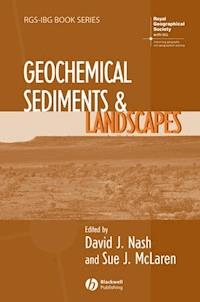
Geochemical Sediments and Landscapes E-Book
25,99 €
Mehr erfahren.
- Herausgeber: John Wiley & Sons
- Kategorie: Wissenschaft und neue Technologien
- Serie: RGS-IBG Book Series
- Sprache: Englisch
This state-of-the-art volume reviews both past work and current research, with contributions from internationally recognized experts. The book is organized into fourteen chapters and designed to embrace the full range of terrestrial geochemical sediments. * * An up-to-date and comprehensive survey of research in the field of geochemical sediments and landscapes * Discusses the main duricrusts, including calcrete, laterite and silcrete * Considers deposits precipitated in various springs, lakes, caves and near-coastal environments * Considers the range of techniques used in the analysis of geochemical sediments, representing a significant advance on previous texts
Sie lesen das E-Book in den Legimi-Apps auf:
Seitenzahl: 806
Veröffentlichungsjahr: 2011
Ähnliche




















Contents
series
copyright
List of Figures
List of Tables
List of Contributors
Series Editors’ Preface
Acknowledgements
Chapter One
Introduction: Geochemical Sediments in Landscapes
1.1 Scope of This Volume
1.1 Scope of This Volume
1.2 Organisation
1.3 Significance of Geochemical Sediments in Landscapes
References
Chapter Two Calcrete
2.1 Introduction: Nature and General Characteristics
2.2 Classification
2.3 Distribution
2.4 Calcretes in a Geomorphological Context
2.5 Macromorphological Characteristics
2.6 Micromorphological Characteristics
2.7 Laminar Calcretes
2.8 Mineralogy and Chemistry
2.9 Mechanisms of Formation of Pedogenic Calcretes
2.10 Profile Development
2.11 Groundwater Calcretes
2.12 Palaeoenvironmental Significance
2.13 Relationships to Other Terrestrial Geochemical Sediments
2.14 Directions for Future Research
Acknowledgements
References
Chapter Three Laterite and Ferricrete
3.1 Introduction
3.2 Distribution, Field Occurrence and Geomorphological Relations
3.3 Laterite and Ferricrete at the Profile Scale
3.4 Mechanisms of Formation
3.5 Mineralogy and Chemistry
3.6 Micromorphological Characteristics
3.7 Dating and Palaeoenvironmental Significance of Lateritic Weathering Profiles
3.8 Relationship to other Terrestrial Geochemical Sediments
3.9 Directions for Future Research
References
Chapter Four Silcrete
4.1 Introduction: Nature and General Characteristics
4.2 Distribution, Field Occurrence and Geomorphological Relations
4.3 Macromorphological Characteristics
4.4 Mineralogy and Chemistry
4.5 Micromorphological Characteristics
4.6 Silica Sources, Transfers and Precipitation Mechanisms
4.7 Models of Silcrete Formation
4.8 Palaeoenvironmental Significance
4.9 Relationships to other Terrestrial Geochemical Sediments
4.10 Directions for Future Research
Acknowledgements
References
Chapter Five Aeolianite
5.1 Introduction: Nature and General Characteristics
5.2 Distribution, Field Occurrence and Geomorphological Relations
5.3 Macro- and Micromorphological Characteristics
5.4 Chemistry and Mineralogy
5.5 Mechanisms of Formation or Accumulation
5.6 Palaeoenvironmental Significance
5.7 Relationships to other Terrestrial Geochemical Processes and Sediments
5.8 Directions for Future Research
References
Chapter Six Tufa and Travertine
6.1 Introduction: Nature and General Characteristics
6.2 Distribution, Field Occurrence and Geomorphological Relations
6.3 Macro- and Micromorphological Characteristics
6.4 Biology, Chemistry, Mineralogy and Petrology
6.5 Mechanisms of Formation and Accumulation
6.6 Palaeoenvironmental Significance
6.7 Relationships to other Terrestrial Geochemical Sediments and Geomorphological Roles
6.8 Directions for Future Research
Acknowledgements
References
Chapter Seven Speleothems
7.1 Introduction to Speleothem-Forming Cave Environments
7.2 Distribution, Field Occurrence and Geomorphological/ Hydrological Relations
7.3 Macro- and Micromorphological Characteristics of Flowstones, Stalactites and Stalagmites
7.4 Chemistry of Speleothems
7.5 Mechanisms of formation
7.6 Summary of Use of Speleothems in Palaeoclimate Determination
7.7 Directions for Future Research
Acknowledgements
References
Chapter Eight Rock Varnish
8.1 Introduction: Nature and General Characteristics
8.2 Distribution, Field Occurrence and Geomorphological Relations
8.3 Macro- and Micromorphological Characteristics
8.4 Chemistry and Mineralogy
8.5 Mechanisms of Formation or Accumulation
8.6 Palaeoenvironmental Significance
8.7 Relationships to other Terrestrial Geochemical Sediments
8.8 Summary and Directions for Future Research
Acknowledgements
References
Chapter Nine Lacustrine and Palustrine Geochemical Sediments
9.1 Introduction
9.2 Nature and General Characteristics
9.3 Geomorphological Relations
9.4 Macro- and Micromorphological Characteristics
9.5 Chemistry and Mineralogy
9.6 Relationships to other Terrestrial Geochemical Sediments
9.7 Palaeoenvironmental Significance and Directions for Future Research
Acknowledgements
References
Chapter Ten Terrestrial Evaporites
10.1 Introduction
10.2 Distribution, Field Occurrence and Geomorphological Relations
10.3 Micromorphological Characteristics
10.4 Chemistry and Mineralogy
10.5 Origin of Solutes
10.6 Mechanisms of Formation and Classification
10.7 Palaeoenvironmental Significance
10.8 Relationship to other Terrestrial Geochemical Sediments
10.9 Directions for Future Research
References
Chapter Eleven Beachrock and Intertidal Precipitates
11.1 Introduction: Nature and General Characteristics
11.2 Occurrence and Distribution
11.3 Macro- and Micromorphological Characteristics
11.4 Chemical Considerations
11.5 Mechanisms of Formation
11.6 Palaeoenvironmental Significance
11.7 Relationship to other Modes of Lithification
11.8 Directions for Future Research
References
Chapter Twelve Sodium Nitrate Deposits and Efflorescences
12.1 Introduction
12.2 The Distribution, Field Occurrence and Geomorphological Relations of the Atacama Nitrate Deposits
12.3 The Chemistry and Mineralogy of the Nitrate
12.4 The Aridity and Age of the Atacama
12.5 Mechanisms of Formation and Accumulation
12.6 Sodium Nitrate in Weathering
12.7 Directions for Future Research
12.8 Conclusion
References
Chapter Thirteen Analytical Techniques for Investigating Terrestrial Geochemical Sediments
13.1 Introduction
13.2 Elemental Analysis
13.3 Mineralogical Analysis
13.4 Isotopic Analysis
13.5 Conclusions
Chapter Fourteen Geochemical Sediments and Landscapes: General Summary
Index
RGS-IBG Book Series
Published
Geochemical Sediments and Landscapes
Edited by David J. Nash and Sue J. McLaren
Driving Spaces: A Cultural-Historical Geography of England’s M1
Motorway
Peter Merriman
Badlands of the Republic: Space, Politics and Urban Policy
Mustafa Dikeç
Geomorphology of Upland Peat: Erosion, Form and Landscape Change
Martin Evans and Jeff Warburton
Spaces of Colonialism: Delhi’s UrbanGovernmentales
Stephen Legg
People/States/Territories
Rhys Jones
Publics and the City
Kurt Iveson
After the ThreeItalies: Wealth, Inequality and Industrial Change
Mick Dunford and Lidia Greco
Putting Workfare in Place
Peter Sunley, Ron Martin and Corinne Nativel
Domicile and Diaspora
Alison Blunt
Geographies and Moralities
Edited by Roger Lee and David M. Smith
Military Geographies
Rachel Woodward
A New Deal for Transport?
Edited by Iain Docherty and Jon Shaw
Geographies of British Modernity
Edited by David Gilbert, David Matless and Brian Short
Lost Geographies of Power
John Allen
Globalizing South China
Carolyn L. Cartier
Geomorphological Processes and Landscape Change: Britain in the Last 1000 Years
Edited by David L. Higgitt and E. Mark Lee
Forthcoming
Politicizing Consumption: Making the Global Self in an Unequal World
Clive Barnett, Nick Clarke, Paul Cloke and Alice Malpass
Living Through Decline: Surviving in the Places of the Post-Industrial Economy
Huw Beynon and Ray Hudson
Swept-Up Lives?Re-envisaging ‘the Homeless City’
Paul Cloke, Sarah Johnsen and Jon May
Climate and Society in Colonial Mexico: A Study in Vulnerability
Georgina H. Endfield
Resistance, Space and Political Identities
David Featherstone
Complex Locations: Women’s Geographical Work and the Canon1850–1970
Avril Maddrell
Mental Health and Social Space: Towards Inclusionary Geographies?
Hester Parr
Domesticating Neo-Liberalism: Social Exclusion and Spaces ofEconomic Practice in Post Socialism
Adrian Smith, Alison Stenning, Alena
Rochovská and Dariusz Świątek
Value Chain Struggles: Compliance and Defiance in the PlantationDistricts of South India
Jeffrey Neilson and Bill Pritchard
Aerial Geographies:Mobilities, Subjects, Spaces
Peter Adey
Queer Visibilities: Space, Identity and Interaction in Cape Town
Andy Tucker
© 2007 by Blackwell Publishing Ltd
BLACKWELL PUBLISHING
350 Main Street, Malden, MA 02148–5020, USA
9600 Garsington Road, Oxford OX4 2DQ, UK
550 Swanston Street, Carlton, Victoria 3053, Australia
The right of David J. Nash and Sue J. McLaren to be identified as the Authors of the Editorial Material in this Work has been asserted in accordance with the UK Copyright, Designs, and Patents Act 1988.
All rights reserved. No part of this publication may be reproduced, stored in a retrieval system, or transmitted, in any form or by any means, electronic, mechanical, photocopying, recording or otherwise, except as permitted by the UK Copyright, Designs, and Patents Act 1988, without the prior permission of the publisher.
Designations used by companies to distinguish their products are often claimed as trademarks. All brand names and product names used in this book are trade names, service marks, trademarks, or registered trademarks of their respective owners. The publisher is not associated with any product or vendor mentioned in this book.
This publication is designed to provide accurate and authoritative information in regard to the subject matter covered. It is sold on the understanding that the publisher is not engaged in rendering professional services. If professional advice or other expert assistance is required, the services of a competent professional should be sought.
First published 2007 by Blackwell Publishing Ltd
1 2007
Library of Congress Cataloging-in-Publication Data
Geochemical sediments and landscapes/edited by David J. Nash, Sue J. McLaren.
p. cm. – (RGS-IBG book series)
Includes bibliographical references and index.
ISBN 978–1-4051–2519-2 (hardcover: acid-free paper) 1. Sediments (Geology) – Analysis. 2. Geomorphology. I. Nash, David J. II. McLaren, Sue J.
QE471.2.G462 2007
551.3–dc22
2007018801
Figures
2.1Settings for calcrete development.2.2Calcrete microstructures.2.3Idealised calcrete profile.2.4(A) Stage V calcrete. (B) Thick pisolitic calcrete horizon.2.5(A) Laminar calcrete overlain by an oolitic-pisolitic layer associated with a calcified root mat layer. (B) Stage V-VI profile with hardpan layer overlain by pisolitic and brecciated level with a prominent calcified root mat layer.2.6End-member types of calcrete microstructure.2.7Models for pedogenic calcrete development.2.8Dynamic model for pedogenic calcrete development.2.9Characteristics of groundwater calcretes.2.10Geometries of groundwater calcretes and dolocretes.3.1Schematic diagram showing the laterite-ferricrete genetic relationship, and the natural continuum between the autochthonous (i.e. in situ weathering profiles) and allochthonous end-members.3.2Examples of mesa-like remnants of a Late Cretaceous lateritised palaeosurface developed on Deccan basalt from widely separated localities across the Maharashtra Plateau, western India.3.3Generalised vertical section through the autochthonous Bidar laterite weathering profile.3.4Examples of laterite and ferricrete profiles.3.5Examples of weathering and lateritic textures at key horizons through the Merces Quarry lateritic weathering profile.3.6Schematic representation of the downward advancement of the weathering front, showing the relative changes in abundances of the major lateritic components, Si and Fe, during profile evolution.3.7Schematic representation of changes in element abundances in a lateritic weathering profile affected by the establishment of a water table.3.8Examples from the ferricrete alteration profile observed at outcrop at Palika Ba, near the Gambia River, Gambia, West Africa.3.9Pathways of formation of secondary minerals in lateritic weathering profiles.3.10Ternary or tri-plots (SiO2, Fe2O3, Al2O3) of (a) Bidar, and (b) Merces Quarry data.3.11(A) Weathering stages of quartz, biotite, K-feldspar and Na-feldspar. (B) Weathering resistance and degree of weathering in humid tropical environments.3.12Photomicrographs illustrating the micromorphology through a low-level coastal laterite profile of Neogene age developed within Deccan basalt from Guhagar, western India.3.13Schematic illustration of the formation and evolution of successive laterite facies.4.1Silcretes in the landscape.4.2Geomorphological classification of silcretes.4.3Pedogenic silcrete profiles.4.4Groundwater silcrete outcrops.4.5(A) Massive drainage-line silcrete in the floor of the Boteti River, Botswana, at Samedupe Drift. (B) Close-up of a partially silicified non-pedogenic calcrete beneath the floor of Kang Pan, near Kang, Botswana. (C) Sheet-like pan/lacustrine silcrete developed through the desiccation of formerly floating colonies of the silicafixing cyanobacteria Chloriflexus at Sua Pan, Botswana.4.6Photomicrographs of pedogenic and groundwater silcretes.4.7Photomicrographs of drainage-line and pan/lacustrine silcretes.4.8(A) Variations in silica solubility with pH. (B) The release and sorption of monosilicic acid by a black earth soil under varying pH.4.9(A) Schematic representation of a ‘typical’ pedogenic silcrete profile. (B) Model of groundwater silcrete development in the Paris Basin.4.10(A) Cores extracted from the bed of the Boteti River at Samedupe Drift, Botswana. (B) Section of silcretes in the Mirackina palaeochannel, South Australia. (C) Schematic representation of geochemical sedimentation patterns in the vicinity of a pan or playa.5.1Aeolianite from North Point, San Salvador, The Bahamas.5.2Internal sedimentary structures, Wahiba Sands, Oman.5.3Differentially cemented laminae.5.4Alternating darker wet and lighter dry layers in a modern-day dune, Studland, UK.5.5Rim cements developed in an aeolianite from Cabo de Gato, southern Spain.5.6Micritic envelopes developed around a former shell fragment that has undergone dissolution and has been partially replaced by secondary porosity and neomorphic spar, Campo de Tiro, Mallorca.5.7Aeolianite from Cap Blanc, Tunisia.5.8Scanning electron microscopy image showing needle fibre cement developed in a root mould, Campo de Tiro, Mallorca.6.1Thin section of a sample of tufa from a Holocene paludal deposit at Wateringbury, Kent.6.2Vertical section through a stream crust colonised by the cyanobacterium Phormidium incrustatum.6.3Some tufa morphologies.6.4Silver Falls, Tianxing Bridge Park, Guizhou Province, China.6.5Pearl Shoal, Juizhaigou, Sichuan, China.6.6Large tufa deposit on the edge of the Naukluft Mountains, Namibia.6.7(A) Highly porous, actively forming Vaucheria tufa from Fleinsbrunnen Bach, Schwabian Alb, Germany. (B) Leaf relics from ancient tufa barrage at Caerwys, North Wales. (C) Large bladed spar crystals developed under high water flow rates at Goredale waterfall, Yorkshire. (D) Laminated cyanobacterial tufa from Fleinsbrunnenbach, Schwabian Alb, Germany (E) Fine-grained, thinly laminated tufa from Whit Beck, North Yorkshire (F) Laminated sparite from dense, recrystallised laminated tufa in the Naukluft Mountains, Namibia.6.8(A) Scanning electron microscopy image of diatom frustules within actively forming barrage tufas at Cwm Nash, Glamorgan.7.1Speleothem characteristics.7.2(A) Conceptual model of the karst system with its physiology of water flow and CO2 transport and release. (B) Cartoon of speleothem occurrence in relation to cave sedimentational history. (C) The concept of karstic capture of high-resolution climatic signals.7.3(A) Seasonal variations in drip rate with superimposed short-term hydrological events from a stalactite in Pere-Nöel cave in Belgium. (B) Variations in cation loads, as monitored by electroconductivity, of drip waters in response to seasonal patterns and individual infiltration events for two drips at Ernesto cave.7.4(A) Dissolved Ca loads resulting from dissolution of pure limestone to saturation and their relationship with (soil or epikarst) pCO2. (B) Plumbing model illustrating processes affecting dripwater hydrology and hydrochemistry.7.5Soda straw stalactites from Ernesto cave and Crag Cave.7.6Stalagmite calcite fabrics.7.7Stalagmite laminae.7.8(A, B) Examples of modelled speleothem macromorphologies. (C) Modelled maximal growth rates of speleothems under a stagnant fluid layer.7.9(A) Cross-section through the Alpine Ernesto cave, Trentino province, Italy. (B) Interpretation of Mg and δ13C records through stalagmite ER76.7.10Diagrammatic relationships between the flow-related and cave-related geomorphological factors and the high-resolution properties of speleothems.8.1Rock varnish at a road cut between Death Valley, California and Las Vegas, Nevada.8.2Rock varnish varies considerably over short distances, over a single boulder and over a single hillslope.8.3Microcolonial fungi are common inhabitants on desert rocks that experience warm season convective precipitation.8.4Rock varnish on Hanaupah Canyon alluvial fan, Death Valley.8.5Forms of varnish micromorphology.8.6High resolution transmission electron microscopy imagery of manganese and iron minerals that appear to be moving from the granular remnants of bacterial sheaths into adjacent clay minerals.8.7Budding bacteria morphologies actively concentrating manganese.8.8Clay minerals that appear to be weathering by the insertion of Mn-Fe.8.9Conceptual models of rock varnish formation.8.10Varnish microlaminations.8.11Rock varnish interlayers with iron film and silica glaze at Whoopup Canyon, Wyoming. (A) Iron film (BSE image) acts as a case hardening agent, and rock varnish accretes on top of the iron film exposed by petroglyph manufacturing. (B) Varnish actively assists in case hardening (BSE image) when the leached cations reprecipitate with silica glaze in sandstone pores.9.1Diagrammatic cross-section of a typical hard-water temperate lake during summer.9.2Sketch of the relationships between oxygen, temperature and biogenic activity in a meromictic lake, at noon in summer.9.3(A) Classification of lacustrine sedimentation in Jura Mountains lakes. (B) Aerial and (C) field view from the palustrine (marsh) zone towards the deep lake (Lake Neuchâtel, Switzerland) in a hard-water lake environment.9.4Simplified sketch of the geomorphological evolution of some lacustro-palustrine landscapes.9.5(A) Horizontal beds forming a transition from floodplain deposits to a palustro-lacustrine environment and lacustrine limestones. (B) Lacustrine deposits with stromatolitic bioherms (C) Palustrine limestone with abundant root traces. (D) Lacustrine bottom-set sediments enriched in organic matter and showing thin turbiditic layers. (E) Palustrine limestone with a well developed palaeosol at the top. (F) Various types of crushed shell fragments in a lacustrine mud. (G) Lacustrine bioclastic and oolitic sand deposited near a shore.9.6(A) ‘Glacial’ varves from a Last Glacial Maximum lake. (B) Slab of a transition from lacustrine to palustrine. (C) Succession of lacustrine mud deposits undergoing short emergence. (D) Lamina of dark micrite and microsparite with ostracod test fragments and Chara encrustations. (E) Pedogenic pseudomicrokarst in emerged lacustrine mud. (F) Traces of pedogenesis in emerged micrite. (G) Palustrine micritic limestone infilled by a dark secondary micrite associated with gypsum crystals.9.7Simplified chart showing the evaporite precipitation sequence from waters of various compositions.9.8(A) Clayey and calcareous diatomite from northern Lake Chad. (B) Spherule-like crystals of kenyaite (hydrous sodium silicate) precipitated in apolyhaline interdunal ponds, Lake Chad. (C) Zeolite crystals inside a crack between a mass of magadiite. (D) Dead Sea brine showing regular salt deposits related to the fluctuation of the lake water level, Israel. (E) Close-up of salt deposits, mainly constituted by halite and sylvite. (F, G) Lake Lisan regular varval deposits composed of detritic marl and endogenous aragonite, Israel.9.9Scanning electron micrographs of lacustrine calcareous sediments.9.10Sketch showing the relationship between space and time in a palustro-lacustrine environment.10.1(A) Playa system at Death Valley, California. (B) Salar de Cauchari, Jujuy Province, Puna, northern Argentina. (C) Laguna Santa Rosa, part of the Salar de Maricunga, east of Copiapó, Chile. (D) Halite crust, Dabuxan Lake, Qaidam Basin, China.10.2Distribution of areas without surface drainage and with interior basin (or endorheic) drainage.10.3(A) Surface halite crust, Lake Koorkoordine, Southern Cross, Western Australia. (B) Lake Eyre North, Australia, after partial flooding and evaporative retreat. (C) Western shoreline of Lake Frome, South Australia. (D) Halite crust, Lake Frome, South Australia. (E) Halite crust with sinuous salt-crystallisation pressure ridges, Sickle Lake, Northern Territory, Australia. (F) Pervasive mudcracked texture, Dry Mudflat facies, Lake Eyre North, Australia. (G) Regressive strandlines, Lake Buchanan, Queensland, Australia. (H) Regressive shorelines, Lake Buchanan, Queensland, Australia. (I) An island composed of Archaean bedrock draped by gypcrete in the halite-encrusted floor of Lake Lefroy, near Kambalda, Western Australia. (J) Carnallite (MgCl2.KCl.6H2O) crystals from the commercial evaporating ponds that use brines trapped within the Qarhan salt plain, Qaidam Basin, China.10.4Playa depositional/evaporative facies arranged parallel to, and potentially concentrically in plan around, the shorelines of an evaporating lake.10.5Depositional cycle within a playa system.10.6Hydrological classification of playa types and their topographic settings.10.7Evaporation sequence for seawater.10.8Brine evolution pathways and a hydrological classification of progressively evaporating non-marine waters.11.1Photographs of beachrock outcrops: Basse Terre, Guadeloupe, West Indies; Halfmoon Cay, Lighthouse Reef, Belize; Kuramathi island, Rasdu Atoll, Maldives.11.2Photographs of beachrock outcrops: Kubbar Island, Kuwait, Arabian-Persian Gulf; Andros Island, Bahamas.11.3Outcrop and hand specimens of beachrock.11.4Diagenetic environments and typical cements, and the formation of beachrock in relation to other cemented coastal deposits.11.5Photomicrographs of marine beachrock cements.11.6Scanning electron microscopy images of marine beachrock cements.11.7Scanning electron microscopy images of marine beachrock and meteoric cayrock cements.11.8Photomicrographs of meteoric cements.11.9Outcrops of beachrock and other cemented beach deposits: Ras Al-Julayah, southern Kuwait; Cay Bokel, Turneffe Islands, Belize; Hurasdhoo, lagoon of Ari Atoll, Maldives.11.10Outcrops of other cemented beach deposits: Cat Cay, western margin of Great Bahama Bank; Barbados, West Indies; Andros Island, Bahamas.12.1The distribution of sodium nitrate deposits in northern Chile.12.2An abandoned officina in the Atacama near Iquique, northern Chile.12.3The hyperarid, salt mantled landscape of the Atacama inland from Iquique.12.4Cemented regolith on a raised beach south of Iquique.12.5The hygroscopic and deliquescent nature of sodium nitrate crystals observed under the scanning electron microscope in the laboratory.12.6The solubility of sodium nitrate in water.13.1Diffractograms showing the importance of correct choice of extractant for the selective dissolution of crystalline Fe from a laterite.13.2Diffractograms comparing XRD analysis from glass slide and membrane mounted samples of the same weathered granite from Meniet (central Algeria).Tables
2.1Morphological types of calcrete horizons.3.1Common alteration minerals found in laterites and bauxites.3.2Geochemical analyses of autochthonous laterite profiles developed on Deccan basalt exposed at Bidar, India and on Proterozoic greywacke exposed at Merces Quarry near Panjim, Goa, India.3.3Geochemical analyses of the ferricrete alteration profile exposed at Palika Ba, Gambia, West Africa.4.1Genetic classification of duricrusts.4.2Morphological classification of silcrete.4.3Classification of silcrete according to matrix (cement) type and macromorphology.4.4Micromorphological classification of silcrete.4.5Genetic classification of silcrete.4.6Examples of regional investigations of silcrete.4.7Bulk chemistry of world silcretes.6.1Tufa morphologies and facies characteristics for the four major tufa types.8.1Different types of rock coatings.8.2A few of the misunderstandings in the literature surrounding rock varnish and its environmental relations.8.3Examples of elemental variation exhibited in bulk chemical analyses of rock varnishes found in desert regions.8.4Criteria that have been used to adjudicate competing models of rock varnish formation.8.5Performance of alternative rock varnish conceptual models with respect to adjudicating criteria.8.6Different methods that have been used to assess rock varnish chronometry.9.1Main minerals and mineral groups associated with lacustrine geochemical sediments and their possible origins.10.1Classification of evaporites by solute sources and geological setting.12.1Salt minerals present in caliche deposits of the Atacama.13.1Characterisation of a selected range of analytical techniques.13.2Selective extraction of a rock varnish highlighting its ability to partition a sample into its constituent phases.Contributors
Dr Andrea Borsato – Museo Tridentino de Scienze Naturali, via Calepina 14, 38100 Trento, Italy. Email: [email protected]
Professor Allan R. Chivas – GeoQuEST Research Centre, School of Earth and Environmental Sciences, University of Wollongong, NSW 2522, Australia. Email: [email protected]
Professor Ronald I. Dorn – School of Geographical Sciences, Arizona State University, P.O. Box 870104, Tempe, Arizona 85287–0104, USA. Email: [email protected]
Professor Ian Fairchild – School of Geography, Earth and Environmental Sciences, University of Birmingham, Edgbaston, Birmingham B15 2TT, UK. Email: [email protected]
Dr Silvia Frisia – School of Environmental and Life Sciences, University of Newcastle, Callaghan, NSW 2308, Australia. Email: [email protected]
Professor Eberhard Gischler – Institut für Geowissenschaften, Universität Frankfurt am Main, Senckenberganlage 32–34, Postfach 11 19 32, D-60054 Frankfurt am Main, Germany. Email: [email protected]
Professor Andrew S. Goudie – School of Geography, Centre for the Environment, University of Oxford, South Parks Road, Oxford, OX1 3QY, UK. Email: [email protected]
Dr Elaine Heslop – School of Geography, Centre for the Environment, University of Oxford, South Parks Road, Oxford, OX1 3QY, UK.
Dr John McAlister – School of Geography, Queens University, Belfast BT7 1NN, UK. Email: [email protected]
Dr Sue J. McLaren – Department of Geography, University of Leicester, University Road, Leicester LE1 7RH, UK. Email: [email protected]
Dr David J. Nash – School of Environment and Technology, University of Brighton, Lewes Road, Brighton BN2 4GJ, UK. Email: d.j.nash@bton. ac.uk
Dr Allan Pentecost – Department of Life Sciences, Kings College London, Franklin-Wilkins Building, 150 Stamford St, London SE1 9NN, UK. Email: [email protected]
Professor Bernie J. Smith – School of Geography, Queens University, Belfast BT7 1NN, UK. Email: [email protected]
Dr Anna Tooth – Groundwater and Contaminated Land, The Environment Agency, Guildbourne House, Chatsworth Road, Worthing, West Sussex BN11 1LD, UK. Email: [email protected]
Dr J. Stewart Ullyott – School of Environment and Technology, University of Brighton, Lewes Road, Brighton BN2 4GJ, UK. Email: [email protected]
Professor Eric P. Verrecchia – Institut de Géologie, Université de Neuchâtel, Rue Emile-Argand 11, CP 2, CH-2007 Neuchâtel, Switzerland. Email: [email protected]
Dr Heather A. Viles – School of Geography, Centre for the Environment, University of Oxford, South Parks Road, Oxford, OX1 3QY, UK. Email: [email protected]
Dr Mike Widdowson – Department of Earth Sciences, The Open University, Walton Hall, Milton Keynes MK7 6AA, UK. Email: [email protected]
Professor V. Paul Wright – School of Earth, Ocean and Planetary Sciences, Cardiff University, Main Building, Park Place, Cardiff CF10 3YE, UK. Email: [email protected]
Series Editors’ Preface
The RGS-IBG Book Series only publishes work of the highest international standing. Its emphasis is on distinctive new developments in human and physical geography, although it is also open to contributions from cognate disciplines whose interests overlap with those of geographers. The Series places strong emphasis on theoretically-informed and empiricallystrong texts. Reflecting the vibrant and diverse theoretical and empirical agendas that characterize the contemporary discipline, contributions are expected to inform, challenge and stimulate the reader. Overall, the RGSIBG Book Series seeks to promote scholarly publications that leave an intellectual mark and change the way readers think about particular issues, methods or theories.
For details on how to submit a proposal please visit:www.blackwellpublishing.com/pdf/rgsibg.pdf
Kevin Ward
University of Manchester, UK
Joanna Bullard
Loughborough University, UK
RGS-IBG Book Series Editors
Acknowledgements
In addition to the editors, who reviewed all the individual chapters, numerous external referees, selected for their expertise in specific geochemical sediments, provided constructive and conscientious reviews of the manuscript. These included: Ana Alonso-Zarza, Department of Petrology and Geochemistry, Universidad Complutense, Madrid, Spain; MarkBateman, Department of Geography, University of Sheffield, UK; JoannaBullard, Department of Geography, Loughborough University, UK; IanCandy, Department of Geography, Royal Holloway, University of London, UK; Frank Eckardt, Department of Environmental and Geographical Science, University of Cape Town, South Africa; Frank McDermott, School of Geological Sciences, University College Dublin, Eire; MartynPedley, Department of Geography, University of Hull, UK; HeatherViles, School of Geography, Centre for the Environment, University of Oxford, UK; John Webb, Department of Earth Sciences, La Trobe University, Melbourne, Australia; and Brian Whalley, School of Geography, Archaeology and Palaeoecology, Queen’s University Belfast, UK.
The majority of the photographs, line diagrams and tables within this volume are the authors’ own. The following organisations and publishers are thanked for their permission to reproduce figures (which, in some instances, may have been redrawn or slightly modified): Association desgéologues du bassin de Paris,for permission to reproduce Figure 4.9B (from Thiry, M. & Bertrand-Ayrault, M., 1988, ‘Les grès de Fontainebleau: Genèse par écoulement de nappes phréatiques lors de l’entaille des vallées durant le Plio-Quaternaire et phénomènes connexes’, Bulletind’Information des géologues du Bassin de Paris25, 25–40. © Association des géologues du bassin de Paris). Cooperative Research Centre for Landscape Environments and Mineral Exploration, for permission to reproduce Figure 3.9 (from Anand, R.R., 2005, ‘Weathering history, landscape evolution and implications for exploration’, In: Anand, R.R. & de Broekert, P. (Eds) (2005) Regolith Landscape Evolution Across Australia, pp. 2–40. © Cooperative Research Centre for Landscape Environments and Mineral Exploration). Elsevier, for permission to reproduce Figure 4.10C (from Summerfield, M.A., 1982, ‘Distribution, nature and genesis of silcrete in arid and semi-arid southern Africa’, Catena Supplement1, 37–65. © Elsevier). Quaternary Research Association, for permission to reproduce Figure 7.2B (from Smart, P.L. & Francis, P.D., 1990, Quaternary Dating Methods – A User’s Guide. © Quaternary Research Association). E. Schweizerbart’sche Science Publishers, for permission to reproduce Figure 3.11 (from Borger, H., 2000, Mikromorphologie undPaläoenvironment: Die Mineralverwitterung als Zeugnis der cretazisch-tertiären Umwelt in Süddeutschland. © E. Schweizerbart Science Publishers). SEPM(Society for Sedimentary Geology), for permission to reproduce Figures 7.7A and 7.10E (from Genty, D. & Quinif, Y., 1996, ‘Annually laminated sequences in the internal structure of some Belgian stalagmites – importance for paleoclimatology’, Journal of Sedimentary Research66, 275–288. © Society for Sedimentary Geology). Springer Science andBusiness Media, for permission to reproduce Figures 10.4 and 10.8 (from Eugster, H.P. & Hardie, L.A., 1978, ‘Saline lakes’. In: Lerman, A. (ed) Lakes: Chemistry, Geology, Physics, pp. 237–293. © Springer, New York). UNESCO, for permission to reproduce Figure 10.7 (from Valyashko, M.G., 1972, Playa lakes – a necessary stage in the development of a saltbearing basin. In: Richter-Bernberg, G. (ed.) Geology of Saline Deposits, pp. 41–51. © UNESCO, Paris). United States Geological Survey, for permission to reproduce Figure 10.6 (from Eakin, T.E., Price, D. & Harrill, J.R., 1976, Summary appraisals of the nation’s ground-water resources – GreatBasin region. USGS Professional Paper 813-G. © United States Geological Survey). John Wiley and Sons Ltd, for permission to reproduce Figure 3.13 (from Thomas, M.F., 1994,Geomorphology in the Tropics. A Study ofWeathering and Denudation in Low Latitudes. © John Wiley and Sons Ltd), Figure 4.10A (from Shaw, P.A. & Nash, D.J., 1998, Dual mechanisms for the formation of fluvial silcretes in the distal reaches of the Okavango Delta Fan, Botswana. Earth Surface Processes and Landforms23, 705–714 © John Wiley and Sons Ltd) and Figure 4.10B (modified from Ollier, C.D. & Pain, C.F., 1996, Regolith, Soils and Landforms © John Wiley and Sons Ltd).
Finally, our thanks go to the British Geomorphological Research Group (now British Society for Geomorphology) for supporting the working group from which this collection arose, and to Jacqueline Scott, AngelaCohen and RebeccaduPlessis at Blackwell Publishing for their patience and assistance during the long, painful gestation period leading to the publication of Geochemical Sediments and Landscapes.
David J. Nash
Sue J. McLaren
Brighton and Leicester, August 2007
Chapter One
Introduction: Geochemical Sediments in Landscapes
David J. Nash and Sue J. McLaren
1.1 Scope of This Volume
Geochemical sediments of various types are an often overlooked but extremely important component of global terrestrial environments. Where present, chemical sediments and residual deposits may control slope development and landscape evolution, increase the preservation potential of otherwise fragile sediments, provide important archives of environmental change, act as relative or absolute dating tools and, in some cases, be of considerable economic importance. Chemical sedimentation may occur in almost any terrestrial environment, providing there is a suitable dissolved mineral source, a mechanism to transfer the mineral in solution to a site of accumulation and some means of triggering precipitation. However, given the increased importance of chemical weathering in the tropics and sub-tropics, they tend to be most widespread in low-latitude regions (Goudie, 1973).
Despite their global significance, terrestrial geochemical sediments have not been considered collectively for over 20 years. Indeed, the last book to review the full suite of chemical sediments and residual deposits was Goudie and Pye’s seminal volume Chemical Sediments and Geomorphology (Goudie and Pye, 1983a). Since then, selected geochemical sediments have been discussed in volumes such as Wright and Tucker (Calcretes; 1991), Martini and Chesworth (Weathering, Soils and Palaeosols; 1992), Ollier and Pain (Regolith, Soils and Landforms; 1996), Thiry and Simon-Coinçon (Palaeoweathering, Palaeosurfaces and Related Continental Deposits; 1999), Dorn (Rock Coatings; 1998), Taylor and Eggleton (Regolith Geology andGeomorphology; 2001), and Chen and Roach (Calcrete: Characteristics, Distribution and Use in Mineral Exploration; 2005). However, many of these texts tend to discuss geochemical sediments within either a geological or pedological framework, often with little attempt to position them in their geomorphological context. As will be seen in section 1.3 and many of the chapters in this volume, understanding the influence of landscape setting upon geochemical sedimentation is of paramount importance if the resulting chemical sediments and residua are to be correctly interpreted. The need for a follow-up volume to Goudie and Pye (1983a) became very apparent during meetings of the British Geomorphological Research Group (BGRG) fixed-term working group on , convened by the editors and Andrew Goudie, which ran between 2001 and 2004. Indeed, the majority of the authors within this collection were members of the working group, and all royalties from this book will go to the BGRG (now the British Society for Geomorphology).
Lesen Sie weiter in der vollständigen Ausgabe!
Lesen Sie weiter in der vollständigen Ausgabe!
Lesen Sie weiter in der vollständigen Ausgabe!
Lesen Sie weiter in der vollständigen Ausgabe!
Lesen Sie weiter in der vollständigen Ausgabe!
Lesen Sie weiter in der vollständigen Ausgabe!
Lesen Sie weiter in der vollständigen Ausgabe!
Lesen Sie weiter in der vollständigen Ausgabe!
Lesen Sie weiter in der vollständigen Ausgabe!
Lesen Sie weiter in der vollständigen Ausgabe!
Lesen Sie weiter in der vollständigen Ausgabe!
Lesen Sie weiter in der vollständigen Ausgabe!
Lesen Sie weiter in der vollständigen Ausgabe!
Lesen Sie weiter in der vollständigen Ausgabe!




